


- Progressive web app development costs $15,000 for simple builds and $150,000+ for enterprise platforms.
- A PWA typically costs 40 to 60 percent less than shipping separate iOS and Android native apps.
- One codebase serves every platform, so you maintain a single product instead of three.
- iOS supports PWA push, but only after a user adds your app to their Home Screen.
- Skipping app stores means skipping Apple’s commission, which reshapes the total cost over three years.
- Retrofitting an existing site into a PWA costs far less than building one from scratch.
Progressive web app development cost in 2026 runs $15,000 to $150,000 for a custom build. A PWA layer added to an existing site starts near $20,000. A standard custom PWA sits at $45,000 to $90,000. Complex commerce and enterprise builds run $90,000 to $150,000 and up.
Offering progressive web app development services for the last 10 years, we have witnessed the cost conversation almost always turn into a different one: should this be a PWA at all, or a native app?
We believe technical leaders deserve complete clarity before committing resources. So this guide covers PWA development costs by complexity, feature, industry, development stage, and team model. Knowing what drives web engineering hours allows you to prioritize high-impact features while keeping development costs predictable.
How Much Does Progressive Web App Development Cost in 2026?
Progressive web app development costs $20,000 to $150,000 in 2026. Converting an existing site into a PWA starts at $20,000. A standard custom PWA runs $45,000 to $90,000. Complex commerce or enterprise builds reach $150,000 and beyond.
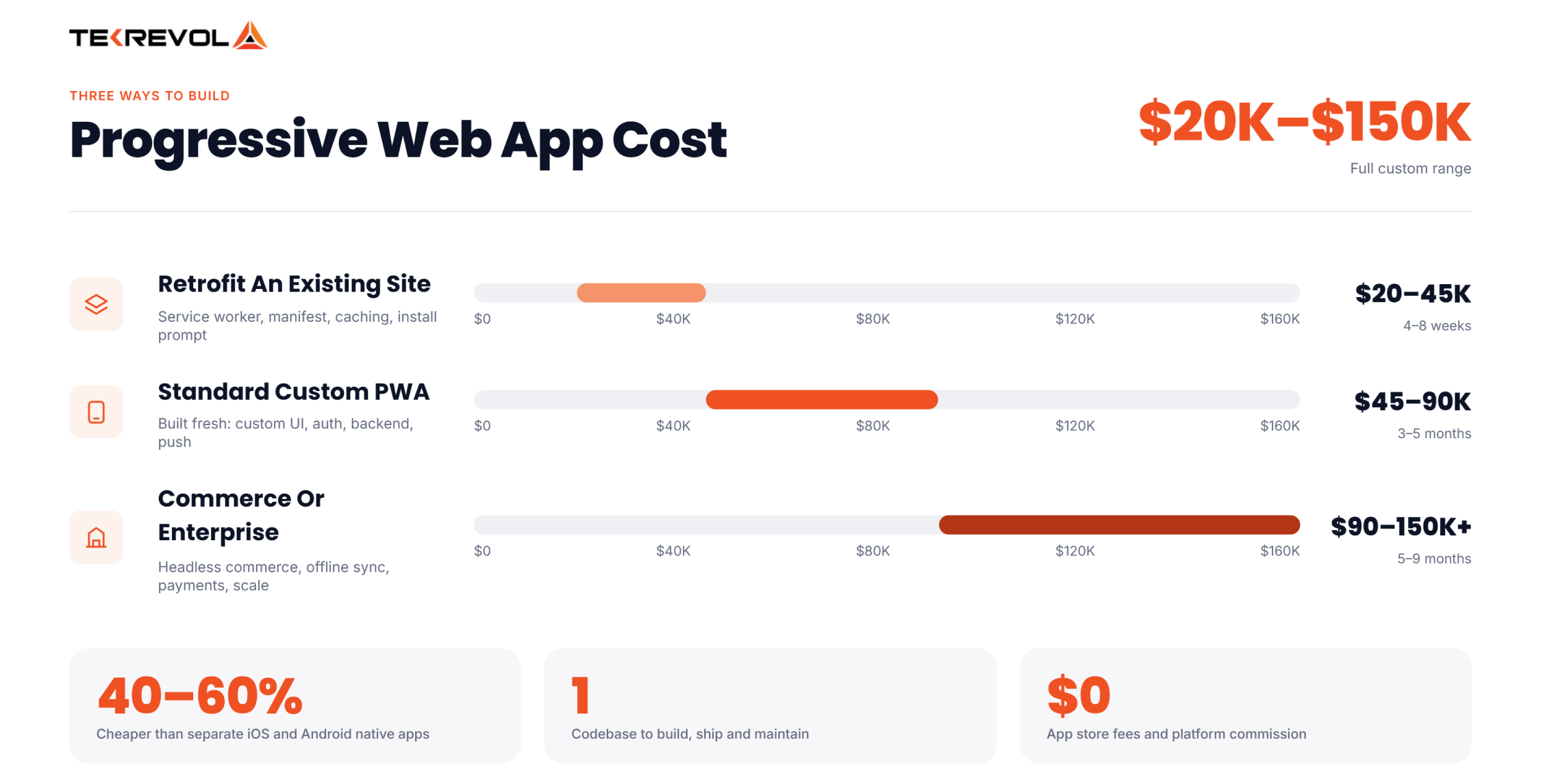
The wide band exists because “PWA” describes a delivery method, not a product size. Adding a service worker, a manifest, and offline caching to a site you already own is a few weeks of work. Building a full commerce platform that happens to be a PWA is a year of it.
Three things decide where you land. Whether you’re retrofitting or building fresh. How much the app has to do offline. And whether you need real backend systems behind it or can run on APIs you already have.
| PWA build type | Cost range | Timeline | What it involves |
| PWA retrofit of an existing site | $20,000 – $45,000 | 4 – 8 weeks | Service worker, manifest, offline caching, install prompt, performance work |
| Standard custom PWA | $45,000 – $90,000 | 3 – 5 months | Built from scratch, custom UI, auth, backend integration, push |
| Complex commerce or enterprise PWA | $90,000 – $150,000+ | 5 – 9 months | Headless commerce, offline sync, payments, multi-role access, scale architecture |
The retrofit path is the one most teams overlook. If your site already works and converts, you often don’t need a rebuild. You need a progressive layer on top of it.
Not Sure Whether a PWA or a Native App Fits Your Product?
Get a side-by-side cost and capability comparison built around your feature list, not a generic template.
Book a Free Strategy SessionWhat Is the Progressive Web App Development Cost by Complexity?
PWA complexity splits three ways. A retrofit of a working site costs $20,000 to $45,000. A custom PWA built from scratch runs $45,000 to $90,000. Enterprise and commerce PWAs with offline sync and payments reach $90,000 to $150,000 and above.
PWA Retrofit: $20,000 to $45,000
You keep your existing site and add the progressive layer on top. A service worker for caching, a web app manifest so it installs to the home screen, an offline fallback, push notification plumbing, and the performance work needed to hit acceptable Core Web Vitals.
Most of the budget goes to performance, not features. Sites that were never built for speed need real refactoring before caching helps, and that’s the line item that surprises people.
Custom PWA: $45,000 to $90,000
Built fresh, with your own interface, authentication, backend integration, and a proper offline strategy. This is where most funded products and mid-market businesses land.
The offline strategy is the fork in the road. Caching content for reading is straightforward. Letting users create and edit data offline, then reconciling it when they reconnect, roughly doubles the engineering.
Enterprise and Commerce PWA: $90,000 to $150,000+
Headless commerce, real payment flows, multi-role permissions, background sync, and architecture designed for traffic you don’t have yet. Retail and logistics platforms dominate this band.
Payments deserve their own budget line. Web-based checkout has to handle declined cards, saved credentials, currency, and refunds, and none of that gets easier because the app runs in a browser.
Which PWA Features Drive the Budget?
PWA features cost between $1,500 and $30,000 each. A manifest and install prompt sit at $1,500 to $4,000. Service worker caching runs $4,000 to $12,000. Full offline data sync is the most expensive single feature at $15,000 to $30,000.
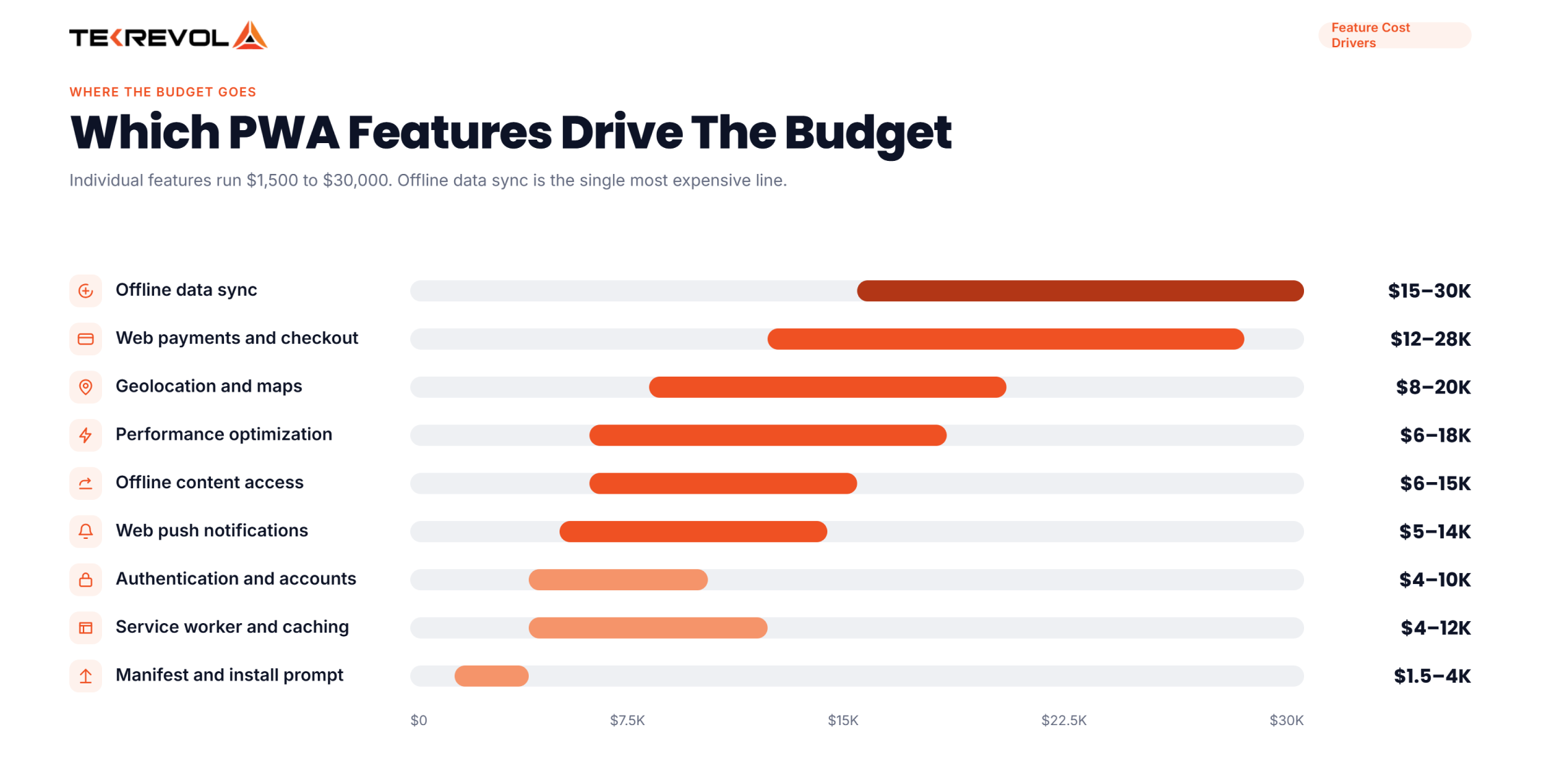
Nearly every PWA quote you receive is one of these lists with a number attached, so this is where budget control actually happens.
| PWA feature | Cost | Build time | Why it costs this |
| Web app manifest & install prompt | $1,500 – $4,000 | 3 – 7 days | Icons, splash screens, install UX across browsers |
| Service worker & caching strategy | $4,000 – $12,000 | 1 – 3 weeks | Cache versioning, update handling, fallback routes |
| Offline content access | $6,000 – $15,000 | 2 – 4 weeks | Local storage strategy, stale-data rules |
| Offline data sync | $15,000 – $30,000 | 4 – 8 weeks | Conflict resolution, queued writes, background sync |
| Web push notifications | $5,000 – $14,000 | 1 – 3 weeks | Cross-browser support, iOS Home Screen path, segmentation |
| Authentication & accounts | $4,000 – $10,000 | 1 – 3 weeks | Sessions, social login, token refresh in a service worker |
| Web payments & checkout | $12,000 – $28,000 | 3 – 6 weeks | Gateway integration, PCI scope, failure and refund states |
| Geolocation & maps | $8,000 – $20,000 | 2 – 5 weeks | Map SDK, permission handling, accuracy tuning |
| Camera & media capture | $5,000 – $14,000 | 2 – 4 weeks | Browser API differences, upload handling, compression |
| Performance optimization | $6,000 – $18,000 | 2 – 4 weeks | Bundle splitting, image pipeline, Core Web Vitals work |
| Analytics & event tracking | $3,000 – $9,000 | 1 – 2 weeks | Offline event queuing, attribution |
Offline sync is the feature to interrogate hardest. Teams put “works offline” on a brief meaning “users can read cached pages,” and the vendor prices “users can create records on a plane and have them merge cleanly on landing.” Those are different products at different prices.
Already Have a Site and a Feature List?
Send both over, and we'll price the retrofit against a fresh build so you can see whether starting over is worth it.
Start With a Free ConsultationPWA vs Native vs Cross-Platform Cost Comparison
A PWA costs 40 to 60 percent less than separate iOS and Android native app development. Native carries two codebases, two maintenance streams, store fees, and Apple’s commission on in-app digital purchases. A PWA carries none of those.
Below is a three-year total for the same mid-complexity product, built three ways.
| Cost line | PWA | Cross-platform (Flutter / React Native) | Native iOS + Android |
| Initial build | $45,000 – $90,000 | $60,000 – $140,000 | $110,000 – $250,000 |
| Annual maintenance (15 – 20%) | $7,000 – $18,000/yr | $9,000 – $28,000/yr | $17,000 – $50,000/yr |
| Codebases to maintain | 1 | 1, plus native modules | 2 |
| App store fees | $0 | $99/yr Apple + $25 Google | $99/yr Apple + $25 Google |
| Commission on in-app digital sales | None | Up to 30% | Up to 30% |
| Release cycle | Instant, you deploy | Store review each release | Store review each release |
| Three-year total (build + maintenance) | $66,000 – $144,000 | $87,000 – $224,000 | $161,000 – $400,000 |
Store fee and commission figures per Apple’s and Google’s published developer pricing. Apple’s standard commission on in-app digital purchases is 30 percent, reduced to 15 percent under its Small Business Program.
Choosing the right development architecture shapes your budget, launch timeline, and maintenance burden. Below is how PWAs compare against alternative development options:
- Native iOS: iOS app development costs $30,000 to $250,000 depending on scope, which puts a focused iPhone-only app inside PWA territory. These apps require separate Swift development pipelines, costing significantly more than web builds.
- Native Android: Android builds demand extensive device fragmentation testing across hundreds of screen resolutions. Android app development costs $35,000 to $280,000, and that wide range is where the extra hours go.
- Cross-platform Framework: Cross-platform tools split the difference on purpose. You keep one codebase and stay in the app stores, but you still pay store fees, still wait for review, and still write some platform-specific code
- Hybrid Strategy: Hybrid app development cost falls between a PWA and full native, which makes it the usual compromise when store presence is non-negotiable.
For the full picture across every mobile route, our breakdown of what it costs to make an app covers native, hybrid, and cross-platform side by side.
Progressive Web App Development Cost Breakdown by Industry
PWA development cost by industry ranges from $30,000 to $130,000. Retail and media sit at the lower end because their needs are content and checkout. Fintech and healthcare sit at the top, where compliance, audit logging, and encryption add work users never see.
| Industry | PWA cost range | What drives the number |
| Retail & ecommerce | $35,000 – $110,000 | Catalog performance, checkout, offline browsing |
| Media & publishing | $30,000 – $75,000 | Offline reading, push segmentation, ad delivery |
| Logistics & field services | $50,000 – $110,000 | Offline data capture, sync, barcode and location |
| SaaS dashboards | $45,000 – $100,000 | Role permissions, real-time data, billing |
| Healthcare | $70,000 – $130,000 | Compliance, encryption, audit trails |
| Fintech | $75,000 – $130,000 | KYC, PCI scope, transaction integrity |
| Education | $40,000 – $90,000 | Course content offline, progress tracking, accessibility |
| Travel & hospitality | $45,000 – $95,000 | Booking flows, offline itineraries, maps |
Retail and E-commerce PWAs
Ecommerce is where PWAs earn their reputation, because mobile shoppers abandon slow sites and a cached storefront loads instantly on a weak connection. Costs run $35,000 to $110,000 depending on catalog size and how much of the checkout you build versus buy.
The comparison worth running is against a native shopping app. Ecommerce app development costs around $50,000 for a native build, and for many retailers a PWA delivers the same conversion lift for less.
Healthcare PWAs
Healthcare PWAs cost $70,000 to $130,000, and compliance is why. Encrypted storage, complete audit logging, and careful handling of anything cached on a device all add work, and offline caching of patient data needs explicit governance rather than a default setting.
Healthcare app development cost sits higher for native equivalents, though the compliance overhead is identical either way.
Fintech PWAs
Fintech PWAs run $75,000 to $130,000. Identity verification, transaction integrity and PCI scope drive the number, and the browser environment adds its own security review that a native app doesn’t face in the same form.
Fintech app development cost is the most expensive mainstream category on mobile too, for the same underlying reasons.
SaaS and Internal Dashboards
SaaS PWAs cost $45,000 to $100,000 and are one of the strongest fits available. Business users already work in a browser, installability gives you a desktop icon without a desktop build, and instant deployment means no store review between you and a fix.
SaaS application development cost sits mostly in the platform beneath the interface, which is true whether you deliver it as a PWA or natively.
Education PWAs
Education PWAs run $40,000 to $90,000. Offline course access is the defining feature, since learners frequently study on unreliable connections, and progress has to sync cleanly when they reconnect.
Accessibility compliance is non-negotiable for institutional buyers, as our breakdown of educational app development sets out.
Retail operations and Field services
Field service and logistics PWAs cost $50,000 to $110,000, and they’re the clearest case for offline sync. Drivers, technicians, and warehouse staff work in places with no signal, capture data anyway, and expect it to arrive when they’re back in coverage.
How is Progressive Web App Development Cost Distributed Across Project Stages?
PWA cost splits across stages in a predictable way. Planning takes 10 to 15 percent and design 15 to 20 percent. The app itself takes 30 to 35 percent, the offline layer 10 to 15 percent, back-end work 10 to 15 percent, and testing 12 to 18 percent.
| Stage | Share of budget | On a $70,000 PWA |
| Planning & scoping | 10 – 15% | $7,000 – $10,500 |
| Design | 15 – 20% | $10,500 – $14,000 |
| Building the app | 30 – 35% | $21,000 – $24,500 |
| Offline & speed layer | 10 – 15% | $7,000 – $10,500 |
| Back-end & integrations | 10 – 15% | $7,000 – $10,500 |
| Testing across browsers | 12 – 18% | $8,400 – $12,600 |
| Launch | 3 – 5% | $2,100 – $3,500 |
Planning and Scoping
Planning decides whether you upgrade or rebuild, what has to work without a signal, and which browsers you’re committing to support. That last decision alone can move your testing bill by 30 percent.
PWA MVP
A PWA makes an unusually good first version. There’s no store review between your build and your users, so you can launch the day you’re ready and improve it daily.
MVP development as a PWA typically runs $20,000 to $45,000, clearly below a native first version with the same features.
Design and Testing
Design runs $10,500 to $14,000 on a $70,000 build. The extra work over a normal website is designing the install prompt, the offline screens, and the “you’re back online” moments, which most design kits simply don’t include.
Testing costs more than teams plan for. You’re checking Chrome, Safari, Edge, and Firefox on both phones and computers, and they don’t all behave the same way once your app is installed.
Back-end and Integration
Back-end work takes 10 to 15 percent on a typical PWA, less than a native build because many PWAs connect to systems that already exist. Back-end app development becomes the highest cost only when you’re building that layer from nothing.
Connecting to other tools follows the same rule. API integration cost stays modest with your own systems and climbs fast with older enterprise software.
PWA Maintenance
PWA maintenance runs 15 to 20 percent of build cost a year. Browsers update, the tools underneath age, and how your app saves content needs revisiting as your content changes.
App maintenance cost is one line where PWAs genuinely save money, because you maintain one product and publish fixes without waiting for approval.
What Does the PWA Tech Stack Add to Cost?
PWA tech stack choices shift cost by 20 to 40 percent. Framework choice, headless commerce platforms, cloud infrastructure, and any AI layer each carry their own price. The service worker itself is cheap. What you connect it to isn’t.
| Stack layer | Added cost | Notes |
| Frontend framework (React, Vue, Angular) | Included in build | Choice affects talent cost more than build hours |
| Headless commerce platform | $15,000 – $50,000 | Integration plus licensing, varies by platform |
| Cloud hosting & CDN setup | $5,000 – $25,000 | Edge caching matters more for PWAs than typical sites |
| Blockchain/wallet layer | $30,000 – $120,000 | Wallet connection, contract interaction, audits |
| Real-time data layer | $10,000 – $30,000 | Sockets, presence, conflict handling |
| Analytics & experimentation | $5,000 – $15,000 | Offline event queuing complicates standard tooling |
Cloud and Edge Infrastructure
Cloud setup costs $5,000 to $25,000 for a PWA and matters more than it does for a standard site, because a PWA’s whole promise is speed. Edge caching and a properly configured CDN do as much for perceived performance as the service worker does. Cloud development covers the ongoing bill, which scales with traffic rather than with features.
Web3 and Blockchain
Wallet-connected apps are a natural PWA use case, since browser wallets already live in the browser. Adding that layer costs $30,000 to $120,000 depending on how much on-chain interaction you need.
Blockchain app development carries audit costs that don’t apply elsewhere, and skipping a contract audit is a deferred liability rather than a saving.
Freelancer, Agency or In-house: What Does Each Team Model Cost?
Team model changes PWA development cost more than any technical choice. Freelancers charge $25 to $75 an hour. Offshore agencies run $25 to $50 an hour. Onshore agencies charge $90 to $180. In-house is most expensive upfront and only pays off on long-lived products.
| Team model | Effective rate | Standard custom PWA | Main trade-off |
| Freelancer | $25 – $75/hr | $25,000 – $60,000 | Cheapest, weakest on offline architecture |
| Offshore agency | $25 – $50/hr | $30,000 – $65,000 | Good value, communication overhead |
| Onshore agency | $90 – $180/hr | $70,000 – $150,000 | Accountability and senior oversight at premium rates |
| Hybrid team | $50 – $100/hr | $45,000 – $95,000 | Balanced, needs a strong technical lead |
| In-house | $170,000+/dev/year | $350,000+ in year one | Full control, slowest to start |
PWAs are unusually sensitive to team quality in one specific area. A freelancer can build a competent interface. Designing a caching and sync strategy that doesn’t serve stale data or lose a user’s work is a different skill, and it’s where cheap builds most often fail.
Ask any candidate how they’d handle a user editing a record offline while a colleague edits the same record online. The answer tells you more than any portfolio.
Weighing an Agency Against Your Own Team?
We'll compare the true cost of both options against your timeline, including the resources and ownership needed for your offline strategy.
Consult Our Strategy TeamAI-Specific Progressive Web App Development Cost Breakdown
Adding AI to a PWA costs $8,000 to $150,000. Connecting a third-party model runs $8,000 to $20,000. A conversational assistant costs $30,000 to $150,000. Search and recommendation layers sit between, at $15,000 to $50,000.
The one PWA-specific consideration is offline behavior. An AI feature that depends on a network call needs a defined fallback for when there isn’t one, and designing that gracefully is real work.
| AI capability | Build cost | Ongoing cost |
| Third-party model integration | $8,000 – $20,000 | $200 – $5,000+/month in tokens |
| AI search & recommendations | $15,000 – $50,000 | Model hosting, retraining |
| Conversational assistant | $30,000 – $150,000 | Inference, guardrails, storage |
| Voice input | $25,000 – $80,000 | Per-minute transcription fees |
AI-powered Features
A general AI layer costs $50,000 and up once you include data pipelines, evaluation, and monitoring rather than a single API call. AI development cost separates the one-time build from the recurring inference bill, which is the distinction most quotes blur.
Start with an API, confirm people use the feature, then decide whether a custom model earns its place.
Conversational Assistant
A conversational AI chatbot app costs $30,000 to $150,000. Conversation memory, guardrails, and adversarial testing consume the hours, not the model integration itself.
AI Chatbots
For structured support flows, a rule-based approach is often better and cheaper. Chatbot development cost drops to $15,000 to $80,000 when defined intents replace a general model.
Voice and Speech Features
Voice input costs $25,000 to $80,000 in a PWA. Browser speech APIs vary in quality and support, so most production builds route to a hosted service instead, which introduces per-minute fees.
Speech recognition app development cost climbs with accuracy requirements, particularly across accents and noisy environments.
Adding AI to a Web Product?
We'll separate the one-time build cost from ongoing inference expenses, so you can plan a budget that still holds up as usage grows.
Book a Free Strategy Call NowNo-code vs Custom Development: Which Progressive Web App Model Fits Your Budget?
No-code PWA builders cost $0 to $6,000 a year. Template builds cost $5,000 to $15,000. Custom development costs $20,000 to $150,000. The right choice depends on whether your app does something standard or something specific to your business.
| Approach | Cost | Best for | The limit |
| No-code builder | $0 – $6,000/yr | Catalogs, brochure apps, internal directories | No custom logic, tied to the platform |
| Template or plugin | $5,000 – $15,000 | Standard online shops on an existing platform | Little control over offline behaviour |
| Custom build | $20,000 – $150,000 | Anything with your own logic or offline needs | Needs real investment |
No-code builders deserve a proper look, and rarely get one from agencies. If your PWA is a catalog, a booking form or an internal reference tool, a builder can launch it this month for the price of a subscription.
The ceiling arrives fast, though. Builders control the offline behaviour for you, so you don’t decide what gets saved or when it updates. The moment you need your own rule, you rebuild.
Our advice is the same every time. Prototype in a builder to prove demand. Then invest in a custom build once you know which parts are specific to your business.
What are the Hidden Costs of Building a PWA?
Hidden PWA costs add 20 to 35 percent to a naive estimate. App store packaging runs $3,000 to $12,000. Cross-browser QA is wider than most teams plan for. iOS behaves differently from Android in ways that shape scope, not just polish.
iOS Support is Real But Conditional
Apple added Web Push for web apps on iOS and iPadOS in version 16.4, and it works. The condition is that the user must add your app to their Home Screen first, per Apple’s WebKit documentation. Push does not work from a Safari tab.
That single requirement changes your product plan. If push is core to your app, you now need an install-prompt strategy for iOS users, and a fallback for the ones who never install.
App Store Packaging Costs Extra
Wrapping a PWA for the Play Store as a Trusted Web Activity costs roughly $3,000 to $6,000. An iOS App Store wrapper costs more, typically $6,000 to $12,000, and carries review risk since Apple scrutinizes thin web wrappers.
Cross-browser QA is Wider Than it Looks
You’re testing Chrome, Safari, Edge, and Firefox across desktop and mobile, in both installed and browser modes. Service worker behavior differs between them, particularly around cache eviction and update timing.
Hosting and Ongoing Costs
PWA hosting runs $600 to $12,000 a year depending on traffic and media volume. Edge caching costs more than basic hosting and matters more, since your performance promise depends on it.
If you’re comparing against a conventional site build, our web development pricing breakdown covers where standard web hosting costs diverge from PWA infrastructure.
How to Cut PWA Cost Without Compromising Quality?
Cutting PWA cost means narrowing scope, not standards. Retrofit instead of rebuilding, define offline behavior precisely, limit browser support to what your analytics justify, and skip app store packaging until you know you need it.
Retrofit Before Rebuild
If your current site works and converts, adding a progressive layer costs a fraction of starting over. Check your analytics first. A rebuild is only justified when the existing codebase can’t hit performance targets. Our guide on turning a website into a mobile app walks through when a retrofit is genuinely enough.
Define Offline Precisely
“Works offline” is the most expensive vague requirement in this category. Write down exactly which screens work offline, which actions users can take, and what happens on reconnect. That specification alone can halve the offline budget.
Support the Browsers Your Users Actually Use
Pull your analytics before committing to a support matrix. Supporting a browser that represents 0.4 percent of your traffic can add a week of QA per release, forever.
Defer App Store Packaging
Ship the PWA, measure whether users install it from the browser, then decide about store distribution. Packaging costs the same in six months, and you’ll know whether you need it.
Ship a Smaller Version First
Trimming the launch feature set to what users can’t do without saves 40 to 60 percent, and a PWA lets you add the rest without waiting on store review. That’s the specific advantage worth exploiting.
Why Choose TekRevol for Progressive Web App Development?
TekRevol is a US-headquartered digital transformation company delivered 800+ projects across web, mobile, and cloud. We scope PWAs against the native alternative before quoting, so you see both numbers before committing to either.
That comparison is the part clients tell us matters. Plenty of agencies will build whatever you asked for. Fewer will tell you the PWA you requested won’t support the Bluetooth feature on your roadmap.
- We price the retrofit and the rebuild separately. If your existing site can carry a progressive layer, we’ll say so, even though the rebuild is the larger contract.
- Web and mobile sit in the same team. Progressive web app and native mobile app development are delivered by the same practice, so the recommendation isn’t shaped by which department needs the work.
- Every project gets a senior architect. On a PWA, that person owns the caching and sync strategy, which is the single decision most likely to force a rewrite if it’s wrong.
- Independently Verifiable. We hold 4.8 out of 5 across 83 verified Clutch reviews, and Forbes ranked us No. 165 on its America’s Best Startup Employers list in 2023.
We’re not the cheapest option and don’t pretend to be. If you want the lowest hourly rate, a freelancer will beat us. If you want someone who’ll tell you when a PWA is the wrong answer, that’s the conversation we’re built for.
Have a PWA Project to Discuss?
You'll leave with a scoped estimate for both the PWA and native routes, so you can compare the options properly before you commit.
Schedule Your Free Consultation




![Web3 Development Cost For Games Like Axie Infinity [Detailed Guide]](https://d3r5yd0374231.cloudfront.net/images-tek/uploads/2025/10/web3-2-400x204.webp)


