



- iOS app development cost typically ranges from $15,000 for a simple MVP to $700,000+ for a complex, enterprise-grade application.
- Feature complexity, not platform choice or team location, is usually the single biggest lever on your final development budget.
- Hiring model matters more than most founders expect: offshore teams can cut costs by 50–70% versus a full US in-house build.
- Regulated industries like healthcare and fintech carry compliance overhead (HIPAA, PCI) that can add $10,000–$40,000 before features even start.
- iOS development runs 10–15% higher than Android on average, driven by specialist Swift talent and Apple’s stricter review guidelines.
- The fastest way to control cost is to validate with an MVP first, then reinvest only in the features users actually use.
You’ve Googled “iOS app development cost” and found different estimates. One says $30,000. Another says $90,000. The third says $250,000.
Same features, same deadline. So who is lying? Usually, no one. Each vendor is quietly answering a question you never asked: where their team sits, what they assume about your scope, and what happens after launch. The number changes because the assumptions change.
As a full-cycle iOS app development company, here is our honest answer up front. On average, the iOS app development cost ranges from $15,000 for a focused MVP to $427,000 for a full gaming platform. Most projects land between $30,000 and $80,000.
This guide breaks down the real drivers behind iPhone app development costs, backed by the numbers TekRevol uses to scope projects. So you can walk away with a number that’s actually specific to what you’re building.
iOS App Development Cost at a Glance
Most iOS apps cost $30,000 to $80,000. Simple MVPs start around $15,000, and large gaming or enterprise platforms have reached $427,000. Below is a quick overview of the cost to develop an iOS app:
| Project Tier | What it includes | Timeline | Cost Range |
| Focused MVP | 3–5 core screens, login, one user role, basic backend | 2–4 months | $15,000 – $40,000 |
| Standard Business App | Custom design, payments, admin panel, two user roles | 3–6 months | $40,000 – $90,000 |
| Complex Platform | Marketplace or on-demand model, real-time sync, multiple roles | 6–10 months | $90,000 – $155,000 |
| Gaming & Enterprise scale | Custom 3D, compliance, legacy integrations, large teams | 10–18+ months | $150,000 – $427,000+ |
Calculator Formula for Average iOS App Development Cost in 2026
Here’s a formula for calculating the cost of developing an iOS app that we have derived to help you estimate your iOS app budget.
iOS App Development Cost = UI/UX Development Hours + App Platform + (Hourly Rates of Developers x Development Time)
This cost calculator formula for iOS apps will give you the rough expense for your product.
- Ready to find out what your app actually costs?
- TekRevol's senior architects map your investment to a measurable ROI milestone before the first sprint begins.
What Drives iOS App Development Costs
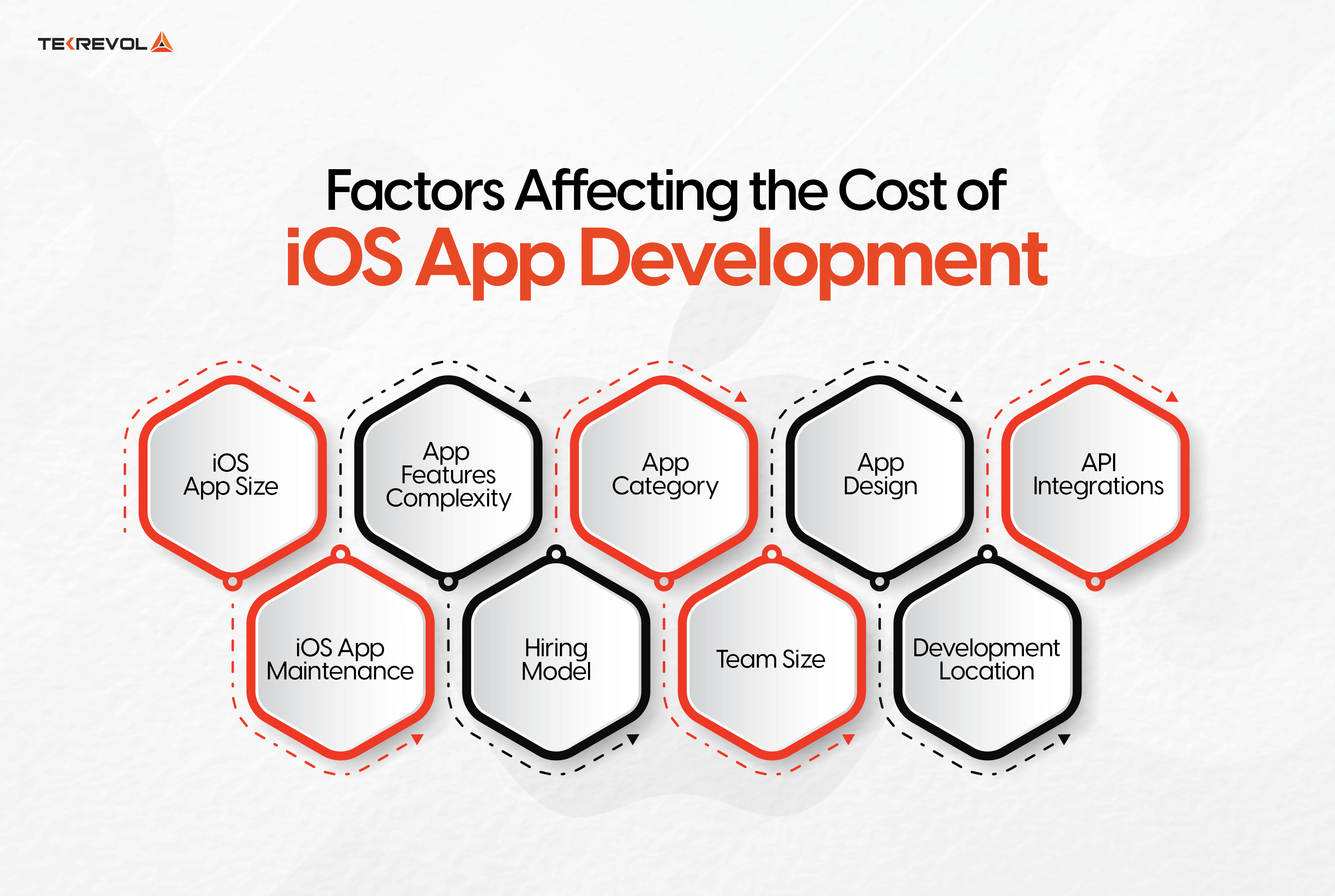
Nine variables shape your final iPhone app development cost. Three of them matter most: feature complexity (the biggest driver), team location (up to a 4x swing), and hiring model. Get those three decisions right, and the rest of the budget largely falls into place.
1. iOS App Size
iOS app development cost by size ranges from $10,000 for a small utility app to $700,000+ for an enterprise platform. Bigger apps mean more development hours, heavier backend infrastructure, and longer QA cycles.
Here is a checklist to determine the average iOS app development cost based on the size:
| iOS App Size | Development Time | Average Cost |
| Small app development cost | 2-4 months | $10,000-20,000 |
| Medium app development cost | 4-8 months | $50,000-150,000 |
| Complex app development cost | 8-18 months | $150,000 – $500,000 |
| Enterprise platform cost | 18+ months | $500,000 – $700,000 |
If you already have a web product, see how you can convert your existing website into an iOS app at a fraction of the ground-up build cost.
- Not sure which size bracket your idea falls into?
- TekRevol maps your idea to an accurate budget range in 15 minutes.
2. Features Complexity
Feature complexity is usually the single biggest lever behind custom iPhone app development cost. A simple content app with read-only screens costs far less than a platform with live data sync, payments, and content moderation.
Developers and stakeholders need to understand the levels of complexity to plan out the budget accurately. Here is how each complexity level maps to the cost tiers.
- Basic iOS app features: login/authentication, simple UI, core functionality, basic database, push notifications.
- Medium iOS app features: social/biometric login, custom UI elements, in-app messaging or payments, advanced database integration, analytics.
- Complex iOS app features: multi-factor auth and role-based access, highly customized UI/UX with animation, real-time collaboration or machine learning, complex backend/API integration, advanced security and compliance.
| App Complexity | Key Features | Average Cost |
| Basic | Authentication, simple UI, push notifications, and basic database | $15,000-60,000 |
| Mid-Level | Custom UI, payments, social login, analytics | $60,000-150,000 |
| Complex | AI/ML, AR, real-time sync, multi-role systems | $150,000-$700,000 |
AI & Advanced Feature Cost Additions
AI features deserve their own line items. They are now the fastest-growing cost variable in iOS development. If your roadmap includes any of the following, add them to your baseline rather than assuming they are covered.
| AI / Advanced Feature | Added Development Cost | Common Use Case |
| On-device AI / Core ML integration | $15,000 – $40,000 | Personalization, image recognition |
| ChatGPT / LLM API integration | $5,000 – $20,000 | In-app AI assistant, content generation |
| AR features (ARKit) | $20,000 – $80,000 | Try-on, navigation overlays, visualization |
| Generative AI UI components | $8,000 – $30,000 | Smart suggestions, dynamic layouts |
| Predictive analytics dashboard | $12,000 – $35,000 | Business intelligence, usage forecasting |
- Adding AI features to your app?
- TekRevol has shipped Core ML, LLM, and AR integrations and knows exactly where teams underestimate this line by 30% or more.
3. iOS App Categories
Different categories carry different baseline expectations. A social app lives or dies on real-time features, and that dependency is what pushes social media app development cost up as concurrent users grow. A medical app lives or dies on compliance. A game lives or dies on performance. So the category alone shifts the cost of iOS app development inside the tiers.
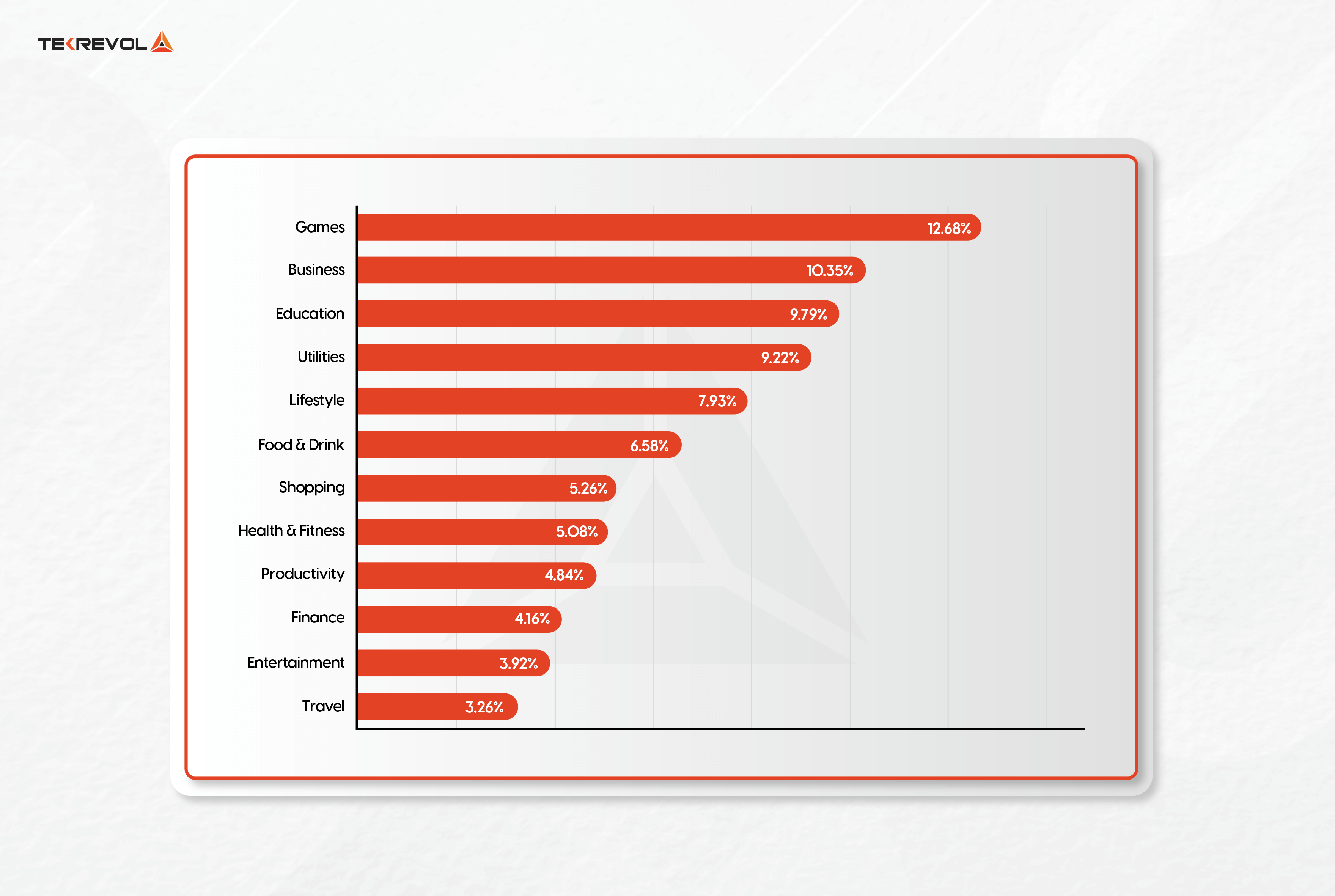
The image below shows the most popular app categories on the App Store with market share percentages in 2026.
Meanwhile, here’s the iOS app development cost breakdown as per the different categories:
| iOS App Categories | Development Time | Average Cost |
| Gaming app | 4-20 months | $30,000-250,000 |
| Business app | 2-10 months | $5,000-150,000 |
| Education app | 2-12 months | $10,000-80,000 |
| Entertainment app | 3-15 months | $15,000-100,000 |
| Travel app | 2-8 months | $5,000-50,000 |
| Shopping app | 3-8 months | $5,000-50,000 |
| Social networking app | 5-8 months | $10,000-60,000 |
| Health and fitness app | 1-15 months | $10,000-250,000 |
| Medical app | 2-6 months | $30,000-90,000 |
4. Custom Design
Custom design adds 20% to 40% on top of baseline development. What looks like ‘just changing colors and fonts’ usually involves design research, multiple wireframe iterations, and custom UI components. It also has to pass Apple’s Human Interface Guidelines, which set a quality floor for anything on the App Store.
Template UI kits keep custom iPhone app development costs down, but they also make your app look like a dozen competitors. If your product wins on brand or user experience, custom design is not optional. Here is the cost breakdown for the iOS app according to the different phases of the design process:
Here is how the design budget breaks down by phase.
| Design Process | Cost |
| UX research and wireframing | $2,000 – $10,000 |
| UI design | $10,000 – $40,000 |
| Branding | $5,000 – $20,000 |
| Animation & illustration | $1000-$25,000 |
5. API Integration in iOS App
Integrating APIs is a key part of app development that impacts costs. The complexity and number of APIs needed, along with customization, affect development costs. Also, factors like API documentation and ongoing support add to the overall cost.
Payment Gateway Integration:
Payment gateway integration is crucial, especially for financial and e-commerce apps. Costs depend on factors like the chosen provider, transaction volume, and security needs.
Customizing payment processes and meeting industry standards like PCI DSS can raise expenses. Ongoing support and maintenance also contribute to development costs.
Here are popular payment integration APIs:
| Payment Gate ways | Transactional Charges | Monthly Charges |
| Paypal | 2.9%+ $0.30/transaction | No fee $30 for PayPal |
| Stripe | 2.9%+ $0.30/transaction | None |
| Authorize.net | 2.9%+ $0.30/transaction | $25 |
| Braintree | 2.9%+ $0.30/transaction (No fees for the first $5000 processed) | None |
| Apple Pay | 1%+ $0.25-$10 for instant transfer | None |
Third-party Integration:
Incorporating external services like social media logins or mapping tools into apps involves third-party integration. Costs vary based on factors such as integration complexity and customization needs.
Moreover, licensing fees, usage-based pricing, and ongoing support can impact expenses. Careful planning and choosing reliable services help manage integration costs efficiently.
Here are some popular 3rd-party API integration and their cost breakdown analysis for your mobile app development project:
| Third-Party Integration | Key Features | Average Cost |
| Google Maps | Navigation or Geolocation Access | $200 |
| Facebook APIs | Authentication & Authorization | $200 |
| Skyscanner API | Offer flight search, ticket costs, and live quotes for traveling | $100 |
| Movie Database API | To access IMDB rating, runtime, release date, awards, etc. | $600 |
| Booking API | To access facilities, costs, and accommodation queries | $800 |
Once development is complete, the next step is to submit your app to the App Store. Here’s a step-by-step guide on how to submit your app to the iOS App Store.
6. Hiring Model
Your model for hiring iOS app developers is the fastest lever on total cost because it changes the rate for every hour of the project. An in-house team gives you the most control at the highest price. Freelancers are flexible, but quality and continuity get risky on anything beyond a small scope. A full-cycle agency sits in the middle, with a structured process at a blended rate. Here is the honest comparison.
1. In-House Developers:
How much does it cost to hire an iOS app developer? Hiring an in-house team of iOS developers provides control and direct communication. However, it’s usually more expensive due to salaries, benefits, and overhead. This model suits long-term projects or continuous support needs.
| Hiring Model | Salary Range | Project Complexity |
| In-House | $100,000/annum | Simple |
| Developers | $120,000/annum | Complex |
2. Freelancers:
Freelancers offer flexibility and cost-effectiveness. They can be ideal for smaller projects or specific tasks. Usually, freelancers charge hourly or per project, but quality control and reliability can be challenging.
| Hiring Model | Salary Range | Project Complexity |
| Freelancers | $34-$79 | Simple |
| $20-$120 | Complex |
3. Outsource to an Offshore App Development Company
Outsourcing to offshore companies balances cost and quality. They have access to diverse talent and lower labor costs, offering competitive pricing. Yet, communication challenges like time zones and cultural differences may require careful management for successful collaboration.
| Hiring Model | Salary Range | Project Complexity |
| Offshore | $45 | Simple |
| Development | $79 | Complex |
- Weighing in-house vs freelance vs offshore for your project?
- TekRevol pairs a US-based product lead with an offshore build team, so clients save 50–70% without sacrificing quality.
7. Team Size
Team makeup directly controls your hourly burn. A lean MVP team, meaning a developer, a designer, and part-time QA, burns $47 to $190 per hour combined. A full project team with a project manager and business analyst runs $187 to $540 per hour.
The right question is not “what is the biggest team I can afford?” It is “What is the smallest team that can ship this scope without cutting corners?” Individual rates below.
| Position | Rate |
| iOS Developer | $20-$100 |
| UI/UX Designer | $15-$50 |
| Scrum Master | $50-$150 |
| QA Engineer | $12-$40 |
| Business Analyst | $30-$70 |
| Project Manager | $60-$180 |
8. Development Location
Where your team sits on a map can swing the total budget by 4x. A San Francisco developer bills $80 to $170 per hour for work; a strong Eastern European or South Asian team delivers at a fraction of that.
But the thing that matters more than the rate card is process maturity. A $35-per-hour team with a broken process ends up costing more than a $70-per-hour team that ships on schedule.
A hybrid model, with senior architecture and project management close to the client and distributed engineering behind them, is often the sensible middle path.
| Region | Cost Per Hour |
| South Asia (India, Pakistan) | $20-40 |
| Eastern Europe (Ukraine, Poland) | $30 – $100 |
| Western Europe | $60 – $150 |
| United States | $80 – $170 |
| Australia | $80-200 |
9. QA and App Testing
Testing is the phase most tempting to squeeze and the most expensive to skip. Every week saved in QA costs about two weeks in post-launch fixes, plus the 2-star App Store review that mentions “buggy.”
Real device coverage across iPhone 13 through 17 and iOS 16 through 19 needs physical devices, not just simulators and emulators. Budget iOS app development cost by test type below.
| Type of Test | Avg. Testing Time | Cost |
| UX Testing | 10-60 Hrs | $200-$1500 |
| Functional Testing | 50-200 Hrs | $700-$3000 |
| Performance Testing | 10-30 Hrs | $150-$500 |
| Security Testing | 50-120 Hrs | $800-$2000 |
| Platform & Device Testing | 10-20 Hrs | $100-$200 |
Detailed Breakdown of iOS App Development Cost by Industry
How much does an iOS app cost?” is actually the wrong question. The right question is: “How much does it cost to develop an iOS app in my industry?” Because two apps with identical feature lists can have wildly different budgets depending on the regulatory environment, data sensitivity, and integration complexity of the sector they serve.
Healthcare and fintech carry the highest floors, at $30K to $50K minimum, because compliance work happens before the first feature is built. E-commerce is the most predictable vertical.
Here what we’ve seen across TekRevol’s project portfolio:
Healthcare iOS Apps: $30,000 to $250,000+
Healthcare is the most expensive vertical. HIPAA compliance isn’t just a checkbox, and it is the single biggest reason healthcare app development cost starts high on every platform. Encrypted data storage, audit trails, role-based access, and BAA agreements with every third-party service add significant engineering overhead before a single clinical feature is built.
- Budget separately for compliance audits ($5,000 to $15,000) and HL7/FHIR integrations ($10,000 to $40,000).
Fintech iOS Apps: $50,000 to $300,000+
Financial apps carry PCI DSS compliance requirements, real-time transaction processing, fraud detection, and often multi-currency support, all of which set the floor on fintech app development cost before the interface is even designed.
Payment gateway integrations alone (Stripe, Plaid, Apple Pay) can add $15,000–$30,000 to a mid-tier build. If you’re building anything involving lending, investment, or crypto, add legal review costs on top.
E-Commerce iOS Apps — $25,000 to $150,000
E-commerce apps are relatively predictable because the feature set is well-understood: product catalog, cart, checkout, payment, order tracking, push notifications. That predictability is why ecommerce app development cost sits in a narrower band than most verticals.
Where budgets expand is around personalization (AI-driven recommendations add $15,000–$40,000), AR product visualization (another $20,000–$80,000), and loyalty program backends.
Logistics & Field Operations Apps — $40,000 to $200,000
GPS tracking, route optimization, offline functionality, and real-time sync with dispatch systems are the cost drivers here.
On-Demand & Marketplace Apps — $35,000 to $180,000
The hidden cost driver in marketplace apps is the dual-sided architecture: You’re essentially building two apps (user-facing and provider-facing) that share a common backend. That structure is the main reason on-demand app development cost runs above a comparable single-audience build. Real-time matching, dynamic pricing logic, and in-app messaging systems add up quickly. Budget for both sides from day one.
iOS Gaming Apps — $30,000 to $250,000+
Mobile games have the widest cost range of any category because “game” covers everything from a simple puzzle app to a multiplayer AR experience. Unity or Unreal integration, in-app purchase architecture, Game Center leaderboards, and performance optimization for older iPhone models all factor in. If your game includes user-generated content or social features, add backend costs in the mobile game development budget accordingly.
- Building in a regulated industry like healthcare or fintech?
- TekRevol accounts for HIPAA, PCI, and compliance overhead that generic calculators miss entirely.
How Long Does iOS App Development Actually Take?
Budget and timeline are two sides of the same equation. You can’t plan one without understanding the other. Here’s what the development calendar actually looks like for a typical iOS app development project
Discovery & scoping — 1 to 3 weeks
A proper discovery phase covers user research, technical architecture decisions, third-party API assessments, and a detailed project scope. Skipping or rushing this phase is the single biggest predictor of budget overruns downstream.
At TekRevol, this phase produces the architectural blueprint and fixed proposal before any development spend is committed.
UI/UX Design — 3 to 6 weeks
Wireframes come first, then high-fidelity mockups, then interactive prototypes. For complex apps with multiple user roles, design alone can stretch to 8 weeks. Apple’s Human Interface Guidelines create a quality floor, but custom design systems, animations, and component libraries push timelines up.
Development (frontend + backend) — 8 to 24 weeks
This is the largest variable in the timeline. A simple utility app with a basic backend can ship in 8 weeks. A marketplace with real-time features, multi-role dashboards, and third-party integrations can run 20–24 weeks alone.
The backend is consistently underestimated since authentication systems, databases, APIs, and admin panels take as long as the user-facing features, sometimes longer.
QA and Testing — 2 to 6 weeks
Testing is not the phase to compress. Every week saved in QA costs an average of 2 weeks in post-launch fixes, plus the reputational cost of a 2-star App Store review that mentions “buggy.”
Device fragmentation across iPhone 13 through iPhone 16 Pro, iOS 16 through iOS 18, and varying screen sizes means your QA cycle needs real devices, not just a simulator.
App Store Submission and Review — 1 to 2 weeks
Apple’s review process has become more predictable over the years, but first submissions for new apps typically take 3–7 business days — after which Apple App Store optimization determines how easily users find your app.
Rejections, which are common for apps with subscription billing, user-generated content, or health claims, can add another review cycle. Build this into your launch date, not your development timeline.
iPhone vs iPad vs VisionOS: Does the Device Change the Cost?
Yes. iPad app costs about the same as an iPhone app, plus a 10 to 20% premium for adaptive layouts. VisionOS apps start around $40,000 and can pass $400,000 for immersive experiences.
Apple’s device family now spans phones, tablets, headsets, and watches, and each one changes the engineering math differently. Here is how the budget shifts by device.
- iPad app development costs run $15,000 to $150,000 for most apps. The premium comes from building adaptive layouts, meaning Split View, Stage Manager, and Apple Pencil support, rather than a stretched iPhone screen. A universal iPhone plus iPad build adds roughly 15 to 25% over a single-device target.
- Apple Vision Pro (visionOS) app development costs near $40,000 for a focused single-experience app. Immersive, hand-tracked, or enterprise spatial apps run $150,000 to $400,000 and up. The premium comes from 3D asset pipelines, spatial interaction design, and the small pool of engineers with RealityKit experience.
- Apple Watch companion apps typically add $8,000 to $25,000 to an iPhone project, depending on how deep the watch features go.
Hidden Factors Affecting the Cost of iOS App Development
Launch day is the starting line, not the finish. Apple charges $99 a year for a developer account and takes 15% to 30% of in-app revenue. Maintenance adds 15% to 20% of your build cost every year.
While the aforementioned cost factors are quite apparent and unlikely to escape your attention, it’s important to note that there are also hidden criteria in iPhone app development that may go unnoticed.
Therefore, we have compiled a list of these criteria to ensure that you don’t overlook any crucial details during the development of your iOS app.
| Hidden Cost Factors | Avg. Cost/Year |
| Data storage | $500 |
| CDN (Content Delivery Network | $150 |
| Apple Developer Program account | $99 |
| Annual iOS updates | $1000 |
| Monitoring and maintenance | $4,000-12,000 |
| Third-party SDK licensing fees | $500 – $5,000/year |
| CI/CD pipeline tooling (e.g., Fastlane, Bitrise) | $600 – $2,400/year |
| TestFlight distribution & beta management | $0 – $500/year |
iOS App Development Cost vs Business ROI
A $100,000 iOS app generating $50,000/month in subscriptions pays for itself in two months. A $40,000 operational app that eliminates $250,000 in annual overhead delivers a 6x ROI in year one.
When you frame the investment this way, the question shifts from ‘how do I spend less?’ to ‘how do I maximize return on what I spend?’
3 iOS App ROI Models TekRevol Uses With Clients
| ROI Model | How It Workd | Payback Timeline |
| Revenue Generation | E-commerce, subscriptions, in-app purchases, marketplace fees | 12–24 months (3–5x ROI over 3 years) |
| Cost Reduction | Automation, field ops, internal tooling, workflow digitization | 6–18 months (full cost recovery) |
| Brand & Retention | Loyalty programs, community platforms, and content apps | LTV increase of 20–40% over 24 months |
TekRevol’s Build–Measure–Scale Cost Framework
Rather than a single large upfront investment, TekRevol structures iOS projects in three accountable phases that help brands achieve 2X revenue with custom iOS apps.
| Phase | Investment Range | What You Get |
| Phase 1: MVP | $15,000 – $80,000 | Core loop validated with real users in the market |
| Phase 2: Growth Build | $50,000 – $200,000 | Scale what works; add revenue-generating features |
| Phase 3: Optimize | $20,000 – $60,000/year | Data-driven iteration; performance and retention lift |
iOS vs Android Development Cost
iOS app development typically runs 10–15% more than Android, due to stricter Apple guidelines, Swift/Objective-C specialist rates, and the $99/year App Store fee (versus Android’s $25 one-time fee).
If you’re pricing the other side of that comparison, Android app development cost breaks down the same variables from the Android side. The gap has narrowed over the years, but a few differences are still worth knowing:
- Design: iOS follows a more standardized design language, often making interfaces cheaper to build than Android’s more fragmented device/screen requirements.
- Development: iOS relies on Swift/Objective-C and stricter Apple guidelines, which can mean specialized (pricier) talent. Android’s Java/Kotlin ecosystem is more flexible but often needs more testing across devices.
- Timeline: iOS development tends to be faster given fewer device variants (20+ vs Android’s much larger spread), which can lower overall cost.
- Testing: Fewer iOS device variants mean lower testing costs relative to Android’s broader OS/device matrix.
- Release: iOS charges a $99/year developer fee vs. Android’s $25 one-time fee, and Apple’s review standards are stricter.
Native iOS vs Cross-Platform | Which Should You Build
Before you commit a dollar to iPhone app development cost, there’s a decision that will shape your entire budget: do you build a native iOS app, or go cross-platform with Flutter or React Native? It sounds technical, but the answer is really a business question.
Price both paths before you choose, because native app development cost and the cross-platform equivalent diverge sharply once your feature list grows.
Build native iOS if:
- Your app relies heavily on device hardware (camera, ARKit, Core ML, Face ID, or Bluetooth)
- You’re targeting a premium user base that expects a polished, Apple-grade experience
- Your roadmap includes features that Apple ships first (like HealthKit integrations or the latest SwiftUI components)
- You’re in a regulated industry where security certifications matter at the OS level
Go cross-platform if:
- You need to ship on both iOS and Android within the same budget cycle
- Your core feature set is UI-heavy rather than hardware-dependent (content apps, marketplaces, booking tools)
- Your MVP timeline is tight, and you need to validate the concept before investing in full native builds
- Your team already works in React Native or Flutter
Here’s what the native vs cross-platform cost differences actually look like:
| Approach | Cost Range | Best For |
| Native iOS (Swift) | $30,000 – $700,000+ | Premium UX, hardware-heavy, regulated industries |
| React Native | $25,000 – $300,000 | Faster MVP, iOS + Android from one codebase |
| Flutter | $20,000 – $250,000 | UI-consistent, cross-platform, startup budgets |
Two options sit outside that table:
The cost to build a hybrid app low above all, though the saving disappears the moment you need a native capability the wrapper doesn’t support. A progressive web app is cheaper still, and it earns its place when search discoverability matters more than device hardware.
Exceptional Tips to Reduce the Average iOS App Development Cost
By now, you must have understood that there are multiple, yet crucial factors that directly impact the average cost of iOS app development.
And seeing all these cost add-ups can sometimes make it challenging to get started. That’s why here are some practical tips to minimize the iPhone app costs and digitize your idea in the most sophisticated manner.
- Build an MVP first. Launch the minimum feature set needed to validate demand before investing in the full vision. This is consistently the biggest lever for cutting early-stage costs.
- Don’t skip testing to save time. Rushed QA leads to expensive rework and a damaged first impression. Both cost more than doing it right the first time.
- Consider outsourcing. A full-cycle offshore agency with a defined process and competitive hourly rates is often the most reliable way to control iOS app development costs without sacrificing quality.
How to Get an Accurate iOS App Development Quote
A trustworthy iPhone app development quote has five parts: a line-item breakdown by phase, written scope assumptions, a timeline that includes App Store review, post-launch costs stated upfront, and proof from your industry. Missing pieces turn into change orders later.
The quality of a quote tells you more about a vendor than their portfolio does. A single lump-sum number with no assumptions attached is not a lower price. It is an undocumented one, and undocumented scope is where budget overruns are born.
Before you sign anything, ask for:
- A cost breakdown by phase: discovery, design, development, QA, and launch.
- Written assumptions covering user roles, integrations, compliance, and device targets.
- A timeline with dependencies, including the review window.
- Year-one running costs, in writing.
- A case study from your industry with a measurable result.
If you want a quote built that way, our iOS app development team turns a free 30-minute scoping session into a line-item proposal with an architecture outline.
How Can TekRevol Help You Optimize the Cost of iOS App Development?
TekRevol doesn’t use a one-size-fits-all iOS app quote. Here’s how we get from “how much does this cost” to a real number:
- Consultation call — we learn your requirements and objectives.
- Project evaluation — scope, complexity, and feature assessment.
- Quotation & architectural blueprinting — a detailed cost breakdown plus a preliminary architecture draft.
- Final proposal — timelines, expenses, and deliverables- is fully transparent before development starts.
With 5+ years building mobile apps across industries, our senior architects map your investment to a measurable ROI milestone before the first sprint begins.
- Want to Introduce the Next Big iOS App in the Market?
- Collaborate with us today to build your product at a fine iOS app development cost.


