



- Arabic RTL support is legally required under the UAE Consumer Protection Law Article 26.
- Apps launched with Arabic from day one see 40–60% higher engagement, retrofitting costs 3–5x more, and delays launch by months.
- Dubai app development requires bilingual architecture, Hijri calendar, AED currency, UAE PASS, and Gulf Arabic tone from sprint one.
- A strong Arabic app development company combines RTL engineering, PDPL compliance, and native UAE cultural UX knowledge.
- TekRevol delivers Arabic RTL, PDPL-compliant apps with a regional UAE team experienced across fintech, real estate, and on-demand verticals
Launching an English-only app in Dubai means leaving the majority of the market unreached from day one.
Dubai’s smartphone penetration is close to 100%. The UAE app economy is one of the fastest-growing in the world. And yet, apps launch here every week with zero Arabic support, then struggle to understand why retention is low, and conversions are half what projections promised.
The answer is not the product. It is the language. Approximately 60% of UAE residents prefer Arabic as their primary language. Under Article 26 of the UAE Consumer Protection Law, consumer-facing apps must support Arabic; it is not a recommendation, it is a legal requirement carrying fines up to AED 200,000.
Arabic app development in Dubai is not a feature you schedule for version two. It is the foundation your product is built on: legally, commercially, and culturally.
This guide is written for founders, product managers, and teams building apps for the Dubai and wider UAE market. Whether you are a startup looking for a mobile app development company Dubai or a scale-up expanding from English into Arabic, here is everything you need to know, from RTL app development UAE engineering decisions to cultural UX, compliance, ASO, and real 2026 cost figures.
What Is Arabic App Development and Why Does It Matter in Dubai?
Arabic app development in Dubai means building mobile apps that are fully functional, legally compliant, and culturally relevant for Arabic-speaking users in the UAE, with proper RTL layouts, Arabic UX, and bilingual architecture.
It is a different discipline at every layer: design, engineering, and compliance. The numbers make the case
- UAE population: ~11.5 million
- Arabic speakers (first or preferred language): ~60–65%
- Apps with Arabic support: 40–60% higher user engagement (source: Netguru, UAE Mobile Market Report)
- Apps without Arabic support: up to 50% lower conversion on registration and payment flows
- Retro-fitting Arabic after launch: costs 3–5x more than building it from Day 1
The Dubai market separates apps that were built for it from those translated into it. Users notice the difference on the first screen.
Your Dubai App Is Speaking the Wrong Language.
Don't lose 60% of your market to a fixable problem. TekRevol builds Arabic-first, RTL-ready apps that feel native to UAE users.
Let's Fix ThatRTL App Development UAE: What Actually Changes in Your Codebase
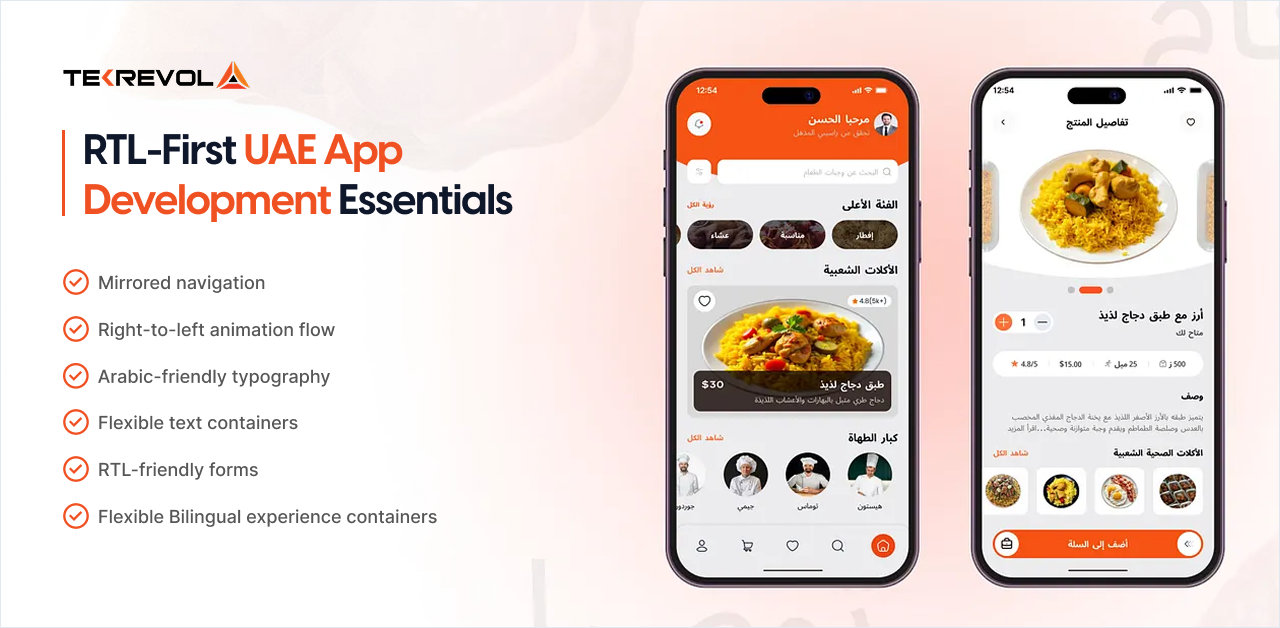
RTL (Right-to-Left) app development means restructuring your entire UI, not just flipping text, so that navigation, layouts, icons, animations, and data flows read naturally for Arabic users.
Arabic is not text that goes the other way. It changes your entire UI architecture. Here is what breaks without proper RTL support:
UI Elements That Break Without Proper RTL Support
- Navigation and back buttons — the back arrow points right in RTL, not left
- Progress bars and sliders — fill direction reverses
- Icon direction — arrows, chevrons, and share icons all need mirroring
- Form fields — alignment, label placement, and input direction shift
- Charts and data visualizations — axis labels and reading order flip
- Scroll behavior — horizontal scrolls go right-to-left
- Animations and transitions — slide-in transitions must reverse direction
Platform-by-Platform RTL Comparison
| Platform | RTL Support | Notes |
| Flutter | Excellent | The directionality widget handles most cases automatically |
| React Native | Good | I18nManager.forceRTL() — some edge cases need manual fixing |
| iOS (SwiftUI) | Good | semanticContentAttribute — but test thoroughly |
| Android | Moderate | android:supportsRtl=”true” — ConstraintLayout has known mirroring issues with complex nested layouts |
For businesses prioritizing Android app development in Dubai, RTL compatibility testing is critical because Android devices in the UAE vary widely across screen sizes and OS versions.
The broader question of which framework to build on, native or cross-platform, directly affects how complex your RTL implementation becomes.
The 5 RTL Mistakes That Break Dubai Apps After Launch
- Hardcoded text strings — any text not externalized into a localization file cannot be translated without a rebuild. This single mistake is responsible for the majority of costly Arabic retrofits.
- Fixed-width UI components — Arabic text expands 25–30%. Buttons, labels, and cards with fixed pixel widths clip Arabic text in production.
- English-only error messages — validation errors and API error responses displayed in English only create a broken experience that Arabic users associate with an unfinished product.
- Mirrored images that should not be mirrored — logos, product photos, and human face images should NOT mirror in RTL. Only directional UI elements (arrows, progress indicators) should mirror. Incorrect blanket mirroring is a common Flutter and React Native mistake.
- Single-language push notification pipeline — sending English push notifications to Arabic-interface users drops open rates significantly. The notification language must match the user’s language setting, requiring a bilingual notification architecture from day one.
Arabic Typography: The Layer Most Teams Skip
Not all fonts render Arabic correctly. Arabic letters connect differently depending on their position in a word. Using the wrong font breaks readability completely.
Recommended Arabic font stack for UAE apps:
- Cairo — clean, modern, works well for UI
- Tajawal — great for body text, easy to read on mobile
- IBM Plex Arabic — professional, strong for fintech and enterprise
- Noto Naskh Arabic — excellent for formal and government-adjacent apps
Arabic text also expands. A button labeled “Submit” becomes “إرسال” — which takes up roughly 25–30% more space. Design every container to handle this expansion. Fixed-width buttons will break.
Bilingual UX Design for Dubai: It Is Not Just a Mirrored English App
Bilingual UX for Dubai means designing interfaces where Arabic and English feel equally native, not where Arabic is an afterthought stapled onto an English layout.
This is where most apps built outside the UAE fail. They translate the words. They do not translate the experience.
How Arabic Users Read a Screen Differently
Arabic readers follow an F-pattern from right to left. The most important content, your CTA, your headline, and your trust signals, should sit on the right side of the screen in Arabic mode. Putting a primary CTA on the bottom-left in an Arabic interface is like hiding it.
Key UX principles for bilingual Dubai apps:
- Language toggle placement: Put it in the header, always visible. Not buried in Settings.
- Onboarding language selection: Ask at first launch. Do not assume based on device language alone — many Dubai residents use English-language iPhones but prefer Arabic in apps.
- Form design: UAE address formats have no zip codes. Fields should include Emirate, Area, Building name, and Flat number.
- Notification copy in Arabic: Gulf Arabic tone is warm and direct. Avoid overly formal MSAs in push notifications. “مرحباً” lands better than a stiff formal greeting.
UAE Cultural Design Standards: What to Know Before You Design
Colors carry meaning here. Gold signals premium; it works. Green is trusted. White is clean and professional. Red is used cautiously; it can signal error or loss in financial contexts.
Imagery matters more than most foreign teams realize:
- Avoid showing non-halal food in general consumer apps
- Do not use imagery featuring Western-style drinking or nightlife in mainstream apps
- Represent the Dubai population accurately — it is diverse. Emiratis, South Asians, Arabs from the Levant and Gulf, Westerners, East Africans. All live here.
- During Ramadan, adapt your UI tone. Muted colors, respectful messaging, and no food imagery during fasting hours.
Localization UAE Apps: The 5 Levels and Where Most Apps Stop Too Early
App localization for UAE goes far beyond translation. Translation is L1. Most apps that fail in Dubai stop there. Here is the full localization stack:
The 5 Levels of Localization
- L1 — Translation: Words in Arabic. Most apps stop here.
- L2 — Linguistic localization: Correct grammar, Gulf Arabic tone, appropriate formality.
- L3 — Cultural localization: Imagery, color, references, religious sensitivity.
- L4 — Functional localization: Hijri calendar, AED currency display, prayer time awareness, UAE working week (Sunday–Thursday in government, Monday–Friday in the private sector).
- L5 — Market localization: Pricing strategy in AED, local payment methods, and UAE-specific content partnerships.
Most apps reach L2. Apps that win in Dubai operate at L4 and L5.
Modern Standard Arabic vs. Gulf Arabic: Which Do You Use?
Use Modern Standard Arabic (MSA) for UI text, buttons, labels, error messages, and navigation. It is universally understood across all Arabic-speaking users in the UAE.
Use Gulf Arabic (Khaleeji dialect) for marketing copy, push notifications, and conversational UX. It feels familiar to Emiratis and Gulf Arab residents, the core high-LTV segment.
Do not default to Egyptian Arabic. It is the most widely understood Arabic dialect globally, but it signals to UAE users that the app was not made for them.
Functional Elements That Need Localization in UAE Apps
- Calendar: Show both Gregorian and Hijri dates where relevant (booking apps, government-adjacent features, event apps)
- Currency: Always AED (د.إ) with correct decimal formatting
- Phone numbers: +971 prefix, UAE mobile format validation
- Address fields: No zip codes in the UAE. Use: Emirate → City/Area → Street → Building → Flat
- Working week awareness: In case your application comes with scheduling capabilities, note that Friday and Saturday are the weekend in the UAE for most private sector companies.
UAE Compliance for Arabic Mobile Apps: Things You Must Not Overlook in 2026
The UAE app compliance extends over three layers: Arabic language law, data protection (PDPL), and sector-specific regulations. If you miss any of these parts, you will be liable to fines, and your app may even be rejected by the App Store.
Layer 1: UAE Consumer Protection Law, Article 26
Consumer-targeted apps have to provide all trading information in the Arabic language. This includes contracts, product descriptions, pricing, and advertising shown inside the app. Being found guilty of these violations will result in paying fines ranging from AED 3,000 to AED 200,000 and possibly other business license-related issues.
Layer 2: PDPL, Personal Data Protection Law (Federal Decree-Law No. 45 of 2021)
PDPL is relevant for your app if it involves collecting or using any personal data from users, such as their name, phone number, email address, location, or payment details.
What compliance requires in practice:
- Explicit consent in Arabic and English before data collection
- A clear privacy policy in both languages
- User rights portal: users can view, correct, and delete their data
- Data breach notification to the UAE Data Office within 72 hours
- Cross-border data transfer restrictions — check where your servers sit
Maximum penalty: AED 5 million for serious violations.
Layer 3: Sector-Specific Rules
| Sector | Regulator | Key Requirement |
| Fintech | CBUAE | Licensed payment gateway, KYC/AML compliance |
| Healthcare | DHA / MOH | Patient data localization, DHA app approval |
| Real estate | RERA | Licensed agent display, transaction transparency |
| EdTech | KHDA | Content approval for apps used in UAE schools |
Additional Payment and Identity Compliance
UAE apps need regional payment gateways. Stripe alone is not sufficient for the UAE market. Use:
- PayTabs — UAE-based, supports AED, Arabic interface
- Telr — strong UAE market presence, supports multiple Arab currencies
- Network International — preferred for enterprise and retail
- UAE PASS — the national digital identity platform; required for government-integrated apps, strongly recommended for fintech and healthcare
App Store Optimization in Arabic: The Biggest Untapped Advantage in Dubai
Arabic ASO (App Store Optimization) means optimizing your App Store and Google Play listing in Arabic to rank for the millions of Arabic-language app searches happening in the UAE every month, a space most competitors still ignore. That gap is a ranking opportunity.
Arabic App Store Listing: What to Optimize
- App name and subtitle: Include your primary Arabic keyword naturally. “تطبيق توصيل الطعام في دبي” outranks a generic English name for Arabic-language searches.
- Description: Write it natively in Arabic, not translated from English. Different sentence rhythm, different CTA phrasing. Gulf Arabic marketing copy converts better than MSA formal text.
- Screenshots: Show the Arabic UI first in your screenshot set for the UAE App Store locale. Arabic users need to see that the app actually works in Arabic before downloading.
- Preview video: Add Arabic voiceover or Arabic on-screen text. 30 seconds showing the Arabic interface in action removes doubt.
- Keywords (iOS): 100-character keyword field — use it entirely in Arabic for the ar locale. Research using tools like AppFollow or Sensor Tower filtered to UAE.
- Ratings and reviews: Encourage Arabic reviews actively. App Store algorithms weigh reviews in the user’s language for local search rankings.
Dual-Language Listing Strategy
Apple App Store and Google Play both support locale-specific metadata. Set separate listings for ar-AE (Arabic – UAE). Do not use a single global listing; you will lose ranking in both Arabic and English searches.
Seasonal ASO in Dubai
Dubai has distinct ASO seasons. Update your screenshots, descriptions, and featured graphics for:
- Ramadan (the highest app download month in the UAE for food, e-commerce, and lifestyle)
- UAE National Day (December 2–3)
- Back to School (September — strong for edtech and productivity apps)
- Dubai Shopping Festival (e-commerce and retail apps)
How to QA and Test Arabic RTL Apps Before Launch
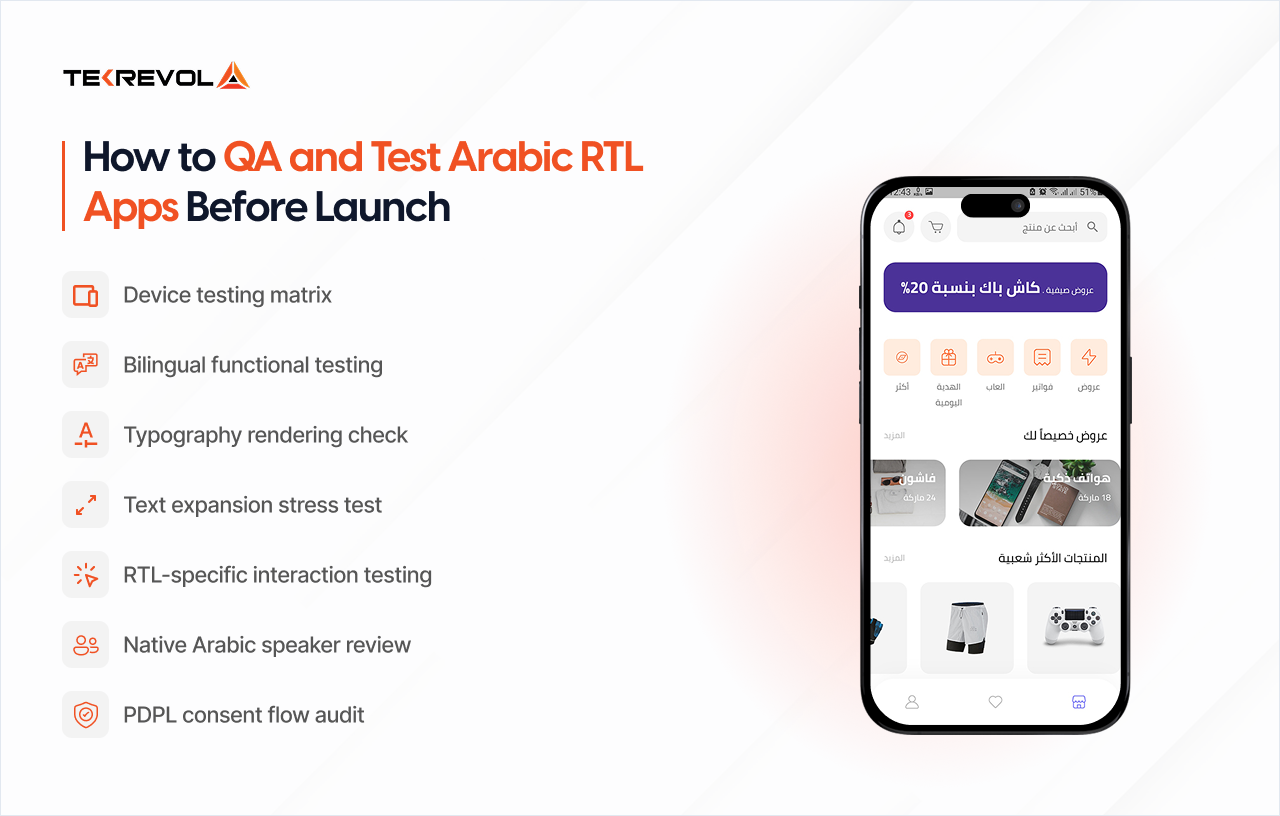
Arabic RTL testing is a separate QA workstream, not a checklist item inside your standard QA cycle. Here is the minimum testing framework for a Dubai market launch:
- Device testing matrix — Samsung Galaxy A-series and S-series dominate the UAE Android market; iPhone 13/14/15 dominate iOS. Test on physical devices, not simulators. Emulator RTL rendering does not match on-device behavior.
- Bilingual functional testing — every user flow must be tested end-to-end in Arabic AND English independently. A flow that works in English can break in Arabic due to text expansion, layout reflow, or string length differences.
- Typography rendering check — Arabic letter connection rendering varies across devices and OS versions. Test with native Arabic readers, not developers reading screenshots.
- Text expansion stress test — force all UI strings to their maximum Arabic length and verify no clipping, overflow, or layout break occurs.
- RTL-specific interaction testing — swipe gestures, back navigation, horizontal scroll, and animation direction must all be verified in Arabic mode.
- Native Arabic speaker review — technical QA catches layout issues; a native Gulf Arabic speaker catches tone, grammar, and cultural appropriateness issues that automated testing cannot.
- PDPL consent flow audit — verify consent is presented in Arabic before any data collection, with the correct right-to-erasure workflow available in Arabic.
Costs of Arabic App Development in Dubai
Arabic mobile app development cost in Dubai fall between AED 60,000 to AED 480,000+, depending on complexity, platform choice, and compliance requirements, with RTL and bilingual support adding roughly 20% to base development costs.
Development Cost by App Type (AED, 2026)
| App Type | Base Cost (AED) | Arabic RTL Premium | Total Bilingual | Approx. USD |
| Simple / MVP app | 50,000–100,000 | +20% | 60,000–120,000 | $16,000–$33,000 |
| Mid-complexity (e-commerce, on-demand) | 150,000–300,000 | +20% | 180,000–360,000 | $49,000–$98,000 |
| Enterprise/fintech/health | 400,000–800,000 | +20% | 480,000–960,000 | $131,000–$261,000 |
Retro-fitting Arabic to an existing app: Add 40–60% of the original build cost. An AED 200,000 app costs AED 280,000–320,000 to retrofit Arabic.
Arabic-Specific Cost Components
| Component | Basic (AED) | Professional (AED) |
| RTL UI/UX Design | 5,000–8,000 | 10,000–18,000 |
| RTL Development | 8,000–15,000 | 18,000–30,000 |
| Professional Arabic Translation | 3,000–6,000 | 8,000–15,000 |
| PDPL Compliance Setup | 7,000–15,000 | 20,000–40,000 |
| Payment Gateway Integration | 5,000–10,000 | 12,000–18,000 |
App Development Timeline Dubai
| App Type | Timeline |
| MVP app (bilingual) | 8–14 weeks |
| Mid-complexity app | 16–24 weeks |
| Enterprise app | 28–48 weeks |
| Retro-fit Arabic to the existing app | 6–16 weeks |
These are not estimates pulled from Western markets. They reflect actual cost and timeline for mobile app development in Dubai from UAE-based experienced teams in 2026.
Industry-Specific Arabic App Development in Dubai
Fintech App Development
Fintech is one of the most active app categories in the UAE. The DIFC and ADGM free zones attract fintech companies from across the world. But fintech app development in Dubai comes with the highest compliance bar.
Mandatory requirements: CBUAE-licensed payment processing, KYC/AML flows in both Arabic and English, UAE PASS integration for identity verification, Arabic language disclosures for all financial products, and full PDPL compliance for sensitive financial data.
Arabic UX for fintech matters even more here; users trust an app with their money only when the language and interface feel native.
e-Commerce App Development
Dubai’s e-commerce market is projected to reach USD 9.2 billion by 2026 (Statista).
Arabic e-Commerce app development means Hijri-aware promotional scheduling (Ramadan sales, Eid offers), AED-first pricing display, Arabic product descriptions that convert (not translated descriptions that confuse), and cash-on-delivery as a payment option, still widely used in the UAE.
Furthermore, teams building an e-Commerce mobile app in Dubai should localize everything from AED pricing displays to Ramadan campaign flows and Arabic product discovery experiences.
Real Estate App Development
Dubai’s property market is one of the most active in the world. Real estate app development for the UAE needs RERA compliance, Arabic-language property descriptions, Hijri/Gregorian calendar support for tenancy contracts, and bilingual customer support chat built in.
On-Demand App Development
On-demand app development in Dubai, whether for food delivery, home services, or logistics, requires an Arabic push notification strategy, Gulf Arabic copy for driver/service provider communication, UAE address format handling (no zip codes), and support for UAE working hour patterns.
AI-Powered App Development
AI-powered app development for Arabic in the UAE requires Arabic NLP models trained on Gulf dialect data, not just MSA.
The Places UAE case study demonstrates this clearly. After integrating dialect-aware Arabic search using Amazon Bedrock, Arabic search usage grew 1,000% and daily searches rose 267%.
Work with teams experienced in the AI app development solutions to ensure Arabic NLP features reflect how users in Dubai actually communicate, not how a textbook says they should.
Arabic RTL, PDPL, UAE PASS — All Handled.
Building bilingual skills from scratch is complex. We've done it across fintech, real estate, and on-demand apps in Dubai.
Get Your Free Project RoadmapMVP App Development for Startups in Dubai: Build Arabic-First From Day One
For startups, MVP app development in Dubai should always include bilingual architecture from the first line of code, because rebuilding RTL layout and i18n infrastructure after launch costs more than the entire original MVP.
Here is what a smart Arabic-ready MVP includes from Day 1:
- Externalized string files for Arabic and English from the start (not hardcoded text)
- RTL-ready design system with flexible containers
- Dual-language onboarding (language selection at first launch)
- Basic PDPL consent flows built in
- AED currency display and UAE address format support
- Arabic App Store listing ready at launch
What can wait for V2: advanced AI features, dialect-specific copy optimization, full Hijri calendar integration, and premium Arabic typography refinements.
The minimum viable product in Dubai is not the minimum viable product in Berlin. The UAE market baseline is bilingual. Build to that baseline.
How to Audit an Existing App for Arabic RTL Readiness
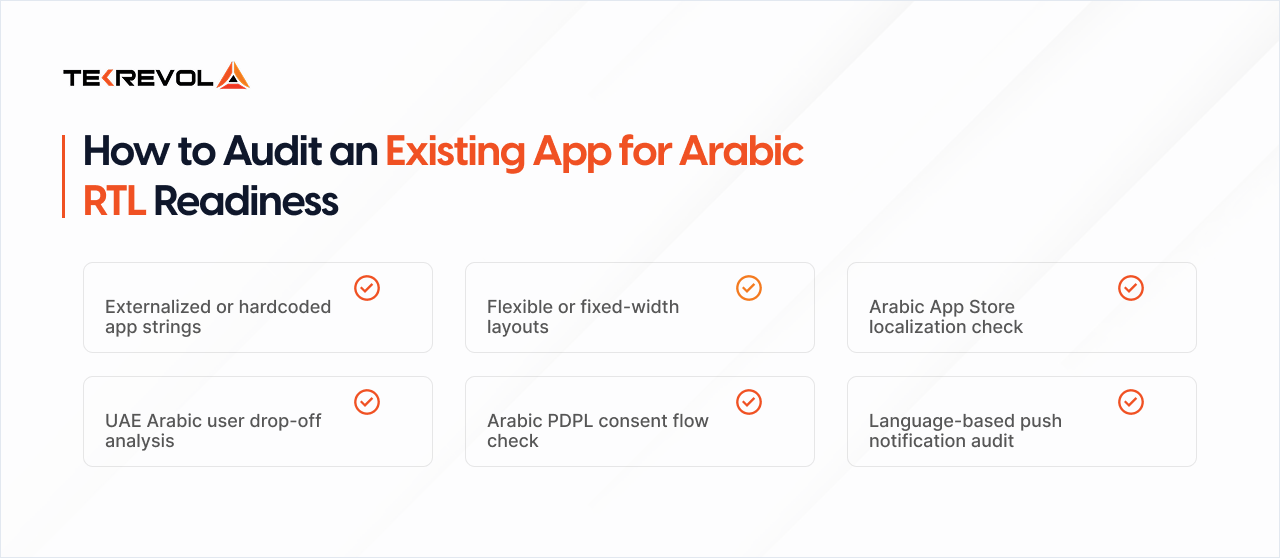
If your app is already live in the UAE and underperforming, run this audit before rebuilding from scratch:
- Are all strings externalized in a localization file or hardcoded? (Hardcoded = rebuild required)
- Does the layout use flexible containers or fixed-width components? (Fixed = text will clip in Arabic)
- Is there an Arabic App Store listing with Arabic screenshots? (Missing = losing 60% of search visibility)
- Does your analytics show UAE Arabic-language device users dropping off at specific screens? (Drop-off in onboarding = RTL layout failure)
- Is your PDPL consent flow presented in Arabic before data collection? (No = compliance violation)
- Are push notifications sent in the user’s language setting? (No = open rate loss)
If more than two of these are “no,” retrofitting is required. The cost is 40–60% of your original build. TekRevol’s UAE team offers Arabic RTL audits as a standalone engagement before committing to a full retrofit.
How to Choose the Right Arabic App Development Company in Dubai
The right Arabic app development company in Dubai has live Arabic apps in the UAE App Store. They demonstrate PDPL compliance and have native Arabic-speaking UX input on their team.
Before you hire mobile app developers in Dubai, make sure the team has proven experience with RTL engineering, bilingual QA, and UAE-specific compliance workflows.
Most offshore teams can build technically sound apps. Very few have the cultural fluency and regulatory knowledge to build for Dubai specifically.
8 Questions to Ask Before You Sign
Before you sign any contract, ask these eight questions. How a team answers them will tell you whether they actually know the UAE market.
- Can you show me live Arabic RTL apps you have built that are live in the UAE App Store?
- Who handles Arabic UX and localization on your team? Is it a native Gulf Arabic speaker?
- How do you implement PDPL compliance? What does your consent flow architecture look like?
- Which framework do you recommend for this project and why (specifically for RTL)?
- How do you handle Arabic text expansion in UI components?
- What is your QA process for bilingual testing?
- Have you integrated UAE PASS before?
- What is your App Store submission process for Arabic listings?
Red Flags to Watch For
- No live Arabic apps to demo
- “We will add Arabic later” as a project plan
- RTL is described as a “simple CSS change.”
- No knowledge of PDPL when you ask
- Quoting timelines that are too short for proper bilingual QA
How TekRevol Helps You Build Arabic Apps for Dubai That Actually Win
TekRevol is a mobile app development company with a strong UAE presence and a track record of building Arabic-first, RTL-compliant, PDPL-ready apps for the Dubai and broader MENA market.
What makes TekRevol the right choice for Arabic app development in Dubai:
- Regional presence: TekRevol operates in the UAE with teams that understand the market, not just the technology
- Arabic RTL expertise: Flutter and React Native projects delivered with native RTL architecture — not patched after launch
- PDPL compliance built in: Consent flows, data subject rights portals, breach notification systems — part of the standard build, not a last-minute addition
- End-to-end localization: Professional Arabic translation, Gulf Arabic UX copy review, and bilingual QA with native Arabic-speaking testers
- Sector experience: From fintech to real estate, and AI-powered app development — TekRevol has delivered across the UAE’s key verticals
- App Store ASO in Arabic: TekRevol handles Arabic App Store metadata, screenshot localization, and keyword strategy for UAE-market launches
Whether you are building a new app from scratch, expanding an existing product into Arabic, or need an audit of an app that is underperforming in the UAE market, TekRevol’s team is ready to work with you.
Your Arabic App Deserves to Win the UAE Market.
TekRevol has the regional presence, the RTL expertise, and the compliance knowledge to get you there.
Book a free consultation with our Dubai team today.


