



- Mobile app development in Dubai typically ranges from AED 25,000 to AED 1,500,000 based on overall complexity.
- A launchable Dubai app realistically starts around AED 25,000 to AED 40,000 for one platform with basics.
- Dubai agencies charge AED 180 to AED 500 per hour; offshore teams charge AED 60 to AED 200.
- Android development is marginally cheaper than iOS in Dubai, though cross-platform frameworks beat both on cost overall.
- Adding AI features to a UAE app costs AED 29,000 to AED 294,000 extra, depending on capability.
- UAE fintech apps need a CBUAE licence if they hold customer funds, requiring AED 100,000 to 3,000,000 in capital.
- Free no-code builders work for validating ideas but can’t meet UAE compliance, payment, or Arabic RTL needs.
- Dubai app development timelines typically run 2–3 months for MVPs up to 10–18 months for enterprise builds.
Dubai moves fast on digital products. But building an app here involves more than a development price tag. You also pay for local user expectations, Arabic and English experiences, payment integrations, data protection rules, and infrastructure that holds up as you grow. That’s why two apps with near-identical feature lists can cost very differently.
In Dubai, mobile app development costs AED 25,000 to AED 1,500,000. Basic apps with limited functionality sit at the lower end. Custom UI/UX, third-party integrations, real-time features, and advanced backend systems push the number up. Most funded business apps land between AED 90,000 and AED 290,000.
The quickest route to an accurate figure is a conversation with people who know local rates. A reliable mobile app development company in Dubai can assess your scope, break the cost down properly, and stop you from overspending on features you don’t need yet.
So this blog covers what really drives app pricing here: ranges by complexity, cost at each development stage, the UAE rules that change your architecture, and how to read a quote before signing.
How Much Does Mobile App Development Cost in Dubai?
Mobile app development in Dubai costs between AED 25,000 and AED 1,500,000, depending on complexity. Most business apps cost between AED 90,000 and AED 290,000 to develop. Compliance, Arabic support, and first-year operating costs can add 50% or more to the overall budget.
To give you a better idea, here is a breakdown based on the complexity of your project. This table provides a quick estimate of the average app cost Dubai businesses face.
| Tier | Typical Cost (AED) | What You Actually Get | Timeline |
| Basic / MVP | AED 25,000 – 80,000 | Single platform, core screens, minimal backend, no regulated data handling | 6–12 weeks |
| Mid-Complexity | AED 80,000 – 220,000 | Cross-platform (Flutter/React Native), payment gateway, custom UI, basic PDPL groundwork | 3–5 months |
| Complex | AED 220,000 – 400,000 | Native or advanced cross-platform, real-time features, full PDPL/RTL build, multi-role backend | 5–9 months |
| Enterprise | AED 400,000+ | AI/ML, multi-region infrastructure, full regulatory architecture, ongoing dedicated team | 9–18 months |
Not ready to hire anyone yet? That's fine.
Send us your brief anyway. We'll give you a realistic cost band and the questions worth asking every agency you speak to, including us.
Get Free Budget Assessment!What Makes the Dubai App Market Different From Other Markets?
Dubai pairs unusually high digital spending power with a regulatory framework that doesn’t map onto GDPR or CCPA. So the opportunity is real, though UAE rules shape your architecture from the first sprint rather than arriving as a pre-launch checklist.
The opportunity, in verified numbers
- Grand View Research puts the UAE mobile application market at USD 2,620.3 million in 2025, reaching USD 7,993.6 million by 2033 at a 15.2 percent compound annual growth rate.
- DataReportal’s Digital 2026 report counts 11.3 million UAE internet users at 99 percent internet penetration, against 23 million active cellular connections, roughly 202 percent of the population.
What changes how you build
- The PDPL, TDRA standards, and the UAE Cybercrime Law create obligations with no clean GDPR equivalent. So a compliance model imported from Europe won’t cover you here.
- UAE Pass integrations follow a structured onboarding process, including initiation, development, assessment, and go-live. The final stages depend on the government partner’s availability and schedule.
- Labour accounts for most of the development budget. While design matters, engineering and architecture decisions often have a much larger effect on the overall cost.
Dubai Mobile App Costs: A Breakdown by App Type
Mobile app development cost by app type in Dubai ranges from about AED 29,000 for a simple e-commerce build to AED 918,000 or more for fintech and healthcare. Regulated categories cost the most, since compliance work and security auditing sit above ordinary development.
E-commerce and Retail
Estimated cost: AED 29,000 to 300,000
The top of this range is driven by multi-gateway payment support, Buy Now Pay Later integrations, VAT-aware cart logic, and an Arabic-language catalogue. A simple storefront selling a limited product range costs far less than a marketplace handling vendor onboarding, split settlements, and returns logistics.
For a deeper look at the development process, features, technology stack, and costs involved, see our guide on how to build an eCommerce mobile app in Dubai.
Real Estate
Estimated cost: AED 92,000 to 441,000
Costs climb with listing sync across portals, virtual tour functionality, RERA-aligned data handling, and agent CRM integration. An app that displays listings costs a fraction of a platform managing the full agent-to-buyer workflow. Because portal sync is rarely standardised, that integration alone often runs longer than planned. Our breakdown of real estate app development costs in the UAE goes deeper into this category.
Tourism and Hospitality
Estimated cost: AED 73,000 to 367,000
Booking engines, multi-currency support, and third-party inventory feeds push costs toward the higher end. Apps that integrate with multiple hotel, tour, or activity providers require more engineering than a single-property booking tool.
EdTech
Estimated cost: AED 73,000 to 367,000
Content delivery systems, progress tracking, and bilingual curriculum handling are the main cost drivers here. A platform supporting both Arabic and English learners with adaptive progress tracking sits well above a basic course-viewing app.
On-Demand and Delivery
Estimated cost: AED 110,000 to 551,000+
One of the most expensive categories, because it usually means three-sided operations across customers, drivers, and vendors. Live dispatch, driver apps, geofencing, and surge logic each add engineering beyond a standard consumer app. Our on-demand app development guide for Dubai covers those flows properly.
Fitness and Wellness
Estimated cost: AED 55,000 to 294,000
Costs rise with wearable device integrations, subscription billing systems, and trainer marketplace features. A simple workout-tracking app costs much less than a platform connecting users with trainers and processing recurring payments.
Healthcare and Telemedicine
Estimated cost: AED 184,000 to 918,000+
At the upper end, healthcare apps require additional investment in data residency, DHA-aligned records, consent trails, and clinical workflows. Compliance and security auditing account for a real share of that total, which is included in our healthcare app development services scope from the start.
Fintech and Wallets
Estimated cost: AED 184,000 to 918,000+
Fintech apps often cost as much as healthcare apps because they require specialized engineering and strict regulatory controls. CBUAE licensing requirements can add significant complexity to the development process. Features such as KYC verification, fraud detection, and banking integrations also require additional development, testing, and regulatory review.
Our guide on how to build a fintech app covers the licensing path and tech stack in far more detail than a cost breakdown allows.
Main Factors Behind Mobile App Development Costs in Dubai
Your total budget depends on more than just the size of your app. Several key elements drive the mobile app cost in Dubai up or down. You must understand these factors to control your spending.
1. App complexity
Complexity decides how many people work on your app and for how long. Because it drives headcount rather than hours, it compounds faster than any other factor here.
A to-do list needs almost no backend. A fintech app with KYC, live transactions, and encryption needs a full team for months. The tier table below holds the numbers, and the honest summary is that complexity moves your budget by an order of magnitude while everything else moves it by a percentage.
| App Complexity | Examples | Team | Cost AED |
| Single-Purpose App | To-do list, booking form | 1–2 devs | 25,000 – 90,000 |
| Multi-Feature App | E-commerce, social features | 3–4 devs + designer | 90,000 – 290,000 |
| Multi-User Platform | On-demand delivery, marketplace | Full team | 200,000 – 735,000 |
| Regulated Platform | Fintech, healthcare, AI platforms | Full team + compliance | 700,000+ |
2. Platform Choice
Another factor in the mobile app cost in the UAE is the platform you choose. Mobile app development cost is near AED 18,000 for a single Android build and reaches AED 808,000 for dual native iOS and Android. Cross-platform frameworks like Flutter and React Native typically cut 25 to 45 percent off that.
| Approach | Typical Dubai range (AED) | Choose it when |
| Android only | 18,000 to 367,000 | Your users skew toward Android, and you want the widest local reach first |
| iOS only | 22,000 to 404,000 | Your buyers are premium, high-spend, and you’re optimising for revenue per user |
| Flutter | 37,000 to 551,000 | You want one codebase, near-native performance, and fast visual iteration |
| React Native | 37,000 to 514,000 | You have JavaScript talent in-house and need heavy third-party SDK support |
| Dual native | 110,000 to 808,000 | You need deep platform APIs, hardware access, or best-in-class performance |
Here’s our honest position on this. Default to cross-platform unless you have a technical reason not to. Most Dubai business apps simply don’t need dual native. Moreover, the money saved is better spent on Arabic quality and compliance engineering than on two codebases doing the same job.
We’ve written up the full trade-off in our guide to native vs cross-platform app development in Dubai, including where native genuinely earns its cost.
3. Feature Complexity
Every feature is engineering hours, and this is the easiest place to overspend without noticing. Push notifications, chat, GPS tracking, and payments each look small in a meeting and land as weeks in a sprint plan.
| Feature Tier | Added cost (AED) | What it buys |
| Basic | 18,000 to 73,000 | Login, static content, simple navigation, basic profiles |
| Intermediate | 73,000 to 220,000 | Push notifications, payments, chat, third-party APIs, admin panel |
| Advanced | 220,000 to 551,000+ | Real-time tracking, AR or VR, complex backend, multi-role dashboards |
4. Design Quality
Dubai users compare your app against Careem, Talabat, and Noon, whether you like it or not. Poor design is noticeable within seconds, and the resulting loss in retention can outweigh any upfront savings. Treat design as a business investment, not a cosmetic expense.
| Design Package | Estimated Cost (AED) | What It Typically Includes |
| Basic Design | AED 22,000–37,000 | Standard UI, core screens, simple design system |
| Custom Design | AED 37,000–73,000 | Custom UI/UX, user flows, interactive prototypes |
| Premium Bilingual Design | AED 73,000–147,000+ | Full branding, Arabic and English UI, RTL support, advanced interactions |
5. Development Team and Location
Mobile app developers in Dubai charge roughly AED 180 to AED 500 per hour at established local agencies, while offshore teams with UAE experience bill AED 60 to AED 200. Hybrid models, with local ownership and offshore engineering, land between AED 120 and 350.
| Engagement model | Typical rate (AED/hour) | What you’re really buying |
| Dubai agency, senior team | AED 180 to 500 | Same time zone, local accountability, regulatory familiarity, contract recourse in the UAE |
| Hybrid (local ownership, offshore build) | AED 120 to 350 | Local decision-making with offshore delivery economics |
| Offshore agency with UAE experience | AED 60 to 200 | Lowest rate, but decisions queue behind time-zone gaps |
| UAE freelancer | AED 70 to 250 | Cheapest for well-defined, self-contained pieces of work |
Don’t choose a development team based on hourly rates alone. Compare total costs for the same scope, then ask how they handle change requests. This gives you a much clearer picture of the final cost.
The model we run from our Dubai office is hybrid: product ownership, compliance decisions, and client communication are handled locally, while engineering is delivered by our wider team of 500 specialists. This allows us to maintain Dubai-standard delivery while keeping costs lower than a fully local team.
6. Third-party Integrations
Third-party integrations are where “simple” apps quietly turn into expensive ones; each connection (payment, maps, ID verification) comes with its own build time, sandbox certification, and monthly bill that outlives the project. Here’s what you can typically expect to pay for common integrations in Dubai and the UAE:
| Integration Type | One-Time Build Cost (AED) | Ongoing Monthly Cost | Notes |
| Basic API hookup (weather, social login, basic 3rd-party) | 7,000 – 18,000 | Minimal/free tier | Fastest to ship, low risk |
| Push notifications and in-app messaging | 7,000 – 18,000 | Free to 900+ | Cheap to add, easy to misconfigure |
| CRM and analytics tools | 10,000 – 25,000 | 100 – 900+ | Testing time is routinely underestimated |
| Chat and support tooling | 10,000 – 25,000 | 100 – 900+ | Adds a second inbox your team has to staff |
| Maps / GPS / real-time tracking (Google Maps API) | 15,000 – 40,000 | Usage-based, scales with active users | Costs creep as your user base grows |
| Government / identity (UAE PASS, DHA approvals) | 25,000 – 65,000+ | Varies by sector | Government approvals can extend timelines, so plan for both extra time and budget. |
| Internal business systems (ERP, POS, existing CRM) | 73,000 – 184,000+ | Varies | The enterprise case, and the one most quotes assume away |
7. Backend Architecture and Hosting
In the UAE, backend infrastructure is more than a technical choice. Data location can affect compliance, making it an important decision to address before launch.
- UAE-region hosting runs 15–25% above US-region equivalents (AWS Bahrain/me-central-1, Azure UAE North). That premium is real, not a rounding error.
- For healthcare data, offshore hosting isn’t an option; DHA/MOHAP requirements decide the region before you do.
- PDPL pushes most regulated apps toward UAE or GCC hosting too, especially fintech.
- Choosing a cheaper offshore region may reduce upfront costs, but moving data later can be expensive and disruptive.
If a quote doesn’t name the hosting region, ask. It’s the one early call that’s most expensive to reverse.
8. Security Architecture and Penetration Testing
Penetration testing is frequently overlooked in app development budgets, either bundled into general “QA” costs or added only when a client raises the requirement after launch. In the UAE, that can be a costly oversight.
Regulated apps often require independent security testing, with CBUAE guidance requiring recurring testing for licensed financial entities.
| Test Scope | Typical Cost (AED) | When You Need It |
| Focused / single-feature (e.g., one API or auth flow) | 9,000 – 15,000 | Pre-launch check, lower-risk apps |
| Standard mobile app assessment | 15,000 – 25,000 | Most consumer apps handle personal data |
| Comprehensive / multi-surface (app + API + cloud infra) | 40,000 – 80,000+ | Fintech, healthcare, high-traffic launches |
| Red team / recurring regulatory testing | 80,000 – 180,000+ | CBUAE-licensed entities, enterprise, annual cycles |
A security audit typically costs AED 10,000–25,000 for a standard app. Fintech and regulated products may require regular testing and documented remediation, especially when working with banks or enterprise partners.
9. AI Integration and Operating Costs
AI is now a standard line rather than an experiment, and it’s the one category with two price tags.
| AI capability | Build cost (AED) | Monthly API cost (AED) |
| Bilingual chatbot, English and Arabic | 29,000 to 73,000 | 730 to 7,300 |
| Personalisation engine | 55,000 to 184,000 | 1,100 to 5,500 |
| Computer vision or image recognition | 37,000 to 128,000 | 370 to 2,900 |
| On-device AI, offline inference | 44,000 to 147,000 | None |
| Arabic natural language processing | 73,000 to 220,000 | 730 to 5,500 |
| Predictive analytics or fraud detection | 92,000 to 294,000 | 1,800 to 11,000 |
Arabic NLP costs more than English for a reason worth knowing: dialect variation across the Gulf means models need tuning rather than plugging in. Our guide to AI-powered app development in Dubai covers the architecture side.
10. UAE Payment Gateway Integration
Stripe has some limitations in the UAE, so many apps use regional payment gateways instead or alongside it. Each integration requires separate development and ongoing fees.
| Gateway | Build Cost (AED) | Ongoing | Notes |
| Card gateway (PayTabs, Telr, Noon Pay, Network International) | 11,000 – 29,000 each | 180 – 1,100+ monthly, plus per-transaction rate | 2 to 4 weeks sandbox certification each |
| Device wallets (Apple Pay, Samsung Pay, Google Pay) | 7,000 – 15,000 | Usually bundled with the gateway | Founders add this late; plan it from week one |
| Buy now pay later (Tabby, Tamara) | 11,000 – 29,000 each | Per-transaction fee | Marketplaces and fintech only |
| Cash on delivery | Varies with ops complexity | Operational, not a fee | Driver reconciliation, partial refunds, failed deliveries |
For a closer look at UAE payment options, see our guide to the most popular payment gateways in the UAE.
UAE Compliance Requirements That Affect App Development Cost
If you’re building an app for UAE users, a few extra rules apply that don’t exist in most other markets. Here’s what each one means in plain terms and what it typically costs to build.
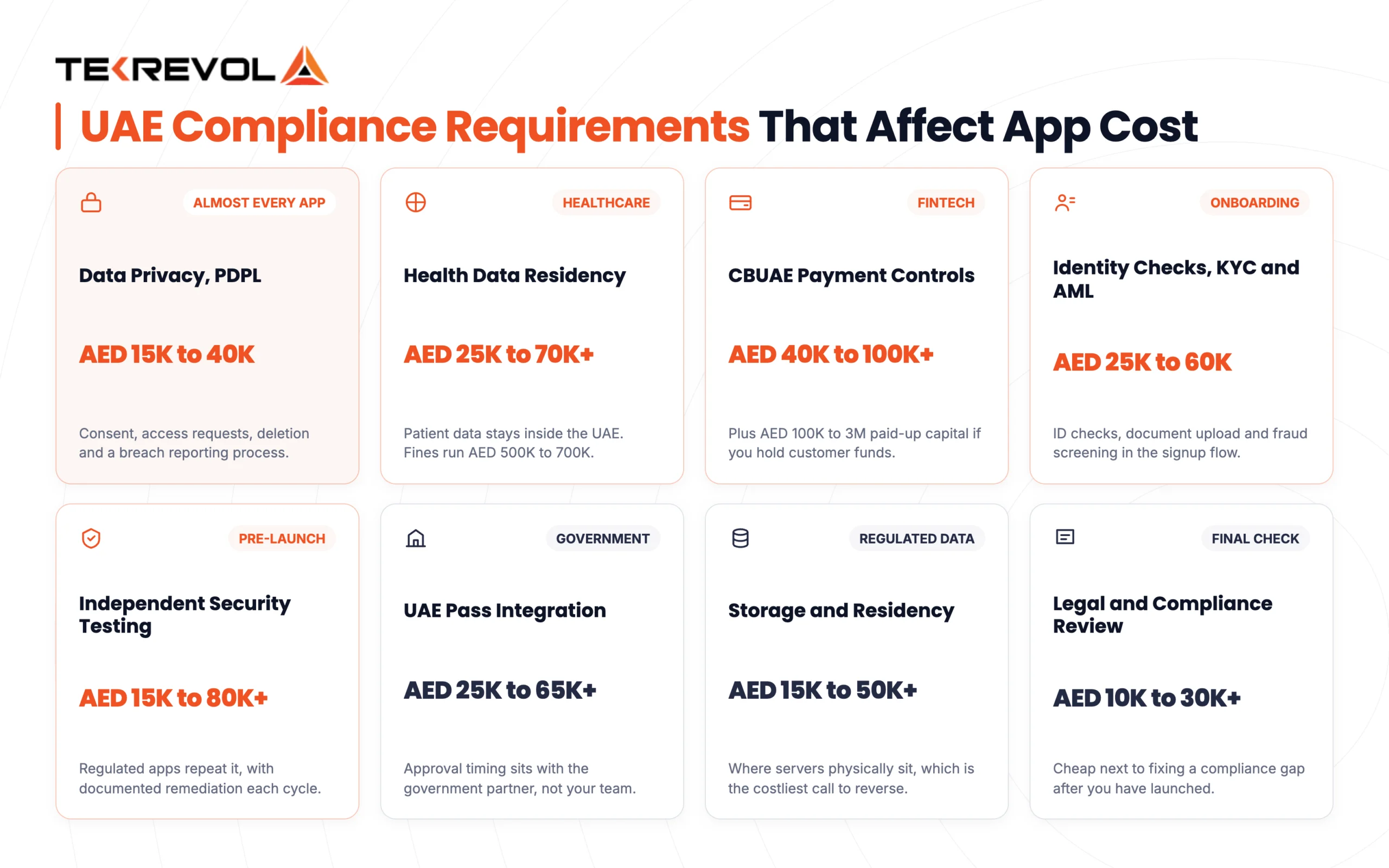
Data privacy (PDPL)
Estimated Cost: AED 15,000–40,000
If your app collects personal information such as names, phone numbers, email addresses, or location data, you need basic privacy controls. Users should be able to understand what data you collect, request access to their information, and have it deleted where applicable. You also need a clear process for handling and reporting data breaches. These requirements apply to almost every app that collects personal data.
Free Zone Data Protection Rules
Businesses registered in DIFC or ADGM may fall under their respective data protection laws instead of the UAE’s federal PDPL. The core privacy controls may be similar, but compliance and reporting requirements can differ, so confirm the applicable regime before development begins.
Applies to: Businesses registered in DIFC or ADGM
Additional development cost: No separate cost; requirements may influence architecture and compliance scope.
Healthcare data rules
Estimated Cost: AED 25,000–70,000+
If your app deals with patient records, medical history, or anything health-related, UAE law says that data has to stay stored inside the UAE, you can’t send it to a server abroad without approval. Getting this wrong carries a serious fine (AED 500,000–700,000), so it’s worth building correctly from day one.
Applies to: telehealth apps, patient portals, healthcare platforms
Fintech and payments rules
Cost to build the related controls: AED 40,000–100,000+
If your app moves money or holds customer balances, the Central Bank requires a license, and the amount of capital you need to hold depends on what your app does, starting around AED 100,000 and going up to AED 3 million for the most complex payment services. If you simply plug in an existing payment provider (like Telr or PayTabs) and never hold customer money yourself, you’re usually exempt from needing your own license.
Applies to: fintech apps, digital wallets, banking apps
Identity verification (KYC/AML)
Estimated Cost: AED 25,000–60,000
If your app lets people sign up for financial services like lending, investing, and payments, you’re required to verify who they are before they can transact. This means ID checks, document uploads, and fraud screening built into your onboarding flow.
Applies to: fintech, lending, and investment apps
Security testing
Estimated Cost: AED 15,000–80,000+, depending on scope
Before launch, your app needs to be tested by an independent security team to find weaknesses before real users (or hackers) do. A simple app might only need a quick check on one feature. A regulated fintech or healthcare app needs a full assessment of the app, its servers, and its data. This costs more and may need to be repeated regularly.
Applies to: fintech, healthcare, enterprise, and any regulated app
UAE Pass integration
Estimated Cost: AED 25,000–65,000+
If you want users to log in or verify their identity using their government Emirates ID (similar to how some countries let you sign in with a national ID), you need to integrate with UAE Pass. This isn’t just a technical build, it also involves an approval process with a government partner, which can add time to your launch schedule that’s outside your developer’s control.
Applies to: government-facing apps, or apps needing verified identity
Data Storage and Residency
Estimated Cost: AED 15,000–50,000+
For healthcare and fintech apps especially, where your servers physically sit matters. UAE-based hosting usually costs a bit more than hosting elsewhere, but it’s often required, not optional, for regulated data. Applies to: healthcare, fintech, government, and enterprise apps
Legal and compliance review
Estimated Cost: AED 10,000–30,000+
A final check before launch, ideally by someone who understands UAE regulation, to confirm nothing was missed. Cheap insurance compared to fixing a compliance gap after you’ve already launched.
Applies to: any app handling regulated or sensitive data
Not sure which of these actually apply to your app?
Get a clear compliance roadmap outlining the UAE requirements that could affect your app’s architecture, cost, and launch.
Schedule A FREE Consultation Now!Arabic Localisation Costs in Dubai: A Legal Requirement
Localisation typically adds 15 to 25 percent to design effort and 8 to 15 percent to development hours in Dubai. Arabic support is a legal requirement in many consumer-facing contexts, covering areas such as contracts, advertisements, invoices, product information, and consumer data. Treat this as a legal requirement, not a design preference, because non-compliance can create significant exposure.
| Requirement | Legal Basis | What It Covers |
| Consumer data, ads, contracts in Arabic | Federal Law No. 15 of 2020, Article 26 | Arabic is mandatory; other languages may be added alongside it |
| E-commerce product information | Federal Law No. 15 of 2020, Article 25 | Adequate Arabic detail on product specs, payment terms, and warranty |
| Invoicing in Arabic | Federal Law No. 15 of 2020, Article 8 | Invoices must be issued in Arabic |
| RTL layout architecture | Engineering requirement, not legal | Mirrored navigation, flipped directional icons, rebuilt form inputs, mixed-script rendering, dedicated QA pass |
| Market opportunity | DataReportal Digital 2026 (UAE) | 11.3 million internet users at 99% penetration; 23 million active cellular connections (202% of population) |
Arabic and RTL support cost less when planned from the beginning. Adding it after launch can require extensive changes across the UI. For the design and market side rather than the legal side, see our guide to Arabic app development and RTL localisation in Dubai.
Mobile App Development Cost Breakdown by Stage in Dubai
Each development stage contributes differently to the overall app budget. Understanding where the money goes helps you plan resources, manage scope, and avoid unexpected costs.
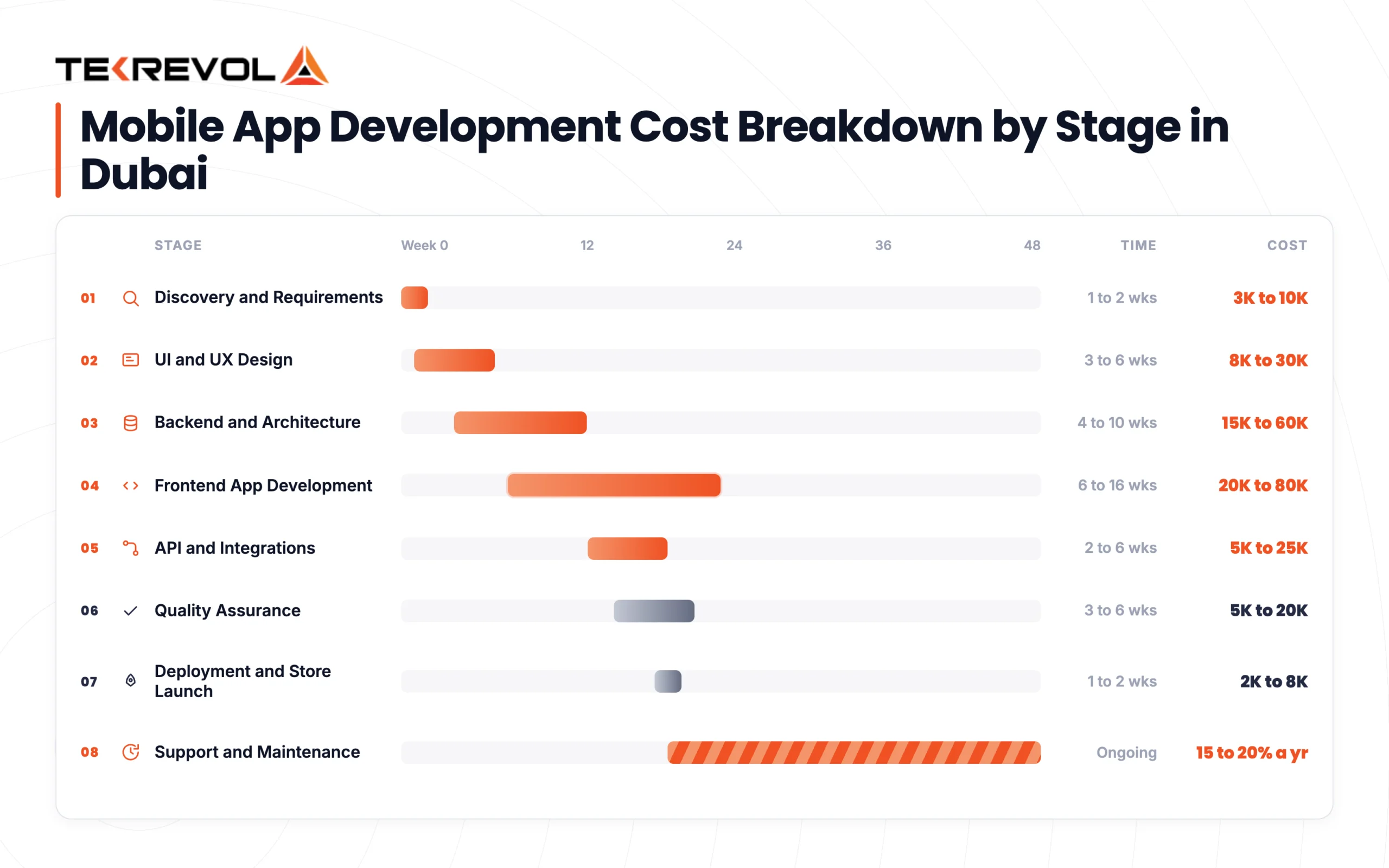
Below is an eight-stage breakdown of the development process, with realistic cost and timeline estimates for Dubai in 2026.
1. Discovery & Requirement Analysis
Estimated Cost: AED 3,000 – 10,000 | Timeline: 1–2 weeks
This is where scope, target users, tech stack, and compliance needs (like UAE PDPL) get defined before a single line of code is written. Skipping this stage is the single biggest cause of scope creep later.
- Market and competitor research
- Feature list and technical roadmap
- Platform decision (iOS, Android, or both)
2. UI/UX Design
Estimated Cost: AED 8,000 – 30,000 | Timeline: 3–6 weeks
Design cost depends heavily on whether you need a custom, branded interface or a template-based layout. Arabic RTL support, a common requirement in Dubai, adds extra design hours.
| Design Type | Cost Range (AED) |
| Template-based UI | 8,000 – 15,000 |
| Custom UI/UX | 15,000 – 30,000+ |
| With Arabic RTL support | +15–20% |
3. Backend Development & Architecture
Estimated Cost: AED 15,000 – 60,000 | Timeline: 4–10 weeks
The backend handles data, servers, user authentication, and business logic, it’s usually the most technically demanding (and expensive) part of the build. Apps requiring real-time data sync or heavy user loads cost more here.
- Database and server architecture
- User authentication and security layers
- Cloud infrastructure setup (AWS, Firebase, Azure)
4. Frontend / App Development
Estimated Cost: AED 20,000 – 80,000 | Timeline: 6–16 weeks
This covers actually building the app for each platform. Native development (separate iOS and Android builds) costs more than cross-platform frameworks like Flutter or React Native, which can cut this stage’s cost by 20–40%.
- Native (iOS + Android separately): higher cost, better performance
- Cross-platform (Flutter/React Native): 20–40% cheaper, faster delivery
5. API & Third-Party Integrations
Estimated Cost: AED 5,000 – 25,000 | Timeline: 2–6 weeks
Payment gateways, maps, push notifications, and CRM or ERP integrations each carry their own cost, and this stage is where quotes often diverge the most between agencies depending on what’s included by default.
- Local payment gateways (PayTabs, Telr, Network International)
- Google Maps / live location tracking
- SMS, push notifications, and chat APIs
6. Quality Assurance & Testing
Estimated Cost: AED 5,000 – 20,000 | Timeline: 3–6 weeks
Testing across devices, OS versions, and network conditions helps identify issues before launch. Skipping thorough QA can result in costly fixes later.
- Functional and performance testing
- Security testing (especially for fintech/healthcare apps)
- Device and OS compatibility checks
7. Deployment & App Store Launch
Estimated Cost: AED 2,000 – 8,000 | Timeline: 1–2 weeks
Beyond developer account fees (approximately AED 364/year for Apple and AED 92 one-time for Google Play), this stage includes app store optimization and final compliance checks before launch.
- App Store and Play Store submission
- Store listing optimization (ASO)
- Final compliance and security review
8. Post-Launch Support & Maintenance
Estimated Cost: 15–20% of build cost, annually | Timeline: Ongoing
Apps need regular updates for OS changes, bug fixes, and new features. This is the stage most business owners underbudget for, and the one that determines whether the app stays functional long-term.
- Bug fixes and OS compatibility updates
- Server and hosting costs (AED 500–10,000/month depending on scale)
- Feature updates and performance monitoring
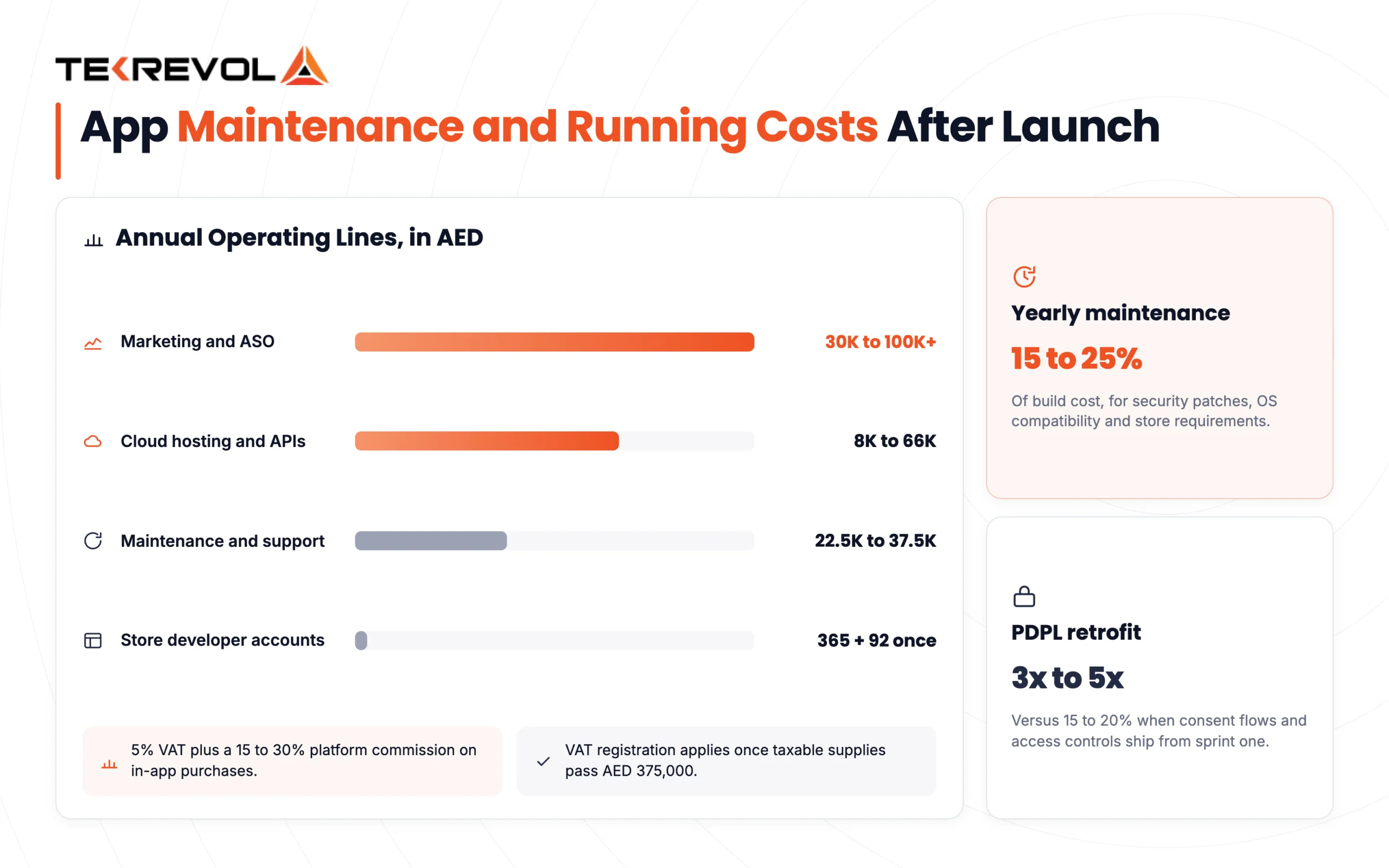
App Maintenance and Running Costs After Launch
The number on your quote and the number you actually spend in year one are rarely the same. Maintenance, hosting, compliance, and marketing all keep running after launch, here’s what to budget for beyond the build.
Annual Maintenance & Technical Support
Estimated cost: AED 22,500–37,500/year (15–25% of build cost)
Bug fixes, security updates, OS compatibility changes, dependency patches, and app store requirements create ongoing costs after launch. These expenses are not one-time items; they are part of the continuous effort required to keep an app secure, stable, and compliant.
PDPL Compliance Retrofit
Estimated cost: 3–5x more than building it in from sprint one
When built into the app from the start, PDPL compliance typically adds 15–20% to the total development cost. Adding it after launch can be significantly more expensive because it may require changes to already-deployed code, including consent flows, data access controls, and breach notification processes. This is why retrofitting compliance often carries a much higher cost.
Cloud Hosting & Third-Party APIs
Estimated cost: AED 8,000–66,000/year
Manageable while the app is still in development, this climbs fast once real users and real traffic show up. Hosting costs depend on storage, bandwidth, API usage, and real-time features. A flat hosting estimate may not reflect the costs of scaling the app.
Arabic RTL Retrofit
Estimated cost: Modest % if built in from sprint one, full UI rework if added later
RTL support is more than a translation toggle. It requires mirrored layouts and navigation, appropriately flipped icons, and a dedicated QA pass to ensure the interface works correctly in right-to-left languages.
Marketing & ASO
Estimated cost: AED 30,000–100,000+/year
Marketing can add AED 30,000–100,000+ to your annual operating budget, covering paid campaigns, creative production, influencer partnerships, and app store optimization. The actual spend depends on how aggressively you plan to acquire users. For most apps, it becomes one of the largest ongoing expenses after launch, yet it’s rarely part of the initial “app cost” conversation at all.
App Store Fees
Estimated cost: AED 365/year (Apple) + AED 92 one-time (Google)
These are relatively small compared with development and ongoing maintenance costs, but they should still be included in the overall launch budget. Both platforms require developer accounts to publish and manage apps, with Apple charging an annual membership and Google Play requiring a one-time registration fee.
VAT & Store Commissions
Estimated cost: 5% VAT + 15–30% platform commission on in-app purchases
Easy to leave out of unit economics entirely, and easy to notice missing only after the first month of real transactions. UAE businesses generally must register for VAT once taxable supplies and imports exceed AED 375,000.
Ways to Reduce Mobile App Development Costs in Dubai
Reducing app development costs starts with making the right decisions before development begins. A focused scope, suitable technology stack, and efficient development process can lower costs without compromising the product’s quality.
Scope a Real MVP
Estimated savings: 40–60% off a full-build quote
A true MVP answers one question: does this solve the user’s problem, with the smallest feature set that proves it. It still needs PDPL and RTL groundwork if you’re launching to UAE users; what it skips is the advanced features, not the legal foundation. A well-planned MVP removes unnecessary features without compromising the foundation of the product.
Our MVP app development guide for Dubai walks UAE startups through what belongs in a first release and what doesn’t.
Default to Cross-Platform Development
Estimated savings: 25–45% versus dual native
Flutter and React Native let you ship one codebase instead of two, and for the large majority of business apps, users won’t notice the performance difference. Reserve native development for apps genuinely dependent on deep hardware access like real-time AR, background GPS at scale, or similar.
Choose a Hybrid Team Model
Estimated savings: 30–50% versus a fully local Dubai team, at comparable quality
A hybrid delivery model keeps product ownership, compliance, localization, and client communication close to the UAE market while using offshore engineering resources for development. This can reduce overall costs without compromising the decisions that have the greatest impact on the final product.
If you’d rather extend your own team than outsource the build, you can also hire mobile app developers in Dubai directly.
Itemize Compliance and RTL in the Contract
Estimated savings: Avoids 3–5x retrofit cost, not a discount on the build itself
The goal is not to make the initial quote cheaper, but to make the final cost more predictable. Clearly scoping PDPL requirements and Arabic RTL support upfront reduces the risk of expensive change requests during development.
Stage Third-Party Integrations
Estimated savings: Avoids paying for integrations before they’re needed
Each third-party integration adds both development effort and ongoing subscription or usage costs. Start with the services your MVP actually needs and add additional gateways, APIs, or platforms as demand justifies the investment.
How Long Does a Dubai App Take to Pay for Itself?
Payback time depends more on the monetization model than on build cost; an AED 300,000 subscription app can break even faster than an AED 80,000 app with no clear revenue path.
| Monetization Model | Typical Payback Window | What Drives It |
| Subscription / SaaS | 8–14 months | Predictable recurring revenue once churn stabilizes |
| E-commerce/marketplace | 12–18 months | Depends on the take rate and repeat purchase behavior |
| On-demand / delivery | 14–20 months | High acquisition cost per active user in early months |
| Fintech / regulated apps | 18–24 months | Compliance and licensing costs extend the runway before revenue scales |
These are directional estimates based on typical UAE monetization patterns, not a guarantee; actual payback depends heavily on execution, marketing spend, and how fast you reach product-market fit.
A well-executed UAE app conservatively recovers its build cost within 12 to 18 months, but only when compliance, Arabic support, and a real monetization plan are built in from day one rather than treated as post-launch add-ons.
Fast-Growing App Categories in the Middle East
The category a founder chooses now says more about their five-year plan than their year-one budget. Six app models are gaining traction across the region, each driven by a different growth factor.
| Category | Estimated Cost (AED) | What’s Actually Driving Growth |
| Super App | 400,000 – 1,000,000+ | Combining services under one login strengthens distribution and reduces customer acquisition costs. |
| Fintech & Digital Wallets | 150,000 – 500,000+ | Policy backing and growing digital payments are fueling demand, with financial data adding long-term value. |
| E-commerce & Retail | 50,000 – 250,000 | The focus has shifted from simply having an app to delivering faster, more personalized experiences beyond checkout. |
| AI-Driven Applications | 100,000 – 300,000 | AI is now being used to lower support costs and improve unit economics, making it more attractive to investors. |
| Gaming | 70,000 – 220,000 | What looks like entertainment is also a powerful monetization model, with long sessions and strong in-app spending. |
| Healthtech & Telemedicine | 80,000 – 250,000+ | Beyond user convenience, better UX can boost institutional efficiency, while recurring consultations and integrated diagnostics support sustainable revenue. |
How to Choose the Right Mobile App Development Company in Dubai?
The quote gets you in the door. The contract is what actually determines what you pay, when scope changes, and who owns what you’ve built. These are the questions that tell you which kind of partner you’re signing with before you find out the hard way.
- Can you send me working links to apps you’ve shipped for UAE clients? A portfolio screenshot proves nothing. An App Store or Play Store listing that you can download and use yourself does.
- Walk me through how RTL gets handled in your design process, step by step: If the answer is vague or generic, your project is where they’re figuring it out.
- What’s your actual process for PDPL compliance, not the policy, the build process? A team that can’t explain consent flows, data access requests, and breach handling in concrete terms hasn’t built for the UAE before.
- Which regional payment gateways have you personally integrated, and how many times? Real experience with Telr, PayTabs, or Noon Pay shows up as weeks saved on your timeline, not just a line on a services page.
- If my lead developer leaves partway through, what happens next? Ask for a specific continuity commitment, not a reassurance. Vague answers here become your problem at the worst possible time.
- Can you connect me with a current client in the UAE or GCC region, not a reference you handpicked for a case study? A short call about how they actually communicate under pressure tells you more than any pitch deck.
- How is a change to scope handled once we’re mid-build? No defined process here is the clearest predictor of a budget that grows without your sign-off.
- What’s covered after launch, and what starts getting billed the day you ship? Get this in writing before launch, not after the first invoice arrives.
- Who holds the IP the moment this contract ends? It needs to be you, stated plainly in the contract, before a single line of code gets written.
- What does “finished” mean for each sprint on this project? If that’s not defined up front, it’s usually where the late-stage disagreements about scope and cost start.
Our own record here is public, so hold us to the same standard. We’ve delivered 80+ UAE projects, hold a 4.8/5 Clutch rating, and you can review our full portfolio of completed work before speaking with anyone.
Partner With TekRevol for Mobile App Development in Dubai
TekRevol helps you plan compliance, Arabic support, and payment integrations from the start. Our Dubai-based development team can support you with the right technical expertise to build, launch, and scale your app.
We build with Dubai-specific needs in mind, from Arabic RTL design and UAE Pass integration to local payments, data residency, and hybrid delivery.
We bring a proven track record of delivering mobile apps for startups and established businesses across Dubai. Whether you want to build a government app, launch a fintech platform, or develop a customer-facing mobile product, our team can help you plan and deliver it with the right technology and local requirements in mind.
Ready to Build Your App in Dubai?
Get a clear development plan and cost estimate based on your app idea, features, and business goals.
Call our Dubai office on +971 4 561 6845.


