
Dubai’s eCommerce market is projected to reach USD 9.2 billion in 2026. Mobile apps drive the majority of that transaction volume. Consumers here expect fast, Arabic-capable, payment-ready experiences from day one. If your product does not meet that baseline, a competitor’s app is one tap away.
Building an eCommerce app in Dubai is different from building one for a Western market. You are working with three compliance layers — the UAE Consumer Protection Law, the Personal Data Protection Law (PDPL), and sector-specific payment regulations from CBUAE.
You also need Arabic RTL architecture, UAE-specific payment gateways (Telr, PayTabs, Tabby), and AED-first pricing built into the product from sprint one. These are not optional add-ons. They are table stakes for the UAE market.
This guide covers the full build process — platform decisions, must-have features, timeline, and real 2026 cost figures in AED. Whether you are a founder scoping your first build or a product team expanding into the UAE, working with an experienced mobile app development company in Dubai that understands the local compliance and UX requirements will determine how fast you go from idea to App Store.
What is an eCommerce mobile app?
An eCommerce mobile app is a platform that allows users to buy or sell products using their smartphones. Unlike a mobile website, it runs installed on the device, which means faster load times, push notification access, biometric payments, and offline functionality.
In recent times, eCommerce has gained tremendous popularity as a thriving entrepreneurial avenue. It encompasses not only the sale of physical goods but also the provision of diverse services, thereby presenting exciting opportunities for various businesses.
For Dubai businesses, ecommerce app development also means a dedicated channel for Arabic-language experiences, UAE payment integration, and loyalty programme mechanics that mobile websites cannot support at the same quality.
Key Insights on eCommerce Mobile Applications
- Dubai’s eCommerce market is projected to reach USD 9.2 billion by 2026 (Statista).
- Mobile apps convert at 3x the rate of mobile websites in retail contexts
- Arabic-language apps see 40–60% higher engagement than English-only equivalents in the UAE market.
- Cash-on-delivery remains a significant payment preference in the UAE — an app that omits it loses a segment of buyers that competitors will capture.
These statistics showcase the bright future of eCommerce mobile applications, which unlock new growth opportunities in the ever-evolving digital landscape.
Why Businesses Should Invest in eCommerce Mobile App Development?
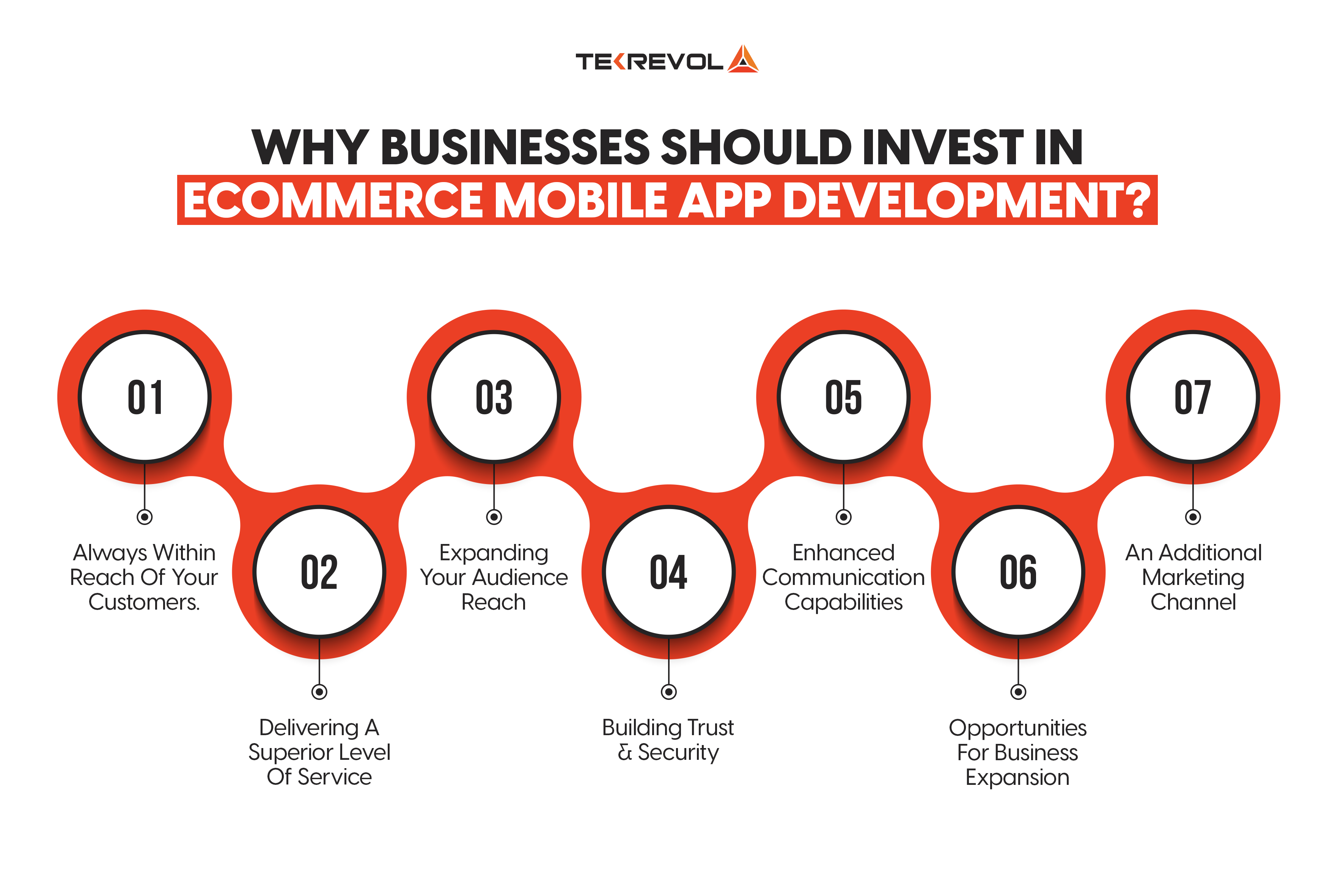
In today’s modern times, there are numerous benefits of a mobile app for an e-commerce business.
Let’s explore the trending reasons that show why one must consider creating an eCommerce app for their business.
1. Always within the influence of your customers
Your products are available 24/7 without a customer needing to open a browser. A native app removes the friction between intent and purchase.
2. Delivering a higher level of service
Creating an eCommerce app uplifts the level of service you provide to your customers.
Besides, it opens up new opportunities for them to make purchases and place orders from anywhere in the world at any time. This enhanced convenience improves customers’ overall experience and satisfaction.
3. Expanding your audience reach
Building an eCommerce app attracts a new audience, particularly the tech-savvy younger generation.
4. Building trust and security
Biometric login, encrypted payment processing, and clear data permissions signal to users that their information is handled carefully. In the UAE, PDPL compliance is also a legal baseline, not a differentiator.
5. Enhanced communication capabilities
Mobile apps excel in providing fast and effective communication.
With an on-demand app for Dubai, you can engage with your customers 24/7. This helps to develop personalized interactions and build stronger relationships.
6. Opportunities for business expansion
An eCommerce mobile application lays the foundation for future business growth.
As your app evolves, you can expand its capabilities, offering users an extensive range of services. This aids in building customer loyalty and helps to attain massive revenue.
7. An additional marketing channel
By offering users access to your business through a mobile app, you create an additional marketing channel. This expands your reach and enhances the effectiveness of your existing marketing strategies.
You can leverage the app to promote ads, implement sales funnels, and execute conversion strategies.
By recognizing the importance of building an eCommerce mobile app, you position your business for success in the digital world.
How to Create an eCommerce Mobile App in 8 Simple Steps
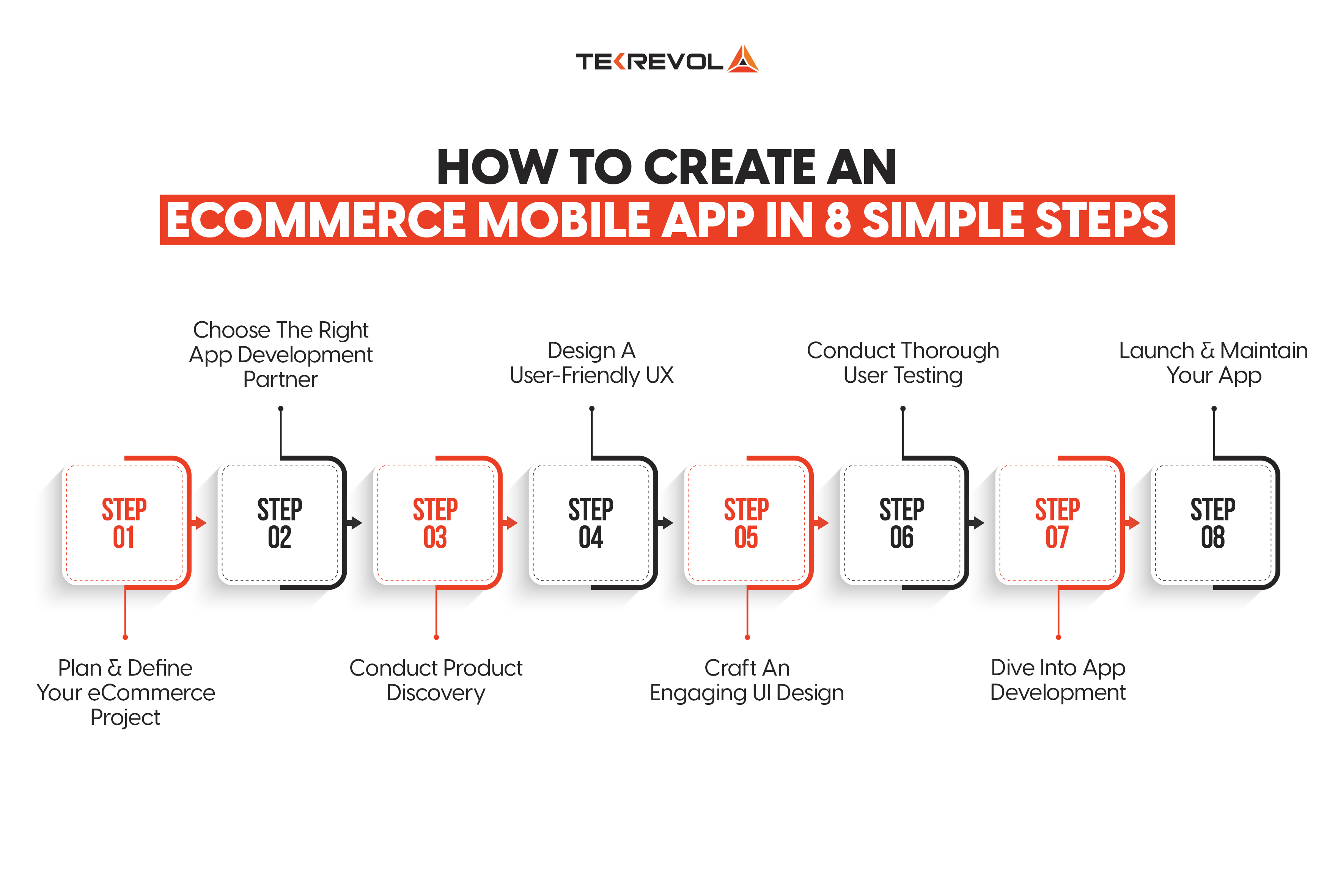
We’ve compiled a step-by-step guide to help you navigate the process with ease.
Step 1: Plan and Define Your eCommerce Project
Before any design or development starts, define your target audience, core features, and compliance requirements. For Dubai, that means deciding from day one whether your app needs Arabic RTL support, UAE PASS integration, and AED-first pricing — not as afterthoughts, but as project requirements.
Step 2: Choose the Right App Development Partner
Selecting a reliable and experienced team is crucial for the success of your project. Take advantage of social networks like LinkedIn, Quora, and Twitter to hire mobile app developers in Dubai.
Also, you can check out ranking sites like Clutch.co, Good Firms, and Sort lists to evaluate teams and seek recommendations from friends and colleagues.
- Looking for a reliable eCommerce app development partner?
- Schedule a One-to-One Call Now with our Ecommerce experts
Step 3: Conduct Product Discovery
Product discovery is an essential step where you work closely with your development team to understand your target audience, their expectations, and their requirements.
This stage involves discussing your project’s business processes, analyzing the competitive market landscape, formulating solutions to business problems, and setting project scope and deadlines.
By collaborating with our team at TekRevol, you’ll benefit from our expertise in product discovery, which includes engaging key team members such as project managers, business analysts, UI/UX specialists, and solution architects.
Step 4: Design a User-Friendly UX
User experience (UX) design focuses on creating a seamless and intuitive digital product.
It involves determining the content hierarchy, designing clear navigation systems, and ensuring the functionality of visual elements.
The key is to solve the user’s problem while aligning with technical and business specifications.
The UX design process typically includes concept sketching, competitive research, user persona creation, wireframing, prototyping, and design validation through testing and analytics.
Step 5: Craft an Engaging UI Design
User interface (UI) design complements the UX design by visually bringing the app to life.
This involves working on graphic elements, such as animation, illustrations, buttons, menus, sliders, photos, and fonts.
The UI design focuses on organizing interface elements effectively, maintaining consistency in style, and ensuring the interface meets basic usability requirements.
The goal is to create an interface that guides users effortlessly through your app. Our team at TekRevol can assist you in creating an appealing and user-friendly UI design for your eCommerce mobile app.
Step 6: Conduct Thorough User Testing
Testing is a crucial step that should never be overlooked. It ensures that your app functions flawlessly and provides a seamless user experience.
Our efficient team, after a detailed testing and analysis process, works to fine-tune your app to perfection.
Step 7: Dive into App Development
Now it’s time to transform your design into a fully functioning eCommerce mobile app.
Our team at TekRevol follows the Agile Development Lifecycle Methodology, allowing us to develop the app in an iterative and efficient manner.
Front-end and back-end developers collaborate to build the client-side and server-side components, while DevOps teams ensure smooth integration and continuous delivery.
Quality assurance engineers rigorously test the code, ensuring a bug-free and high-performing app.
Step 8: Launch and Maintain Your App
Once your app is thoroughly tested and refined, it’s time to launch it into the market.
This involves meticulous preparation, including identifying your target audience, developing a compelling slogan and timeline, and creating a customer onboarding process.
It’s also essential to establish a strong online presence through a dedicated website and strategic advertising.
After launch, we recommend ongoing maintenance and scaling of your app to incorporate new features and functionalities, ensuring your app continues to thrive in the competitive eCommerce landscape.
Top Tech Stacks for eCommerce Mobile App Development in 2026
Finding the best technology is the most crucial part in mobile development. Its performance, scalability, and future-readiness are highly dependent on it. Below are some of the leading tech stacks taking over in 2026:
1. Frontend Frameworks
- Flutter: Google’s cross-platform framework. A single codebase covers iOS and Android, with native Arabic RTL support built in — the most time-efficient choice for most Dubai eCommerce builds.
- React Native: Strong cross-platform track record with a large component library.
- Swift (iOS) & Kotlin (Android): For companies choosing native apps, Swift and Kotlin are still the best choices for improved device-level performance and security.
Both frameworks are compared in detail in the native vs cross-platform app development guide for Dubai, including cost and timeline differences per app type.
2. Backend Technologies
- Node.js: Fast and efficient, Node.js is best suited for real-time applications such as chat support in eCommerce apps.
- Laravel (PHP): A robust backend framework for developing secure APIs and handling server-side operations effectively.
- Django (Python): Extremely secure and scalable, ideal for rapidly growing eCommerce platforms.
3. Database Options
Firebase: A real-time NoSQL database with integrated user authentication, analytics, and cloud functions—optimal for startups.
MongoDB: A document-oriented database that is scalable and best used to manage intricate data structures in eCommerce.
MySQL/PostgreSQL: Dependable options for legacy relational data requirements.
4. Payment Integration Tools
Stripe, PayPal, Razorpay: Integrate global and local payment gateways smoothly with secure handling of transactions.
5. Other Key Tools
Firebase Cloud Messaging (FCM): For sending push notifications.
AWS or Google Cloud: To host and scale storage.
GraphQL: Fast data querying to minimize load time and maximize performance.
What Makes an eCommerce App Stand Out? Key Features to Consider

When developing your eCommerce mobile application, it’s crucial to incorporate the right features to enhance user experience and drive success.
Let’s explore the core functionalities that should be present in your app.
1. Personal Account
Enable users to create personal profiles, manage their shopping carts, view purchase history, and engage in seamless buying and selling.
2. Apple Pay / Google Pay
Embrace popular payment methods like Apple Pay and Google Pay, catering to the preferences of modern users.
3. Streamlined Checkout Process
Design an intuitive and user-friendly checkout process that simplifies the purchasing journey, ensuring convenience and ease of use.
4. Smart Filters
Implement robust filtering options, allowing users to swiftly locate the desired products through a range of criteria, enhancing their overall shopping experience.
5. Reminder and Notification System
Keep users informed about order updates, ensuring they stay updated on every step of the process, while giving them the option to customize their notification preferences.
6. AR/VR Size Advisor
Elevate the user experience by incorporating augmented reality (AR) or virtual reality (VR) technology, allowing users to virtually try on clothes or experience products without leaving their homes.
7. Biometric Identification
Enhance security and user convenience by integrating biometric identification methods like iris scanners, facial recognition, or fingerprint scanning for seamless user authentication.
8. Real-Time Information
Via eCommerce apps, you can offer users real-time updates on their orders.
Also, these apps help to display relevant information such as order processing, shipping status, and delivery updates within their personal accounts.
By incorporating these essential features into your eCommerce mobile app, you’ll be able to create an exquisite platform that delivers a seamless and engaging shopping experience.
How Much Time is Required to Build an eCommerce App
Creating an eCommerce mobile app requires careful planning and consideration of various factors. Some of them are;
- The complexity of your project
- The desired functionality
- The intricacy of the UI/UX design
- The expertise of your development team, and so on.
All of the aforementioned factors play a significant role in determining the mobile app development timeline for Dubai. The following table provides a breakdown of the different stages involved in creating an eCommerce mobile app.
Don’t forget that every project is unique, and the estimated time involved in the creation of app mentioned in this table is just an approximation.

How Much Does It Cost to Build an eCommerce App?
eCommerce app development in Dubai ranges from AED 35,000 for a basic catalogue app to AED 300,000+ for a full marketplace with AI personalization and multi-vendor support. The main variables are:
The reason is that the app development cost in Dubai can vary depending on several factors. For instance,
- Project complexity
- Required features and functionalities
- Development approach
- Technology stack
- Development team’s location, business size, and previous projects.
Location plays a significant role in service quality. While US-based startups often hire top-tier talent, the demand surpasses the available supply.
That’s why many forward-thinking businesses opt to outsource their eCommerce app development to Eastern Europe or GCC, where they find an excellent balance of price and quality.
It’s important to keep in mind that these are general price ranges and can vary based on project requirements and the expertise of the development team.
Essential Challenges to Anticipate When Building Your eCommerce Mobile App

Building an eCommerce mobile app comes with its fair share of challenges.
Let’s take a closer look at some of the difficulties you may encounter during the development process.
1. Security
UAE consumer data is governed by the PDPL. Your app needs end-to-end encryption on payment flows, explicit consent before data collection, and a data breach notification process — required within 72 hours under PDPL. UAE App Store submission also requires a privacy policy URL that covers these obligations.
2. API Integration
APIs offer extensive possibilities for enhancing your mobile app.
Integrating external interfaces allows for features like social media login, online forms, currency converters, chatbots, map integration, and more.
Leveraging APIs helps automate processes, improve user experience, and expand functionality, making them a valuable addition to your eCommerce app.
3. Information Architecture
Building a scalable product is essential for the future growth of your business.
Carefully planning the information architecture ensures that your app can adapt to changes without compromising its functionality.
A well-designed architecture enhances the user experience and enables seamless navigation and expansion as your business evolves.
4. AI/Big Data Integration
Incorporating AI and Big Data technologies can revolutionize your eCommerce app.
AI enables personalized experiences, automates processes, optimizes resource utilization, and generates intelligent responses.
Big Data analysis also provides valuable insights into customer behavior, target audience identification, message selection, and campaign tracking.
eCommerce App Monetization Strategies to Maximize ROI
Creating a working eCommerce app is only the first step. The real challenge lies in making your app a self-sustaining revenue stream. Here are some top monetization strategies that you can use:
1. In-App Purchases
Provide users with the option to purchase products, high-end services, or special offers directly within the app. This is the core revenue model for the majority of eCommerce platforms.
2. Subscription Model
For B2B or niche eCommerce apps, a yearly or monthly subscription plan can provide advantages such as free shipping, early access to promotions, or high-priority customer service—like Amazon Prime.
3. Freemium + Paid Features
Provide free access to the bare app with extra paid features such as customization, premium listings, or improved user experience. Such a model proves particularly effective for platforms that sell services in addition to products.
4. Revenue Based on Commissions
In case your app brings buyers and sellers together (such as eBay or Etsy), charge a modest commission per sale. This makes it possible for you to grow revenue in sync with platform use.
5. Advertisements
Integrate non-intrusive advertisements (e.g., banners, native ads) to earn passive income. Utilize services such as Google AdMob or Facebook Audience Network.
6. Affiliate Marketing
Promote third-party products or services and earn commission on sales generated through your app’s referral links.
Building a Powerful eCommerce Mobile App with TekRevol
TekRevol builds eCommerce apps for the Dubai market with Arabic RTL architecture, UAE payment gateway integration (Telr, PayTabs, Network International), and PDPL-compliant data handling built into the standard build.
We are consistently listed among the most trusted app development companies in the UAE, with 500+ apps delivered globally and a DIFC-based team that builds to UAE regulatory standards from sprint one.
When partnering with TekRevol for your eCommerce app development, expect the following exceptional services:
Flexibility & Adaptability
We understand the ever-evolving nature of the eCommerce landscape. Our team ensures that your app is built with the utmost flexibility and adaptability, allowing you to easily scale and adapt to changing market demands.
Seamless Operations
We optimize the operations of your eCommerce solution app, streamlining processes and enhancing efficiency. From inventory management to order processing, we ensure a seamless operational experience for both you and your customers.
Security & Compliance
Safeguarding your app and customer data is our top priority.
Henceforth, we implement robust security measures that ensure compliance with industry standards. Thus, providing users with a safe and secure shopping environment.
- Bring Your eCommerce App Idea to Life
- Work 1-on-1 with TekRevol’s mobile experts who know this market inside out.