



- Building an app like Shein costs $60,000–$250,000 for most US founders, scaling toward $1.2M for full platforms.
- Cheapest entry point: a native layer over an existing store, starting near $25,000, launching in 8–12 weeks.
- Personalization costs $30,000–$80,000 to build but drives the repeat purchases that actually generate profit.
- Maintenance runs 18–25% of build cost yearly, roughly $32,000–$45,000 annually on a $180,000 app.
- Developer location can shift costs by 4–5x, with US rates of $100–$200/hour versus $25–$55 offshore.
- The app is the affordable part; inventory, logistics, and customer acquisition cost far more than development.
Every 24 hours, Shein’s algorithm makes thousands of small bets. Which colors will trend? Which styles will flop? Which products deserve a bigger push? It gets most of them right, and that is not luck. It is a system built to learn faster than the fashion cycle moves. That is why Shein remains the blueprint founders study before writing a line of code.
Building an app like Shein costs $60,000 to $120,000 for a standalone fashion commerce MVP in the US. A production app with personalization and returns handling runs $120,000 to $250,000. A multi-vendor marketplace runs $250,000 to $500,000. And if you only need a native app layer over an existing store, that starts near $25,000.
These numbers shift fast with scope. So most founders bring in an e-commerce app development company early, just to pressure-test the budget before they commit.
This guide breaks down SHEIN-style app costs by tier and feature, explains the key cost drivers, and covers US apparel compliance.
How Much Does It Cost to Build an App Like Shein in 2026?
Building an app like Shein costs $25,000 for an app layer on top of an existing store and up to $1.2 million for a full platform with supply chain and customs systems. Most US founders land between $120,000 and $250,000.
| Tier | Build cost | Timeline | What you actually get |
| App layer on an existing store | $25,000–$60,000 | 8–12 weeks | Native shell over Shopify or a headless backend |
| Standalone fashion commerce MVP | $60,000–$120,000 | 3–5 months | Own catalog, cart, checkout, basic personalization |
| Production app | $120,000–$250,000 | 5–8 months | Recommendation engine, returns, multi-carrier, analytics |
| Multi-vendor marketplace | $250,000–$500,000 | 8–14 months | Seller onboarding, payouts, moderation, multi-warehouse |
| Full Shein-model platform | $500,000–$1,200,000 | 12–24 months | All the above, plus supply chain and customs systems |
Keep one distinction in mind: These figures cover software only. Inventory, marketing, and customs duties require separate budgets, while the top tier reflects the broader business investment.
Not sure which tier your idea belongs in?
Tell us what you're selling and where you're shipping from. We’ll define the scope and provide a clear cost range before you commit your budget.
Get a Free Consultation!The SHEIN Model: What Makes Its App So Successful?
SHEIN’s success goes beyond its massive fashion catalog. Its app combines personalized discovery, rapid product launches, social commerce, and gamification to create a highly engaging shopping experience. That digital-first model has helped drive significant growth, with SHEIN reporting $38.8 billion in revenue in 2024 and $41.9 billion in 2025.
Here are the key elements behind the model:
1. AI-Powered Personalization
SHEIN uses shopper behavior, search activity, and purchase data to personalize product recommendations and the shopping feed. This helps surface relevant products and encourages longer browsing sessions.
2. Rapid Product Discovery
SHEIN’s technology-driven supply chain allows it to test and introduce new designs quickly. Its constantly refreshed catalog gives shoppers a reason to return frequently and keeps the “New In” experience fresh.
3. Social Commerce
Product reviews, user-generated content, creator promotions, sharing, and affiliate features turn customers into part of the marketing funnel. Social discovery also makes it easier to evaluate dnztlev gonhoeba before purchase.
4. Gamified Shopping Experience
Limited-time promotions, rewards, points, and loyalty mechanics encourage repeat visits and purchases. These features add urgency while giving customers additional reasons to engage with the app.
Essential Features for a SHEIN-Style App & Their Estimated Cost
A Shein-style app needs more than a catalog and a checkout. The experience rests on fast discovery, variant-heavy product pages, personalization, flexible payments, returns, loyalty, and strong merchandising tools.
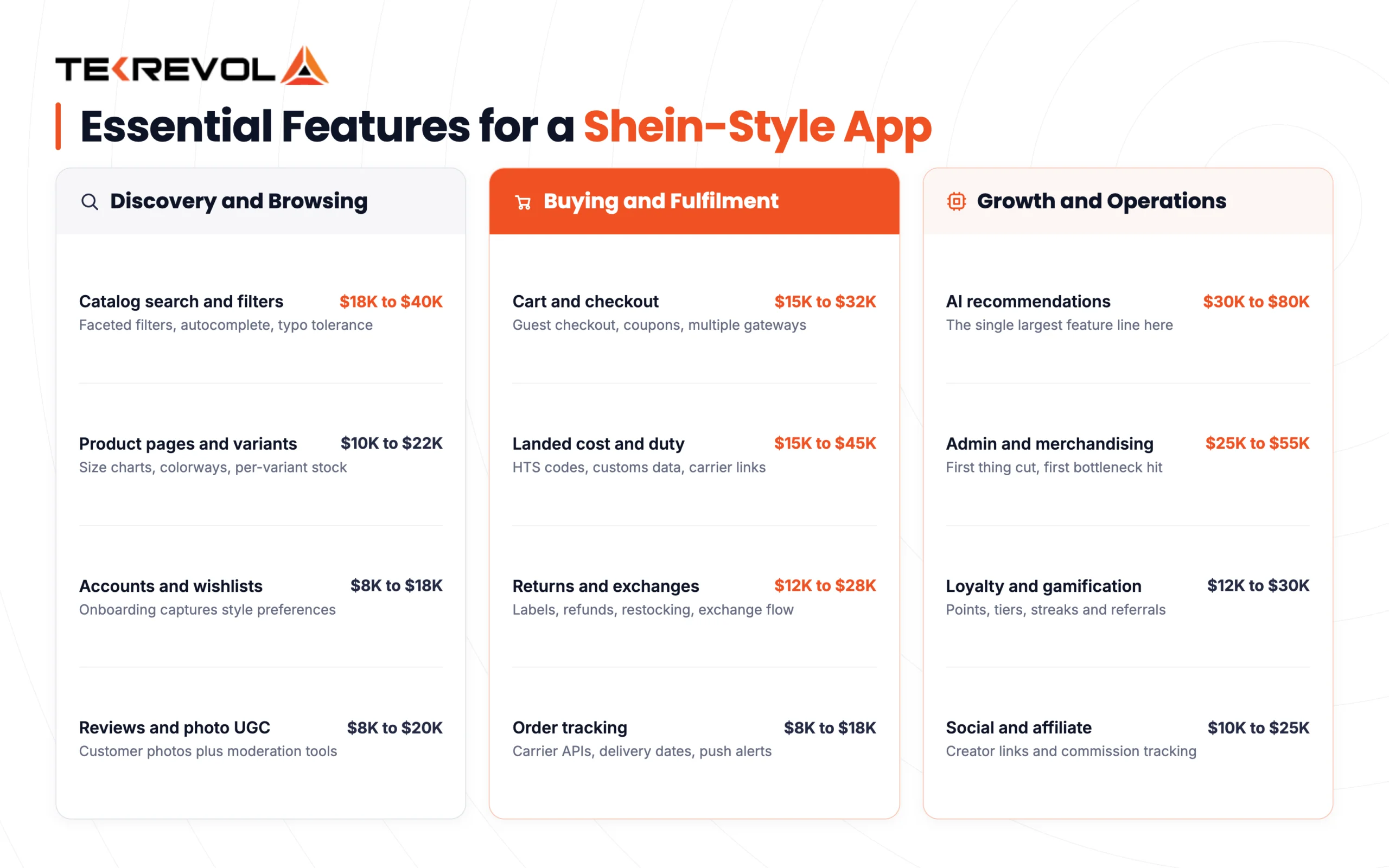
Catalog Search and Product Discovery
Estimated cost: $18,000–$40,000
Large fashion catalogs need more sophisticated search than a basic keyword box. Faceted filters for size, color, price, category, brand, availability, and other attributes help shoppers narrow thousands of SKUs quickly. Search can also include sorting, autocomplete, typo tolerance, and personalized results as the catalog grows.
Product Pages and Variant Management
Estimated cost: $10,000–$22,000
Fashion products often come with multiple sizes, colors, images, and inventory levels, making variant management more complex than on a standard product page. The build typically includes size charts, colorways, variant-specific stock, image galleries, product details, and related-item recommendations.
Accounts, Onboarding, and Wishlists
Estimated cost: $8,000–$18,000
Account features cover registration, login, profiles, saved addresses, preferences, and wishlists. For a Shein-style experience, onboarding can also capture style and shopping preferences that later feed personalization and product recommendations.
Cart and Checkout
Estimated cost: $15,000–$32,000
Checkout needs to support the full purchase journey, including guest checkout, saved payment methods, address management, coupons, shipping options, and multiple payment methods. International stores may also require additional payment gateways and currency support.
Landed Cost and Duty Calculation
Estimated cost: $15,000–$45,000
Selling fashion internationally adds another layer of complexity. Landed-cost functionality can calculate duties, taxes, shipping charges, and other import costs before payment. Depending on the markets you serve, this may require HTS or tariff codes, customs data, carrier integrations, and automated documentation.
AI-Powered Recommendations
Estimated cost: $30,000–$80,000
Personalization is one of the biggest differentiators in a Shein-style shopping experience. A recommendation engine can use browsing behavior, purchase history, product similarity, and real-time interactions to surface relevant products, complete-the-look suggestions, and personalized feeds. More advanced systems require additional data engineering, model development, testing, and ongoing optimization.
Order Tracking and Notifications
Estimated cost: $8,000–$18,000
Customers expect visibility after placing an order. This feature can connect carrier APIs with the app to provide shipment status, estimated delivery dates, push notifications, and alerts for delays or delivery changes.
Returns and Exchanges
Estimated cost: $12,000–$28,000
Fashion e-commerce needs a flexible returns workflow because customers may order multiple sizes or colors. The feature can cover return requests, eligibility rules, label generation, refund processing, exchange handling, restocking, and customer notifications.
Reviews and Photo UGC
Estimated cost: $8,000–$20,000
Reviews become more valuable when shoppers can see how products look on real customers. A typical implementation includes ratings, written reviews, customer photos, review moderation, reporting, and verification mechanisms.
Loyalty and Gamification
Estimated cost: $12,000–$30,000
Points, rewards, tiers, streaks, referrals, and limited-time incentives can increase repeat purchases and engagement. The cost depends on how deeply these mechanics connect with promotions, customer accounts, order history, and the broader loyalty program.
Social Sharing and Affiliate Features
Estimated cost: $10,000–$25,000
Social and creator-driven commerce can extend the app beyond its own customer base. Features may include product sharing, creator links, referral codes, affiliate attribution, commission tracking, and campaign-level reporting.
Admin and Merchandising Console
Estimated cost: $25,000–$55,000
The customer-facing app is only one part of the platform. Merchandising teams need an administrative console to manage products, variants, inventory, pricing, promotions, collections, customer activity, and performance reports. More advanced consoles can also support automated merchandising and personalized storefront management.
SHEIN-Style App Costs: Key Factors to Consider
The cost of a SHEIN-style app depends on more than its feature list. Platform choice, app complexity, integrations, personalization, team location, and scalability can significantly affect the final budget.
Here’s what each of these actually means for your budget.
1. App Development Cost by Complexity Tier
Every e-commerce app doesn’t need to launch fully loaded. Most teams start lean, validate, then build up, so costs naturally break into tiers.
| Tier | Estimated Cost | Timeline | What’s Included |
| Simple App | $40,000 – $75,000 | 4–6 months | Browsing, cart, checkout, profiles, payments, push notifications |
| Mid-level App | $75,000 – $150,000 | 6–10 months | Starter + AI recommendations, loyalty program, reviews, advanced search, admin dashboard, analytics |
| Complex App | $150,000 – $300,000+ | 10–18 months | Growth + multi-vendor support, AI sizing, real-time inventory sync, custom logistics, CRM, social commerce |
2. Inventory Model
Estimated cost: $20,000–$180,000, a swing of up to 2.5x
This is the first decision you make and the costliest to reverse. It sets which backend you build, not just which features you add.
| Model | Estimated cost | What you build |
| Dropship or supplier-fed | $20,000–$50,000 | Supplier feeds, stock sync, order routing to fulfiller |
| Own inventory | $35,000–$85,000 | Purchasing, receiving, warehousing, stock reconciliation |
| Multi-vendor marketplace | $70,000–$180,000 | Seller onboarding, verification, moderation, payouts, disputes |
Marketplace payouts, commission accounting, and seller tax reporting all reach into your ledger, your order model, and your admin console. Adding them later is close to a rebuild. That is why this belongs in discovery, not in month four.
3. Import and Customs Exposure
Estimated cost: $0 domestic-only, $35,000–$105,000 for an apparel importer
- Domestic fulfillment only: $0. You ship from a US warehouse, and none of this applies.
- Customs entry, HTS classification, and landed cost: $15,000–$45,000.
- UFLPA supply chain traceability: $20,000–$60,000.
The strategic move is simple. Launch domestically. Prove the model. Then add cross-border once your margin can absorb both the duty and the engineering.
4. Catalog Size and Update Frequency
Estimated cost: $18,000–$110,000, a swing of up to 2x on the front half of the build
Shein adds thousands of new products daily. At that rate, the bottleneck stops being page design and becomes ingestion. Image processing, categorization, deduplication, and search indexing all have to keep pace with the catalog, not just display it.
A catalog of 5,000 SKUs and one of 500,000 SKUs are different engineering problems wearing the same interface. The larger the catalog and the faster it updates, the more you’ll spend on:
| Catalog Size | Estimated cost | What it takes |
| Under 5,000 SKUs | $18,000–$28,000 | Standard search, manual categorization, basic faceting |
| 5,000–50,000 SKUs | $30,000–$55,000 | Hosted search, deep faceting, automated image processing |
| 50,000–500,000 SKUs | $60,000–$110,000 | Ingestion pipeline, deduplication, auto-categorization |
| 500,000+ SKUs | $110,000+ | Distributed indexing, real-time reindexing, relevance tuning |
The faster your catalog changes, the more infrastructure you need. Daily updates require continuous processes for product ingestion, image processing, categorization, and search reindexing.
5. Personalization Depth
Estimated cost: $0–$80,000
Personalization can range from simple rule-based recommendations to AI-driven product feeds. Start with features such as recently viewed, similar products, and best sellers, then introduce more advanced recommendations as you collect enough customer behavior data.
| Approach | Estimated cost | When it fits |
| Rule-based merchandising | $0–$8,000 | Launch until you have real behavioral data |
| Pre-trained recommendation model | $30,000–$50,000 | A few thousand active users onward |
| Custom-trained engine | $50,000–$80,000 | Large catalog, high session volume, repeat-purchase focus |
This is where the budget pays back fastest. It is also where it is most often wasted, by spending too early. A model trained on a few thousand sessions has nothing to learn from, and it performs no better than hand-picked merchandising rules. Our AI development services can help determine whether a pre-trained model is enough or a custom recommendation system is worth the investment.
6. Platform Strategy
Estimated cost impact: 0.7x to 1.9x
Your platform choice can significantly affect both the initial build cost and long-term maintenance. The right approach depends on your target market, feature requirements, and whether you need advanced device-specific capabilities.
| Approach | Best For | Cost Impact |
| Single native app (iOS or Android) | Validating one market first | 0.7x |
| Cross-platform (React Native or Flutter) | Most fashion commerce | 1x, the baseline |
| Progressive web app plus native | SEO reach alongside an app experience | 1.3x |
| Two native apps | Heavy AR try-on or camera features | 1.9x |
Cross-platform handles catalog, checkout, and payments comfortably. Native earns its premium only for camera-heavy features such as virtual try-on. Our comparison of native app development cost covers where that line falls.
If reach matters as much as experience, a progressive web app gives you an indexable storefront alongside the native build.
6. Team Location and Composition
Estimated cost impact: up to 4x on hourly rates
The team you hire can significantly influence your development budget without necessarily changing the app’s scope. Location, experience, and team structure all affect hourly rates and overall project costs.
| Region | Hourly Rate | Same $150,000 scope |
| US onshore | $100–$200 | $250,000–$400,000 |
| US plus nearshore blend | $60–$120 | $150,000, the baseline |
| Western Europe | $80–$150 | $200,000–$320,000 |
| Eastern Europe | $50–$85 | $110,000–$180,000 |
| Latin America | $45–$80 | $100,000–$170,000 |
| South Asia | $25–$55 | $60,000–$120,000 |
Team composition matters as much as hourly rates. A SHEIN-style app may require specialists in search, catalog management, and customs data. If you only need those skills temporarily, IT staff augmentation can be more practical than hiring full-time.
7. Returns and Exchange Complexity
Estimated cost: $12,000–$28,000
Apparel has the highest return rate of any e-commerce category. That makes returns a core workflow. The budget covers:
- Return initiation and eligibility rules, including final-sale exclusions by product type.
- Prepaid label generation, Alivestock carrier tracking.
- Refund and restocking logic, including partial refunds.
- Exchange flow, which reserves against livestock rather than simply refunding.
- Cross-border returns and duty drawback, if you import.
Exchanges are often more complex than refunds. A refund closes one transaction, while an exchange requires the return, replacement, and typically a new shipment to stay synchronized.
8. Integration Count
Estimated cost: $4,000–$30,000 each, with six to nine typically at launch
Integration requirements can quickly increase both development and operating costs. The number of third-party services, their complexity, and recurring fees all need to be considered when planning the budget.
| Integration | Build cost | Ongoing billing |
| Payment gateway | $12,000–$25,000 | ~2.9% plus $0.30 per transaction |
| Shipping and carrier rates | $8,000–$18,000 | Per label |
| Sales tax calculation | $10,000–$25,000 | Per transaction plus filing |
| Hosted search | $8,000–$20,000 | Per query or catalog size |
| Email and SMS | $4,000–$10,000 | Per message |
| Reviews and UGC | $5,000–$12,000 | Monthly, tiered by volume |
| Analytics and attribution | $4,000–$12,000 | Per event |
| ERP or inventory sync | $15,000–$30,000 | Licence plus support |
A typical launch carries $50,000 to $120,000 of integration work. The ongoing column deserves equal attention. By year two, those recurring fees routinely exceed what the integrations cost to build.
SHEIN-Style App Development Cost Breakdown by Phase
Building a Shein-level e-commerce app requires strategic budget allocation across multiple development phases. Here’s a transparent breakdown of where every dollar goes, based on real-world project data from leading development firms.
Discovery and Compliance Scoping
Estimated cost: $18,000 | Timeline: 2–3 weeks
The smallest line item on the budget, and the one with the most leverage over everything after it. Skipping it does not save money. It moves the cost downstream, where fixing a wrong inventory model costs far more in month four than in week two.
- Inventory model decision (own stock vs. marketplace)
- Sourcing and import route mapping
- Regulatory and compliance obligations by target market
- Technical architecture recommendations based on catalog scale
UI/UX Design
Estimated cost: $27,000 | Timeline: 4–6 weeks
Shein’s addictive user experience doesn’t happen by accident. Expect to develop:
- 50+ high-fidelity screen designs
- Interactive prototypes for user testing
- Motion design for micro-interactions
Custom illustrations and branded visual elements add 15-20% to this budget. The ROI comes through higher conversion rates.
Core flows designed in this phase:
- Browse and category navigation
- Filtering and search
- Product detail pages
- Cart and checkout
- Returns and exchanges
Frontend Development
Estimated cost: $45,000 | Timeline: 8–12 weeks
This phase turns the approved designs into a functional shopping experience. It covers the interfaces and interactions customers use across the catalog, search, cart, accounts, and mobile app.
| Component | What’s Built |
| Catalog UI | Product grids, filters, sorting |
| Search | Query handling, autocomplete, results ranking |
| Cart | Add/remove logic, quantity updates, saved items |
| Accounts | Login, profile, order history, saved addresses |
| Native builds | Platform-specific packaging and optimization |
Backend and Integrations
Estimated cost: $54,000 | Timeline: 10–14 weeks
Backend carries the largest share of the budget, which surprises people who assume a shopping app is mostly screens. In reality, payments, carrier links, inventory sync, and customs classification all live here, and at Shein-level catalog sizes, this is where most of the engineering complexity sits.
This phase includes:
- Core commerce engine (product, order, and inventory data models)
- Payment gateway integration and fraud detection
- Shipping carrier connections and rate calculation
- Customs and duty classification for cross-border orders
- Admin tooling for merchandising and operations teams
Admin tooling is often the first area cut during budget reviews, but it quickly becomes a bottleneck as the business grows. On CMORE, a commerce platform we built, giving merchandising teams real-time order visibility produced a 35% faster project delivery timeline and a 32% engagement lift. Without solid admin tooling, merchandising teams can’t change prices, run promotions, or fix catalog errors without filing a support ticket, which slows down the exact team that needs to move fastest.
Personalization and AI
Estimated cost: $21,600 | Timeline: 4–6 weeks (can run parallel to backend)
This phase builds the recommendation engine and the behavioral data pipeline feeding it. It’s a smaller share of the budget than backend or frontend, but it’s the piece most directly tied to conversion and repeat purchase rate, since it’s what determines whether a browsing session turns into a sale.
- Behavioral data collection (scroll depth, dwell time, cart activity)
- Recommendation model selection (pre-trained vs. custom)
- Integration into product pages, cart, and post-purchase flows
QA, Testing, and Launch
Estimated cost: $14,400 | Timeline: 3–4 weeks (overlaps with earlier phases)
The smallest phase by budget share, but not one to compress. This is where payment edge cases, device compatibility, and app store submission requirements get caught before real users do.
- Payment failure and edge-case testing (declined cards, partial refunds, currency mismatches)
- Cross-device and cross-OS testing
- Load testing for traffic spikes
- App Store and Google Play submission athe nd review prep
How Long Does It Take to Build an App Like Shein?
An app like Shein takes 8 weeks to 24 months, depending on the tier. A standalone MVP ships in 3 to 5 months, a production app in 5 to 8 months, and a full marketplace in 8 to 14 months.
| Tier | Timeline | The critical path |
| App layer on an existing store | 8–12 weeks | Design, integration, app store review |
| Standalone MVP | 3–5 months | Catalog, checkout, payment setup |
| Production app | 5–8 months | Personalization and returns, built in parallel |
| Multi-vendor marketplace | 8–14 months | Seller onboarding, payouts, moderation |
| Full platform | 12–24 months | Supply chain and customs systems |
Catalog readiness usually delays launches more than engineering does. Product photography, sizing data, fiber content for labeling, and tariff codes all take longer to gather than teams expect. So, start that work during development.
What Does the End of De Minimis Mean for a SHEIN-Style App?
The de minimis exemption that lets sub-$800 parcels enter the US duty-free is indefinitely suspended as of June 2026. Every shipment now needs customs entry, classification, and duty paid — which affects both your pricing and the computation.
What this adds to your app:
- HTS classification: every SKU needs the correct tariff code
- Duty calculation: duty is computed at checkout, not as a surprise later
- Landed-cost display: shows the total price upfront, so orders don’t get refused at delivery
Estimated cost: $15,000–$45,000
Apparel tariffs run over five times the average US import rate, so getting this right is a margin issue, not just paperwork.
How Do US Regulations Affect Fashion E-Commerce Apps
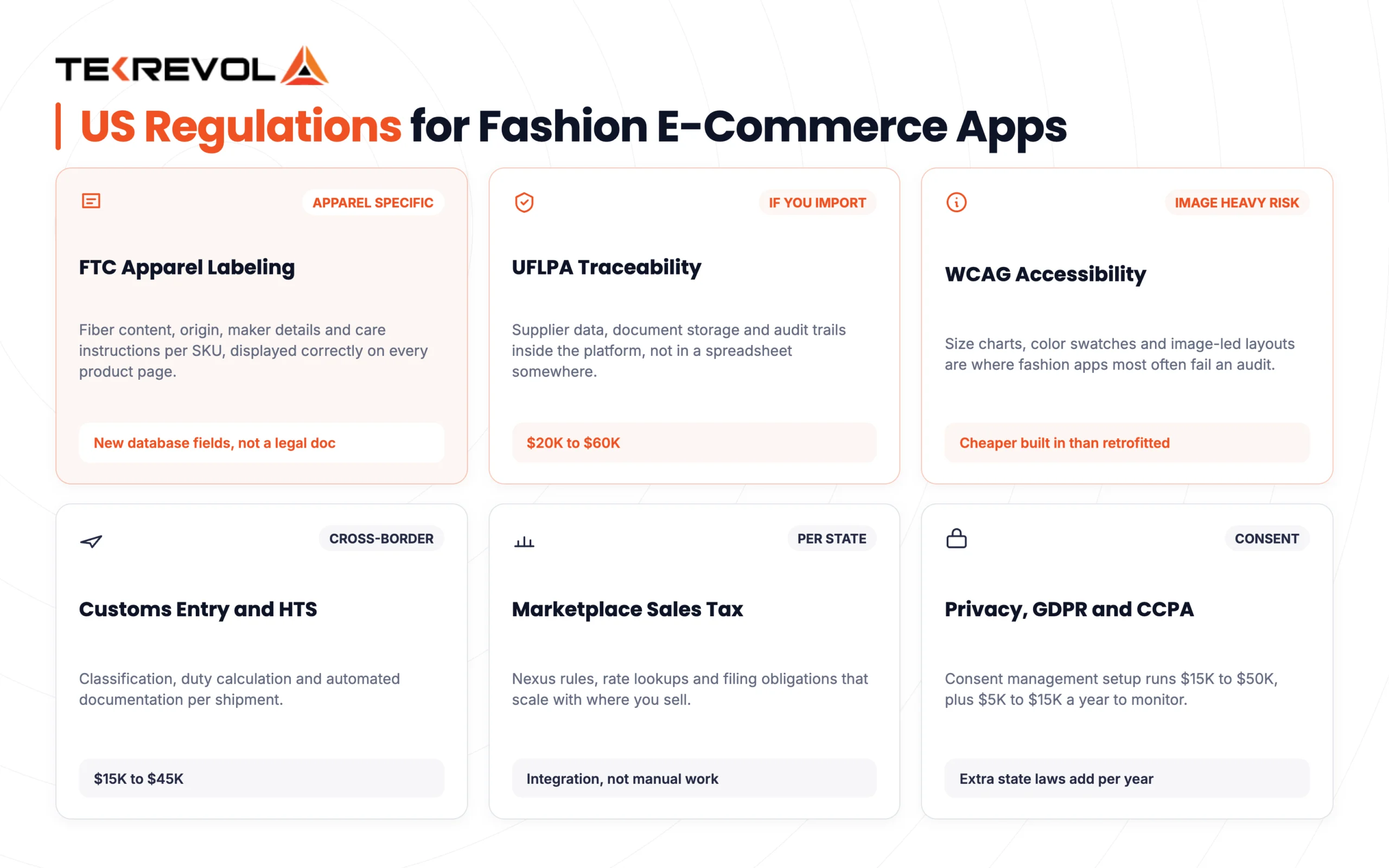
US fashion e-commerce carries customs entry, FTC apparel labeling, marketplace sales tax, accessibility, and privacy obligations. Together, these can add $122,000 to $358,000 to the cost of operating an importing apparel brand.
| Requirement | Applies when | What it adds |
| Customs entry and landed cost | You import for US customers | $15,000–$45,000 |
| FTC apparel and textile labeling | You sell clothing | $8,000–$20,000 |
| UFLPA supply chain traceability | You import apparel | $20,000–$60,000 |
| Marketplace facilitator sales tax | You collect for third-party sellers | $25,000–$70,000 |
| PCI DSS 4.0 | You touch card data | $15,000–$50,000 |
| ADA Title III and WCAG 2.2 AA | Always, in practice | $15,000–$40,000 |
| State privacy laws (CCPA, CPRA) | Depends on users and revenue | $10,000–$35,000 |
| ROSCA and click-to-cancel | You run subscriptions | $8,000–$20,000 |
| FTC Endorsement Guides | You use influencers or affiliates | $6,000–$18,000 |
| Total for an apparel importer | $122,000–$358,000 |
Three areas deserve extra attention because they are specific to apparel and often missed by businesses:
- FTC labeling: Your database needs fiber content, origin, maker details, and care instructions for each SKU. Product pages must display them correctly.
- UFLPA compliance: Apparel imports require supply-chain records and supporting documents, so your platform needs supplier data, document storage, and audit trails.
- Accessibility: Size charts, color swatches, and image-heavy layouts can create WCAG issues. Building accessibility in from the start is cheaper than fixing it later.
Not sure which of these apply to your product?
We'll map your sourcing model, your shipping route, and your catalog against US requirements, then show you what each one adds to the build.
Book a Strategy CallOngoing Costs of Running a Fashion E-Commerce App
Launching the app is just the beginning of the spend. Fashion e-commerce apps cost 18% to 25% of build cost annually to maintain, so on a $180,000 app, that’s roughly $32,000 to $45,000 a year just to keep the lights on.
Payment processing and catalog operations sit on top of that baseline and scale directly with revenue, so the bigger you get, the bigger this number gets too.
Here’s where that money actually goes.
App Maintenance & Engineering: $50,000 – $200,000/year
Covers:
- Bug fixes and dependency upgrades
- OS compatibility updates (2 major iOS/Android releases yearly — Apple and Google both push updates that can break existing functionality overnight)
- Security patches and performance optimization
Pro tip: Allocate 15–20% of your original development budget annually for maintenance (steady-state, years 2+). Budget for year one to run higher, often 40–50% of your original build cost, while you stabilize the codebase and fix what early testing missed.
Cloud & Hosting: Scales with users and media weight
Cloud costs grow with both your user base and the amount of media your app serves. Video, AR, and live shopping can push infrastructure costs significantly higher than those of a standard commerce app.
| Monthly Users | Estimated Cost |
| 50,000 | $2,000 – $8,000 |
| 500,000 | $15,000 – $35,000 |
| 5M+ | $50,000 – $100,000+ |
Note: These ranges assume a media-moderate app. If your product is media-heavy, such as video, AR try-ons, or live shopping streams, expect costs to reach the higher end or go beyond it. At scale, video egress, storage, and CDN delivery can become larger cost drivers than compute.
Negotiate committed use discounts (reserved instances/savings plans) with cloud providers once you hit stable growth; this alone can cut 25%+ off compute costs at scale.
Payment Gateway Transaction Fees
Every transaction through Stripe, PayPal, or similar processors carries a standard fee of roughly 2.9% + $0.30 per successful charge. This scales directly with revenue, not with a budget line you set once:
- At $100,000/month in transaction volume, expect to lose $2,900–$5,000/month to gateway fees alone
- At $1M/month, that’s $29,000–$50,000/month
- Currency conversion and cross-border transactions typically add another 1–2% on top
Treat payment fees as part of your unit economics from day one. At higher volumes, renegotiate rates with your payment provider.
Search and Personalization Services
Estimated cost: $6,000–$30,000 a year
Hosted search and recommendation platforms typically bill per query or based on catalog size, meaning this cost rises in step with both your product count and your traffic. The wide range reflects the gap between a basic hosted search tool and a full-scale personalization engine processing behavioral data at volume.
Third-Party Service Subscriptions: $500 – $3,000/month
Separate from hosting, most live apps run a stack of recurring SaaS tools:
- Push notifications: Firebase (FCM), OneSignal, Airship: $0–$500/month depending on volume
- Email/SMS platforms: transactional + marketing sends: $100–$1,000/month
- Fraud detection: especially important for e-commerce with real payment volume: $200–$1,000/month
- Analytics: Mixpanel, Amplitude, or similar: $0–$1,000/month depending on event volume
These are easy to underestimate individually, but add up to a real monthly line; budget for the stack, not just hosting.
AI Feature Development and Ongoing Costs
If AI personalization is part of your product, features such as recommendation feeds, visual search, and dynamic pricing each have their own development costs. Unlike static features, they also require ongoing maintenance for model retraining and inference.
| AI Feature | Build Cost | What drives ongoing cost |
| Personalized product feed | $8,000 – $18,000 | Retraining as catalog/behavior shifts |
| Visual search | $10,000 – $25,000 | Inference compute scales with query volume |
| Dynamic pricing engine | $8,000 – $20,000 | Continuous demand-signal ingestion |
| Trend detection; | $12,000 – $30,000 | Highest ongoing cost — needs fresh social/search data |
You don’t need to build all of these at launch; start with a personalized feed, then add the rest once you have real user data to train on. Budget inference/compute for whichever you ship as part of your monthly cloud line, not as a one-time cost.
Catalog Operations: scales with SKU count
Someone has to photograph, categorize, tag, and classify every new product entering the catalog. At Shein’s pace, this is an entire department. At a smaller scale, it’s still a real, recurring cost — and the one line item most founders forget to budget for, because it looks like a one-time task until the catalog starts growing weekly.
Marketing & Promotion: 20–40% of Revenue During Growth
Recommended allocation (2026 standard framework):
- 40% performance marketing: user acquisition (TikTok/Instagram/Apple Search Ads)
- 35% retention & engagement: email/SMS, lifecycle campaigns, re-engagement
- 25% brand & experimentation: influencer collaborations (micro/nano-weighted, macro reserved for launches) and emerging-format tests (AI-personalized content, agentic shopping)
Influencer spend specifically is trending up sharply industry-wide, so treat that 25% brand bucket as a floor if influencer is core to your acquisition strategy.
Legal, Compliance & App Store Fees: $5,000 – $100,000+/year
These costs cover the legal, regulatory, and platform requirements needed to operate and maintain the app across its target markets:
- Apple Developer Program ($99/year) and Google Play ($25 one-time) listing fees
- Security audits and penetration testing ($1,000–$10,000/year baseline)
- Privacy law compliance like GDPR/CCPA consent management setup ($15,000–$50,000) plus $5,000–$15,000/year ongoing monitoring; additional state privacy laws can add $3,000–$10,000/year each
- PCI validation, accessibility audits, and tariff schedule updates for cross-border sourcing
Regulated categories cost meaningfully more: HIPAA compliance (healthcare) runs $20,000–$100,000/year, PCI DSS (payments) adds $15,000–$40,000/year, and COPPA (kids’ apps) adds $10,000–$30,000/year. If none of these apply to you, budget toward the low end; if any do, treat this as a core line item.
Feature Updates
Plan for 2-3 major feature releases annually ($100k–$300k each). Recent winning investments include AR virtual try-ons and live shopping integrations, both of which remain active areas of consumer app investment in 2026.
How a Shein-Style App Makes Money
Apps like SHEIN primarily earn through product sales, with loyalty programs, affiliate partnerships, and advertising adding secondary revenue streams. Here’s how each revenue stream works and what it typically generates.
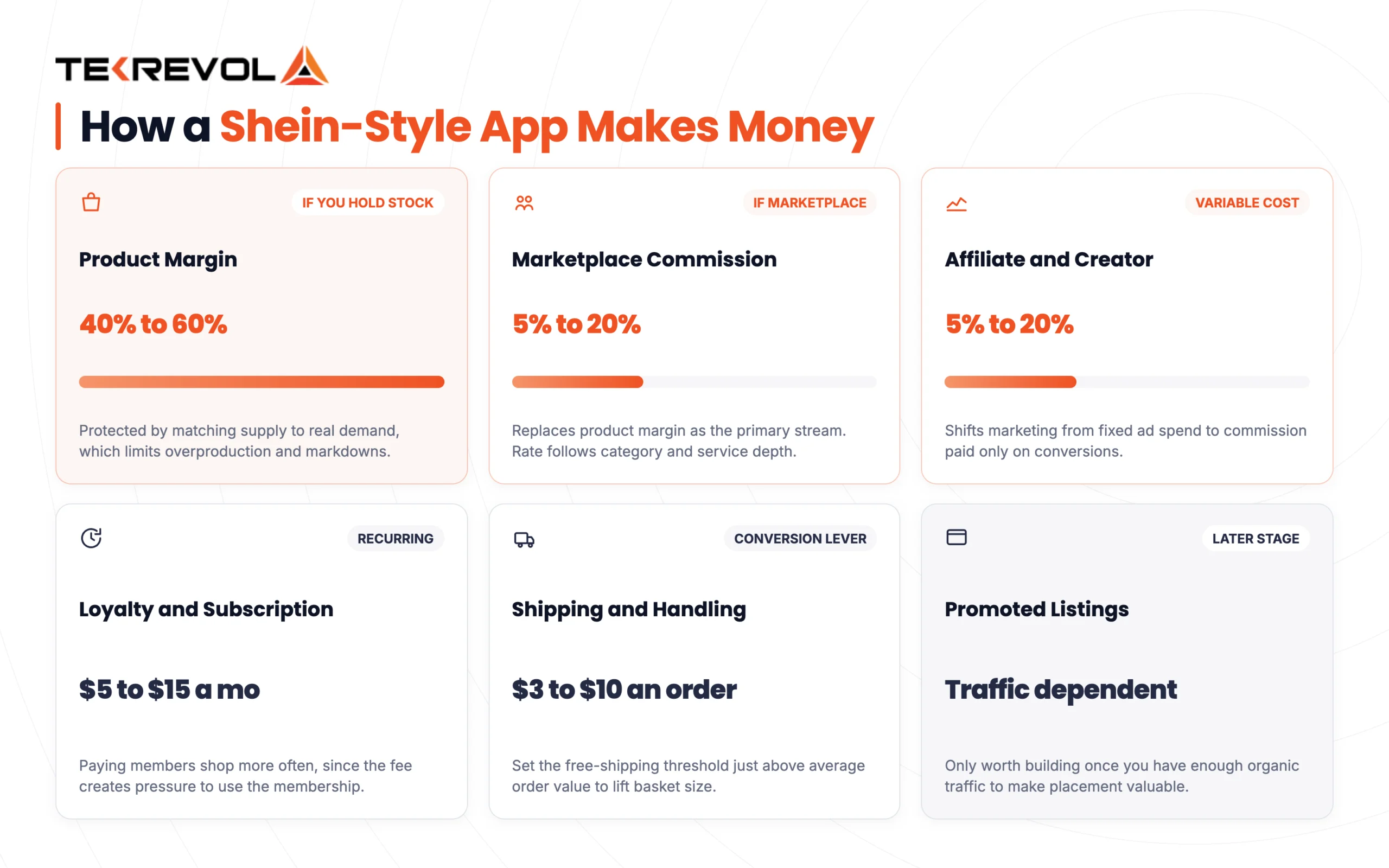
Product Margin
Typical range: 40%–60% gross
This is the core revenue driver for any business holding its own inventory. It’s the direct markup between what you pay to source or manufacture a product and what you sell it for. At Shein’s scale, this margin is protected by an extremely tight production cycle that limits overproduction and markdowns; the faster you can match supply to actual demand, the more of that margin you keep.
Marketplace Commission
Typical range: 5%–20%
If you’re running a marketplace model instead of owning inventory, this replaces product margin as your primary revenue source. You take a cut of every transaction between buyers and third-party sellers on your platform. The rate typically depends on category, seller volume, and how much value-added service (fulfillment, marketing placement, customer support) you provide on top of the transaction itself.
Shipping and Handling Fees
Typical range: $3–$10 per order
Charged below a free-shipping threshold, this is a smaller but consistent revenue line. It also functions as a conversion lever; setting the free-shipping threshold just above your average order value nudges customers to add one more item, which is often more valuable than the shipping fee itself.
Loyalty and Subscription
Typical range: $5–$15 a month
Paid membership tiers offering free shipping, early access, or member-only discounts create a predictable recurring revenue stream on top of transactional sales. More importantly, subscribers tend to shop more frequently once they’re paying for the privilege of free shipping, since the fee creates pressure to “use” the membership.
Affiliate and Creator Programs
Typical range: 5%–20% of sale
Commission paid to creators and influencers who drive sales through their own content and audiences. This shifts a portion of marketing spend from fixed costs (ads) to variable costs (commission only paid on actual conversions), which is part of why it scales well for fast-fashion catalogs with constant new inventory to promote.
Promoted Listings
Typical range: Varies by traffic
Sellers or brands pay for premium placement within the catalog or search results. This only becomes a meaningful revenue stream once you have enough organic traffic to make placement valuable; it’s typically a later-stage addition rather than a launch feature.
Shopify vs Custom Development for a SHEIN-Style App
Build from scratch when your catalog scale or sourcing model breaks a platform’s limits. Use Shopify or headless commerce when speed matters more than control, which,h for most first launches, it does.
| Factor | Custom build | Shopify or headless |
| Upfront cost | $60,000–$500,000 | $25,000–$60,000 for the app layer |
| Time to launch | 3–14 months | 8–12 weeks |
| Catalog ceiling | Whatever you engineer | Platform limits on variants and SKUs |
| Checkout control | Full | Constrained, though improving |
| Customs and landed cost | Build it your way | Depends on the available apps |
| Cost to leave | High, but the code is yours | High, and data migration is painful |
For most brands launching a first app, a native layer over an existing commerce backend is the right call. You validate demand for a fraction of the budget, and you keep the option to move later.
The exception is catalog scale. If you add thousands of SKUs a week with deep variant structures, platform limits bite sooner than most vendors admit. Our retail app development cost breakdown covers that ceiling.
How Can You Reduce the Cost of Building a SHEIN-Style App?
Building a SHEIN-style app does not mean launching every feature at once. A focused MVP, reusable technology, and phased expansion can significantly reduce upfront development costs while leaving room to scale as demand grows.
Start With a Focused Product Category
Launch with one category instead of building a full fashion marketplace from day one. A smaller catalog requires fewer filters, simpler merchandising, and less content management. You can expand the catalog once you understand customer demand, and our MVP development cost guide shows how a narrow scope translates into a lower first invoice.
Use an Existing Commerce Backend
Build the mobile experience on top of an established commerce platform or headless backend instead of developing every commerce component from scratch. This can reduce development time and infrastructure costs while still allowing you to customize the customer experience.
Delay Advanced Personalization
Do not build an expensive recommendation engine before you have enough user data. Start with rule-based recommendations such as related products, recently viewed items, and best sellers, then introduce AI personalization as usage grows.
Integrate Instead of Building
Use proven third-party solutions for services such as payments, tax calculation, shipping, and accessibility testing. Integrations are usually faster and more cost-effective than building mature infrastructure internally.
Choose Cross-Platform Development
Using cross-platform frameworks can reduce development and maintenance costs by allowing one codebase to support both iOS and Android. Native development may still make sense for advanced features such as AR try-on or platform-specific experiences.
Plan Landed Costs Early
If you plan to sell internationally, account for duties, taxes, and shipping during the initial architecture. Adding landed-cost calculations after checkout is already live and can require costly changes to pricing, payments, and order workflows.
Expand Into New Markets Gradually
Start with one market before adding international complexity. A domestic launch can simplify payments, taxes, logistics, and compliance, allowing you to validate the product before taking on cross-border requirements.
Partner With TekRevol for Your E-commerce App Development
Building a SHEIN-style e-commerce app requires more than a feature-rich interface. TekRevol helps businesses plan the right architecture, prioritize high-impact features, and build scalable commerce experiences that can grow with their catalog, customers, and markets.
We’ve shipped 500+ apps across 11 industries, from sneaker resale marketplaces with live raffles to B2B procurement platforms handling real transaction volume, so we’ve already solved the problems your app is about to run into. Our write-up on how we helped a business achieve 10x growth shows what that looks like in practice.
We don’t hand you off between teams. One mobile app development services group owns your app from the first wireframe to App Store submission, which means fewer dropped details and a faster path to a live, revenue-generating product.
- Built to convert, not just to launch: checkout flows, product discovery, and repeat-purchase journeys engineered to reduce drop-off at every step.
- AI baked in, not bolted on: personalized recommendations and behavior-based feeds that adapt to each shopper in real time.
- One team, zero hand-off gaps: UX, engineering, payments, and QA under a single roof from kickoff to launch.
- Battle-tested across formats: Marketplaces, B2B platforms, Shopify-integrated storefronts, and niche catalogues already in production.
Ready to Build Your Fashion E-Commerce App?
Share your catalog, target markets, and goals. We’ll define the right features and architecture to build an app that scales.
Discuss Your Project Now


