



- Most funded 2026 MVPs cost $15,000 to $50,000, while simple single-workflow builds start near $5,000.
- Team location shifts MVP budgets more than any single feature or platform decision does.
- Cross-platform frameworks reuse 70-90% of code, cutting both build and long-term maintenance costs significantly.
- Hidden costs like compliance, hosting, and app store fees add 15% to 25% to your build annually.
- Cutting an entire user type saves far more budget than cutting five individual product features.
- AI tools cut build hours by 10% to 20%, but Veracode found 44% of that output ships insecure.
- Discovery costs 10% of your budget and prevents the mistakes that consume the other 90%.
Building an MVP typically costs between $5,000 and $150,000, though most funded startups land between $15,000 and $50,000. The real number swings on what you’re building, not on how good the idea is.
Ask five founders what an MVP costs, and you’ll hear five different figures. The reason is simple: an MVP for a basic booking app is a very different product from one for a regulated fintech.
Costs are sorted into three tiers. A lean MVP runs $5,000 to $15,000, a standard custom MVP runs $15,000 to $50,000, and an AI-native or enterprise MVP runs $50,000 to $150,000 or more. The first buys quick validation, the second adds custom development and integrations, and the third covers AI, multiple platforms, and compliance.
What actually moves the needle: how many features you launch with, whether you build for one platform or three, and who writes the code, an in-house team, a freelancer, or an MVP development company.
Below, we break down each cost, the factors that drive your budget, and what to expect at every stage.
How Much Does MVP Development Cost in 2026?
MVP development costs $5,000 to $150,000+ in 2026, depending on the product’s complexity, features, platforms, and compliance requirements. Simple MVPs run $5,000 to $15,000, standard builds $15,000 to $50,000, and complex multi-role products $50,000 to $135,000. Regulated enterprise MVPs start around $135,000. The table below shows the typical cost and timeline for each MVP type.
| MVP Complexity / Scope | Typical 2026 Cost | Typical Timeline |
| A simple, single-workflow MVP | $5,000–$15,000 | 6–12 weeks |
| A standard MVP with 3–5 features | $15,000–$50,000 | 10–16 weeks |
| A complex, multi-role MVP | $50,000–$135,000 | 16–24 weeks |
| An enterprise or regulated MVP | $135,000–$200,000+ | 20–30+ weeks |
The biggest factors affecting MVP development cost are the number of user types, platforms, development approach, and compliance requirements. Understanding these variables helps you estimate your budget more realistically before development begins.
If you’re still deciding whether you need a full MVP or something smaller first, our breakdown of PoC vs MVP covers where each one makes financial sense.
Tired of Quotes That Swing by $50,000 for the Same Brief?
Send us your feature list, and we'll come back with an hour-level estimate you can actually audit, not a range.
Schedule A FREE Consultation Now!Biggest Factors That Affect MVP Development Cost
The biggest factors affecting MVP development cost include team location, product complexity, number of user types, platform coverage, integrations, security requirements, and development timeline. Each can significantly change the time, resources, and expertise required to build an MVP.
Ranked by how much they actually move your budget:
1. Team location and seniority
This is the single biggest lever you have. The same 1,000-hour build can cost $30,000 or $150,000 depending purely on where your developers are based and how senior they are. A $25/hour team that needs 1,800 hours can end up costing more than a $150/hour senior who finishes it in 600 hours.
2. Number of user types
This one surprises most founders. It’s not feature count that quietly inflates a budget; it’s user roles. Add a second user type (say, an admin alongside a regular user), and you’re not just adding a screen; you’re duplicating permissions, notifications, and QA across two paths. That single change can add 30–40% to a build, more than most individual features cost on their own.
3. Regulatory environment
Fintech and healthtech MVPs carry a real tax, encryption, audit logs, access controls, and security review, before a single customer-facing feature exists. Expect 1.4x to 2x on top of a comparable non-regulated build. This one isn’t really negotiable, since the requirement comes from regulators, not your roadmap.
4. Platform coverage
Building separately for iOS and Android can nearly double development and QA effort compared with using one cross-platform codebase. The added cost continues after launch because every new feature must be developed and tested for both platforms. This is worth deciding deliberately upfront rather than bolting on a second platform later.
5. Integration count
Third-party integrations can increase MVP development costs through API development, authentication, testing, and maintenance. Payment gateways, maps, identity providers, and other core services may require significant integration work, so prioritize only the integrations essential to your MVP’s core functionality.
6. Design ambition
A custom, accessible, fully branded interface adds $5,000 to $20,000 over a build using an established component library. For an MVP validating demand, a component library delivers most of the perceived quality for a fraction of the design hours.
7. Timeline pressure
Rushing an MVP does not reduce the amount of work. It usually means adding more developers and resources to finish faster, which can increase costs by 20–40%. AI-assisted development can shorten timelines, but faster delivery still requires more coordination, testing, and resources.
8. Scope discipline
Scope is the one cost factor you can control most directly. Small feature additions can quickly extend timelines and push an MVP over budget. The best approach is simple: if you add something new, remove or postpone something else.
The first three account for most of the variance in real quotes. When comparing proposals, normalize those before looking at feature lists.
MVP Development Cost by Category
MVP development cost by category ranges from $5,000 for a lean SaaS web app to $120,000 for fintech. Category sets your floor because regulated products carry compliance, audit, and security work before a single feature gets built.
| MVP category | Typical 2026 range | What drives the cost |
| SaaS web app | $5,000–$25,000 | Auth, billing, dashboard, one core workflow |
| Mobile app (iOS or Android) | $8,000–$30,000 | Cross-platform framework, push, app store release |
| Two-sided marketplace | $12,000–$50,000 | Two user types: search, payments, or escrow |
| AI-powered product | $15,000–$60,000 | Model integration, data pipeline, human review loop |
| Healthtech (regulated) | $20,000–$100,000+ | HIPAA, audit trails, encryption, access control |
| Fintech/payments | $20,000–$120,000+ | Transaction integrity, fraud controls, PCI DSS |
Some industries just cost more to build in. The same app costs more if it handles money or medical records, because you have to prove it’s safe before anyone lets you launch it. Fintech is the most expensive category for exactly this reason.
Here’s what that looks like in real money. Say your build would normally cost $30,000:
| Your industry | What you’ll actually pay | Why it costs more |
| Ecommerce or EdTech | $30,000–$39,000 | Standard security, nothing unusual required |
| SaaS or B2B | $33,000–$42,000 | User accounts, billing, keeping customer data separate |
| Healthcare | $42,000–$54,000 | Patient data must be encrypted and every access tracked |
| Fintech or payments | $45,000–$60,000 | Moving money needs fraud checks and financial audits |
The extra money buys things your users never see: locked-down data storage, a record of who opened what and when, and an outside expert testing your security before launch. None of it is optional, and none of it can be added cheaply later.
So if you’re interested in healthcare app development or building a finance app, work out that extra cost first, then choose your features with whatever budget is left.
MVP Development Cost Based on App Complexity
App complexity changes MVP development cost by roughly 10x. Complexity isn’t feature count; it’s how many user types the product serves. One user type is simple. Two who transact with each other double your permission logic, notifications, and QA.
| Tier | Cost | What’s actually included |
| Simple | $5,000–$15,000 | One user type, one core workflow, basic auth, functional UI, deployment, light analytics |
| Standard | $15,000–$50,000 | 3–5 features, admin panel, payments, multi-role access, 1–2 integrations, automated testing, staging and production |
| Complex | $50,000–$135,000 | AI or real-time features, multi-tenant architecture, granular permissions, auto-scaling, native mobile, full test coverage |
| Enterprise / regulated | $135,000–$200,000+ | SOC 2 readiness, audit logging, SSO, compliance review, high-availability architecture |
The most expensive scoping mistake we see is founders cutting an individual feature to save money when they should have cut an entire user type. Removing the admin role saves more than trimming five small features, because it removes an entire permission surface rather than one screen.
More examples of how we scope first releases sit in our project portfolio.
MVP Development Cost by Platform
MVP development cost by platform runs from $15,000 for a web app to $150,000 for native builds on both stores. The web is the cheapest and fastest. Native costs the most because you build, test, and maintain the same product twice
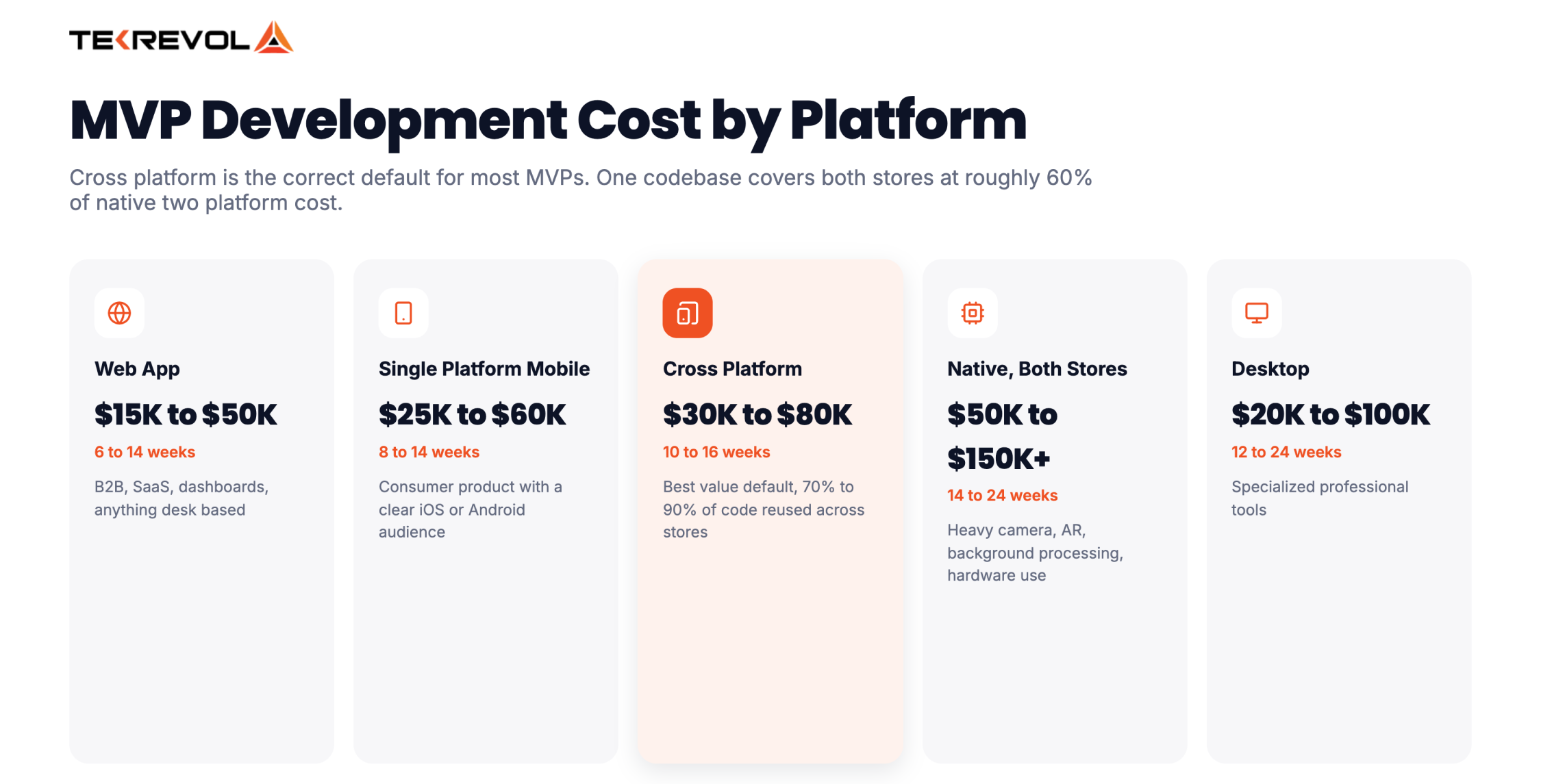
| Platform | Typical 2026 cost | Timeline | When it’s the right call |
| Web app | $15,000–$50,000 | 6–14 weeks | B2B, SaaS, dashboards, anything desk-based |
| Mobile, single platform | $25,000–$60,000 | 8–14 weeks | Consumer product with a clear iOS-or-Android audience |
| Cross-platform | $30,000–$80,000 | 10–16 weeks | You need both stores, one codebase, one budget |
| Native, both platforms | $50,000–$150,000+ | 14–24 weeks | Heavy camera, AR, background processing, hardware use |
| Desktop | $20,000–$100,000 | 12–24 weeks | Specialized professional tools |
For most MVPs, cross-platform app development is the correct default. One codebase covers both stores at roughly 60% of the native two-platform cost.
Go native only when the product depends on the device itself: continuous background location, real-time camera processing, augmented reality, or hardware integration. Otherwise, you’re paying a premium for a difference your first thousand users won’t notice.
If you’re picking one store to start with, iOS app development typically monetizes faster across the US and premium markets.
For broader international reach or hardware-diverse audiences, Android app development is the smarter first launch, and the second store can wait for demand.
MVP Development Costs Across Different Tech Stacks
MVP costs typically range from $5,000 to $150,000+, with the tech stack being one of the biggest cost drivers. Web stacks (React/Node.js) are the cheapest, cross-platform (Flutter/React Native) sits in the middle, and native mobile, AI, or compliance-heavy builds push costs highest.
| Stack choice | Cost Estimate | Trade-off you’re accepting |
| No-code / low-code | $3,000–$15,000 | Fast and cheap, but you hit a ceiling and rebuild later |
| Modern web / cross-platform | $20,000–$50,000 | The default for most MVPs, well-supported talent pool |
| Backend-heavy | $30,000–$70,000 | Higher upfront cost, scales without a rewrite |
| Cloud-native (microservices, serverless) | $40,000–$90,000 | Real scalability, real DevOps overhead too early |
| AI / ML integrated | $60,000–$150,000+ | Model costs, data pipeline, and an evaluation loop |
Adding AI capability typically adds 15% to 30% to the budget, mostly for data preparation and evaluation rather than the model call itself. Compliance-first design adds another 10% to 40%.
No-code is excellent for validating demand and poor for scaling a business. If your MVP’s only job is proving people will pay, build it on a no-code platform for $8,000 and find out in three weeks. If it becomes your permanent product, the rebuild costs more than building properly once.
For AI-driven MVPs, the model isn’t the expensive part. The data pipeline, guardrails, and human review loop are.
The same applies to blockchain app development, where the smart contract rarely breaks the budget. Wallet handling, chain reliability, and transaction edge cases consume the hours.
Worried You'll Pick the Wrong Stack and Pay for It Twice?
We'll map your growth plan against each option and show you exactly where the rebuild risk sits.
Book a Free Strategy Call Now!MVP Cost by Development Team Location
MVP development costs vary significantly by development team location, because developer rates differ across regions. Teams in North America and Western Europe typically charge more than teams in Eastern Europe, Latin America, or Asia. Choosing the right location can reduce your development budget without necessarily compromising quality.
| Region | Blended hourly rate | What you’re really paying for |
| North America | $80–$200+ | Full time-zone overlap, easiest hiring and oversight |
| Western Europe | $60–$140 | Senior talent depth, strong compliance familiarity |
| Eastern Europe | $35–$70 | Strong engineering fundamentals at a mid-tier price |
| Latin America | $25–$75 | Nearshore convenience, real-time overlap with US hours |
These figures are broad estimates because the final price also depends on the MVP’s scope, technical requirements, and team composition. A lower hourly rate does not always mean a lower overall cost if communication gaps, rework, or quality issues extend the project.
A hybrid model can balance cost and expertise by combining onshore product or architecture leadership with offshore development capacity. Our Miami MVP cost breakdown shows how development costs can vary in a specific market.
MVP Development Costs Across Different Team Models
MVP development costs vary by hiring model, with freelancers generally offering the lowest upfront rates, agencies providing broader expertise, and in-house teams requiring higher ongoing costs. The right option depends on your budget, project complexity, and how much technical ownership you want to keep internally.
| Team model | Hourly rate | Typical MVP total | Best for | The catch |
| Freelancers | $30–$120 | $10,000–$40,000 | Tight scope, technical founder who can manage | You own integration, QA, and continuity risk |
| Agency / outsourced | $50–$200 | $30,000–$150,000+ | Founders who need a full team from day one | Scope discipline matters, or the number climbs |
| In-house | $80–$170+ | $80,000–$200,000+ | Products that are the company, long-term | Hiring takes 2–3 months before code exists |
| Staff augmentation | $40–$120 | $25,000–$90,000 | You have a lead, you need hands | You still manage delivery |
In-house isn’t only more expensive; it’s slower to start. You’re 8 to 12 weeks into recruitment before a line of production code exists. For an MVP built to reach customer feedback fast, that delay usually costs more than the rate difference.
If you already have a technical lead and need capacity, IT staff augmentation sits in the middle of this table and is the model first-time founders most often overlook.
Not Sure Which Team Model Fits Your Stage?
We'll map your budget, timeline, and in-house capability against all four models and tell you honestly which one wins, even when the answer isn't us.
Consult Our Strategy Team!What Is the Full Breakdown of MVP Development Costs?
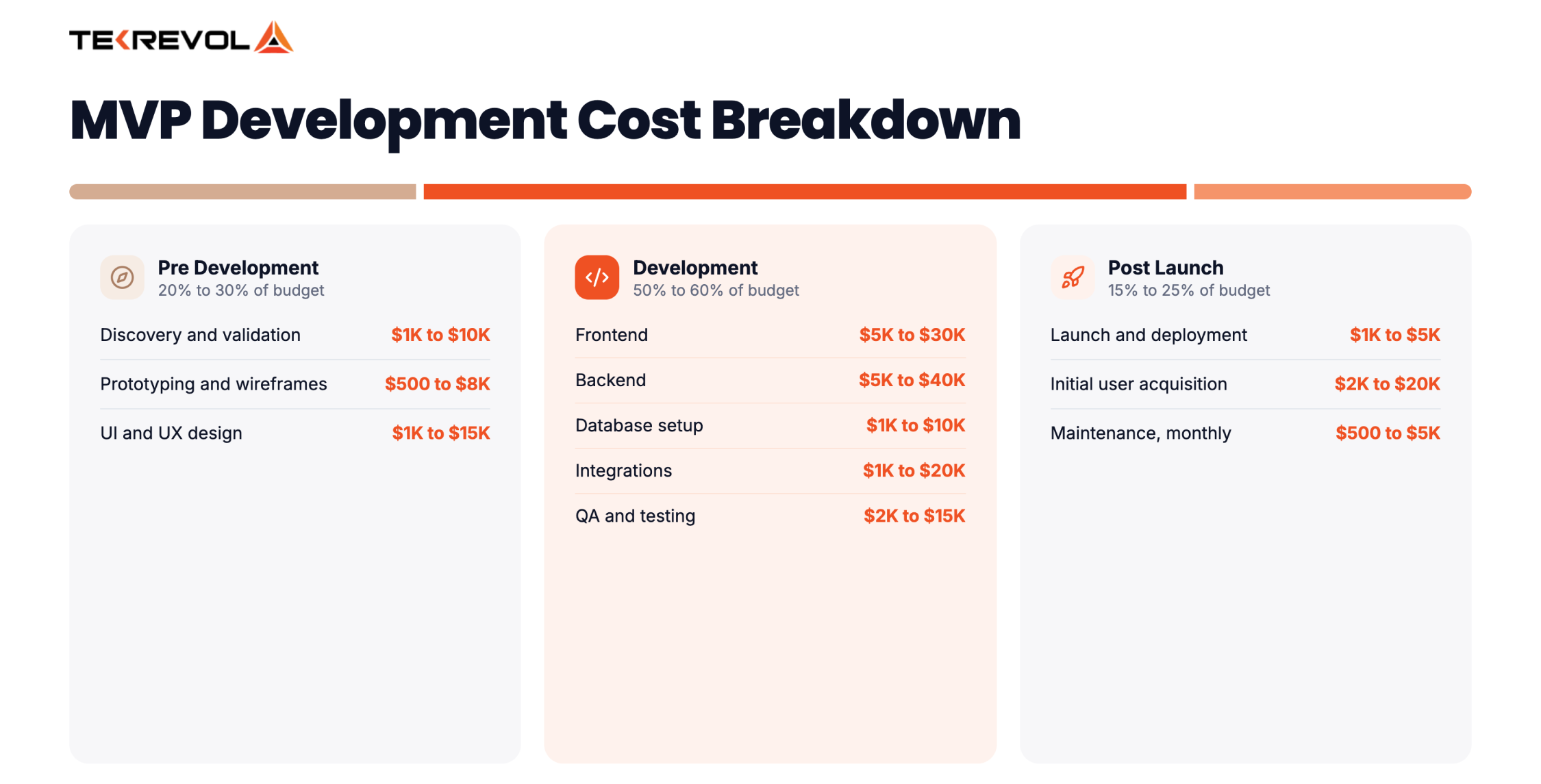
MVP development costs break into three phases: pre-development at 20% to 30% of the budget, development at 50% to 60%, and post-development at 15% to 25%. Development is the largest line item, but discovery failures cause the overruns.
Pre-development (20–30% of budget)
This is where you figure out what to build before anyone touches code. Skipping or rushing it is the single most common reason costs balloon later — every unclear requirement here becomes an expensive rebuild during development.
| Activity | Cost | Timeline |
| Discovery & market validation | $1,000–$10,000 | 1–2 weeks |
| Prototyping & wireframing | $500–$8,000 | 1–2 weeks |
| UI/UX design | $1,000–$15,000 | 2–4 weeks |
Development (50% to 60% of budget)
The largest line item is where most of your timeline gets spent. This is also where scope discipline (or the lack of it) shows up most directly in the final invoice.
| Activity | Cost | Timeline |
| Frontend development | $5,000–$30,000 | 4–8 weeks |
| Backend development | $5,000–$40,000 | 4–8 weeks |
| Database setup | $1,000–$10,000 | 1–2 weeks |
| Third-party integrations | $1,000–$20,000 | 2–4 weeks |
| QA and testing | $2,000–$15,000 | 2–4 weeks |
Post-development (15% to 25% of budget)
Launch is not the finish line; it’s where real feedback starts and where recurring costs begin. Many founders underbudget this phase because it doesn’t feel like “building” anymore, even though it’s ongoing.
| Activity | Cost | Timeline |
| Launch and deployment | $1,000–$5,000 | 1–2 weeks |
| Initial marketing and user acquisition | $2,000–$20,000 | Ongoing |
| Maintenance and support | $500–$5,000 | Monthly |
Discovery looks like the easiest place to save $5,000 and is the most expensive. Skipping it doesn’t remove the work; it moves the work into development, where changing your mind costs roughly five times more.
A CB Insights analysis of 431 failed startups found that 70% ran out of money, while 43% struggled with poor product-market fit. This shows why validating your idea early matters: a focused MVP can help you test whether people actually want the product before you spend heavily on development.
For how these phases price out beyond MVP scope, our app development cost guide covers full production builds.
Hidden Costs of MVP Development You Should Budget For
Most MVP quotes only cover the build, not everything that comes with it. These extra costs rarely show up until after you’ve signed, and they can add 20–40% on top of your original budget.
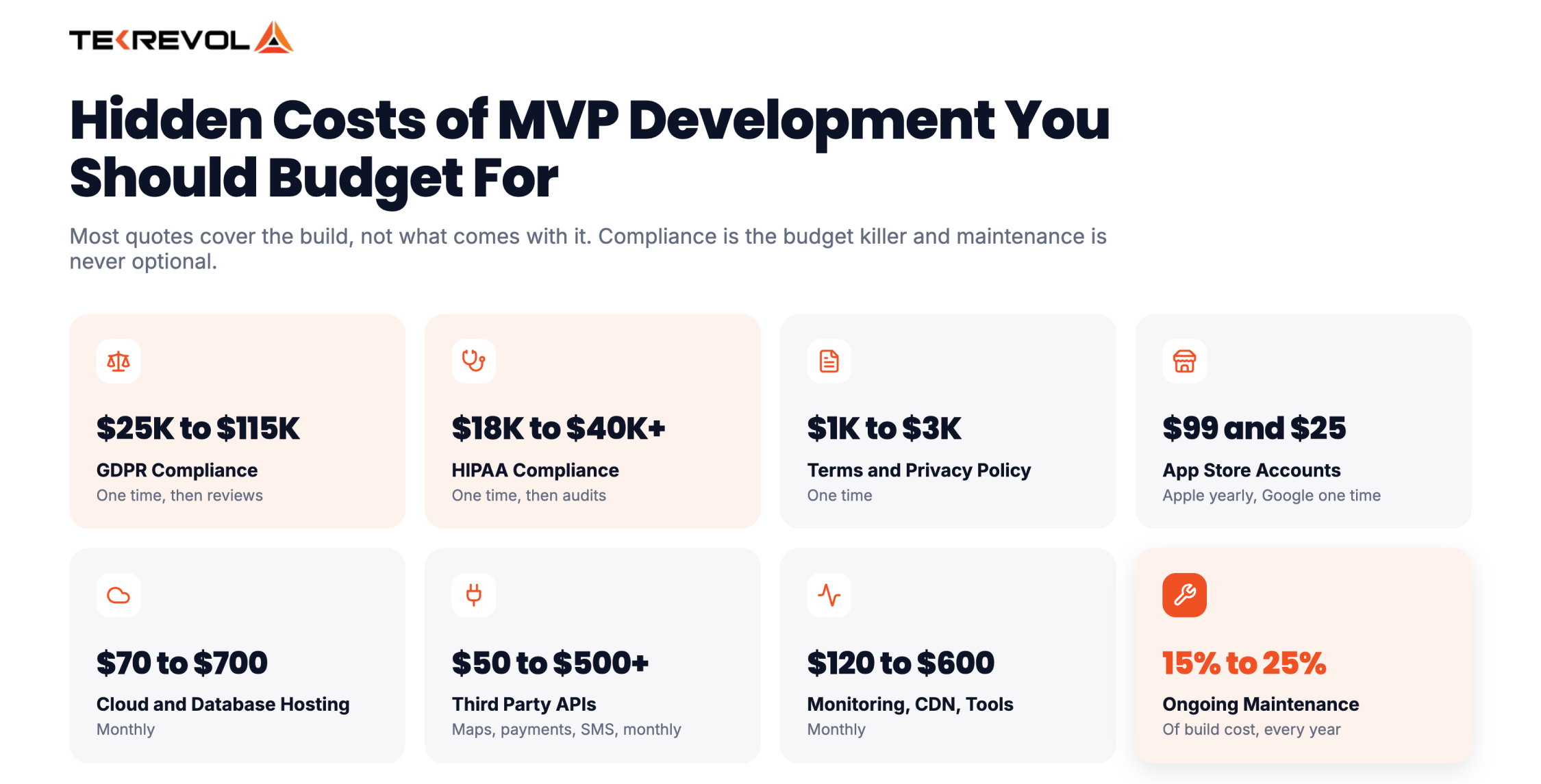
| Hidden cost | 2026 price | Frequency |
| Terms of Service and Privacy Policy | $1,000–$3,000 | One-time |
| GDPR compliance | $25,000–$115,000 | One-time, then reviews |
| HIPAA compliance | $18,000–$40,000+ | One-time, then audits |
| Apple App Store developer account | $99 | Annual |
| Google Play developer account | $25 | One-time |
| Cloud hosting | $50–$500 | Monthly |
| Database hosting | $20–$200 | Monthly |
| Third-party APIs (maps, payments, SMS) | $50–$500+ | Monthly |
| Monitoring and logging | $50–$300 | Monthly |
| CDN and file storage | $20–$100 | Monthly |
| Project management tools | $50–$200 | Monthly |
| Domain and SSL | $10–$120 | Annual |
| Ongoing maintenance | 15%–25% of build cost | Annual |
Compliance is the budget killer: A fully GDPR-ready build can cost more than the MVP development itself. If your MVP involves regulated data, plan the compliance budget before finalizing development costs.
Maintenance is not optional: Budget 15% to 25% of build cost annually from day one. On a $40,000 MVP, that’s $6,000 to $10,000 a year just to keep infrastructure running. Managed cloud services are usually what keeps that number at the bottom of the range.
Founders routinely raise exactly enough to build and nothing to operate. Six months after launch, the product works, and the runway doesn’t.
How Long Does an MVP Development Actually Take?
MVP development typically takes 6–24 weeks, while enterprise or regulated products can take 20–30+ weeks. The timeline depends on the product’s complexity, number of platforms, integrations, design requirements, and compliance needs.
| Delivery pace | Timeline | Cost effect |
| Careful | 4–6 months | Baseline, or slightly below |
| Normal | 2–3 months | Baseline |
| Compressed | 3–6 weeks | 30%–60% above baseline |
Important: AI can reduce repetitive development work and shorten timelines. However, teams still need to budget for testing, security, and code review.
Need Something in Front of Investors Next Month?
We'll tell you honestly what ships in four weeks and what doesn't, then scope the fastest credible version.
Discuss Your Strategy Today!Does AI-Assisted Development Actually Lower MVP Cost?
AI-assisted development can cut MVP build hours by 10% to 20%, but only for teams already fluent with the tools. Almost every AI development company you talk to will mention AI as a reason their quote is competitive. AI does reduce some development work, but the actual savings depend heavily on how it’s used.
The productivity gains are real. Research found that more than 80% of surveyed technology professionals said AI improved their productivity, while 59% reported a positive impact on code quality.
For an MVP, the biggest benefits usually come from:
- Faster development: Generate boilerplate code and common components more quickly.
- Quicker testing: Create test cases and identify potential issues earlier.
- Faster debugging: Get suggestions for errors and fixes without starting from scratch.
- Less repetitive work: Speed up documentation, data handling, and other routine tasks.
There is a downside: AI-generated code still needs careful review. Veracode found that around 45% of AI-generated code samples contained security vulnerabilities, including issues such as cross-site scripting and SQL injection.
AI does not replace experienced developers. Architecture, security, code review, testing, and product decisions still need human oversight. Used this way, AI can help an MVP team move faster and make better use of its development budget.
Best Practices to Reduce MVP Development Cost
The cost-saving strategies that work are cutting user types before features, choosing cross-platform over native, buying managed services instead of building infrastructure, and running fixed-scope sprints. Cutting QA, discovery, or documentation costs more later.
Strategies that work:
Simplify User Roles Before Removing Core Features
Removing the admin role or the second side of a marketplace saves more than trimming five small features. A feature is a line item; a user type is an entire slice of screens, permissions, edge cases, and QA paths. Removing one collapses far more scope than it looks like on paper.
Go Cross-Platform
One codebase covers both stores at roughly 60% of the native two-platform cost. The bulk of that saving comes from engineering. Teams reuse 70-90% of the code across iOS and Android instead of maintaining two separate builds.
Use Ready-Made Solutions for Non-Core Features
Auth, payments, notifications, and search have mature managed services. Custom-building any of them on an MVP is money burned; you’re paying to reinvent infrastructure a vendor has already hardened, tested, and maintained for years.
Use a component library
Use a polished design system to achieve a professional UI without spending the time and cost required to design every component from scratch. Save the custom design work for the two or three screens that actually define your product’s identity, not the settings page.
Run Fixed-scope Sprints
Time-and-materials pricing can become expensive when the scope keeps changing. Defining the MVP scope upfront helps you make tough decisions early instead of paying for them later.
If you’re pre-seed and every dollar counts, our mobile app development team scopes to the smallest release that produces real signal, which is usually smaller than founders expect.
Why Do MVP Quotes Differ So Much Between Agencies?
MVP quotes differ because agencies quote different products under the same label. One firm’s “simple MVP” excludes discovery, design, and QA. Another includes all three plus six months of support. Normalize the scope before comparing any two numbers.
Ask every vendor for the same seven things, and their quotes become directly comparable:
| Ask for | Why it matters |
| Total estimated hours | Turns a price into arithmetic you can check |
| Blended hourly rate | Separates rate from scope |
| Team composition and seniority | A team of three juniors is not a team of three engineers |
| What’s included in QA | “Testing” can mean automated coverage or one manual pass |
| Discovery and design inclusion | Some quotes exclude both, then bill them |
| Post-launch support window | Two weeks and eight weeks are very different products |
| Who owns the code and infrastructure | Occasionally, and unpleasantly, not you |
Once all three vendors answer those, you’ll usually find the cheapest quote excludes discovery, design, and QA, while the most expensive quietly includes months of post-launch support.
You aren’t shopping for a price. You’re shopping for a scope, and an accurate price follows from it.
Why Choose TekRevol for MVP App Development?
TekRevol helps startups and businesses turn focused product ideas into launch-ready MVPs without overbuilding the first release. We’ve delivered MVPs across 11+ industries, with pricing based on transparent, trackable development hours rather than rigid packages.
We’re not the cheapest option on this page and aren’t trying to be. What we do is scope honestly, price by the hour you can audit, and tell you when your MVP is bigger than it needs to be.
How we work on MVPs:
- Study and ideation: We pressure-test the idea against the market before designing anything, because a validated scope is the cheapest cost control that exists.
- MVP architecture design: We build on modular codebases and cloud-ready frameworks, so the MVP scales instead of getting rewritten at Series A.
- Roadmap definition: You get a phased plan, so you know what ships now and what waits.
- User acquisition modeling: An MVP nobody uses produces no signal, so launch planning is part of the build.
Turn Your MVP Idea Into a Clear Development Plan
Get a phased scope, transparent cost estimate, and clear feature priorities for your MVP. We'll help you identify what to build first, what to defer, and what it will realistically cost.
Schedule Your Free MVP Consultation!


