



- Miami MVPs cost between $30,000 and $80,000, depending on platform, features, and integration depth.
- A single-platform Miami MVP ships in 8 to 16 weeks from discovery sprint to App Store launch.
- MVP app development in Miami needs four features: authentication, core workflow, push notifications, and analytics.
- Hybrid development teams give Miami startups the best balance of quality and cost at $75 to $125/hr.
- Miami fintech, healthtech, logistics, and hospitality verticals carry different compliance and feature requirements.
- Move to Phase 2 when user data validates which specific features are worth investing in next.
You have an app idea. You believe in it. But building the full product before testing it carries a real financial risk.
Miami makes that tension feel urgent. According to the Startup Blink report, the city now ranks #22 globally among startup ecosystems, backed by $4.13 billion in South Florida venture capital in 2025 alone. The window to stake your claim is open, but it will not stay that way forever.
A Minimum Viable Product (MVP) app development in Miami helps you move past that tension. It is the smallest version of your product that solves one core problem, gathers real user feedback, and proves your idea works before you build the rest.
Partnering with experienced mobile app developers in Miami gives you an edge. You get a team that understands the local market, moves fast, and keeps your scope tight. This guide covers what MVP development costs in Miami, how long it takes, and what to look for in a development partner.
What an MVP Actually Is in App Development (and What It’s Not)
An MVP is the smallest shippable product that validates one core assumption about your business model.
The goal of the MVP development company is speed with purpose. You build the smallest version of your idea that delivers real value. You ship it and measure how people respond. Then you build the next version around what the data shows.
That protects your budget and sharpens your product direction. Investors expect proof that your idea works in the real world. An MVP gives you that.
MVP vs Prototype vs Proof of Concept
Most founders confuse MVP with a prototype and proof of concept. They mean different things, and the difference directly affects your budget and your timeline.
| What it is | What it test | Approx. cost | |
| Proof of concept | A technical experiment | Can we build this? | Varies |
| Prototype | A clickable design file | Does this look and feel right? | $5,000 |
| MVP | A working, live product | Will real users come back? | $30,000–$80,000 |
| Full v1 | A complete product build | Everything, fully polished | $150,000+ |
A prototype lives inside a design file. Users tap through screens, and the experience feels real. It simulates the product running on design software, with the real functionality layer still ahead.
A proof of concept runs on a test server. It answers one technical question: can we integrate this API, can we process this file type? You rebuild it for production once it gives you that answer. Neither one tells you whether real users will return to your product.
Your MVP sits between a proof of concept and a full v1. It live and does one thing well enough for a user to complete a real task. They use it, and they decide whether they’d come back tomorrow.“
A food delivery MVP, for example: A user can browse menus, place an order, and track delivery. Loyalty points, referral codes, and live chat belong in Phase 2. You add those after you confirm people order food through your app at all.
The POC vs MVP decision is where most founders lose $10,000 to $30,000 to misdirected scope before the first developer call.
Scoop Your MVP Right
Tell us what you're building. We'll map your core features, estimate your cost range, and show you a comparable App Store app we've already built.
Book your 30-minute free sessionWhy Miami Founders Choose MVPs over Full Builds in 2026
Miami’s startup scene moves at a different pace than most US cities. The city ranked #22 globally and #10 among US metros in the 2025 Startup Genome Global Startup Ecosystem Report.
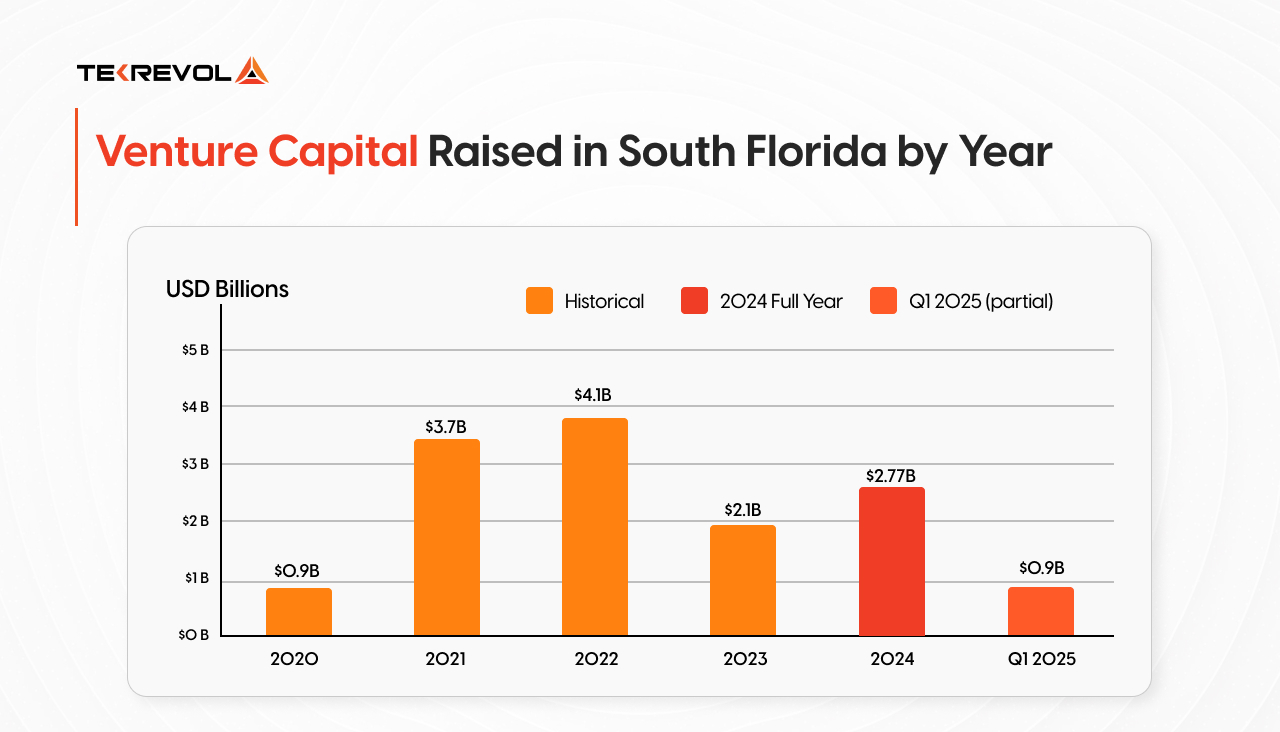
South Florida startups raised $2.77 billion in 2024, ranking 9th nationally by total funding across 323 deals. Q1 2025 alone logged $900 million, putting the region on track to surpass that record, incited in PitchBook via Refresh Miami, 2025.
With over 1,500 active startups and six unicorns already in the market as reported by Miami-Dade Beacon Council, competition for investor attention is real. Founders here carry pressure to show traction fast. An MVP gives you that traction. You ship a product, gather data, and go back to investors with proof, not a pitch deck alone.
Miami’s Fintech, proptech, healthtech, hospitality, and tech all reward speed to market. An MVP fits that rhythm well. Each of these sectors runs on digital products. Founders here are building tools that solve problems like cross-border payments, property management, guest experience, and bilingual healthcare access. The demand is real. So is the funding.
Miami’s investor community moves fast. They fund founders who show traction. An MVP gives you something concrete to bring to that conversation. It turns your idea into a story built on actual user data.
How Much Does MVP App Development Cost in Miami?
A custom MVP development costs between $30,544 and $40,574 on average. Most first-time founders land between $30,000 and $80,000, depending on platform scope and feature depth.
| Complexity | Platform | Features | Integrations | Est. Cost |
| Simple | Single (iOS or Android) | 3–5 | None | $20,000–$30,000 |
| Mid | Single or dual | 5–7 | 1–2 (e.g. Stripe) | $30,000–$60,000 |
| Complex | Dual (iOS + Android) | 7–8+ | 3+ with custom UI | $60,000–$80,000+ |
If you’re budgeting beyond the MVP stage, app development costs in Miami follow a similar structure but with wider ranges as complexity scales. Miami-based founders follow the same cost structure as the broader market.
What Drives MVP App Development Cost in Miami?
Your final number depends on four variables: platform, feature count, third-party integrations, and design complexity.
- Platform: The iOS vs Android decision comes down to your target user and which store your competitors are already on. Most passionate founders launch iOS-first to validate in the App Store. Android is in Phase 2, once user feedback shapes the roadmap.
- Feature count: A true MVP runs on 3–8 core features. Each feature added to that list adds time and cost.
- Integrations: Payment processing, maps, and push notifications each expand your build scope. Pre-built tools like Stripe, Twilio, and Firebase cost less than custom-built alternatives.
- Design complexity: Standard UI templates cost less. Custom visual design adds time and budget to every sprint.
Cost by Client Type
Your cost also shifts based on what you’re building. Two client profiles show up consistently:
| Client Type | Avg. Cost | Typical Build |
| Passion Founder | $40,575 | Consumer apps: marketplaces, social platforms, on-demand services |
| Business Operator | $30,600 | Internal tools and workflow-replacement platforms |
Business operators build within a defined workflow so the scope stays focused. Passion founders build for a new audience, so more features feel essential early.
Either way, both profiles pay on a milestone structure. You pay as features get delivered, sprint by sprint.
Miami Local vs Offshore vs Hybrid
Cost estimates only tell part of the story. Where your team is based and how they’re structured can shift your final number by $30,000 or more, even for the same feature set.
| Hourly Rate | Est. MVP Cost | Best For | |
| Miami Local | $150–200/hr | $60,000–$150,000+ | On-site collaboration, compliance-heavy builds |
| Offshore | $25–75/hr | $20,000–$60,000 | Budget-first, defined feature sets |
| Hybrid | $75–125/hr | $30,000–$90,000 | Most startups, quality and value in balance |
Most Miami startups choose hybrid. You get a US-based mobile app development company for strategy and project management, with a global team running the build. That structure keeps communication tight and costs manageable.
One thing to ask every agency: who runs your development team? Some local agencies charge Miami rates while offshore teams handle the actual build. Get clarity on that before you sign.
How to Build an MVP App for Miami? Process and Timeline
A strong Miami MVP follows four phases: discovery, design, development, and launch. The timeline runs 8–16 weeks from kickoff to App Store.
Here’s how to build an MVP app in Miami, whether you’re launching a hospitality booking app in South Beach, a fintech tool for the Latin American banking corridor, or a real estate platform for Brickell brokers.
| Phase | Duration | What Gets Delivered |
| Discovery Sprint | 2 weeks | User flows, feature roadmap, wireframes, fixed-price proposal |
| Design | 2-4 weeks | UI mockups, branding, clickable prototype (8–12 screens) |
| Build | 4–8 weeks | Working app, single or dual platform, core features live |
| QA + Launch | 1-2 weeks | Bug fixes, testing, App Store, and Play Store submission |
| Total | 8–16 weeks | Launch-ready MVP |
If you’re in Miami and need to launch before funding dries up or a competitor beats you to market, the 8-week floor is realistic for a single-platform MVP with no backend.
The 16-week ceiling is more common for cross-platform app development with API integrations and user-generated content.
Discovery Sprint (2 Weeks)
Discovery is where you map user flows, prioritize features, and nail down your technical architecture before anyone writes code. A 2-week discovery sprint produces wireframes, a feature roadmap, and a fixed-price build proposal.
Most founders skip this step and pay for it later with scope creep and rewrites. We structure discovery as a standalone engagement so you can walk away with a plan even if you decide to pause or build elsewhere.
Design Phase (2-4 Weeks)
Design covers UI mockups, branding, and clickable prototypes. Four weeks is standard for a focused MVP with 8 to 12 core screens. If you need custom illustrations, animation, or a design system that scales across platforms, add another 2 weeks. The output is a prototype you can test with real users before the build phase starts.
Build Phase (4-8 Weeks)
Eight weeks gets you a single-platform MVP with a straightforward feature set: user login, core workflow, basic backend.
Twelve weeks is typical when you need iOS and Android simultaneously, third-party API integrations, or real-time features like chat or location tracking.
We work in 2-week sprints with milestone approvals so you see progress every two weeks, not at the end of month three.
QA and App Store Launch (1-2 Weeks)
Two weeks cover internal QA, bug fixes, and submission to the App Store and Play Store. App Store review averages 24 to 48 hours if your metadata and permissions are clean. Play Store is faster but requires more post-launch monitoring for policy flags.
AI-Compressed Timelines: The 2026 Reality
Those timelines are shifting. AI development tools compress MVP development timelines by 40–60%. The discovery that once took four weeks now takes two. Build phases that ran for 12 weeks can close in 7.
Ask any agency how they use AI in the app development process. The answer tells you how current their workflow is and how far your budget will stretch.
What Should Your MVP App Include?
Most founders build their feature list around everything they want to show. A strong MVP, regardless of vertical, needs the same four-feature foundation: user authentication, the core workflow, push notifications, and analytics.
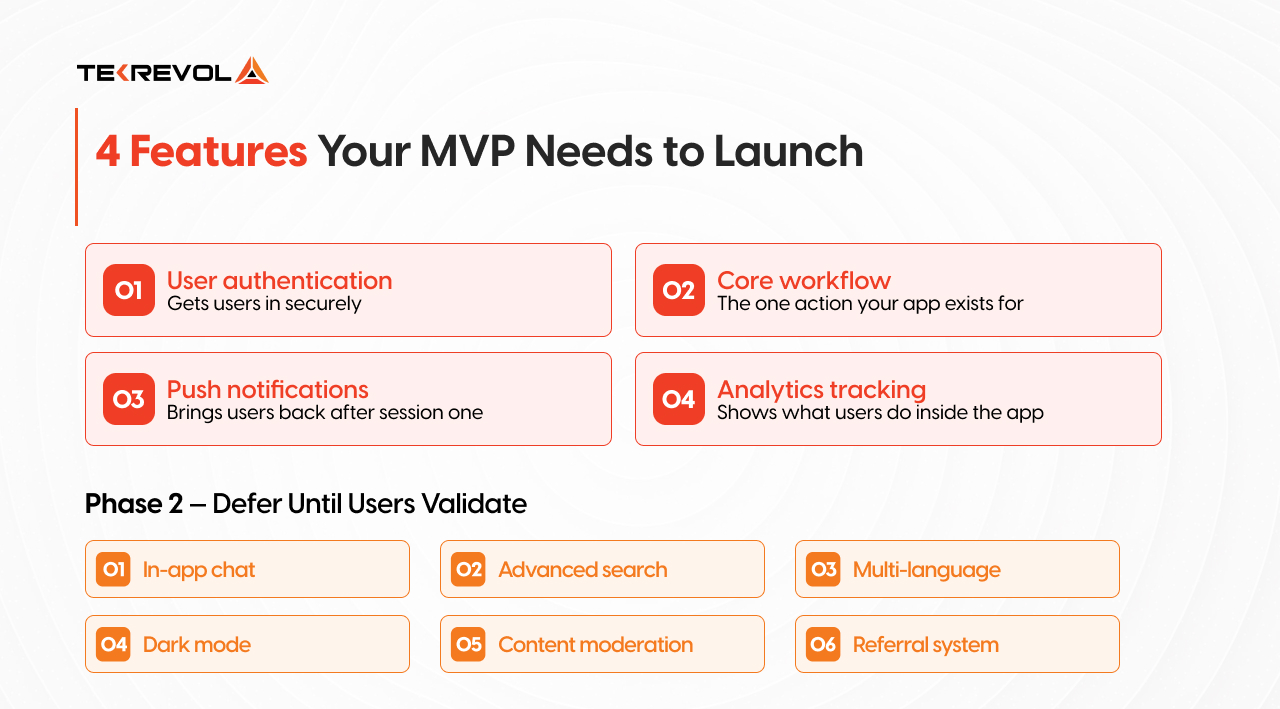
Authentication gets users in, and push notifications bring them back. Your core workflow is the action your app exists to perform. Analytics show you what they do inside. Those four features give you a working product and a real feedback loop.
How to Scope Your MVP Without Cutting the Wrong Things
“Minimum” in MVP means lean, functional, focused, and built around one core action. Your app should do one thing well enough that a real user pays for it or returns repeatedly. That starts with identifying your core user action: the single transaction, behavior, or outcome your app exists to enable.
Here’s what that core workflow looks like across Miami’s most active startup verticals:
| Miami Vertical | Your Core Workflow |
| Fintech | Send or receive a payment, convert currency |
| Proptech | Browse listings or submit a maintenance request |
| Hospitality-tech | Book a service or complete a digital check-in |
| Healthtech | Book an appointment or connect with a provider |
Build that workflow well. Everything else: in-app chat, advanced search, multi-language support, dark mode, and content moderation belong in Phase 2. Add those features after users tell you they matter.
The Two Scoping Errors That Cost the Most
Two patterns show up consistently.
- Cutting the authentication or payment infrastructure to reduce the budget. That removes the ability to validate monetization and measure retention from the start.
- Insisting on an admin dashboard, multi-language support, or gamification in Version 1.0. These features leave the core user action unchanged.
Before you add anything to that list, ask yourself one question:
“If this feature breaks on launch day, does my app stop working or does it feel incomplete?”
If the app stops working, it’s MVP. Or if it feels incomplete, it’s Phase 2. That single filter has saved an average of $30,000 and 8 weeks on first builds.
The MoSCoW Framework for Non-Technical Founders
MoSCoW is a prioritization tool that sorts every feature into four buckets:
- Must have: the app fails without it
- Should have: important, but the app launches without it
- Could have: a strong addition if time and budget allow
- Won’t have this time: Phase 2 and beyond
For a first MVP, your Must Have list should match the four features in the table above. If that list grows beyond six items, run each one through the scoping question. Most will shift to Should Have or Could Have on their own.
Miami’s Top Startup Verticals For MVP Development
Miami’s geographic position creates product opportunities specific to this market. Here, the startup economy runs on four verticals: fintech, healthtech, logistics platforms, and hospitality tech. Each vertical shapes what an MVP looks like and what it takes to launch one successfully.
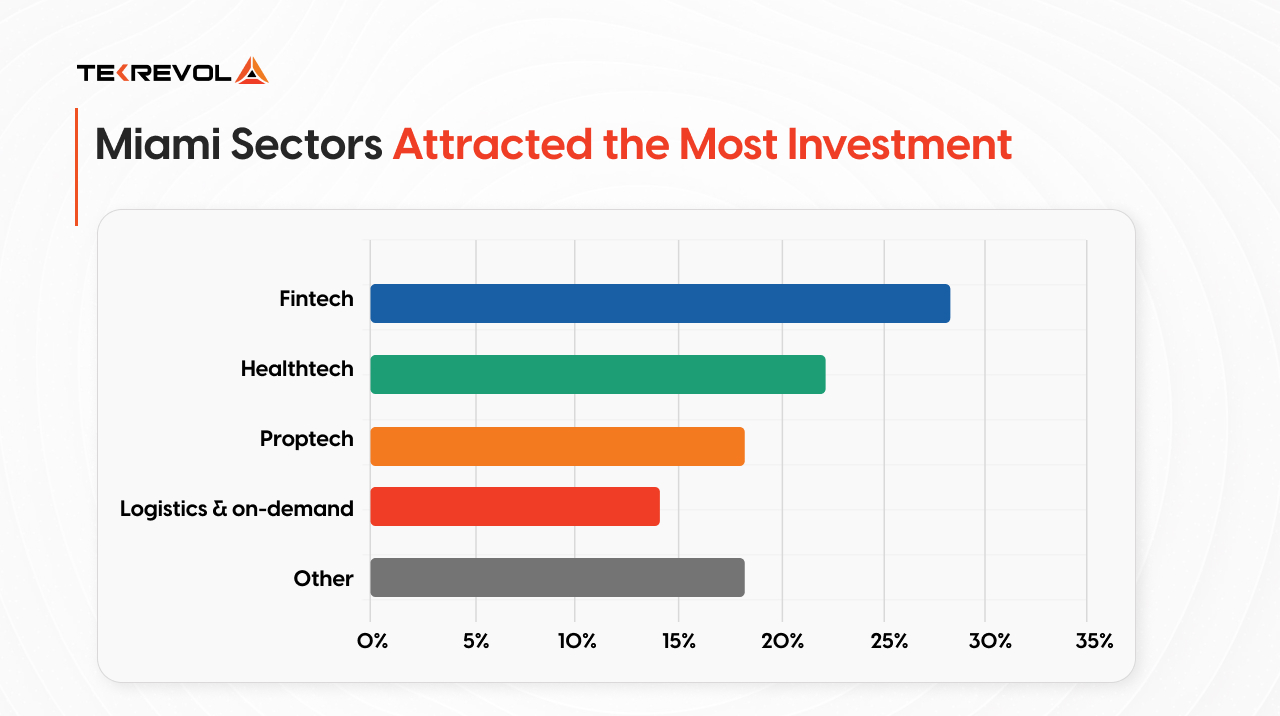
Here’s how each vertical compares on cost and core build requirements:
| Vertical | Est. MVP Cost | Key Build Requirements |
| Fintech | $60,000–$120,000 | PCI-DSS compliance, banking integrations, and audit trails |
| HealthTech | $45,000–$90,000 | HIPAA compliance, data encryption, and provider verification |
| Logistics | $40,000–$90,000 | Real-time tracking, driver dispatch, and payment processing |
| Hospitality Tech | $50,000–$100,000 | Booking system, multi-currency payments, multi-language UI |
Fintech and Payment Platforms
Miami’s fintech market concentrates on three product types: cross-border payments, remittance platforms, and currency exchange tools.
These MVPs require PCI DSS compliance for payment handling, banking partner integrations, and audit trails. That compliance layer sets the minimum threshold for building a fintech app in Miami, which is why fintech MVPs start at $60,000 to $120,000.
HealthTech and Wellness Apps
Miami’s aging population and medical tourism economy drive consistent demand for healthcare app development services.
HIPAA compliance, patient data encryption, and provider verification systems add $15,000 to $30,000 to a baseline healthcare app development cost for Miami.
The bilingual population also creates demand for Spanish-language interfaces, a localization decision that belongs in design. Build compliance into the architecture from the start. Retrofitting it after launch costs far more.
Logistics, Delivery, and On-Demand
Miami’s port infrastructure and urban density make it one of the Southeast’s strongest markets for an on-demand app development company, particularly in last-mile logistics and food delivery. Real-time tracking, driver dispatch, and payment processing are standard requirements. These MVPs range from $40,000 to $90,000, depending on user roles and integration depth. The choice between third-party delivery APIs and custom routing algorithms is the primary cost variable.
Hospitality and Travel Tech
Miami’s tourism economy creates steady demand for hospitality tech products. Booking systems, multi-language interfaces, and multi-currency payment processing are common MVP features in this vertical. Projects start around $50,000 and scale when you add real-time inventory management or dynamic pricing.
Each vertical has a different MVP complexity floor. A social app can be validated at $25,000. A fintech MVP starts at $60,000 because compliance shapes the product from the foundation up.
What Happens After Your MVP Launches
Your MVP launch is the starting point for real product validation. Most of what you learn about your product surfaces in the first 60 days, and how you respond to that data determines whether your product grows.
Post-Launch Support
A 30 to 60-day support window covers the transition from launch to live product. That window includes bug fixes, crash resolution, and performance problems that surface during initial user adoption. App Store and Play Store submission issues fall within scope as well.
Feature additions belong in a Phase 2 conversation. The distinction matters in practice. A login button that breaks is a bug fix. Adding social login is a feature request. Your project manager schedules a two-week post-launch check-in. That session reviews user feedback and sorts what needs immediate attention from what belongs in Phase 2.
When to Move From MVP to Full Build
Move to Phase 2 when user data validates which features are worth investing in. The foundation was already built. Phase 2 added capability on top of the existing infrastructure.
Your Post-Launch Roadmap
- 30 Days: Run your first user feedback sprint. Gather behavior data, support tickets, and feature requests.
- 45 Days: Open the Phase 2 conversation with your development partner. Early discussion produces better scoping.
- 60 Days: Run an analytics review with your project manager. Map user requests to the development effort and priority.
- Before 90 Days: Lock in Phase 2 scoping before your support window closes. Most clients sign Phase 2 contracts within 6–12 months of launch.
Each Phase 2 engagement costs 60–80% of the original MVP budget. Founders who build lasting products treat their MVP as a learning tool. The launch starts the data collection. Phase 2 builds on what that data shows. Once a Phase 2 scope spans multiple user roles, departments, and data layers, the architecture shifts from MVP thinking into an enterprise app development.
How to Measure MVP Success Beyond Downloads
Downloads tell you one thing: people were curious. Retention tells you something more valuable: people came back. A successful MVP surfaces the exact data you need before committing your next budget to Phase 2.
| Metric | What It Measures | Signal to Watch |
| Daily Active Users (DAU) | How many people open your app each day | Consistent or growing week over week |
| 7 / 30 / 90-Day Retention | Whether users return after the first session | 40%+ at day 7 indicates real retention |
| Churn Rate | Percentage of users who leave each month | High day-1 churn points to a UX issue |
| CAC vs CLV | Cost to acquire vs. lifetime value per user | CLV should run at least 3x your CAC |
Eric Ries (American entrepreneur) calls this validated learning, proof that your product solves a real problem people return to solve.
Reading Your Numbers
Your MVP gives you clear signals when you know what to look for.
- If 40% of users return after day 7, you have retention.
- If 60% leave after one session, you have a signal, either a usability issue or a positioning mismatch. Both call for user research before you scope Phase 2.
- And if your CAC sits at $15 and your CLV reaches $80, you have a business model. If those numbers flip, you have a marketing problem to solve before you scale.
Every answer shapes your Phase 2 roadmap.
Build Feedback Loops From Day One
Your MVP should include basic analytics: Google Analytics 4 or Mixpanel. Add in-app feedback prompts and a direct line to your first 100 users.
How to Choose MVP Developers in Miami
Miami’s development market has grown alongside its startup ecosystem. More agencies mean more options. Most founders shortlist three or four candidates from top MVP development companies for US startups before narrowing to one.
The signals worth evaluating show up before you sign. They appear in how an agency talks about process, team structure, and post-launch support.
| Green Flag | Red Flag |
| Shows shipped MVPs with real user metrics | Presents mockups and design files as proof of work |
| Charges a discovery fee before quoting the build | Quotes a full project price on the first call |
| Post-launch support appears in the contract | The post-launch plan is absent from the proposal |
| Introduces the team that builds your product | Avoids specifics on who runs development |
| Case studies include named clients and measurable outcomes | Generic testimonials, metrics, and outcomes are absent |
| Presents a clear path from MVP to full product | Treats the MVP as a one-time, standalone engagement |
The agencies worth trusting plan for Phase 2 before your MVP launches. They quote after discovery, once they understand your scope. Then introduce you to the team building your product. They back every claim with a shipped product and a measurable result.
Ask any agency you speak with for a case study from a client in your vertical. Who manages your project and who writes your code? Ask what the post-launch support window covers. The answers tell you more than any proposal document.
Partner With TekRevol for MVP App Development in Miami
Building an MVP is an investment in validated proof that tells you exactly what to build next. That requires the services of top developers in Miami who know what founders need in the first 16 weeks.
TekRevol has an active Miami presence and has worked with founders across Florida, Texas, and 23 other US states. OnSite Social, a workforce management platform built for field operations teams, is one of the MVPs we’ve shipped for Miami clients. That Southeast track record means you’re working with a team that already knows your market.
We understand the compliance landscape your product operates in. Every build ships to the App Store and Play Store. You go live with a functional product from day one. We structure every MVP engagement with milestone payments, full IP ownership, and a Phase 2 expansion path so your second build starts faster than your first.
Ready to map your idea to a Miami MVP?
TekRevol has helped Miami founders, established businesses, and tech professionals turn ideas into validated, investor-ready products.
Get a free estimate Today


