- In Miami, iOS holds roughly 58% U.S. smartphone market share, making it the dominant platform for premium local audiences
- iOS app development in Miami costs $30K–$80K, while Android runs $40K–$120K due to device fragmentation.
- iOS users spend $10.40 per month on apps, compared to just $1.40 for Android users in the U.S.
- Flutter and React Native reduce Miami app development costs by 30–50% compared to two native builds.
- Android controls 84%+ of the smartphone market in key LATAM markets, making it essential for LATAM expansion plans.
- Miami’s 70% Hispanic population makes Android essential for community-facing apps.
- For most Miami startups, the winning strategy is iOS first, Android second, with cross-platform bridging the gap.
Ask any app developer in Miami about iOS vs Android app development, and watch the room divide. Half will swear by iOS. The other half will defend Android like their career depends on it.
The truth is, both sides have a point. Miami is not like New York or Austin. It is a city of contrasts, where culture, income, and demographics shift block by block.
The short answer: For most Miami startups, iOS first. But if your customer lives in Hialeah, Doral, or Little Havana, or if Latin America is your three-year roadmap, Android belongs in your near-term plan, not your someday plan.
What works in San Francisco will not automatically work on Calle Ocho. Most developers will hand you a technical answer, frameworks, costs, and deployment timelines. But Miami demands you think local first, and this guide will show you exactly how to do that.
This guide covers the full iOS vs Android app development decision in Miami with a mobile app platform comparison built for its unique market, giving you a clear framework to decide which platform deserves your time and money first.
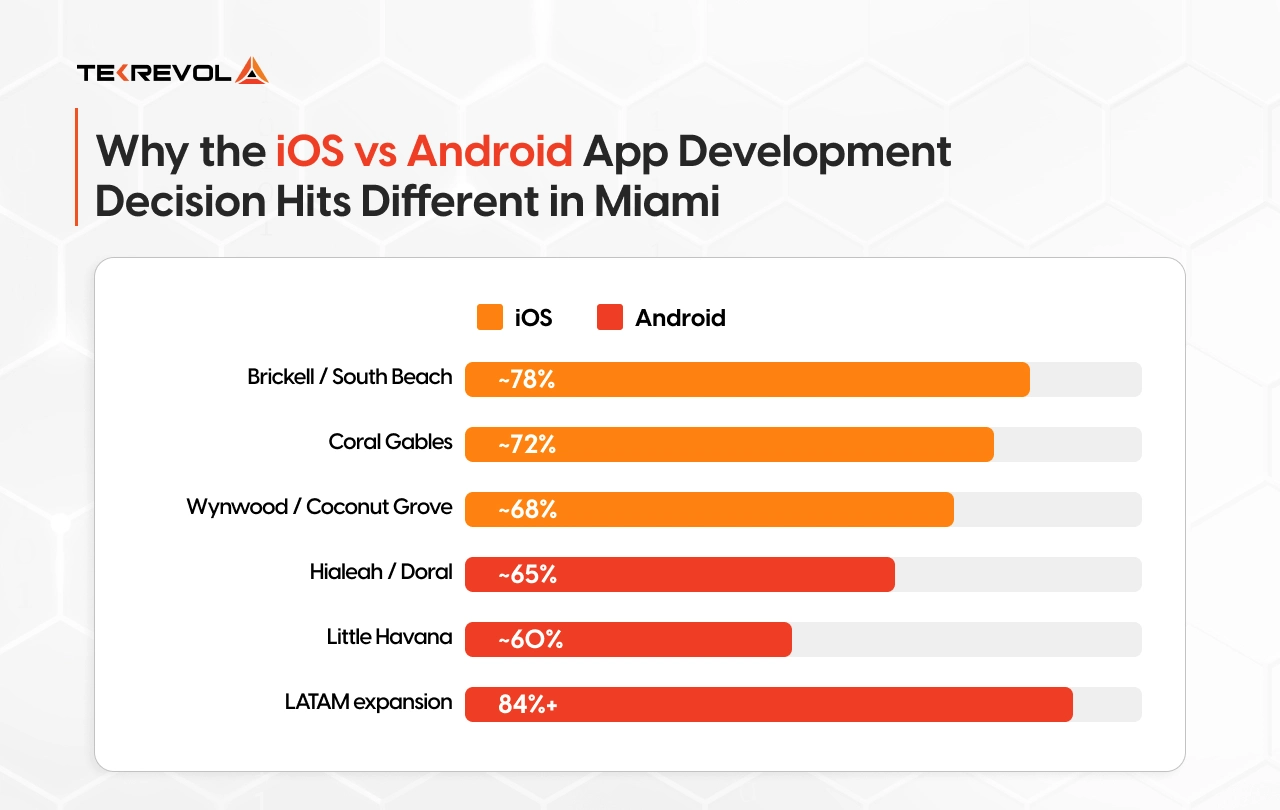
Why the iOS vs Android App Development Decision Hits Different in Miami
Miami has two distinct smartphone audiences, and which one you’re building for determines your platform.
Most articles on this topic give you generic global stats and call it a day. That’s useless if you’re building in Miami. If you’re still evaluating your options, our mobile app development company in Miami structures every build around the city’s unique iOS and Android split, because what works in Chicago will not work on Calle Ocho.
Miami’s Smartphone Market Leans Heavily Toward the iPhone.
Walk into any coffee shop in Wynwood or any co-working space in Brickell. Count the iPhones. The data backs up what you already see.
In the U.S., iOS holds roughly 58–59% of the smartphone market, but Miami is not a typical U.S. city. Due to Miami-Dade’s unique demographics, iOS market share here is likely lower than the U.S. national average.
In Brickell, Coral Gables, and South Beach, Miami’s highest-income professional hubs, the divide is even clearer. Finance professionals, luxury brokers, and corporate lawyers there don’t shop for budget smartphones.
Miami ranks among the top 25 global startup ecosystems, with its 2024 ecosystem valued at $95 billion, and $2.77 billion in venture capital raised that same year. Miami’s investors, founders, and operators largely use iPhones. If you are building a premium product, flawless iOS performance matters.
Miami’s Hispanic Community Changes the Android Equation
Miami-Dade County is nearly 70.3% Hispanic, one of the highest concentrations of any major U.S. metro. That matters for your platform decision more than any global stat will tell you.
28% of Hispanic adults are smartphone dependent; their phone is their primary, and sometimes only, internet connection. That figure jumped from 20% in 2023 to 28% in 2025. Smartphone-dependent people prefer low-cost and easy-to-find gadgets, and Android is the leader in this category in both the U.S. Hispanic market and the countries where the majority of Miami families have strong ties.
If your app is even a little bit geared toward the Miami Latino population, Android isn’t even a consideration. It’s table stakes.
Miami as a Latin America Gateway: The Dual-Market Reality
Miami is the unofficial capital of Latin America. Brands launch here first because cracking Miami means you’ve cracked the gateway to an entire continent of potential customers.
That creates a dual-market reality no other U.S. city faces at this scale. You might be building an app for Miami’s Brickell power brokers today. If your roadmap includes cities like Bogotá, Mexico City, or São Paulo, the platform landscape shifts. Android dominates in Brazil, Mexico, and Colombia, while iOS leads in the United States.
Business Case for iOS App Development in Miami
For most Miami startups, iOS is the smarter first move, and the revenue numbers back it up. Here is exactly why iOS wins for most Miami founders on cost, speed, and revenue.
Higher Spending Power Per User
iPhone users in the U.S. make an average of $85,000 annually, while Android users make $61,000 annually, indicating that they have more purchasing power and a greater digital spending tendency.
The app spend figure is also around $10.40 per month for iOS users versus $1.40 for Android, creating a significant revenue disparity on subscription and in-app purchase revenue.
This is even more pronounced in certain neighborhoods such as Brickell and South Beach, where finance workers and global travelers are the primary users of the premium app.
Faster Development, Leaner Budget
Apple’s closed ecosystem gives Miami founders a real head start. Fewer devices, fewer screen sizes, fewer OS variations. However, building an iOS app is inherently leaner than Android. Lower testing costs, faster delivery, and less runway burned before your first paying user shows up. For startup businesses in Miami, the faster they get it off the ground, the faster they will get validated and start earning revenue.
Investor Confidence Starts With Product Quality
In Miami’s fast-growing startup ecosystem, first impressions matter. When you show up with a polished iOS product, investors can already see that you’ve refined your product, planned your monetization pathway, and chosen the platform your premium users actually live on.
For Miami founders heading into a funding conversation, working with a credible iOS app development company signals execution discipline before you say a word.
The Revenue Advantage of iOS
iOS continues to outperform when it comes to app revenue. Despite Android’s larger global market share, Apple’s App Store continues to generate substantially higher revenue than Google Play, driven by stronger user spending and subscription behavior.
Business Case for Android App Development in Miami
Android is the right first platform when your users live in Miami’s working-class communities or when Latin America is your real target market. Do not let anyone tell you Android is the backup plan. For the right product, in the right Miami context, it is the only logical starting point.
Building For Miami’s Majority Community
Hialeah, Doral, and Little Havana represent some of Miami’s fastest-growing and most diverse populations.
Android dominates globally with over 72% market share, driven by emerging markets and affordability. In Latin America, a key extension of Miami’s ecosystem, Android commands 84%+ smartphone usage across key markets. For logistics, delivery, field services, and small business tools, Android is often the most practical starting point because it aligns with the real device ownership patterns of these communities.
Your Real Market Is Latin America
Miami is the bridge to LATAM, and Android dominates that entire region. Countries like Brazil, Mexico, and Colombia are overwhelmingly Android-first, with iOS representing a much smaller share compared to North America.
Brazil runs 84% Android. Mexico sits at 76%. Colombia follows the same pattern. Across Latin America as a whole, Android commands 84%+ of the smartphone market in key countries, compared to just 42% in the United States. If your roadmap includes expansion beyond Florida, launching on Android in Miami acts as a live testing ground for an entire continent.
Faster Iteration, More Flexible Publishing
Google Play typically allows faster iteration cycles and more frequent updates compared to Apple’s stricter review process. This makes Android especially useful for early-stage startups that need rapid feedback loops and product-market fit validation.
Ad-Supported or Freemium Business Models
Android’s massive global install base makes it the natural home for scale-driven monetization. Ad-supported apps, freemium platforms, and content-heavy utilities all perform better where the audience is largest, and with 3.9 billion Android users worldwide, the math works heavily in your favor.
Still Not Sure Which Platform to Build First? Let Us Decide With You
Get clear, data-driven guidance on whether iOS, Android, or cross-platform development makes the most sense for your app, audience, and business goals.
Claim Your Free Platform AuditiOS vs Android App Development: Core Differences Explained
iOS and Android app development differ at the ecosystem level. iOS is closed and controlled, built for speed and consistency. Android is open, flexible, and fragmented. That single difference drives everything else: your code, your cost, your launch date, and your QA bill, which is exactly why picking the right Android app development company matters as much as picking the right platform.
| Factor | iOS | Android |
| language | Swift / Objective-C | Kotlin / Java |
| IDE | Xcode (Mac only) | Android Studio |
| Ecosystem | Closed — Apple controls everything | Open source — any manufacturer |
| Design System | Human Interface Guidelines (HIG) | Material Design |
| Min. Tappable Size | 44px | 48px |
| Device Range | ~20 active device models | Thousands of device/OS combos |
| QA Complexity | Low — limited devices | High fragmentation across brands |
| Security | High — tightly controlled | Moderate — open source exposure |
| Best For | Fintech, luxury, healthcare, SaaS | B2B, cross-border, custom hardware |
iOS vs Android App Development Cost in Miami
iOS app development cost in Miami typically ranges from $30K to $80K for an MVP. Android costs more, typically $40K–$120K, due to device fragmentation and longer QA cycles. iOS is cheaper to launch because Apple’s closed ecosystem means fewer devices to test, lower testing costs, and faster delivery to market.
This iOS vs Android app development cost Miami breakdown is based on real 2026 market rates.
Here is the full breakdown:
| Factor | iOS | Android |
| Average MVP cost | $30K–$80K | $40K–$120K |
| Local Dev Hourly Rate | $70–$150/hour | $80–$130/hr |
| QA / Testing Time | Shorter (fewer devices) | 20–25% longer |
| App Store Fee | $99/year | $25 one-time |
| Launch Timeline | Faster by ~15–20% | Longer due to fragmentation |
| App Store approval time | 24 to 48 hours. | 12 to 24 hours. |
| Monthly revenue per user (U.S.) | ~$10.40 | ~$1.40 |
| Best for | Fintech, premium, B2C, hospitality | Logistics, community services, Latin expansion |
| Annual Maintenance | 15–20% of the build cost | 20–25% of the build cost |
Android can end up costing 20–30% more overall, even with lower hourly rates, mainly due to device fragmentation increasing testing costs. The right move is to hire Android developers who already know the Miami market and build fragmentation testing into the timeline from day one. iOS demands a higher upfront hourly rate but saves you significantly on QA and post-launch fixes.
iOS and Android App Development Hidden Costs
The quoted development price is never the full picture.
Apple Developer Program: iOS publishing requires a $99 annual Apple Developer Program membership, non-negotiable and renewed every year to keep your app live on the App Store.
Android post-launch maintenance: Because of fragmentation, Android apps surface bugs on specific device/OS combinations that don’t show up in testing. Plan for a larger ongoing maintenance budget, typically 20–25% of your initial build cost per year.
Marketing costs: Whether you launch on iOS or Android, user acquisition in a competitive market like Miami costs an average of $4.70 per install on iOS and $3.70 on Android. iOS users cost more to acquire but spend significantly more in-app. Android users are cheaper to acquire but monetize at a lower rate per user.
Miami-specific advantage: The city’s deep Latin American connections give you access to quality nearshore development teams, particularly strong Android teams, at 30–40% lower cost than U.S. market rates. That changes the Android cost equation if you’re willing to manage a distributed team.
Cross-Platform as a Budget Play
If your Miami startup has a budget under $75K and genuinely needs both iOS and Android at launch, cross-platform frameworks are worth a serious look. Flutter and React Native reduce app development and maintenance costs by 30–50% through a single shared codebase for iOS and Android.
The trade-offs are real. Cross-platform apps can struggle with heavy graphics, AR features, or security-sensitive fintech use cases.
If your app relies on deep native integrations like Apple Pay, ARKit, or complex camera functions, a native app development company is still the better call. For content-driven apps, e-commerce platforms, and MVPs where you need market validation fast, cross-platform is the smarter starting point.
In 2026, cross-platform is no longer a compromise; the real question is which framework best fits your Miami app.
Flutter vs React Native: Which One for Your Miami App?
In 2026, Flutter and React Native both deliver near-native performance for 90% of apps, and cut your build cost by 30–50% compared to two separate native builds. Here’s how to pick:
| Factor | Flutter | React native |
| Built by | Meta | |
| Language | Dart | JavaScript |
| UI Consistency | Pixel-perfect across both platforms | Slight variations possible |
| Best for | Fintech, custom UI, polished consumer apps | Content apps, web teams going mobile |
| Miami dev availability | Growing fast in local agencies | Larger talent pool, easier to hire |
| Cost savings | 30–40% vs native | 30–50% vs native |
Find Out Exactly What Your Miami App Will Cost — Free Estimate in 24 Hours
Share your app idea with our Miami team and receive a detailed, itemized cost breakdown for iOS, Android, or cross-platform development—tailored to your features, scope, and goals.
Get My Free Cost EstimateWhich Platform Makes More Money? iOS vs Android Monetization for Miami Apps
For Miami apps targeting premium users and subscription models, iOS typically delivers higher ARPU and stronger user spending, often generating 2–4x more revenue than Android. Meanwhile, Android performs better for mass-market and ad-supported apps focused on scale.
The iOS Revenue Advantage in Miami’s Market
Miami’s high-income urban demographic amplifies the iOS monetization advantage.
The city’s finance, tech, and real estate sectors are full of people who pay for Calm, pay for Superhuman, and pay for premium apps without thinking twice. Subscription-based apps, SaaS tools, fitness platforms, productivity apps, and digital content perform dramatically better on iOS. Historically and currently, that pattern holds.
If your Miami app is targeting:
- Wealth management clients in Brickell
- Real estate professionals across Miami-Dade
- Corporate wellness programs for Miami’s growing tech workforce
- Premium hospitality or concierge services
iOS is where your revenue will come from. Build there first.
When Android Wins on Revenue in Miami
Ad-supported and freemium models flip the equation.
If your app relies on ad impressions instead of purchases, Android’s scale becomes a major advantage. More users mean more inventory and higher revenue potential.
Miami-specific use cases where Android revenue logic wins:
- Remittance and cross-border payment apps targeting Miami’s Latin community
- Bilingual content platforms serving the city’s Spanish-language market
- Local service apps (delivery, home services, transportation) where driver and worker-side apps run on mixed-device fleets
- Any app building toward the Latin American market expansion, where Android holds 84%+ market share in key LATAM countries
iOS vs Android: Industry-Specific Platform Strategies
When choosing between iOS and Android, your decision should heavily align with the specific industry vertical you are targeting in the South Florida market. User demographics, compliance standards, and monetization strategies vary drastically across sectors.
Fintech
Platform choice plays a massive role in user trust and data security. If you are launching a fintech app in Miami, you must evaluate how each operating system handles biometrics, data encryption, and secure payment gateways, especially when targeting a high-net-worth cross-border user base.
Healthcare
Regulatory landscapes differ significantly when dealing with sensitive patient data. Navigating strict compliance frameworks, such as HIPAA, requires a meticulous engineering approach. For healthcare app development in Miami, developers must ensure that data transmission, cloud storage, and device-level caching meet stringent medical privacy laws on both iOS and Android.
Real Estate
Local market dynamics dictate how your application should leverage hardware features like GPS mapping, high-definition camera arrays, and AR virtual tours. Capitalizing on the local property boom by deploying real estate apps in Miami means tailoring your platform’s user experience to perfectly handle rich property listings and spatial data on the devices your local buyers use most.
Monetization Strategy by Miami Industry Vertical
Miami’s market is vertical-driven, and each industry has a clear platform winner based on who the customer is and how they pay.
| Industry | Platform Recommendation | Reason |
| Fintech / Wealth Management | iOS first | High-income users, subscription-ready |
| Luxury Real Estate | iOS first | Miami agents and buyers on iPhone |
| Health & Wellness | iOS-first | Apple Health integration, premium users |
| Hospitality / Restaurants | Both (iOS consumer, Android staff) | Mixed device environment |
| Latin Market / Remittances | Android-first | Demographic platform preference |
| Cross-border E-commerce | Cross-platform | Dual U.S. + LATAM audience |
| B2B Enterprise Tools | Android or Cross-platform | Mixed corporate device fleets |
Should Miami Startups Build iOS or Android First? The Decision Framework
Most Miami startups should build iOS first, but if your audience includes the Hispanic community or your roadmap targets Latin America, Android belongs in your near-term plan, not your someday plan.
Here’s the clean mobile app platform comparison framework.
Build iOS First If…
For most Miami founders, iOS remains the best mobile platform for startups launching in premium neighborhoods. Here is when to build iOS first:
- Your target customer lives in Miami’s premium markets (Brickell, Coral Gables, South Beach, Wynwood, Coconut Grove
- Your revenue model is subscriptions, in-app purchases, or a paid app
- You’re building in fintech, luxury real estate, health/wellness, or corporate SaaS
- You need to pitch Miami investors with a working product — fast
- Your scale plan targets other high-iOS markets (New York, LA, Chicago, Western Europe)
- You want faster QA, a cleaner dev process, and a shorter road to launch
Build Android First If…
- Your primary users are in Miami’s Hispanic community or the Latin American diaspora.
- Your revenue model is ad-supported or freemium
- Your three-year roadmap includes expansion into Latin American markets
- You’re building a B2B or enterprise tool that runs across mixed corporate device fleets
- You need hardware flexibility, POS systems, IoT, and non-Apple device integrations
- The speed of app submission and iteration cycle matters more than monetization per user
Go Cross-Platform If…
- Your total build budget is under $75K
- You’re building an MVP and need market validation before committing to native.
- Your app is content-driven (media, news, e-commerce) without heavy device-specific features.
- You need to serve both Miami’s local market and Latin American users from day one.
- You want to reduce ongoing maintenance costs by 30–40% with a single shared codebase.
The Miami App Launch Sequence: A Phase-by-Phase Platform Rollout
Most Miami founders don’t fail because they picked the wrong platform. They fail because they tried to build for both simultaneously and burned their runway before finding product-market fit. Here’s the sequence that actually works:
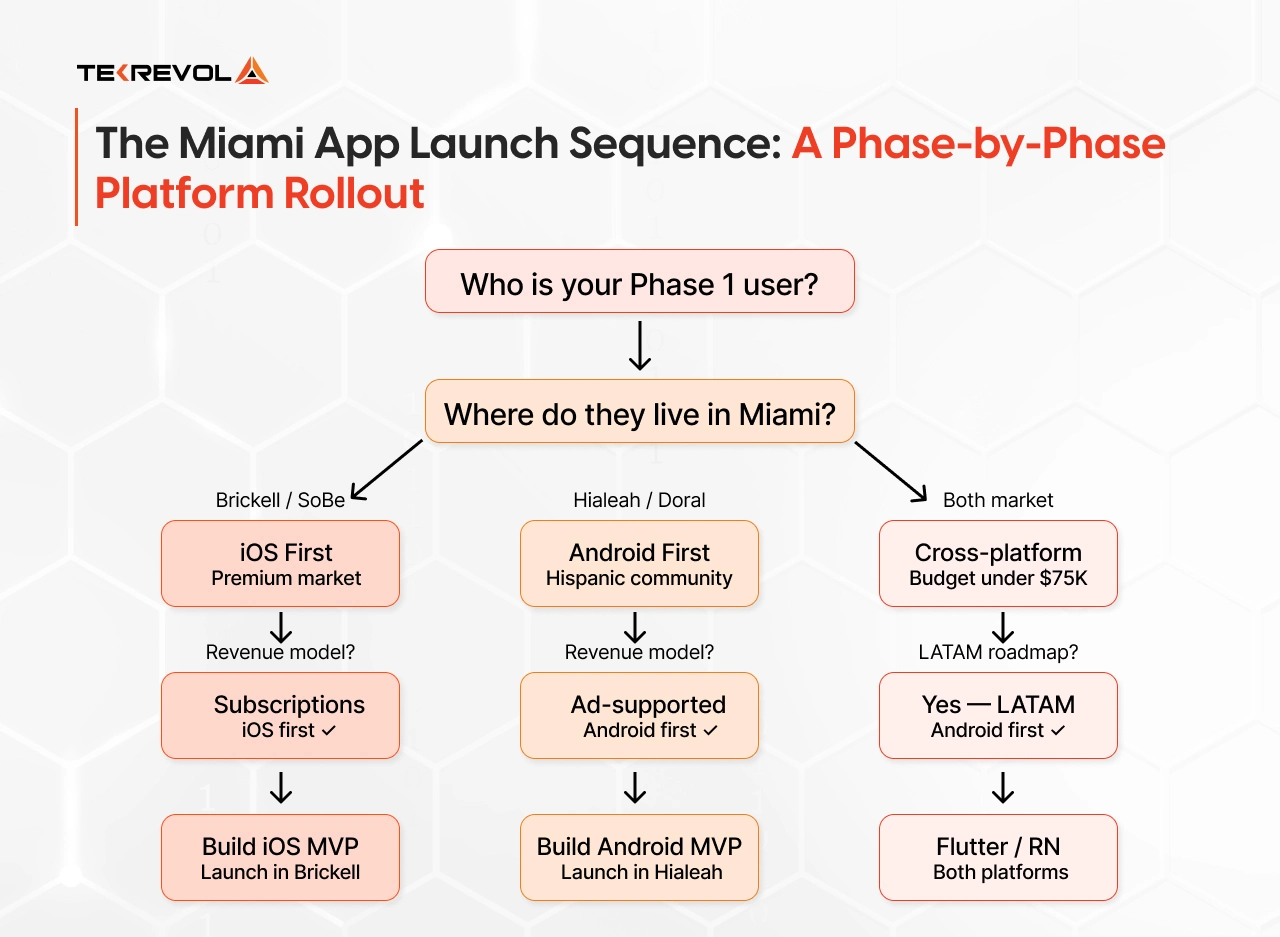
Phase 1: Month 0 to 6: Launch and Validate on Your Primary Platform
If iOS is your call, build an MVP for Miami and get it in front of users in Brickell, Wynwood, Coral Gables, and South Beach. Keep the feature set tight. Measure three things only: retention, revenue per user, and churn.
If Android is your call, launch in Miami’s Hispanic communities or soft-launch for a LATAM audience. Use Google Play’s faster publishing cycle to iterate quickly. Treat this phase as your live testing ground before you scale.
Phase 2: Month 6 to 12: Expand to Your Second Platform
Now you’re not guessing, you’re replicating a validated product for a new audience. iOS founders expand to Android to capture Miami’s Latin community and begin their LATAM growth play. Android founders expand to iOS to access higher-spending users and strengthen their investor narrative. This phase pays for itself because you already know what works.
Phase 3: Month 12 and Beyond: Optimize, Maintain, and Scale
Two live platforms mean two maintenance cycles, two QA pipelines, and two update schedules. This is the moment to evaluate whether Flutter or React Native can consolidate your codebase without sacrificing the product quality your users already expect. Not at the start, but when the operational burden of maintaining two native builds becomes clear, and the trade-offs start to matter.
5 Questions to Ask Any Miami App Development Agency Before You Sign
Most agencies will tell you what you want to hear. These five questions will tell you what you need to know:
- Who is your primary user, and what device are they on? If an agency recommends a platform before asking this question, walk out. Platform choice follows the audience. Always.
- Can you show me the apps you’ve launched for Miami’s market specifically? Local experience matters. A portfolio full of generic e-commerce apps built for clients in Ohio tells you nothing about building for Brickell or Hialeah.
- What is your device testing process for Android fragmentation? Any serious Android shop should have a clear answer. If they say “we test on a few devices,” that’s a red flag worth taking seriously.
- How do you handle App Store rejection cycles? Apple rejects apps. It happens to everyone. What separates good agencies from expensive ones is how fast they diagnose, fix, and resubmit. Ask for a real example.
- What does post-launch maintenance actually include, and what does it cost? The quoted build price is never the full picture. Get the maintenance scope in writing before you sign anything.
Why Choose Tekrevol for Your App Development Project in Miami
At TekRevol, we don’t lead with a tech stack recommendation; we lead with your market. Miami is our home, and we understand its nuances in a way that generic dev shops simply don’t. From Brickell fintech founders to Hialeah small business owners, we’ve built for the full spectrum of Miami’s diverse, demanding user base.
Our team has delivered iOS, Android, and cross-platform apps across fintech, real estate, hospitality, and LATAM-facing markets, with local market intelligence baked into every product decision we make.
- Miami-native market knowledge: we know which platforms your customers are actually on, block by block
- Full-spectrum development: iOS, Android, Flutter, and React Native under one roof, no outsourcing surprises
- LATAM-ready builds: bilingual UX, currency integrations, and cross-border functionality built in from day one.
- Transparent cost structures: no hidden QA bills, no surprise maintenance fees, no “that’s out of scope” conversations mid-build
- Proven Miami portfolio: real apps, real users, real revenue across the city’s highest-growth industries
Get a Free 30-Minute App Strategy Session With Our Miami Team
Our Miami-based experts will review your idea, target audience, and budget, then provide a clear, actionable platform recommendation tailored to your business goals.
Let’s Connect!