Businesses in Miami are investing in mobile apps faster than ever as customer expectations shift toward seamless digital experiences. But most app development cost guides still treat Miami like a standard US market, ignoring the unique factors that significantly impact development costs here.
Building a mobile app in Miami costs between $25,000 for a basic MVP and $400,000+ for a complex enterprise platform. The range is wide because complexity, platform choice, bilingual requirements, and industry-specific compliance all move the number significantly.
Miami is not an ordinary US market. It is one of the fastest-growing tech ecosystems in the country, and building an app here has specific requirements that generic cost guides completely miss. The bilingual English/Spanish UX requirement alone adds $8,000–$20,000 to any serious Miami app build. Florida regulatory compliance for healthcare and fintech adds tens of thousands more.
This is why working with a mobile app development company in Miami requires more than standard development expertise; it demands local market understanding, bilingual product strategy, and experience with Florida-specific compliance requirements.
Whether you are a Brickell fintech founder, a Wynwood startup building your first product, or an SME in Coral Gables exploring digital transformation, this guide breaks down exactly what your app development cost in Miami and why.
Let’s get into it.
How Much Does It Cost to Build an App in Miami?
Building an app in Miami typically costs $25,000–$60,000 for a simple app, $75,000–$150,000 for a medium-complexity app, and $150,000–$400,000+ for enterprise platforms. Miami-specific requirements like bilingual UX, LatAm payment integrations, and Florida compliance can further increase overall development costs.
Here is the quick reference before anything else:
| App Type | Miami Cost Range | Timeline |
| Simple / Basic App | $25,000–$60,000 | 2–4 months |
| MVP (Minimum Viable Product) | $30,000–$75,000 | 8–14 weeks |
| Medium Complexity App | $75,000–$150,000 | 4–7 months |
| Complex / Enterprise App | $150,000–$400,000+ | 7–14+ months |
Miami developer hourly rates sit between $65–$190/hour, depending on seniority. That is competitive with major US tech hubs, and reflects the talent concentration Miami has built since its 2021 tech wave brought thousands of developers from New York, San Francisco, and internationally.
| Developer Level | Miami Rate ($/hr) |
| Junior Developer | $65–$85 |
| Mid-Level Developer | $85–$130 |
| Senior Developer | $130–$190 |
| Lead / Architect | $190–$300 |
These numbers matter because most Miami agency proposals are based on hourly estimates multiplied by team size and timeline. Understanding the rate structure helps you evaluate whether a quote is fair or whether someone is padding margins.
Hiring mobile app developers in Miami means getting these rates with a full team structure, project manager, designer, developer, and QA under one engagement.
Why Miami App Development Rates Reflect a Maturing Tech Ecosystem
Miami app development rates reflect a tech ecosystem that has rapidly matured since 2021. The city attracted experienced developers from major global tech hubs, creating a strong talent pool with expertise tailored to Miami’s business landscape.
- Strong expertise in bilingual English/Spanish app development
- Deep understanding of LatAm payments and compliance systems
- Specialized experience in fintech, tourism, and hospitality apps
- Growing tech hubs in Brickell, Wynwood, and Miami Beach
- Access to talent with both US and international market exposure
Miami is no longer just an emerging tech city. It has become a specialized development market where businesses pay for regional expertise, industry knowledge, and scalable product execution.
Got a Miami App Idea but No Idea What It Should Cost?
Stop guessing. TekRevol gives you a fixed-price, milestone-structured proposal within 48 hours, built for Miami's bilingual, LatAm-facing market.
Get My Miami App QuoteWhat App Type Are You Building and What Does It Cost in Miami?
The most reliable way to estimate your Miami app development cost is by app type and industry. A simple booking app costs $25,000–$60,000, a marketplace costs $100,000–$200,000, and a fintech or healthcare app with Florida compliance requirements costs $150,000–$400,000+.
Simple Apps ($25,000–$60,000)
Simple apps have basic functionality. Login and signup, a profile page, push notifications, and a core action — booking, browsing, or contacting.
Miami examples: local restaurant reservation apps, South Beach venue directories, retail loyalty apps for Brickell City Centre merchants, basic service booking apps.
Timeline: 2–4 months. Platform recommendation: Flutter for cross-platform reach, it covers the English and Spanish-speaking Miami audience simultaneously without doubling the build cost.
MVP Apps ($30,000–$75,000)
Building an MVP in Miami allows you to deploy a functional, lean version of your product to the App Store, proving your business model before unlocking heavier secondary funding tiers.”
Miami examples: early-stage fintech wallets, proptech listing apps for the Coral Gables or Coconut Grove market, and on-demand service platforms for the Wynwood startup community.
Critical Miami-specific decision at MVP stage: build Spanish language support from day one. Retrofitting it after launch costs 40–60% more than building it in from the wireframe stage.
Medium Complexity Apps ($75,000–$150,000)
These are apps with custom UI, backend systems, API integrations, and multiple user roles.
Miami examples: e-commerce apps for South Florida retail brands, healthcare appointment platforms for Doral-area clinics, food delivery apps in Miami serving neighborhoods from Little Havana to Hialeah.
Timeline: 4–7 months. Bilingual UX (English/Spanish) is effectively mandatory at this tier for any consumer-facing Miami app.
Complex and Enterprise Apps ($150,000–$400,000+)
These are multi-platform, compliance-heavy, integration-rich platforms. They require the most experienced development teams and the most careful planning.
Miami examples: LatAm-facing fintech app development company in Miami requiring FinCEN compliance and cross-border payment architecture.
Also, a healthcare app development company serving Jackson Health System’s patient base, and real estate platforms integrating Miami MLS and property transaction data.
Timeline: 7–14+ months, including regulatory review periods.
Cost by Miami Industry
| Industry | Miami Cost Range | Key Add-On |
| Fintech / Crypto | $150,000–$400,000+ | FinCEN compliance, LatAm payment rails |
| Real Estate / PropTech | $80,000–$200,000 | Miami MLS API, Florida DBPR |
| Healthcare / Telemedicine | $120,000–$300,000 | HIPAA, Florida AHCA requirements |
| Hospitality / Tourism | $60,000–$150,000 | Multilingual UX, booking integrations |
| On-Demand / Delivery | $80,000–$180,000 | Spanish-English bilingual, geofencing |
| E-commerce / Retail | $60,000–$130,000 | Spanish catalog, local logistics APIs |
Fintech
Financial technology platforms carry premium pricing due to intense security infrastructure. Building a secure fintech app in Miami requires allocating a significant portion of your budget to real-time bank account integrations, automated anti-money laundering (AML) protocols, and multi-factor authentication systems that satisfy federal monetary compliance laws.
Healthcare
Medical software requires specialized architecture to avoid heavy legal liabilities. Navigating regional and federal patient data protections adds specialized QA steps to your timeline. Achieving structural compliance for a healthcare app in Miami demands end-to-end database encryption and secure server environments that satisfy HIPAA data-handling parameters.
Real Estate App Development Cost
PropTech applications rely heavily on massive data aggregation and mapping systems. Building scalable real estate apps in Miami means budgeting for advanced geographic features, custom administrative dashboards, and continuous synchronization with regional MLS databases to supply live property inventories to local buyers.
Yeppy is a super app built by TekRevol that combines financial services, bookings, retail, and exclusive deals into one platform. The multilingual payment and UX architecture developed for Yeppy directly mirrors what Miami’s LatAm-facing super app and fintech platforms require — English/Spanish switching, multiple payment rails, and scalable infrastructure for a culturally diverse user base.
What Factors Drive App Development Costs in Miami, specifically?
The eight factors that most significantly affect app development cost in Miami are given below.
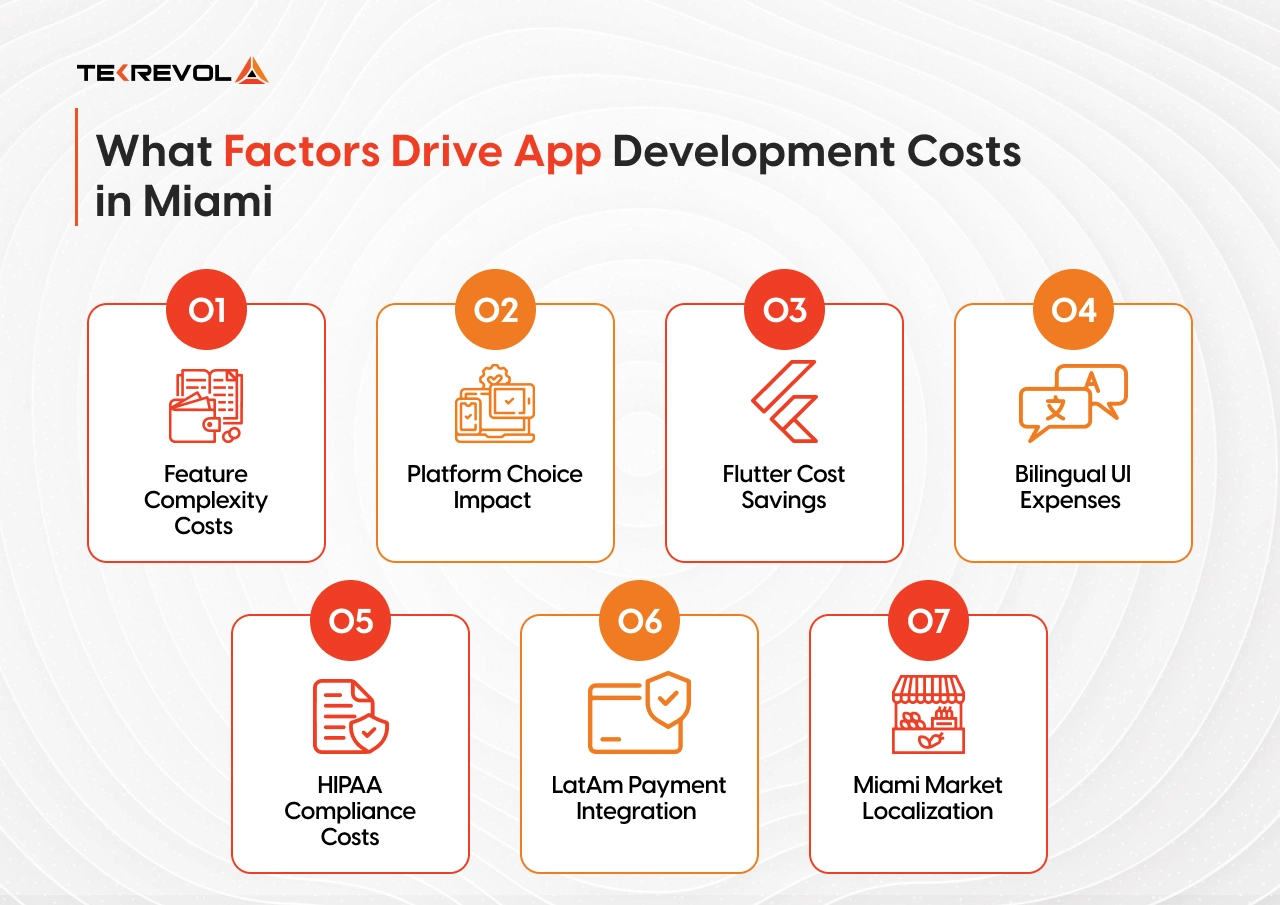
Feature Complexity
Every feature adds development hours. Here is what individual features actually cost in Miami’s market:
| Feature | Cost Range |
| User authentication | $2,000–$6,000 |
| Payment integration (Stripe) | $5,000–$12,000 |
| Geolocation (Miami neighborhood precision) | $4,000–$10,000 |
| Push notifications | $2,000–$5,000 |
| In-app chat/messaging | $6,000–$15,000 |
| AI/ML features | $12,000–$40,000+ |
| Bilingual English/Spanish UI | $8,000–$20,000 |
| HIPAA Florida compliance architecture | $15,000–$35,000 |
| LatAm payment gateway integration | $8,000–$20,000 |
iOS vs. Android App Development in Miami
Platform choice is one of the most consequential early decisions, and it directly affects your budget. iOS vs Android app development in Miami breaks down differently than in most US cities.
Miami’s market tends toward iOS among the premium consumer and B2B segment, Brickell, Coral Gables, and Miami Beach. Android has stronger penetration across the broader South Florida market, including Hialeah, Homestead, and much of the Spanish-speaking demographic.
While precise split data varies by source, most Miami app teams plan for a genuinely mixed platform environment.
| Platform | Cost Impact | Miami Market Fit |
| iOS only | Baseline | Premium, B2B, fintech in Brickell |
| Android only | Baseline | Broader Miami market, higher Spanish-speaking reach |
| Cross-platform Flutter | -20–30% | Best for most Miami startups needing both audiences |
| Dual native iOS + Android | +40–60% | Enterprise healthcare, regulated fintech |
For most Miami startups and SMEs, Flutter is the right call. One codebase. Both platforms. Full bilingual support. 20–30% cost savings vs. dual native.
The Bilingual Factor — Miami’s Unique Cost Driver
This is the cost factor no national guide mentions, and the one that matters most in Miami.
Over 67% of Miami-Dade County residents speak Spanish at home. That is not a target demographic to consider. That is the Miami market. An app without genuine Spanish support is not built for Miami.
What does building Spanish support from day one cost?
- UI/UX design for both languages from the wireframe stage: +$5,000–$15,000
- Spanish copywriting by native Miami/South Florida writers: +$3,000–$8,000
- Bilingual App Store Optimization: +$2,000–$5,000
- Bilingual content management system: +$5,000–$12,000
Total bilingual add-on built from day one: $15,000–$40,000
Total bilingual retrofit added after English-only launch: $25,000–$75,000
Build it in. The math is obvious.
TekRevol developed Mdrouz, a multi-vendor eCommerce platform that required deep localization for regional markets. This project mirrors the Miami market’s need for seamless bilingual (English/Spanish) switching and regional payment integrations. The proptech UX overhaul was delivered in 14 weeks within the mid-complexity app timeline, with bilingual English/Spanish listing descriptions built into the architecture from sprint one.
Florida-Specific Regulatory Compliance
Miami apps in regulated industries face compliance requirements that most generic cost guides do not account for:
Fintech compliance (Florida-specific):
- Florida Office of Financial Regulation (OFR) licensing requirements
- FinCEN registration for money service businesses
- Bank Secrecy Act (BSA) compliance architecture
- AML/KYC system build: adds $20,000–$60,000
Healthcare compliance (Florida-specific):
- HIPAA technical safeguards: $15,000–$35,000
- Florida Agency for Health Care Administration (AHCA) requirements
- Florida telehealth statutes (Chapter 456, Florida Statutes) — specific to telemedicine apps operating in the state
Real estate compliance:
- Florida Department of Business and Professional Regulation (DBPR) requirements for licensed real estate agents
- Miami Association of Realtors MLS API integration: $8,000–$20,000
Miami’s LatAm Business Context
Miami is the US headquarters for hundreds of Latin American companies building apps for both the US and LatAm markets simultaneously. This creates development requirements unique to Miami:
- Dual market architecture: US regulations + LatAm payment systems in one codebase
- Currency handling: USD + local LatAm currencies
- LatAm payment gateway integration: Mercado Pago, PIX, OXXO
- Cross-border data compliance considerations
Dual-market LatAm/US architecture is one of the most common project types TekRevol handles for Miami clients, and it is a cost and complexity factor that simply does not exist at this scale in any other US city.
Working with a custom software development company that has built this architecture before means you are not paying for their learning curve.
What Is the Phase-by-Phase Cost Breakdown of Building an App in Miami?
Miami mobile app development costs break down across six phases, from discovery and UI/UX design to development, testing, and post-launch maintenance. Early-stage planning and design usually account for 10–20% of the budget, while core development consumes the largest share due to frontend, backend, API, and infrastructure work.
Phase 1 — Discovery and Strategy ($5,000–$25,000 | 1–3 Weeks)
This is where your entire project gets defined. Feature prioritization, technical feasibility, regulatory mapping, and bilingual scope.
Miami-specific: discovery must include Spanish-language user research. Miami’s Spanish-speaking users behave differently in apps than English-speaking users — payment preferences, navigation patterns, and trust signals differ meaningfully.
Skipping discovery is the single most expensive decision a Miami founder makes. Every dollar here prevents $5–$10 of rework in development.
Phase 2 — UI/UX Design ($8,000–$40,000 | 2–5 Weeks)
Wireframes, visual design, interactive prototype, and user testing.
Miami-specific: design must work in English AND Spanish from the wireframe stage — not as a post-design adaptation. Miami’s multicultural aesthetic, shaped by Cuban, Colombian, Venezuelan, and Caribbean design sensibilities, differs from generic US app design. Your visual design needs to resonate with a genuinely diverse audience.
Phase 3 — Development ($40,000–$280,000 | 6–20 Weeks)
This is the largest cost block, and where Miami-specific integrations add the most budget impact.
Miami-specific integration costs:
- Stripe + LatAm payment gateway (Mercado Pago): $8,000–$20,000
- Miami MLS API integration: $8,000–$20,000
- HIPAA Florida AHCA compliance: $15,000–$35,000
- Bilingual content management system: $5,000–$12,000
- FinCEN compliance system architecture: $20,000–$60,000
Houze Hook Up is a real estate app built by TekRevol with a TikTok-style swipe feed that replaces static listings with a scroll-based discovery experience. The redesign led to 3x more clicks than traditional real estate interfaces, showing how mobile-first UX drives higher engagement in proptech.
Phase 4 — QA and Testing ($8,000–$30,000 | 2–4 Weeks)
Functional testing, performance testing, security testing, and UAT.
Miami-specific: bilingual QA is a completely separate test cycle. Every screen needs independent testing in Spanish AND English. This is not the same as running English tests twice; Spanish UI layouts, text expansion behavior, and form field rendering require dedicated Spanish-language QA sessions.
Phase 5 — App Store Launch ($3,000–$8,000 | 1–2 Weeks)
App Store and Google Play submission, bilingual metadata, screenshots in both languages, ASO setup.
Miami-specific: Spanish App Store metadata (title, description, keywords, screenshots) is a separate optimization exercise from English ASO. Spanish-speaking Miami users search differently from English-speaking users. You need both optimizations to capture organic downloads across the full Miami market.
Phase 6 — Post-Launch Maintenance ($8,000–$60,000/Year)
Annual maintenance is 15–20% of your initial development cost. It covers OS updates, bug fixes, security patches, server hosting, and feature iterations.
Miami-specific ongoing costs: Spanish content updates, LatAm payment API changes, Florida regulatory framework updates, and annual iOS/Android OS compatibility updates.
Not Sure Which Phase Is Eating Your Budget?
TekRevol breaks your Miami app into a phase-by-phase cost roadmap — so you know exactly what you are paying for before development begins.
See My Cost Breakdown
How Long Does It Take to Build an App in Miami? (2026 Timelines)
Miami app development timelines follow the same complexity drivers as cost, but three Miami-specific factors consistently extend timelines beyond national averages.
Timeline by App Type:
| App Type | Development Timeline | With Miami-Specific Requirements |
| Simple / Basic App | 2–4 months | +2–3 weeks (bilingual QA) |
| MVP | 8–14 weeks | +2–4 weeks (Spanish UX + compliance) |
| Medium Complexity | 4–7 months | +4–6 weeks (bilingual + integrations) |
| Enterprise / Regulated | 7–14+ months | +2–4 months (Florida regulatory review) |
Three Miami-Specific Timeline Drivers:
- Bilingual QA is a separate cycle — every screen tested independently in Spanish and English adds 1–2 weeks per sprint. Teams that plan for this upfront stay on schedule. Teams that discover it mid-sprint fall behind.
- Florida regulatory review runs outside your control — Florida telehealth licensing takes 4–8 weeks minimum. OFR fintech licensing takes 3–6 months. Starting these on day one of the project, not after the app is built, is the single most important timeline decision a Miami founder makes.
- LatAm payment gateway sandbox delays — Mercado Pago and regional LatAm gateway sandbox credential initiation takes 1–3 weeks. If not initiated at project start, it becomes a blocker during the payment integration sprint.
Freelancer vs. Miami Agency vs. Offshore — Which Model Fits Your Budget?
For most Miami startups and SMEs, a local or regional Miami development agency delivers the best value. It’s because bilingual UX, LatAm payment integration, and Florida compliance require market knowledge that offshore teams and generalist freelancers consistently lack.
Miami-Based Agency ($100–$170/hr)
Full team: PM, designer, developer, QA. Miami market knowledge. Bilingual capability. Local accountability.
Best for: fintech, healthcare, real estate, LatAm-facing apps. What you pay: $100,000–$350,000 for most serious projects.
Hiring top mobile companies in Miami at this tier means getting teams that have already solved the problems your project will face, bilingual architecture, Florida compliance, LatAm payment integration, rather than figuring it out on your budget.
South Florida Regional Agency ($75–$130/hr)
Similar service to Miami-based agencies at 15–20% lower cost. Still has local market knowledge.
Best for: medium-complexity consumer apps, e-commerce, hospitality platforms. What you pay: $75,000–$250,000 for most projects.
Miami-Based Freelancers ($55–$100/hr)
Lower upfront cost. No team continuity. No PM. Limited post-launch support.
Best for: simple apps where you have a technical lead managing the work. Risk: cost overruns from scope drift and lack of project management are common.
Offshore with Miami Project Management ($50–$90/hr blended)
Lowest cost option for full builds. Significant trade-offs for Miami-specific requirements.
Risk: offshore teams miss bilingual UX nuance, LatAm payment specifics, and Florida compliance details that in-market teams handle automatically. What you pay: $40,000–$120,000, but budget 15–25% more for rework from communication gaps.
Comparison Summary
| Model | Hourly Rate | Best For | Miami Market Knowledge |
| Local Miami Agency | $100–$170 | Complex, regulated, LatAm-facing | Excellent |
| South Florida Agency | $75–$130 | Mid-complexity consumer apps | Strong |
| Miami Freelancer | $55–$100 | Simple apps with existing PM | Variable |
| Offshore + Miami PM | $50–$90 blended | Budget-constrained builds | Limited |
Miami vs. Other US Cities — Is Building Here Worth It?
| Market | Avg Agency Rate | Bilingual Capability | LatAm Payment Expertise | Florida Compliance Knowledge |
| Miami | $100–$170/hr | Native | Strong | Strong |
| New York | $150–$250/hr | Limited | Limited | N/A |
| Austin | $100–$160/hr | Limited | Limited | N/A |
| Los Angeles | $120–$200/hr | Moderate | Moderate | N/A |
| Offshore (blended) | $40–$80/hr | Variable | Weak | None |
For apps that do not require Spanish support, LatAm payment architecture, or Florida compliance, New York or Austin agencies offer comparable technical capability at similar or slightly higher rates.
For any Miami-market consumer app, LatAm-facing fintech, or Florida-regulated healthcare platform, Miami-based or Miami-experienced teams deliver expertise that cannot be replicated by importing a generic US development team.
What Are the Hidden Costs of App Development in Miami Nobody Mentions?
Many businesses budget only for development and overlook hidden app development costs like third-party API subscriptions, cloud hosting, App Store fees, maintenance, security upgrades, and post-launch bug fixes.
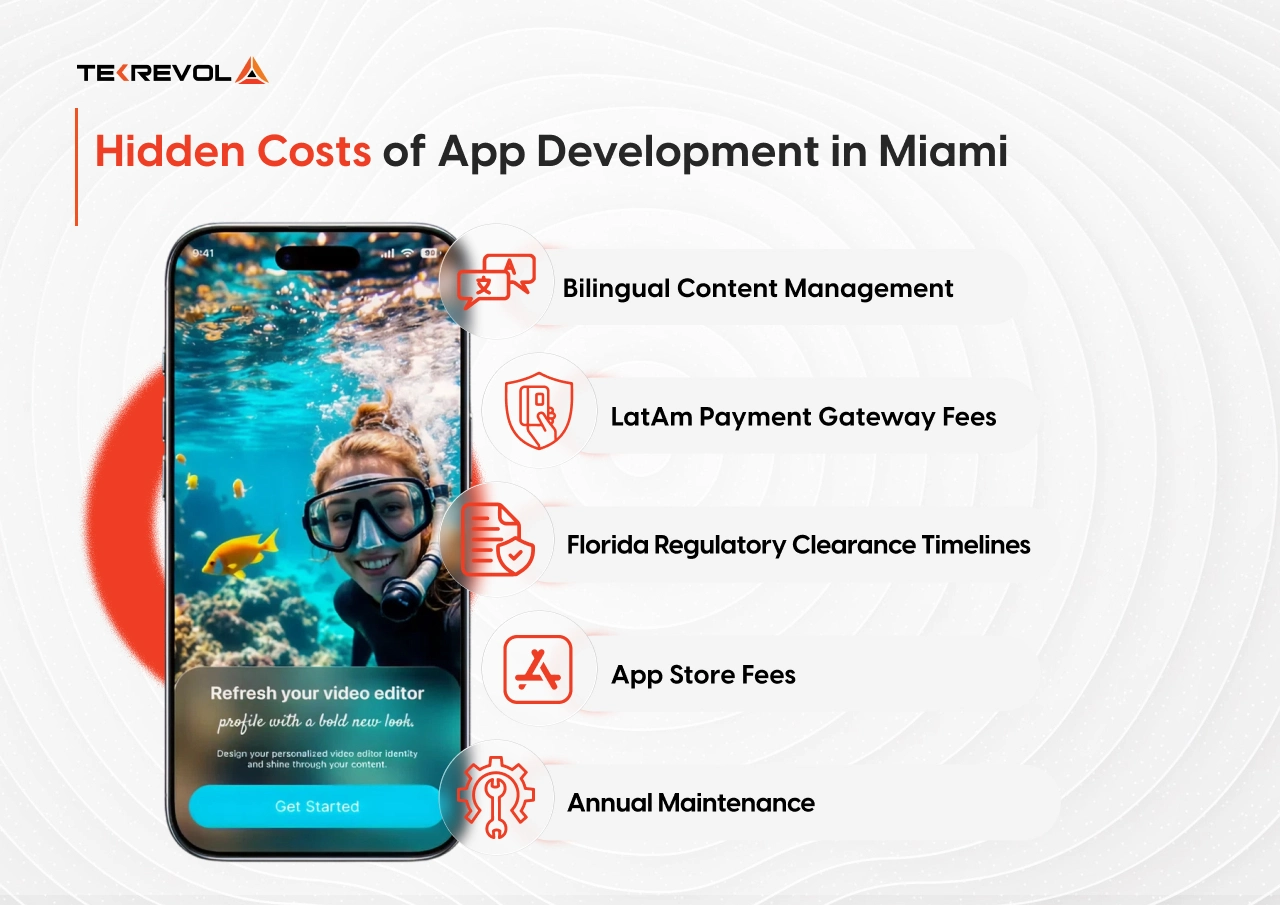
In Miami, costs can also increase due to compliance requirements, bilingual UX needs, scalability planning, and ongoing feature updates required to stay competitive in fast-moving industries.
Bilingual Content Management
- Spanish content updates: $500–$2,000/month for active apps
- Spanish QA for every new feature sprint: adds 1–2 weeks per sprint
- Spanish App Store update management: $500–$1,500 per major update cycle
LatAm Payment Gateway Transaction Fees
- Stripe standard rate: 2.9% + $0.30 per transaction
- Mercado Pago: 2.79–4.99% per transaction, depending on card type and region
- At $1M/year in transactions, payment fees consume $29,000–$50,000 annually
- Build this into your unit economics from day one — not after you see your first monthly statement
Florida Regulatory Clearance Timelines
These are completely outside your development team’s control, and most founders discover them too late:
- Florida telehealth app licensing review: 4–8 weeks minimum
- Florida Office of Financial Regulation fintech licensing: 3–6 months
- Start these applications on day one of your project — run them in parallel with development, not sequentially after
App Store Fees at Scale
- Apple Developer Account: $99/year
- Google Play Account: $25 one-time
- App Store commission: 15–30% on in-app purchases and subscriptions (15% for developers earning under $1M/year under Apple’s Small Business Program)
- At $500,000/year in subscription revenue, App Store commissions consume $75,000–$150,000 annually
Annual Maintenance Reality
15–20% of your build cost per year. Not optional. Not negotiable with iOS and Android releasing major OS updates annually.
| Build Cost | Annual Maintenance Estimate |
| $50,000 | $7,500–$10,000/year |
| $100,000 | $15,000–$20,000/year |
| $200,000 | $30,000–$40,000/year |
| $400,000 | $60,000–$80,000/year |
Budget for this before you sign a development contract. It will exist regardless.
How Can You Reduce Your App Development Cost in Miami Without Cutting Corners?
Miami founders can reduce app development costs by 20–40% through MVP-first scoping, Flutter cross-platform development, and locking feature scope before development begins. Costs can be reduced further by building Spanish support from day one and partnering with an agency that already has pre-built Miami-specific integrations.
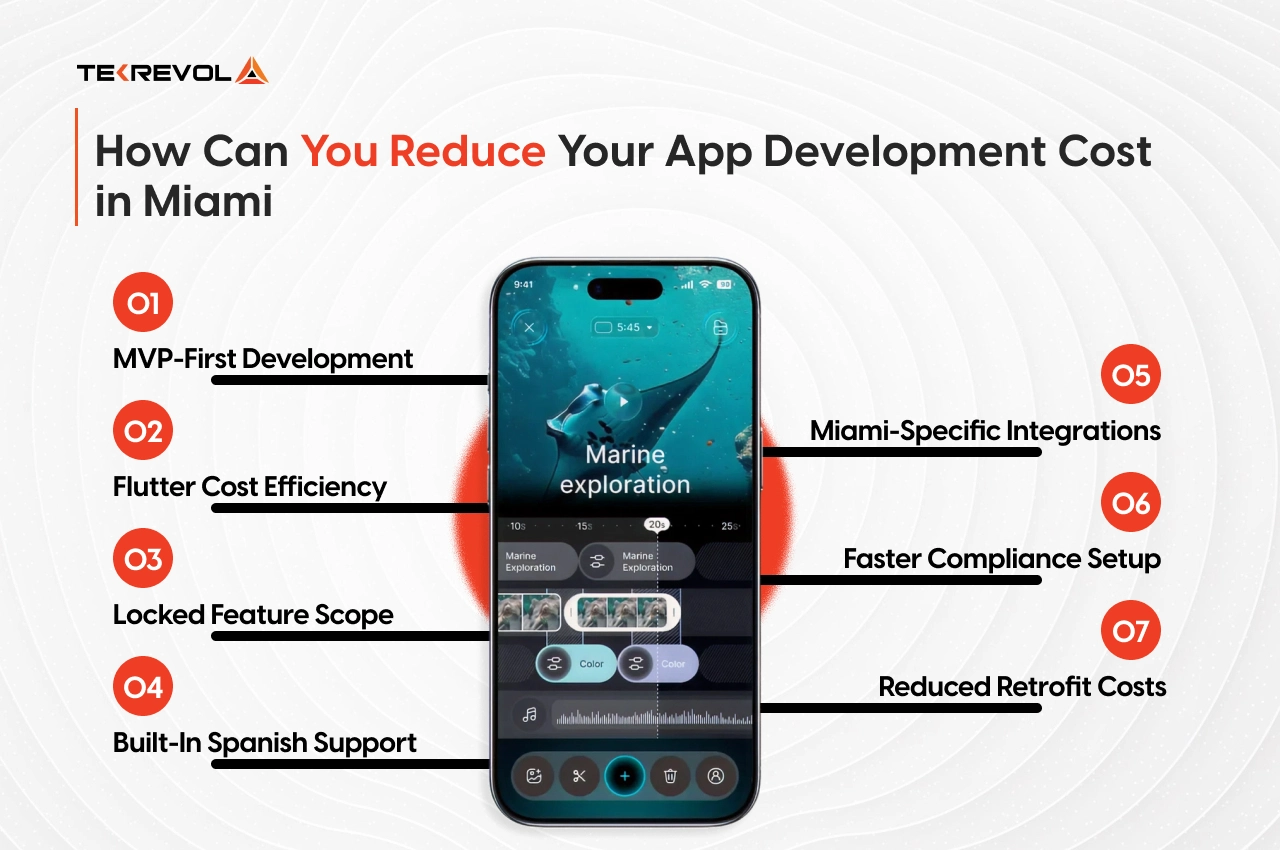
Start With an MVP
Launch with core features only. Validate with real Miami users. Then invest in complexity based on actual data, not assumptions.
Miami MVP must-haves:
- Core user journey — the one action your app must do perfectly
- English AND Spanish interface from launch
- One payment gateway — Stripe is sufficient for MVP
- Basic push notifications
- App Store-ready compliance
Miami MVP skip list:
- Loyalty programs and referral systems
- AI-powered recommendations
- Multiple payment gateways
- Advanced analytics dashboard
- LatAm expansion features (version two after US validation)
Choose Flutter for the Miami Market
Flutter covers iOS and Android in one build. It handles English/Spanish bilingual switching natively. It saves 20–30% vs. dual native development. For most Miami consumer apps, e-commerce, on-demand, healthcare booking, and real estate, a Flutter app development company delivers everything you need.
The only exceptions: deep hardware integration requirements, real-time video processing at enterprise scale, or platform-specific UI patterns that are core to the product.
Build Spanish Support From Day One
This bears repeating because it is the most consistently expensive mistake Miami app founders make.
Built-in from day one: $15,000–$40,000 additional cost. Retrofitted after English-only launch: $25,000–$75,000 additional cost. Market reach lost during the English-only period: unquantifiable but real.
Partner With Pre-Built Miami Integration Experience
An agency that has integrated Mercado Pago before does it in days, not weeks. An agency with HIPAA Florida AHCA experience does not learn Florida healthcare compliance on your budget. An agency with Miami MLS integration experience skips the 2–3 week API documentation phase.
Ask every agency you evaluate: “Have you built this specific integration before, and can I speak to that client?” The answer determines whether you are paying for expertise or paying for their education.
How Does TekRevol Help Miami Businesses Build Apps on a Budget?
TekRevol helps Miami businesses control app development costs through a discovery-first process, pre-built bilingual development frameworks, and experience with Florida fintech and healthcare compliance. The team also supports LatAm payment integrations and follows milestone-based Agile delivery with transparent pricing from day one.
Miami app development is not generic US app development. It requires bilingual capability, LatAm market intelligence, Florida regulatory awareness, and experience with the specific integrations that Miami’s industries depend on.
TekRevol brings all of that to the table:
- Bilingual development: English/Spanish apps with native-level Spanish UX — not machine translation overlaid on an English interface
- LatAm payment integration: pre-built experience with Stripe, Mercado Pago, and cross-border payment systems that Miami’s LatAm-facing businesses require
- Florida compliance knowledge: HIPAA, Florida AHCA requirements, OFR fintech context, DBPR real estate compliance — mapped in discovery, built into architecture
- Discovery-first process: regulatory scoping, bilingual UX definition, and feature prioritization happen before any design or development spending begins
- Milestone-based delivery: payments tied to delivered milestones — not calendar dates or vague progress claims
- Post-launch accountability: 30-day bug warranty at no extra charge, named post-launch contact, maintenance retainer options at pre-agreed rates
- Full ownership: source code, App Store accounts, hosting credentials — all under your ownership at final handover
Whether you are building a fintech platform for Miami’s LatAm-facing financial community, a healthcare app for South Florida’s diverse patient population, or a Spanish-first on-demand service platform for Hialeah and Little Havana, TekRevol has the market knowledge and technical depth to build it right, on budget, and on schedule.
Your Miami App Deserves a Team That Gets This Market.
From Brickell fintech apps to Wynwood startup MVPs, TekRevol builds bilingual, Florida-compliant apps with transparent pricing and full IP ownership.
Start My Miami App Project