



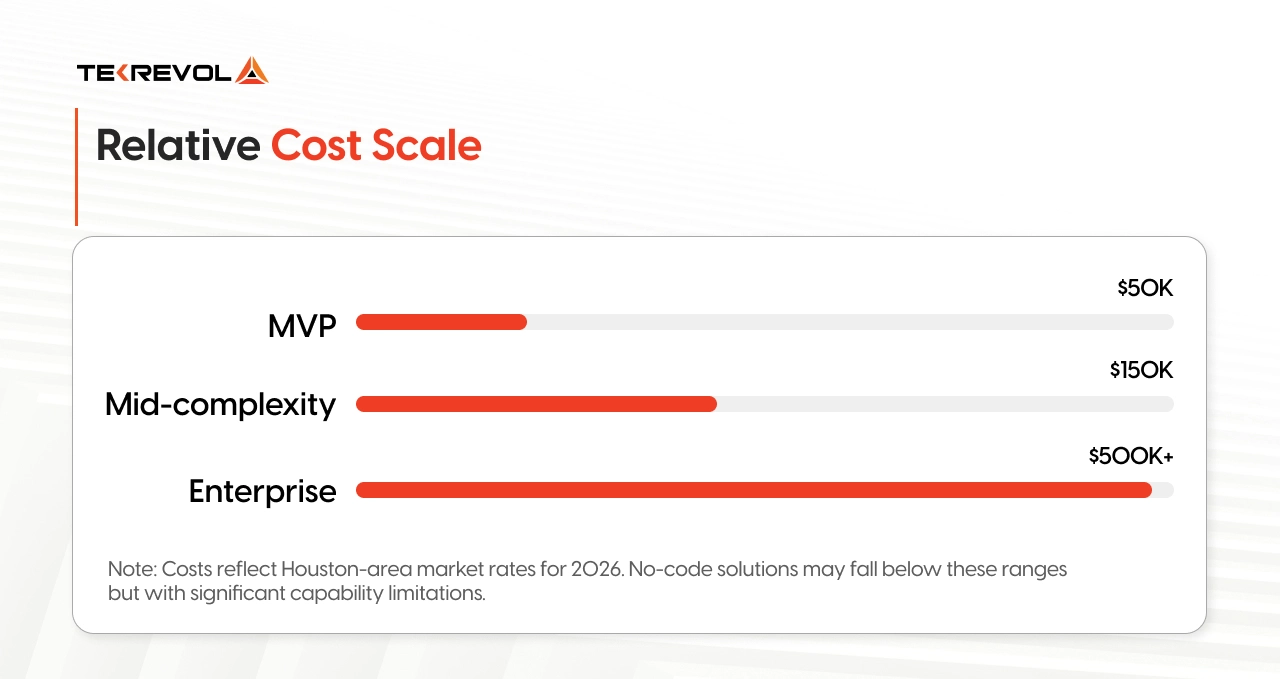
- App budgets range from $25K (MVP) to $500K+ (enterprise) based on complexity and feature scope.
- Houston app development costs can be 20–30% lower than many major U.S. tech markets, with senior enterprise developers billing up to $235/hr for specialized solutions
- Platform, features, backend, integrations, design, compliance, and AI are the 7 main cost drivers.
- Hidden costs like maintenance, ASO, legal, and marketing can add $30K–$50K beyond dev quotes.
- Build an app only if users engage weekly, need hardware access, or a high retention ROI is clear.
- Start MVP-first, choose cross-platform, scope fully, and budget 15–20% annually for maintenance.
- A local Houston partner means same-time zone speed, industry context, and long-term accountability.
One of our restaurant-tech projects started with a problem most people already know firsthand: waiting too long to place an order, struggling with outdated reservation systems, and dealing with disconnected dining experiences.
The team behind Reck’N didn’t just want another food ordering app. They wanted customers to reserve tables, order directly from their phones, interact socially inside the platform, and help restaurants run operations more smoothly, all in one place.
At first, the idea sounded fairly straightforward. But like most app projects, the deeper they got into development, the more layers appeared. Features that seemed “simple” suddenly involved payment systems, live notifications, restaurant dashboards, customer analytics, backend infrastructure, and scalability planning.
That’s where many businesses get caught off guard. The term “mobile app development in Houston” sounds simple until you realize it can encompass a wide range of complexity. One app might only handle basic ordering, while another quietly powers logistics, user engagement, loyalty systems, and real-time operations behind the scenes.
Houston’s app market has grown rapidly because of this demand. Startups, retail brands, healthcare companies, and logistics businesses are all investing in digital products, which means pricing can vary wildly depending on what’s actually being built underneath the interface. Two apps may look almost identical to users while requiring completely different levels of development work behind the curtain.
Whether you’re a founder preparing your first pitch deck, a retail brand looking to launch an e-commerce mobile app, or a business owner who’s been putting this off because you simply didn’t know where to start, understanding the landscape of app development in Houston can give you a much more grounded reference point before you invest.
What Makes Houston’s App Market Different in 2026?
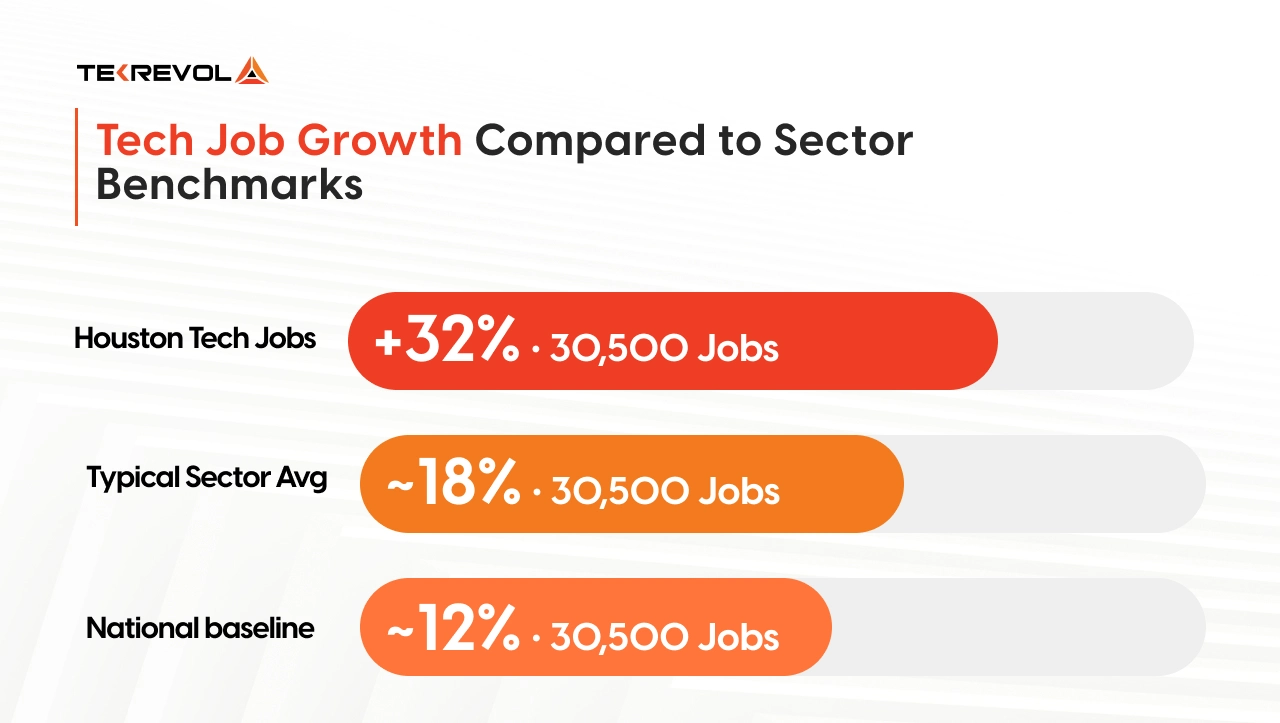
Houston isn’t Silicon Valley. That’s not a criticism; it’s actually one of the most useful things to understand before you start budgeting for an app development company in the USA. The city has quietly become one of the fastest-growing tech ecosystems in the U.S., with more than 230,800 tech professionals contributing over $28 billion to the regional economy.
Houston also led the country in tech job posting growth, recording a 45.6% year-over-year increase. That growth matters because businesses hiring locally gain access to developers with real expertise in healthcare, energy, logistics, and retail industries, shaping today’s most demanding app requirements.
What Houston Offers That Other Markets Don’t
For businesses asking “how much does it cost to build a mobile app in Houston” versus other major cities, the answer usually surprises them. Houston’s development rates run 20–30% lower than those of other big tech cities, while the talent pool is deep enough to handle everything from an MVP to an enterprise platform. Senior developers in the Houston–The Woodlands–Sugar Land corridor typically bill between $165–$235/hr, with junior developers at $90–$120/hr. Compare that to San Francisco rates that routinely exceed $250–$350/hr for senior talent.
The city’s momentum is also fueled by the Ion District, Houston’s 16-acre innovation hub that now supports over 300 businesses and has helped attract more than $6 billion in startup investment over the last five years.
Houston App Development Cost Breakdown — 2026 Quick Reference
| App Tier | Cost Range | Timeline | Platform | Best For |
| MVP / Simple | $25,000–$50,000 | 4–8 weeks | Single (iOS or Android) | Startups, validation, basic tools |
| Mid-Complexity | $80,000–$150,000 | 3–5 months | Both (Cross-platform) | Business apps, ecommerce, portals |
| Enterprise / Complex | $190,000–$500,000+ | 6–18 months | Both (Native or Cross) | Healthcare, fintech, AI platforms |
Why 2026 Is a Different Calculation
According to Fortune Business Insights, the global mobile application market was valued at $330.61 billion in 2025 and is projected to grow to over $1 trillion by 2034 at a CAGR of 15.1%. In the US alone, mobile app revenue is expected to hit $178 billion in 2025.
Users in 2026 expect immediate response times, personalized experiences, and seamless performance across devices. Research shows that mobile app users view 22 products per session versus just 5.7 on mobile browsers, and app purchase conversion rates run 130% higher than mobile web.
Building an app that underdelivers on these expectations doesn’t just frustrate users; it actively damages brand credibility. The practical effect for businesses in Houston is this: the bar for a “good enough” app has risen sharply. This is why investing in scalable solutions like e-commerce app development has become a competitive necessity rather than an optional upgrade.
Need To Know What Your Houston App Idea Could Realistically Cost in 2026?
Talk to experts who understand local market trends, scalable development, and what it takes to build high-performing apps that drive real user engagement and conversions.
Get Your Free App Cost Estimate →The 2026 App Development Cost Breakdown in Houston — Pricing by Tier
If you’ve Googled how much does it cost to build an app in Houston and gotten wildly different answers, you’re not doing something wrong. App development pricing genuinely spans a wide range because apps themselves span a wide range. The only honest way to quote a number is to start with what you’re actually building.
Here’s how the app development cost breakdown in Houston maps across the three primary tiers of complexity in 2026.
Tier 1 — MVP / Simple Apps: $25,000–$50,000
An MVP (Minimum Viable Product) is a focused, functional app built around your core value proposition, stripped of everything that isn’t essential for launch. It’s not a half-built app; it’s a strategically scoped one.
What you get:
- 5–10 screens
- Core features only (content display, simple forms, push notifications)
- Single platform: iOS or Android
- Standard UI/UX using established design patterns
- Basic backend: user accounts, data storage, notifications
- Timeline: 4–8 weeks
Best for:
Startups validating a concept, event apps, simple directories, basic booking or scheduling interfaces, loyalty card replacements, and proof-of-concept builds before a larger investment round.
Tier 2 — Mid-Complexity Apps: $80,000–$150,000
This is where most Houston businesses actually land when they fully scope what their users need. Mid-complexity apps combine custom design, dual-platform support, and real integrations with existing business systems.
What you get:
- 10–25 screens with more complex user flows
- Both iOS and Android (via cross-platform frameworks like Flutter or React Native)
- User authentication and account management
- Custom API development and third-party integrations (POS, CRM, payment gateways)
- Custom branding and design
- Push notifications with targeting logic
- Analytics and basic reporting dashboard
- Timeline: 3–5 months
Best for:
Restaurant ordering and loyalty apps, appointment booking with payment processing, customer portals for service businesses, field operations tools, and e-commerce app development for retail brands.
Tier 3 — Complex / Enterprise Apps: $190,000–$500,000+
Enterprise-grade platforms are a different category entirely. These aren’t just apps with more features — they’re systems that need to handle scale, compliance, real-time data, and multiple user types with different permission levels.
What you get:
- Large-scale applications with extensive feature sets
- Advanced functionality: real-time sync, complex algorithms, AI integration
- Multi-user architectures (customer panel + admin panel + vendor/operator panel)
- Extensive third-party and enterprise system integrations (ERP, HIPAA-compliant databases, financial APIs)
- High-security backends with audit logging
- Admin dashboards and operational management tools
- Scalable cloud infrastructure
- Timeline: 6–18 months
Best for:
Healthcare platforms requiring HIPAA compliance, fintech applications with banking integration, multi-vendor marketplaces, large-scale logistics platforms, energy sector operations tools, and AI-native enterprise products.
Houston Tech Ecosystem at a Glance
| Metric | Figure |
| Net tech workforce | 230,800+ professionals |
| Tech sector GDP contribution | $28.1 billion |
| Venture capital raised (5-year) | $6+ billion |
| Tech job growth (2019–2023) | 32% (30,500+ jobs added) |
| Senior dev hourly rate (Houston) | $165–$235/hr |
| vs. California/NY rates | 20–30% lower |
| Ion District businesses | 300+ |
Read the full case study here.
Key Cost Factors in Houston App Development
Understanding the app development cost breakdown in Houston goes beyond knowing the tier your app falls into. Two apps in the same tier can have wildly different price tags depending on a set of technical and strategic decisions made early in the process. These are the factors that actually move your budget needle.
1. Platform Choice: The Decision That Changes Everything
How you choose to build your app, be it native, cross-platform app development, or PWA, is probably the single biggest lever on your total cost.
Native iOS + Native Android: Two separate apps, two separate codebases, two separate development streams. Highest possible performance and deepest access to device hardware. Also, the most expensive approach,it effectively doubles your development cost.
Cross-Platform (Flutter / React Native): A single codebase deploys to both iOS and Android. Performance is excellent for the vast majority of business use cases. This approach typically delivers 30–40% cost savings over a two-native build, and it’s TekRevol’s recommended default for most Houston businesses.
Progressive Web App (PWA): Technically, an advanced website that can be “installed” on phones. Development cost is comparable to a high-quality website build, significantly lower than a native app. However, PWAs have real limitations: push notifications on iOS are restricted, hardware access (camera, GPS, Bluetooth) is limited, and there’s no App Store presence or discoverability.
Rule of thumb: If your users need your app weekly or more, cross-platform native is worth the investment. If they’ll use it infrequently and primarily for content consumption, a well-built PWA may be sufficient.
Platform Cost Comparison
| Platform Approach | Relative Cost | Performance | App Store | Best For |
| Native iOS only | Baseline | Excellent | iOS only | iOS-first audiences |
| Native Android only | Baseline | Excellent | Android only | Android-first audiences |
| Native iOS + Android | ~2x | Excellent | Both | Premium products requiring max performance |
| Cross-Platform (Flutter/RN) | ~1.3x baseline | Very Good | Both | Most Houston businesses — best value |
| PWA | ~0.5x | Good | None | Infrequent use, content-focused |
2. Feature Scope and Screen Count
Every screen needs to be designed, developed, tested, and integrated with your backend. Every feature, like real-time chat, payments, search, AI recommendations, and offline mode, adds development hours that compound as the project scales.
The most common reason an app project goes over budget isn’t a bad developer; it’s the scope that wasn’t fully defined before development began. Features added mid-sprint routinely cost 3–4x what they would have cost if scoped at the start.
What to watch:
- Real-time features (live chat, live tracking, live updates): add significant backend complexity
- Offline functionality: requires a local data sync architecture
- Search with filtering: more complex than it looks
- User-generated content (photos, reviews, uploads): adds storage and moderation requirements
- Multi-language support: add 10–20% to design and dev cost
3. Backend Complexity
Your app is the front door. The backend, your server, database, APIs, and business logic, is everything behind it. Backend complexity is frequently underestimated in early-stage budgets.
| Backend Type | What It Covers | Added Cost |
| Simple | User accounts, data storage, basic notifications | $10,000–$30,000 |
| Moderate | Payments, real-time updates, 2–3 integrations | $30,000–$80,000 |
| Complex | High-volume transactions, AI pipelines, multi-system integrations | $80,000+ |
For Houston businesses in energy, healthcare, or logistics, the backend often ends up being the most expensive part of the build, not the front-end features users can see.
4. Third-Party Integrations
Every connection to an external system requires custom API development, authentication, error handling, and ongoing maintenance. Here’s what typical integrations add to a Houston app development budget:
| Integration | Added Cost Range |
| POS system (Square, Toast, etc.) | $5,000–$20,000 |
| Payment processing (Stripe, Braintree) | $5,000–$15,000 |
| CRM (Salesforce, HubSpot) | $3,000–$15,000 |
| Inventory management | $5,000–$25,000 |
| Shipping carriers (UPS, FedEx) | $5,000–$15,000 per carrier |
| Social login (Google, Apple, Facebook) | $2,000–$5,000 |
| ERP systems | $15,000–$50,000 |
Each integration isn’t just a one-time cost; it requires ongoing maintenance as the external systems update their APIs. Budget accordingly.
5. UI/UX Design Depth
Design is directly tied to conversion, retention, and the overall business value your app delivers. But design also sits on a spectrum:
| Design Level | What It Includes | Cost Range |
| Standard | Platform conventions, common patterns, solid execution | $5,000–$15,000 |
| Custom | Unique visual identity, custom components, branded animations | $15,000–$50,000 |
| Premium | Motion design, micro-interactions, award-level interface work | $50,000+ |
For most Houston businesses, a standard design executed well delivers the best ROI. Custom design makes sense when the app is the brand experience, a consumer product, a flagship retail app, or anything where visual differentiation directly drives engagement.
6. Compliance and Security Requirements
This is the factor most often missing from early-stage estimates, and the one most likely to create budget surprises later.
| Compliance Type | Industry | Added Cost |
| HIPAA | Healthcare | $10,000–$50,000 |
| PCI-DSS | Any app taking payments | Handled via certified processors; audit costs vary |
| ADA accessibility | Consumer-facing apps | Should be built in from day one |
| SOC 2 / ISO 27001 | Enterprise SaaS | $15,000–$40,000 |
| Texas data privacy (TDPSA) | Consumer data apps | $5,000–$20,000 |
Houston’s concentration of healthcare, energy, and financial businesses means compliance is a foundational requirement. A software development company in Houston that understands these requirements can build compliance from the start rather than retrofitting it at high cost later.
7. AI Integration — The 2026 Budget Factor
According to CMARIX’s 2026 mobile app development statistics, 63% of mobile app developers now integrate AI features into their apps, and 70% use AI to improve user experience. For Houston businesses in competitive markets, AI is increasingly becoming a table stake.
What AI adds to your budget depends on your approach:
| AI Approach | What It Covers | Budget Impact |
| Off-the-shelf APIs (OpenAI, Claude, Gemini) | Chatbots, recommendations, and content generation | $5,000–$20,000 |
| Custom ML model training | Predictive analytics, specialized classification | $20,000–$80,000 |
| Private LLM deployment | IP-sensitive industries, on-premise data control | $80,000–$200,000+ |
| AI-native app architecture | Full intelligent UX, behavior-based personalization | 40%+ of total budget |
For most Houston SMBs, off-the-shelf AI APIs deliver strong value at a manageable cost. For energy, healthcare, and fintech platforms where data privacy is paramount, a private deployment is worth the investment. TekRevol’s AI development company team works across both models.
Read the full case study here.
The Hidden Costs Most Houston Businesses Overlook
Here’s the uncomfortable truth about most mobile app development pricing Houston quotes: they cover development. They don’t always cover everything development requires.
A quote for $80,000 in development can easily become a $110,000–$130,000 total investment once you account for the surrounding work that makes the app actually launchable and usable. These aren’t bad faith omissions; they’re genuinely separate categories. But not knowing about them in advance causes real budget problems.
Total Cost Reality Check — A $100K App in Houston
| Cost Category | Estimated Range |
| Core development | $80,000–$100,000 |
| Content and creative assets | $5,000–$15,000 |
| Legal documentation | $2,000–$8,000 |
| ASO and App Store setup | $1,500–$5,000 |
| Year 1 maintenance | $15,000–$20,000 |
| Initial marketing | $5,000–$20,000 |
| Total Year 1 investment | $108,500–$168,000 |
Development is the biggest single line item, but rarely the only one.
Content, Assets, and Creative
Your app needs images, icons, copy, product descriptions, and in some cases, video. Almost none of this is included in a development quote.
| Asset Category | Typical Cost Range |
| Professional photography | $500–$5,000 |
| Copywriting (screens, onboarding, marketing) | $1,000–$5,000 |
| Custom icons and illustrations | $1,000–$5,000 |
| Explainer or demo video | $3,000–$20,000 |
| Brand identity (if not already established) | $3,000–$15,000 |
Legal and Compliance Documentation
Any app that collects user data, which is nearly every app, needs legal infrastructure in place before launch.
| Legal Requirement | Cost Range |
| Terms of Service and Privacy Policy | $1,000–$5,000 |
| HIPAA compliance documentation | $10,000–$50,000 additional |
| ADA accessibility audit | $2,000–$8,000 |
| Legal review of payment and data handling | $2,000–$10,000 |
App Store Setup and Optimization (ASO)
Getting your app listed is one thing; getting it discovered is another. App Store Optimization (ASO) is the mobile equivalent of SEO, and like SEO, it requires ongoing investment to deliver strong results
| ASO Activity | Cost Range |
| Initial listing and keyword optimization | $500–$2,000 |
| Screenshot design and preview video | $500–$3,000 |
| App Store fees | $99/yr (Apple), $25 one-time (Google) |
| Ongoing A/B testing and optimization | $500–$1,500/month |
Post-Launch Maintenance — The Cost That Never Ends
This is the most consistently underestimated line item in app budgeting. Apps aren’t websites; they require active, ongoing maintenance to remain functional as iOS and Android release annual updates.
Plan on 15–20% of your initial build cost annually. For a $100,000 app, that’s $15,000–$20,000 per year.
| Maintenance Category | Annual / Monthly Cost |
| iOS/Android OS compatibility updates | $5,000–$15,000/year |
| Bug fixes and ongoing improvements | $500–$3,000/month |
| Server and hosting costs | $100–$1,000/month |
| Third-party API maintenance | $1,000–$5,000/year |
| App Store fees | $99/year (Apple) + $25 one-time (Google) |
User Acquisition and Marketing
The hardest part of launching an app often isn’t building it, it’s getting anyone to download it. The app stores aren’t discovery engines for unknown brands; you need active marketing investment.
| Marketing Activity | Cost Range |
| Pre-launch buzz and waitlist building | $2,000–$10,000 |
| Paid install campaigns | $0.50–$10 per install, depending on targeting |
| Influencer or community seeding | $1,000–$15,000 |
| Ongoing retention and re-engagement | $500–$3,000/month |
Don’t Let Hidden Costs Derail Your App Budget
TekRevol helps Houston businesses plan for every stage of app development—from strategy and design to launch essentials—so you can avoid unexpected costs and build with confidence.
Get A Clear Breakdown Of Your App Costs →Should You Build an App at All?
Honesty is more useful than enthusiasm when it comes to app investment decisions. Not every Houston business needs a native mobile app. Some need a better mobile website. Some need a retail app development strategy that starts with an MVP and scales deliberately.
And some discover during the planning process that their original app concept needs significant rethinking before any development starts.
Before spending anything on development, work through this framework.
When a Mobile App Is the Right Investment
An app earns its place and its price tag when it delivers something a website fundamentally cannot. That typically means one or more of the following:
Frequency: Your users will engage with it weekly or more often. Push notifications, offline functionality, and the reduced friction of a home screen icon all add measurable value when engagement is frequent. If customers only interact with your business quarterly, the ROI math rarely works.
Hardware access: Your product requires the device’s camera, GPS, Bluetooth, accelerometer, or biometric authentication. Mobile browsers have expanded their hardware access significantly, but native apps still have a clear advantage for hardware-intensive features.
Performance and reliability: Your app needs to function offline, handle large data sets locally, or deliver real-time experiences that browser-based apps can’t match consistently.
Loyalty and retention mechanics: Loyalty programs, personalized push notifications, in-app purchases, and gamified engagement all perform significantly better in native apps than in mobile browsers.
According to SQ Magazine research, app purchase conversion rates are 130% higher than mobile browser rates, a difference that compounds over a customer’s lifetime.
Long-term customer lifetime value: If your average customer spends meaningfully with you over the years, the ROI calculation on an app changes significantly. The investment that looks expensive as a one-time line item often pays back quickly when modeled against customer retention improvements.
When a Better Website Is the Right Answer
The app you don’t build is also a business decision. A mobile website or PWA may be the better investment when:
- Customers interact with your business infrequently (once a month or less)
- Your primary goal is information delivery, lead generation, or brand presence
- You have a limited initial budget and can’t commit to ongoing app maintenance
- Your core user journey doesn’t require hardware access or offline functionality
- A well-designed mobile website would serve 80% of your use cases at 20% of the cost
For reference on how to evaluate your app’s earning potential in the Houston market, see TekRevol’s analysis of which apps perform best for online earnings in Houston.
The No-Code / Low-Code Middle Ground
For businesses that need to validate an idea before committing to a full build, no-code tools (Bubble, Glide, Adalo, FlutterFlow) offer a genuine middle path. They can produce working prototypes in days rather than months, and at a fraction of the cost.
The limitations are real: performance ceilings, constrained customization, platform lock-in, and limited scalability. But for a startup that needs to demonstrate product-market fit to investors before raising a development budget, starting no-code and transitioning to a custom build after validation is a legitimate, and increasingly common strategy.
How to Control App Development Costs in Houston
Knowing the cost to build an app in 2026 is the first step. Knowing how to make that investment go further is what separates businesses that launch successfully from those that burn budget and stall. Here are the strategies that consistently deliver better outcomes for Houston businesses building apps.
Strategy 1: Start With an MVP — Always
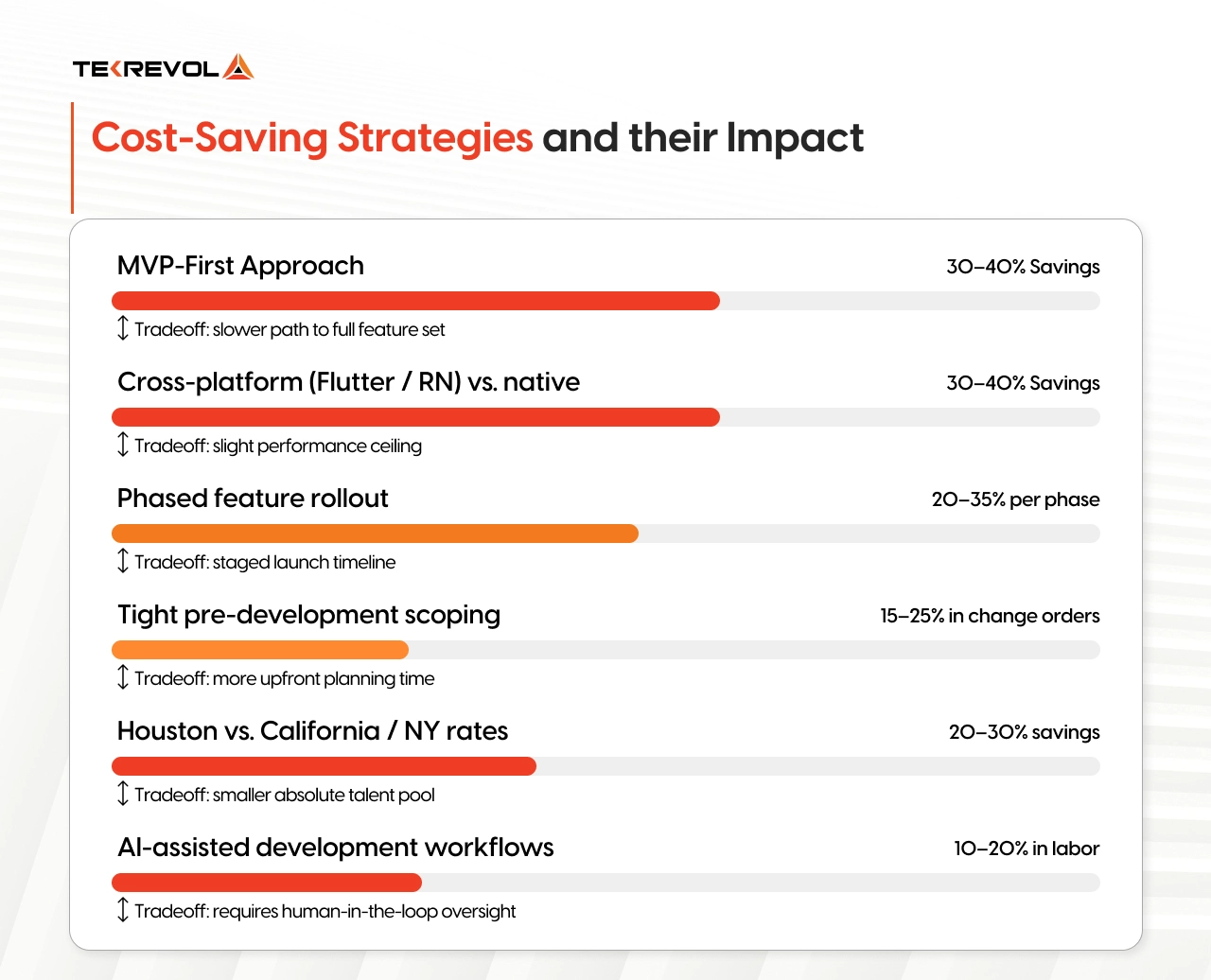
The MVP-first approach is the most reliably effective cost-control strategy in app development. By launching with your core feature set only, validating with real users, and iterating based on actual behavior rather than assumptions, you:
- Reduce initial development spend by up to 40%
- Get to market faster, generating revenue or user data sooner
- Avoid building features users don’t actually want
- Create a feedback loop that makes every subsequent development dollar more effective
The best apps on the market today, from Instagram to Airbnb, were launched as MVPs with a fraction of their current features. The discipline to launch small and iterate based on real data is a competitive advantage, not a compromise.
For a detailed breakdown of how MVP development costs compare to full builds, see this guide on the cost to make an app.
Strategy 2: Choose Cross-Platform Unless You Have a Compelling Reason Not To
For most Houston businesses, Flutter or React Native delivers 30–40% cost savings over separate native builds with a performance difference that most end users will never notice. Unless your app requires deep hardware optimization (like an AR/VR experience or a high-performance camera application), cross-platform is the right call.
Strategy 3: Scope Before You Quote
Every feature added mid-sprint costs 3–4x what it would have cost to scope upfront. Before you solicit development quotes, invest time in a proper discovery process: define every user flow, every screen, every integration, and every edge case you can anticipate. The upfront investment in proper scoping pays back many times over in reduced change orders and cleaner delivery.
Strategy 4: Plan for Maintenance Before You Build
The single biggest cause of apps that go dark within 18 months of launch is not failure, it’s unplanned maintenance cost. When the iOS 20 update drops and your app breaks, that’s not optional to fix. When a third-party API changes its authentication system, that’s not optional to fix.
Budget 15–20% of your build cost annually for maintenance before you start building. If that number doesn’t work in your financial model, adjust the build scope until it does. A well-maintained $60,000 app serves your business for years. A $100,000 app that goes unmaintained is dead within 18 months.
Strategy 5: Insist on a Written Technical Roadmap Before Any Commitment
Any credible Houston development agency will provide a documented technical roadmap, scope of work, technology stack, architecture decisions, milestone schedule, and cost breakdown before asking you to sign anything. If an agency can’t or won’t produce this, that tells you something important about how they’ll operate once development begins.
Strategy 6: Leverage AI-Assisted Development — Intelligently
In 2026, development teams using AI-assisted workflows (GitHub Copilot, automated testing tools, and AI code review) can reduce certain development tasks’ timelines by meaningful margins. This can translate to real cost savings but only if there’s strong human oversight of the AI-generated output. Saving 15% on development time means nothing if it requires 25% more QA time to catch quality issues. Ask potential development partners how they integrate AI tooling into their process and what quality controls they maintain alongside it.
Cost to Build a Mobile App in Houston Calculator
1. What Type of Mobile App Do You Want to Build?
- Basic App — $10,000–$20,000
- eCommerce Mobile App — $20,000–$50,000
- On-Demand Service App (Delivery, Booking, Taxi, etc.) — $40,000–$80,000
- Enterprise or Custom Scalable App — $80,000–$150,000+
2. Which Platforms Should Your Mobile App Support?
- Android Only — +$5,000
- iPhone (iOS) Only — +$5,000
- Both Android & iOS — +$12,000
- Cross-Platform with Web Dashboard — +$20,000
3. What Features Do You Need in Your Mobile App?
- User Login & Profiles — +$3,000
- Payment Gateway Integration — +$5,000
- Real-Time Chat & Notifications — +$8,000
- GPS Tracking, Booking & Live Features — +$15,000+
4. What Design & Maintenance Level Do You Prefer?
- Simple UI Design — +$2,000
- Custom Premium UI/UX — +$8,000
- Monthly Maintenance & Updates — +$1,000/month
- Full Scaling, Cloud & Security Support — +$3,000/month
What You Actually Get from a Local Houston Partner?
A software development company in Houston with real local presence delivers things that don’t show up in an hourly rate comparison:
- Same-timezone communication — decisions that take 48 hours offshore take 2 hours locally
- Market context — a team that understands Houston’s industries, user behaviors, and regulatory environment
- In-person collaboration — whiteboard sessions, design reviews, and product strategy meetings that drive better outcomes
- Long-term accountability — a local partner has a reputation to protect in the same community you operate in
- Integration knowledge — familiarity with the specific POS, ERP, and healthcare systems common in Houston’s dominant industries
For a deeper look at current development trends shaping costs and timelines, check this guide on mobile app development trends and what they mean for modern app builds.
Read the full case study here.
How TekRevol Helps Houston Businesses Build Smarter Apps
Houston isn’t just where TekRevol is headquartered; it’s where the team has spent years working alongside founders, retailers, healthcare operators, and enterprise teams, navigating the exact questions this guide covers.
When a business owner walks in knowing they need an app but not knowing where the budget goes, that conversation tends to start in the same place: what problem are you actually trying to solve, and for whom?
That orientation shapes everything at TekRevol, from deciding whether to build native or cross-platform, to whether an MVP is the right first move, to how much backend complexity a business actually needs on day one versus month twelve.
The Range of What Gets Built
The portfolio reflects the full cost spectrum covered in this guide. At the MVP tier: concept validation apps for startups preparing for fundraising rounds. At mid-complexity: marketplace apps like MoCuts Pro, booking platforms, and retail app development projects for Houston-area commerce brands. At the enterprise level: HIPAA-compliant healthcare platforms, AI-powered tools, and industry-specific B2B platforms like Equitrip.
Across all of them, the deliverable is the same: a production-ready app that works on day one, built with architecture that doesn’t create problems on day 365.
For businesses specifically exploring mobile commerce, whether that’s a standalone shopping app, a multi-vendor marketplace, or a Shopify-integrated storefront, TekRevol’s e-commerce app development practice covers the full spectrum, from native mobile to web+mobile platforms to AI-powered personalization engines.
Our app developers in Houston offer a 30-minute strategy call that ends with a written scope and estimate, not a sales pitch.
Build the Right App From Day One, Not Just Any App
TekRevol helps Houston businesses turn vague ideas into structured product roadmaps—making decisions around budget, tech stack, and timelines clear, strategic, and scalable.
Book Your 30-Minute Strategy Call →


