- MVP app development in Houston costs between $15,000 and $60,000 for most market-ready products, with complex AI-native builds exceeding $60,000.
- The MVP product development process in Houston should always begin with hyper-local idea validation before a single line of code is written.
- Choosing the right tech stack, no-code, cross-platform, or native, is the single biggest variable in your budget and timeline.
- Top MVP app developers in Houston prioritize a formal Discovery Phase, HIPAA compliance awareness, and AI-assisted coding workflows.
- Post-launch maintenance should be budgeted at 15–20% of your initial build cost annually.
Houston doesn’t build things halfway. From the energy corridors of the Westheimer loop to the biotech campuses surrounding the Texas Medical Center, this city has always been wired to solve big, real-world problems at scale.
And in 2026, a growing wave of Houston founders is channeling that same ambition into software, specifically into MVPs that test bold ideas without burning through the entire runway.
If you’re researching MVP mobile app development in Houston right now, you’re entering the market at the perfect moment. Two powerful forces are converging: a thriving local tech ecosystem anchored by innovation hubs like the Ion District and Greentown Labs, and a national shift toward AI-powered development that has slashed build costs dramatically compared to just two years ago.
The result? A product that would have cost $80,000 to build in 2023 can now reach the market in 2026 for closer to $55,000, with cleaner architecture and faster delivery.
Saying that, this guide gives Houston founders a complete roadmap, from validating your idea in the local market to picking a tech stack, understanding real budget tiers, and finding the right development partner.
Step 1: Validate Your Idea, Solve a “Houston-Sized” Problem
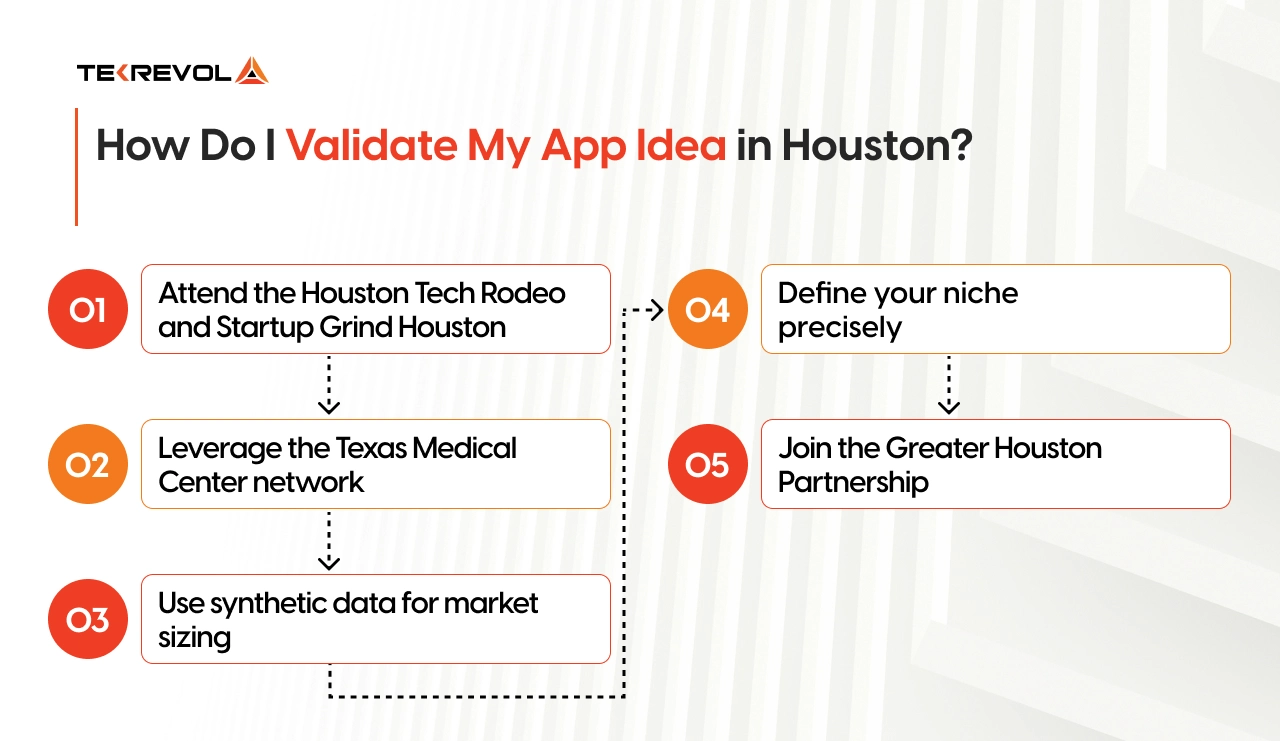
How Do I Validate My App Idea in Houston?
Skipping validation is the most expensive mistake a founder can make. Before you build an MVP app in Houston, you need to prove that a real problem exists, that real people are frustrated by it, and that they’re willing to pay for a fix.
The good news: Tech Startup in Houston‘s industry ecosystems are unusually accessible compared to coastal tech hubs, giving local founders a natural head start.
Houston’s three dominant sectors, Energy, Healthtech, and Logistics, are generating more software-ready problems than the city currently has solutions for. That’s your opportunity.
Local Validation Tactics That Work
- Attend the Houston Tech Rodeo and Startup Grind Houston: These aren’t just networking events; they’re live focus groups. Bring a mockup, watch reactions, and count how many people ask “when can I sign up?”
- Leverage the Texas Medical Center network: If your product touches healthcare, the TMC is the largest medical complex in the world and remarkably open to early-stage conversations with founders.
- Use synthetic data for market sizing: AI tools can now simulate user behavior patterns in the Texas market before you invest in development, giving you realistic adoption projections based on comparable regional products.
- Define your niche precisely: “Healthcare app” is not a product. “A scheduling tool for independent home health aides in Harris County” is a product. The sharper your problem statement, the cheaper and faster your MVP becomes.
- Join the Greater Houston Partnership: This organization connects tech founders with enterprise procurement teams, if your MVP solves a problem in energy, logistics, or construction, this is where you find your first anchor client.
Your 48-Hour Consultation Window Is Open
Lock in your free discovery session today and skip the 4-week queue. Connect with TekRevol’s experts to fast-track your project planning and development strategy.
Claim Your Priority SlotStep 2: Choose the Right MVP Tech Stack for 2026
No-Code vs. Cross-Platform vs. Native: Which Is Right for You?
The MVP development steps that matter most in 2026 begin here, with your tech stack decision. This single choice determines your timeline, your budget, and your ceiling for growth. Here’s how the three main approaches compare:
| Approach | Speed | Cost | Best For |
| No-Code (Bubble / FlutterFlow) | 2–4 Weeks | Low ($5k–$20k) | Simple marketplaces, internal tools, pre-seed validation |
| Cross-Platform (Flutter / React Native) | 8–12 Weeks | Mid ($25k–$60k) | Most consumer & B2B apps targeting both iOS and Android |
| Native (Swift / Kotlin) | 16+ Weeks | High ($60k+) | Hardware-heavy apps requiring deep device integration |
What Most Houston Startups Should Choose?
For the majority of founders working to build an MVP app in Houston, particularly in logistics coordination, healthcare workflows, and field service operations, cross-platform development using Flutter or React Native is the smartest call. Here’s why:
- One codebase runs on both iOS and Android, reducing development time and cost by 30–40% versus building separate native apps.
- Performance is strong enough for 90% of B2B and consumer app use cases.
- Timelines fit within seed-stage runways, getting you to market feedback before your next fundraising deadline.
No-code tools like Bubble work well for pre-funding validation, but most platforms hit technical ceilings quickly. Rebuilding a no-code MVP on a custom backend often costs more than building it right the first time.
Native development is justified only when your app depends heavily on device hardware, think LiDAR scanning for industrial inspection or AR overlays in clinical environments.
For a deeper look at how platform choice affects your overall budget, TekRevol’s mobile app development cost guide walks through the full breakdown by complexity tier.
Step 3: Understand the Full MVP Product Development Process in Houston
Whether you’re working with a boutique agency or a full-service partner, the MVP product development process in Houston should follow a disciplined sequence. Cutting corners at any stage adds cost and risk downstream.
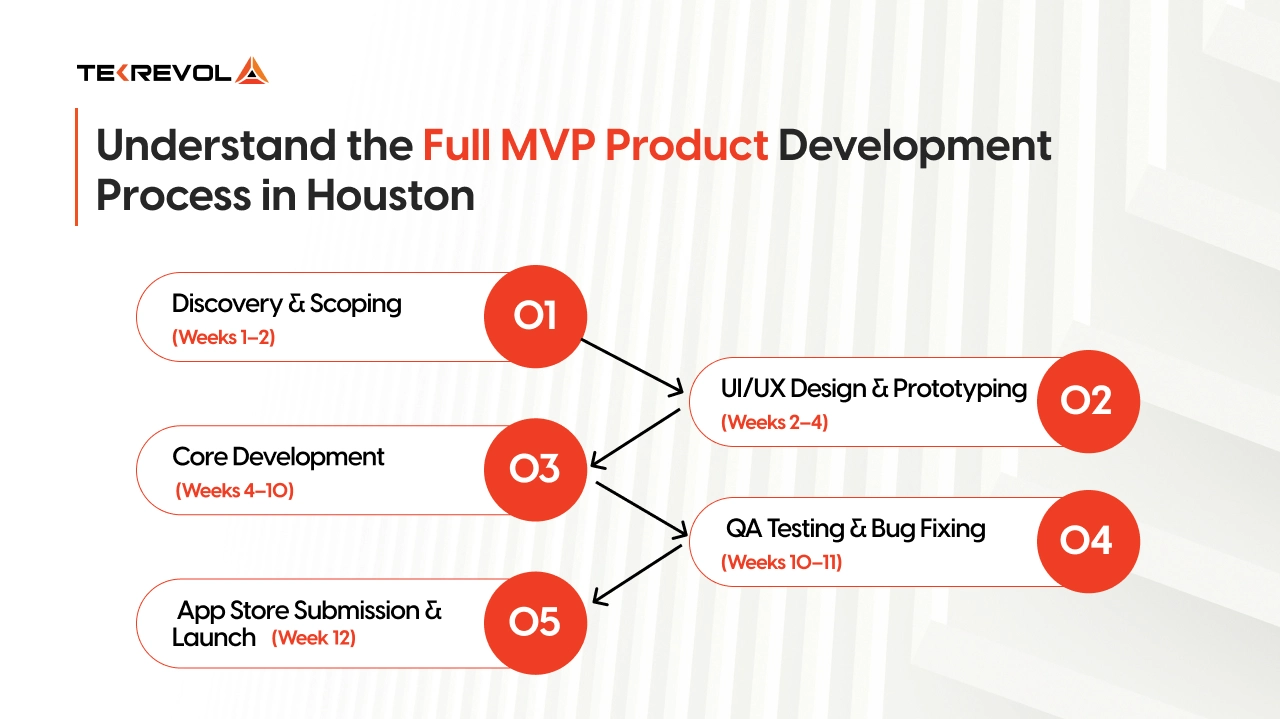
1. Discovery & Scoping (Weeks 1–2)
This is where your product’s success is really decided. A formal Discovery Phase maps user journeys, defines architecture, and produces a clickable prototype that stakeholders can actually test. Teams that skip this phase almost always pivot at least once post-launch at high cost. Read TekRevol’s breakdown of PoC vs. MVP development to understand exactly what should happen at each early stage.
2. UI/UX Design & Prototyping (Weeks 2–4)
Every screen, user flow, and interaction should be designed and reviewed before development begins. This phase catches expensive logic problems while they’re still just pixels on a screen.
3. Core Development (Weeks 4–10)
This is where your backend logic, API integrations, authentication, and core feature set are built. In 2026, AI-assisted coding tools like GitHub Copilot and Cursor allow experienced teams to move through standard logic in a fraction of the time, compressing this phase significantly.
4. QA Testing & Bug Fixing (Weeks 10–11)
A thorough QA investment reduces post-launch failures and user complaints. This phase should cover functional testing, performance benchmarking, security scanning, and compliance checks.
5. App Store Submission & Launch (Week 12)
Submitting to the App Store and Google Play, configuring live servers, and conducting a soft launch with your first cohort of real users. Submission costs are typically $1,000–$5,000 and represent the lowest-cost phase of the entire process.
Houston-Specific Compliance: Don’t Skip This
If your product touches patient data, employee records, or financial transactions, your development team needs to understand the regulatory landscape specific to Texas.
- HIPAA Compliance is non-negotiable for Healthtech products serving Houston’s Texas Medical Center ecosystem. It must be architected into the backend from day one, not bolted on after launch.
- Data Privacy requirements for enterprise clients in the energy sector often include SOC 2 Type II readiness, especially when integrating with operational technology (OT) environments.
- Fintech Compliance requirements vary by product type but generally require encrypted data handling and audit-ready logging from the first build.
Step 4: Find the Right MVP App Developers in Houston
What to Look for in a Development Partner?
The Houston market offers everything from solo freelancers to mid-size agencies with decade-long portfolios. Knowing how to evaluate MVP app developers in Houston before you sign anything will save you months of rework and tens of thousands of dollars. Use this checklist:
- Discovery Phase included: Any serious partner leads with a structured discovery process. If they want to skip straight to development, that’s a red flag.
- Houston industry experience: A team that has shipped B2B SaaS for oil and gas clients understands the procurement cycles, user personas, and integration requirements in a way no out-of-state agency can replicate.
- HIPAA & compliance fluency: Especially critical for Healthtech, but increasingly important in fintech and enterprise logistics as well.
- AI-assisted workflow: Top MVP app developers in Houston in 2026 are using tools like GitHub Copilot or Cursor. Ask directly: how has AI tooling impacted your delivery speed in the last 12 months?
- Transparent pricing model: Fixed-price contracts work well for well-scoped MVPs. Time & Materials (Agile) pricing is better for products with evolving requirements. Know which model your partner defaults to.
- Relevant portfolio: Ask for case studies from clients in your specific vertical, not just “we’ve done healthcare” but “here’s the product we built for a Texas-based home health startup.”
Step 5: Build Your 2026 Houston MVP Budget
What Does It Actually Cost to Build an MVP App in Houston?
Here’s the honest answer that most blogs won’t give you: your cost depends entirely on your problem complexity, platform choice, and the polish level required to impress your first users. Based on current market rates for MVP app development in Houston, here are the three realistic investment tiers:
| Tier | Budget Range | Timeline | What You Get |
| Lean MVP (Pre-seed validation) | $15,000 – $25,000 | 4–6 Weeks | Single-core workflow, basic UI, enough to test with real users |
| Standard MVP (Market-ready) | $25,000 – $60,000 | 8–12 Weeks | Full auth, core features, admin panel, App Store submission |
| Complex / AI-Native MVP | $60,000+ | 14–20 Weeks | ML models, IoT integrations, enterprise compliance, real-time data pipelines |
Feature-Level Cost Breakdown
The biggest cost drivers aren’t always the visible screens; they’re the invisible logic powering them.
| Feature | Development Hours | Estimated Cost (2026) |
| User Authentication & Onboarding | 80–120 hrs | $4,000 – $10,000 |
| Core Feature Set (primary workflow) | 200–350 hrs | $12,000 – $30,000 |
| Admin Dashboard & Analytics | 100–180 hrs | $6,000 – $15,000 |
| Third-Party API Integrations | 80–150 hrs | $5,000 – $12,000 |
| UI/UX Design & Prototyping | 80–160 hrs | $5,000 – $14,000 |
Hidden Costs: Maintenance & Scaling
Post-launch expenses are the most commonly overlooked line item in any founder’s budget. As TekRevol’s hidden app development cost guide confirms, you should plan to budget 15–20% of your initial build cost annually to cover:
- OS compatibility updates for new iOS and Android releases
- Security patches and vulnerability monitoring
- Server scaling as your user base grows
- Feature iterations based on real user feedback
For a $40,000 MVP, that means budgeting roughly $6,000–$8,000 per year in post-launch maintenance, a number that catches many first-time founders off guard.
Step 6: Launch & The Houston Feedback Loop
From MVP to MLP, Minimum Lovable Product
Shipping your MVP is not the finish line. It’s the starting gun for the most important phase of the MVP product development process in Houston: the feedback loop.
Your goal after launch is to gather enough real usage data to graduate from MVP to MLP, the Minimum Lovable Product that users don’t just tolerate but actively recommend.
How to Get Your First 100 Houston Users?
- Startup Grind Houston is your fastest channel for recruiting beta testers who will give you honest, structured feedback rather than polite encouragement.
- Rice University and the Ion District are fountains of early-adopter talent. Students and resident startups are often willing to test and break early-stage products in exchange for being part of the founding story.
- LinkedIn Local Houston hubs can drive targeted early signups from exactly the professional profiles you’re trying to serve.
- Industry conferences like CERAWeek (energy) and the TMC Innovation Summit (healthcare) put you in front of decision-makers who have the budget to become your first paying customers.
The shift from MVP to MLP is where Houston startups have historically made the leap from scrappy to scalable. The key is measuring the right things from day one: feature adoption rates, session depth, churn timing, and which flows users abandon before completing.
How TekRevol Can Help?
At TekRevol, we don’t just build MVPs, we engineer market-ready digital products with a clear path to scale. Our MVP development services are built around a Product-First philosophy: every engagement starts with a structured Discovery Phase that maps your user journeys, validates your architecture, and produces a clickable prototype before a single line of production code is written.
For Houston founders, that means you get a partner who understands the specific compliance demands of the Texas Medical Center ecosystem, the integration complexities of enterprise energy clients, and the fast-paced procurement cycles of the city’s logistics sector.
Here’s what working with TekRevol looks like in practice:
- Discovery-First Process: We scope every MVP with a formal discovery sprint so you launch with confidence, not guesswork.
- AI-Powered Development: Our teams use GitHub Copilot and Cursor to compress development timelines by 25–30% without sacrificing code quality.
- Full Compliance Coverage: From HIPAA-ready architecture for Healthtech to SOC 2-aligned data handling for enterprise clients, compliance is built in from day one.
- Transparent Pricing: Whether you need a Lean MVP at $15,000 or a complex AI-native product at $60,000+, we provide itemized cost breakdowns, no surprises post-kickoff.
- Post-Launch Partnership: We don’t disappear after App Store submission. Our teams stay engaged through your first feedback loop, helping you iterate from MVP to MLP.
Over 1,500 successful digital products shipped. Clients have collectively raised over $1.5 billion. A mobile app development team that has been in the trenches with founders at every stage, from pre-seed idea validation to Series B scale.
Claim Your $450 Expert Strategy Blueprint For Free
Get a realistic project timeline, a prioritized feature roadmap, and a detailed cost estimate from a team that has successfully launched products across your industry.
Secure Your Free Blueprint Now