



- The app store optimization process is a repeatable loop: audit, plan, execute, measure, not a one-time metadata fix.
- Ranking moves from audit to measurable results in roughly eight sequential steps, each depending on the one before it.
- Skipping the audit step is the single most common reason ASO efforts fail to show results.
- Change one metadata or creative field at a time, or you’ll never know what actually worked.
- The ranking algorithm scores conversion, ratings, and retention just as heavily as keywords.
- TekRevol runs this exact audit-to-ranking process for clients, cycle after cycle, instead of a one-time fix.
Most apps don’t struggle because of poor features—they struggle because there’s no repeatable optimization process behind them. Teams update a title, replace a screenshot, or add new keywords, then wait for rankings to improve without knowing what actually made a difference.
The app store optimization process solves that problem by turning ASO into a structured cycle of auditing, planning, optimizing, testing, and measuring. Instead of making random changes, each step builds on the last, helping you identify what improves visibility, increases conversions, and drives sustainable organic growth.
This guide breaks down the complete app store optimization process in eight practical steps, from your first ASO audit to ongoing performance measurement. You’ll learn what to optimize, when to optimize it, and how to measure success after every update. If you’d rather have experts manage the entire process, an experienced ASO agency can continuously monitor, test, and refine your store listing while you focus on building a better product.
What Is the App Store Optimization Process?
The ASO process is a repeatable cycle: audit your current listing, set goals, research keywords, optimize metadata and creatives, then measure results and start over. It’s not a checklist you run once at launch.
Most guides describe ASO as a list of fields to fill in: title, subtitle, keyword field, and screenshots. That’s what. This guide covers the how and when, the sequence that actually produces a ranking you can hold onto.
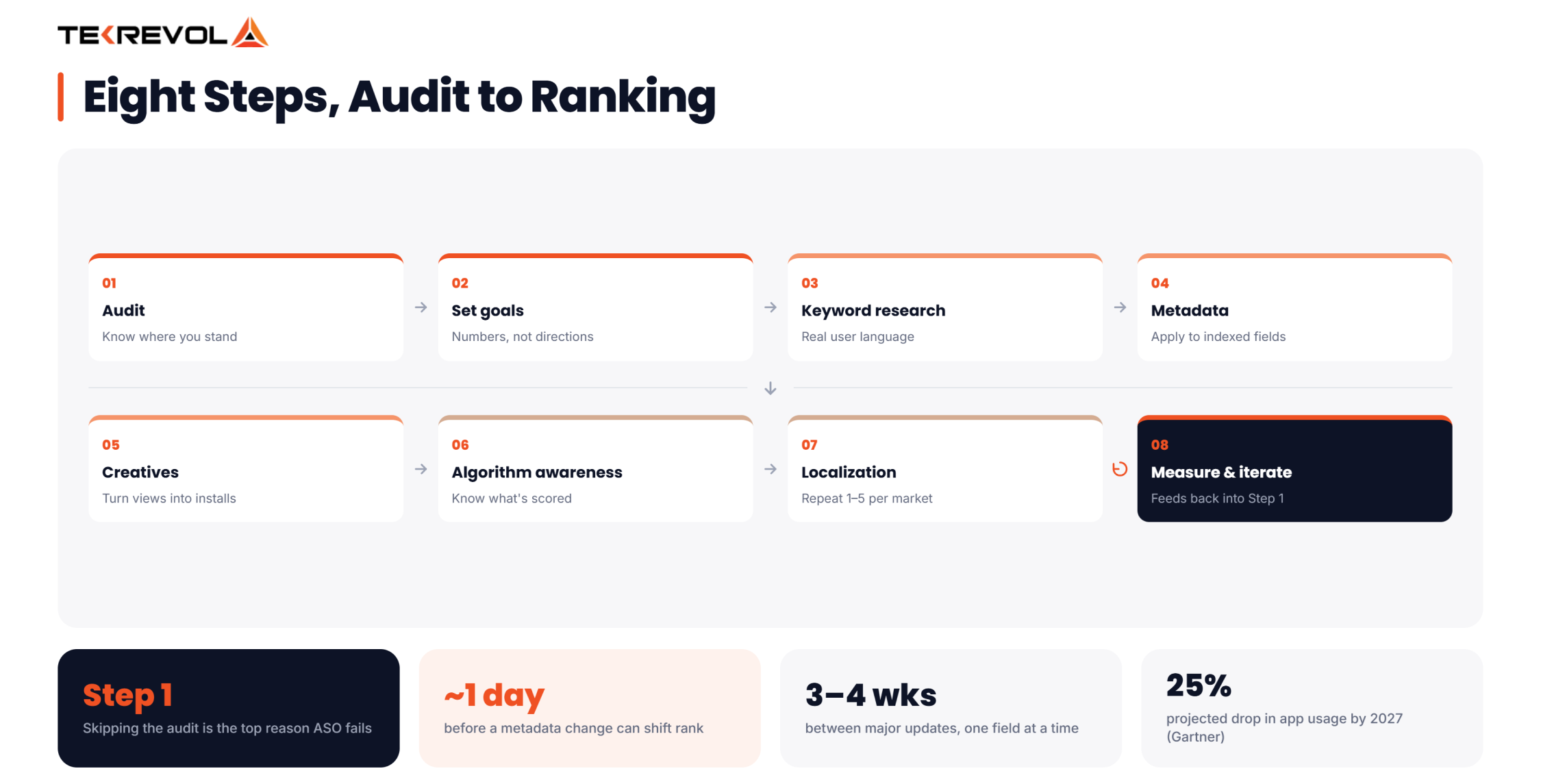
Here are the eight stages, in the order they should happen:
- Audit — know where you stand before changing anything
- Set goals — define what “better” actually means
- Keyword research — find the terms real users type
- Metadata optimization — apply keywords to indexed fields
- Creative optimization — turn impressions into installs
- Algorithm awareness — understand what’s actually being scored
- Localization — repeat the process per market
- Measurement and iteration — close the loop, then start again
Not sure where your listing actually stands right now?
A short audit shows exactly which step of this process your app is missing.
Get a Free ASO Audit →Why Does ASO Need to Be a Process, Not a One-Time Task?
ASO needs to be a process because store algorithms never stop changing, and a listing that isn’t revisited slowly loses rank even if nothing about it got worse.
A one-time ASO project fixes what’s broken today. A process catches what breaks next month. That distinction matters more than most teams realize, since why app store optimization is important has as much to do with staying ranked as it does with getting ranked in the first place.
The Business Process Optimization Framework Behind ASO
Borrow the same loop used in any operational improvement effort:
- Define — what does a successful listing look like for your category
- Measure — where do you stand today, in numbers
- Improve — change one thing, based on data
- Control — track it, then repeat the loop
Apps that treat ASO this way outperform apps that treat it as a launch-week task and move on.
Step 1 — How Do You Run an ASO Audit?
An ASO audit measures four things: overall ranking, category ranking, keyword ranking, and conversion rate. It tells you exactly where the gaps are before you touch a single field.
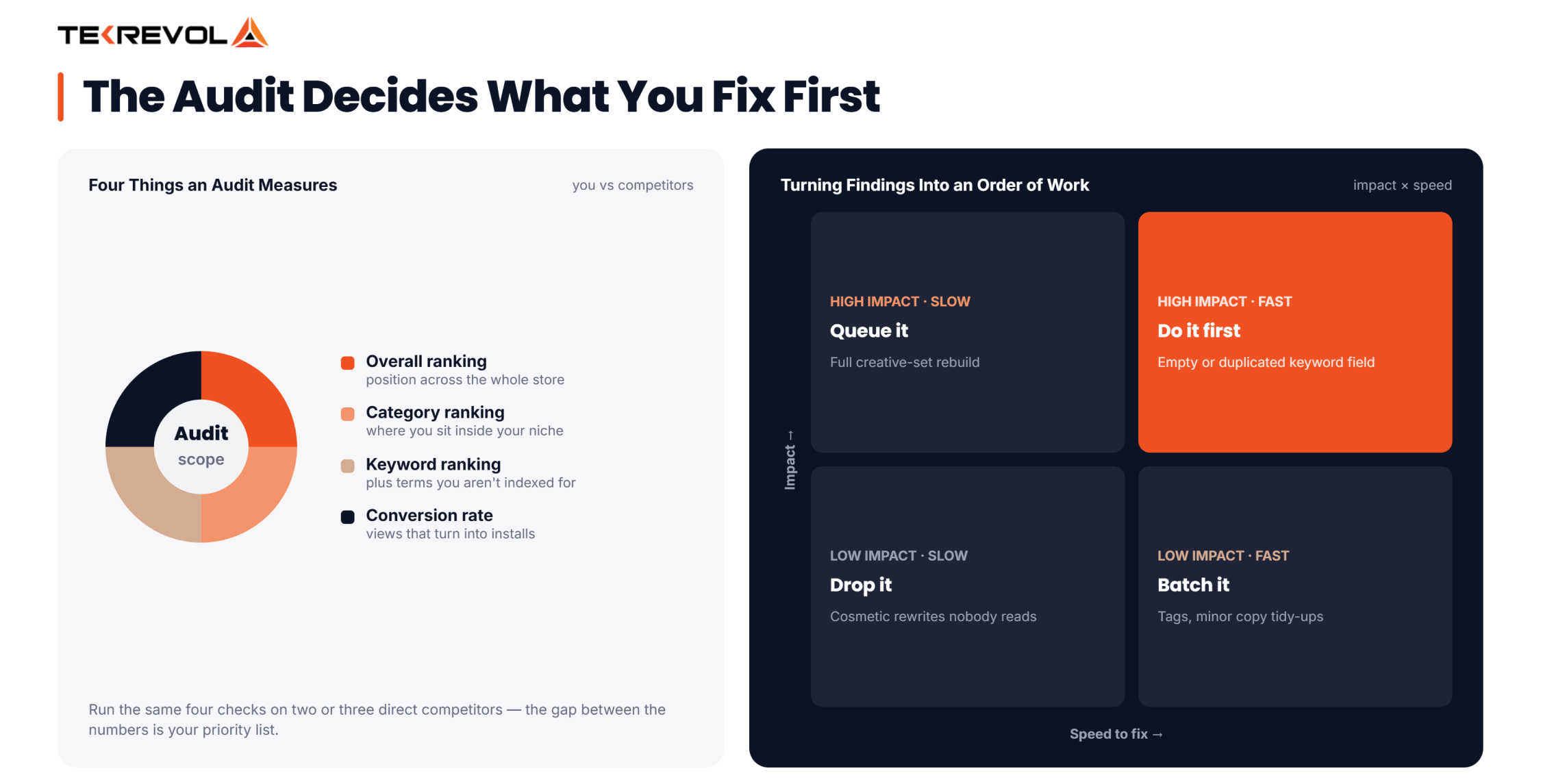
- Overall ranking — your app’s position across the entire store
- Category ranking — where you stand inside your specific niche
- Keyword ranking — your position for the terms that matter, plus terms you’re not indexed for at all
- Conversion rate — what share of people who view your listing actually install
Audit your own listing first, then run the same check on two or three direct competitors. The gap between your numbers and theirs is your starting priority list.
How to Turn Audit Findings Into a Priority List
Rank each gap by two things: how much it’s likely costing you, and how fast it can realistically be fixed. A weak keyword field is usually a quick fix. A conversion problem tied to the entire creative set takes longer, but often moves the needle further. Fix the fast, high-impact items first, then queue the bigger rebuilds.
Step 2 — Set Goals Before Optimizing
Set goals before optimizing, so you know what a “win” looks like before you start changing fields. Without a baseline, every result is just a guess dressed up as progress.
- Visibility goals — keyword rank movement, impression growth
- Conversion goals — install rate, view-to-download percentage
Write both down before touching metadata. If you don’t know your starting conversion rate, you won’t know whether a new screenshot set actually helped three weeks from now.
Put a number next to each goal, not just a direction. “Improve keyword rank” isn’t a goal. “Move three priority keywords into the top 10 within eight weeks” is something you can actually measure against.
Step 3 — Conduct Keyword Research for ASO
Keyword research for ASO starts with real user language, not internal product terms. You’re trying to guess exactly what someone types right before they search for an app like yours.
- Brainstorm every term a real user might type, based on what your app actually does
- Check autocomplete suggestions inside the App Store and Google Play
- Look at what similar ranking apps are already targeting
- Narrow the list by search volume, competition, and relevance
A quick example: a budgeting app shouldn’t just target “budget app.” Real users search “spending tracker,” “save money app,” and “budget planner free” just as often, sometimes with less competition attached to each term.
This is also where how to search keywords for ASO gets genuinely tricky; Apple hides its keyword field from users entirely, so you’re writing for an algorithm, not a reader. A deeper look at mobile app keywords worth targeting by category is worth a separate read once this step is done.
Step 4 — Optimize Metadata After Keyword Research
Metadata optimization means placing your researched keywords into the fields each store actually indexes: title, subtitle, keyword field on iOS, and long description on Google Play.
- Build keyword combos across the title and subtitle instead of repeating the same word twice
- Use the full iOS keyword field; testing shows no ranking benefit to leaving space unused
- Write the Google Play long description for indexing, since Google reads it directly
- Skip words already covered elsewhere in your metadata; duplication wastes space that could cover new terms
Each store weighs these fields differently, which is exactly why a single copy-pasted metadata strategy underperforms on at least one platform.
Metadata Optimization Isn’t a One-Time Rewrite
Treat this step the way you’d treat any process input: revisit it every cycle, not just at launch. A keyword that ranked well six months ago may be losing ground to a new competitor today, and the only way to know is to run this step again during the next loop.
Step 5 — Optimize Creatives for Conversion
Creative optimization means testing your icon, screenshots, and preview video against real conversion data, not assuming a redesign is automatically an improvement.
- Icon — simple, legible at small sizes, instantly signals what the app does
- Screenshots — lead with your strongest value proposition in the first 2–3 frames
- Preview video — show the core feature within the first 10–30 seconds
Metadata gets your app found. Creatives decide whether that view turns into an install. For a broader look at execution quality, these mobile app development tips cover how build quality and visual polish reinforce each other.
Guessing which screenshot or icon actually converts better?
Run a real A/B test before rolling out a visual change store-wide.
Talk to TekRevol About Creative Testing →How Does the App Store Ranking Algorithm Actually Score Your App?
The app store ranking algorithm scores your app on keyword relevance, download velocity, conversion rate, ratings, and retention — not just how well your metadata is written.
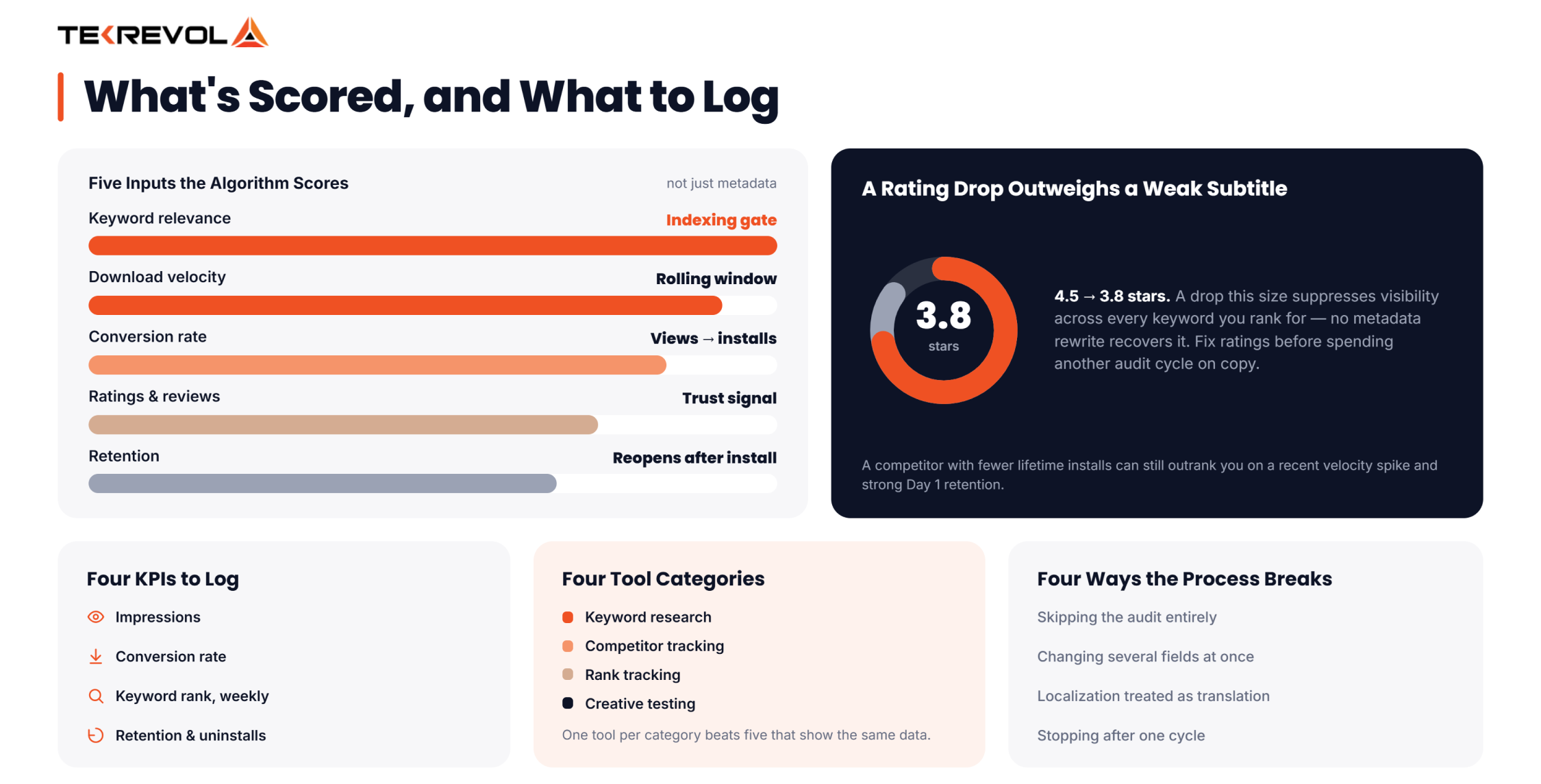
- Keyword relevance — how closely your indexed fields match what users search
- Download velocity — how fast installs are growing over a rolling window
- Conversion rate — what share of viewers become installers
- Ratings and reviews — a trust signal; both stores factor directly into ranking
- Retention — whether users open the app again after installing
This is why a competitor with fewer total installs can still outrank you; a sharp recent spike in downloads and strong Day 1 retention often outweighs raw lifetime numbers. Understanding the app store ranking algorithm this way changes how you prioritize fixes, since a low rating can suppress visibility, no matter how well your keywords are placed.
A rating drop from 4.5 to 3.8 stars often does more damage to visibility than a poorly written subtitle ever could. That’s worth remembering before spending a full audit cycle on metadata alone.
Step 6 — Localize an ASO Process for Global Markets
Localizing the ASO process means repeating every step above per target market, not just translating your existing metadata word-for-word.
- Translate metadata natively for each language, not through direct machine translation alone
- Adapt screenshots to match local audience expectations, not just the text inside them
- Use cross-localization where available; some storefronts can index multiple language localizations at once, multiplying your usable keyword space
- Prioritize markets by real demand signal, not by convenience
When TekRevol expanded a client’s e-commerce app into three new regions, running the full keyword-and-creative process separately for each market instead of a single translated pass lifted category visibility in all three within one update cycle.
Why Localization Fails Without the Full Process
A translated title with no local keyword research behind it rarely ranks. Run steps 1 through 5 again for each market, not just step 4.
Step 7 — Implement and Test ASO Changes
Implement ASO changes one field at a time, with roughly 3 to 4 weeks between major updates, so you can actually attribute what caused a ranking shift.
- Change one variable per test cycle — title, then subtitle, then creatives, never all at once
- Coordinate metadata updates with your app’s release schedule instead of running them independently
- Give each change enough time in the market before judging it a win or a loss
Ranking shifts can appear within about a day of a metadata change, but the data needs weeks to stabilize into something you can trust.
Step 8 — Measure and Iterate on ASO Results
Measure ASO results against the KPIs you set in Step 2 — impressions, conversion rate, keyword rank, and retention — then feed what you find back into the next audit.
- Impressions — how often your listing appears in search or browse results
- Conversion rate — whether your creatives are actually doing their job
- Keyword rank — weekly movement on your top priority terms
- Retention and uninstall rate — whether the users you’re attracting actually stick around
This is the step most teams skip. They implement changes, see a small bump, and stop. The process only compounds if Step 8 leads straight back into Step 1, a fresh audit, using what you just learned.
Keep a simple running log: what changed, when, and what moved afterward. Six months in, that log becomes more valuable than any single tool, since it shows you exactly which levers actually work for your specific app and category.
What Tools Do You Need to Run an ASO Process at Scale?
You need four categories of ASO tools to run this process consistently: keyword research tools, competitor trackers, rank trackers, and creative testing.
| Function | What It Solves |
| Keyword research | Finds real search terms and volume data |
| Competitor tracking | Shows what’s working for apps outranking you |
| Rank tracking | Confirms whether a change actually moved your position |
| Creative testing | Measures the conversion impact of icon/screenshot changes |
Tool choice matters less than most teams assume. A mid-tier toolset run through a consistent process will consistently outperform a premium toolset used without one.
Start with one tool per category rather than stacking five keyword-research platforms that mostly show the same data. The process- audit, research, test, and measure is what produces results. The tool just makes each step faster to execute.
What Mistakes Break the ASO Process Most Often?
- Skipping the audit and jumping straight to metadata changes, with no baseline to measure against
- Changing too many fields at once makes it impossible to know what actually caused a ranking shift
- Treating localization as translation only, without repeating keyword research per market
- Abandoning the process after one cycle instead of feeding results back into the next audit
Each of these breaks a different link in the same chain. Fix the sequence, and most of these mistakes disappear on their own.
For teams building the process and the app at the same time, these proven mobile app promotion strategies are worth pairing with your ASO cycle, since ranking and promotion reinforce each other rather than working in isolation.
How Does TekRevol Run the ASO Process From Audit to Ranking?
At TekRevol, App Store Optimization is an ongoing growth strategy, not a one-time metadata update. Every engagement starts with a comprehensive ASO audit to assess keyword visibility, competitor performance, conversion opportunities, and listing quality. These insights are then used to prioritize the changes most likely to improve discoverability and organic installs.
Our process combines keyword research, metadata optimization, creative testing, localization, review management, and continuous performance tracking. Rankings, conversion rate optimization, and user feedback are reviewed after every release, allowing the team to refine the strategy as search trends and app store algorithms evolve.
This data-driven approach has been applied across apps in fitness, education, fintech, healthcare, eCommerce, and on-demand services. Projects such as Alif Play and TruthGPT reflect TekRevol’s experience in building and growing digital products for competitive markets through continuous optimization and long-term growth strategies.
Ready to turn ASO into a repeatable process instead of a one-time fix?
Get an audit-to-ranking roadmap built around your app's actual gaps, not a generic checklist.
Book Your ASO Strategy Call →


