



- A free ASO audit scores your listing across keywords, metadata, visuals, reviews, and localization within minutes.
- Screenshot captions, retention curves, Custom Product Pages, and Android crash rates now directly shape your store ranking.
- Your audit score reveals exactly where downloads are leaking, not just that a problem exists somewhere.
- Only 31% of eligible apps use Custom Product Pages, leaving a major, low-competition ranking opportunity untouched.
- Free tools catch surface issues; real growth needs competitor context, sequencing, and a prioritized action plan.
- Run a full ASO audit quarterly, and immediately after any ranking drop or algorithm update.
Struggling to figure out why your app isn’t ranking despite having solid features and decent reviews? You’re not alone. Most app owners guess what’s holding them back: keywords, screenshots, or fierce competition. A free ASO audit replaces guesswork with real data, showing exactly where your listing stands and where it can improve.
A free App Store Optimization (ASO) audit reveals your app’s hidden ranking flaws and growth opportunities. It checks keyword visibility, metadata strength, conversion rates, and competitor gaps. So you can see exactly how easily users find your app and where you’re losing potential downloads along the way.
Many app owners turn to an ASO agency to run this audit, since spotting these gaps and turning them into a real strategy takes more than a quick glance at the numbers.
This blog will walk you through exactly what a free ASO audit uncovers, how to read the results, and what to do with them. So, let’s get started!
What Is an ASO Audit, Exactly?
An App Store Optimization (ASO) audit is a detailed review of your app’s App Store or Google Play listing. It identifies opportunities to improve visibility, attract the right users, and increase downloads.
It looks at your title, subtitle, description, keywords, screenshots, icon, ratings, and how fresh your listing is. Then it tells you what’s pulling your rankings down and what’s already working.
Before learning about an audit, it will be helpful to learn what exactly App Store Optimization (ASO) is?
ASO Audit vs. ASO Tool vs. ASO Strategy
An ASO audit diagnoses what’s working, what’s not, and what’s holding your listing back. An ASO tool is the software you use to analyze those areas, while an ASO strategy is the plan you build from the audit’s findings to improve visibility, rankings, and conversions.
- ASO audit: A one-time (or recurring) diagnostic. It tells you what’s broken right now.
- ASO tool: the software you use to run that diagnostic, track keywords, or generate metadata.
- ASO strategy: the ongoing plan built from what the audit found. The audit tells you what. The strategy tells you how and when.
You need all three eventually. But the audit always comes first. You can’t build a strategy on guesses
If you’re coming at this from a web SEO background, it’s worth understanding how ASO differs from SEO before you start; the ranking systems, keyword logic, and even what counts as a “conversion” are fundamentally different.
Why ASO Matters More in 2026 Than It Did Two Years Ago
The mobile app landscape has gotten dramatically more crowded and more competitive. A few numbers put that in context:
- The App Store and Google Play together offer millions of apps, making visibility increasingly competitive.
- Global app downloads reached nearly 150 billion in 2025, while consumer spending on apps and games hit $167 billion, highlighting the scale and competitiveness of the mobile market.
- Apple reports that 65% of App Store downloads occur directly after a search, highlighting the importance of search visibility for app discovery.
- Only about 25–26% of users return to an app after the first day, making ongoing visibility and retention critical for sustained growth.
That last stat is the important one for business owners. Getting discovered is only step one because app store ranking algorithms increasingly consider what happens after the install, including retention, engagement, and review sentiment, as ranking signals in their own right.
The Algorithm Has Quietly Changed Its Rules
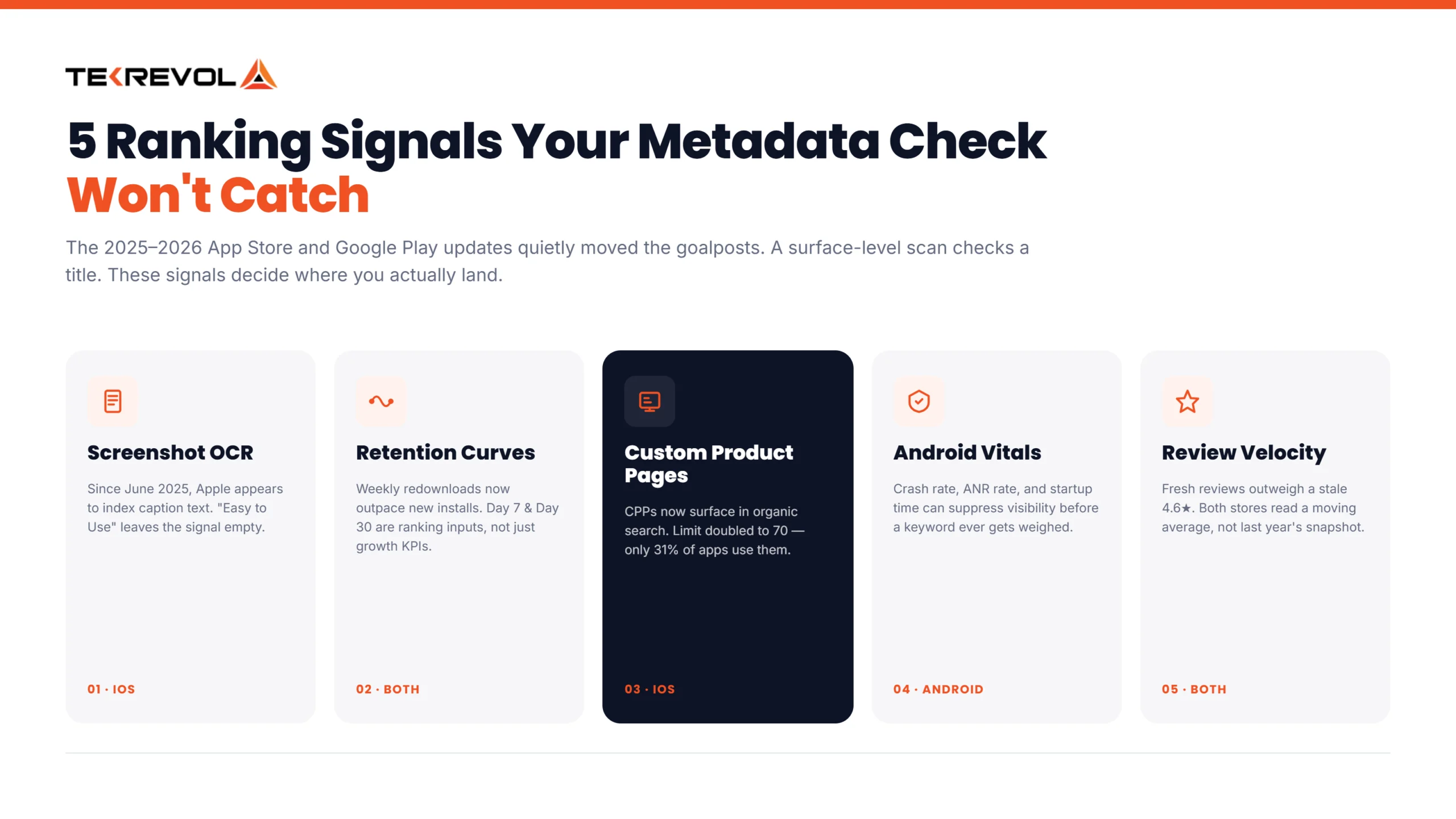
The App Store and Google Play algorithms now weigh screenshot text, Custom Product Pages, technical performance, and review freshness- signals a basic metadata check won’t catch.
Here’s what shifted, and what’s still confirmed versus contested:
Screenshot Text Can Influence Rankings
Since Apple’s June 2025 update, the App Store appears to run OCR on screenshot captions and factor that text into relevance. The impact of screenshot text on rankings is still debated in the ASO community. The safest approach is to use clear, keyword-aware captions instead of vague phrases like “Easy to Use,” especially since strong screenshot copy can improve conversions.
Retention Matters More Than Raw Downloads
Recent research on App Store ranking shows that algorithms consider both behavioral relevance, such as clicks and downloads, and textual relevance, such as how closely an app matches a search query. Both are important ranking signals, rather than relying on keyword matching alone.
Weekly redownloads on the App Store now regularly outpace new downloads, showing that keeping users matters alongside acquiring them. An app that gets many downloads but is quickly deleted may not perform as strongly in rankings.
Custom Product Pages Can Drive Organic Growth
Since mid-2025, you can assign keywords to specific CPPs and have them surface in organic search, not only ads. Apple doubled the CPP limit to 70 pages in late 2025. Despite that, only around 31% of apps actually use CPPs, and the ones that do report meaningful conversion lifts. This is one of the biggest gaps most competitors haven’t closed yet.
Android Vitals Can Influence App Rankings
Google Play can reduce visibility for apps with high crash or ANR rates and may also consider startup time when evaluating app quality. Crossing these thresholds can hurt visibility and trigger warning badges, while weak keyword coverage can limit how well your app is discovered in search.
Fresh Reviews Matter as Much as Star Ratings
Both stores appear to weight recent review velocity more heavily than a static rating that hasn’t moved in a year. An app sitting on a 4.6 average from 18 months ago isn’t sending the same trust signal as one collecting fresh reviews every week.
None of this shows up if an audit only checks whether your title has a keyword in it. That gap is exactly why a surface-level free scan and a genuine audit produce very different action plans.
Want to See Where Your Listing Actually Stands?
Get a clear view of your app's ranking potential, conversion gaps, and the opportunities your competitors are capturing.
Get Your Free ASO Audit Report!What Does a Genuine ASO Audit Actually Review?
A surface-level check looks at your title and maybe your screenshots. A real audit is a structured pass across every signal the stores actually use, split into two categories:
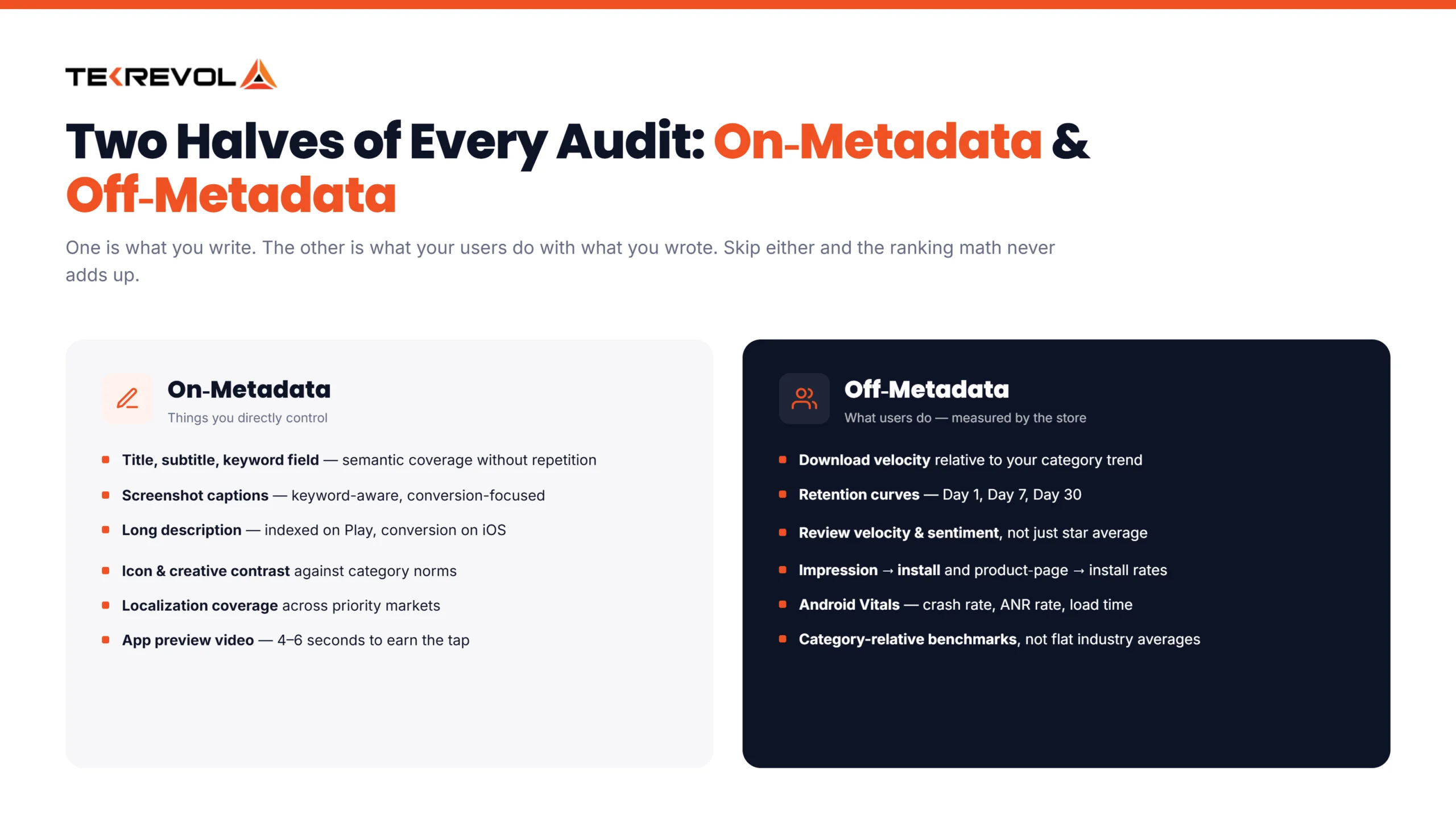
On-metadata factors (things you directly control):
- Title, subtitle, and keyword field coverage and semantic overlap. Add missing high-value keywords to your subtitle or keyword field. A good app store keyword research tool makes this far faster than guessing.
- Screenshot captions with keyword-aware, conversion-focused messaging.
- Long description structure and keyword density (fully indexed on Google Play, conversion-only on the App Store)
- Icon and creative contrast against category norms.
- Localization coverage across key markets to capture more organic impressions.
- App preview video and poster frame, where the first 4–6 seconds should immediately show what makes your app worth downloading.
Off-metadata factors (things the store measures based on user behavior):
- Download velocity and category-relative trend.
- Retention curves (Day 1, Day 7, Day 30) against category benchmarks.
- Review velocity and sentiment, not just star average.
- Conversion rate from impression to install, and from product page view to install.
- Technical health signals (crash rate, ANR rate, load time) on Android.
| Audit Area | What It Reveals | Why It Matters |
| Keyword & metadata coverage | Gaps between what users search for and what your listing targets | Missed keywords are missed traffic you’re not even competing for |
| Creative & screenshot analysis | Whether your visuals convert impressions into taps | Conversion rate averages roughly 25% on iOS and 27.3% on Google Play, falling meaningfully below that of a direct download loss |
| Ratings & review health | Whether sentiment and velocity are dragging your rank down | Stores are understood to weigh review recency and velocity, not just your static star average |
| Competitive positioning | Where competitors are gaining ground on shared keywords | If a rival climbs on a term you used to win, you’ll see it before your installs drop, not after |
| Technical / engagement signals | Retention curves and (on Android) crash/ANR data | These are now explicit ranking inputs, not just “nice to have” quality metrics |
How to Read Your ASO Audit Score
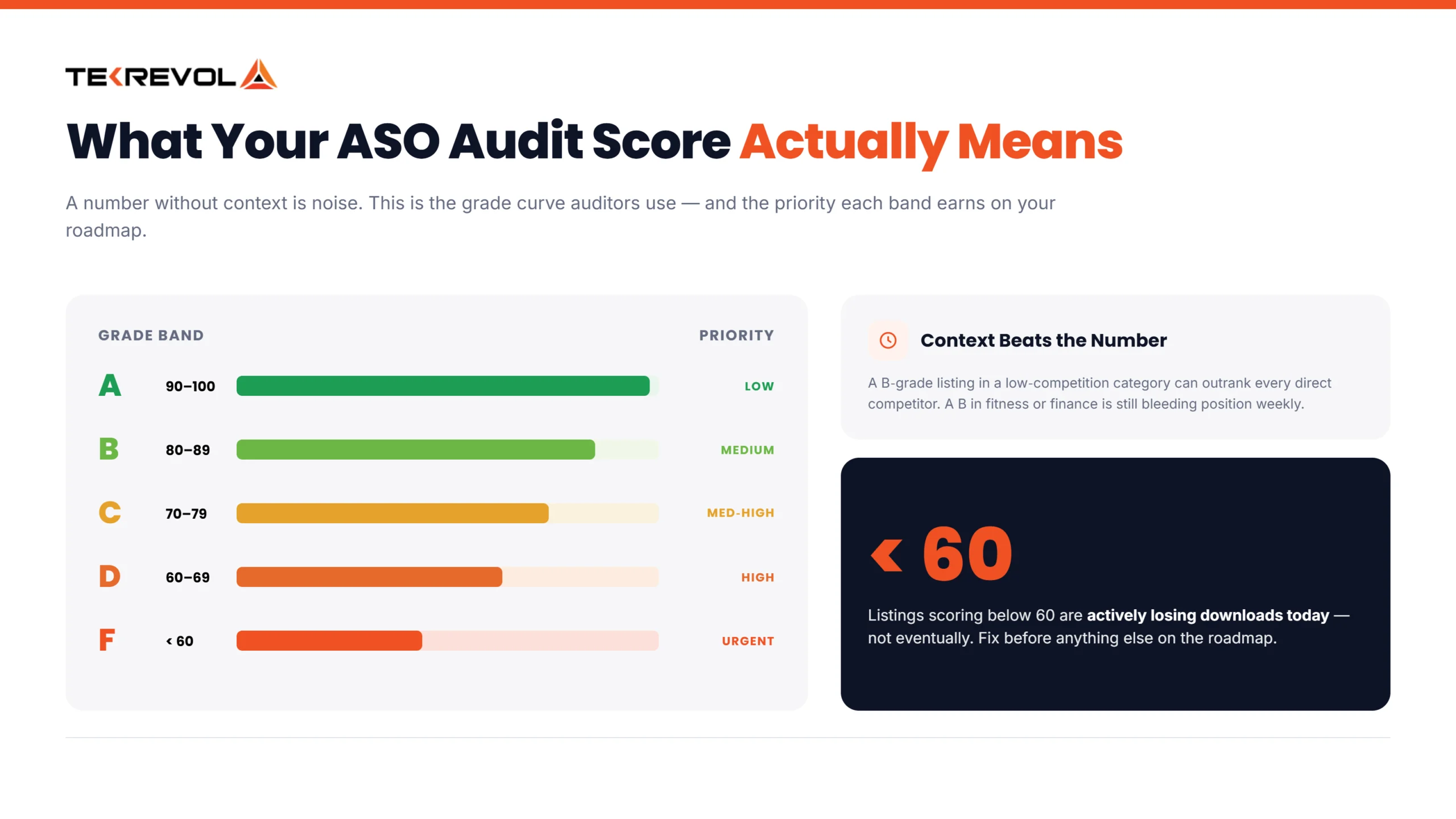
Most audit tools give your listing a 0–100 score or an A–F grade. The score shows how closely your listing follows ASO best practices, not how good your app is overall.
| Score | Grade | What It Means | Priority |
| 90–100 | A | Excellent, minor tweaks only | Low |
| 80–89 | B | Good, a few gaps worth closing | Medium |
| 70–79 | C | Average, real room to improve | Medium-High |
| 60–69 | D | Below average, actively losing downloads | High |
| Below 60 | F | Significant issues, fix immediately | Urgent |
A 90+ or an A means your listing is doing almost everything right. Below 60, or an F, means there are real, fixable gaps costing you visibility today, not eventually.
Why Deep Competitor Research Is the Part Most Audits Skip
Competitor research shows more than your score. It reveals why competing apps rank higher, including the keywords and strategies they use.
Most free tools stop at your score. Very few tell you why the app sitting one spot above you in search results owns the one keyword that actually matters to your business.
Ranking keywords vs. invisible keywords
Every audit surfaces two different problems. First: keywords you already rank for, where you’ve likely captured most of the available value. Second, and more important: high-value keywords you don’t rank for at all. That second bucket is where the real growth sits, and it’s the harder one to find on your own.
How Competitors Are Winning the Same Keywords
Once you know which keywords you’re invisible on, the next question is why a competitor owns them. Look at exactly what’s ranking above you: their title, their subtitle, their precise terminology, not just the general topic they’re targeting. Small wording differences, “tracker” versus “monitor” versus “planner,” can be the entire reason a competitor outranks you on a keyword you both have an equal claim to.
A thorough competitive pass covers:
- Keyword overlap and gap mapping: Which terms competitors rank for that you don’t, and which terms you’re contesting but losing.
- Creative benchmarking: How their first screenshot, icon, and preview video compare to yours on the exact same search results page.
- Category and download-volume context: Whether your organic performance is normal for your category or there is untapped potential you could improve.
- Rank-history tracking: Catching a competitor’s upward movement early, before it costs you position, rather than explaining it after the fact
- Update cadence patterns: Competitors shipping frequent, keyword-aware updates keep freshness signals working in their favor continuously
How to Know Which Keywords Are Worth Keeping
Three things matter more than the keyword itself: search volume, the number of relevant long-tail phrases it can unlock, and ranking difficulty. A broad term like “learning” can create more opportunities than a narrow term like “conjugation,” while a lower-volume keyword may still be more valuable if you have a realistic chance of ranking for it.
That last point matters more than most audits explain. Ranking on page four rarely drives meaningful downloads because most keyword-driven installs go to the top few results. If you rank 40th or 50th for a keyword, it may be better to focus on terms where you have a realistic chance of reaching the top.
iOS vs Google Play: What Changes in the Audit
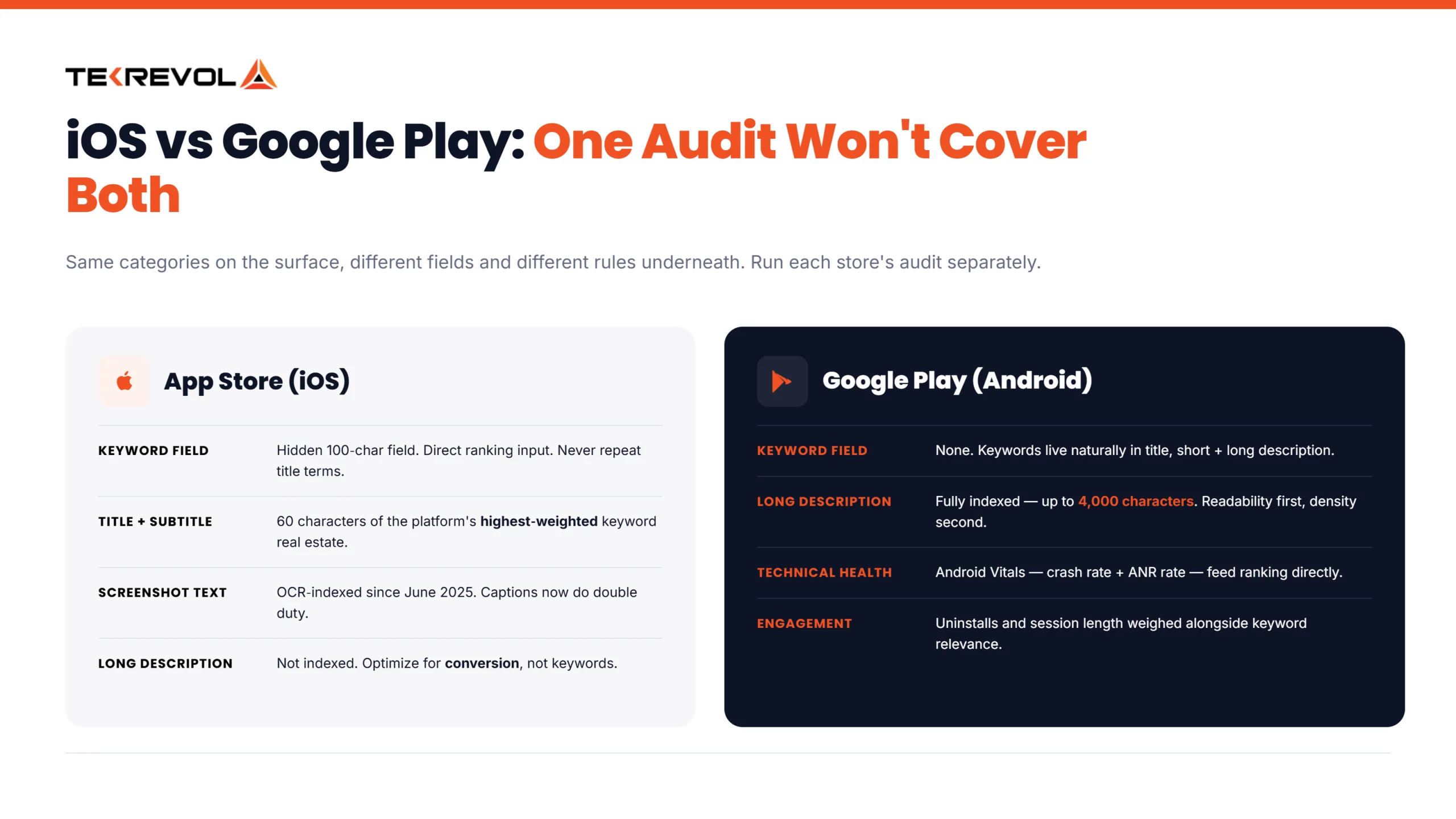
The core audit categories stay the same across both stores, but the specific fields and rules underneath them change. Run the audit for each platform separately; a listing optimized for one doesn’t automatically transfer to the other.
App Store (iOS) specifics:
- The keyword field is hidden from users but directly affects ranking, so it needs to be dense and non-repetitive with your title and subtitle.
- Screenshot captions may affect rankings through OCR, though research is mixed. Using relevant keywords in your captions is still a safe way to improve conversion potential.
- The title and subtitle together give you 60 characters of your highest-weighted keyword, real estate, on the platform.
Google Play specifics:
- There’s no hidden keyword field. Your keywords have to live naturally in the title, short description, and long description.
- The long description gives you up to 4,000 characters, so keyword density matters more here than on iOS, though both stores are shifting toward natural-language matching. Write for readability first, density second.
- Google Play’s ranking model is generally understood to weigh engagement metrics like uninstalls and session length alongside keyword relevance
This is exactly why running one generic audit and applying the findings to both stores tends to leave real ranking gains on the table on at least one platform.
Where Free Audit Tools Fall Short
Free ASO checkers are genuinely useful for one thing: an instant, automated score based on surface-level metadata rules. That’s a real starting point. It is not the same thing as a strategic audit, for a few concrete reasons.
- They score structure, not intent: An automated tool confirms your title contains a keyword. It can’t tell you whether that keyword actually converts for your category, or whether a lower-volume, higher-intent phrase would outperform it.
- They rarely model true competitive context: Most free tools compare your listing against generic best practices, not against the five apps actually outranking you this week.
- They don’t weigh off-metadata signals well: Retention, review trends, and Android Vitals need historical data and category benchmarks that a single audit cannot capture.
- They can’t turn findings into a sequenced plan: A score tells you something is wrong. It doesn’t tell you which fix to make first, second, or third. In ASO, sequencing matters because keyword changes and creative updates work best when they support each other.
In short: A free audit highlights the warning signs, while a full audit reveals what’s actually causing the problem.
What This Means for You as the Business Owner
If you’re a founder, marketing lead, or app owner reading this, the practical takeaway is straightforward:
- If you haven’t checked your keyword rankings in the last two weeks, you’re likely behind; rankings drift, and competitors update constantly. A full audit should be run quarterly, while regular rank checks help you spot sudden drops before they become bigger problems.
- If your screenshots don’t have deliberate, keyword-aware captions, you’re leaving a confirmed ranking signal completely untouched.
- If you haven’t looked at your Day 7 and Day 30 retention relative to your category, you don’t actually know whether the algorithm is rewarding or quietly penalizing you right now.
- If you’re running paid installs into an unoptimized listing, you’re patching a leak rather than fixing it. Every paid click still has to convert on a page that the algorithm and the user both judge by the same rules.
See Where Your App Can Improve
We’ll give you a clear ASO roadmap to improve your app’s visibility and conversions.
Contact Us to Request Your Free ASO AuditWhat to Fix First After Your ASO Audit
Fix the highest-impact, lowest-effort changes first, then move to the bigger structural work.
Quick wins:
- Rewrite your title to lead with your strongest keyword
- Reorder your first two screenshots to lead with your best hook
- Add missing high-value keywords to your subtitle or keyword field
- Write keyword-aware screenshot captions instead of generic taglines
Bigger lifts:
- Full metadata rewrite based on real keyword research, not guesswork
- Building out Custom Product Pages tied to your top organic keywords
- Localizing your listing for new markets
- Fixing crash rate or ANR issues flagged in Android Vitals before touching anything else
Once your listing itself is optimized, pair it with broader mobile app promotion strategies to drive traffic into that improved conversion funnel.
How Often Should You Run an ASO Audit?
Run a full ASO audit every quarter, plus immediately after a ranking drop, an algorithm update, or before any major listing change.
Quarterly baseline: even if nothing feels wrong, audit every 3 months. Rankings change over time as competitors update their listings, so what worked in January may underperform by summer.
Trigger points: Run an audit if you notice a sudden ranking drop, before a major listing update, or after an Apple or Google algorithm change. Waiting for downloads to fall can make the problem harder and more expensive to fix.
DIY Audit vs. Working with an ASO Agency
You can run a basic ASO audit yourself with free tools. Where it gets harder is turning that data into a strategy that actually moves rankings.
When you can run it yourself: if you’re early-stage, in a low-competition category, or just want a quick health check, a free audit tool gets you most of the way there. Fix the obvious stuff, monitor your rankings, repeat quarterly.
When the data needs a trained eye: once you’re competing in a crowded category, the gaps get subtler: which keyword combination actually converts, which screenshot order is quietly costing you installs, what a competitor changed last month that bumped them past you. This is usually where working with an ASO agency pays off. Spotting those patterns across thousands of listings and knowing which fix to sequence first takes experience most in-house teams haven’t had time to build.
How We Approach an ASO Audit at TekRevol
Our process is built around the same two categories above, on-metadata and off-metadata, applied against your actual competitive set, not generic industry averages.
- Full metadata and creative teardown across title, subtitle, keyword field, screenshots, and description, benchmarked against how the App Store and Google Play currently index each field.
- Competitor keyword and rank mapping against the apps genuinely contesting your category, using live rank-tracking data rather than a single snapshot.
- Retention and engagement review to check whether behavioral signals are helping or hurting your position, the part most self-serve tools skip entirely.
- A prioritized action plan, sequenced by expected impact, so you know what to fix this week versus what to plan for next quarter.
- Platform-specific recommendations, since iOS and Google Play weigh ranking factors differently, and a single generic playbook consistently underperforms on at least one of them.
We build this into the same process we use for product development, because listing performance and product performance are the same conversation, not two separate ones. That’s the difference between an audit that hands you a checklist and one that hands you a plan your team can actually execute against a real competitive set.
Wrapping Up
An ASO audit shows where your app is losing visibility, missing valuable keywords, and falling behind competitors. Free tools can highlight basic issues, but real growth requires competitor insights, conversion analysis, and a clear optimization strategy.
TekRevol is a mobile app development company with ASO built into how we work, because a ranking problem and a product problem are usually the same problem. We help businesses improve visibility, attract the right users, and build apps designed for long-term retention.
If your app hasn’t been reviewed recently, now is the time to find the gaps and fix them.
Ready to Improve Your App’s Rankings and Conversions?
Connect with TekRevol’s ASO experts to identify gaps, build a focused strategy, and drive sustainable app growth.
Book A FREE Consultation Now!


