



- ASO is the practice of ranking higher in App Store and Google Play search and converting more views into installs.
- ASO works by aligning metadata, visuals, ratings, and retention with what App Store and Google Play algorithms reward.
- iPhone ASO relies on title, subtitle, and a hidden keyword field; Android depends on a fully indexed long description.
- Basic ASO tools start around $50 a month, while agency-managed ASO runs $2,000 to $5,000 per market monthly.
- A 4.4+ star rating and quarterly creative testing now directly influence rankings on both app stores in 2026.
- TekRevol has driven measurable ASO results across fitness, super-app, and education apps, including 3M+ downloads for a client.
Launching an app is only the beginning. If people can’t find it in the App Store or Google Play, even the best features won’t translate into downloads. That’s where App Store Optimization (ASO) comes in.
So, what is App Store Optimization? ASO is the process of improving your app’s visibility in search results while increasing the number of users who tap Install after discovering your listing. The challenge is that most ASO guides either stop at a basic definition or get lost in technical jargon. With millions of apps competing for attention, small improvements to your listing can have a significant impact on visibility, conversions, and long-term growth.
This guide breaks down what works in 2026, from ranking factors and keyword research to ASO tools, costs, and common mistakes that hurt discoverability. Whether you’re launching a new app or looking to grow an existing one, our app store optimization services will help you to improve your app’s visibility and drive more organic installs.
What Is App Store Optimization?
App store optimization (ASO) is the process of improving an app’s visibility, ranking, and conversion rate inside the Apple App Store and Google Play, so more of the right users find and download it. It covers keywords, screenshots, ratings, and metadata.
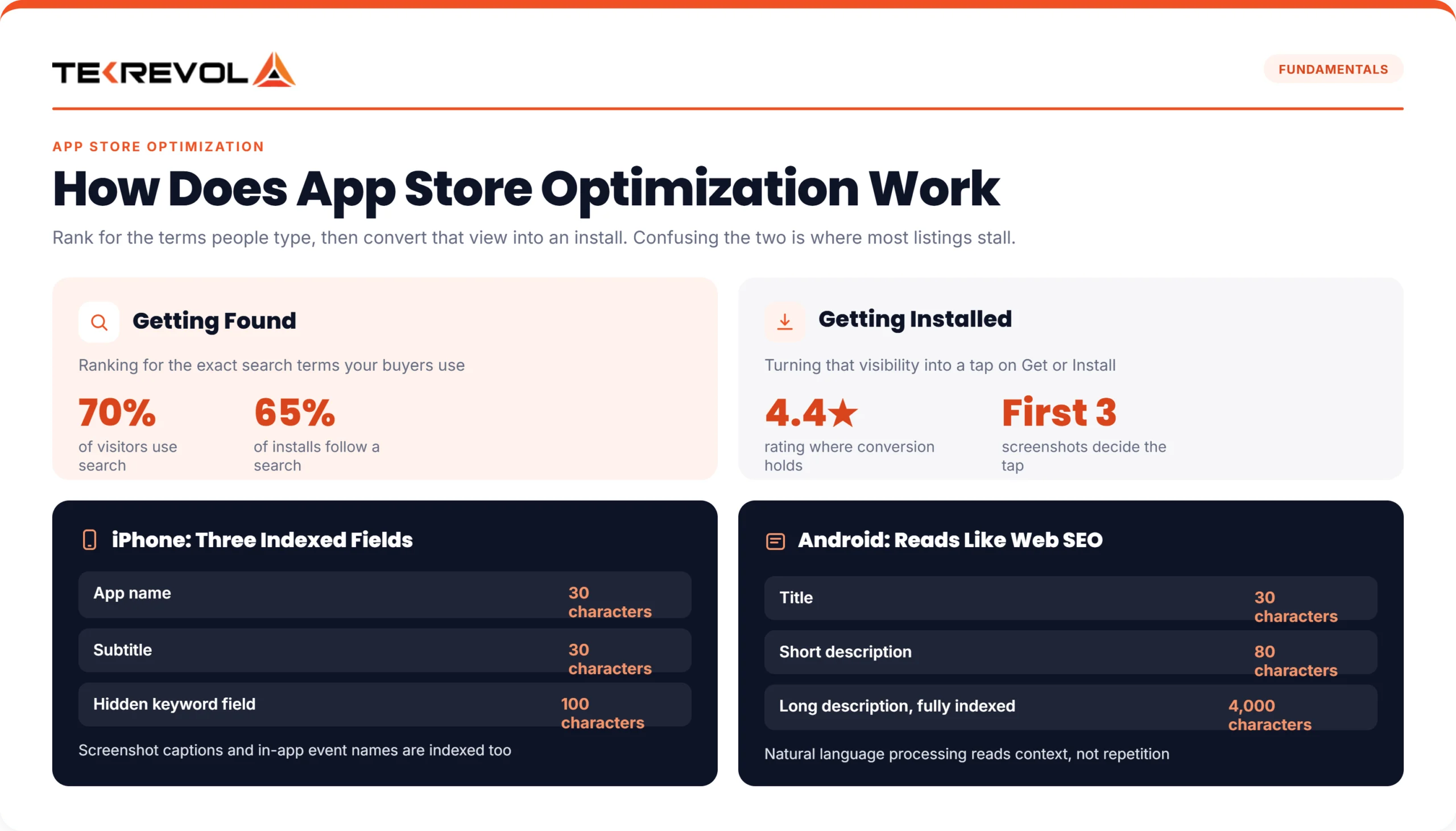
ASO has two real jobs, and confusing them is where most people go wrong:
- Getting found. Ranking for the exact terms people type when they’re looking for an app like yours.
- Getting installed. Turning that visibility into an actual tap on “Get” or “Install” once someone lands on your page.
Apple reports that 70% of App Store visitors use search to discover apps, and 65% of downloads happen directly after a search, highlighting why search visibility is one of the biggest drivers of organic app installs.
What is App Store Optimization on iPhone?
On iPhone, ASO comes down to three metadata fields Apple gives you to target search: a 30-character app name, a 30-character subtitle, and a hidden 100-character keyword field that users never see but the algorithm reads directly.
As of 2025, screenshot captions and in-app event names are indexed too, which means your visuals now double as keyword real estate. Getting this right takes real Apple App Store search optimization work, since every character in those fields is competing for attention.
What Is App Store Optimization for Android?
On Android, ASO looks a lot more like traditional web SEO. Google indexes your entire 4,000-character-long description using natural language processing, so keyword context and natural phrasing matter more than stuffing exact-match terms.
Your 30-character title and 80-character short description carry the most weight early on, but the long description is where Google Play does its real reading. This is one of the clearest examples of app store SEO in action. Write for a human first, and the algorithm follows.
Not Sure Where Your App Currently Ranks?
Get a free ASO audit and see exactly which keywords, visuals, and listing gaps are costing you downloads.
Get My Free ASO Audit →Why Is App Store Optimization Important?
App store optimization matters because it lowers user acquisition cost, builds organic growth that compounds over time, and puts your app in front of people who are already looking for a solution like yours, without paying for every single install.
Here’s what that actually looks like in practice:
- Discoverability. Most people don’t browse categories anymore; they search. Understanding why app store optimization is important as a channel comes down to one fact: being the app that shows up first when someone types a relevant term.
- Lower cost per install. Organic installs sourced through solid app store SEO cost nothing per download, unlike paid user acquisition, where every install has a price tag attached.
- Higher lifetime value. Users who find your app through search tend to stick around longer and spend more than users who tapped a paid ad, simply because they were already looking for what you offer.
- Compounding growth. Paid campaigns stop the moment you stop paying. ASO doesn’t work that way; better rankings bring more downloads, and more downloads reinforce better rankings, quietly building momentum month over month.
How Does App Store Optimization Work?
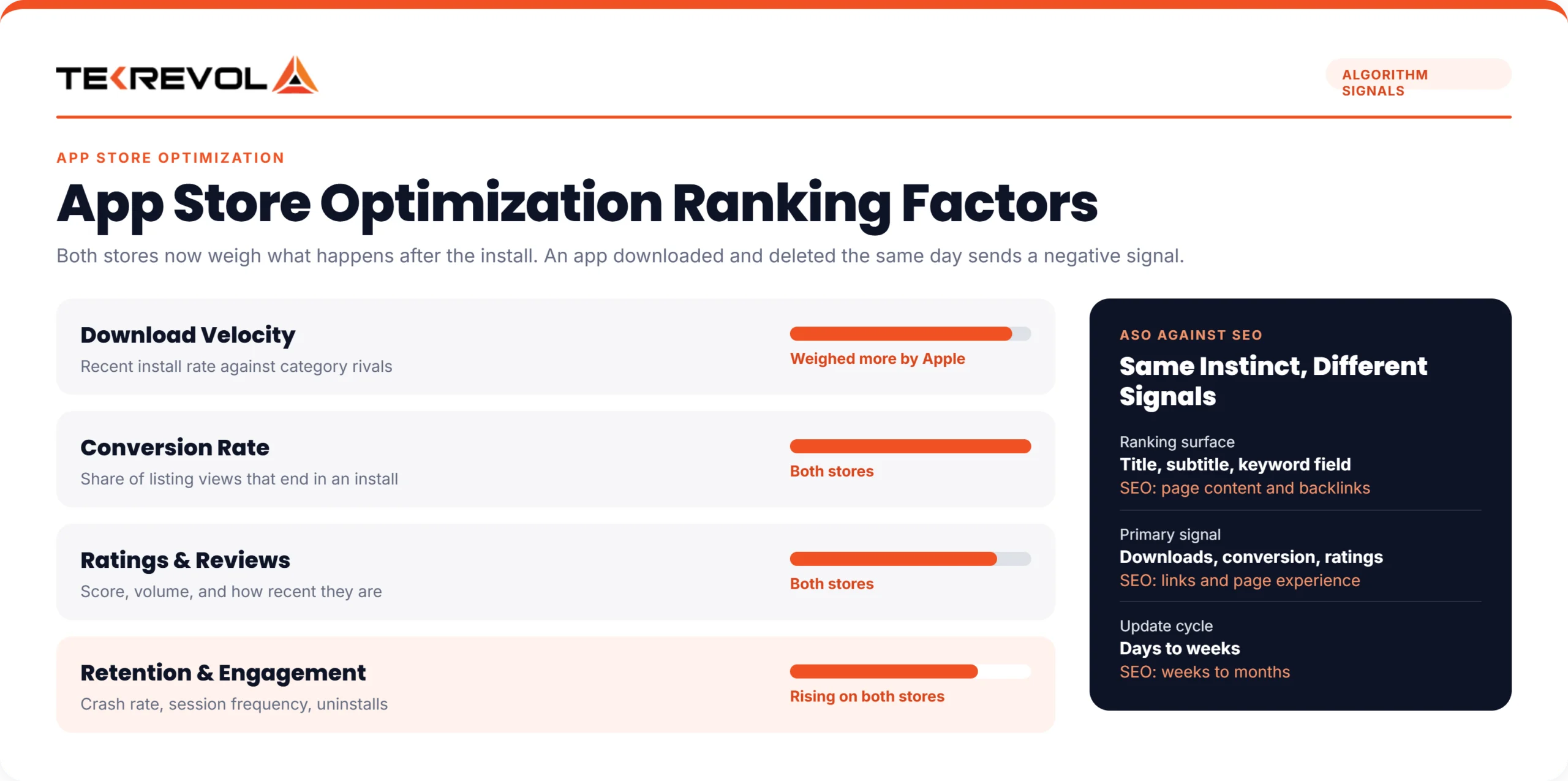
A step-by-step app store optimization process lines up your app’s metadata, visuals, ratings, and engagement signals with what the App Store and Google Play algorithms actually reward, mainly download velocity, conversion rate, ratings and reviews, and retention.
ASO Ranking Factors Matter Most in 2026
| Factor | What It Measures | Which Store Weighs It More |
| Download velocity | Rate of recent installs vs. category competitors | Apple App Store |
| Conversion rate | % of people who view the listing and install | Both |
| Ratings & reviews | Score, volume, and recency | Both |
| Retention & engagement | Crash rate, session frequency, uninstalls | Both, increasingly |
Notice retention is on that list. As of 2026, both stores pay closer attention to what happens after the install, not just the install itself. An app that gets downloaded and deleted within a day sends a bad signal.
ASO vs SEO: What’s the Difference?
| Factor | ASO | SEO |
| Platform | App Store, Google Play | Google and Bing search engines |
| Ranking surface | App title, subtitle, keyword field, description | Web page content, backlinks, meta tags |
| Primary signal | Downloads, conversion rate, ratings | Backlinks, content relevance, and page experience |
| Update cycle | Days to weeks | Weeks to months |
| Goal | App installs | Website traffic and conversions |
If you want the full breakdown of how these two disciplines overlap and where they split, our ASO vs SEO page goes deeper.
How Do You Search for the Right ASO Keywords?
Effective ASO keyword research follows four steps: brainstorm 30 to 50 candidate terms, narrow that list down to 15 or 20 based on volume and competition, place them correctly across your metadata fields, then measure and refine every 4 to 8 weeks.
Where to Find Keyword Ideas
You don’t need expensive tools to start this process. Some of the best keyword ideas come from:
- Competitor listings: read how similar apps describe themselves
- Autocomplete suggestions inside both app stores as you type
- Paid search-term reports, if you’re already running Apple Ads or Google Ads
- User reviews, both on your app and on competitors’ apps
If you want a repeatable process for this, our guide on how to search keywords for app store optimization walks through it step by step.
Narrowing Down to the Right Terms
Not every keyword deserves a spot in your metadata. Weigh each candidate against:
- Search volume or popularity score — how many people actually search for it
- Competition level — two-word phrases often hit a sweet spot between volume and difficulty
- Conversion potential — does this term match what your app actually does
- Relevance — ranking for an unrelated term brings installs that churn fast
Keyword Research Eats Hours If You're Doing It Manually.
See the exact keywords your competitors rank for and the gaps you can win, all in one clear report.
Run My Free Competitor Keyword Report →App Store Optimization Tools — Which Ones Are Worth Paying For?
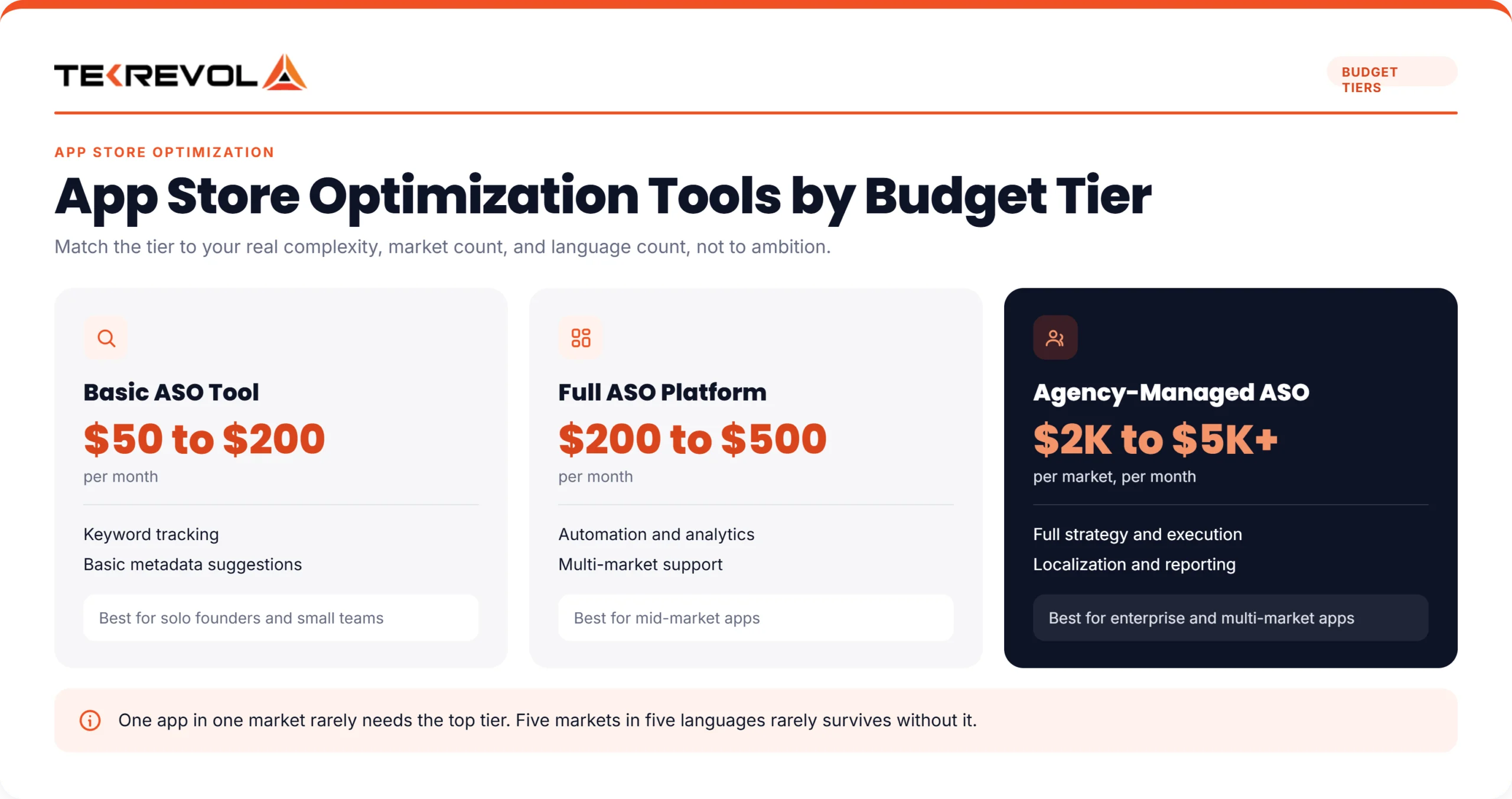
The best app store optimization tools fall into three budget tiers: basic keyword tracking tools running $50 to $200 a month, full ASO platforms with automation and analytics at $200 to $500 a month, and agency-managed ASO at $2,000 to $5,000 a month per market.
| Tier | Cost/Month | What’s Included | Best For |
| Basic ASO tool | $50–$200 | Keyword tracking, basic metadata suggestions | Solo founders, small teams |
| Full ASO platform | $200–$500 | Automation, analytics, multi-market support | Mid-market apps |
| Agency-managed ASO | $2,000–$5,000+ | Full strategy, execution, and reporting | Enterprise, multi-market apps |
A solo founder tracking one app in one market rarely needs the top tier. A company shipping the same app across five markets, in five languages, usually can’t run that without agency-level support. Match the tier to your actual complexity, not your ambitions.
For a full breakdown of what each platform offers, see our app store keyword research tools comparison.
How Do You Optimize App Store Visuals and Conversion Rate?
Optimizing app store conversion rate means treating your app store listing like a landing page, testing one variable at a time across your icon, screenshots, and preview video. Ranking well for a keyword means nothing if nobody taps “Get” once they land on the page.
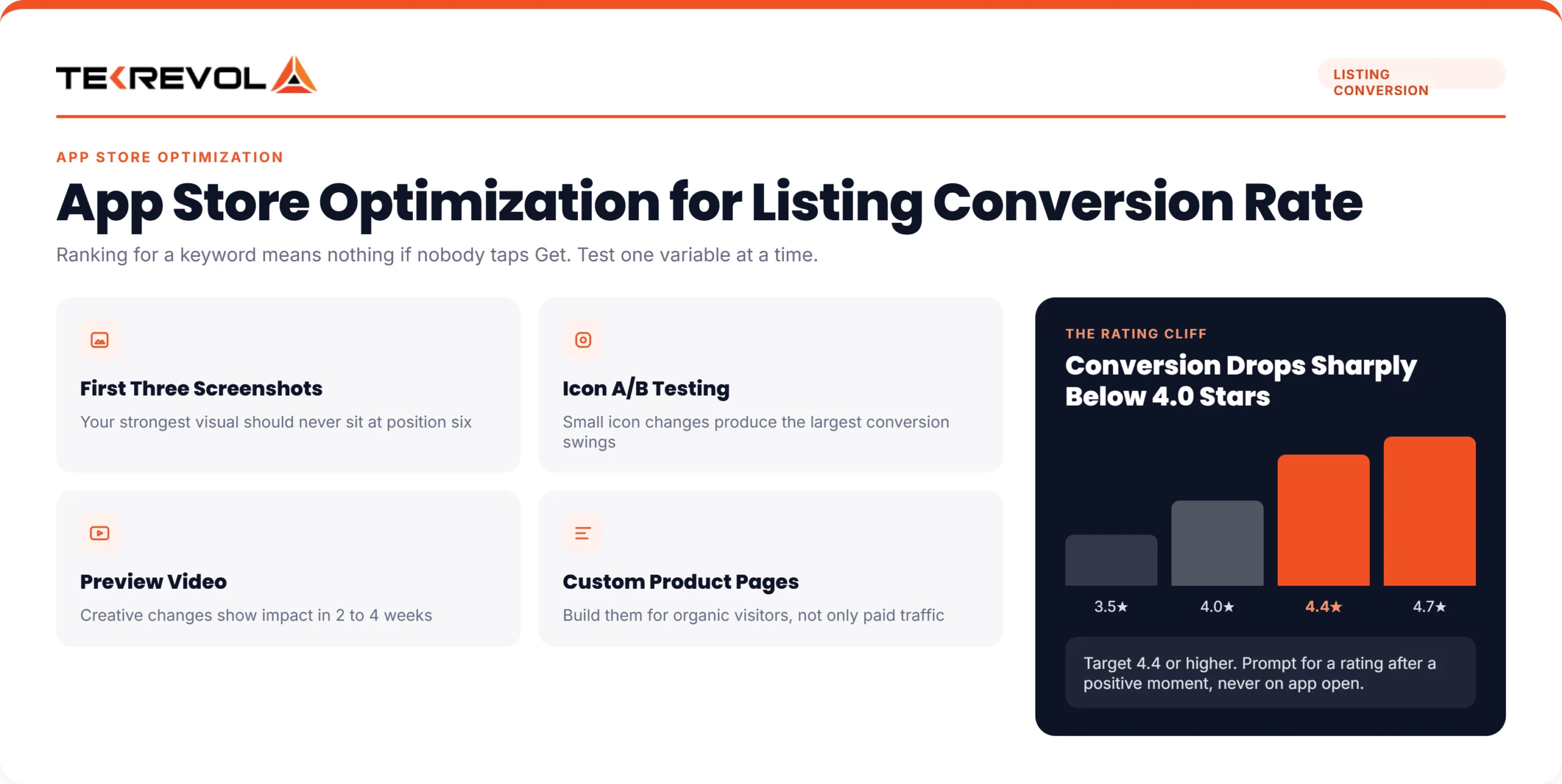
A few things worth testing directly:
- First three screenshots — most users decide within seconds, so your strongest visual should never be screenshot six
- Icon A/B testing — small changes here often produce the largest swings in conversion rate
- Custom product pages (Apple) and custom store listings (Google) — let you tailor the pitch to different audience segments
- The 4.0-star cliff — conversion rates tend to drop sharply below a 4.0 average rating, so ratings management isn’t optional
How Do You Measure ASO Success and Performance?
You can’t improve what you don’t measure. The most important ASO metrics include keyword rankings, search impressions, conversion rate, organic installs, and user retention. Since App Store and Google Play algorithms take time to reflect changes, evaluate performance over 4 to 8 weeks instead of expecting immediate results.
Before making any updates, establish a baseline for your current rankings and install performance. This gives you a reliable point of comparison and helps you determine whether changes to keywords, screenshots, or app descriptions are actually driving results.
A simple way to measure ROI on ASO cost is to compare the increase in organic installs, conversion rate improvements, and the lifetime value (LTV) of newly acquired users.
Keep in mind that not every optimization delivers results at the same pace. Creative updates, such as new screenshots or app preview videos, often show an impact within 2 to 4 weeks. Keyword optimizations typically take 4 to 8 weeks, as app stores need time to re-index your listing and adjust search rankings. Also, check out proven app marketing strategies to increase the ROI.
Best Practices for App Store Optimization
The best 2026 ASO practices are index-aware screenshot captions, custom product pages built for organic search rather than only paid traffic, a 4.4+ rating target, quarterly creative testing, and treating paid and organic keyword data as one shared strategy instead of two separate teams.
- Write screenshot captions knowing they’re indexed, not just decorative
- Build custom product pages for organic visitors, not only paid campaign traffic
- Aim for a 4.4-star average or higher, since this is where conversion really stabilizes
- Re-test your creative assets every quarter, not once a year
- Share keyword data between your paid and organic teams instead of running them separately
- Update Google Play descriptions with natural phrasing, not repeated exact-match terms
- Monitor Android Vitals and crash reports as part of your regular ASO review, not a separate process
Following these best practices helps improve visibility, increase organic installs, and keep your app competitive as store algorithms evolve. More importantly, they lay the foundation for long-term app success post-launch, ensuring your app continues to attract, convert, and retain users well beyond its initial release.
What Mistakes Should You Avoid in App Optimization?
The most common ASO mistakes are keyword stuffing in Google Play descriptions, repeating the same keyword across every iOS metadata field, asking for ratings at the wrong moment, ignoring crash data, and treating ASO as a one-time project instead of an ongoing practice.
- Keyword stuffing on Google Play — write naturally instead; the algorithm reads context, not repetition
- Repeating one keyword everywhere on iOS — spread different terms across the title, subtitle, and keyword field to cover more ground
- Asking for ratings at the wrong moment — prompt after a positive interaction, not right after opening the app
- Ignoring Android Vitals crash data — a high crash rate quietly tanks your ranking even if your metadata is perfect
- Treating ASO as one-time work — rankings shift as competitors update their listings, so review yours on a set schedule
Avoiding these mistakes is a key part of mobile app optimization. Regularly refining your listing, tracking performance, and fixing technical issues help improve visibility and sustain app store rankings.
How TekRevol Approaches App Store Optimization
At TekRevol, App Store Optimization is an ongoing process, not a one-time task. We start with a comprehensive ASO audit to identify visibility gaps, analyze competitors, and uncover keyword opportunities. From there, we optimize your app’s metadata, refine visual assets, and continuously monitor performance to improve rankings and organic installs.
Our approach combines keyword research, ASO A/B testing for screenshots and app icons, localization for region-specific audiences, and regular performance reporting. Every optimization is backed by real data, allowing us to refine your listing based on changing search trends, user behavior, and app store algorithm updates.
Whether you’re launching a new app or improving an existing one, our App Store Optimization services help increase discoverability, attract high-intent users, and turn more store visits into installs. Get in touch with TekRevol to build ASO strategies tailored to your app and growth goals.
Ranking Higher Is Just the Start; Maximizing Installs Is the Real Goal.
TekRevol's ASO team will map your current gaps across both stores and give you a prioritized action plan to increase installs.
Book My Free ASO Strategy Session →


