



Publishing a great app is only half the battle. If users can’t find it, downloads will remain low regardless of how useful or innovative your app is. That’s where App Store Optimization (ASO) comes into play.
At the heart of every successful ASO strategy lies keyword research, a process that helps you understand what potential users are searching for before they install an app.
Whether you’re launching a brand-new application or trying to improve an existing one, choosing the right keywords can significantly improve your visibility in both the Apple App Store and Google Play Store. From identifying user search intent to tracking keyword performance, every step contributes to stronger organic growth.
This guide walks you through the complete process so you can build a keyword strategy that supports long-term app success, and if you’d rather see the strategy in action first, TekRevol’s app store optimization team put exactly this process behind Tamreeni, a fitness app that grew past 3 million downloads on the back of ASO-optimized store listings and high-conversion metadata.
Well, for now, let’s dive into the blog below to check out what app store keyword research is and how to get it done efficiently.
What Is App Store Keyword Research?
App Store keyword research is the process of identifying the search terms users enter in app marketplaces to discover new apps. It helps developers optimize app titles, subtitles, descriptions, and metadata so their apps appear in relevant search results and attract more qualified downloads.
Unlike traditional SEO, App Store Optimization focuses entirely on how users search within app marketplaces. Instead of competing for rankings on Google, you’re competing for visibility inside the Apple App Store and Google Play Store.
Learning how to search keywords for app store optimization starts with understanding how users think. People rarely search using technical terminology. Instead, they search for problems they want to solve.
For example, someone looking for a budgeting app might search:
- Budget planner
- Expense tracker
- Money manager
- Personal finance app
- Monthly budget
Each of these represents an opportunity to improve discoverability through effective app store optimization research.
Keyword research helps answer important questions like:
- What phrases are users searching?
- Which keywords have high search demand?
- How competitive are those keywords?
- Which terms match my app’s purpose?
- Which keywords are worth targeting first?
By answering these questions early, you avoid optimizing your app around keywords that generate little traffic or attract the wrong audience.
Ready to Climb the App Store Charts?
Turn smart keyword research into a stronger organic growth strategy and more downloads with TekRevol's ASO expertise.
Talk to Our ASO Experts TodayWhy Keyword Research Is the Foundation of App Store Optimization
Keyword research is the foundation of App Store Optimization because it connects your app with users actively searching for solutions. Selecting relevant keywords improves visibility, increases organic installs, and strengthens your overall ASO performance.
Many developers spend months perfecting app design and functionality, but dedicate very little time to keyword strategy. That approach often leads to disappointing results.
Think of ASO as opening a retail store. Even if the products are excellent, customers won’t visit if your store is hidden in an alley with no signs. Keywords are those signs.
Strong keywords and app store optimization strategies help search algorithms understand what your app does, who should see it, and which searches it should appear for.
App Store search remains one of the largest sources of app discovery: Apple reports that 70% of App Store visitors use search to find apps in the first place, which is exactly why learning how to search keywords for ASO is one of the highest-return marketing activities available to app publishers.
Benefits of Effective Keyword Research
Good keyword research provides advantages beyond rankings. It helps you increase organic downloads, reduce paid acquisition costs, reach users with stronger purchase intent, improve conversion rates, and discover emerging market trends.
Businesses investing in mobile app development often include ASO planning from day one because visibility directly influences launch performance.
How to Search Keywords for App Store Optimization (Step-by-Step)?
The best way to search keywords for App Store Optimization is by understanding your audience, researching competitors, using ASO tools, evaluating search demand, and continuously refining your keyword list based on ranking performance.
If you’re wondering how to search for keywords for app store optimization, the process becomes much easier when broken into manageable steps. Let’s explore each one in detail.
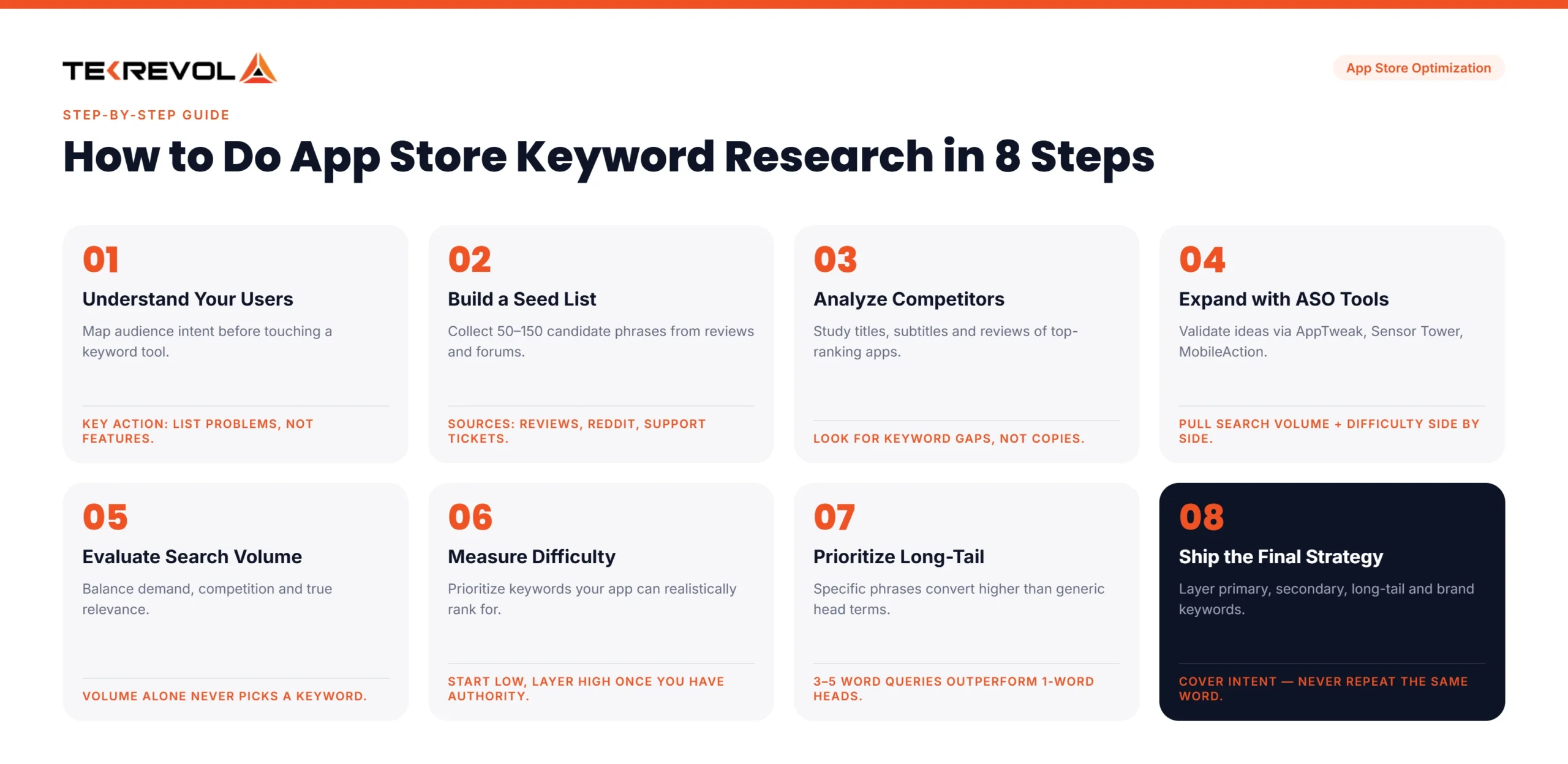
Step 1: Understand Your Users Before Choosing Keywords
Many beginners immediately open an ASO tool and start collecting keywords. That skips the most important step.
Before researching keywords, identify who will use your app, what problem it solves, which words your audience would naturally use, and what goals they’re trying to achieve.
For example, imagine you’re launching a meditation app. Different users may search differently.
| User Intent | Possible Search |
| Stress relief | Stress relief app |
| Better sleep | Sleep sounds |
| Mindfulness | Meditation app |
| Anxiety | Anxiety relief |
| Focus | Focus timer |
These phrases become your initial seed keywords. Good app store optimization research always begins with understanding real user language rather than guessing what sounds professional.
Step 2: Build Your Seed Keyword List
Once user intent is clear, create a broad keyword list. Don’t worry about search volume yet. Instead, capture every relevant phrase.
Your seed list can come from customer interviews, app reviews, competitor listings, Reddit discussions, community forums, and customer support tickets.
At this stage, quantity matters more than perfection. A typical seed list may contain anywhere from 50 to 150 potential keywords. Later, you’ll narrow it down using search volume and competition data.
Learning how to search keywords for ASO becomes much easier when you start with a rich collection of ideas instead of chasing only obvious keywords.
Step 3: Analyze Your Competitors
One of the fastest ways to discover valuable keywords is by studying successful competitors. Search for apps similar to yours, and pay close attention to the app title, subtitle, short description, long description, user reviews, and frequently mentioned features.
Competitor analysis often reveals keyword opportunities you might never have considered. Ask yourself which keywords appear repeatedly, which benefits are emphasized, which audience competitors are targeting, and which keywords seem underserved.
Businesses exploring TekRevol’s guide on how UK apps can succeed with ASO often discover that competitor research uncovers gaps where smaller apps can compete effectively.
Avoid copying competitors word for word. Instead, identify patterns that can strengthen your own keyword strategy.
Step 4: Expand Keywords Using ASO Research Tools
Now it’s time to validate your ideas. Professional ASO platforms help estimate search popularity, keyword difficulty, traffic potential, related keyword suggestions, and competitor rankings.
Some of the most widely used tools include:
| Tool | Best For |
| AppTweak | Enterprise ASO research |
| Sensor Tower | Competitor intelligence |
| Mobile Action | Keyword discovery |
| App Radar | Beginner-friendly ASO |
| AppFollow | Keyword monitoring |
App store optimization research becomes significantly more reliable when supported by data rather than assumptions.
These tools also generate hundreds of related ASO keywords that may not immediately come to mind. Instead of targeting only broad phrases like “fitness app,” you’ll uncover highly specific opportunities with stronger ranking potential.
Step 5: Evaluate Search Volume Without Chasing Only High-Traffic Keywords
Search volume indicates how often users look for a keyword, but it should never be the only deciding factor. The best ASO strategies balance search demand, competition, and relevance to maximize long-term visibility.
One of the biggest misconceptions about ASO is that higher search volume automatically means better results. It doesn’t. A keyword searched 100,000 times every month may seem attractive, but if hundreds of established apps are competing for it, your chances of ranking are slim.
Instead, evaluate every keyword using three factors: relevance, search popularity, and competition. This balanced approach is the foundation of successful app store optimization research.
Rather than targeting one extremely competitive keyword, many successful apps combine medium-volume and long-tail keywords to generate consistent organic installs. For example:
| Avoid | Better Alternative |
| Fitness | Home workout planner |
| Notes | AI note organizer |
| Travel | Budget travel planner |
| Calendar | Daily planner for students |
These alternatives typically have clearer search intent and lower competition. Learning how to search keywords for app store optimization is about identifying opportunities your competitors overlook.
Step 6: Measure Keyword Difficulty Before Finalizing Your List
Keyword difficulty estimates how challenging it will be to rank for a search term. Choosing keywords with manageable competition gives newer apps a stronger chance of earning visibility.
Search demand only tells half the story. Competition determines whether ranking is realistic. Several factors influence keyword difficulty: the number of competing apps, the strength of top-ranking competitors, app ratings, download volume, metadata optimization, and user engagement.
Most ASO platforms provide a keyword difficulty score. Although each tool uses a different methodology, they all help answer one question: “Can my app realistically compete for this keyword?” A practical strategy prioritizes low-competition keywords immediately, includes medium-competition keywords strategically, and saves high-competition keywords to target once the app has gained authority.
Businesses working with TekRevol’s iOS app development team often use this framework during launch planning to maximize organic discoverability from day one.
Step 7: Prioritize Long-Tail Keywords
Long-tail keywords are specific search phrases with lower competition and higher user intent. They often generate better conversion rates because they closely match what users are looking for.
Broad keywords attract attention. Specific keywords attract users who are ready to install. Consider these examples.
| Broad Keyword | Long-Tail Alternative |
| Budget | Budget planner for families |
| Workout | Home workout without equipment |
| Meditation | Guided meditation for beginners |
| Scanner | PDF scanner with OCR |
Notice how each long-tail phrase clearly describes the user’s goal. This is where keyword app store optimization becomes more strategic. Instead of competing against thousands of apps targeting “fitness,” you compete for searches that better align with your app’s unique value proposition.
Long-tail keywords also improve conversion rates because users already know what they’re looking for. When learning how to search keywords for ASO, don’t overlook niche phrases simply because they receive fewer searches. Often, they deliver the highest-quality traffic.
Step 8: Build Your Final Keyword Strategy
A successful keyword strategy combines primary, secondary, and long-tail keywords across your app’s metadata while avoiding duplication and keyword stuffing.
By now, you should have a refined keyword list. The next step is organizing those keywords into primary keywords for your highest-priority searches, secondary keywords for related searches, long-tail keywords for niche traffic opportunities, and brand keywords for company and app recognition.
Avoid repeating the same keyword unnecessarily. Instead, create a balanced keyword portfolio that reflects different search behaviors. Good ASO app store optimization keyword strategies focus on coverage rather than repetition.
Businesses following TekRevol’s guide on how to make a successful app often prepare keyword spreadsheets before publishing their apps to ensure every metadata field supports discoverability.
Common Mistakes to Avoid During Keyword Research
Even experienced developers make avoidable mistakes. Here are some of the most common ones.
- Choosing Keywords Based on Assumptions. Never assume users search the same way you do. Always validate ideas using real data.
- Ignoring User Intent. Ranking means very little if users aren’t looking for what your app actually provides. Relevance should always come before traffic.
- Stuffing Every Metadata Field. Adding the same keyword repeatedly won’t improve rankings. Instead, diversify your keyword portfolio. Natural optimization performs better over time.
One mistake that needs to be avoided at all costs?
Forgetting Localization.
Users in different countries search differently. A keyword that performs well in the United States may generate very little traffic in Germany or Japan. That gap matters more than it looks:
Android alone runs on more than 70% of smartphones worldwide, so skipping regional keyword variants means ignoring how most of the planet’s users actually search. Effective app store optimization research considers regional search behavior from the beginning.
Best Tools for App Store Optimization Research
ASO keyword research tools provide valuable insights into search volume, competition, rankings, and competitor performance. Using reliable tools helps developers make data-driven optimization decisions instead of relying on guesswork.
Professional ASO tools save hundreds of hours of manual research. Each platform has unique strengths, from enterprise analytics and competitor insights to keyword discovery, metadata optimization, review management, and search popularity data.
Beyond keyword suggestions, many of these platforms also help identify trending keywords, competitor rankings, seasonal opportunities, and app store rank tracking, making them valuable long after your app launches.
Top 5 ASO Tools for High-Impact Keyword Research
To help you choose the right platform for your app’s growth, here are the top five ASO tools in 2026, each selected for its distinct strengths:
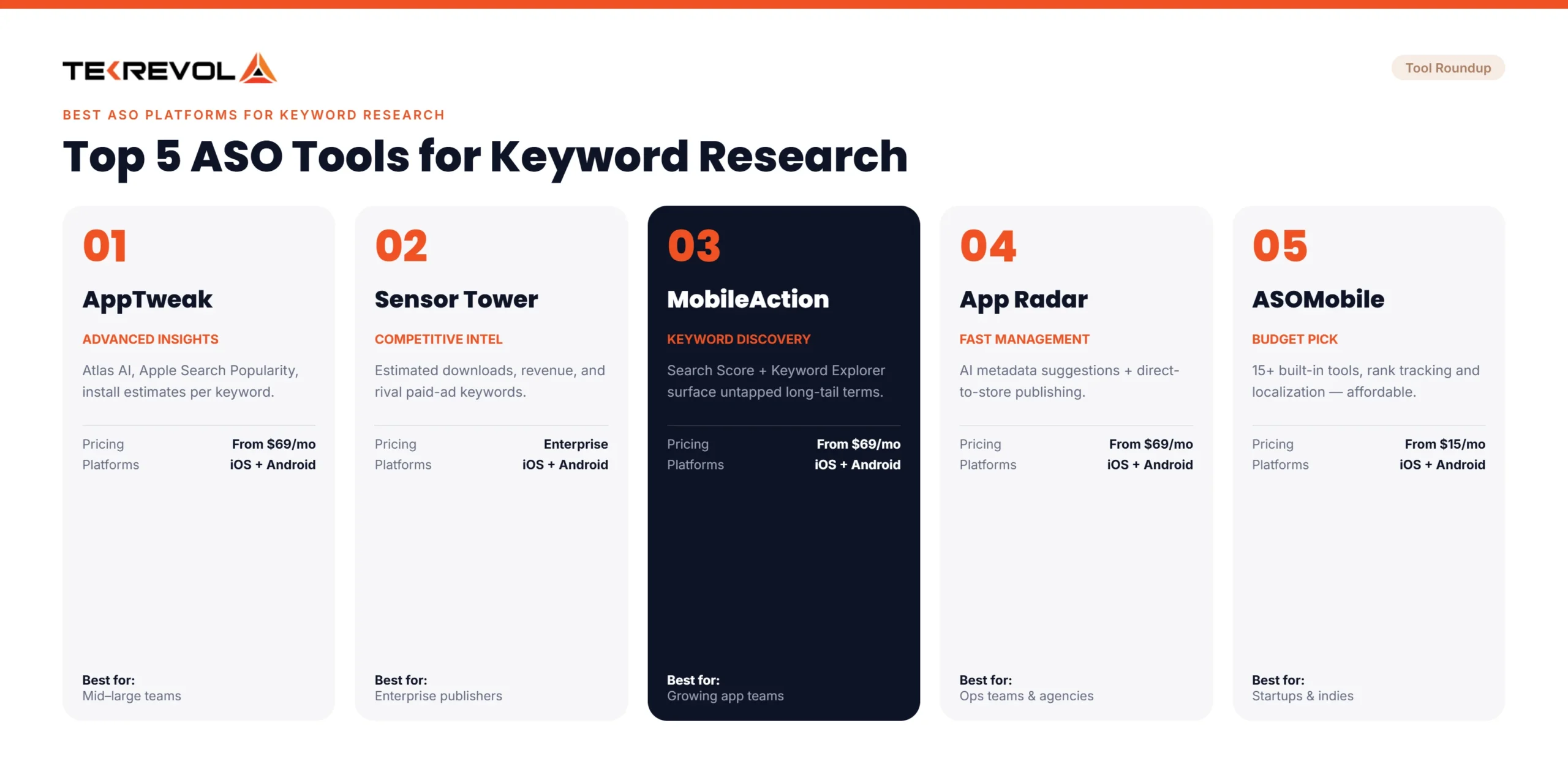
1. AppTweak: Best for Advanced Keyword Insights
AppTweak is widely considered the gold standard for data-driven app store optimization.
Powered by its proprietary “Atlas AI,” the platform provides highly accurate metrics, including Apple’s actual Search Popularity scores, organic install estimates per keyword, and custom recommendations.
It is the ideal tool for mid-to-large-sized teams looking to maximize organic visibility across both iOS and Android.
2. Sensor Tower – Best for Competitive Intelligence
If you want to know exactly how your competitors are succeeding, Sensor Tower is the ultimate market intelligence tool.
It acts as a deep analytical “spy tool,” allowing you to see estimated downloads, global revenue, and even the specific keywords your competitors are targeting in their paid ad campaigns. It is a premium, enterprise-grade platform built for larger publishers.
3. MobileAction – Best for Keyword Discovery
MobileAction is a powerhouse for uncovering untapped search terms. It features a highly accurate “Search Score” and “Keyword Explorer” tool that suggests low-competition, long-tail keywords that are much easier for new or growing apps to rank for.
It also tracks real-time keyword difficulty, helping you prioritize the terms most likely to drive organic traffic.
4. App Radar (by SplitMetrics) – Best for Time-Saving Management
App Radar focuses on speed and ease of use, combining deep keyword research with an update manager.
It offers AI-powered metadata recommendations and allows you to push changes, like title and description updates, directly to the App Store or Google Play Console from within the platform. It is perfect for teams looking to streamline their publishing workflows.
5. ASOMobile – Best for Budget-Conscious Startups
For independent developers and startups, ASOMobile offers a highly capable and affordable entry point into paid keyword research.
With over 15 built-in keyword tools, it provides robust rank tracking, competitor analysis, and localization features without the steep enterprise price tag.
ASO Tools Comparison at a Glance
| Tool | Primary Strength | Best For | Supported Stores |
| AppTweak | AI-driven insights & organic install tracking | Mid-to-large marketing teams | iOS & Android |
| Sensor Tower | Market intelligence & competitor revenue tracking | Large publishers & enterprise brands | iOS & Android |
| MobileAction | Keyword discovery & high-accuracy Search Scores | Growing app teams & search marketers | iOS & Android |
| App Radar | Direct store integration & visual metadata editing | Operations-focused teams & agencies | iOS & Android |
| ASOMobile | Affordable, feature-rich ASO suite | Bootstrapped startups & indie developers | iOS & Android |
Ready to Improve Your App Rankings?
Let our high-authority, DR 75 team map out a growth strategy tailored to your app and ranking goals.
Get Your Free Consultation TodayWhat Is App Store Rank Tracking and Why Does It Matter?
Getting your app to rank for a high-value keyword is a major achievement, but the work doesn’t stop there. The app stores are living, breathing marketplaces. Every day, competitors tweak their metadata, new apps launch, and store algorithms update.
App Store Rank Tracking is the continuous process of monitoring where your app ranks in search results for specific keywords over time. It is the compass that tells you whether your optimization efforts are moving you forward or letting you slide into obscurity.
Why Rank Tracking is Vital for App Success
Without consistent rank tracking, you are essentially flying blind. Monitoring your keyword positions matters for three critical reasons:
- Measuring Your ROI (Return on Investment): When you update your app’s title, subtitle, or description, rank tracking shows you the direct impact of those changes. If you see your app jump from position #45 to #5 for a core search term, you know your new metadata is working.
- Spotting Competitor Moves: If your rank for a major keyword suddenly drops, tracking tools will help you identify why. You can quickly see if a competitor has optimized their listing to target your space or if they are aggressively bidding on your keywords through paid search ads.
- Detecting Algorithm Updates: Both Apple and Google frequently update their ranking search engines. Sudden, sitewide shifts in your keyword rankings—either up or down—are often the first indicator of an algorithm update, allowing you to adapt your strategy before your download numbers take a hit.
Key Metrics to Monitor in Your Tracking Dashboard
When tracking your rank, you should look beyond just a single number. A complete tracking strategy focuses on three core metrics:
- Keyword Rank Distribution: Instead of just tracking your top keyword, monitor how many of your target keywords rank in the Top 3, Top 10, and Top 50. Ranking in the Top 3 drives the vast majority of organic downloads.
- Search Visibility Score: This is a blended metric provided by most ASO tools. It calculates your overall presence in the store based on your ranking positions across all tracked keywords and the search volume of those terms. A rising visibility score means your organic reach is expanding.
- Keyword Volatility: Keep an eye on how much your rankings bounce around day-to-day. Highly volatile keywords might require you to strengthen your app’s conversion rate or user reviews to lock in a stable, top-tier position.
Businesses reading TekRevol’s guide to mobile app marketing strategies often discover that ongoing optimization consistently outperforms one-time ASO efforts.
Advanced ASO Keyword Strategies for 2026
Advanced ASO keyword strategies focus on user intent, competitor movements, seasonal trends, and continuous optimization. Businesses that refine their keyword strategy regularly are more likely to maintain strong app visibility and sustainable organic growth.
Keyword research doesn’t end once your app goes live. Successful apps continually adapt their keyword strategy based on changing search behavior and marketplace trends.
If you’ve mastered how to search keywords for app store optimization, the next step is making your strategy more dynamic. Here are several advanced techniques used by successful app publishers.
Monitor Seasonal Search Trends
User behavior changes throughout the year. For example:
| Season | Keyword Opportunities |
| January | Fitness challenge, habit tracker |
| Summer | Travel planner, hotel booking |
| Back to School | Study planner, note-taking app |
| Holiday Season | Gift list, budgeting apps |
Updating your metadata to reflect seasonal demand can improve visibility without changing your app’s core functionality. Regular app store optimization research helps identify these trends before competitors capitalize on them.
Analyze Competitor Updates Regularly
Your competitors aren’t standing still. Every few months, review competing apps and note changes to the app title, subtitle, screenshots, promotional text, feature updates, and user reviews.
Patterns often emerge. If multiple competitors suddenly target similar phrases, it may indicate a growing search trend worth investigating. However, don’t imitate their strategy blindly. Instead, look for gaps where your app can offer something unique.
Businesses following TekRevol’s mobile game marketing strategies guide often combine competitor insights with customer feedback to uncover untapped keyword opportunities.
Don’t Ignore User Reviews
User reviews are one of the most overlooked keyword research resources. Customers naturally describe your app using the language they’re familiar with. Pay attention to recurring phrases such as “budget tracker,” “easy workout planner,” “secure password manager,” or “daily meditation app.”
These terms often become valuable as app store optimization keywords because they reflect genuine user intent rather than marketing language.
Some of TekRevol’s own mobile app promotion strategies content points to a similar pattern: research shows that 65% of App Store downloads originate from a search, so the exact words a reviewer uses to describe your app are often the same words a future user will type in.
Apple App Store vs Google Play Keyword Optimization
While both platforms share the same ultimate goal, connecting users with the apps they need, their search engines work in fundamentally different ways. Think of it like comparing a physical filing system to a highly advanced web search engine.
If you copy your Apple keyword strategy and paste it directly into Google Play, your app’s visibility will likely suffer on both stores.
Understanding how these two giants index keywords differently is critical to getting your app discovered.
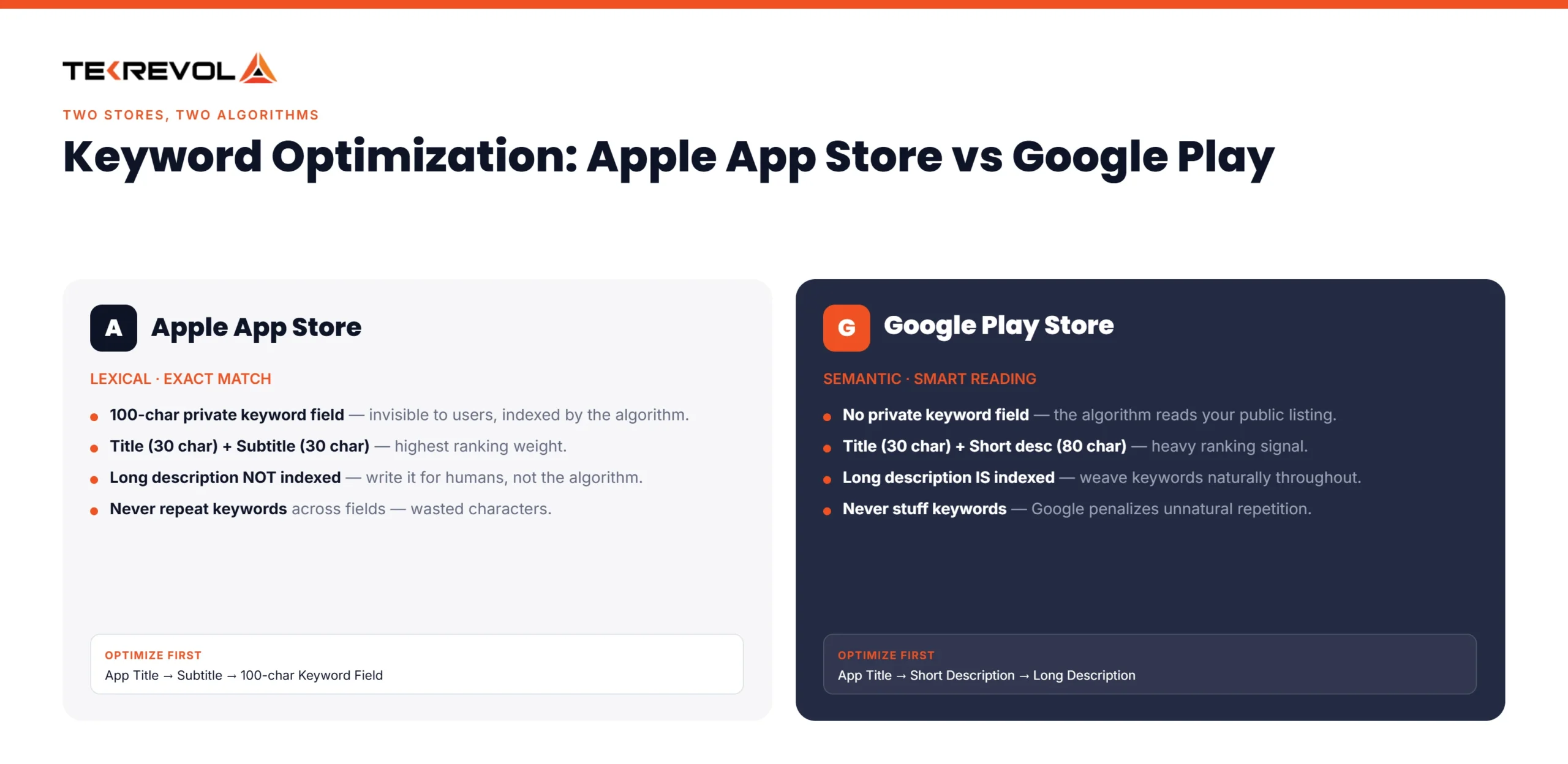
The Core Difference: Exact Matching vs. Smart Reading
The most important distinction lies in where the algorithms look for keywords and how they read them:
- Apple App Store (The Lexical System): Apple operates on a highly specific, structured system. Beyond your visible app title, Apple gives you a private 100-character keyword field. Users never see this field; it is purely for the algorithm. Apple takes these words, combines them with your title, and ranks you based on exact matches.
- Google Play Store (The Semantic System): Google Play does not have a private keyword field. Because Google is a search engine company at its core, its algorithm “reads” your entire public store listing, especially your description, just like it reads a website. It looks at the frequency, context, and natural flow of your words to figure out what your app does.
Key Metadata Fields Compared
To optimize successfully, you need to treat the character limits and indexing rules of each store with a tailored approach:
1. App Title (30 Characters on Both Stores)
This is the absolute highest-value real estate on both platforms. Your most critical, highest-volume keyword must live in your title. Because space is so tight, every character counts.
2. Subtitle vs. Short Description
- Apple Subtitle (30 Characters): This appears directly under your app name in search results. It should contain your secondary keywords and clearly explain the app’s value to users.
- Google Play Short Description (80 Characters): While this doesn’t show up directly in search results, it has a massive impact on ranking. Adding your target keywords here acts as a major signal to Google’s algorithm.
3. Long Description (4,000 Characters)
- On the Apple App Store: Apple’s search engine does not index the long description. You do not need to repeat keywords here. Write this space purely to convince human readers to download your app.
- On Google Play: Your long description is a major ranking factor. You must weave your core keywords naturally throughout the text. However, avoid “keyword stuffing” (repeating words mindlessly), as Google will penalize unnatural text. Aim to mention key phrases naturally a few times in a highly readable format.
That distinction matters more as the platform grows: Google Play alone now hosts roughly 2.06 million live apps, so Android’s share of ranking signals is spread across a genuinely massive catalog.
Businesses exploring TekRevol’s Android app development services often create separate ASO strategies to maximize visibility on each platform.
How AI Is Changing App Store Keyword Research?
Artificial intelligence is transforming ASO by helping developers discover keyword opportunities faster, analyze competitors more accurately, and predict search trends using large datasets.
AI isn’t replacing keyword research. It’s making it smarter. Modern ASO tools increasingly use AI to recommend related keywords, semantic keyword clusters, competitor opportunities, ranking predictions, and metadata suggestions. This allows marketers to spend less time gathering data and more time making strategic decisions.
However, AI should support your research, not replace it. Human judgment remains essential when evaluating search intent, brand relevance, audience expectations, and conversion potential.
Understanding how to search keywords for app store optimization still requires knowing your users better than any algorithm can.
With Apple Ads reporting more than 850 million weekly App Store visitors, even a small improvement in relevance matching can compound into a meaningful visibility gain.
How Can TekRevol Help?
A successful ASO starts with smart keyword research, but maintaining visibility requires continuous optimization.
From understanding how to search for keywords for app store optimization to implementing effective app store rank tracking, every step contributes to stronger organic growth.
At TekRevol, our ASO specialists combine market research, competitor analysis, metadata optimization, and performance monitoring to help businesses improve app discoverability and attract high-intent users.
Whether you’re launching your first mobile app or scaling an established product, our team can create a data-driven ASO strategy tailored to your business goals.
Ready to Turn More Searches Into Downloads?
Let's build an ASO strategy designed to improve visibility, increase installs, and deliver lasting organic growth.
Get Your Free ASO Consultation


