



- ASO grows your app store rankings and installs, while SEO grows your website’s visibility on Google.
- The ASO vs SEO difference comes down to platform, ranking signals, and the type of content each one rewards.
- ASO leans on download speed and conversion rate, while SEO leans on backlinks, content quality, and site health.
- ASO costs less upfront than SEO, but SEO scales further once your website earns lasting search authority.
- SEO usually takes three to six months to show results, while ASO keyword changes can move in two to four weeks.
- Running ASO and SEO together lets a brand capture demand at every stage, from a Google search to an app store install.
- AI search tools like ChatGPT and Perplexity influence both disciplines, rewarding clear, well-structured, fact-based content.
App Store Optimization and Search Engine Optimization are constantly lumped together, mostly because people assume ASO is just “SEO for apps.” That’s only half right.
ASO vs SEO are two distinct optimization disciplines: App Store Optimization (ASO) improves app visibility and downloads within the Apple App Store and Google Play. Search Engine Optimization (SEO) improves content visibility on Google Search and Bing. They run on different algorithms. They use different keyword systems. They reward different kinds of content. Mix them up, and you end up polishing the wrong listing for the wrong crowd.
This guide walks through the differences between ASO and SEO, how each ranking system works, and how you can tell which one your app needs, or whether it is time to run both together. If you’d rather skip the research and talk to an ASO agency directly, our growth team can map this out for you on a single call.
What Is App Store Optimization (ASO)?
App Store Optimization is the process of improving your app’s ranking and visibility inside the Apple App Store and Google Play, so more of the right people find it and tap install.
That is the short version of the App Store optimization definition. But there is more going on under the hood. Apple has said search drives roughly 65% of App Store downloads, making keyword strategy central to any ASO plan.
Core Elements of ASO
- App title and subtitle: the two most heavily weighted ranking fields, especially on iOS
- Keyword field (iOS) and long description (Google Play): hidden and visible keyword real estate
- Icon, screenshots, and preview videos: the biggest levers for conversion rate
- Ratings and reviews: a trust signal that both stores factor into ranking
- Install velocity and retention: behavioral signals the algorithm reads over time
For a deeper walkthrough of every ranking lever, see our App Store Optimization guide, which covers metadata, localization, and experimentation in more depth.
Not Sure Where Your App Stands?
Get a free ASO audit from TekRevol and see exactly which keywords, screenshots, and metadata fields are costing you installs.
Request a Free ASO AuditWhat Is SEO (Search Engine Optimization)?
Search Engine Optimization is the practice of improving a website’s visibility in search engines like Google, so it shows up when people search for topics related to your business.
Unlike app stores, Google reads your whole page. It looks at your headers and your body content. It checks how fast your site loads, how mobile-friendly it is, and how many other trustworthy sites link back to you. Our search engine optimization team spends most of its time on exactly these levers: content depth, technical health, and earning links from sites Google already trusts.
Core Elements of SEO
- On-page content: keyword-relevant copy, headings, and answer-first structure
- Technical health: site speed, mobile-friendliness, crawlability, and security
- Backlinks: off-page trust signals from other authoritative websites
- Internal linking: how pages connect and pass authority to each other
- User experience signals: click-through rate, dwell time, and bounce rate
ASO Vs SEO: Side-by-Side Comparison
The core difference between ASO and SEO lies in the discovery environment. ASO operates within app marketplaces where users search for apps, while SEO operates across the open web where users search for information, solutions, or services.
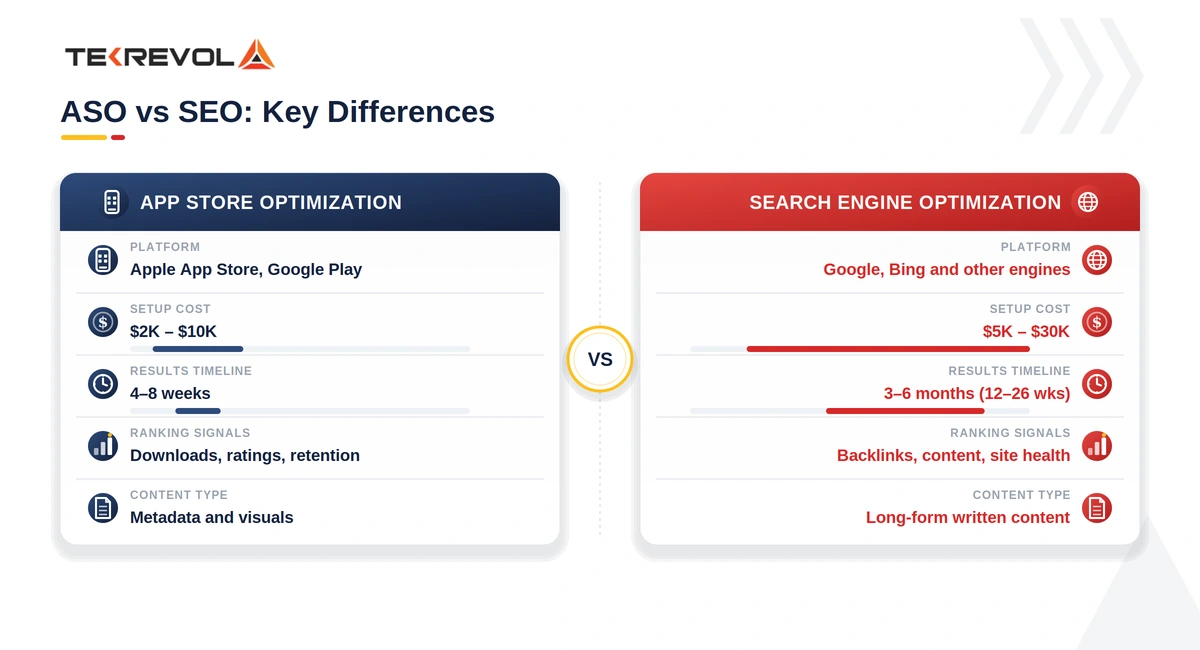
Here’s the ASO vs SEO comparison laid out side by side, across the dimensions that matter most when you’re deciding where to put your budget:
| Aspect | ASO (App Store Optimization) | SEO (Search Engine Optimization) |
| Platform | Apple App Store, Google Play | Google, Bing, and other web search engines |
| Main Goal | App installs and store visibility | Website traffic, leads, and conversions |
| Search Intent | Transactional, Action-Oriented, Direct | Informational, Commercial, Navigational |
| Ranking Factor | Download speed, conversion rate, ratings, retention | Backlinks, content quality, site authority, page speed |
| Primary KPIs | Impressions, conversion rate, and keyword rank | Organic traffic, keyword rank, and backlinks |
| Content type | Structured metadata and visuals | Long-form written content and landing pages |
| Cost | $2,000 to $10,000 setup | $5,000 to $30,000 setup |
| Results timeline | 4 to 8 weeks for keyword movement | 3 to 6 months for competitive terms |
| Common tools | App Radar, AppTweak, Sensor Tower | Google Search Console, Ahrefs, SEMrush |
| Update Frequency | Iterative, Based on Release Cycles | Continuous, Driven by Content Compounding |
Once you see it laid out like this, the ASO SEO comparison helps you allocate resources effectively and set realistic timelines for each channel.
Running ASO and SEO in Silos?
TekRevol builds combined ASO and SEO roadmaps so your app shows up whether someone searches on Google or inside the App Store.
Talk to Our Growth StrategistWhich Platforms Does ASO Target vs SEO?
- ASO targets the search and browse surfaces inside the Apple App Store and Google Play.
- SEO targets web search engines, mainly Google, along with Bing and, in some regions, Yahoo.
That split sounds obvious, but it has real consequences. A page ranking on Google does nothing for your app’s position inside the App Store. Similarly, a perfectly optimized app listing won’t show up anywhere on a Google results page unless you also build Android or Apple App Store search optimization into a wider web presence.
How Search Intent Differs Across ASO vs SEO
The fundamental difference between ASO and SEO lies in the target platform and the mindset of the person searching.
ASO operates strictly within native mobile app marketplaces. Users inside an app store exhibit immediate, action-oriented intent. They are usually looking for a specific tool, game, or service to download and use right away.
Web SEO targets open browsers where user intent varies wildly. Someone searching on Google might be looking for a detailed answer to a question, a product review, or a broad guide. This difference in user psychology changes how content must be framed for an effective ASO SEO comparison.
Keyword Research For ASO vs SEO
ASO keyword research starts inside the app store itself, using autocomplete suggestions and competitor listings. SEO keyword research starts with search volume and competition data pulled from the open web.
For app store keyword research, you are trying to guess exactly what someone types right before they hit install. For SEO, you are usually chasing a broader search intent. Things people ask while they are still researching a problem, long before they are ready to buy or download anything.
How to Search Keywords for App Store Optimization
If you are wondering how to do a keyword search for ASO without expensive software, here is the basic process to follow:
- Brainstorm every term a real user might type, based on what your app actually does.
- Check autocomplete suggestions inside the App Store and Google Play for those terms.
- Look at what similar, successful apps are ranking for.
- Narrow your list down based on search volume, competition, and relevance.
- Test your top picks in your title, subtitle, and keyword field, then measure what moves.
This is also where Apple App Store search optimization gets tricky, since Apple hides your keyword field from users entirely. You are optimizing for a machine, not a reader, which is a very different writing exercise from SEO copy.
Building a Word Cluster for Web SEO
Web SEO strategies focus heavily on user education and research behavior. Instead of targeting short individual phrases, web marketers build an expansive keyword cluster for internal links. This method maps out a primary topic alongside dozens of related informational queries. By targeting long-tail informational phrases, a brand can capture prospective users early in their journey before they even realize they need a dedicated mobile application.
How Do ASO and SEO Ranking Algorithms Differ?
App Store algorithms mostly watch what people do after they see your listing. Google mostly watches what your content says and who links to it.
On the App Store side, downloads, install speed, conversion rate, and how long people stick around after installing all feed the App Store ranking algorithm. Google, on the other hand, crawls your actual text, checks your site’s technical health, and weighs how many other credible sites point back to your page.
This is exactly why the app store ranking algorithm changes hit differently than a Google update. A Google core update usually rewards or punishes content quality across thousands of sites overnight. An app store algorithm shift is more likely to reward apps with strong recent download momentum, even if their total lifetime installs are smaller than a competitor’s.
ASO Ranking Algorithm Mechanics/Factors
App Store Optimization works by influencing the App Store ranking algorithms that the Apple App Store and Google Play use to surface apps in search results and category pages
App Title and Keyword Placement
Both stores weigh keywords placed in the title heavily, and apps with relevant terms in the title consistently outrank apps that rely only on the description or keyword field.
Apple gives developers a 100-character keyword field, a backend space that never appears to users, for extra search terms. Google Play skips a dedicated keyword field entirely and instead reads the short and long descriptions for ranking signals.
Ratings and Reviews
Ratings and reviews pull double duty, working as both a ranking signal and a conversion lever. Apps sitting below 3.5 stars tend to get suppressed in search results, while apps above 4.5 stars usually get a ranking boost.
Download Velocity
Download velocity measures how quickly an app is gaining installs over a rolling window. A sharp jump in daily downloads tells the algorithm your app is gaining traction, which earns it a higher spot in search results and category charts.
Retention
Retention, the share of users who open the app again after installing, is just as important. High uninstall rates or weak Day 1 retention signal a poor fit between the app and the people finding it, and both stores respond by quietly suppressing visibility.
Conversion Rate
Conversion rate tracks what share of people who view your store listing actually install the app. Screenshots, preview videos, icon design, and the first line or two of your description all shape this number.
Web Search Engine Ranking Mechanics
Web search engine algorithms operate on a model of contextual authority and experience. Google relies on systems that analyze link profiles, web content depth, and user experience metrics. Understanding these SEO ranking factors helps the team decide where to actually spend its time, whether that is on content, site architecture, or earning links.
Content Quality and Topical Authority
Search engines favor pages that answer a query completely, with accurate information and a clear structure. Topical authority builds up when a website publishes several strong pieces on related subjects, which signals real expertise in that area.
Backlinks
When a trustworthy website links to your page, search engines read that as a vote of confidence. Quality matters far more than volume here. One link from a respected research institute or an established publication is worth more than dozens of directory listings.
Technical Optimization and Page Speed
Technical health decides whether search engines can even crawl your site properly and whether visitors stick around once they land. Search engines favor sites that load fast, render cleanly on mobile, and maintain a tidy site structure. A page that takes longer than three seconds to load on mobile will rank below a faster competitor.
Content and Visuals For ASO vs SEO
ASO leans almost entirely on visuals, icons, screenshots, and preview video. SEO leans on long-form written content, clear headers, and internal linking.
Your app store listing behaves like a tiny landing page. ASO content is constrained and structured: app title, subtitle, keyword field (iOS), short and long descriptions, screenshots, preview videos, and developer responses to reviews. Nobody reads three paragraphs. That is why app businesses so often shoot a short preview video showing the app in action. A 15-to-30-second clip usually does more convincing than any paragraph of copy ever could.
SEO content works the opposite way. Semantic SEO thrives on comprehensive, high-quality written content that naturally includes keywords. Marketers use structural headings, structured schema markups, and contextual internal linking to help search crawlers understand their site. Visuals are important for user experience on the web, but text density and link equity serve as the primary drivers of web search rankings.
Ready to Grow Beyond One Channel?
Partner with TekRevol for a unified ASO and SEO strategy built around your app's actual growth bottleneck, not a generic checklist.
Book a Free Strategy CallTools for ASO vs SEO
ASO and SEO tools serve similar purposes, including keyword research, competitor analysis, performance tracking, and optimization. However, they rely on completely different datasets. ASO tools analyze the Apple App Store and Google Play, while SEO tools analyze web search engines such as Google.
| Task | ASO Tools | SEO Tools |
| Keyword research | AppTweak, MobileAction, App Radar | Semrush, Ahrefs |
| Competitor analysis | Sensor Tower, AppTweak, MobileAction | Semrush, Ahrefs |
| Ranking tracking | AppTweak, MobileAction, App Radar | Ahrefs Rank Tracker, Semrush Position Tracking |
| Performance analytics | App Store Connect, Google Play Console | Google Search Console, Google Analytics 4 |
| Metadata or on-page optimization | App Radar, AppTweak | Semrush, Ahrefs |
| Technical audits | Store listing diagnostics and testing tools | Screaming Frog, Semrush Site Audit, Ahrefs Site Audit |
How Cost and Resources Are Allocated Between ASO and SEO
ASO generally needs a smaller initial investment. A full app store optimization setup cost, including keyword research, metadata optimization, and creative assets, runs between $2,000 and $10,000. Ongoing monthly ASO maintenance through an agency or freelancer usually costs $500 to $3,000.
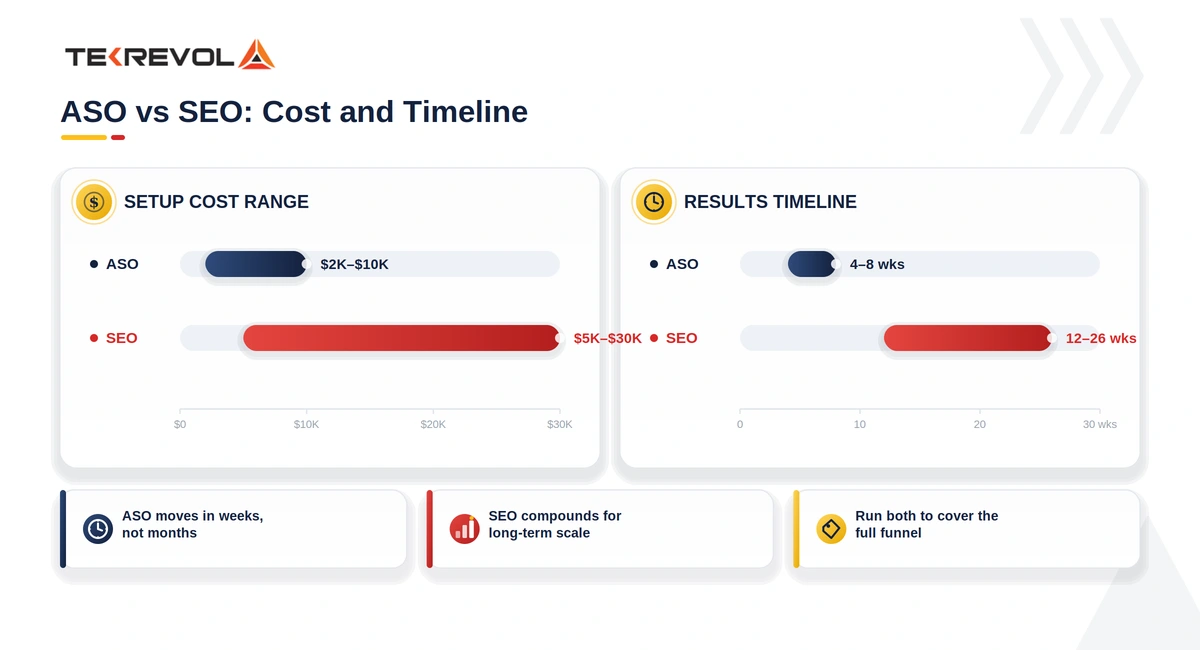
SEO asks for a bigger commitment. An initial audit and strategy engagement runs $5,000 to $30,000, with ongoing monthly SEO services starting from $1,500 to $10,000.
The gap comes down to scope. ASO optimizes one listing across two stores, while SEO covers site-wide architecture, content production, and link building across potentially hundreds of pages.
Team and Staffing
- ASO can run on a single specialist who handles keyword monitoring, screenshot and description testing, and competitor tracking. The person usually sits inside product marketing or growth, with design support for visual assets.
- SEO needs a broader team: a technical specialist for site architecture, a content strategist to plan keyword targeting, and a writer to produce the content. Mid-sized companies running SEO in-house often carry two to four dedicated roles.
Early-stage teams frequently outsource both to a specialized digital marketing agency, with ASO retainers starting around $1,000 a month and SEO retainers usually starting closer to $3,000.
Tool Costs
- App store keyword and rank-tracking platforms typically run $300 to $500 a month.
- SEO tool stacks, covering keyword research, backlink analysis, and site audits, run $200 to $600 a month for smaller teams and can climb into the thousands for enterprise-grade platforms.
Maintenance
- ASO needs close, weekly attention during the first 60 days after launch while you iterate on metadata and creative. It then settles into monthly check-ins once rankings stabilize.
- SEO maintenance never really stops, since new content, technical audits, and outreach are a steady, year-round workload
KPIs to Track: ASO vs SEO Metrics
ASO metrics center on store visibility, conversion efficiency, and what happens after someone installs. SEO metrics center on discovery reach, engagement depth, and authority.
Tracking the right numbers is what separates real progress from noise. ASO and SEO need different measurement frameworks because they run through different ecosystems with different conversion mechanics.
ASO Metrics That Matter
- App Store impressions show how often your listing appears in search or browse results. If impressions are low, your keyword targeting is probably too narrow, or your category placement is off.
- Conversion rate tells you whether your screenshots, video, and description are actually doing their job. A strong conversion rate sits above 8% for consumer apps and above 5% for enterprise tools.
- Download velocity tracks how fast installs are coming in over time and directly feeds store ranking algorithms, since both stores reward steady growth over one-off spikes.
- Retention rate, meaning how many users come back after one day, seven days, and thirty days, is arguably the most honest metric on this list.
- Keyword rankings and uninstall rate round out the picture, and both are worth checking weekly for your top ten priority terms.
SEO Metrics That Matter
- Organic traffic is the total number of visitors arriving through unpaid search. It is best segmented by landing page so you can see exactly which content is pulling its weight.
- Keyword rankings track your position for target queries, and the fastest wins usually sit on page two, close enough to the top ten to be worth a push.
- Backlinks are votes of confidence from other sites. Ten links from ten different domains carry more weight than fifty links from a single site.
- Time on page and click-through rate from search results round things out. A high click-through rate at a low-ranking position is a strong hint that better placement alone will unlock real traffic.
How ASO and SEO Work Together: The Dual Strategy
For sustained, long-term market leadership, the ASO vs SEO debate disappears.
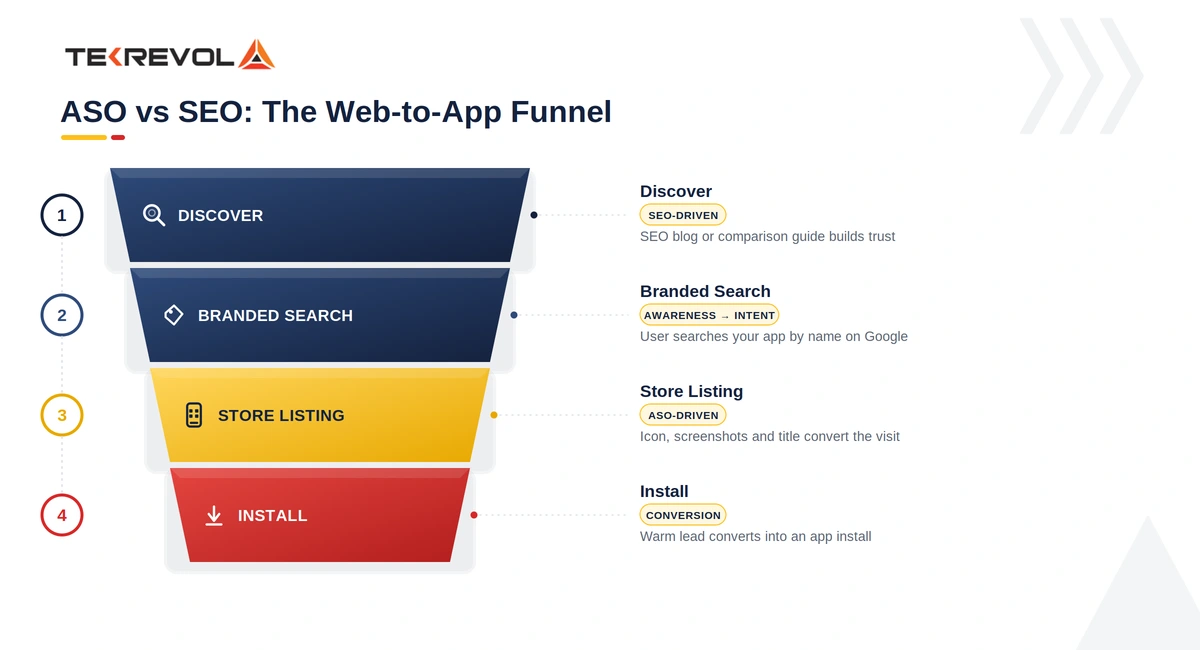
You can use web SEO to build high-quality informational blogs that capture users searching for answers on Google. Once those users land on your website, you can use smart banners to guide them smoothly to your optimized app store listing.
This multi-channel approach reduces your reliance on search engine marketing and keeps your product visible across every digital touchpoint.
The Web-to-App Funnel
A user finds your product through an SEO-optimized blog post or comparison guide. That content builds trust and introduces the app as the answer.
The user then searches for your app by name, which is a branded search, and lands on your store listing. ASO then takes over. The icon, screenshots, title, and opening line of the description have to convert that warm lead into an install.
That’s why App Store optimization is important alongside SEO. SEO builds awareness and answers questions, while ASO converts that awareness into an install.
Deep Linking and App Indexing
Deep links route users from a web page straight into a specific in-app screen instead of dumping them on a generic home screen, which cuts friction and lifts conversion.
App indexing lets Google surface in-app content inside mobile search results. A user searching on their phone might see app-indexed content sitting right alongside regular web pages. Tapping it either opens the app or sends the user to the store if the app isn’t installed yet.
Setting this up takes URL scheme configuration on iOS, App Links on Android, and a sitemap of app content submitted through Google Search Console.
When to Prioritize ASO vs SEO: Decision Matrix
Prioritize ASO if your core product is a mobile app with in-app monetization, where users download and transact entirely inside the app itself.
Prioritize SEO if your product is web-based, needs real user education before someone converts, or runs as a content platform where people find you through organic search.
The answer really comes down to one question: Where does your target user actually start their journey, and where does the sale happen?
Lead With ASO When
- App monetization drives more than 70% of revenue
- Users complete their entire transaction inside the mobile app
- Your category already has strong search volume inside the app stores
Lead With SEO When
- The product needs real educational content before someone commits
- Web traffic converts at a higher rate than app downloads
- Being accessible across desktop, tablet, and mobile web matters
Run Dual Optimization When
- You operate both a mobile app and a web platform, serving distinct use cases
- Content marketing supports both app discovery and user onboarding
- Attribution data shows web search is already informing app downloads
ASO vs SEO Decision Matrix According to Product
Founders building entertainment, gaming, or lifestyle apps should usually lead with ASO. Those categories see people searching for “workout tracker” or “photo editor” directly inside a store with high intent already in place.
A fintech app or banking alternative benefits from that same store-first visibility, since people tend to download financial apps through a trusted store environment rather than clicking through from a web search.
On the other hand, B2B SaaS products with a longer buying cycle and multiple stakeholders need search engine visibility first. Decision-makers research on Google long before they would consider downloading an app, reading comparison guides and case studies along the way.
E-commerce brands selling physical goods lean on their websites for catalog browsing and checkout, even when a companion app exists.
Most teams underinvest in the channel they think doesn’t apply to them.
- A mobile-first startup that skips web content entirely misses users earlier in their research.
- A web-first brand that never builds a companion app leaves conversion on the table once users are ready to buy.
How Does AI Search, Including ChatGPT and Perplexity, Affect ASO and SEO?
AI assistants are becoming a real discovery layer for both apps and websites, and they reward clear, well-structured, quotable content over pages stuffed with keywords.
For SEO, Google’s AI Overviews now answer many queries directly at the top of the page, accelerating the rise of zero-click searches and shifting the goal from ranking first to being the source an AI actually cites. Adoption of AI-assisted search keeps growing among everyday users, with no sign of slowing.
For ASO, conversational app discovery is still early, but it’s moving in a similar direction. Ask ChatGPT or Perplexity for “a good budgeting app”, and you’ll get a recommendation pulled from a mix of reviews, articles, and structured data, not from the app store’s own search bar. That means an app’s presence across the web, including its reviews, press coverage, and comparison-article mentions, feeds into how AI tools recommend it, even outside the store itself.
The shared takeaway for both channels:
Write clear definitions, specific numbers, and concise, quotable statements so a machine could lift a sentence out and use it as a direct answer.
How TekRevol Helps You Build a Joint ASO and SEO Roadmap
A joint ASO and SEO roadmap connects app store visibility with organic web discovery. ASO helps users find and install your app through the Apple App Store and Google Play, while SEO attracts users who begin their research on Google or other search platforms.
Building a dual-channel strategy requires coordination. Having spent years building and marketing apps across categories, TekRevol can help you here. Our marketing team understands the nuances of cross-platform visibility, ensuring your technical metadata aligns with the latest marketplace guidelines. By combining technical web optimization with smart keyword positioning, we help enterprise brands unlock reliable organic growth.
Pure Plank, a fitness app we built and optimized, holds a 98% user satisfaction rate, a 50% increase in user engagement, and a position as a top-rated fitness app in its category. That kind of outcome rarely comes from luck. It comes with custom app growth strategies that bridge the gap between traditional web search and mobile app storefronts.
Ready to Grow Beyond One Channel?
Partner with TekRevol for a unified ASO and SEO strategy built around your app's actual growth bottleneck, not a generic checklist.
Book a Free Strategy Call


![Estimated Cost to Build a Social Media App for USA [2026 Guide]](https://d3r5yd0374231.cloudfront.net/images-tek/uploads/2025/09/socail-media-app-2-400x159.webp)


