



- Healthcare app development in Austin costs $60,000 to $300,000+ in 2026, depending on compliance, integrations, and AI.
- HIPAA compliance increases development costs by 15 to 25%, covering security, audits, penetration testing, and regulatory infrastructure.
- Austin’s healthcare ecosystem increasingly prioritizes AI-native care, continuous monitoring, and intelligent clinical workflows over traditional patient portals.
- Epic EHR integration typically adds $20,000 to $55,000 in specialized engineering, testing, and interoperability implementation costs.
- TekRevol has delivered 60+ HIPAA-compliant healthcare solutions, including Kinekt, an AI-powered patient feedback platform built in Austin.
- Delaying or rushing HIPAA compliance often becomes the costliest mistake, increasing rework, security risks, and regulatory expenses.
Healthcare app development in Austin costs between $60,000 and $300,000+ in 2026. Where your project lands depends on how much of that range is compliance, how much is EHR integration, and how much is genuinely new clinical functionality. A basic HIPAA-compliant MVP with patient portal and telehealth basics sits at the low end. A platform with Epic or Cerner integration, AI-assisted triage, and multi-facility deployment sits at the high end.
That range only means something once you know which side of it your project actually falls on, and which side you land on often comes down to the healthcare app development company you choose to build it. This guide breaks down the real cost drivers, what Austin’s healthcare tech landscape looks like right now, and why the city’s direction is shifting in a way most national cost guides haven’t caught up to yet.
Why Austin Is a Different Healthcare Market Than It Was Two Years Ago
In April 2026, Michael and Susan Dell committed $750 million (on top of prior gifts, bringing their total support past $1 billion) to launch the UT Dell Campus for Advanced Research and a new, explicitly “AI-native” UT Dell Medical Center, projected to open in 2030.
Claudia Lucchinetti, dean of Dell Medical School, described the goal as shifting healthcare “from a system that reacts to illness to one that is continuously supporting health,” with patient data, labs, history, and even wearable information continuously analyzed rather than reviewed only at appointments.
That’s not a hospital expansion story. It’s a signal about what kind of healthcare apps Austin’s ecosystem is going to need over the next few years: continuous remote monitoring, wearable data pipelines, and AI-assisted care coordination, not just a patient portal bolted onto a scheduling system.
Why this matters for your app
If you’re a founder or a clinic building in Austin today, you’re building into a market that’s actively moving toward AI-native, continuous-care models. A patient portal built to 2023 standards will look dated against what Austin’s own flagship medical institution is now defining as the baseline. This doesn’t mean every app needs AI on day one. It means the architecture should be built to add remote monitoring and AI-driven features later without a rebuild.
Austin also has a direct, structured pipeline from research to product. Dell Medical School’s Texas Health Catalyst program supports researchers and founders translating health innovations, including digital health products specifically, into real-world companies, connecting them with the Austin Technology Incubator and UT’s broader commercialization network.
If your app idea started as university research or a clinical observation, this is the ecosystem it likely needs to plug into before it ever needs outside development help.
What Drives Healthcare App Development Cost in Austin
Compliance depth, clinical integration requirements, and AI complexity create an enormous spread between a basic MVP and a full enterprise platform. Here’s where the budget actually goes.
EHR integration complexity varies significantly by system. Epic integration alone typically adds $20,000 to $55,000 in specialized engineering hours as part of a broader healthcare software development services effort, covering FHIR API development, custom data mapping, and the certification work required for hospital system access. Cerner and Meditech integrations follow a similar pattern, though exact scope depends on the specific health system’s implementation.
Texas-specific regulatory review applies to any telemedicine features. Texas Medical Board rules on virtual care require legal review and feature adjustments that a generic national platform won’t already account for; this is the same regulatory layer healthcare app development in Houston has to clear, since it’s a state requirement, not a city one.
Post-launch Maintenance
Post-launch compliance maintenance is ongoing, not a one-time checkbox. HIPAA technical safeguards, audit logging, and security patching need continuous attention after launch, and that maintenance budget should be planned alongside the initial build, not treated as a surprise six months in.
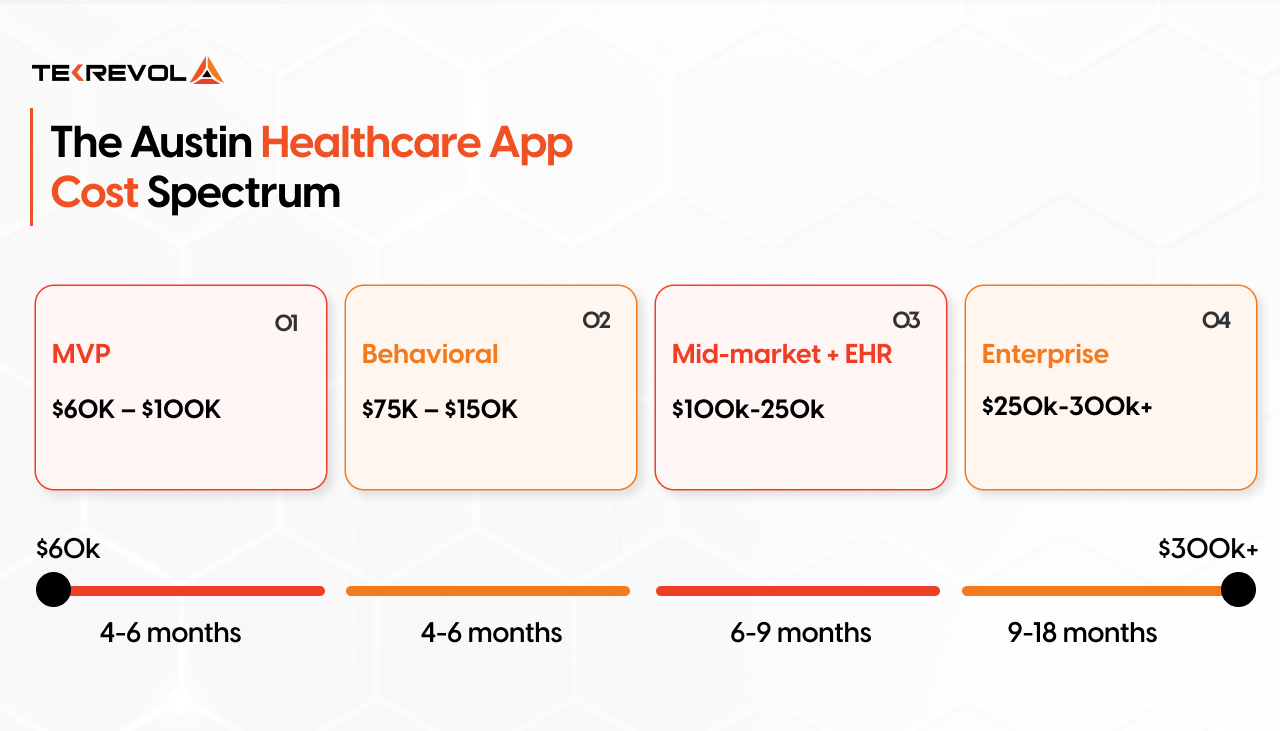
| App Type | Cost Range | Timeline |
| HIPAA-compliant MVP (patient portal, basic telehealth) | $60,000–$100,000 | 4–6 months |
| Mental health / behavioral therapy app | $75,000–$150,000 | 4–6 months |
| Mid-market clinical app with EHR integration | $100,000–$250,000 | 6–9 months |
| Enterprise platform (AI diagnostics, multi-facility) | $250,000–$300,000+ | 9–18 months |
Not sure which tier your project falls into? Get a healthcare app development quote scoped to your actual compliance and integration needs. For a broader look at what drives app pricing in this market generally, TekRevol’s Austin app development cost guide breaks down non-healthcare cost factors like platform choice and team model.
Ongoing Costs After Launch: What Most Estimates Leave Out
A healthcare app’s sticker price is only the build. Hosting, compliance maintenance, and monitoring continue every month after launch, and skipping this line item is how founders end up with a great app and no budget to keep it compliant.
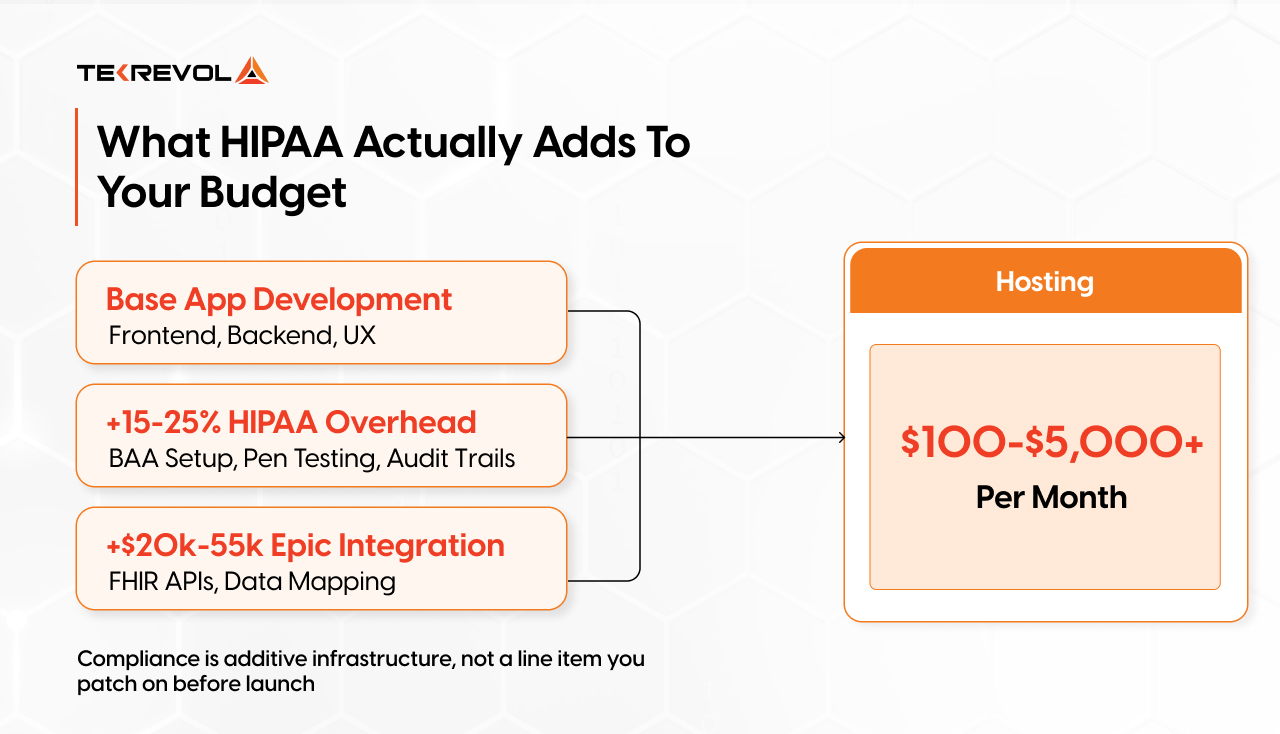
HIPAA-eligible hosting runs $100 to $500/month for a simple app on AWS or GCP with basic storage and limited traffic. A mid-sized telemedicine platform supporting real-time video and growing user demand runs $500 to $2,000/month. A large enterprise system with heavy data processing and high scalability requirements runs $2,000 to $5,000+/month.
Compliance maintenance is not optional and not occasional. Security patching, audit log review, annual risk assessments, and BAA renewals with every third-party vendor in your stack need a standing budget, not a one-time line item. Most healthcare founders underbudget this by treating it like general app maintenance instead of a distinct compliance function.
Post-launch clinical iteration matters more in healthcare than almost any other app category. Real clinical feedback surfaces workflow gaps that discovery sessions can’t fully predict. Budgeting 15 to 20% of the original build cost for the first year of post-launch refinement is a realistic planning number, consistent with what TekRevol recommends across its broader Austin app development practice.
Note: Fintech compliance and build costs in Austin follow the same curve for the same reason but with a different regulator and identical architecture-first requirement.”
Two Realistic Austin Healthcare App Scenarios
These are illustrative project profiles built from current 2026 Austin market rates, not a specific named client, useful as a planning anchor for where your own project might land.
Scenario A: Independent Behavioral Health Practice, Therapy Access App
Estimated cost: $75,000–$95,000 | Timeline: 4–5 months
Austin’s wellness and behavioral health scene, amplified by Dell Medical School’s own focus on mental health as part of its continuous-care model, makes this one of the more consistently requested app types among Austin health-tech founders right now.
Scenario B: Independent Clinic Group, Patient Engagement Platform with Epic Integration
A three-location clinic group wants a patient-facing iOS and Android app connecting to Epic via SMART on FHIR, appointment scheduling, secure messaging, and a lightweight population health dashboard for their care coordination team.
Estimated cost: $180,000–$230,000 | Timeline: 7–9 months
The Epic integration is the dominant cost driver here, not the mobile app development company itself, which is a pattern that surprises most first-time healthcare founders scoping a project for the first time.
What to Ask Before You Hire an Austin Healthcare App Partner
Healthcare is one category where the wrong vendor doesn’t just cost you money. It creates liability. A few questions separate a compliance-first partner from one that’s guessing.
Will you sign a Business Associate Agreement before development starts, not after? If a vendor treats the BAA as a formality to handle later, that’s a sign compliance isn’t built into their process from day one.
Who performs your security audit and penetration testing, and is it a named third party? “We test for security” without a specific, independent audit process is not a real answer for an app that will hold patient data.
Have you shipped HIPAA-compliant apps before, and can you show one? Healthcare architecture decisions, encryption at rest, audit logging, and access control are different from a standard consumer app. A portfolio without a healthcare example is a real gap, not a minor one.
How do you handle EHR integration specifically? Epic, Cerner, and Meditech each have their own certification and API quirks. A vague answer here usually means the actual integration work will surface as a costly surprise mid-project.
What happens to compliance after launch? If the proposal ends at deployment with no mention of ongoing audit logging or security patching, ask directly who owns that after the contract ends.
What to Build: Features That Match Where Austin Is Heading
Given the direction Austin’s own medical institutions are moving, a healthcare app built here should be architected for more than a static patient record.
Patient portal and appointment scheduling remain the foundation. This is table stakes, not differentiation, but it has to be built correctly: role-based access, encrypted messaging, and a scheduling flow that actually reduces no-shows rather than just digitizing a paper calendar.
Telehealth and secure video consultation are now a standard expectation, not an add-on. Understanding how telemedicine apps work under the hood matters here, because HIPAA-compliant video infrastructure has to handle real-world conditions: dropped connections, multi-participant calls for family consultations, and screen sharing for reviewing test results together.
Remote patient monitoring connects to wearables and Bluetooth-enabled devices to transmit biometric data to provider dashboards. Given Austin’s push toward continuous-monitoring care models, this is the feature category most likely to separate a forward-built app from one that will need a costly rebuild in eighteen months.
EHR/EMR integration via HL7 or FHIR standards lets providers access patient history without leaving the app, and is usually the largest single scope item inside a healthcare software development engagement. It’s also the feature that makes an app usable inside an actual clinical workflow instead of existing alongside it.
AI-assisted triage or care coordination is where Austin’s market is visibly heading, based on what Dell Medical School’s leadership is building toward. You don’t need it in version one; you need a data architecture that can support it later without a rewrite.
Real Experience: What We’ve Actually Built in Austin’s Healthcare Ecosystem
TekRevol’s Austin app development company team built Kinekt, an AI platform that listens to patient feedback, surfaces what matters, and catches care gaps early, for the local healthcare ecosystem. Clinics use it to collect and analyze patient feedback in a way that catches problems before they show up in satisfaction scores or, worse, in outcomes.
That project is a useful example of the gap between a generic feedback form and a genuinely AI-native healthcare tool: the difference isn’t the survey questions; it’s what happens to the data after a patient submits it. Kinekt processes feedback continuously and surfaces patterns clinics would otherwise only catch during a quarterly review, which is exactly the “continuously supporting health” model Austin’s medical institutions are now building toward at a much larger scale.
Across TekRevol’s broader app development projects for Austin, we’ve shipped 60+ HIPAA-compliant healthcare products with a clean regulatory record, executing a signed Business Associate Agreement before any patient data ever touches our development environment. That’s not a differentiator we mention lightly in a healthcare context: a single unsigned BAA or an audit-log gap is the kind of mistake that turns a soft-launch delay into a real liability.
The Compliance-First Build Process
Healthcare app development is not a build-then-secure process. Security and compliance have to be part of the architecture from day one, not a phase you bolt on before submitting to the App Store.
Discovery and compliance scoping: Before any code is written, the specific regulatory requirements for your app type, whether that’s HIPAA alone or HIPAA plus FDA Software as a Medical Device guidance, get mapped against your actual feature list. This determines both the architecture and the realistic budget.
Development in agile sprints: Backend APIs, frontend interfaces, EHR integrations, and every compliance-layer component get built with weekly stakeholder reviews to keep clinical accuracy intact throughout, not just checked at the end.
Security verification before real data touches the system: Penetration testing, vulnerability scanning, HIPAA technical safeguard verification, and a third-party security audit happen before any real patient health information is introduced. This step is not optional. It’s the difference between a compliant app and a liability.
Controlled launch: App Store and Google Play submission, a soft launch with a controlled user group, performance monitoring, and rapid iteration based on real clinical feedback come before a broader rollout.
Still validating the concept before committing to a full build? A scoped healthcare MVP is almost always the smarter starting point financially. TekRevol’s guide on the benefits of custom healthcare app development walks through how to prioritize features by clinical and operational impact at each stage.
Building Healthcare Technology in Austin? Let’s Scope It Right
Austin’s healthcare ecosystem is moving toward AI-native, continuously connected care faster than most national guides account for. Building an app that only solves today’s problem risks a rebuild in eighteen months. Building one architected for where the market is headed costs the same today and saves the rebuild later.
TekRevol’s healthcare app development team has shipped 60+ HIPAA-compliant products, including Kinekt, built for Austin’s own clinical ecosystem. Austin startups choose TekRevol because we execute a signed BAA before any patient data touches our environment, and we scope every healthcare project against your actual compliance and integration needs, not a generic template.
Ready to scope your healthcare app the right way?
Talk to TekRevol's healthcare app development specialists for a detailed estimate within 48 hours.
Schedule a Free Consultation


