

- Most healthcare apps cost between $40,000 and $500,000, and compliance drives more of that than features do.
- HIPAA compliance typically adds 20% to 40% to your build, plus recurring audit and monitoring costs every year.
- EHR integration is the biggest budget variable, running from $20,000 read-only to $100,000 or more bidirectional.
- AI features push healthcare apps past $150,000, and inference costs keep running long after your launch day.
- Who buys your app matters more than what it does when you’re forecasting integration and security spend.
- Annual maintenance runs 15% to 20% of the build cost, so budget for three years, not one.
Healthcare app development costs vary widely, making it difficult to estimate a realistic budget before development begins. Some quotes come in under $50,000, while others exceed $300,000, leaving teams unsure what’s realistic for their idea.
So instead of guessing, we’re going to show you exactly what moves that number. Based on our own project data, healthcare app development typically lands between $40,000 for a lean, HIPAA-compliant MVP and $500,000+ for an enterprise platform with AI diagnostics and full EHR integration. Most mid-range builds settle somewhere between $80,000 and $250,000.
What matters is knowing your app’s cost range and what makes it increase. This is exactly why founders often turn to an experienced healthcare app development company to map out realistic estimates, avoid hidden costs, and plan a budget that actually fits their vision.
In this guide, we’ll break down cost by app type, by feature, by compliance requirement, and by team structure, plus a few hidden expenses most guides skip entirely, so you can walk into your next development conversation with a real budget in hand.
How Much Does Healthcare App Development Cost in 2026?
Healthcare app development costs $40,000 to $400,000 in 2026, with most funded projects landing between $80,000 and $250,000. Complexity, compliance scope, and the number of systems you integrate with drive the range far more than the raw number of screens.
The complexity tiers below reflect how we scope projects internally. They represent different product types, not simply different levels of scale.
| Tier | Cost Range | Timeline | What you actually get |
| MVP / proof of concept | $40,000 to $90,000 | 3 to 5 months | One platform, 5 to 8 core features, basic HIPAA controls, no EHR integration, cloud hosting on a managed service |
| Production app | $90,000 to $180,000 | 5 to 8 months | Both platforms or cross-platform, secure messaging, payments, one read-only integration, full risk assessment, admin dashboard |
| Advanced platform | $180,000 to $320,000 | 8 to 12 months | Bidirectional EHR sync, video consultations, device or wearable data, role-based clinical workflows, penetration testing |
| Enterprise / AI-driven platform | $320,000 to $600,000+ | 12 to 18 months | Multi-tenant architecture, several EHR connections, clinical decision support, AI components, SSO, audit tooling, SLA support |
The cost increases aren’t linear. Moving from an MVP to production can nearly double the budget, while the next jump is driven largely by integrations and compliance rather than additional screens.
Meanwhile, the market keeps pulling money in. Grand View Research values the global mHealth apps market at $49.9 billion in 2026, growing to $86.4 billion by 2030 at a 14.8% compound annual rate. Plenty of that spend is going into products that were budgeted like consumer apps and priced like clinical ones.
Have a healthcare app idea? Know what it will take to build it.
Get a realistic cost estimate based on your project scope, technology, and compliance requirements.
Schedule A Free Consultation now!Formula to Calculate the Healthcare App Development Cost
One hundred people have their 1000 different claims and opinions! Let us step up and do something that will put your life at ease. Our experts have come up with a super straightforward formula that will help you estimate the healthcare app development cost within seconds.
Final Cost = Hourly Rates x Development Hours Invested
Hourly Rates
It is the amount you are being charged per hour by the development team. The hourly rates depend on the expertise and location of the development team that is building your healthcare app.
If you have an offshore team, then you might gain some advantages in costs. However, highly skilled professionals might charge higher rates.
So, you’ll need to make sure you balance expertise and budget to ensure the best value for your app development investment.
Development Hours Invested
The total Cost of your healthcare app depends on the number of development hours invested. The final estimate of your healthcare mobile app development cost relies on the duration of your project.
Regional hourly rates are discussed in detail below.
Healthcare App Development Costs Across Different App Types
Healthcare app development costs vary widely by app type. Wellness apps can start around $30,000, while telemedicine platforms typically cost $70,000–$200,000, and EHR-integrated clinical systems can reach $150,000–$500,000+. The difference comes down to the level of compliance, real-time functionality, clinical workflows, and integration depth each app requires.
Fitness and Wellness App Development
Estimated cost: $30,000–$100,000
Fitness and wellness apps help users track workouts, activity, sleep, nutrition, and other health goals. Basic features such as user profiles, workout plans, progress tracking, and dashboards keep costs near the lower end. Wearable integrations, real-time synchronization, personalized recommendations, and support for multiple device families can push development toward $100,000.
Nutrition and Diet App Development
Estimated cost: $30,000–$70,000
Nutrition and diet apps help users track meals, calories, nutrients, and dietary goals. Features such as meal planning, barcode scanning, food databases, progress reports, and personalized recommendations affect development costs. Licensing a food and nutrient database can also create recurring expenses beyond the initial build.
Mental Health Apps
Estimated cost: $50,000–$150,000
Mental health apps connect users with therapists or provide tools for assessments, mood tracking, secure messaging, and virtual sessions. Basic versions cost less, while therapist matching, live video, patient assessments, clinician dashboards, and care management increase the budget. Crisis escalation workflows and clinician credentialing can add further engineering and operational requirements.
Medication Management App
Estimated cost: $40,000–$90,000
Medication management apps help patients organize prescriptions, receive dosage reminders, track medication history, and manage refills. Reminder and tracking features are relatively straightforward, but drug databases, interaction checking, pharmacy integrations, and medication records increase development effort. Apps that provide clinically relevant medication guidance may also require additional validation and oversight.
Doctor Appointment Booking App
Estimated cost: $45,000–$120,000
If you want to build a doctor appointment app, core features should include provider search, availability, appointment booking, cancellations, and rescheduling. Simple booking is relatively affordable, but calendar sync, payments, provider tools, and practice integrations increase costs. Clinical-system connections add further complexity through authentication and healthcare data exchange.
Telemedicine App Development
Estimated cost: $70,000–$200,000
Telemedicine apps work by connecting patients and providers through video, audio, and secure messaging. They can also include scheduling, e-prescriptions, patient records, provider dashboards, and payments. Real-time clinical communication requires secure, scalable infrastructure, making these apps more complex than asynchronous healthcare platforms.
Remote Patient Monitoring App
Estimated cost: $100,000–$250,000
Remote patient monitoring apps collect health data from connected devices and deliver it to patients, clinicians, or care teams. Device integrations, continuous data ingestion, dashboards, real-time alerts, and clinical workflows drive much of the development cost. Device certification and alert tuning add further complexity, especially when alerts must stay useful without creating notification overload.
Chronic Disease Management App
Estimated cost: $60,000–$160,000
Chronic disease management apps help patients monitor symptoms, medications, vital signs, treatment plans, and ongoing care. Features such as patient education, care plans, provider communication, and progress tracking increase the development scope.
Patient Portal Development
Estimated cost: $80,000–$250,000
Patient portals give users secure access to medical records, test results, appointments, billing, documents, and provider communication. Costs rise with identity verification, access controls, secure messaging, and document management. EHR integration is often the biggest cost driver, especially when the portal needs to read and write clinical data rather than simply display it.
EHR/EMR Integrated App
Estimated cost: $150,000–$500,000+
EHR and EMR-integrated apps connect healthcare applications with clinical systems to exchange patient, provider, appointment, and medical record data. Bidirectional integration can add roughly 40%–100% or more to development costs compared with a similar standalone app, depending on the number and depth of integrations. API development, sandbox testing, certification, permissions, security controls, and deployment across multiple healthcare organizations all contribute to the higher cost.
Health Insurance App
Estimated cost: $90,000–$220,000
Health insurance and benefits apps let members check eligibility, manage plans, track claims, access benefits, and view insurance documents. Costs increase with claims and eligibility APIs, secure document handling, member portals, and insurer integrations. Supporting multiple payers, plan types, and state-specific requirements can add further complexity.
Medical Billing App
Estimated cost: $60,000–$150,000
Building medical billing software involves more than managing invoices. Claims processing, coding workflows, payer integrations, payment tracking, and denial management can significantly increase development effort and backend complexity.
e-Prescription App
Estimated cost: $70,000–$160,000
e-Prescription apps allow authorized providers to create and send prescriptions electronically while connecting with pharmacies and medication databases. Provider authentication, prescription workflows, pharmacy integrations, patient records, and drug information all contribute to development costs.
Hospital and Clinic Management System
Estimated cost: $150,000–$450,000
Hospital and clinic management systems bring multiple operational functions into one platform, including scheduling, patient records, billing, staff management, inventory, reporting, and department workflows. The number of departments, user roles, integrations, and modules has a major effect on cost.
AI Diagnostic and Clinical Decision Support App
Estimated cost: $200,000–$600,000+
AI diagnostic and clinical decision support apps use AI to support diagnosis, risk assessment, triage, or treatment decisions. Costs extend beyond the model to include data preparation, clinical validation, explainability, security, monitoring, and workflow integration. If clinicians rely on the output for medical decisions, regulatory requirements and potential FDA pathways can significantly increase costs and timelines.
Take telemedicine as an example, one of the categories we’re asked about most. A basic app with video calls and appointment booking sits at the lower end, while e-prescriptions, insurance verification, and multi-provider scheduling can push costs into six figures. We saw this firsthand with Kinekt, an AI-driven platform we built to analyze patient feedback and flag care gaps, requiring both clinical-grade reliability and a user-friendly interface.
Factors That Affect Healthcare App Development Cost
The factors that drive healthcare app costs are compliance scope, integration count, feature complexity, platform choice, design depth, team location, and team size. Compliance and integrations usually account for the largest share of variance between two otherwise similar quotes.
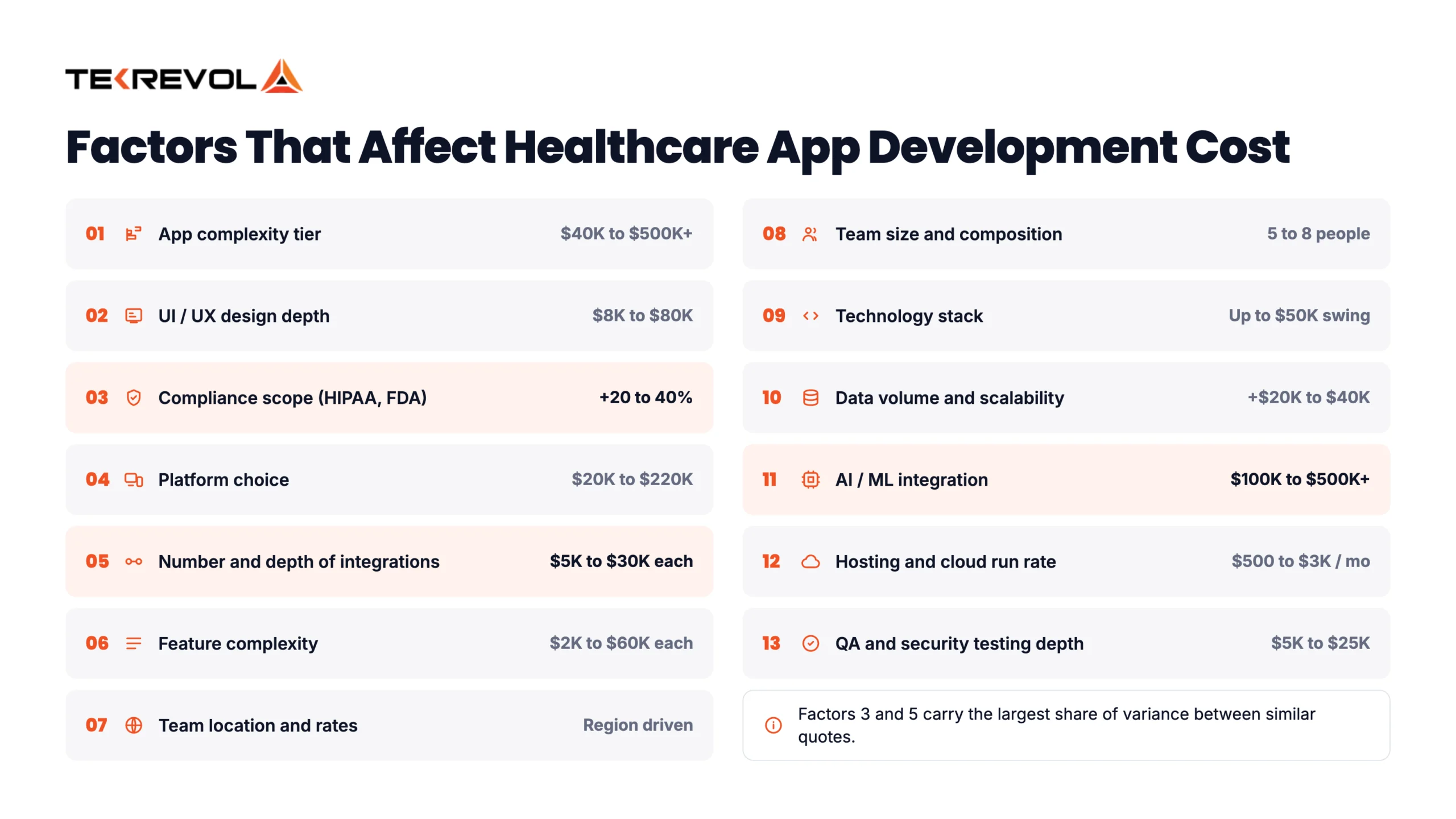
Let’s take these one at a time, because vendors love to list them and rarely explain which ones actually move the needle.
1. App Complexity
Think of complexity as the top-level cost driver. It brings together compliance, integrations, and feature requirements to define the project tier. If the tier doesn’t align with the proposed features, the estimate may need to be reassessed.
- Basic (booking, reminders, secure storage, single integration): $40K–$80K
- Mid-level (telemedicine, EHR integration, secure messaging): $80K–$150K
- Advanced (AI-driven features, multi-provider workflows, deeper wearable sync): $150K–$250K
- Enterprise (multi-platform, hospital-system integration, full compliance stack): $250K–$500K+
Treat this as an initial benchmark, not a fixed price. Features, integrations, and compliance can shift the estimate up or down.
2. App design (UI/UX) depth
Healthcare app design costs $8,000–$20,000 for a standard MVP, $20,000–$45,000 for a custom build, and up to $80,000 for enterprise UX. The cost difference comes less from visual design and more from research, testing, accessibility, and workflow complexity.
- Standard ($8,000 to $20,000): wireframes, a component library built on platform conventions, one user role, basic accessibility compliance.
- Custom ($20,000 to $45,000): original design system, two or three user roles, clinical workflow mapping, usability testing with real users, WCAG 2.2 AA conformance.
- Enterprise ($45,000 to $80,000): multi-role interfaces, clinician-facing dashboards, contextual observation of actual clinical workflows, design documentation for handoff and long-term governance.
Accessibility is essential because elderly, impaired, and one-handed users are part of the primary user base.
3. Compliance Scope
Healthcare apps carry regulatory requirements most consumer apps never touch, and that compliance work isn’t a one-time line item; it runs through design, development, and every year after launch. HIPAA alone typically adds 20%–40% to a base build. If your app qualifies as a medical device, FDA requirements add a separate layer on top, scaled to how the software is classified.
- HIPAA compliance: $15,000–$50,000 to implement, covering encryption, access controls, audit logging, and secure authentication.
- SOC 2 compliance: $30,000–$80,000 for the initial audit, plus $20,000–$50,000 a year to maintain, often required by enterprise or B2B buyers and investors, even when HIPAA alone would otherwise be enough
- FDA Class I software (low-risk, e.g., basic tracking tools): $5,000–$15,000 for registration
- FDA Class II software (e.g., diagnostic support tools): $50,000–$100,000 for 510(k) clearance
- FDA Class III software (high-risk, e.g., tools directly guiding treatment decisions): $200,000+, often requiring clinical trials
- Multi-state/telemedicine licensing: $5,000–$25,000, since each state can require its own compliance review before you can operate there
4. Platform choice
Your platform decision sets your baseline. Here’s roughly how it plays out, based on 2026 market data:
- Responsive web only: $20K–$60K (roughly 0.7×–0.8× of single-platform mobile cost)
- Single platform (iOS or Android): $30K–$120K (baseline)
- Cross-platform (Flutter or React Native): $60K–$150K for both platforms, roughly half the cost of two native builds for comparable scope, which is why most of our healthcare clients choose it
- Two native builds (iOS + Android): $90K–$220K
- Mobile plus responsive web portal: add 30%–50% on top of the mobile baseline
Clinicians work at desktops. Administrators live in dashboards. If your users are staff rather than patients, a healthcare web application usually costs 20% to 30% less than the mobile version and gets used more.
Note: For most of the healthcare clients we work with, cross-platform app development delivers both platforms for a fraction above the single-platform cost, with no meaningful compromise for typical patient-facing features. If a no-code platform can meet your requirements effectively, that’s the route we’d recommend rather than pushing you toward a custom build.
5. Number and depth of integrations
Each integration is a small project with its own discovery, sandbox testing, error handling, and ongoing maintenance. One read-only FHIR connection is manageable. Four bidirectional connections across different EHR vendors are a program, not a feature.
- Single read-only integration (e.g., one wearable or one FHIR feed): $5K–$15K
- Bidirectional integration (writing data back, not just reading): $15K–$30K per connection
- Multiple EHR vendor connections: budget as a separate workstream, not a line item; costs and timeline compound with each added vendor
6. Feature complexity
Every feature you add is engineering hours, and engineering hours are the actual currency here. A login screen and appointment calendar are cheap. A real-time video consultation engine with encrypted file sharing is not. As a rough guide:
- Basic features (profiles, appointment booking, push notifications): low complexity, fast to build.
- Mid-tier features (telemedicine video, secure messaging, payment gateways): moderate complexity, third-party SDK-dependent.
- Advanced features (AI diagnostics, wearable integrations, remote patient monitoring): high complexity, custom engineering required.
7. Team location
Rates vary enormously by geography, and this is where a lot of budget decisions get made. The ranges below reflect what we see quoted across the market and in competitive bids we’re part of.
| Region | Typical hourly rate | Practical note |
| United States and Canada | $100 to $180 | Highest rates, easiest time-zone overlap, strongest familiarity with US healthcare regulation |
| Western Europe | $70 to $130 | Strong on GDPR, variable on HIPAA specifics |
| Australia and New Zealand | $80 to $150 | Small talent pool for healthcare specialists |
| Eastern Europe | $45 to $85 | Strong engineering, growing healthcare experience |
| Latin America | $40 to $75 | Time-zone overlap with the US at lower rates |
| South Asia | $25 to $60 | Widest quality spread, so vendor selection matters most here |
8. Team size and composition
A typical team is one project manager, one designer, two to four developers, one QA engineer, plus part-time DevOps and compliance help. Bigger teams ship faster, but not cheaper. Past a certain size, the cost of keeping everyone in sync eats the gains. If you already have engineers and just need specialist capacity, IT staff augmentation is usually cheaper than a full outsourced build.
9. Technology Stack
The tech stack you choose will directly affect the budget; the languages, frameworks, and integration standards a team picks aren’t interchangeable, and each one carries its own cost signature. Two teams building the same feature list can land $50K apart purely on stack choice.
| Layer | Common choices | Estimated Cost |
| Frontend | React/Angular (web), Swift (iOS), Kotlin (Android), React Native/Flutter | $15K–$60K |
| Backend | Node.js, Python (Django), Java (Spring Boot), Ruby on Rails | $20K–$80K |
| Database | PostgreSQL, MongoDB, time-series DBs for streaming/wearable data | $10K–$35K |
| Interoperability (FHIR/HL7) | Read-only FHIR, bidirectional FHIR, per-vendor connectors | $15K–$150K+ |
| Cloud & compliance infra | AWS/Azure/GCP with signed BAA, AWS HealthLake for FHIR-native data | $500–$3,000/mo hosting + $15K–$40K setup |
| Third-party services | Twilio (HIPAA video/messaging), Stripe, insurance eligibility APIs | $5K–$20K integration + per-use fees |
10. Data volume and scalability
What happens behind the app matters as much as the feature list. Real-time data, high user volumes, and continuous processing can significantly increase backend and infrastructure costs.
- Low-volume apps (thousands of records, low concurrency): baseline backend cost.
- High-volume apps (continuous data streams, tens of thousands of users) add $20K–$40K+ in architecture work.
- Real-time processing and high-concurrency video both push this further.
- Ask what the user count looks like at month 12. Scale decisions made early are expensive to retrofit later.
11. AI/ML Integration
AI deserves its own cost category because its budget drivers differ from those of standard features. Data science, model development, validation, and monitoring can vary significantly by use case.
- Basic AI (chatbots, simple predictive scoring): $100K–$200K
- Diagnostic-grade or generative AI in a clinical context: $250K–$500K+
If your AI features go beyond basic personalization into predictive or generative territory, that’s a specialized build; our AI development team scopes those separately from standard app development.
12. Hosting and ongoing cloud costs
This is separate from the annual maintenance line most guides mention, and it starts immediately, not a year after launch. HIPAA-eligible hosting isn’t the same product as standard cloud hosting; it requires a signed Business Associate Agreement with the provider and carries a real premium over generic infrastructure.
- HIPAA-eligible cloud hosting (AWS, GCP, Azure with a signed BAA): $500–$3,000/month for a mid-size app
- Enterprise-scale, heavy data volume: can run into five figures monthly
- Frequently missing from founder budgets that are built around development cost alone
13. QA and Security Testing Depth
Compliance gets designed in from day one, as covered above, but it also has to get tested, and that’s a phase many quotes fold silently into “development” rather than pricing on its own. Skipping it doesn’t make the cost disappear; it just moves it downstream to wherever the bug or vulnerability eventually surfaces.
- Functional and security testing: $5K–$15K
- Full penetration test and usability audit before launch: $10K–$25K
A missed QA phase resurfaces later as a post-launch incident, which always costs more than catching it early
Healthcare App Development Costs Across Key Features
Healthcare app features can cost from $2,000 for basic notifications to $60,000 for HIPAA-compliant video consultations. The final price depends on the feature’s complexity, security requirements, integrations, and whether it handles protected health information (PHI).
User Registration and Multi-Option Login
Estimated cost: $4,000–$12,000
Healthcare apps often require more than basic email and password authentication. Features such as multi-factor authentication, role-based access, identity verification, and secure session management increase development effort.
Patient Profiles and Health Records
Estimated cost: $8,000–$25,000
Patient profiles can include medical histories, test results, medications, documents, and other sensitive health information. Encryption, access controls, audit trails, and secure data storage make these profiles more complex than standard user accounts.
Appointment Scheduling
Estimated cost: $5,000–$18,000
Healthcare scheduling features allow patients to find providers, view availability, book appointments, and manage cancellations or rescheduling. Provider calendar synchronization, appointment rules, reminders, and no-show handling can increase the cost.
Push Notifications and Reminders
Estimated cost: $2,000–$6,000
Notifications can remind patients about appointments, medications, or other healthcare tasks. The system must be designed carefully so sensitive health information does not appear on lock screens or in unsecured notification content.
Secure In-App Messaging
Estimated cost: $12,000–$30,000
Secure messaging allows patients, doctors, and care teams to communicate within the app. Encryption, message retention, access controls, attachments, audit logs, and secure data export make healthcare messaging more expensive than standard chat.
HIPAA-Compliant Video Consultation
Estimated cost: $25,000–$60,000
Video consultation features enable patients and providers to conduct remote appointments through secure audio and video. HIPAA-eligible infrastructure, BAA-covered vendors, authentication, session security, and recording policies can significantly increase development costs compared with consumer video solutions.
Payment Processing
Estimated cost: $8,000–$25,000
Healthcare payment features can support consultation fees, copays, insurance-related workflows, refunds, and payment history. In addition to payment security, the app may need to connect payment processing with eligibility or billing systems.
e-Prescription
Estimated cost: $20,000–$50,000
e-Prescription functionality allows authorized providers to create and send prescriptions electronically. Pharmacy network integrations, medication databases, provider authentication, and additional requirements for controlled substances can increase development complexity.
Wearable and Medical Device Integration
Estimated cost: $12,000–$40,000
Wearable and device integrations allow apps to collect information such as heart rate, activity, blood pressure, or glucose readings. Supporting multiple device SDKs, normalizing different data formats, maintaining reliable synchronization, and handling continuous data streams can quickly increase costs.
Analytics and Reporting Dashboard
Estimated cost: $10,000–$35,000
Healthcare dashboards turn patient and operational data into reports, trends, and actionable insights. Role-based access, secure data processing, auditability, and de-identification requirements add complexity when analytics involve clinical information.
Admin and Provider Portal
Estimated cost: $15,000–$45,000
An admin or provider portal gives healthcare staff tools to manage patients, appointments, records, messages, and reports. It effectively creates a second product with its own dashboards, permissions, workflows, and security requirements.
AI Chatbot or Triage
Estimated cost: $20,000–$60,000
Healthcare AI chatbots can handle patient questions, intake, appointment support, or basic triage. Guardrails, escalation to human clinicians, monitoring, secure data handling, and integration with healthcare systems make these features more complex than those of general-purpose chatbots.
Geolocation and Provider Finder
Estimated cost: $7,000–$18,000
Provider-finder features help patients locate doctors, clinics, pharmacies, or other healthcare facilities. Maps and location APIs are relatively straightforward, but location data can become sensitive when connected with a patient’s health condition, treatment, or care history.
Healthcare App Development Cost Breakdown by Phase
Healthcare app costs are distributed across planning, design, development, testing, launch, and ongoing maintenance, with complexity influencing the time and budget required at each stage.
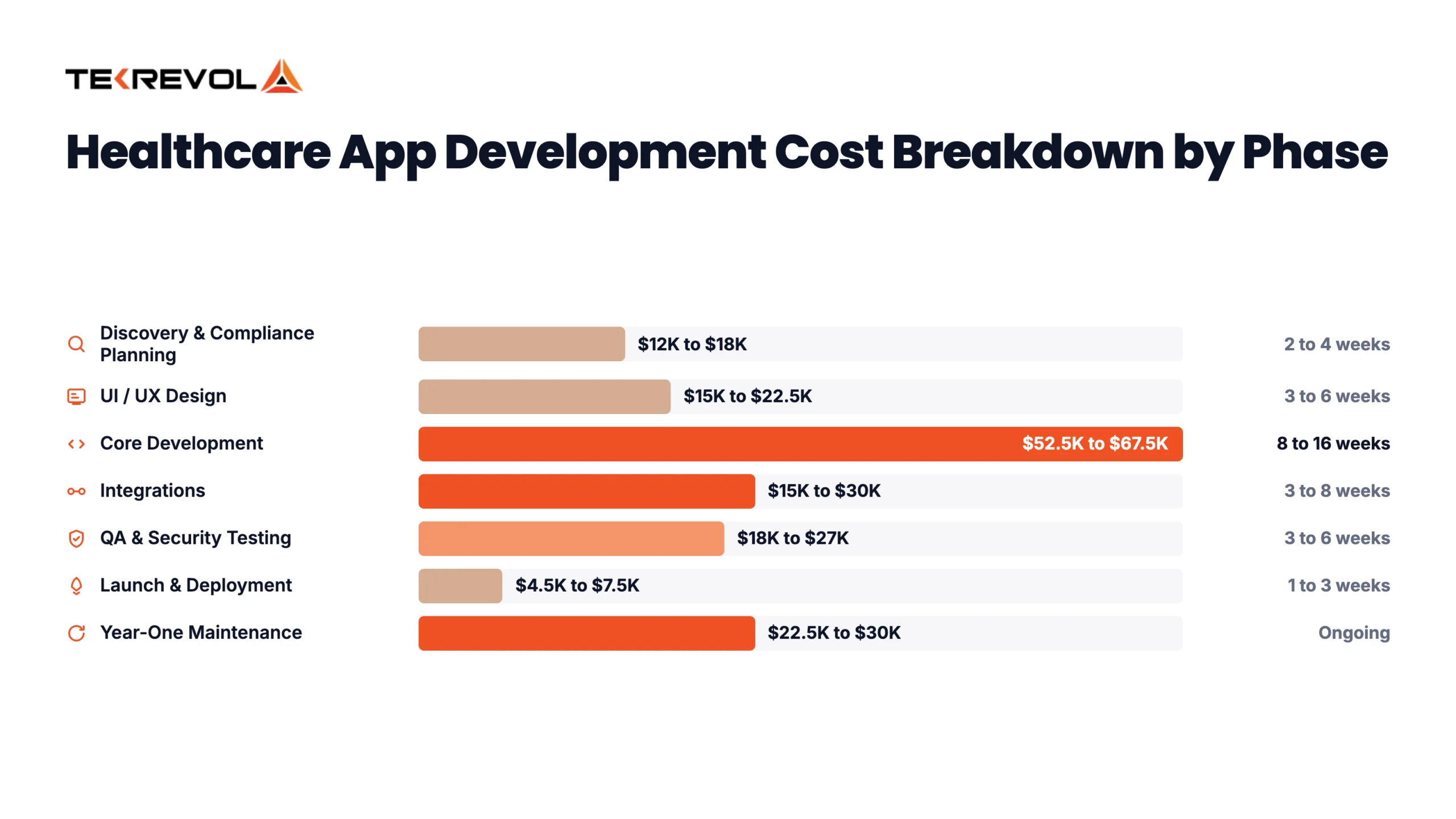
1. Discovery and Compliance Planning
Estimated cost: $12,000–$18,000 | Timeline: 2–4 weeks
Discovery establishes what the app needs to do and how it should be built. For healthcare products, this phase also covers compliance, clinical workflows, data handling, integrations, and technical architecture before development begins.
2. UI/UX Design
Estimated cost: $15,000–$22,500 | Timeline: 3–6 weeks
Healthcare UI/UX requires more than creating polished screens. Designers need to account for accessibility, different user roles, clinical workflows, and usability in situations where users may be stressed, distracted, or unfamiliar with the technology.
3. Core Development
Estimated cost: $52,500–$67,500 | Timeline: 8–16 weeks
Core development typically takes the largest share of the budget because this is where the product itself is built. The work can include the mobile or web interface, backend services, databases, authentication, APIs, and the business logic connecting everything together.
- Frontend and backend development
- Database architecture
- APIs and authentication
- User roles and permissions
- Core healthcare workflows
4. Integrations
Estimated cost: $15,000–$30,000 | Timeline: 3–8 weeks
Integrations can become one of the least predictable parts of a healthcare project. Connecting an app with EHR systems, payment providers, medical devices, or third-party healthcare APIs often requires additional authentication, data mapping, testing, and vendor coordination.
5. QA and Security Testing
Estimated cost: $18,000–$27,000 | Timeline: 3–6 weeks
Testing goes beyond checking whether buttons and screens work. Healthcare apps need to be tested for security, data handling, permissions, performance, and compliance before they reach production.
6. Launch and Deployment
Estimated cost: $4,500–$7,500 | Timeline: 1–3 weeks
Launch involves moving the application into production and making sure its infrastructure is ready for real users. It can also include app store submission, cloud configuration, monitoring, and final security checks.
7. Year-One Maintenance
Estimated cost: $22,500–$30,000 | Timeline: Ongoing
Development doesn’t end when the app goes live. Healthcare products need regular maintenance to address bugs, operating system changes, security updates, performance issues, and smaller improvements based on real-world usage.
How Much Does HIPAA Compliance Actually Add to the Cost?
HIPAA compliance adds roughly 20% to 40% to healthcare app development costs, or about $15,000 to $50,000 on a mid-size build, plus $10,000 to $30,000 a year in ongoing audits, monitoring, and risk assessment. The penalty exposure for skipping it is published and substantial.
This is where most cost guides wave their hands. We’ll use real numbers from the regulators instead.
Where the compliance money goes
- Security architecture and encryption: $8,000 to $25,000. Encryption at rest and in transit, key management, secure session handling.
- Access control and audit logging: $6,000 to $20,000. Role-based permissions, unique user IDs, immutable logs on every PHI touch.
- Initial risk assessment and documentation: $5,000 to $15,000. Required under the Security Rule, and the first thing an auditor asks for.
- Penetration testing: $10,000 to $30,000 for a healthcare-grade test with remediation.
- BAAs and vendor review: $2,000 to $8,000 in legal and engineering time across your cloud, analytics, messaging, and payment vendors.
- Annual risk reassessment and monitoring: $10,000 to $30,000 every year thereafter.
The US Department of Health and Human Services sets civil monetary penalties for HIPAA violations, adjusted for inflation each year. In 2025, 710-746 breaches affecting 500+ records were reported, impacting about 61.6 million people.
When we delivered Libido Health, a HIPAA-compliant wellness platform handling genuinely sensitive personal health information, the privacy design came first, and the feature list was built to fit it. That order matters more than any single tech choice.
Worried your compliance scope is bigger than your budget?
We’ll map your data flows to HIPAA requirements and identify the controls you need before development starts.
Book a Free HIPAA Scoping Session!What Does EHR Integration Cost, and Why Does It Break Budgets?
EHR integration costs $20,000 to $40,000 for a simple read-only connection, $40,000 to $80,000 for standard bidirectional sync, and $80,000 to $150,000 or more for multi-system enterprise integration. It breaks budgets because vendor sandboxes, certification, and per-site rollout aren’t visible during scoping.
Integration is usually the biggest single line item in a clinical app. It’s also the one most often under-scoped in a proposal.
The four levels of EHR integration
Level 1: Read-only FHIR ($20,000 to $40,000): Your app pulls patient demographics, medications, allergies, or lab results through a standards-based API. Big EHR vendors expose these fairly well, so this is the safe end of the range.
Level 2: Bidirectional FHIR ($40,000 to $80,000): Your app writes data back into the record. Write access is where things get strict. You now need vendor review, sandbox sign-off, and error handling that assumes a write can fail without telling you.
Level 3: Legacy HL7 v2 interfaces ($50,000 to $120,000): Plenty of hospitals still run interface engines on HL7 v2 message feeds. These work fine. But each site sets them up its own way, so what you build for one hospital rarely moves cleanly to the next.
Level 4: Multi-system enterprise integration ($100,000 to $250,000+): Several EHR vendors, several sites, an interface engine in the middle, and a rollout schedule measured in quarters.
Here’s what proposals leave out. Even on a standards-based build, every hospital you deploy to has its own setup, its own IT sign-off, and its own security review. Budget $5,000 to $20,000 per additional site after the first, and budget calendar time too, because health system IT queues move at their own pace.
What Is the Cost of Developing an AI-Powered Healthcare App?
AI-powered healthcare apps cost $70,000–$150,000 for assistive features like chatbots and triage, $150,000–$350,000 for predictive analytics and personalization, and $300,000–$600,000+ for clinical-grade diagnostic tools requiring validation and possibly FDA clearance.
AI is often underestimated in healthcare budgets because the initial build is only one part of the total cost.
| Tier | Cost | Examples |
| Assistive | $70,000–$150,000 | Triage chatbots, appointment routing, documentation summarization |
| Predictive | $150,000–$350,000 | Readmission risk scoring, adherence prediction, personalized care pathways |
| Clinical | $300,000–$600,000+ | Image analysis, diagnostic support, anything informing a clinical decision |
Note: AI adds ongoing costs beyond development. Every model call creates an inference expense, so budget for usage, monitoring, testing, and retraining as recurring costs, not one-time development expenses.
Adding AI to a healthcare product?
We’ll assess your AI use case, regulatory requirements, data needs, and development scope so you can budget with confidence.
Schedule a Free AI Feasibility ReviewBuyer Type and Its Impact on Healthcare App Cost
Who uses and pays for your healthcare app can change its technical requirements and overall cost. A patient-facing app may need a simpler setup, while a hospital or enterprise product often requires more roles, integrations, security controls, and administrative features.
| Who’s buying | Extra cost | Why | How long does it take to sell |
| Consumer | Baseline | App Store approval, payments, and standard security | Days to weeks |
| Employer | +$20K–$60K | SSO, usage reporting, admin tools, and security review | 2–4 months |
| Hospital | +$80K–$200K | EHR integration, IT security review, enterprise workflows, and pilot testing | 6–18 months |
| Health insurer | +$100K–$250K | Claims integrations, reporting, security, and regulatory requirements | 9–24 months |
| Pharma company | +$120K–$300K | Extensive documentation, compliance controls, and safety reporting | 12–24 months |
Why it matters: The core app may look similar, but enterprise buyers often require additional security, integrations, documentation, and approvals. A $60,000 consumer app can become a $200,000+ project when adapted for a hospital.
Avoid this mistake: Decide on your target buyer early. Building for consumers first and adding hospital requirements later can make retrofitting far more expensive.
Hidden Costs of Running an App After Launch
Post-launch healthcare app costs typically add 15%–25% of the original development cost each year. These expenses cover maintenance, cloud infrastructure, security, compliance, third-party services, and ongoing improvements. Planning for them early helps prevent year-two costs from becoming a surprise.
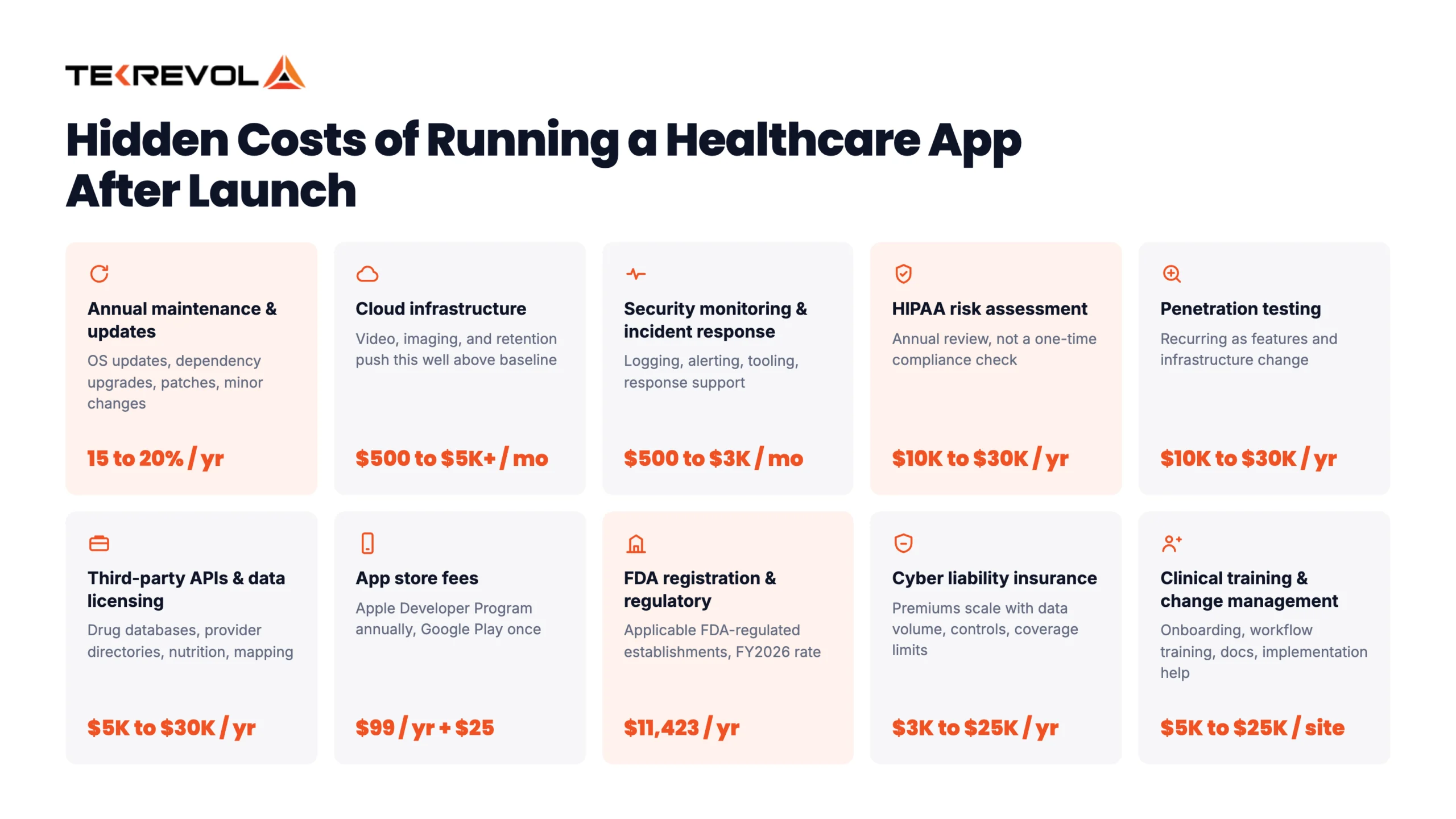
Annual Maintenance and Updates
Estimated cost: 15%–20% of the original build cost per year
Healthcare apps need regular maintenance for operating system updates, dependency upgrades, bug fixes, security patches, and minor feature changes. Costs can increase when the app depends on older healthcare APIs or integrations that require ongoing updates.
Cloud Infrastructure
Estimated cost: $500–$5,000+ per month
Cloud costs depend on user volume, data storage, traffic, and the type of healthcare data being processed. Video, medical images, continuous monitoring data, and long-term record retention can push infrastructure costs well above those of a standard healthcare app.
Security Monitoring and Incident Response
Estimated cost: $500–$3,000 per month
Healthcare apps need continuous monitoring for suspicious activity, failed authentication attempts, vulnerabilities, and potential security incidents. Logging, alerting, security tools, and incident response support create recurring costs after launch.
HIPAA Risk Assessment
Estimated cost: $10,000–$30,000 per year
HIPAA-covered products need ongoing security risk assessments rather than a one-time compliance check. Annual reviews help identify new vulnerabilities, evaluate changes to the application, and update safeguards as the product and infrastructure evolve.
Penetration Testing
Estimated cost: $10,000–$30,000 per year
Regular penetration testing helps identify vulnerabilities that automated security scans may miss. Healthcare applications with sensitive patient data often require recurring testing as new features, integrations, and infrastructure are introduced.
Third-Party APIs and Data Licensing
Estimated cost: $5,000–$30,000 per year
Healthcare apps often rely on external services for drug databases, nutrition information, provider directories, mapping, medical data, or other specialized functionality. These services may charge recurring subscription or usage-based fees that continue long after development is complete.
App Store Fees
Estimated cost: $99 per year for Apple and $25 one-time for Google Play
Publishing and maintaining a healthcare app on major app stores also comes with developer account fees. Apple charges an annual fee for its Developer Program, while Google Play requires a one-time registration fee for a developer account.
FDA Registration and Regulatory Costs
Estimated cost: $11,423 per year for applicable FDA-regulated establishments in FY2026
If the healthcare product qualifies as a regulated medical device, additional regulatory costs may apply. These can include establishment registration and other compliance activities, depending on the product’s classification and intended use.
Cyber Liability Insurance
Estimated cost: $3,000–$25,000 per year
Healthcare companies may need cyber liability coverage to protect against costs associated with data breaches, cyberattacks, and other security incidents. Premiums vary based on the amount and type of health data handled, security controls, company size, and coverage limits.
Clinical Training and Change Management
Estimated cost: $5,000–$25,000 per deployment site
Provider-facing healthcare software often requires staff training before it can be adopted effectively. Costs can include onboarding sessions, workflow training, documentation, support materials, and implementation assistance for each clinic or healthcare organization.
Cost-Saving Strategies for Healthcare App Development
You can reduce healthcare app development costs by 30%–50% through tighter MVP scope, cross-platform development, phased integrations, and reusable compliance infrastructure. The key is cutting unnecessary scope, not security, accessibility, or audit controls.
Start With a Focused MVP
Estimated savings: 40%–60% of first-release costs
Launch with the three features that prove your core value instead of building the entire roadmap upfront. Our MVP development services can help you prioritize essential functionality, reduce development and testing requirements, and keep initial infrastructure costs under control.
Phase EHR Integrations
Potential savings: $30,000–$60,000
Start with read-only EHR access when possible, then add write capabilities after validating the product. This reduces initial integration complexity without blocking the core launch.
Use Managed HIPAA-Eligible Infrastructure
Potential savings: Varies by project scope
Managed cloud services can provide much of the infrastructure needed for a compliant healthcare app without requiring you to build everything from scratch. Choose providers that support appropriate security controls and can provide required agreements, such as a Business Associate Agreement (BAA).
Lock the Scope Before Development
Estimated savings: Project-dependent
Clear specifications reduce expensive mid-development changes. In healthcare projects, a late feature change can affect architecture, integrations, testing, documentation, and compliance controls, multiplying the cost of a seemingly small request.
Don’t Cut Security to Save Money
Encryption, access controls, audit logging, secure infrastructure, and accessibility should be part of the initial architecture. Retrofitting these controls after launch often costs significantly more than building them correctly from the start.
Top Healthcare App Monetization Strategies
Healthcare apps can generate revenue through subscriptions, consultations, freemium plans, enterprise licensing, in-app purchases, and reimbursement models. The best model depends on your users, app type, and target market.
Subscription
Predictable, recurring revenue that works well for mental health, fitness, and chronic care management, categories where users engage over months, not once. The trade-off is consumer churn, which tends to be the model’s biggest threat to long-term revenue.
Pay-Per-Consultation
A natural fit for telemedicine, where revenue scales directly with usage. This model ties income to actual clinical activity rather than engagement, making it easier to forecast against provider capacity.
Freemium
The widest acquisition funnel of any model, since a free tier removes the barrier to first use. The entire model lives or dies on conversion rate; a strong free experience that never upgrades users is just an expensive customer acquisition channel with no return.
Enterprise Licensing
Selling per seat or per site to hospitals, clinics, or employers produces the highest contract values of any model on this list, but also the slowest close. Enterprise buyers require security review, IT sign-off, and often a pilot before committing, which is why sales cycles run 6 to 24 months rather than days.
Payer Reimbursement
Remote patient monitoring and certain digital therapeutics can bill through established CPT codes, turning the app into a revenue line for providers rather than a cost center for them. This shifts the sales conversation entirely. You’re no longer asking a health system to spend money; you’re showing them how to bill for care they’re already delivering.
In-App Purchases
Apps can charge for individual programs, premium content, reports, assessments, or other optional services. This approach works best when users have clear reasons to purchase something beyond the core experience.
Data as a Service
Aggregated, de-identified patient insights were sold for research purposes. This can be lucrative, but it’s legally sensitive territory. Get counsel involved early, since de-identification standards and consent requirements vary significantly by jurisdiction and use case.
Partner With TekRevol for Healthcare App Development
TekRevol helps healthcare businesses turn complex product ideas into secure, scalable digital solutions. We provide transparent cost breakdowns early, so you understand the investment before development begins. We’ve delivered 60+ healthcare applications and hold a 4.8-star Clutch rating across 80+ verified reviews.
Our healthcare work spans consumer health records, on-demand clinical services, HIPAA-compliant wellness platforms, and AI patient feedback systems. If you want to see what that looks like applied to your idea, our healthcare app developers will walk you through a real estimate.
What a scoping call with us actually covers:
- Whether your app touches PHI, and what that means for architecture from day one
- Which EHR integration tier do you actually need, not the one a vendor defaults to
- Whether your AI feature crosses into FDA-regulated territory
- Who your real buyer is, and what that changes about your cost and timeline
- A cost range you can take to investors or a budget committee with confidence
Ready to find out what your healthcare app will actually cost?
Book a 30-minute healthcare app cost consultation to pressure-test your scope, uncover hidden costs, and leave with a board-ready budget range.
Schedule Your Free Consultation!