



Legacy apps with poor architecture often cost more to extend than to rebuild from scratch. Have a technical audit done before deciding.
Most cost guides give you a number. This one gives you a decision framework for mobile app development in Kuwait— and the data behind it.
- Kuwait app costs range from KWD 1,500 to over KWD 100,000 — but the tier alone is meaningless without context.
- Arabic-first UX, KNET payment integration, and CITRA compliance are Kuwait-specific requirements affecting every budget tier.
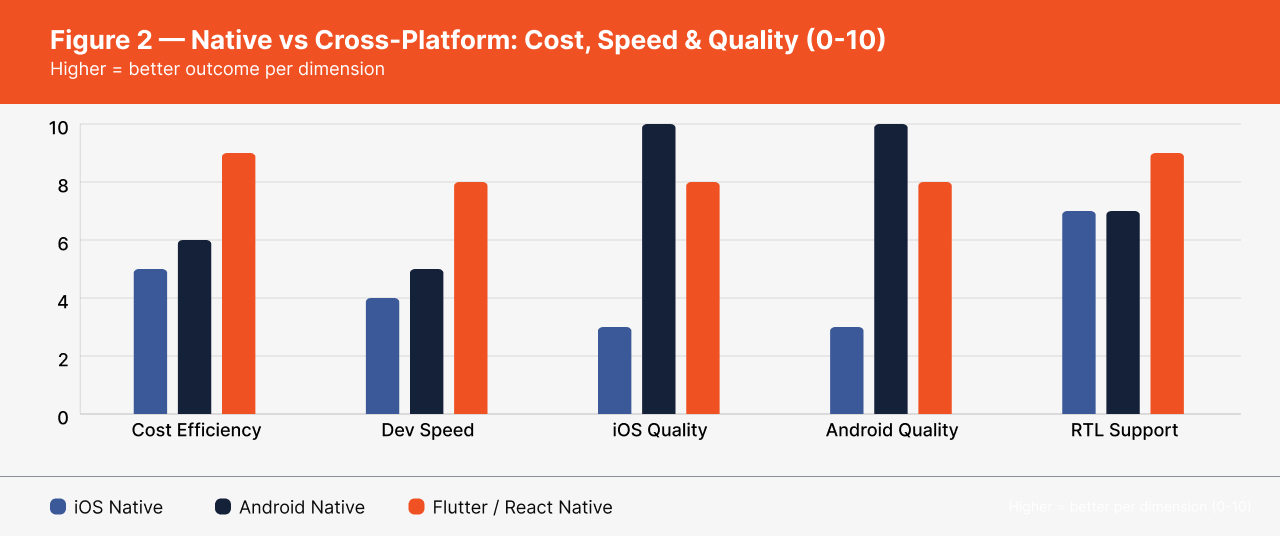
- Cross-platform frameworks (Flutter, React Native) cut costs 25–40% without sacrificing quality for most use cases.
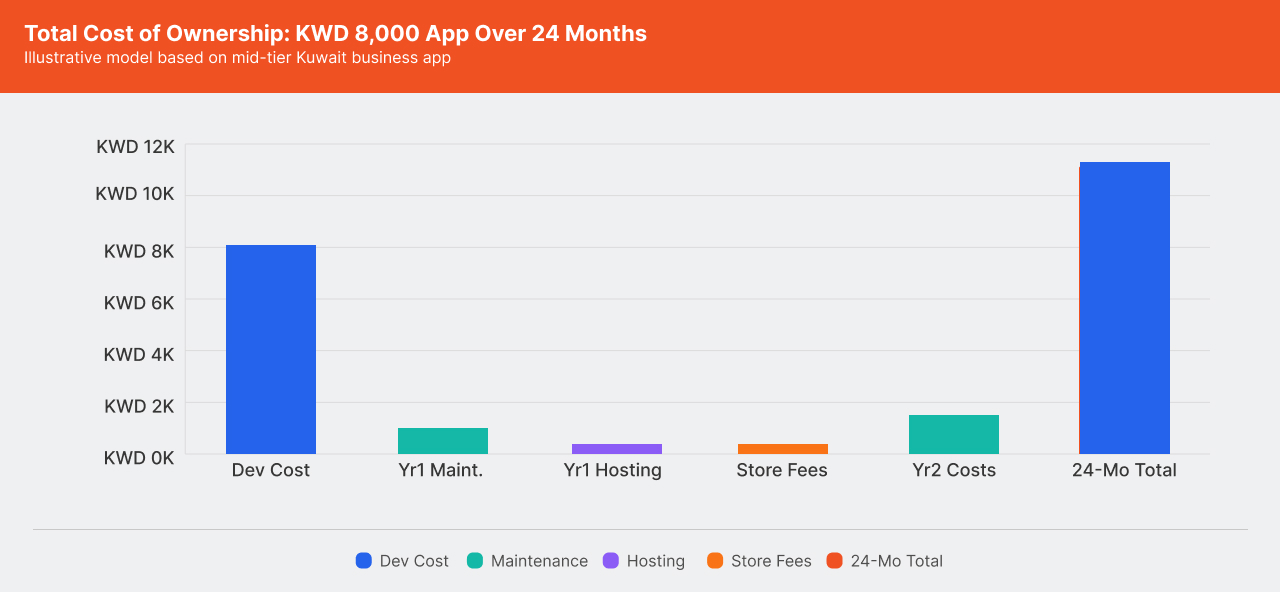
- Post-launch costs add 15–20% of development budget annually — factor this into your business case from day one.
- Kuwait’s 99% internet penetration means users have high expectations; under-investing in UX is a false economy
The problem with most “app development cost” articles is that they’re written to sound helpful while actually saying nothing. You read the whole thing and still don’t know whether your idea costs KWD 3,000 or KWD 30,000 — or why.
This guide is different. Below you’ll find real numbers, the specific factors that move them in Kuwait, and things almost no one tells you until after the contract is signed.
99%
Internet Penetration
Kuwait leads the GCC in digital adoption — your users know what quality looks like.
$1.85B
E-Commerce Market
Kuwait's digital commerce market in 2025, projected to reach $2.42B by 2030.
+40%
Cost Saved
Maximum savings by choosing cross-platform vs. dual-native development.
Why Kuwait Is Not a Generic Market
Kuwait has one of the highest smartphone penetration rates in the GCC. Your users have already downloaded and deleted hundreds of apps. They know what polished feels like — and they have low tolerance for anything less.
Three Kuwait-specific requirements will affect your budget before you write a single line of code:
-
1Bilingual UX by default
Arabic-first isn't a nice-to-have — it's expected. RTL interfaces done poorly are immediately abandoned.
-
2KNET payment integration is non-negotiable
KNET is the dominant payment network in Kuwait. An app that doesn't support it loses conversions.
-
3Regulatory compliance has real teeth
Fintech, health, and logistics apps may need to meet CITRA and CBK guidelines.
What a Mobile App Actually Costs in Kuwait
Here’s an honest breakdown by complexity. These ranges reflect what businesses building for the Kuwait market are actually spending in 2026.
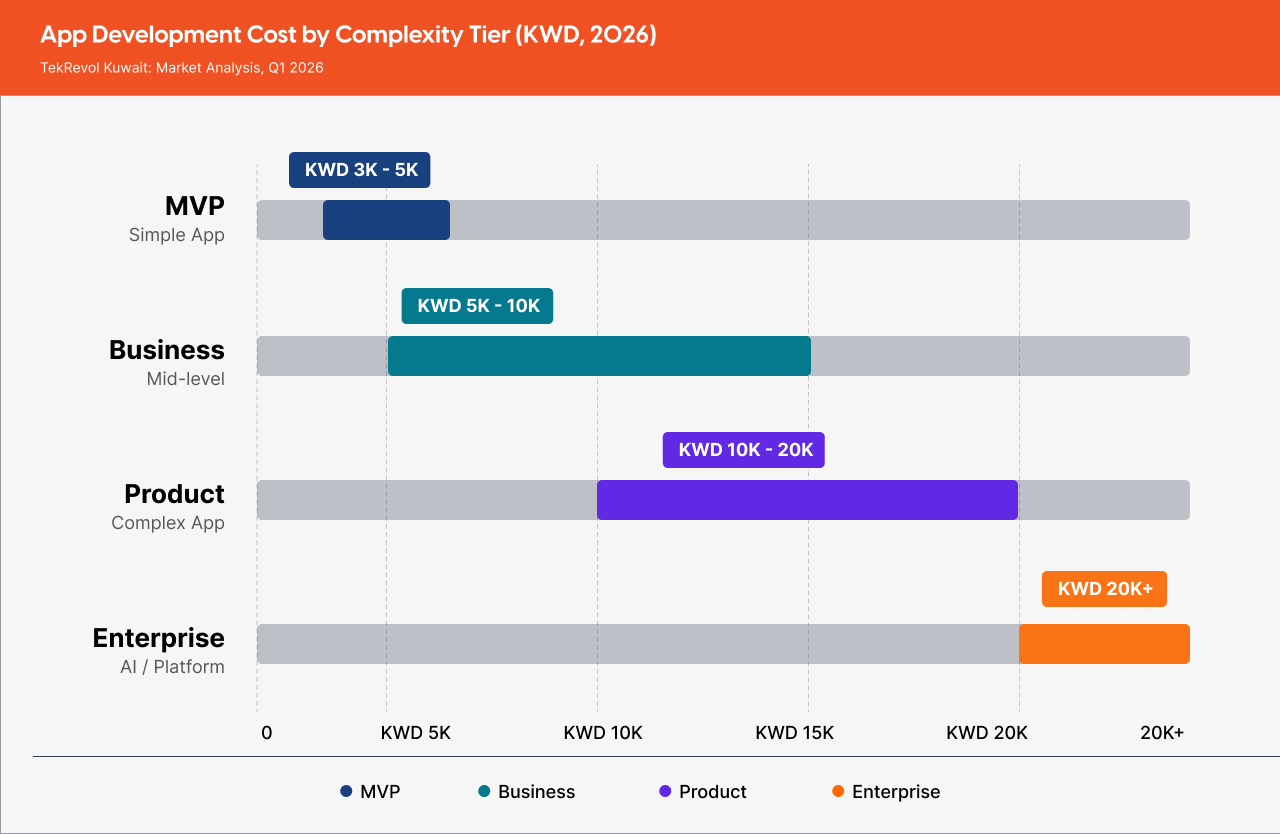
Cost Ranges by App Type
These ranges reflect mobile app development costs in Kuwait while also accounting for global trends and expectations in 2026.
| App Tier | Estimated Cost (KWD) | Timeline | Description |
| MVP | ~1,500–5,000 | 2–6 weeks | Proof of concept, idea validation |
| Business | ~5,000–10,000 | 8–12 weeks | E-commerce, booking, loyalty platforms |
| Product | ~10,000–20,000 | 12–20 weeks | Real-time features, AI modules, complex APIs |
| Enterprise | ~20,000-100,000 | 20+ weeks | Compliance-heavy, multi-role scalable platforms |
Simple Mobile Apps
A simple mobile app is often ideal for startups, informational tools, and early-stage business ideas. These apps typically include:
- A few static screens
- Basic user login (optional)
- Minimal backend functionality
- No real-time data or complex interactions
Estimated Cost: ~KWD 1,500 – KWD 5,000
These apps are perfect for MVPs or pilot projects where validating your idea quickly and cost-effectively matters most.
Mid-Level or Moderate Apps
Mid-level apps are where many business apps sit. They offer enhanced functionality and user engagement without reaching enterprise levels.
Common features include:
- User authentication
- Social logins
- Payment integrations (e.g., MyFatoorah or KNET)
- API connections (e.g., CRM development services)
- Push notifications
Estimated Cost: ~KWD 5,000 KWD 10,000
These applications offer a good mix of user-friendliness and affordability, making them suitable for e-commerce, booking systems, loyalty programs, or service platforms at a local level.
Complex or Advanced Mobile Apps
At this level, we consider app creation as a kind of business development. Such apps differ significantly from e-commerce app development services as they tend to immerse the user in a highly innovative and attractive user journey.
Some features of this kind of app may be:
- Live or real-time features (e.g., chat, live tracking)
- AI and machine learning modules
- Extensive integrations across ecosystems
- Scalability for high traffic
Estimated Cost: ~KWD 10,000 – KWD 20,000+
Complex apps require more planning, backend architecture, robust QA, and testing to deliver high performance and reliability.
Enterprise-Grade and High-End Apps
At the top end of the spectrum, you have apps that power major businesses or digital ecosystems. These often feature:
- Artificial intelligence & predictive systems
- Augmented reality experiences
- Custom backend and cloud infrastructures
- High-security compliance
Estimated Cost: 100,000+ KWD
Enterprise and AI/AR-powered apps involve a significant investment not only in technology but also in user experience.
- From KNET Integration to CITRA Compliance, we’ve got it covered.
- Skip the generic form and speak with a strategist who understands the Kuwaiti ecosystem
Factors That Affect Mobile App Development Cost in Kuwait
Since you now know the general price ranges, here’s what actually moves the needle (up or down) when building an app in the Kuwaiti market.
App features & functionality
+KD 500 – KD 8,000+ per major feature
Every feature has a price tag. The more complex the capability, the more development time, QA cycles, and specialist expertise you need.
- Real-time chat or live tracking: KD 800 – KD 2,500 depending on scale
- Payment gateway integration (KNET, Tap Payments, credit cards): KD 600 – KD 1,800
- AI features like smart recommendations or chatbots: KD 1,500 – KD 8,000+
- Data dashboards and reporting panels: KD 500 – KD 2,000
- Simple informational features (listings, contact forms): KD 200 – KD 600
App design & UI/UX complexity
+KD 400 – KD 5,000 depending on customisation level
Design is far more than visuals in Kuwait’s bilingual, multicultural market. Getting it right takes deliberate effort, and it costs accordingly.
- Arabic + English dual-language interface with proper RTL (right-to-left) layout
- Custom typography, Ramadan/National Day seasonal themes, culturally relevant visuals
- Template-based UI: KD 400 – KD 1,000
- Fully custom, interactive design (animations, micro-interactions): KD 2,000 – KD 5,000+
- A poorly localised RTL layout often leads to costly rework, budget for it upfront
Platform choice (iOS, Android, or both)
+KD 1,500 – KD 6,000 extra for dual-platform native builds
Kuwait has a high smartphone penetration rate with strong usage of both iOS (iPhones are popular across demographics) and Android. Your platform choice directly shapes the budget.
- Android only: typically the lowest entry cost, broader device reach
- iOS only: moderate cost, strong among Kuwait’s premium consumer segment
- Both platforms (native builds): KD 4,000 – KD 10,000+, depending on complexity
- Cross-platform via React Native or Flutter: KD 2,500 – KD 7,000 — good balance of cost and quality for most Kuwaiti startups
Backend infrastructure & APIs
+KD 800 – KD 6,000+ depending on integrations
Behind every smooth app is a backend (servers, databases, APIs, and security layers). Kuwait’s specific integrations add meaningful complexity to this layer.
- Basic backend (user auth, database, REST API): KD 800 – KD 2,000
- Civil ID verification integration (MOI API): KD 1,000 – KD 2,500
- Kuwaiti bank or payment system APIs (NBK, Gulf Bank, KNET): KD 1,500 – KD 4,000
- Government portal integrations (Sahel, eGovernment): KD 2,000 – KD 6,000+
- Third-party logistics/delivery APIs common in Kuwait’s e-commerce market: KD 600 – KD 1,800
Regulatory Compliance & Security
+KD 500 – KD 4,000 for compliance-heavy apps
Kuwait’s regulatory environment, particularly for fintech, healthtech, and apps handling personal data, equires serious investment in security and compliance architecture.
- End-to-end encryption and secure authentication (OTP, biometrics): KD 500 – KD 1,500
- CBK (Central Bank of Kuwait) compliance for fintech apps: KD 1,500 – KD 4,000
- Health data handling per Ministry of Health guidelines: KD 1,000 – KD 3,000
- GDPR-aligned data protection (increasingly expected by Kuwaiti enterprises): add 10–15% to backend cost
- Redundant backup systems and disaster recovery: KD 400 – KD 1,200/year ongoing
Testing & Quality Assurance
Typically 15–25% of total project budget
A polished app in Kuwait needs to work seamlessly across Android and iOS, from flagship Samsung and iPhone models to budget Androids common in Kuwait’s expat communities.
- For a KD 5,000 app, expect KD 750 – KD 1,250 in QA costs
- For a KD 15,000 app, QA can reach KD 2,250 – KD 3,750
- RTL/LTR layout switching bugs are among the most common issues in Kuwaiti bilingual apps — require dedicated test cases
- Device fragmentation testing is critical: Kuwait’s Android market spans many brands and screen sizes
- User acceptance testing (UAT) with real Kuwaiti end users before launch: strongly recommended
The Hidden Cost Nobody Warns You About
Your mobile app development cost in Kuwait does not end at launch. But the real cost of app ownership extends well past go-live.
Many business owners underestimate these recurring costs, so plan accordingly. Ongoing costs include:
- Maintenance & updates – Often 10–20% of original development cost annually
- Hosting & server fees – Depending on traffic and data usage
- App store fees – Apple and Google Play charges
- Marketing & user acquisition – Essential for adoption and retention
Here’s what two years of ownership actually looks like.
How Tekrevol Helps You Build the Right Mobile App in Kuwait
Tekrevol is no doubt a reliable and trusted partner for businesses in Kuwait and beyond when it comes to transforming your idea into a creative, scalable, and user-focused mobile app. Tekrevol doesn’t just code mobile apps. We help you by being an ideal business partner for you:
-
1Check our portfolio for RTL/Arabic-first apps we've shipped
This isn't a skill you want a team to learn on your project. Request live App Store links, not screenshots.
-
2Our KNET integration experience
Teams without local experience routinely underestimate — and underprice — the quirks involved.
-
3We offer post-launch SLA terms in writing
A development partner who disappears at go-live is a vendor. Ensure your contract covers OS updates, security patches, and response times.
-
4We explain architecture decisions for your use case
If our team can't articulate why they're recommending Flutter over React Native for your specific situation, as per your liking.
![How to Build a Social Networking App: Features, Cost & Monetization [2026]](https://tekrevol-stage.s3.us-east-1.amazonaws.com/images-tek/uploads/2025/06/Tek-Feature-1-400x160.jpg)


