



- Most Bahrain apps cost between BHD 1,800 and BHD 35,000, depending on features and backend complexity.
- Bahrain runs on iPhone, so an Android-first launch here reaches the smaller half of your market.
- Add 10% VAT, PDPL consent work, and BENEFIT Pay integration into every Bahrain app budget you build.
- Wide quote gaps almost always mean different scopes rather than different rates, so compare written deliverables.
- Budget another 20% to 30% of your build cost every year for hosting, maintenance, and store fees.
Mobile apps have become normal in Bahrain. Name any service or product, and you will find its online version. But to reach this level, businesses spend between BHD 1,800 and BHD 5,000 ($5,000 to $13,500), as mobile app development cost Bahrain. And that is only for basic and small startups. When companies create a fully functional product with advanced features and integrations, the cost to build an app in Bahrain can rise well beyond BHD 100000.
The numbers show why having a clear budget is important before starting. A simple idea might only need a few screens and limited features. However, for a large-scale product, you would require strong design, custom integrations, and a secure backend. Each of these choices pushes the app development Bahrain price 2026 higher.
If you have been asking how much to create an app in Bahrain, this guide will give you the complete picture. You will see the mobile app development cost in Bahrain with timelines, the main factors, and how to compare proposals from a mobile app development company in Bahrain without paying twice for missing work.
How Much Does Mobile App Development Cost in Bahrain in 2026?
The standard mobile app development cost in Bahrain is BHD 1,800 ($5,000). When moving to the upper mid-range apps with more features, payments, and a custom backend, expect to pay between BHD 5,000 and 12,000 ($13,500 to $32,000). At the top of the funnel lie large or enterprise-level projects, which often exceed BHD 35,000.
To make your app budget estimate in Bahrain for 2026 easier, here’s a simple breakdown:
| Tier | What you get | BHD | USD | Timeline |
| Basic / MVP | Standard UI, login, profiles, a few screens, no heavy backend | 1,800 to 5,000 | $5,000 to $13,500 | 1 to 2 months |
| Mid-level | Custom UI, payment gateway, API integrations, admin panel | 5,000 to 12,000 | $13,500 to $32,000 | 2 to 4 months |
| Complex / enterprise | Real-time tracking, AI, scalable custom backend, high security | 15,000 to 35,000+ | $40,000 to $90,000+ | 4 to 8+ months |
Looking at the price, you may wonder why the app development Bahrain price 2026 has skyrocketed. Well, never underestimate the fact that the country’s software sector of the country is expanding steadily.
The ICT market, which was valued at USD 4.6 billion in 2024, is expected to cross USD 8.97 billion by 2032. This underscores the growing demand for software solutions and apps for Bahrain.
Don’t rush your app budget planning
Consult with Tekrevol and get a custom mobile app development cost estimate template for controlled spending.
Book a Free Scoping CallMobile App Development Market of Bahrain
Bahrain has become one of the most active digital hubs in the Gulf. The country’s application development market is worth USD 32.75 million in 2025 and is expected to grow at a CAGR of 5.61% through 2029, eventually crossing USD 40.74 million (Statista).
This steady rise reflects how government digitization fuels the adoption of new mobile apps, making them part of everyday life. Finance apps like Benefit-pay for Bahrain make payments faster and safer, while eCommerce platforms now connect retailers with thousands of Bahraini customers every day. The surge in demand not only influences Bahrain app development pricing but also makes it competitive.
When comparing the mobile app development Bahrain price 2026 with the Middle East, you’ll realize that it is more cost-efficient to build quality mobile apps for Bahrain without the extra financial burden. In neighboring regions like the UAE or Saudi Arabia, higher operational expenses push up the average app development cost in the Middle East.
What Factors Influence the Mobile App Development Cost in Bahrain?
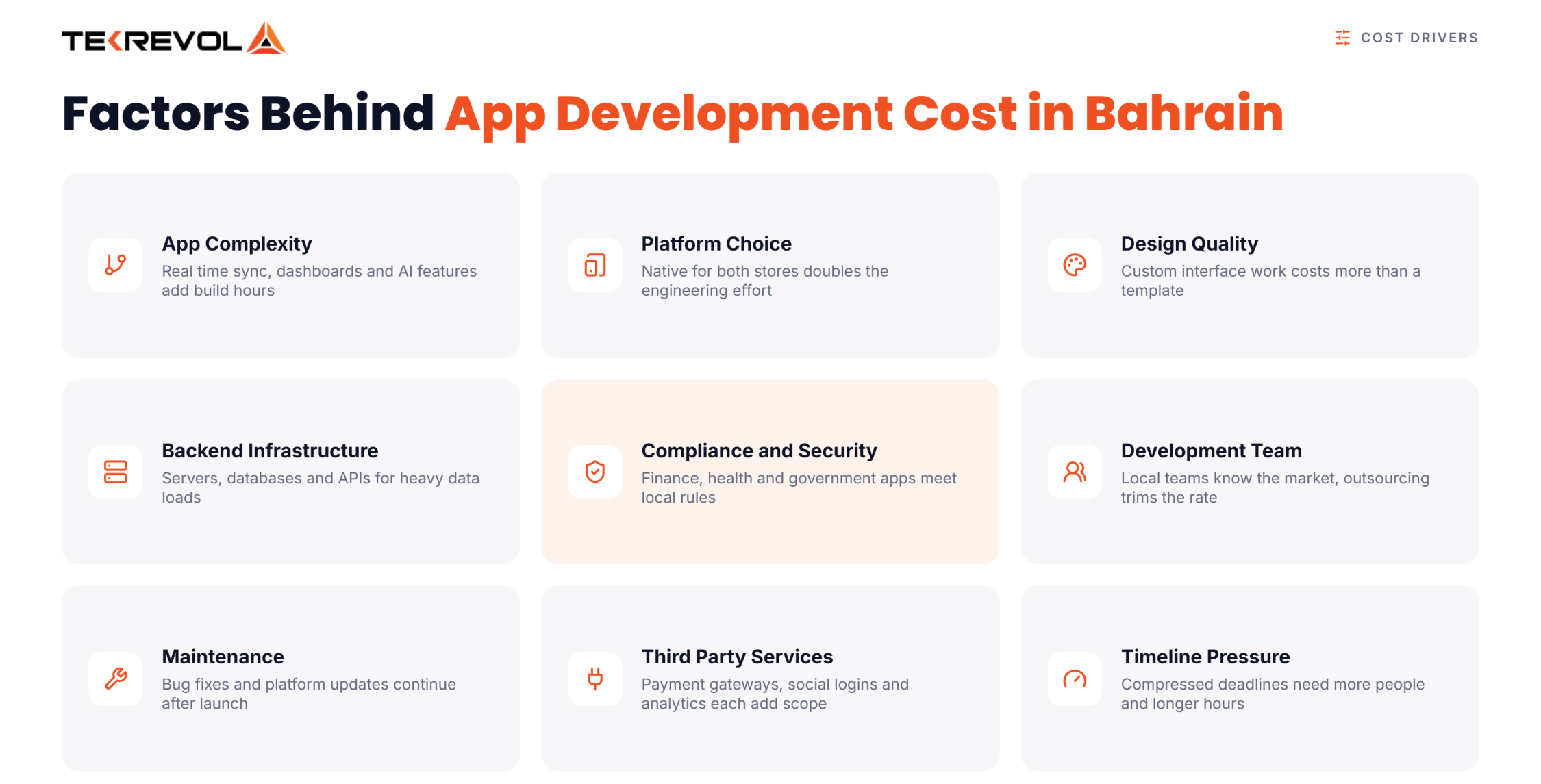
Factors affecting mobile app development cost in Bahrain fall into nine areas, from feature complexity down to post-launch support. Complexity and backend architecture consume the largest share of the budget, while compliance and integrations cause the most unpleasant surprises later.
Below, we explain how each factor can significantly increase or decrease your total cost to build an app in Bahrain.
1. App Complexity and Features: BHD 1,800 to BHD 35,000+
This is your biggest lever, and it’s the one people underestimate most. Simple apps with static pages and basic login features are cheaper; a live order-tracking map with driver assignment needs geolocation, sockets, dispatch logic, and failure handling.
Every feature you add carries four costs, not one: design, build, testing, and maintenance for as long as the app lives.
2. Platform Choice: BHD 0 to BHD 9,000
Choosing iOS, Android, or both affects the budget. Native apps for each platform require separate development, doubling your frontend cost. Cross-platform developemnt services cover both from one codebase for around 60% to 70% of that. Given Bahrain’s iOS majority, launching on one platform first is usually the smarter play anyway.
3. UI/UX Design: BHD 900 to BHD 4,000
Design runs 15% to 20% of a typical project, covering flows, wireframes, a full screen set, a reusable design system, and a clickable prototype. Standard component libraries sit at the bottom of that range; custom design systems with motion and illustration sit at the top. Cut design, and you’ll pay for it in support tickets instead.
4. Backend Architecture: BHD 1,200 to BHD 12,000
Serverless with a managed database is the fastest and cheapest to launch, and it’s the right answer for most first releases. However, some apps for Bahrain need a solid backend to handle lots of data or run in real time. Adding servers, databases, and APIs will push up your mobile app development cost in Bahrain. Choosing wrong in either direction gets expensive, because rearchitecting a live product is worse than building it twice.
5. Third-Party Integrations: BHD 350 to BHD 2,800 each
Adding services like payment gateways, social logins, or analytics enhances functionality but increases your app budget estimate Bahrain 2026. Each integration means build time, sandbox testing, error handling, and a subscription fee you’ll pay every month forever. Three integrations sound small in a kickoff meeting and reliably add a month to delivery.
6. Arabic and Bilingual Support: 15% to 25% of budget
Every screen mirrors, icons flip, gestures reverse, and Arabic typography needs its own line heights and font pairings. Then you maintain two versions of every string, notification, and legal page indefinitely. Decide this before design starts, because retrofitting it costs three to four times more.
7. Regulatory Compliance: BHD 1,200 to BHD 9,000
Any app handling personal data falls under Bahrain’s PDPL, which requires designed consent flows with auditable records rather than a checkbox. Fintech apps carry an additional Central Bank layer on top of that. This is a genuine line item, and it’s the one almost no published Bahrain quote includes.
8. Team Model and Location: BHD 4 to BHD 20 per hour
A Manama agency, a regional offshore team, and a freelancer will quote wildly different hourly rates for identical work. Local teams in Bahrain understand the market but often charge more. Outsourcing can reduce costs but may introduce communication or quality risks.
9. Maintenance and Support: 15% to 20% of build cost, annually
After launch, all apps, whether basic or special, need maintenance services to fix bugs, update the existing features to keep up with user preferences, and adapt to new OS versions. Budget this from day one rather than discovering it in month fourteen. An app nobody maintains stops working, usually right after a major iOS release.
10. Timeline and Urgency
Projects with restricted deadlines require more resources or extended hours, which resultantly raise the mobile app development cost Bahrain. That’s why having a well-planned timeline with reasonable working hours is important to manage expenses efficiently.
Platform Impact on Bahrain App Development Pricing: Android vs iOS vs Cross-Platform
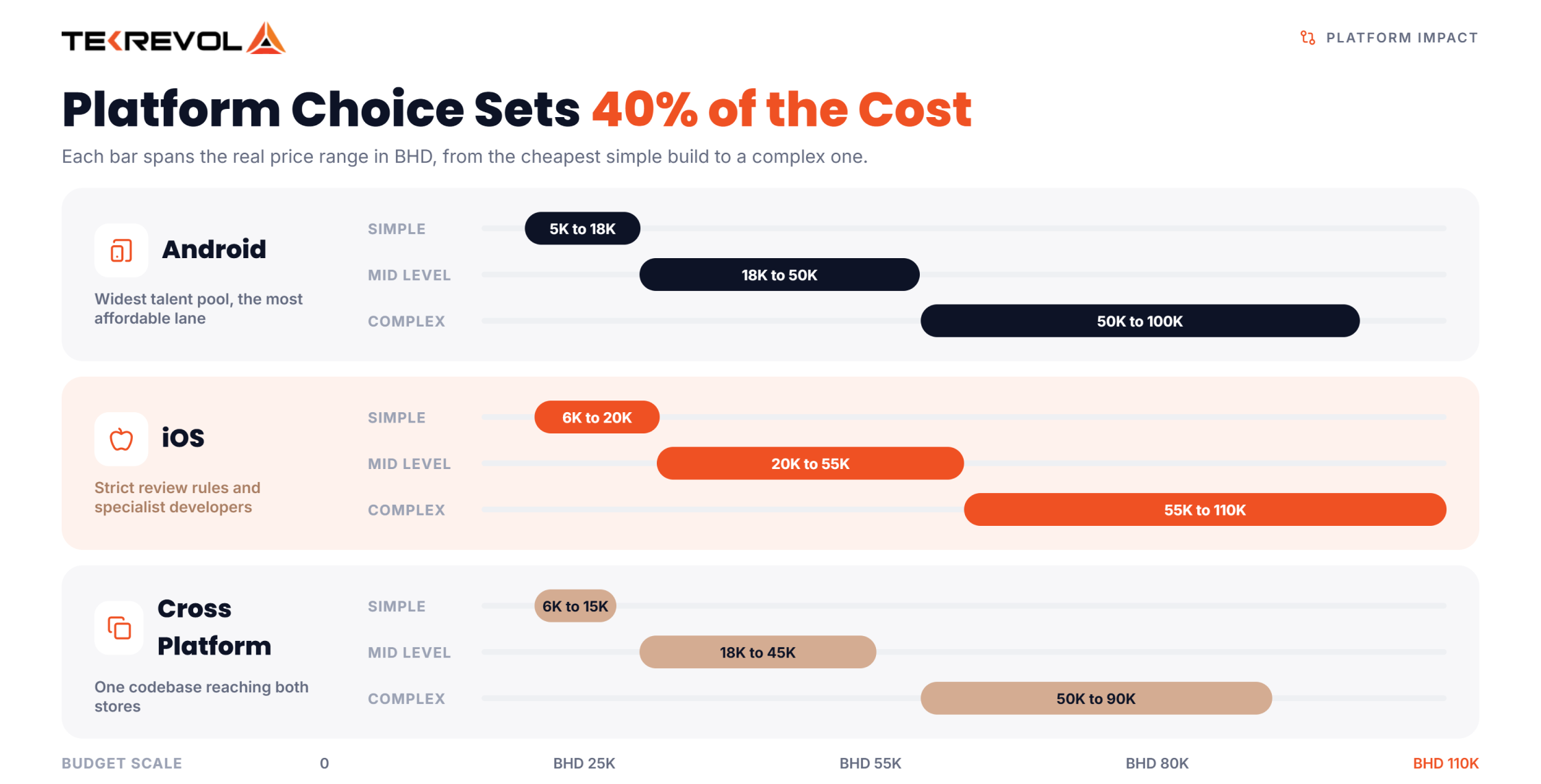
Platform choice impacts Bahrain app development pricing by up to 60%. Cross-platform costs less in Bahrain for most apps, covering both platforms for roughly 60% of what two native builds cost. A single native iOS app is cheaper still, and it reaches 55% of the market on its own. However, Apple’s strict guidelines and need for specialized developers raise the iOS mobile app development cost in Bahrain.
Here’s a table comparing iOS and Android app development Bahrain price 2026 with cross-platform at different levels of complexity and technicality:
| Approach | Basic / MVP | Mid-level | Complex | Reaches |
|---|---|---|---|---|
| Single native (iOS or Android) | BHD 1,800 to 4,500 | BHD 4,500 to 10,000 | BHD 13,000 to 30,000 | One platform |
| Cross-platform (Flutter, React Native) | BHD 2,200 to 5,000 | BHD 5,000 to 12,000 | BHD 15,000 to 35,000 | Both platforms |
| Two native builds | BHD 3,500 to 8,500 | BHD 8,500 to 20,000 | BHD 25,000 to 58,000 | Both platforms |
Our recommendation: launch iOS-first as a single native build, prove it with real users, then go cross-platform when phase two justifies the second platform. Cheapest route to real feedback, and you learn more.
Mobile App Development Bahrain Cost Breakdown by Industry
Mobile app development costs by industry in Bahrain range from BHD 5,000 for retail apps to BHD 35,000+ for regulated fintech. Industry drives cost mainly through compliance requirements, integration depth, and data sensitivity, rather than through screen count or visual polish.
| Industry | BHD | USD | Main cost driver |
| Retail and eCommerce | 5,000 to 12,000 | $13,500 to $32,000 | Payments, catalogue, inventory sync |
| Tourism and hospitality | 5,000 to 13,000 | $13,500 to $34,500 | Booking engine, multilingual content |
| Food delivery | 8,000 to 20,000 | $21,000 to $53,000 | Live tracking, dispatch, three user types |
| Healthcare | 9,000 to 22,000 | $24,000 to $58,500 | Patient data, PDPL, clinical workflows |
| Logistics and fleet | 10,000 to 25,000 | $26,500 to $66,500 | Route optimisation, driver apps, ERP links |
| Fintech | 12,000 to 35,000+ | $32,000 to $93,000+ | CBB requirements, security audits, KYC |
These figures assume custom development. Templates, no-code products, internal prototypes, and existing software customization follow different pricing models.
Fintech: BHD 12,000 to BHD 35,000+
The most expensive category here, and Bahrain adds a layer nobody else charges for. Any app touching regulated financial activity falls under the Central Bank, which means sandbox reporting, KYC flows, audit trails, and a security posture built in from day one rather than bolted on. Budget BHD 3,500 to BHD 9,000 of that total for compliance engineering alone. Our fintech app development services scope the regulatory work as its own line so you can see it.
eCommerce: BHD 5,000 to BHD 12,000
The most predictable build on this list, because the problems are solved and the components exist. Cost sits in catalogue architecture, inventory sync with whatever you already run, and checkout. Add BENEFIT Pay alongside cards and Apple Pay, since card-only checkout quietly loses local customers.
Healthcare: BHD 9,000 to BHD 22,000
Carries fintech’s compliance weight without fintech’s revenue model to absorb it. Patient records are sensitive personal data under Bahrain’s PDPL, so consent, storage location, and access logging need to be designed into the architecture. Expect 15% to 20% above a comparable unregulated app for that alone.
Food Delivery: BHD 8,000 to BHD 20,000
You’re building three products, not one: a customer app, a driver app, and a dispatch console. Live tracking is the expensive part, since it needs sockets, geolocation, assignment logic, and graceful failure when a driver loses signal. Our on-demand development team handles all three tiers as one system.
Logistics and Fleet: BHD 10,000 to BHD 25,000
Similar three-part structure, but the cost climbs on route optimisation and integration with your existing ERP or WMS. These apps are also Android-heavy regardless of Bahrain’s iOS majority, because drivers carry company-issued hardware. That single fact can cut your platform budget in half.
Tourism and Hospitality: BHD 5,000 to BHD 13,000
Cheap to build, expensive to maintain. The booking engine and availability sync are simple, but here Arabic and English both have to be genuinely good, since half your users are visitors and half are local. Budget the full 15% to 25% localisation cost rather than treating it as phase two.
How Much Do Arabic and RTL Support Add to Bahrain Mobile App Cost?
Arabic and RTL support adds 15% to 25% to a Bahrain app budget, or roughly BHD 750 to BHD 3,000 on a mid-range project. The cost isn’t the translation. It’s rebuilding layouts to mirror correctly, handling mixed-direction text, and maintaining two content sets permanently.
- Layout mirroring: Every screen flips. Navigation, icons, progress bars, swipe gestures, charts. Retrofit this after launch, and you’ll pay three to four times what building it in would have cost.
- Mixed-direction text: Arabic sentences containing English brand names or Latin numerals break naive implementations in ways that only show up in production. This needs real testing on real content.
- Typography: Arabic type needs different line heights, different weights, and different font pairings. Your English design system won’t simply transfer, however carefully you built it.
- Content operations: Two versions of every string, notification, error message, and legal page. Forever. That’s an ongoing staffing question, not a one-off build cost.
How Much Does Mobile App Development Cost Per Hour and Per Month in Bahrain?
Mobile app development costs $20 to $150 per hour in Bahrain (BHD 7.5 to BHD 56.5), which works out to $3,200 to $24,000 per month (BHD 1,200 to BHD 9,000) for a full-time dedicated developer on a standard 160-hour month.
The rates form the basis for calculating the cost to build an app in Bahrain. Where you land depends almost entirely on whether you hire an independent freelancer, a mid-market agency, or a specialist enterprise firm.
Cost breakdown by Engagement Model
| Engagement type | Hourly (USD) | Monthly (USD, 160 hrs) | Monthly (BHD) | Best used for |
| Freelancer / offshore team | $20 to $40 | $3,200 to $6,400 | 1,200 to 2,400 | Simple features, MVPs, minor bug fixes |
| Mid-sized agency/tech lead | $40 to $80 | $6,400 to $12,800 | 2,400 to 4,820 | Standard cross-platform or custom business apps |
| Premium/enterprise agency | $80 to $150+ | $12,800 to $24,000+ | 4,820 to 9,000+ | Complex fintech, eCommerce, AI-driven apps |
Rates climb with accountability, not just skill. A freelancer bills for their hours. An agency bills for their hours plus project management, QA, and someone answering the phone when your payment gateway breaks on a Thursday night. Our wider guide to mobile app development cost per hour breaks down what sits inside each band globally.
How Much Does BENEFIT Pay and Local Payment Integration Cost?
BENEFIT Pay and local payment integration costs BHD 700 to BHD 2,800 ($1,900 to $7,400), depending on how many rails you support. That cost covers integration, sandbox testing, reconciliation logic, and failure handling, though it excludes the transaction fees you’ll pay on every payment afterwards.
Payment work gets underestimated constantly, because the happy path is genuinely easy. Everything else isn’t.
- Reconciliation: Matching what the gateway says against what your database says, every single day.
- Failure handling: Timeouts, partial captures, duplicate charges, refunds, chargebacks; each needs a designed path and a tested one.
- Testing: Sandbox environments behave differently from production. Always. Plan a proper testing window.
- Compliance: Touch raw card data and your security scope expands dramatically. Most teams shouldn’t.
Most Bahrain consumer apps end up supporting BENEFIT Pay alongside Apple Pay and cards, since that combination covers local habits and visitors. Each additional rail adds roughly BHD 350 to BHD 900 to the build.
What Does Bahrain Regulatory Compliance Add to an App Budget?
Bahrain regulatory compliance adds BHD 1,200 to BHD 9,000 to an app budget, depending on the data you handle. Every app processing personal data falls under Law No. 30 of 2018. Fintech apps carry an additional Central Bank of Bahrain layer, including its regulatory sandbox.
Personal Data Protection Law (Law No. 30 of 2018)
Bahrain’s PDPL came into force on 1 August 2019 and is administered under the Ministry of Justice. Three provisions carry direct build cost:
- Written, explicit consent is required before you obtain or process personal data. That means designed consent flows with stored, auditable records. Not a checkbox in your onboarding.
- Cross-border transfers need specific consent. If your backend sits outside Bahrain, that’s an architecture decision with a legal consequence attached.
- Biometric processing and surveillance recording require prior written authorisation from the Ministry of Justice. So Face ID login isn’t the free feature your developer thinks it is.
Budget BHD 1,200 to BHD 3,500 for consent architecture, data mapping, retention logic, and access controls on a standard app.
Central Bank of Bahrain Requirements for Fintech
If your app touches regulated financial activity, the CBB layer stacks on top. Its Regulatory Sandbox lets licensed institutions and startups, local or foreign, test innovative solutions before scaling up. The published terms are refreshingly concrete:
| Sandbox term | Detail |
| Application fee | BHD 100, non-refundable |
| Authorisation period | Up to 12 months, extendable with 30 days’ notice |
| Volunteer customer cap | 100 customers, more at CBB discretion |
| Ongoing obligations | Quarterly progress reporting, immediate adverse-event notification |
| Banking requirement | Dedicated client money account at a CBB-licensed bank |
How Is Mobile App Development Cost Divided Across Project Phases?
Mobile app development cost is split across five phases: discovery, design, development, Q and deployment. Development usually receives the largest share, although design, backend engineering, integrations, and quality assurance can become substantial when the product has complex workflows or regulations.
A typical allocation of cost across the mobile app development process may look like this:
| Phase | Share | What happens |
| Discovery and scoping | 10% to 15% | Requirements, architecture, risk mapping |
| UI/UX design | 15% to 20% | Flows, screens, design system, prototypes |
| Development | 40% to 50% | Frontend, backend, integrations |
| QA and testing | 10% to 15% | Functional, device, performance, security |
| Deployment and launch | 5% to 10% | Store submission, monitoring, handover |
These percentages should not be applied blindly. For instance, an internal operations app may require modest visual design but extensive backend integration. Meanwhile, a consumer lifestyle app may invest more heavily in research, onboarding, motion, and visual polish.
What is the Average Timeline of App Development in Bahrain?
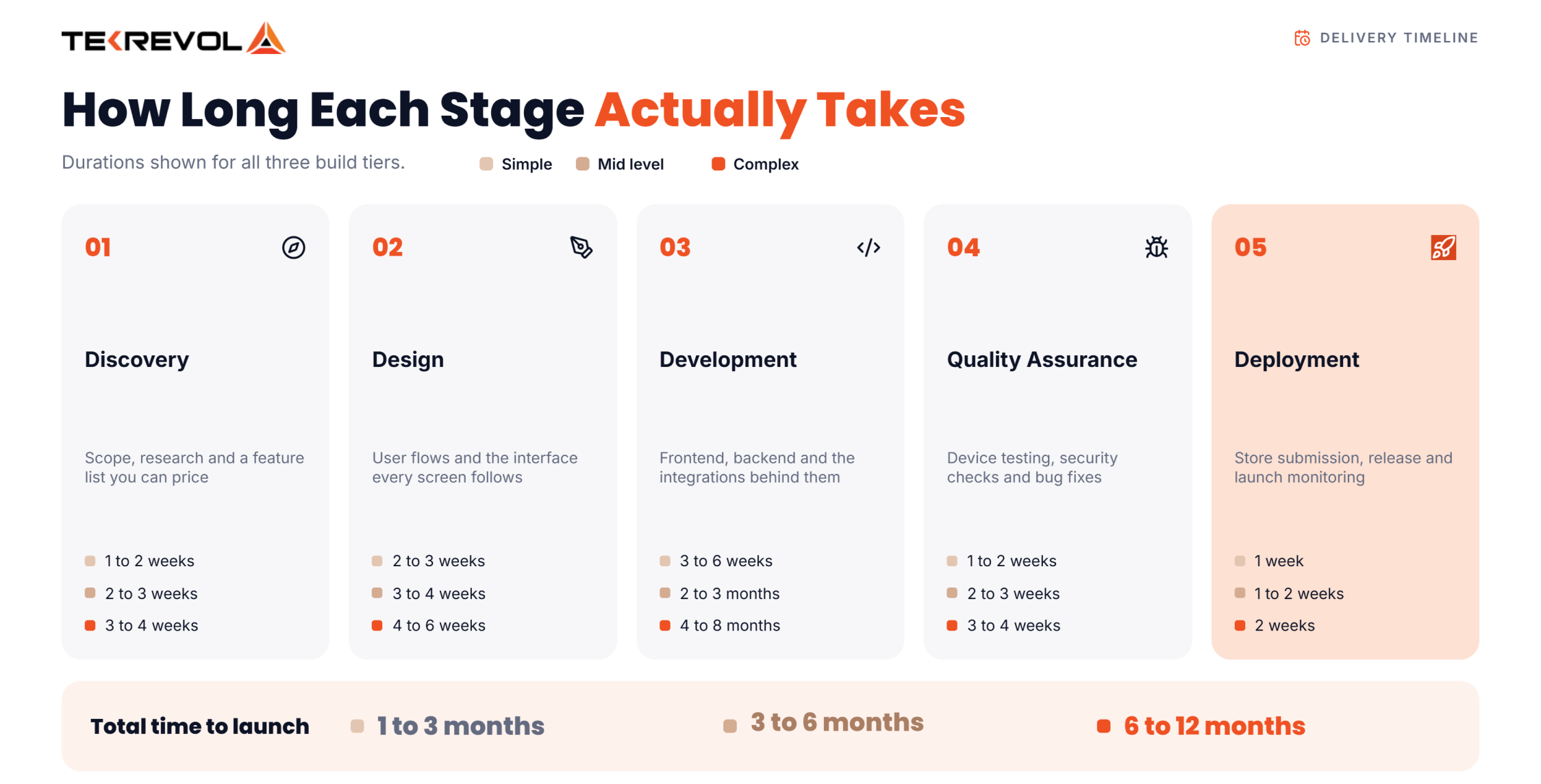
Your app’s complexity defines the timeline for mobile app development cost Bahrain. Simple apps usually take 1–3 months, whereas the duration for mid-level apps spans 3 to 6 months and 6–12 months for full-featured applications.
Here is a generic schedule covering all stages from discovery and design to development and deployment.
| Stage | Simple App | Mid-Level App | Complex App |
| Discovery | 1–2 weeks | 2–3 weeks | 3–4 weeks |
| Design | 2–3 weeks | 3–4 weeks | 4–6 weeks |
| Development | 3–6 weeks | 2–3 months | 4–8 months |
| QA | 1–2 weeks | 2–3 weeks | 3–4 weeks |
| Deployment | 1 week | 1–2 weeks | 2 weeks |
| Total Duration | 1–3 months | 3–6 months | 6 to 12 months or more |
Careful evaluation of each stage helps businesses plan their app budget estimate Bahrain 2026 realistically and avoid hidden app development costs. For instance, a small café app with simple menu browsing may only take two months. While a finance app with secure transactions and analytics dashboards could take 9–12 months.
Need a clear app timeline in Bahrain?
TekRevol breaks down every stage with precision so you know when your app goes live.
Claim Free Consultation NowWhat are the Hidden Costs of Building an App in Bahrain?
Hidden costs of building an app in Bahrain include maintenance, cloud hosting, API licences, app store fees, payment gateway charges, localisation, and VAT. Together, they add 25% to 50% of your build cost in year one.
Figuring out how much to create an app in Bahrain involves a whole set of ongoing expenses that sit outside the initial development figure. Here’s every one of them, with what it actually costs.
Ongoing Maintenance and Updates
- Annual cost: typically 10% to 15% of the original development budget, every year.
- What you’re paying for: bug fixes, performance work, and adapting to new iOS and Android releases. Apple and Google both ship breaking changes annually, so this isn’t optional.
- The risk if you skip it: an unmaintained app usually stops working within two OS cycles, and the fix costs more than the maintenance would have.
Cloud Infrastructure and Hosting
- Monthly cost: BHD 50 to BHD 400+ ($130 to $1,050+), depending entirely on traffic.
- What you’re paying for: servers, databases, and storage on AWS, Google Cloud, or Azure to run your backend and sync user data.
- What moves the number: stored media, background jobs, and concurrent users. A photo-heavy app costs several times what a text-based one does.
Third-Party API and Licence Fees
- Annual cost: BHD 150 to BHD 2,000, depending on how many services you lean on.
- What you’re paying for: SMS notifications for OTP logins, mapping via Google Maps API, push notification services, analytics, and specialised SDKs. Most charge per use or per month.
- The one that surprises people: SMS. Every OTP is a paid message, so a login-heavy app with a growing user base sees this line climb quietly month after month.
App Store Developer Fees
- Apple App Store: $99 (around BHD 37) per year, every year.
- Google Play Store: $25 (around BHD 9) as a one-time registration fee.
- Also worth budgeting: both stores take 15% to 30% commission on in-app purchases and subscriptions, with the lower rate applying to smaller developers.
Payment Gateway Transaction Fees
- Ongoing cost: usually 1.5% to 3% of each transaction, plus a fixed fils amount per payment.
- Setup: local gateways including BENEFIT, Tap Payments and CrediMax charge setup fees on top of the per-transaction rate.
- Why it matters at scale: on a marketplace turning over BHD 20,000 a month, a one-point difference in gateway rate is BHD 2,400 a year. Negotiate this properly before you integrate.
Localisation and Compliance
- Cost: BHD 750 to BHD 3,000 for Arabic and RTL, plus BHD 1,200 to BHD 3,500 for PDPL compliance work.
- What you’re paying for: right-to-left layout support, dual-language English and Arabic content, and the consent architecture Bahrain’s Personal Data Protection Law requires.
- The trap: both get treated as launch-day extras, and both are architectural. Retrofitting either costs three to four times what building it in would have.
VAT on Your Development Invoice
- Cost: 10% of the contract value, per Avalara’s Bahrain country guide. Businesses must register once annual taxable supplies pass BHD 37,500.
- In practice: a BHD 8,000 contract from a Bahrain-registered supplier carries BHD 800 in VAT. Recoverable if you’re registered yourself; a straight cost if you’re not.
- Why nobody mentions it: almost every published Bahrain cost guide quotes ex-VAT figures without saying so, which is how a budget misses by 10% before work starts.
Marketing and App Store Optimisation
- Cost: BHD 800 to BHD 8,000 in year one, and it varies more than anything else on this list.
- What you’re paying for: store listing optimisation, creative assets, paid acquisition, and review generation.
- The uncomfortable truth: this is frequently larger than every other post-launch line combined. An app nobody can find isn’t a cheap app. It’s a wasted one.
How Can You Reduce Mobile App Development Expenses in Bahrain?
Try these industry-recommended tips to manage your mobile app development cost Bahrain:
- Build a basic MVP first with core features to test your idea. A good MVP should complete one valuable customer journey. It should not become a smaller version of every future feature.
- Prioritize features that deliver the most value to users. Separate features into: Required for launch; Required after validation; Useful but unproven; and Operationally unnecessary
- Avoid adding every idea at once. Payments, AI accuracy, legacy APIs, offline behavior, and regulated workflows can create significant technical risk. A short proof of concept may be cheaper than discovering a limitation after full development begins.
- Use cross-platform technology when it fits. Flutter or React Native can reduce duplicated mobile work. However, choose the framework after reviewing hardware access, performance, long-term roadmap, and available expertise.
- Design for Arabic and compliance upfront. Retrofitting either costs three to four times what including it costs.
- Use a mobile app development cost calculator to forecast savings and adjust features for a realistic app budget estimate for Bahrain 2026.
How Do Apps Make Money in Bahrain?
Apps in Bahrain make money through four models: in-app purchases, subscriptions, advertising, and transaction commission.
All four are standard worldwide. What shifts here is which ones survive contact with a small, high-spending, iPhone-heavy audience. That filter matters more than the model list itself, so hold onto it.
Common App Monetization Models in Bahrain
- Transaction commissions and fees: Marketplaces, delivery platforms, and fintech products clip a percentage or a flat fee off every sale or transfer they process. Food delivery and multi-vendor retail run on this.
- Subscriptions and premium tiers: Fitness, health, learning, and productivity apps bill a recurring dinar amount for premium features or gated content. Revenue becomes forecastable, and since iPhone owners are the likeliest group to pay for software, Bahrain’s platform split works in your favour.
- In-app advertising: Free apps serve targeted ads and collect revenue per impression or click, often with a paid option to switch them off. Quickest model to launch. Toughest one to make profitable, for reasons covered below.
- Service and delivery charges: F&B and logistics apps tack a delivery fee or service markup onto the order, paid by the customer. Simple, easy to explain, and completely outside app store commission. That exemption is worth more than most founders realise.
How Do You Choose a Mobile App Development Company in Bahrain?
Choosing a mobile app development company in Bahrain comes down to six checks: relevant portfolio, technical depth, product thinking, security practice, communication rhythm and post-launch commitment. Ask for a written scope before you compare prices, because scope explains most price differences.
Questions worth asking every shortlisted agency
- Can you show a released app with similar integrations, not just similar screens?
- Who owns the repository, the accounts, and the design files at handover?
- How have you handled PDPL consent flows before?
- What’s your process when a requirement changes mid-build?
- What does month 13 look like, and what does it cost?
- Which of these features would you cut from the first release, and why?
That last question is the most revealing one on the list. An agency that won’t cut anything is selling you hours. One that argues for a smaller first release is thinking about your outcome. For a view of the local landscape, our roundup of top app development companies in Bahrain covers who’s active here.
Why Choose TekRevol to Manage Your Mobile App Development Cost in Bahrain
TekRevol builds mobile apps for Bahrain businesses from our Manama office, covering iOS, Android, cross-platform, and AI-driven products. We scope in dinars, price compliance work as its own line, and tell you which features to cut before you pay us to build them.
We start with a scoping session rather than a proposal. You get a written scope covering every screen, integration, and architecture decision, plus a straight answer on what we’d leave out of release one. Then you get a price against that scope, in BHD, with VAT and compliance shown separately instead of folded into one comfortable number.
Our Bahrain practice holds a 4.8 out of 5 rating on Clutch, and across the company we’ve delivered for 800+ clients across 11+ industries. You can browse our project portfolio to see the range.
And if you’re still building the internal case rather than the app itself, our piece on why Bahrain businesses are investing in apps makes that argument properly.
Launch a winning app in Bahrain on budget with TekRevol!
We help you manage app costs and handle maintenance to keep performance steady.
Let's Connect!


![How to Develop a Food Ordering Website [2026 Guide with Cost & Frameworks]](https://assets.tekrevol.com/images-tek/uploads/2026/03/imgi_1_Tek-Feature-3-1-400x182.webp)


