



- Native apps cost more because you’re building and maintaining two separate codebases, one for iOS and one for Android.
- Cross-platform apps use one codebase for both platforms, which is why they typically cost 20 to 40 percent less upfront.
- React Native app development cost usually lands lower than native, but hidden costs like custom plugins can close that gap.
- Hidden costs, like device testing, App Store fees, and ongoing maintenance, can add 15 to 25 percent to your budget every year, no matter which path you pick.
- Startups on a limited budget usually save money by going cross-platform first, then move to native only if performance actually becomes a problem.
- Accurate cost estimates depend on real project scoping, not generic online ranges.
Choosing between native and cross-platform development is one of the biggest decisions that affects your app budget. Two projects with nearly identical features can have very different price tags simply because they’re built using different development approaches.
Native app development typically costs $50,000 to $150,000 per platform as it requires separate codebases for iOS and Android, which increases development time and cost, while cross-platform development costs 20 to 40 percent less because it uses one codebase for both iOS and Android.
The right choice depends on your app’s complexity, performance requirements, long-term goals, and available budget.
In this guide, you’ll learn how native and cross-platform development costs compare in 2026, what factors influence pricing, the hidden expenses to plan for, and when each approach makes the most sense. If you’re looking for native vs cross-platform app development services, understanding these trade-offs will help you make a smarter investment from the start.
Native vs Cross-Platform App Development Cost: The Quick Answer
Understanding the native vs cross-platform cost is critical when budgeting for your mobile app. On average, developing a native platform app for iOS or Android can range from $50,000 to $150,000, depending on features, design complexity, and integrations.
In comparison, cross-platform app development saves cost as it is 20–30% less costly upfront. While React Native app development costs are lower initially, long-term maintenance, debugging, and performance optimization may add to the total.
| App Complexity | Cross-Platform App Development | Native App development |
| Simple Apps | $40,000 – $50,000 | $25,000 – $50,000 |
| Medium Apps | $55,000 – $160,000 | $50,000 – $120,000 |
| Complex Apps | $80,000 – $250,000+ | $120,000 – $300,000+ |
By comparing cross-platform vs native development costs, businesses can decide whether to prioritize performance, speed-to-market, or cost efficiency. Knowing the differences between native and cross-platform development helps in making strategic decisions about timelines and resource allocation.
Not sure which approach fits your budget?
TekRevol helps you compare native and cross-platform development based on your app's features, timeline, and long-term goals.
Get My Free Cost Estimate →Native vs Cross-Platform Apps: A General Overview
When planning to build a mobile app, awareness of native vs cross-platform cost is crucial. The core differences help in evaluating performance, maintenance, and long-term investment.
What Are Native Apps?
Native apps are developed specifically for iOS or Android using the platform’s original programming languages. That is:
- Swift or Objective-C for iOS
- Kotlin or Java for Android
Since these apps are developed for a particular platform, they get access to the device’s entire capabilities, providing excellent performance, quick load times, and silky smooth animations.
Best for:
- Apps requiring the best performance (e.g., mobile games, AR/VR, real-time applications)
- Advanced apps with rich integration with device hardware
- Companies with a large budget and long-term product planning
What Are Cross-Platform Apps?
Cross-platform applications use a single codebase across iOS and Android, often via Flutter, React Native, and Xamarin. While the React Native app development cost is lower than native, it saves both development and maintenance time.
Best for:
- Small startups and SMEs with constrained budgets
- Applications that require instant access to users across both platforms
- MVPs and proof-of-concept applications
This comparison clarifies the difference between native and cross-platform development costs, helping teams make informed decisions.
Full Cost Breakdown: Native vs Cross-Platform App Development
Understanding native vs cross-platform cost is essential when planning your app development budget. The choice affects not only initial development expenses but also long-term maintenance and updates.
Native Platform Costs
Developing a native platform app requires separate codebases for iOS and Android. This can increase React Native app development cost if you later attempt hybrid solutions. Native apps excel in performance, hardware integration, and user experience, justifying the higher investment for complex applications.
Cross-Platform App Costs
A cross-platform native app development approach uses a single codebase for multiple platforms. This reduces both time and cost while maintaining reasonable performance.
Frameworks like Flutter and React Native make it easier to manage updates and scalability, lowering overall cross-platform vs native development cost.
The table below compares the typical costs of both approaches in 2026.
| Cost Component | Native App (iOS + Android) | Cross-Platform App |
| Design & UI/UX | $10,000 – $30,000 | $8,000 – $20,000 |
| Development | $100,000 – $250,000 | $60,000 – $150,000 |
| Testing & QA | $10,000 – $25,000 | $8,000 – $15,000 |
| Maintenance (Yearly) | $20,000+ | $10,000+ |
| Total Estimate | $140,000 – $300,000+ | $80,000 – $180,000+ |
While native development offers maximum performance and platform-specific optimization, cross-platform development provides a more cost-effective option for many businesses by reducing development time and ongoing maintenance without sacrificing essential functionality.
What’s Included Beyond the Initial Build? Hidden Costs to Know
While cross-platform vs native development cost often favors cross-platform apps upfront, it’s important to account for hidden expenses that affect your total budget for both approaches
Hidden Expenses in Native App Development:
- Full Device & OS Testing: Testing across multiple devices and operating systems for iOS and Android increases QA effort and adds to native vs cross-platform cost.
- Ongoing Platform Updates: All OS platforms are updated from time to time, making sure their systems remain up-to-date and work with various apps.
- Multiple Codebases to Support: Expanding the number of codebases results in more work to keep all updates, fixes, and security in order.
- App Store Compliance & Submission Fees Native applications need to adhere to strict App Store and Google Play guidelines, sometimes incurring extra development effort and submission fees.
- Performance Tuning: Native apps are also subject to constant performance tuning to keep up with changing user requirements and available hardware.
Hidden Costs in Cross-Platform Development:
- Bridging Native Features: Integrating advanced device capabilities may need custom plugins, adding to the React Native cost.
- UI/UX Customization: Getting the app to feel indistinguishably native on each platform, constantly matching animations, gestures, and design guidelines, can take additional tweaking.
- Third-Party Library Limitations: Certain libraries or SDKs can be poorly designed or unsupported in cross-platform frameworks, requiring further workarounds.
- Performance Bottlenecks: Modern frameworks are fast, but high-performance applications may need platform-specific code to optimize speed.
- Debugging Complexity: Cross-platform applications can present special debugging complexities, as problems can result from interactions between the shared code and native elements.
By factoring these hidden elements, you get a realistic view of native vs cross-platform cost for long-term planning.
Don't let hidden costs derail your budget.
TekRevol helps you identify long-term development, maintenance, and scalability costs before your project begins, so there are no surprises later.
Get My Free Project Cost Breakdown →Factors That Influence The Native and Cross-Platform Costs
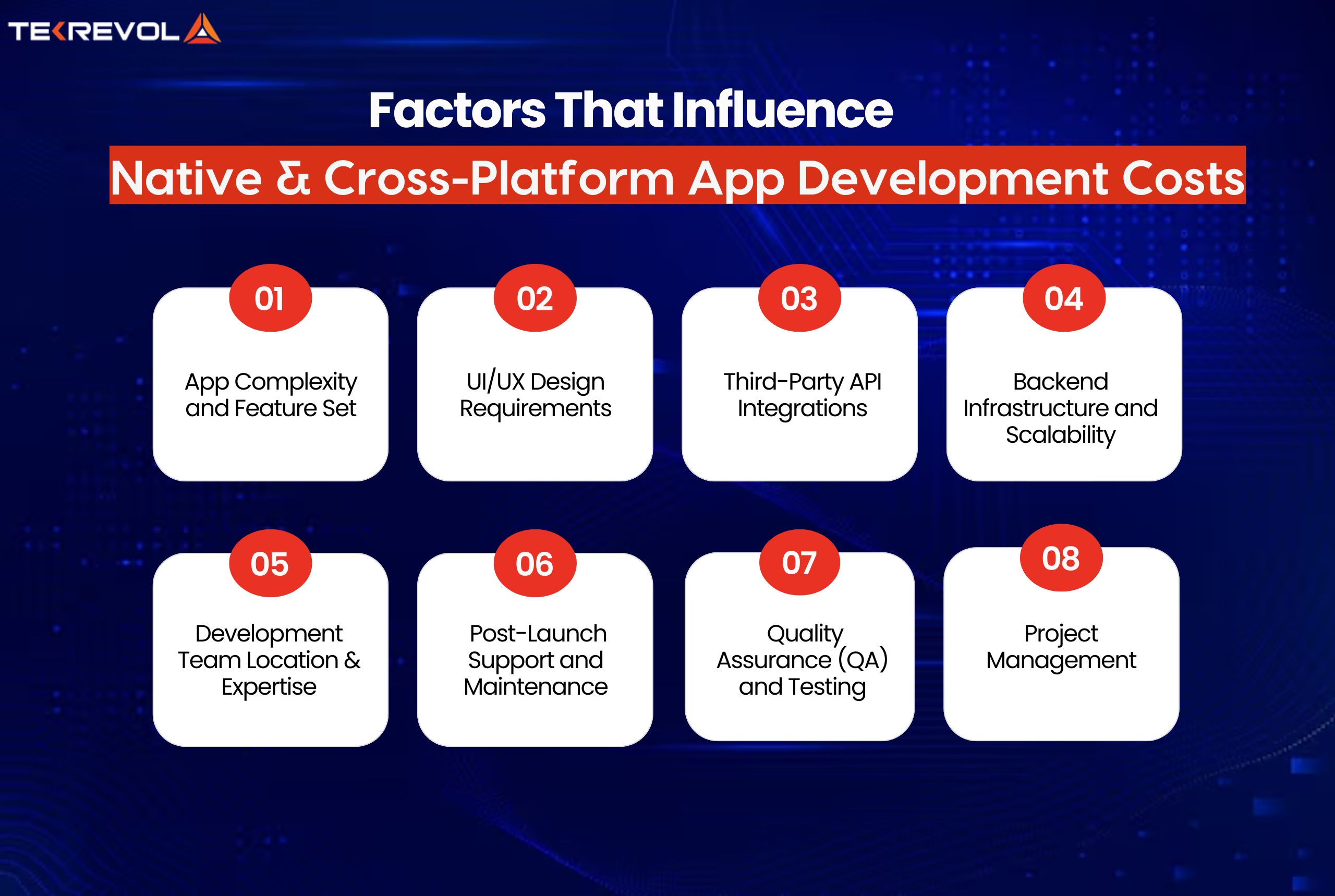
Choosing between native and cross-platform development is just the start. Several factors significantly impact your native vs cross-platform cost, helping you plan better and avoid surprises.
1. App Complexity and Feature Set
Feature complexity is the biggest cost driver. The more advanced your app, the higher the cross-platform vs native development cost.
Examples of expensive features:
- Artificial Intelligence & Machine Learning integration
- Augmented/Virtual Reality features
- Real-time messaging or video calling
- In-app payment systems and digital wallets
- GPS and location services
- Custom animations and motion graphics
- Complex backend with role-based user management
Average cost of a feature-packed app: $80,000 – $250,000+
2. UI/UX Design Requirements
Design is absolutely the most important aspect when it comes to user interaction and retention. The UI/UX design’s level of complexity and sophistication can significantly impact your user retention and native vs cross-platform cost budget.
| Design level | Features | Estimated cost |
| Basic UI | Simple layouts, standard components | $5,000 – $15,000 |
| Mid-Level UI | Custom graphics, interactive elements, smooth transitions | $20,000 – $50,000 |
| High-End UI | Gesture controls, AR features, real-time customization, pixel-perfect | $75,000+ |
3. Third-Party API Integrations
Apps are not often standalone. Integration with third-party services brings both value and expense.
Some common APIs are:
- Social media sign-ins (Google, Facebook, Apple)
- Payment gateways (Stripe, PayPal)
- Analytics platforms (Google Analytics, Mixpanel)
- Communication APIs (Twilio, Firebase)
- Maps and geolocation (Google Maps, Mapbox)
Each integration will take days or weeks, based on complexity and platform demands.
4. Backend Infrastructure and Scalability
A solid backend app development is essential to handle logic, store data, perform user authentication, and scale, which directly influences native vs cross-platform cost.
Drivers of backend expense:
- Custom-developed vs. BaaS (Backend-as-a-Service)
- Requirements for real-time data processing
- Security measures and compliance (HIPAA, GDPR)
- Cloud hosting providers (AWS, Azure, Google Cloud)
Backend development can contribute 20-40% of the overall project expense.
5. Development Team Location & Expertise
Developer rates vary greatly by geography and skill level. Your react native app development cost can fluctuate drastically depending on where your development team is located.
| Region | Hourly Rate (Average) |
| North America / Western Europe | $47 – 150+ |
| Eastern Europe / Latin America | $30 – $70 |
| India / Southeast Asia | $15 – $50 |
6. Post-Launch Support and Maintenance
Application development does not conclude with launch. Regular support becomes crucial to maintain performance, compatibility with OS updates, and user satisfaction.
Common maintenance activities:
- Bug fixing
- Security patches
- Performance tuning
- New feature releases
- OS and device compliance
The average annual maintenance budget is between 15% to 25% of the original development expense.
7. Quality Assurance (QA) and Testing
It is essential to ensure that your app performs seamlessly across various devices and conditions. QA testing can never be an afterthought.
Phases of testing might involve:
- Functional testing
- UI/UX testing
- Performance testing
- Device and OS compatibility testing
- Security testing
Testing might comprise 15-20% of the overall development expenses.
8. Project Management
Every successful app has good project management behind it. The process of coordination between design, development, QA, and business teams demands active supervision. Therefore.
Agile process, sprint planning, and communication tools (e.g., Jira, Trello, Slack) are frequently involved. Whether outsourced or included in agency fees affects the native vs cross-platform cost.
How to Decide Between Native and Cross-Platform App Development? Key Considerations
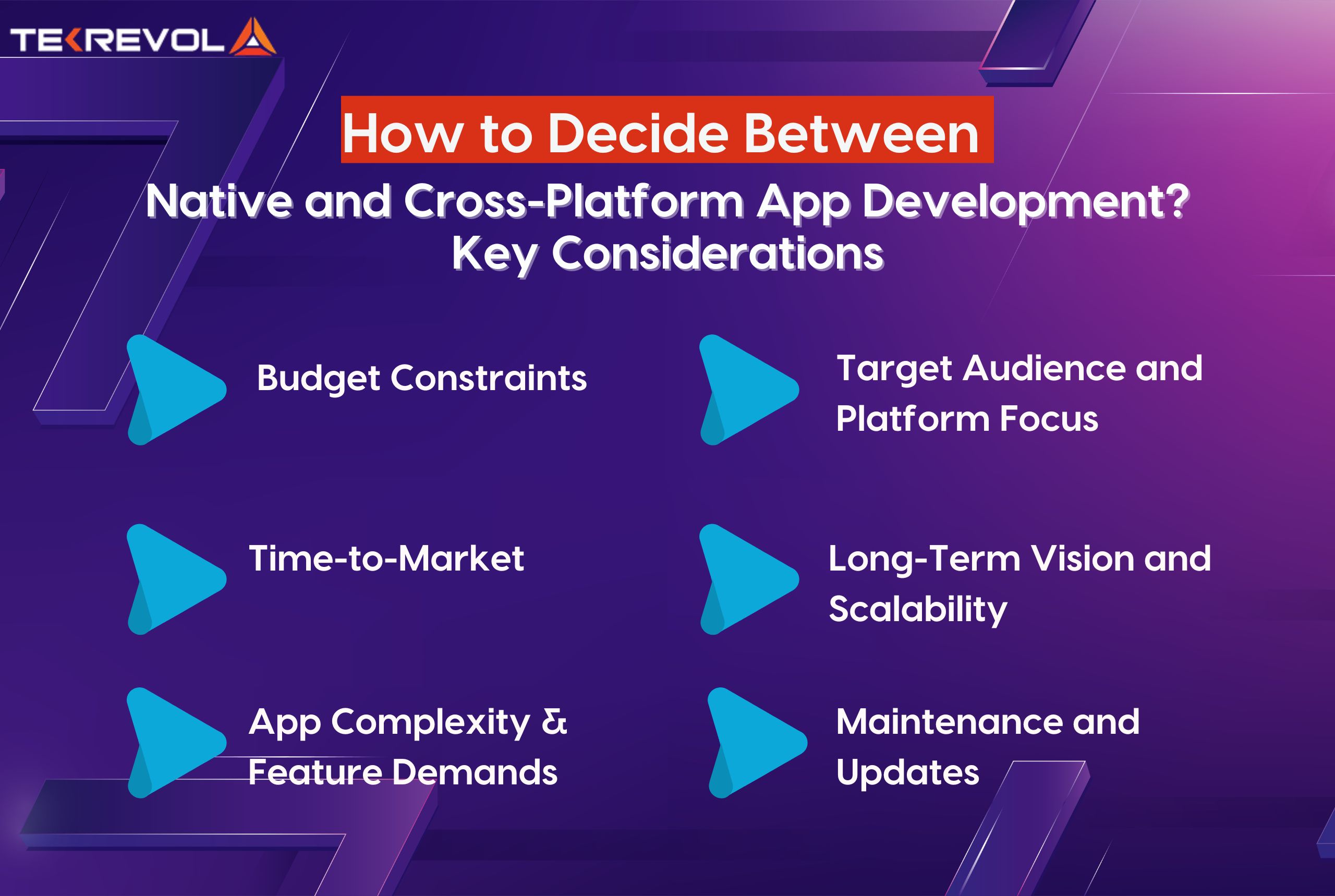
The choice between native and cross-platform development mainly affects your native vs cross-platform cost. Here’s what to consider to pick the right approach for your app:
1. Budget Constraints
Higher Budget? If budget permits, native development can provide best-in-class performance and an optimized user experience that’s specific to each platform. Native apps usually excel with silky-smooth animations, quicker response rates, and more seamless integration with device features.
Tight Budget? Cross-platform development saves money. Since you’re writing one codebase for iOS and Android, you pay considerably less for development time and maintenance, typically getting 30-40% off your budget versus native.
2. Time-to-Market
If you’re on a tight deadline to go live on both iOS and Android at the same time, cross-platform is typically the quickest way. Shared codebase results in briefer development cycles and more streamlined rollouts of updates.
Native applications tend to be longer in development because you must have different teams working on each platform, doubling the development and testing efforts.
3. App Complexity & Feature Demands
Complex apps with features such as augmented reality (AR), virtual reality (VR), high-end GPU processing, or direct hardware access perform better when developed natively. Native environments offer direct access to device features without middleware constraints.
Cross-platform frameworks have advanced significantly, but when your app is built primarily around cutting-edge or platform-specific features, native app development tends to make your app more stable and performant.
4. Target Audience and Platform Focus
Since your user base is focused so greatly on a single platform (say, 80% iOS users), native development enables you to customize the experience to exactly that ecosystem’s design guidelines and user expectations.
But if you want to achieve maximum reach across various user bases, cross-platform app development is a good decision. It provides uniform functionality for both iOS and Android, so you don’t lose any potential users.
5. Long-Term Vision and Scalability
Many startups and companies that release MVPs prefer cross-platform development because it allows them to test their ideas quickly and at a low cost.
If your application grows and needs more advanced features or to be optimized for specific platforms, resorting to native might bring better and more enjoyable experiences for users.
6. Maintenance and Updates
Cross-platform apps make maintenance easier since a single codebase translates to less to update, and bug patches apply across all platforms at once.
Native apps, although possibly more solid, necessitate parallel streams of maintenance, which add continually rising costs and resource demands.
Native vs Cross-Platform: Which Should You Choose?
Match your choice to your actual constraints, not to what sounds more impressive. Use this scorecard as a starting point:
| Your Situation | Recommended Approach |
| Tight budget, need to launch fast | Cross-platform |
| Building an MVP to test an idea | Cross-platform |
| Need both iOS and Android on day one | Cross-platform |
| Performance-heavy app (games, AR/VR) | Native |
| Deep hardware integration required | Native |
| Large budget, long-term product plan | Native |
| 80%+ of users on one platform | Native |
Many startups and companies building an MVP start cross-platform to test their idea cheaply, then move parts of the app to native later if performance demands it. That staged approach is usually the smartest way to control cost without limiting where you can grow.
How TekRevol Helps You Choose the Right Development Approach
Choosing between native and cross-platform development isn’t just a technical decision; it’s a business decision that affects your budget, launch timeline, maintenance costs, and long-term scalability. The challenge is knowing which approach delivers the best value for your specific product, not which option is generally cheaper.
At TekRevol, we build both native and cross-platform applications, giving our clients objective recommendations based on their goals, user requirements, and growth plans. Whether you’re validating an MVP, launching a consumer app, or building an enterprise platform, our team helps you select the right technology stack before development begins.
From project discovery and cost estimation to design, development, testing, and post-launch support, we help businesses avoid unnecessary development costs while building products that are ready to scale. The result is a development strategy aligned with your budget today and your growth goals tomorrow.
Ready to Get a Real Cost Estimate for Your App?
Talk to our team that can scope your actual project and give you a number based on what your app really needs.
Book My Free Consultation →


![How to Build Real-Time Tracking On-Demand App [2026 Guide]](https://d3r5yd0374231.cloudfront.net/images-tek/uploads/2026/07/Featured-Image-3-400x225.webp)


