



- Most education apps cost between $35,000 and $250,000, with complexity driving the gap more than platform choice.
- A lean MVP takes about 3 to 4 months; a full learning platform with live classes takes 9 to 12.
- COPPA’s amended rule reached full compliance on April 22, 2026, adding genuine budget weight to kids’ apps.
- Your region changes your rate more than your scope: roughly $25 per hour in Asia versus $150 in North America.
- Hidden costs like hosting, store commissions, and content licensing add 25% to 40% over your first year.
- Cutting scope beats cutting quality; a focused MVP protects both your budget and your launch date.
Ask five agencies what an education app costs and you’ll get five wildly different numbers. We’ve seen quotes for the same brief land at $30,000 and $300,000 in the same week. Nobody’s lying. It’s just that “education app” covers everything from a flashcard tool to a district-wide platform with live video and grade sync.
So here’s the honest answer up front. In 2026, a working education app costs roughly $35,000 to $250,000, and where you land depends on complexity, feature depth, compliance load, and who’s building it.
This guide pulls that number apart: cost by complexity, by app type, by feature, and by region, plus timelines, compliance spend, and the hidden costs most budgets miss. We build these systems every day through our education software development services, so the ranges below come from real scoping work, not a template.
What Is the Cost to Build an Education App by Complexity?
The cost to build an education app by complexity ranges from $35,000 for a simple single-purpose app, to $80,000 to $150,000 for a mid-tier platform with user accounts and content management, up to $250,000 or more for an enterprise learning system.
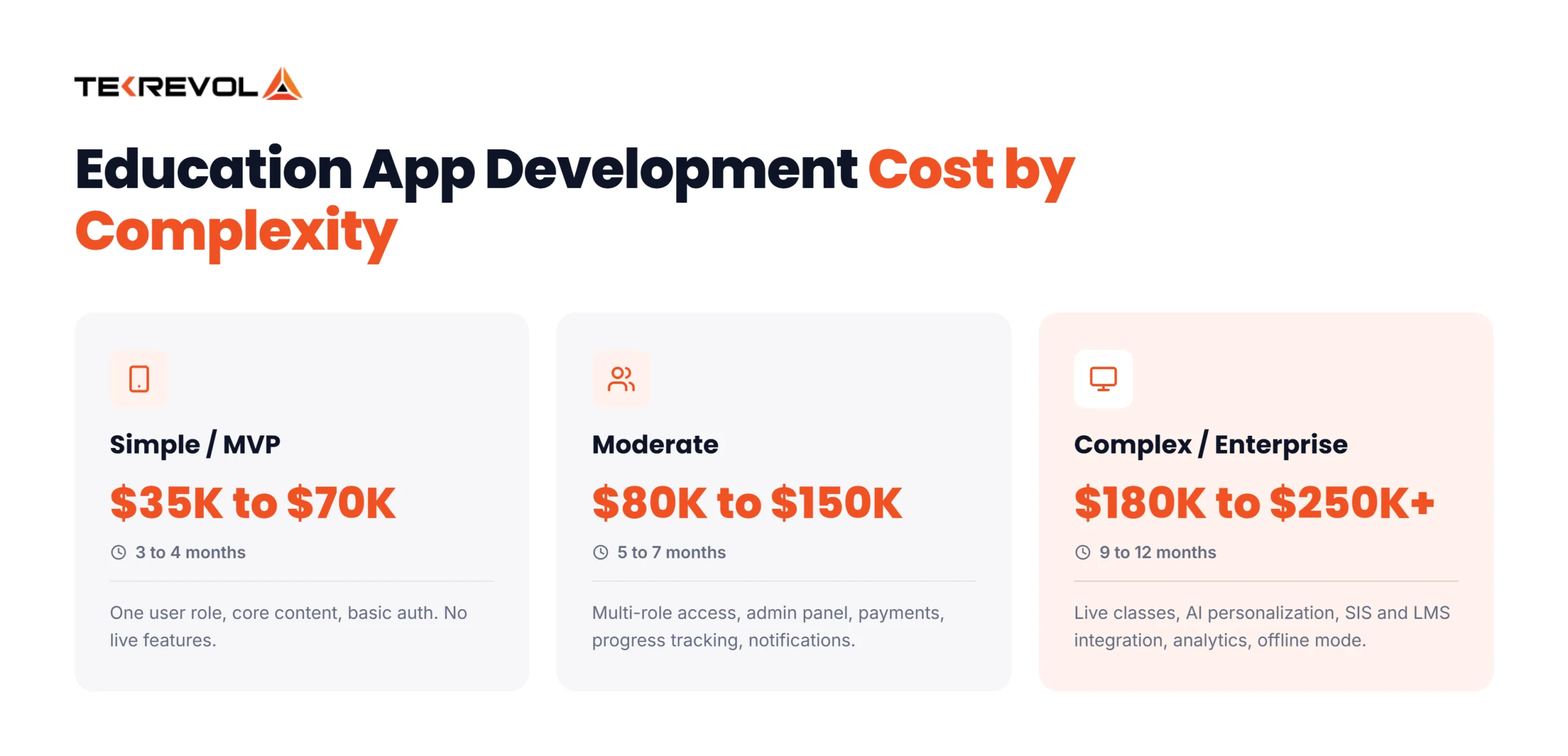
| Complexity tier | What you get | Cost range | Timeline |
| Simple / MVP | One user role, core content, basic auth, no live features | $35,000–$70,000 | 3–4 months |
| Moderate | Multi-role access, admin panel, payments, progress tracking, notifications | $80,000–$150,000 | 5–7 months |
| Complex / Enterprise | Live classes, AI personalization, SIS/LMS integration, analytics, offline mode | $180,000–$250,000+ | 9–12 months |
Complexity is the biggest lever on your budget. It isn’t about how the app looks. It’s about how many moving parts have to talk to each other without breaking.
A moderate app introduces the second user type, and that’s where the price jumps. Now you need an admin panel, a teacher view, a student view, progress tracking, payments, and a backend that keeps all three in sync.
A complex app adds live classes, smart learning paths, links to school systems, and full offline use. Each one is a system of its own, not a feature.
Not sure which tier your idea actually falls into?
Book a free scoping session and we'll turn your wish list into a real number before you spend a dollar.
Book Your Free Scoping Session →2026 Education Apps Market At A Glance
The 2026 education apps market is large, competitive, and still growing. Statista projects global education app revenue to reach $29.69 billion in 2026, up 10.4% year over year. That growth shows the market can support new products, but competition remains intense.
- $6.4B in consumer spending: Education apps generated $6.4 billion in 2025, with 1B+ downloads. Business of Apps
- 412,000+ apps: Roughly 412,000 education apps compete across major app stores. Business of Apps
- AI is accelerating: The AI in education market is projected at $11.4B in 2026, growing to $57.2B by 2033. Grand View Research
- Top apps dominate: Duolingo alone generated about $1B in revenue and 172M downloads.
With hundreds of thousands of competing apps, differentiation needs to be built into the product, not added through advertising later. That can increase upfront development costs, but a focused niche and strong value proposition can make the investment more worthwhile.
Education App Development Cost by Types
Types of education apps fall into three broad families: apps for learners, apps for teachers and administrators, and platforms serving both. Learner apps typically cost $30,000 to $120,000, teacher and admin tools $25,000 to $90,000, and full two-sided platforms $120,000 to $400,000.
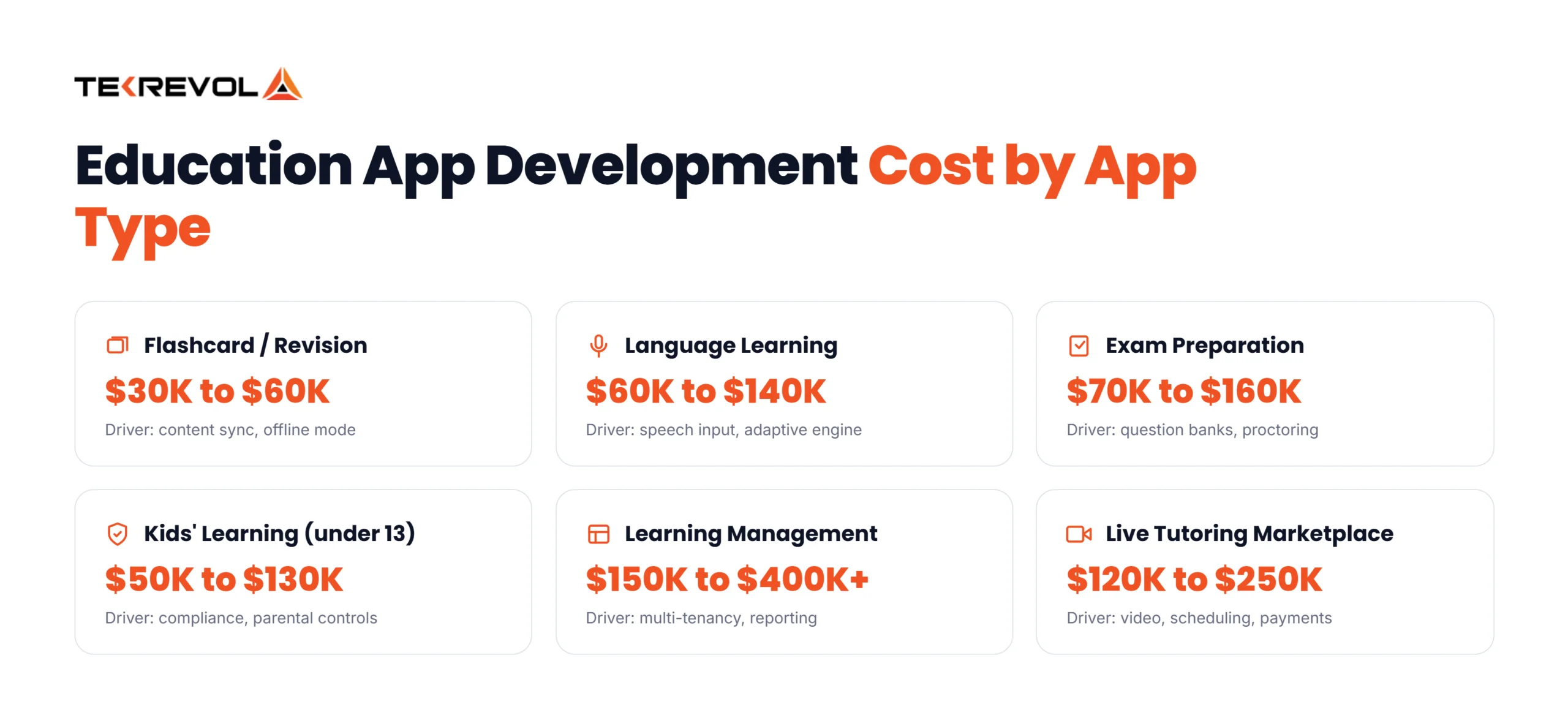
The type you pick shapes your cost more than almost any other early call. Each one carries a different amount of backend weight.
Language apps look simple and aren’t. The lessons are easy. The review engine, streak logic, speech input, and content pipeline are not. Exam prep apps carry big question banks. Learning management systems carry the lot.
| App type | Primary user | Typical cost | Main cost driver |
| Flashcard/revision app | Student | $30,000–$60,000 | Content sync, offline mode |
| Language learning app | Student | $60,000–$140,000 | Speech recognition, adaptive engine |
| Exam preparation app | Student | $70,000–$160,000 | Question banks, analytics, proctoring |
| Kids’ learning app (under 13) | Child + parent | $50,000–$130,000 | Compliance, animation, parental controls |
| Classroom management tool | Teacher | $25,000–$70,000 | Roster sync, attendance, messaging |
| Grading & assessment tool | Teacher | $40,000–$90,000 | Rubric logic, SIS integration |
| Learning management system | Institution | $150,000–$400,000+ | Multi-tenancy, permissions, reporting |
| Live tutoring marketplace | Two-sided | $120,000–$250,000 | Video infrastructure, scheduling, payments |
| AR/VR immersive learning | Student | $90,000–$220,000 | 3D assets, device optimization |
Picking your type early saves real money. Still torn between a learner app and a school platform? Our guide to educational app development walks the trade-offs feature by feature.
What Does a Feature-by-Feature Education App Cost Breakdown Look Like?
A feature-by-feature education app cost breakdown starts around $2,000 for basic authentication and climbs past $40,000 for AI-driven personalization. Core features typically consume 40% of the budget; advanced features, integrations, and QA absorb the rest.
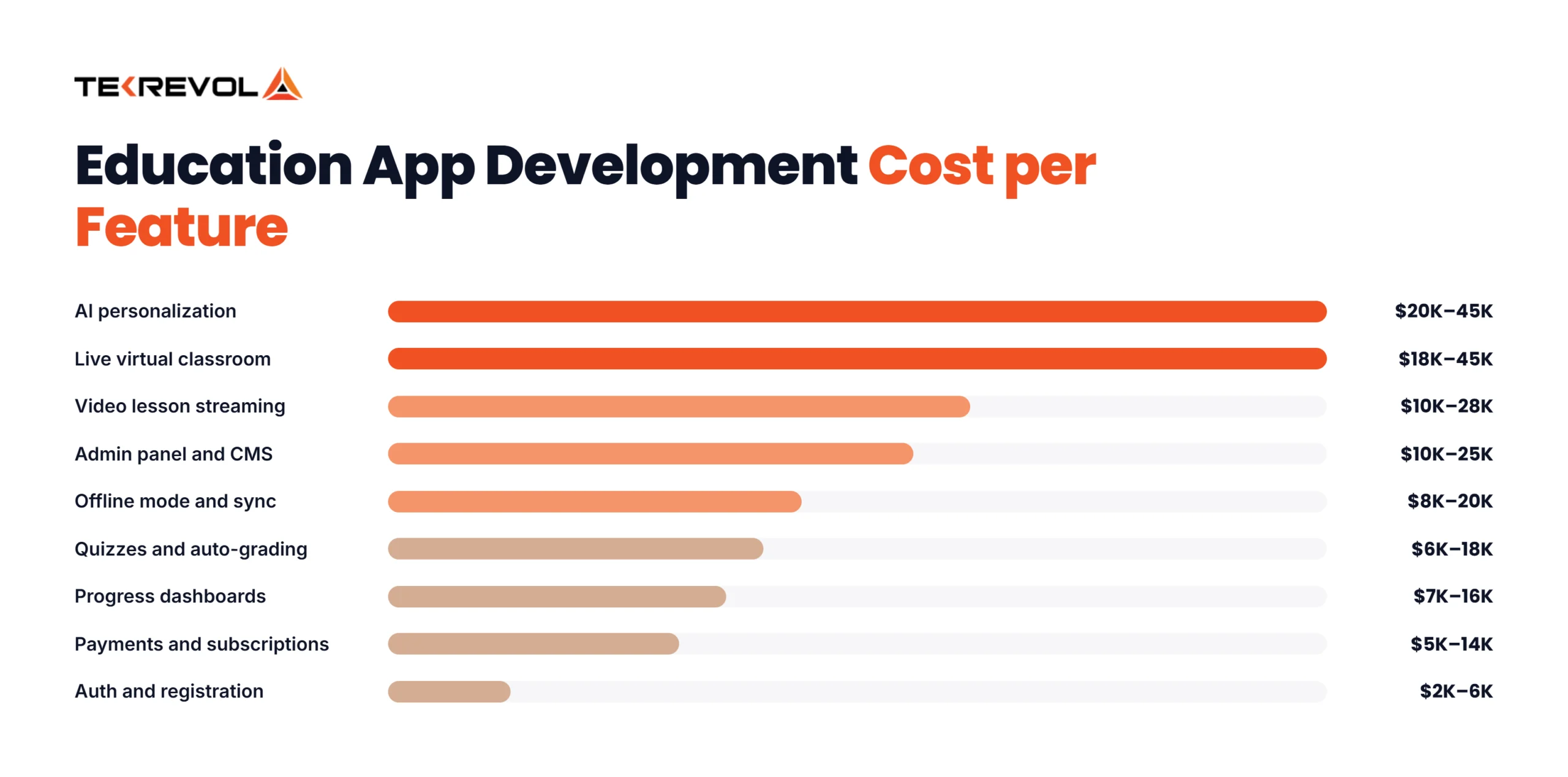
Feature prices don’t just stack up. Adding video calls to an app that already has live chat costs less than adding it cold, because the plumbing is shared.
| Feature | Cost range | Build time | Notes |
| User registration & authentication | $2,000–$6,000 | 40–90 hrs | Social login adds ~$1,500 |
| Course catalogue & search | $5,000–$12,000 | 90–200 hrs | Filtering complexity drives cost |
| Video lesson streaming | $10,000–$28,000 | 180–400 hrs | CDN and DRM add ongoing spend |
| Live virtual classroom | $18,000–$45,000 | 300–700 hrs | Third-party SDK cuts this substantially |
| Quizzes & auto-grading | $6,000–$18,000 | 120–300 hrs | Question types drive scope |
| Progress tracking & dashboards | $7,000–$16,000 | 130–280 hrs | Per-role dashboards multiply cost |
| Gamification (points, badges, streaks) | $6,000–$15,000 | 110–260 hrs | Often underestimated |
| AI personalization / adaptive paths | $20,000–$45,000 | 350–800 hrs | Model choice changes everything |
| Payments & subscriptions | $5,000–$14,000 | 90–240 hrs | Multi-currency adds cost |
| Offline mode & sync | $8,000–$20,000 | 150–350 hrs | Conflict resolution is the hard part |
| Admin panel & CMS | $10,000–$25,000 | 180–420 hrs | Scales with role count |
| Push notifications & messaging | $3,000–$9,000 | 60–160 hrs | In-app chat costs more |
One rule from our own project data. Whatever your core feature list costs, add 60% on top for design, QA, project management, and the wiring work that only shows up once the parts are joined.
How Long Does Education App Development Take at Each Stage?
Education app development takes about 3 to 4 months for an MVP and 9 to 12 months for a full platform. Discovery runs 2 to 4 weeks, design 3 to 6 weeks, development 10 to 30 weeks, QA 3 to 8 weeks, and launch 1 to 2 weeks.
Time and money move together here. Every extra week of build time costs you a week of team rate. Padding the timeline pads the budget.
| Stage | Duration | Share of budget | What actually happens |
| Discovery & requirements | 2–4 weeks | 5–10% | Feature mapping, tech decisions, compliance scoping |
| UX/UI design | 3–6 weeks | 10–15% | Wireframes, prototypes, design system |
| Backend & API development | 6–16 weeks | 25–30% | Database, auth, business logic, integrations |
| Frontend/app development | 8–20 weeks | 25–30% | Screens, state, offline handling |
| QA & testing | 3–8 weeks | 10–15% | Functional, device, load, accessibility |
| Deployment & store submission | 1–2 weeks | 3–5% | Store review, monitoring, rollout |
Backend and frontend overlap in practice. A good team runs both at once from about week six. That’s why the total is shorter than the stages added up.
The stage teams skip most often is discovery. Two weeks spent nailing the brief saves six weeks of rework later. Rework is the priciest time you will ever buy.
Worried your timeline will slip before you've even started?
We'll break your build into sprints and show you what ships at each stage and what it costs. No strings, no sales pitch.
Request Your Free Development Roadmap →How Much Does Education App Development Cost in Different Regions?
Education app development cost in different regions varies by up to six times for identical work. North American teams charge $100 to $180 per hour, Western Europe $70 to $140, Eastern Europe $45 to $80, Latin America $40 to $70, and South Asia $25 to $45.
Rate is the most misused number in this whole talk. A cheap hourly rate on a team that needs three tries to ship a feature isn’t cheap.
| Region | Hourly rate | Same mid-tier app (~1,200 hrs) | Practical trade-off |
| USA & Canada | $100–$180 | $120,000–$216,000 | Best timezone overlap, highest cost |
| Western Europe | $70–$140 | $84,000–$168,000 | Strong GDPR fluency |
| Eastern Europe | $45–$80 | $54,000–$96,000 | Good balance of cost and seniority |
| Latin America | $40–$70 | $48,000–$84,000 | US timezone alignment |
| South Asia | $25–$45 | $30,000–$54,000 | Lowest rate, needs a strong process |
| Middle East (UAE, KSA) | $50–$100 | $60,000–$120,000 | Regional compliance knowledge |
What we tell most clients is to blend the two. Keep product, architecture, and legal calls close to your market. Run the build work where rates are lower. That lands 30% to 45% under a full onshore build, without the handoff pain of a full offshore one.
Security and Compliance Cost for an Education App
Security and compliance requirements for an education app add $15,000 to $60,000 to development, plus $8,000 to $25,000 annually. Apps serving children under 13 or US school data carry the heaviest load because COPPA and FERPA both apply.
This is the line item that shocks people most. And 2026 made it heavier.
The FTC’s amended COPPA Rule reached its full compliance deadline on April 22, 2026. As documented by privacy counsel at Hunton Andrews Kurth, the rule now asks for separate parental consent before you share a child’s data with third parties.
It also sets new limits on how long you keep data, and widens what counts as personal data. If your app touches under-13 users, that’s not a checkbox. It’s architecture.
| Requirement | One-time cost | Annual cost | When it applies |
| COPPA compliance (under-13 users) | $8,000–$25,000 | $3,000–$8,000 | Kids’ apps, consumer edtech |
| FERPA alignment (US student records) | $6,000–$18,000 | $2,000–$6,000 | K-12 and higher-ed institutions |
| GDPR / UK GDPR | $5,000–$15,000 | $2,000–$5,000 | Any EU or UK users |
| Data encryption & secure storage | $4,000–$12,000 | $1,500–$4,000 | Effectively all education apps |
| Role-based access control | $5,000–$14,000 | Included in maintenance | Multi-role platforms |
| Accessibility (WCAG 2.2 AA) | $6,000–$16,000 | $1,000–$3,000 | Public sector, most institutions |
| Penetration testing & audits | $5,000–$15,000 | $4,000–$10,000 | Anything handling student data |
Bolting this on after launch costs two to four times what building it in costs. We’ve watched teams learn that the hard way.
What Hidden Costs Do Education App Budgets Usually Miss?
Hidden costs in education app budgets include app store commissions, cloud hosting, content licensing, third-party API fees, annual maintenance, and marketing. Together, these typically add 25% to 40% of your development cost during the first year alone.
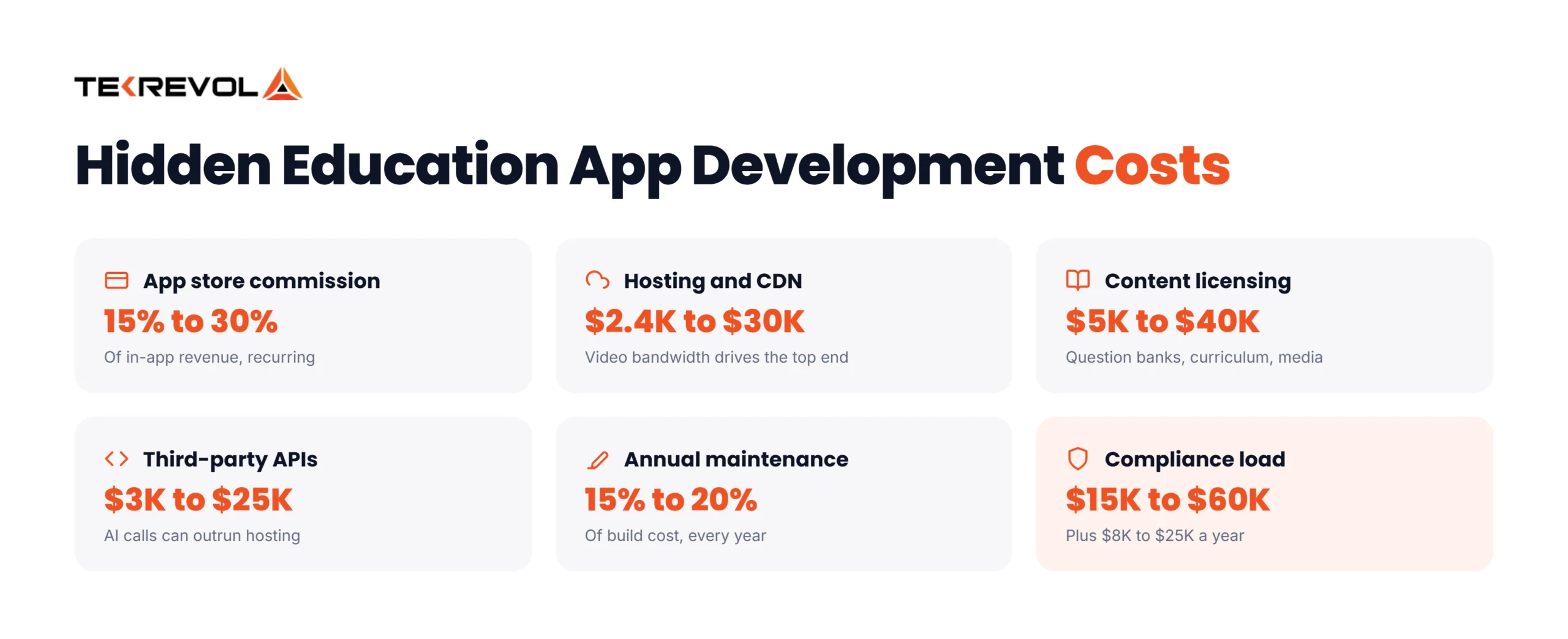
Build cost is the one people plan for. These are the ones that land after launch, when the invoice is paid and the budget is closed.
App store cuts
Apple and Google both take a slice of in-app revenue. Per RevenueCat’s 2026 write-up of both programs, Apple’s Small Business Program cuts the rate from 30% to 15% for developers under $1 million a year. Google Play charges 15% on the first $1 million, and 15% on all auto-renewing subscriptions from day one. Above that line, plan for 30%.
Cloud hosting and streaming
A small education app runs $200 to $800 a month. Add video and that changes fast. Bandwidth for 10,000 active video learners can hit $2,000 to $6,000 a month.
Content licensing
Curriculum, question banks, stock media, and fonts all carry fees. Licensed question banks alone can run $5,000 to $30,000 per subject.
Outside APIs
Video kits, speech input, payments, and AI model calls are all priced by usage. An AI tutor at scale can cost you more each month than your hosting does.
Yearly upkeep
Budget 15% to 20% of build cost each year. That covers OS updates, security patches, bug fixes, and small tweaks. Skipping it is how apps quietly rot.
Marketing
Education app installs cost $2 to $6 per user in busy categories. A 10,000-user launch is a real marketing budget, not a rounding error.
| Hidden cost | First-year impact | Recurring? |
| App store commission | 15%–30% of in-app revenue | Yes |
| Cloud hosting & CDN | $2,400–$30,000 | Yes |
| Content licensing | $5,000–$40,000 | Often |
| Third-party API usage | $3,000–$25,000 | Yes |
| Maintenance & updates | 15%–20% of dev cost | Yes |
| User acquisition | $20,000–$60,000 | Yes |
How Can You Reduce Education App Development Costs Without Cutting Quality?
You can reduce education app development costs without cutting quality by shipping a focused MVP, choosing cross-platform, buying infrastructure instead of building it, using a blended delivery team, and locking requirements before development starts. Combined, these typically save 30% to 45%.
Cost cutting done badly just moves the bill to next year. Here’s what works.
Ship an MVP that does one thing brilliantly
Not a thin version of everything. One full, polished flow. This alone cuts first-round spend by 40% to 60%, and gives you real user data before you spend the rest.
Go cross-platform unless you have a hard reason not to
Flutter and React Native cover both stores from one codebase. The saving repeats every year, because upkeep is one codebase too.
Buy the hard parts
Video calling, login, payments, and search are solved problems. A live-class kit costs a fraction of building video from scratch, and it works on day one.
Reuse what’s proven
Teams that have shipped education apps before don’t start from zero on roster sync, user roles, or offline clashes. That know-how is a discount, not a premium.
Lock the brief, then build
Mid-sprint changes are the priciest thing in software. A fixed discovery phase costs a few thousand and saves tens of thousands.
Want a step-by-step view of the build itself? Our walkthrough on how to create an educational app covers what to include in phase one and what to push back.
Successful Education Apps Examples & Their Cost Estimates
Khan Academy-style content library cost $60,000; $250,000-plus for a Duolingo-style adaptive platform. These are rebuild estimates for comparable core functionality, not the original companies’ actual multi-year spend.
Duolingo didn’t spend $200,000 building Duolingo. They’ve spent years and employed hundreds of engineers. What follows is what a similar app costs to build today.
| Comparable app | Core functionality to replicate | Rebuild estimate | Timeline |
| Khan Academy style | Video library, progress tracking, quizzes, free access | $60,000–$110,000 | 4–6 months |
| Quizlet style | Flashcards, study modes, sharing, search | $50,000–$95,000 | 3–5 months |
| Duolingo style | Adaptive lessons, streaks, speech recognition, gamification | $150,000–$260,000 | 8–12 months |
| Coursera style | Course marketplace, video, certificates, payments | $130,000–$240,000 | 7–11 months |
| Google Classroom style | Assignments, roster, grading, notifications | $90,000–$170,000 | 6–9 months |
| Outschool style | Live class marketplace, scheduling, video, two-sided payments | $140,000–$250,000 | 8–12 months |
Two patterns show up every time. Anything with live video or smart learning paths starts above $130,000. Anything content-first, with no live features, can ship under $110,000.
Why Choose TekRevol for Education App Development?
TekRevol has delivered education products including Gear Up, Schology, Project Impact, and UNA, with a focus on building scalable learning experiences.
Our partners choose us for app development for measurable product outcomes, transparent pricing, and compliance built into the project from day one.
Here’s what sets our education projects apart:
- Compliance from the start: COPPA, FERPA, GDPR, and access requirements are considered during discovery and reflected in the estimate.
- Feature-level pricing: Get a clear breakdown of what each feature costs, so you can cut or prioritize scope with confidence.
- Built for growth: Modular architecture and shared codebases make it easier to add features without rebuilding the product.
TekRevol holds a 4.8/5 rating across 83 verified Clutch reviews, with design work recognized by the Horizon Interactive Awards and dotCOMM Awards. The goal is simple: give you a learning product that’s practical to launch, easier to scale, and clear to budget.
Ready to put a real number on your education app?
We'll Bring us your feature list. We'll send back a line-by-line estimate with compliance priced in and a timeline mapped out. No strings attached.
Schedule a Free App Consultation →


