



- Blockchain app development costs $30,000 to $500,000+ in 2026, depending on chain, complexity, and compliance.
- The initial build is only about 30% to 40% of your real three-year blockchain spend.
- Smart contract audits run $5,000 to $250,000 and belong in every quote as a separate line.
- Chain choice moves your build cost by up to 2x before a single feature gets added.
- Regulated industries like finance and healthcare add 15% to 30% on top of base development.
- A quote without audit, node, and gas line items is not a real quote yet.
Two vendors can quote the same blockchain project at $45,000 and $260,000, and both estimates can be reasonable. The difference usually comes down to what’s actually included: blockchain selection, smart contract complexity, integrations, security audits, compliance, and post-launch infrastructure.
Blockchain app development cost in 2026 can range from around $30,000 for a lean MVP to $500,000+ for a complex enterprise platform. This guide breaks down what drives that range, including costs by use case, development phases, hidden operating expenses, and a practical formula for estimating your own budget.
If you’re comparing vendors, you need more than a development quote. This guide covers the costs that can surface after launch and the questions worth asking before you sign. It also draws on TekRevol’s experience as a blockchain development company working across multiple industries and blockchain use cases.
How Much Does Blockchain App Development Cost in 2026?
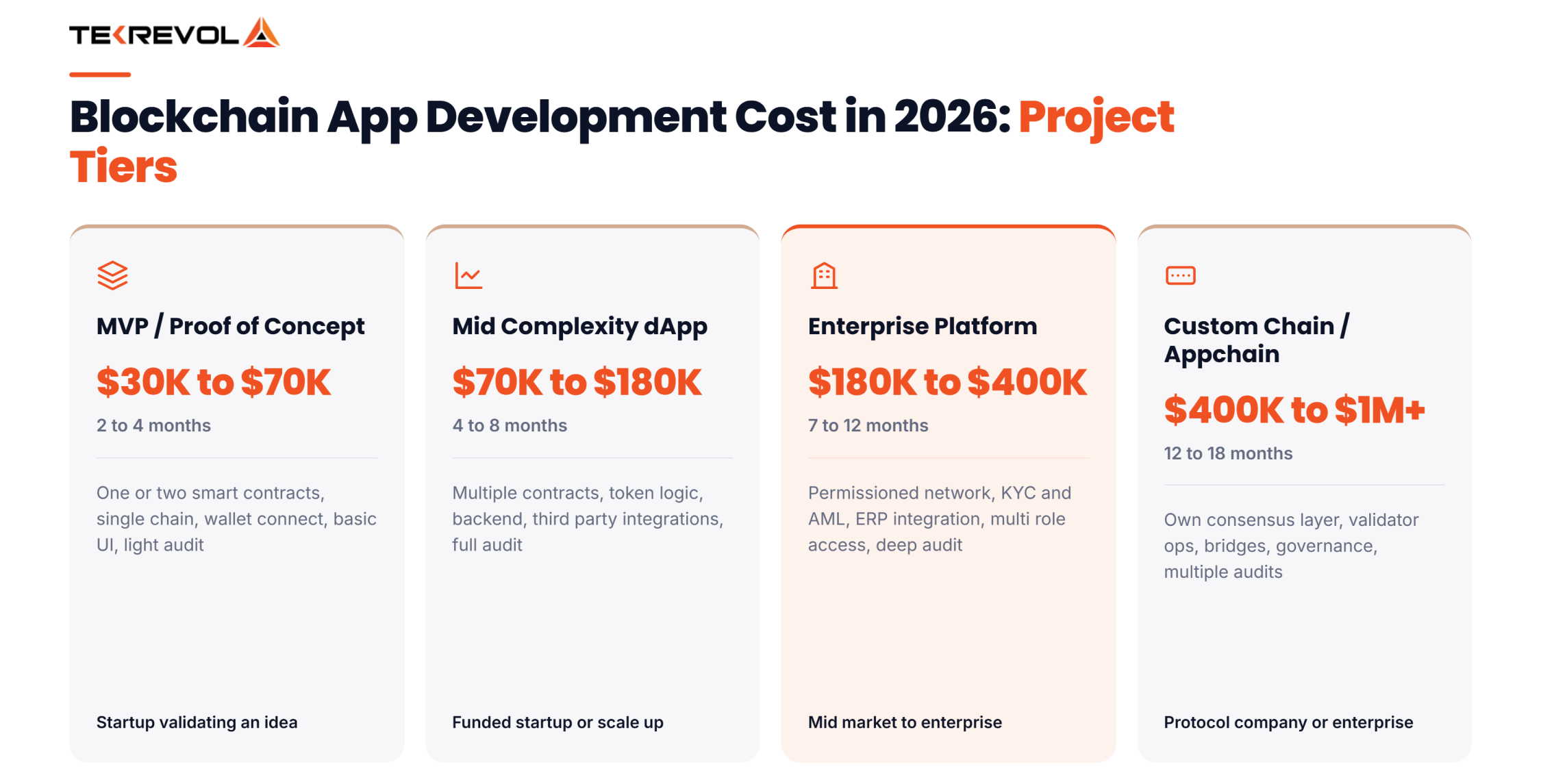
Blockchain app development costs between $30,000 and $500,000+ in 2026. A simple MVP with basic smart contracts lands at $30,000 to $70,000. Mid-complexity dApps run $70,000 to $180,000. Regulated enterprise platforms with custom chains start around $200,000 and climb from there.
That’s the short answer. Now the useful part: what actually puts you in each band.
| Tier | Cost range | Timeline | What you get | Typical buyer |
| MVP / Proof of concept | $30,000–$70,000 | 2–4 months | One or two smart contracts, single chain, wallet connect, basic UI, light audit | Startup validating an idea |
| Mid-complexity dApp | $70,000–$180,000 | 4–8 months | Multiple contracts, token logic, backend, third-party integrations, full audit | Funded startup or scale-up |
| Enterprise platform | $180,000–$400,000 | 7–12 months | Permissioned network, KYC/AML, ERP integration, multi-role access, deep audit | Mid-market to enterprise |
| Custom chain / appchain | $400,000–$1M+ | 12–18 months | Own consensus layer, validator ops, bridges, governance, multiple audits | Protocol company or large enterprise |
Two things worth flagging about this table. First, the timelines aren’t padding. Smart contract work is slow because it’s unforgiving, and you cannot patch a deployed contract the way you patch an API.
Second, every band above assumes one production-grade audit. Skip it, and you’ve just moved your cost to a different column called “incident response.”
If you’re comparing this against a general app budget, our guide to blockchain application development walks through the build process itself in more detail.
Not sure which cost band your idea falls into?
Get a free 30-minute scoping call to map your concept to a real number, including audit and infrastructure costs.
Book Your Free Blockchain Scoping Call →Blockchain Market 2026
The blockchain market is growing rapidly, but market growth alone doesn’t tell you what your project will cost. Grand View Research estimates the global blockchain technology market at $57.7 billion in 2025, rising to $108.3 billion in 2026. Financial services account for 28.1% of revenue, while North America represents 37.2%.
Three market signals matter more when estimating your budget:
Interoperability is still expensive
Gartner expects 20% of monetary transactions to be programmable by 2030 but identifies fragmented standards and poor interoperability as key barriers. Apps connecting multiple chains or legacy financial systems may require significant custom integration.
Tokenization doesn’t guarantee liquidity
A July 2026 Forbes analysis found that 910 of 1,289 tokenized assets over $100,000 had zero weekly transfer activity. Building the token is only part of the investment; demand and liquidity also affect the overall business cost.
Smart contract audits can add substantial costs
Sherlock’s 2026 pricing reference puts smart contract audits at $5,000–$250,000+, depending on complexity. Simple ERC-20 audits may cost $5,000–$20,000, while complex DeFi audits can reach $40,000–$100,000+.
Your actual blockchain development cost depends more on architecture, integrations, security, and compliance than on overall market size.
What Factors Affect Blockchain App Development Cost?
The factors affecting blockchain app development cost break into six that actually move the number: chain choice, smart contract complexity, security and audit depth, compliance requirements, integration count, and team location. Everything else is noise around these six.
Let’s take them one at a time, because a couple of them behave differently than people expect.
Chain choice: the multiplier nobody quantifies
The blockchain network you choose directly affects development complexity, transaction costs, infrastructure, and integration requirements. To make these differences easier to account for in a budget, we use Polygon as a 1.0x baseline and apply a multiplier based on the selected chain and project requirements.
| Chain | Build multiplier | Why | Running cost |
| Polygon PoS | 1.0x | EVM, deepest Solidity talent pool | Very low gas |
| Base / Arbitrum / Optimism | 1.0x | EVM Layer 2s, same tooling | Very low gas |
| BNB Chain | 1.0x | EVM compatible | Low gas |
| Ethereum mainnet | 1.0x–1.1x | Same code, more caution required | Highest gas by far |
| Solana | 1.3x–1.5x | Rust, scarcer talent, different mental model | Low gas |
| Hyperledger Fabric | 1.4x–1.8x | Permissioned setup, node orchestration, no public tooling | No gas, but you host and run nodes |
| Cosmos SDK / custom appchain | 2.0x+ | You build the chain, then the app | Validator operations, ongoing |
The audit side backs this up with published numbers. Sherlock’s 2026 pricing reference lists a 25% to 40% premium for non-Solidity languages like Rust on Solana, and 30% to 45% for Cairo and Move. So the chain doesn’t just change your build. It changes what you pay to have that build checked.
Our practical read: unless you have a specific throughput or ecosystem reason, an EVM Layer 2 is the cheapest competent default in 2026. You get Solidity talent, mature tooling, cheap gas, and the widest pool of auditors who’ve seen your patterns before.
Smart contract complexity
Smart contract complexity is usually the largest single swing in a blockchain quote. A single ERC-20 token contract is a few thousand dollars of work. A lending protocol with liquidation logic, oracle dependencies, and upgradeable proxies is a different species entirely.
- What drives it up: external calls to other protocols, oracle integrations, upgradeability patterns, multi-signature governance, and anything involving pooled funds.
- What keeps it down: single-purpose contracts, well-trodden token standards, and off-chain computation wherever the chain doesn’t need to be involved.
Security and audit depth
Security cost scales with what’s at risk, not with your codebase size. Two contracts of identical length get priced differently if one holds $200 and the other holds $20 million. Auditors price risk exposure, and honestly, they should.
Sherlock’s data also notes that rush timelines add 20% to 40% to audit pricing. Booking your audit slot three months out is one of the cheapest savings available to you, and almost nobody does it.
Compliance requirements
Compliance is the quiet budget killer. KYC and AML for a financial product, HIPAA for health data, GDPR for European users, and securities rules for anything token-like. Each one adds design constraints, documentation, third-party tooling, and legal review.
Integrations
Every external system you connect to is a small project of its own. A payment processor, an ERP, a KYC provider, a custody solution, an existing user database. Budget each meaningful integration as its own scoped item rather than assuming it’s included.
Enterprise teams building on existing infrastructure should read our breakdown of how enterprises are using blockchain to build secure systems, because the integration surface is usually where enterprise budgets blow out.
Team location and structure
Rates vary widely by region, and blockchain talent is scarcer than general app talent everywhere.
| Region | Blended hourly rate | Same MVP would cost |
| North America | $100–$200 | $100,000–$200,000 |
| Western Europe | $70–$130 | $70,000–$130,000 |
| Eastern Europe | $45–$85 | $45,000–$85,000 |
| South Asia | $25–$55 | $25,000–$55,000 |
For context on what individual talent costs to hire directly, Built In’s 2026 US data puts the average blockchain developer base salary at $140,477, with total compensation averaging $157,824 and a reported range of $75,000 to $275,000.
What Is the Full Breakdown of Blockchain Development Costs?
The breakdown of blockchain development costs splits across six phases, and coding is only about 40% of it. Discovery takes 8% to 12%, design 8% to 12%, development 35% to 45%, audit 8% to 15%, QA 12% to 15%, deployment 5% to 8%.
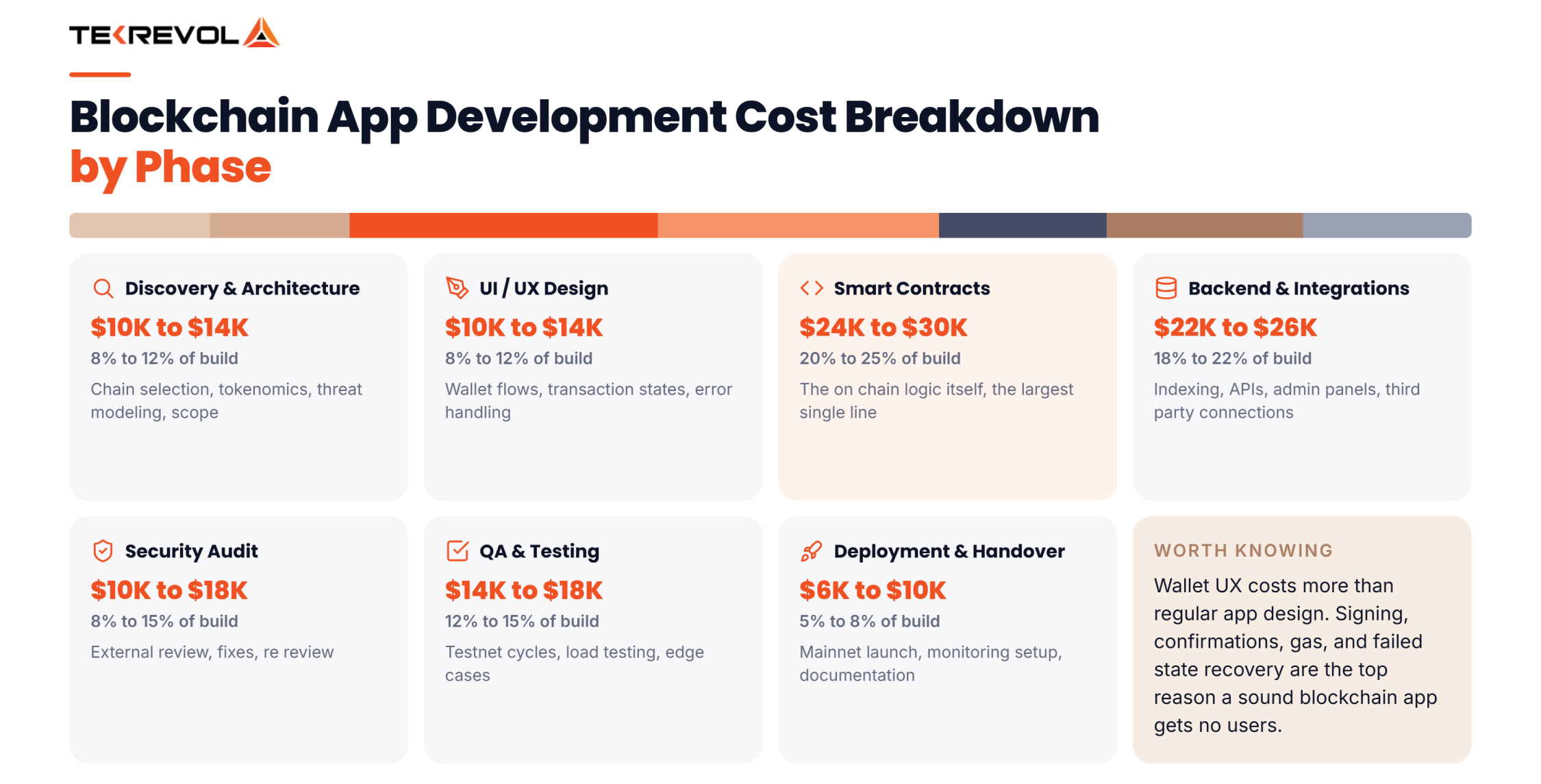
Here’s what that looks like against a real number. We’ve modeled it on a $120,000 mid-complexity dApp, which sits right in the middle of the band most funded startups land in.
| Phase | % of build | What happens here |
| Discovery and architecture | 8–12% | Chain selection, tokenomics, threat modeling, scope |
| UI/UX design | 8–12% | Wallet flows, transaction states, error handling |
| Smart contract development | 20–25% | The on-chain logic itself |
| Backend, frontend, integrations | 18–22% | Indexing, APIs, admin panels, third-party connections |
| Security audit + remediation | 8–15% | External review, fixes, re-review |
| QA and testing | 12–15% | Testnet cycles, load testing, edge cases |
| Deployment and handover | 5–8% | Mainnet launch, monitoring setup, documentation |
One detail that surprises people: wallet UX design costs more than regular app design. Users have to sign transactions, wait for confirmations, understand gas, and recover from failed states.
Designing that so a non-crypto user doesn’t rage-quit is genuinely hard work, and skimping there is the most common reason a technically sound blockchain app gets no users.
Blockchain Development Cost by Industry
Blockchain development cost by industry ranges from $50,000 in retail and logistics to $500,000+ in banking and government. The gap is almost entirely due to regulation. Industries that handle money, health records, or legal title pay a compliance premium that shows up in every phase.
| Industry | Typical range | Timeline | What drives the cost |
| Banking and fintech | $120,000–$500,000+ | 6–14 months | KYC/AML, securities rules, custody, core banking integration |
| Healthcare | $90,000–$300,000 | 6–12 months | HIPAA, consent management, EHR integration, permissioned access |
| Real estate | $80,000–$350,000 | 5–12 months | Title verification, securities treatment, escrow, legal review |
| Supply chain and logistics | $60,000–$250,000 | 4–10 months | Multi-party onboarding, IoT feeds, ERP integration |
| Gaming and Web3 | $50,000–$250,000 | 4–10 months | Token economies, marketplaces, high transaction volume |
| Insurance | $80,000–$280,000 | 5–11 months | Parametric triggers, oracles, claims integration, regulator sign-off |
| Retail and loyalty | $50,000–$150,000 | 3–7 months | Lightest compliance load, mostly integration work |
| Energy and utilities | $70,000–$250,000 | 5–11 months | Metering data, grid integration, settlement logic |
| Government and public sector | $150,000–$500,000+ | 9–18 months | Procurement, audit trails, accessibility, long approval cycles |
Emerging markets are a genuinely different cost picture, since infrastructure gaps change which problems are worth solving on-chain. We covered that in our piece on blockchain’s impact on app development in developing countries.
Budgeting a blockchain build in a regulated industry?
Compliance can quickly increase your blockchain budget. Get a free review to see which requirements affect your architecture and costs.
Get Your Free Compliance Cost Review →What Does Blockchain Development Cost by Use Case?
Blockchain development cost by use case starts near $15,000 for a standalone smart contract and reaches $400,000+ for a DeFi protocol. Use case matters more than industry, because it sets how much value sits on-chain and how much security you buy.
| Use case | Cost range | Timeline | Cost concentration |
| Standalone smart contract | $15,000–$40,000 | 3–8 weeks | Audit is most of it |
| Token launch (ERC-20 or equivalent) | $25,000–$60,000 | 4–10 weeks | Contract plus distribution logic |
| Crypto wallet | $60,000–$180,000 | 4–9 months | Key management, recovery, security |
| NFT marketplace | $50,000–$160,000 | 4–9 months | Minting, listings, royalties, storage |
| Blockchain game | $70,000–$300,000 | 5–12 months | Game build plus token economy plus marketplace |
| Supply chain traceability | $60,000–$250,000 | 4–10 months | Multi-party onboarding and integrations |
| Asset tokenization platform | $100,000–$400,000 | 6–14 months | Compliance, custody, investor onboarding |
| DeFi protocol | $120,000–$400,000+ | 6–15 months | Audits, oracles, economic modeling |
| Crypto exchange | $150,000–$500,000+ | 6–15 months | Matching engine, custody, licensing |
| DAO / governance platform | $40,000–$150,000 | 2–6 months | Voting logic, treasury contracts |
Games carry a hidden cost most quotes miss: the marketplace and the economy are effectively a second product sitting next to the game. If you’re pricing something similar, our Web3 game development cost breakdown goes deeper on token economies.
For wallet projects specifically, key management and recovery flows are where the budget goes, and we walk through that in detail in our guide on how to create a crypto wallet app.
What Are the Hidden Costs of Blockchain Development?
The hidden costs of blockchain development are the running costs, and they’re bigger than buyers expect. Across three years, the initial build is roughly 30% to 40% of total spend. Audits, nodes, gas, compliance monitoring, and maintenance are the rest.
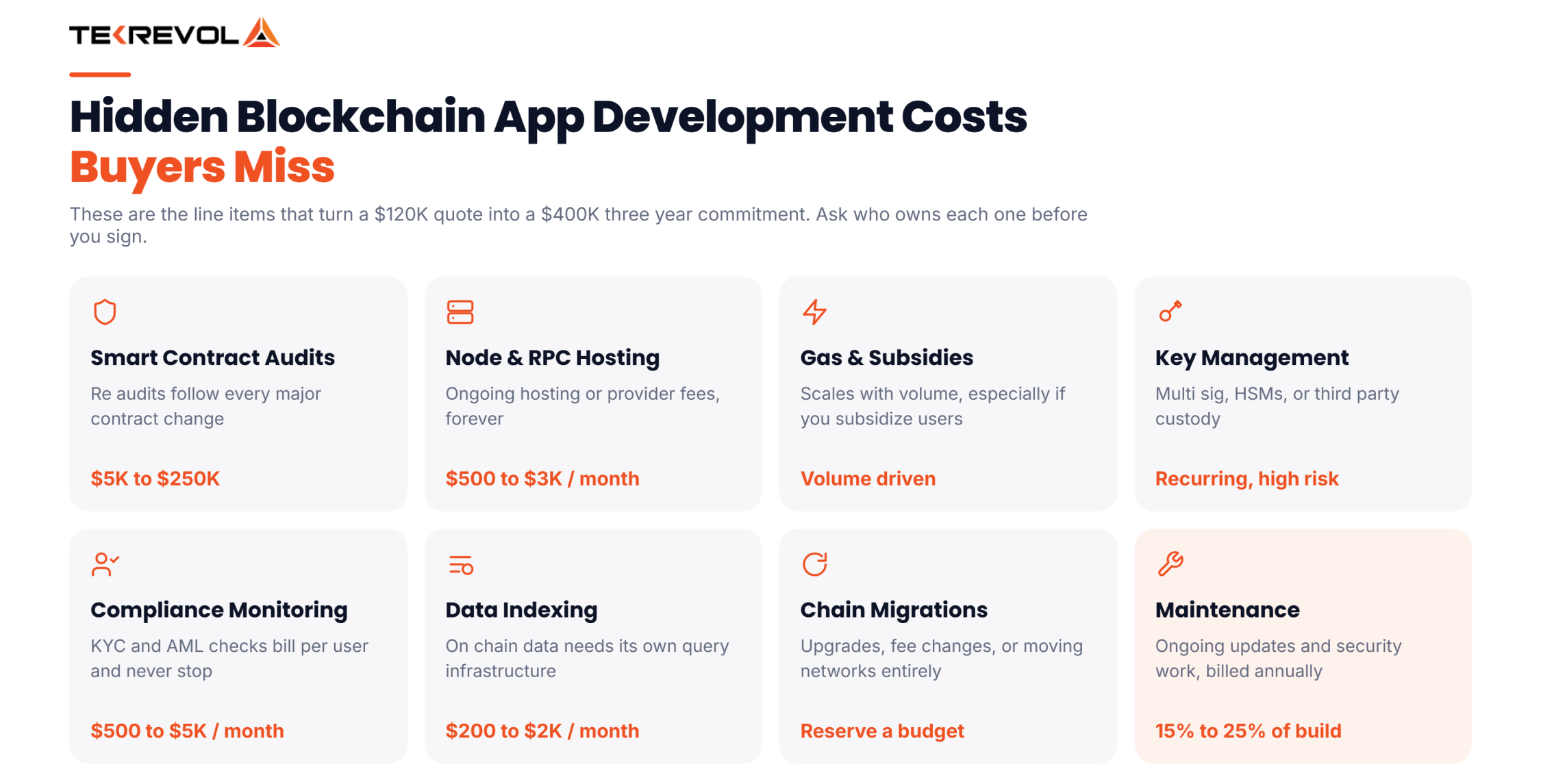
Below is a three-year total cost of ownership view for that same $120,000 mid-complexity dApp. Assumptions are stated openly so you can swap in your own.
| Cost item | Year 0 | Year 1 | Year 2 | Year 3 |
| Initial build | $120,000 | n/a | n/a | n/a |
| Pre-launch audit + remediation | $35,000 | n/a | n/a | n/a |
| Re-audit after major changes | n/a | n/a | $15,000 | n/a |
| Node / RPC infrastructure | n/a | $18,000 | $18,000 | $21,000 |
| Gas and transaction subsidies | n/a | $9,000 | $12,000 | $15,000 |
| Compliance monitoring tooling | n/a | $12,000 | $12,000 | $14,000 |
| Maintenance (17.5% of build) | n/a | $21,000 | $21,000 | $24,000 |
| Monitoring and incident response | n/a | $6,000 | $6,000 | $6,000 |
| Chain upgrade / migration reserve | n/a | n/a | n/a | $15,000 |
| Annual total | $155,000 | $66,000 | $84,000 | $95,000 |
Three-year total: approximately $400,000. The build is 30% of it.
What Are the Main Hidden Costs?
- Smart contract audits: Re-audits may be needed after major contract changes.
- Node and RPC infrastructure: Ongoing hosting or provider fees.
- Gas fees: Costs increase with transaction volume, especially when you subsidize users.
- Key management and custody: Multi-sig, HSMs, or third-party custody add recurring costs.
- Compliance monitoring: KYC/AML checks can create ongoing per-user expenses.
- Data indexing: Blockchain data indexing requires additional infrastructure.
- Chain migrations: Budget for upgrades, fee changes, or moving to another network.
- Maintenance: Ongoing updates and security work can cost 15%–25% of the initial build annually.
The development quote is only the starting point. Your long-term budget should account for the full cost of operating and securing the blockchain product.
How Do You Optimize Blockchain Development Cost?
You can optimize blockchain development cost by cutting scope before you cut rates. The five biggest savings, in order: confirm you need a blockchain, choose a Layer 2, keep data off-chain, reuse audited contract standards, and ship an MVP first.
Start by Asking Whether You Need a Blockchain
This is the largest cost saving available. Blockchain earns its cost when you have multiple parties who don’t fully trust each other, need a shared record nobody can quietly edit, and benefit from settlement without a middleman. If your answer to all three isn’t yes, a well-designed database does the job for a fraction of the money.
Choose a Layer 2 Over Mainnet
Moving from Ethereum mainnet to Polygon, Base, Arbitrum, or Optimism keeps your Solidity code and your talent pool while cutting transaction costs dramatically. For most applications, there is no meaningful downside, and it changes your running cost profile permanently rather than once.
Keep Data off-chain by Default
Store only what genuinely needs consensus on the chain. Everything else goes in conventional storage with a hash anchored on-chain for verification. This single decision routinely cuts both build complexity and lifetime gas spend.
Reuse Audited Standards
Start from battle-tested contract libraries rather than writing token logic from scratch. Auditors price familiar patterns lower because they can review them faster, so you save twice.
Build the MVP First
Ship the smallest version that proves the on-chain mechanic works, then invest based on what real users actually do. A 30% to 40% reduction in initial scope is normal and rarely costs you anything you needed.
Two More that matter
- Book your audit early. Rush audit timelines carry a 20% to 40% premium according to Sherlock’s 2026 pricing data. Scheduling three months ahead is free money.
- Pick your team model deliberately. In-house blockchain teams cost $150,000 to $400,000+ annually before you ship anything. Freelancers are cheapest and carry the most risk, especially on contracts holding funds.
A specialist blockchain development company usually lands in between, with the advantage that audit relationships and deployment experience come included.
How Do You Hire an Expert Blockchain App Development Company?
Start by auditing the proposal, not just the portfolio. A reliable blockchain development quote should clearly cover audits, infrastructure, gas, compliance, and post-launch costs. If these are missing, ask who is responsible for them.
| Line Item | What to Check | Potential Exposure |
| Smart contract audit | Named auditor + fixed fee | $5K–$250K |
| Audit remediation | Separate cost | $5K–$20K |
| Node / RPC hosting | Monthly estimate | $500–$3K/month |
| Gas strategy | Cost responsibility + volume estimate | Variable |
| Data indexing | Monthly estimate | $200–$2K/month |
| Key management | Named security approach | High |
| Compliance tooling | Per-user or monthly cost | $500–$5K/month |
| Maintenance | Annual percentage | 15%–25% of build |
| Incident response | Defined SLA | Downtime risk |
| Code & key handover | Explicit deliverable | Vendor lock-in |
What Should You Ask a Blockchain Development Company?
- Which audit firms have you worked with? Ask for redacted audit reports to verify their security experience.
- What have you deployed to mainnet? Look for live contracts with verifiable addresses, not just testnet demos.
- Why did you choose this blockchain? The recommendation should match your use case, cost, scalability, and technical requirements.
- How will the contract be upgraded after launch? They should explain the upgrade pattern, security implications, and associated costs.
If you want more grounding before those calls, our blockchain development blog covers the technical side in more depth.
New to the space entirely? Our guide for blockchain enthusiasts is a good primer on where the technology genuinely fits and where it doesn’t.
Why Choose TekRevol for Blockchain App Development?
TekRevol combines 500+ tech experts, a 98% project completion rate, and experience across 11 industries to deliver blockchain solutions across Ethereum, Polygon, Solana, Hyperledger, Cardano, Tezos, Polkadot, and BNB Chain. More importantly, we evaluate whether blockchain is actually the right solution before development begins.
What sets our approach apart:
- Transparent cost planning: Proposals account for development, audits, infrastructure, gas, compliance, and ongoing maintenance—not just the initial build.
- Cross-industry experience: Projects such as Revcoin, Ether Legends, and Muirfield demonstrate experience across tokenization, NFT gaming, and real estate.
- Cost-driven chain selection: We evaluate blockchain platforms based on scalability, fees, architecture, and long-term operating costs.
- Full-stack expertise: From dApps and smart contracts to wallets, DeFi, tokenization, NFTs, DAOs, Layer-2 solutions, and metaverse development when a project needs it.
- Realistic estimates: We model variables such as gas costs, adoption, and regulatory requirements as ranges rather than promising false precision.
Want a blockchain quote with no hidden costs?
Get a three-year cost estimate covering development, audits, infrastructure, and compliance.
Schedule Your Free Blockchain Consultation →


