



- Mobile app development in UK costs between £8,000 to £300,000, depending on its complexity.
- A focused UK MVP commonly starts near £25,000, while complex integrated platforms can exceed £150,000.
- UK software developer contracts currently show a £515 median daily rate, according to IT Jobs Watch.
- VAT adds 20% to every UK agency invoice, but registered businesses reclaim that amount in full.
- Cross-platform frameworks cover both iOS and Android for roughly 60 to 75% of dual-native cost.
- Budget 15 to 25% of your build cost annually for maintenance, hosting, and OS updates.
There is no doubt that customer-centric mobile solutions help businesses connect to their clients globally by giving an unconventional user experience. But the cost of app development in the UK is a significant factor businesses must consider before commencing their app development journey.
Mobile app development costs in the UK range from £8,000 to £300,000 or more. Most businesses land between £30,000 and £80,000 for a production app with user accounts, payments, and a couple of integrations. Simple single-workflow builds start near £8,000. Regulated and AI-heavy platforms climb past £150,000.
Then there is the part that moves your budget further than any of those figures. The number on the invoice is not the number your business pays. VAT-registered companies reclaim 20% of it. Qualifying development work reduces it again through R&D tax relief.
TekRevol, as a reliable mobile app development company UK, created this article based on our vast experience creating the best-performing native and cross-platform app development solutions. We will give you the current UK price bands as well as what it takes to market an app in the UK market.
Stay tuned to learn more about how much does it cost to make an app in the UK and strategies that help you optimize your budget.
How Much Mobile App Development Costs in the UK [Pricing by App Complexity]
UK app development costs range from £8,000 to £300,000+ in 2026, depending on the complexity and build scope.
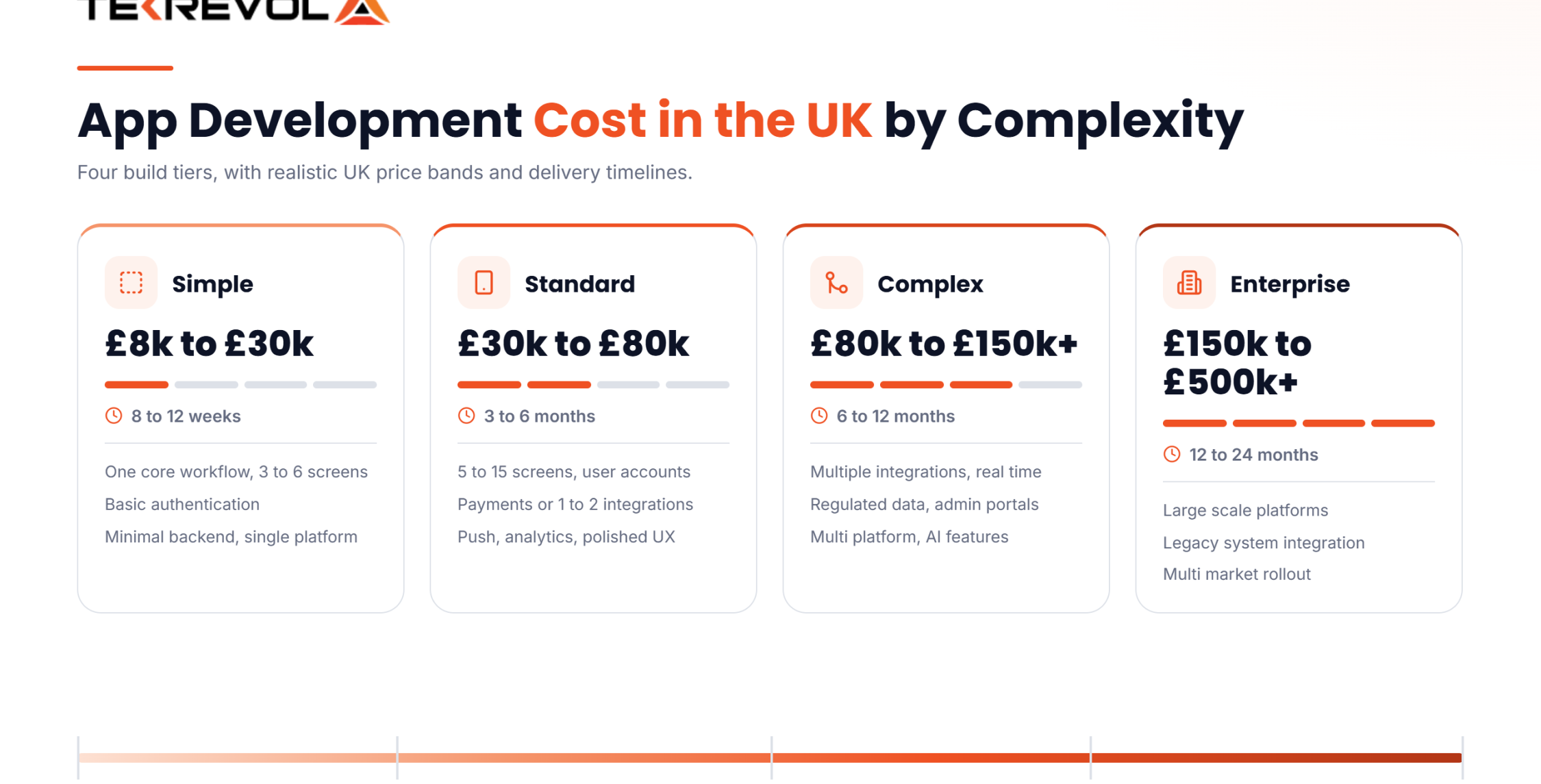
A focused MVP typically costs £25,000 to £45,000, a standard production app £30,000 to £80,000, and complex platforms £80,000 to £150,000+. Enterprise products run £150,000 to £500,000+ when integrations, compliance, real-time workflows, or multi-system operations increase scope.
Below are the four standard tiers, with realistic UK market pricing for 2026:
| Tier | UK cost | Timeline | Feature Scope |
| Simple | £8,000 – £30,000 | 8–12 weeks | One core workflow, 3 to 6 screens, basic authentication, minimal backend, one platform or lightweight cross-platform |
| Standard | £30,000 – £80,000 | 3–6 months | 5 to 15 screens, user accounts, payments or one to two integrations, proper backend, push notifications, analytics, polished UX |
| Complex | £80,000 – £150,000+ | 6–12 months | Multiple integrations, real-time features, regulated data, admin portals, multi-platform, AI features |
| Enterprise | £150,000 – £500,000+ | 12–24 months | Large-scale platforms, legacy system integration, multi-market rollout, formal governance |
These are planning figures, not fixed market prices, because two apps with the same number of screens can require very different engineering underneath.
A note on “simple”
One of the most common mistakes is assuming an app is “quite simple.” Clients often describe a “simple app” and then list 30+ features. A genuinely simple app has one core function, a minimal backend, and no payments or real-time data. The moment you add any of these, costs move into the £30,000–£80,000 bracket.
Sitting on two quotes that do not match?
Send them over. A 30-minute scoping call will tell you what each one actually includes and which gaps will surface later as change requests.
Get a Free Quote ComparisonHow Much Do Common Mobile App Features Cost in the UK?
Common mobile app features can add roughly £1,500 to £30,000+ each in the UK, depending on backend logic, security, integrations, data flows, and testing. Payments, real-time tracking, chat, offline sync, and AI usually cost more than basic notifications or authentication.
A feature name alone is not enough to price the work. “Payments” might mean a simple Stripe checkout, or it might include subscriptions, refunds, split payouts, tax logic, and reconciliation. The ranges below are TekRevol planning estimates for features added within a wider production app.
| Feature | Estimated add-on cost | What moves the estimate |
| User authentication and profiles | £2,000 to £6,000 | Social login, password recovery, permissions and SSO. |
| Push notifications | £1,500 to £4,000 | Segmentation, scheduling, deep links and campaign logic. |
| Search, filters and sorting | £2,500 to £7,500 | Catalogue size, ranking logic, advanced filters and location. |
| Payments or subscriptions | £4,000 to £12,000 | Subscriptions, refunds, split payouts, tax and reconciliation. |
| Maps, GPS and geolocation | £4,000 to £15,000 | Geofencing, routing, live movement and location history. |
| In-app chat or messaging | £6,000 to £18,000 | Media, read receipts, presence, groups and moderation. |
| Offline mode and data sync | £6,000 to £18,000 | Conflict handling, local storage, background sync and recovery. |
| Admin dashboard | £6,000 to £20,000 | Roles, reporting, approvals, content controls and audit logs. |
| Real-time tracking or live status | £8,000 to £25,000 | Sockets or events, background updates and failure recovery. |
| Standard third-party API integration | £2,000 to £7,500 each | Read-only vs two-way, legacy APIs, permissions and actions. |
| AI assistant or recommendations | £10,000 to £30,000 | RAG, data pipelines, evaluation, guardrails and model run costs. |
These ranges are not meant to be added mechanically. Several features can share authentication, backend, data and admin components, while one “simple” feature can become expensive when it introduces permissions, real-time behaviour, compliance or legacy-system dependencies.
What Factors Affect Mobile App Development Cost in the UK?
When planning to develop a mobile app in the UK, several key elements determine the total investment. The biggest cost drivers are workflow complexity, backend logic, integrations, platform coverage, UX depth, compliance, testing, and team structure.
Costs rise fastest when an app must coordinate multiple users, move sensitive data, work in real time or modify external systems safely. Let’s explore each factor with UK-specific examples and practical insights.
1. Complexity and Scope of the App
The more complicated your desired app is, the higher the app development costs in the UK.
Screen count is a weak cost metric. A five-screen checkout flow with payments, refunds, stock validation, and fraud checks can cost more than a twenty-screen content app because the expensive work sits in rules, states, permissions, and failure handling.
To ensure the quality of the app’s features, you must decide whether you need an application programming interface (API) or a content management system (CMS) to integrate with other services.
2. App Design (UX/UI Complexity)
A functional interface built around familiar mobile patterns costs considerably less than a product requiring custom animations, complex dashboards, interactive maps, gesture-driven interfaces, or an extensive design system.
For UK projects, UI/UX work may account for roughly 12% to 18% of the overall build. A straightforward product design can fall around £4,000 to £12,000, whereas sophisticated consumer or enterprise experiences may require £15,000 to £40,000+.
The key question is not whether the app should look premium. It is which custom interactions genuinely improve conversion, task completion, or retention.
3. App Features
Features are usually the biggest cost driver because complexity compounds as workflows begin interacting. Login, profiles, payments, messaging, search, notifications, and admin controls may each look straightforward alone, but combining them introduces permissions, edge cases, backend logic, and additional QA.
A focused MVP may keep feature development within £25,000 to £45,000, while multi-role marketplaces or operational platforms can add £40,000 to £100,000+ in functional scope. Before development, separate features required to prove the business case from those that can wait for later releases.
For early-stage products, TekRevol’s MVP development services focus the first build around the assumptions that actually need validation.
4. AI and Machine Learning Features
Adding AI is not simply an API call. A production feature may require model selection, prompt architecture, retrieval, business-data preparation, safety controls, evaluation, analytics, fallback logic, and ongoing usage monitoring.
A focused AI feature such as summarisation, recommendations, document extraction, or conversational assistance may add £10,000 to £30,000. More advanced RAG, voice, computer vision, or agentic workflows can add £30,000 to £80,000+, alongside recurring model and infrastructure costs.
Teams planning AI-led products can review our AI development services before deciding whether AI should sit inside the MVP or a later release.
5. Third-Party Integrations and APIs
Integrations consume around 10% to 15% of the project budget, but the system being connected matters more than the integration count. Stripe, Google Maps, Firebase, or a modern REST API may require only several development days, while an older ERP, CRM, or proprietary backend can take several weeks.
As a planning range, a standard third-party integration may add £2,000 to £7,500, while complex two-way CRM, ERP, healthcare, banking, or legacy-system integrations can add £8,000 to £25,000+ each. Map every system and required data flow before requesting quotes.
6. Delivery Team and Speed
A faster deadline usually requires more parallel work, senior decision-making, and tighter coordination. Meanwhile, a lower day rate is not automatically a lower project cost if the team needs more time, rework, or management to reach production quality.
If you are still at the rough-planning stage, try the app development cost calculator already on this page. It is useful for testing how complexity, industry, platform, and design choices shift an estimate. Treat the result as a first-pass range, then validate integrations, compliance, and operational edge cases during discovery.
7. Maintenance and Ongoing Updates
The cost to run an app per month does not stop at hosting. After launch, you still need bug fixes, OS updates, security patches, API maintenance, analytics, performance improvements, and support for new Apple and Android releases.
A practical rule is to budget around 15% to 25% of the original development cost per year for maintenance. That means a £60,000 app may require roughly £9,000 to £15,000 annually, or around £750 to £1,250 per month, before substantial new features are added.
8. Compliance and Security Requirements (GDPR)
Compliance with UK and EU data protection laws is mandatory for apps handling personal data. Failure to comply can result in fines, legal penalties, and reputational damage.
For planning purposes, compliance and security requirements can add roughly 10% to 25% to development cost, depending on the industry and risk level. Building these requirements into the architecture early is usually considerably cheaper than retrofitting them before launch.
For example, regulated financial products often require security and governance decisions from the first architecture sprint, which TekRevol addresses through its fintech app development practice.
How Does Platform Choice Impact Mobile App Cost UK [iOS vs Android vs Cross-Platform]
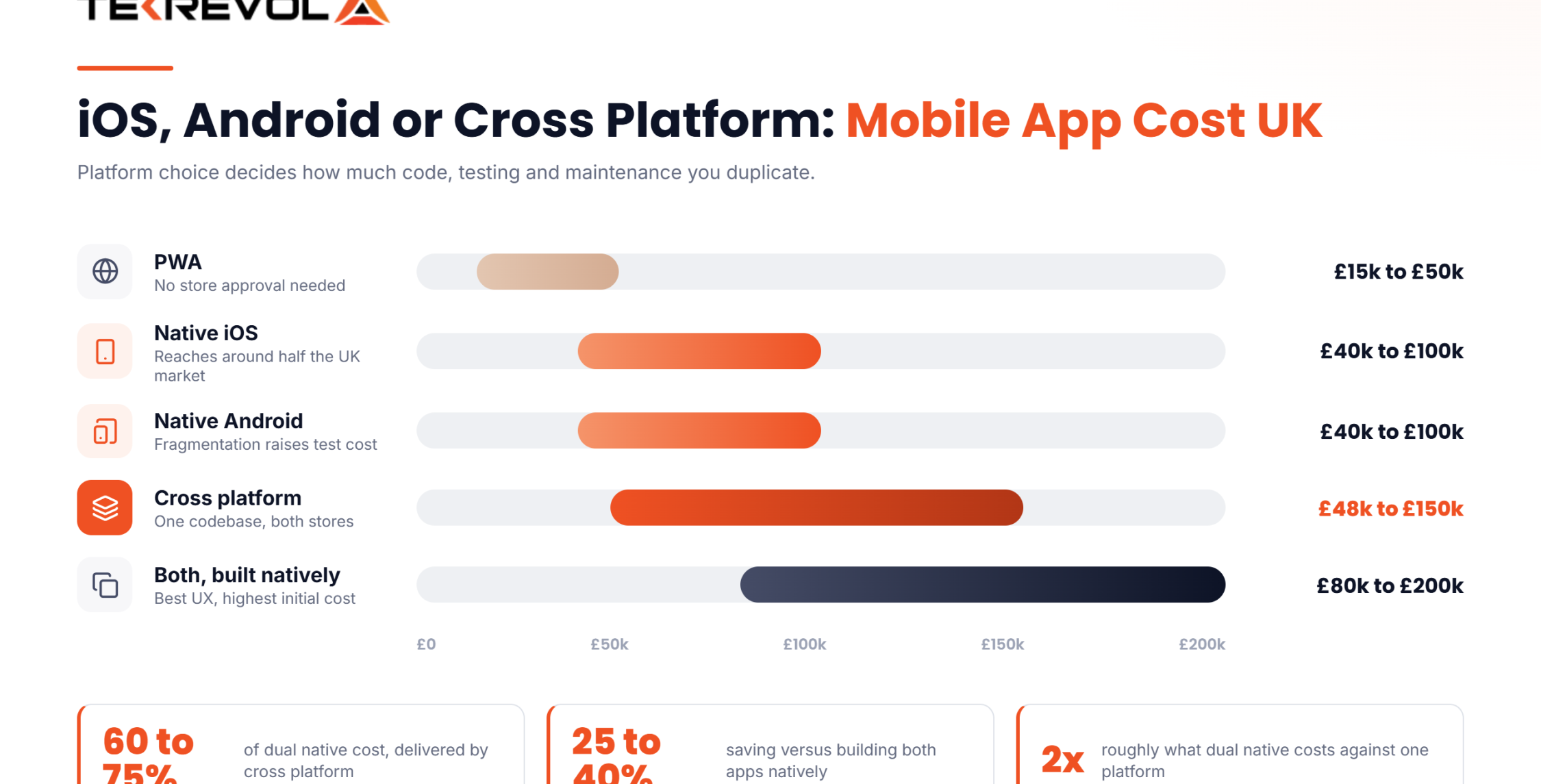
Choosing which platform to build for significantly shifts the cost to develop an app in the UK. Platform choice changes how much code, testing, and maintenance you duplicate.
A single native app is your baseline. Building both natively roughly doubles it. Cross-platform delivers both iOS and Android for roughly 60% to 75% of dual-native cost, and a PWA can halve it again.
1. Native iOS or Android
Building “natively” means writing bespoke code, using Swift for iOS or Kotlin for Android. This approach offers the highest performance and seamless access to camera, GPS, and biometrics.
| Platform | Typical Cost | Pros | Cons |
| Native iOS | £40,000 – £100,000 | Elite performance; access to high-spending UK iPhone users | Reaches only ~50% of the UK market |
| Native Android | £40,000 – £100,000 | Massive global reach; easier Play Store submission. | Device fragmentation increases testing costs |
| Both (Native) | £80,000 – £200,000 | The gold standard for UX and speed on every device. | The highest initial cost of making an app |
| Cross-Platform | £48,000 – £150,000 | Single codebase; faster launch; lower maintenance | Limited for high-end gaming or complex AR |
| PWA | £15,000 – £50,000 | No store approval needed; instant updates | Limited hardware access (e.g., FaceID) |
2. Cross-Platform (React Native & Flutter)
Cross-platform frameworks are the most popular way to manage mobile app development cost in the UK. Using tools like Flutter or React Native, cross-platform development services give your business a single codebase that runs beautifully on both iOS and Android.
Cost Impact: This approach is highly efficient, typically reducing the cost to build an app in the UK by 25% to 40% compared to dual native builds.
- Typical Cost (Mid-Range): £48,000 – £150,000
- Pros: Single codebase; faster launch; lower maintenance
- Cons: Limited for high-end gaming or complex AR
3. Progressive Web Apps (PWAs)
A PWA is essentially a website that mimics a mobile app. It lives in the browser but can be saved to a user’s home screen and work offline. PWAs drastically lower app development costs in the UK because they eliminate store fees and platform-specific coding.
- Typical Cost: £15,000 – £50,000
- Pros: No store approval needed; instant updates
- Cons: Limited hardware access (e.g., Face ID)
Which Should You Choose?
When calculating how much does it cost to make an app in UK, always weigh the performance needs against your long-term maintenance budget. Cross-platform is not automatically the cheapest answer. However, when both iOS and Android need essentially the same workflows, React Native or Flutter can reduce duplicated implementation and maintenance. TekRevol’s guide to cross-platform development cost savings explains where that trade-off works and where it does not.
App Cost Breakdown for UK by Development Phases
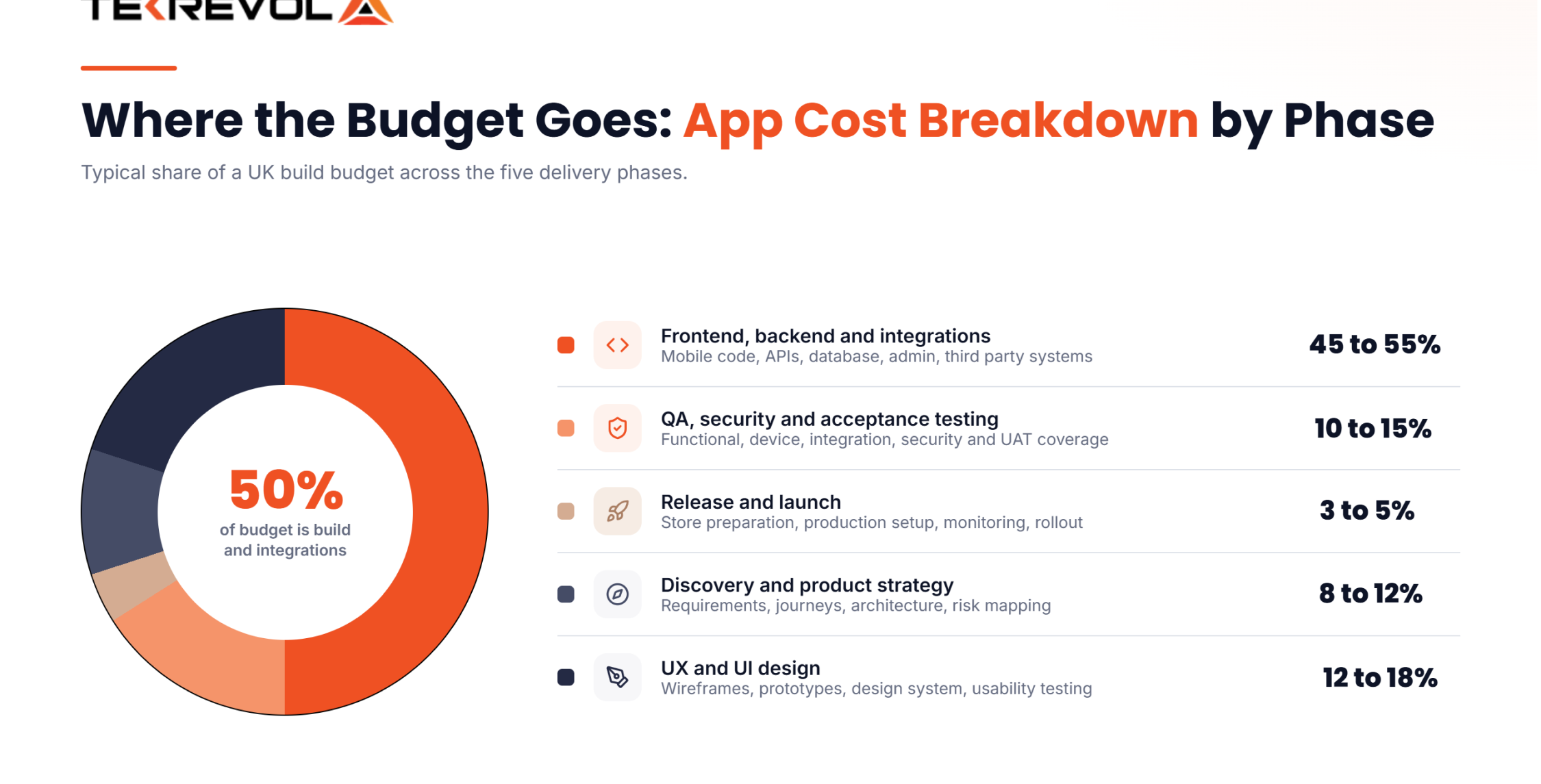
A healthy app development cost breakdown is not spent evenly. A professional UK app project moves through distinct phases, each with its own cost contribution.
Discovery and design reduce uncertainty, engineering carries the largest share, QA protects the release, and deployment prepares the product for production. Skipping early work rarely removes cost; it usually moves that cost into rework later.
So, let’s look at the development cost breakdown and how each phase will eat up a segment of your app development budget.
| Development phase | Typical share of build budget | What you are paying for |
| Discovery and product strategy | 8% to 12% | Requirements, market context, journeys, architecture, risk mapping |
| UX and UI design | 12% to 18% | Wireframes, prototypes, design system, usability validation |
| Frontend, backend and integrations | 45% to 55% | Mobile code, APIs, database, admin, third-party systems |
| QA, security and acceptance testing | 10% to 15% | Functional, device, integration, security, and UAT coverage |
| Release and launch | 3% to 5% | Store preparation, production setup, monitoring, rollout |
This table is also the most useful part to turn into a mobile app development cost breakdown PDF for procurement or board review, because it explains where the budget goes rather than showing one unexplained total.
Discovery and Product Strategy (£3,000 to £5,000)
Excellent mobile app ideas for UK startups require an in-depth plan for a mobile app business and market analysis.
A discovery phase turns a feature wishlist into a buildable product. It should clarify users, core journeys, business rules, integrations, security constraints, platform choice, technical architecture, and what the MVP needs to prove.
Our UK team currently prices a fixed discovery sprint at £3,000 to £5,000. That spend is intended to make the production quote more reliable, not to create a long strategy document nobody uses.
UX and UI Design (Approx. £4,000–£40,000+)
The design phase is where your app’s visual identity and user journey come to life. UK users demand high-performance interfaces that are both accessible and aesthetically “on-brand.” This involves creating the wireframes (blueprints) and the final high-fidelity mockups.
This stage ensures the app is intuitive and easy to navigate, reducing the risk of high user churn after launch. You should expect this phase to consume about 12% to 18% of your total budget, taking roughly 40 to 150 hours.
Key outputs include:
- User Personas & Journeys: Mapping how different users move through the app.
- Wireframes: Skeletal outlines of each screen’s layout.
- Interactive Prototypes: A “clickable” version of the app to test flow before coding.
- Visual Design: Final colour palettes, typography, and branded elements.
- Style Guide: A document ensuring consistency for future updates.
Frontend, Backend and Integrations (Approx. £20,000–£120,000+)
This is the “engine room” of the project and represents the largest portion of your investment. It involves building the frontend (the part users see) and the backend (the servers, databases, and APIs that power the logic).
In the UK, development costs are heavily influenced by the seniority of the engineers and the complexity of integrations like payment gateways or AI modules. This phase typically requires 300 to 1,000+ hours of coding. At this stage, the team builds:
- Frontend Development: Coding the interactive interface using Swift, Kotlin, or Flutter.
- Backend Development: Setting up secure servers and database architecture.
- API Integrations: Connecting third-party services like Stripe, Google Maps, or AWS.
- Core Feature Logic: Programming the unique functionality that makes your app work.
QA, Security and Project Delivery (Approx. £2,500–£12,000)
Testing is non-negotiable for a professional UK launch. It ensures the app is stable, secure, and functions perfectly across various devices (from the latest iPhone to older Android models).
This phase identifies bugs and security vulnerabilities that could lead to negative reviews or GDPR compliance issues. Expect to allocate about 10% to 15% of the budget for roughly 40 to 120 hours of rigorous checking. This includes:
- Functional Testing: Ensuring every button and feature works as intended.
- Usability Testing: Verifying that the app is easy for real people to use.
- Security Testing: Protecting user data and preventing unauthorised access.
- Device Compatibility: Testing on different screen sizes and OS versions.
How Much Does It Cost to Publish an App on the App Store?
Along with app development costs, finding out the cost of putting an app on the App Store is also essential.
Publishing costs roughly £99 in year one and £79 a year after that. The Apple Developer Program is $99 per year, around £79. Google Play charges a one-time $25 registration, around £20, which never renews. Store commissions on digital sales are the higher cost.
Two figures get misquoted constantly, so let us settle them.
- Apple’s $99 covers both individuals and organisations. The $299 Apple Developer Enterprise Program exists to distribute internal apps to your own employees, and it cannot publish to the public App Store at all. Anyone budgeting £299 a year for a public listing has the wrong programme.
- Google’s $25 really is one-time. No annual renewal, and a single account publishes unlimited apps.
App Publishing Cost of the Amazon Appstore
The Amazon Appstore is an alternative app publisher with a more transparent pricing policy than other App Stores. You can register as a developer, and mobile app publishing is free. Moreover, a 30% fee will be charged for each transaction.
Now you must clearly understand the cost and timeline to publish the app on the App Store and Play Store.
Review timelines and the cost of a rejection
Apple review averages around 24 hours; Google Play around two hours. Add a buffer for a first rejection, which arrives more often than first-time publishers expect.
Apple most commonly rejects on missing Privacy Manifest declarations and vague permission strings. Google most commonly rejects on Data Safety declarations and target API level compliance. A failed cycle burns days of developer time at full rate, so build a week of slack into the launch plan.
Not sure which store fees actually apply to your model?
Whether you pay 15%, 30% or nothing at all depends on what you sell. We will map it against your revenue model.
Get a Free ConsultationPost-Launch Maintenance and Ongoing Costs
Once the app has been launched, your marketing efforts must revolve around user acquisition through targeted advertising or referral programs. A lack of post-launch planning is one of the top reasons UK startups fail at app launch.
Including hosting and infrastructure, the initial build is roughly 65% to 75% of the total cost of ownership (TCO) over the first two years. To keep your app functional, secure, and visible in the UK market, you must budget for recurring expenses.
Annual Maintenance Breakdown
Industry benchmarks for 2026 suggest budgeting 15% to 25% of your original development cost annually for upkeep. For a £50,000 app, expect an annual maintenance bill of £7,500 to £12,500.
The component ranges below apply across UK projects of varying size. On a £50,000 build, expect each to sit toward the lower end.
- OS Updates & Compatibility (£2,000 – £5,000): Ensuring your app doesn’t “break” when Apple or Google release new iOS/Android versions.
- Bug Fixes & Security Patches (£3,000 – £8,000): Reactive technical support to resolve user-reported issues and proactive security hardening.
- Performance Monitoring (£1,000 – £3,000): Using tools like Firebase or Datadog to track crashes and load times.
Our mobile app support and maintenance services exist because we kept watching good products decay from neglect rather than from anything wrong with the build.
How Much Do UK App Development Costs Vary by Industry?
Industry influences both your feature set and your compliance overhead because users expect different capabilities. A booking app needs scheduling and payments, while fintech, healthcare, and marketplaces add security, compliance, multi-role workflows, integrations, and operational edge cases that raise both build and testing effort.
Fintech and healthcare carry the largest premiums because of regulatory work. Informational and booking apps sit at the lower end. Here are realistic budget ranges for the UK’s most common app development verticals:
| Industry | UK budget range | Main Cost Drivers |
| Booking/scheduling | £30,000 – £70,000 | Calendars, payments, notifications |
| eCommerce | £45,000 – £120,000 | Catalogue, checkout, inventory sync, loyalty |
| Edtech/e-learning | £25,000 – £90,000 | Video streaming, progress tracking, WCAG accessibility |
| Hospitality/travel | £30,000 – £80,000 | Booking engine, third-party APIs, geolocation |
| Field service/logistics | £40,000 – £130,000 | Offline mode, scheduling, back-office integration |
| On-demand / marketplace | £60,000 – £180,000 | Two-sided marketplace, real-time tracking, payment splitting |
| Social / community | £50,000 – £150,000 | Messaging, feeds, moderation, media handling |
| Healthcare / NHS-facing | £70,000 – £250,000+ | NHS DTAC, GDPR health data, HL7/FHIR, clinical workflow |
| Fintech/banking | £80,000 – £300,000+ | FCA compliance, Open Banking APIs, biometrics, fraud detection |
| Internal enterprise tool | £40,000 – £150,000 | Legacy integration, SSO, role-based access, MDM |
Note: The ranges are useful for early budgeting. They are not quotes, because an industry label does not reveal the actual scope.
What Does GDPR, Accessibility and the Online Safety Act Add to Your Build?
UK GDPR compliance costs £2,500 to £7,000 upfront and £1,000 to £5,000 annually. Accessibility built in from day one adds 5 to 10% to design and build. Regulated sectors carry a further 10 to 15% premium. Retrofitting any of it costs several times more.
UK GDPR applies if the app handles personal data, including names, emails, location, and payment information. The upfront work covers your privacy policy, lawful basis, data mapping, consent flows, and a DPIA where processing is high risk. The ICO publishes clear guidance on what adequate looks like, and it is worth reading before you brief anyone.
Accessibility under WCAG 2.2 AA is mandatory for public sector apps and increasingly expected commercially. Built in from the first sprint, it adds roughly 5 to 10%. Retrofitted after launch, it runs 15 to 25% of the original build, because you end up rebuilding screens rather than adjusting them.
Platform privacy declarations now require active work. Apple’s Privacy Manifest requirements and Google Play’s Data Safety section both demand you declare every SDK you use and what data it touches. Get this wrong, and you fail the review.
The Online Safety Act 2023 applies if your app carries user-generated content: reviews, comments, messaging or media sharing. Safety duties cover content moderation, reporting mechanisms, and age assurance in some contexts. Budget 5 to 15% additional engineering plus ongoing moderation costs for any UGC feature.
Scaling a health app internationally? The cost of adding HIPAA compliance to a mobile app sits on top of your UK obligations rather than replacing them.
UK App Developer Rates You Should Consider While Budgeting
The hourly rate of your development team is a major factor in mobile app development cost in the UK. The “app developer costs” question has two dimensions: where the developer is based, and how senior they are.
UK developer rates run £20 to £40 per hour for juniors, £40 to £70 for mid-level, and £70 to £130 for senior specialists. Agency blended day rates sit between £550 and £1,100. Every quote you receive is a day-rate calculation underneath, so these numbers let you sanity-check it.
For the wider market, IT Jobs Watch recorded a £515 median day rate for UK software developer contracts across 413 job ads in the six months to 20 August 2026, with the 25th percentile at £424 and the 75th at £575.
| Role | Hourly rate | Day rate |
| Junior developer | £20 – £40 | £160 – £320 |
| Mid-level developer | £40 – £70 | £320 – £560 |
| Senior developer | £70 – £130 | £560 – £1,040 |
| Specialist/lead (London) | £100 – £160+ | £800 – £1,280+ |
| UK agency blended team | n/a | £550 – £1,100 |
Lower hourly rates do not always mean lower app development costs in the UK. Delays from time zones, misaligned cultural understanding, or compliance mistakes can increase total costs.
Does app development cost more in London than elsewhere in the UK?
Yes. Regional teams of equivalent seniority typically cost 33% to 58% less per hour than London. That gap has narrowed since remote-first working became standard, and it largely reflects overheads rather than a quality difference on standard business apps.
| City | Avg hourly rate (£) | Moderate complexity (£) | Complex apps (£) | Cost vs London |
| London | £80–£150 | £30,000–£80,000 | £80,000–£150,000 | Baseline |
| Bristol | £55–£100 | £20,000–£54,000 | £54,000–£101,000 | ~33% cheaper |
| Edinburgh | £50–£95 | £19,000–£50,000 | £50,000–£95,000 | ~37% cheaper |
| Manchester | £48–£90 | £18,000–£48,000 | £48,000–£90,000 | ~40% cheaper |
| Leeds | £45–£85 | £17,000–£46,000 | £46,000–£86,000 | ~43% cheaper |
| Birmingham | £42–£80 | £16,000–£42,000 | £42,000–£80,000 | ~47% cheaper |
| Glasgow | £40–£75 | £15,000–£40,000 | £40,000–£75,000 | ~50% cheaper |
| Belfast | £32–£65 | £13,000–£34,000 | £34,000–£63,000 | ~58% cheaper |
For most projects, that regional discount is real money and worth taking. Mobile app developers in Manchester get you the same seniority for meaningfully less, with no time zone friction and full familiarity with UK GDPR and HMRC requirements. For the full evaluation framework, our guide on how to hire an app development company in the UK covers vetting, contracts, and IP ownership.
What Does VAT Add to Your App Development Cost in the UK?
VAT can add 20% to an invoice from a VAT-registered UK development company. A £60,000 app becomes £72,000 gross, although a VAT-registered business may reclaim the £12,000 VAT where the development cost qualifies as a taxable business expense.
| Your VAT status | Build | VAT charged | Potentially reclaimed | Net cost |
| VAT registered* | £60,000 | £12,000 | £12,000 | £60,000 |
| Not registered | £60,000 | £12,000 | £0 | £72,000 |
*Assumes the VAT is fully recoverable under normal HMRC rules
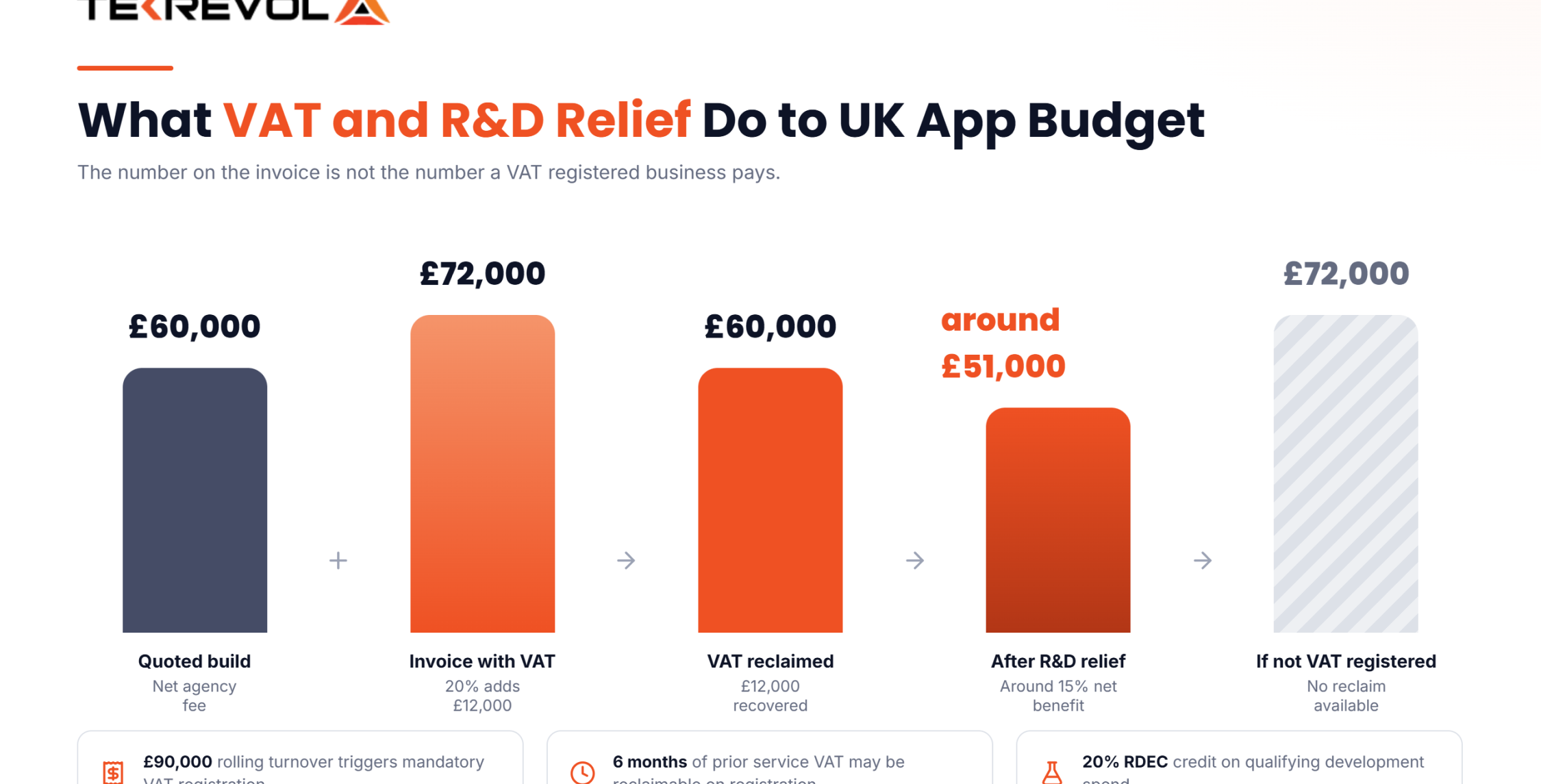
UK businesses must register when taxable turnover exceeds £90,000 in a rolling 12-month period. Businesses below that threshold can register voluntarily, which may be worth considering before a major app-development purchase.
Timing matters too. A startup commissioning a £50,000 build faces £10,000 in VAT. HMRC allows eligible VAT on services purchased up to six months before registration to be reclaimed, subject to its normal conditions.
Cash flow is still important because VAT is normally paid with the supplier invoice before it is recovered through a VAT return. Therefore, when comparing UK and offshore quotes, compare the recoverable net development cost, not simply the gross invoice value.
UK Funding and Tax Relief to Lower Your App Cost
UK businesses can reduce mobile app development costs in the UK through R&D tax relief, Innovate UK grants, SEIS/EIS, Knowledge Transfer Partnerships, and regional funding. R&D relief is often the most broadly applicable, delivering roughly a 15% to 16% net benefit on qualifying development spend.
R&D Tax Relief
The merged scheme provides a 20% Research and Development Expenditure Credit on qualifying costs, which typically nets around 15% for profit-making companies and about 16% for loss-making companies. R&D-intensive SMEs, where qualifying R&D represents at least 30% of total expenditure, may access Enhanced R&D Intensive Support. Custom app development involving genuine technical uncertainty may qualify, while routine configuration generally does not.
Innovate UK Grants
Innovate UK can co-fund genuinely innovative software, AI, and technology projects through competitive programmes. These grants are better suited to projects advancing the field technically, rather than standard app builds that are only new to the business.
SEIS and EIS
Seed Enterprise Investment Scheme (SEIS) and Enterprise Investment Scheme (EIS) do not directly reduce the app development cost breakdown, but they can make fundraising easier. SEIS gives investors 50% income tax relief on investments up to £200,000 per individual per tax year, within a company lifetime limit of £250,000. EIS offers 30% income tax relief on qualifying investments of up to £1 million per individual.
Knowledge Transfer Partnerships
KTPs can cover a substantial share of project costs when the app involves a genuine research challenge with a university partner. They are especially relevant for advanced AI, data science, machine learning, or human-computer interaction projects.
Regional Funding
Scottish Enterprise, Business Wales, Invest NI, and English regional authorities also offer digital and innovation funding. These programmes can sometimes be more accessible for smaller projects than national grant schemes.
Consider funding during discovery, alongside your build budget and expected cost to run an app per month. For R&D claims, technical documentation should begin with the project rather than being reconstructed at year-end.
Strategic Cost Optimization Tips for Mobile App Development in the UK
Developing a mobile app isn’t so much about shelling out; it’s about shelling out strategically. You’re a startup, SME, or enterprise; we get it. Knowing how to maximize your app development budget without sacrificing quality can literally transform your return on investment.
The following are some practical tips through which TekRevol helps you avoid hidden app development costs without compromising on achieving best-in-class outcomes in the UK mobile app space:
1. Select the Appropriate Development Method (Native vs. Cross-Platform):
By building applications for Android and iOS, these companies can integrate the Flutter and React Native platforms to provide a single codebase. It will execute on multiple platforms, which cuts down their cost by 25% to 40%.
2. Prioritize an MVP First:
Rather than going big right from the beginning, rolling out a Minimum Viable Product (MVP) with key functionality allows you to validate market interest before investing any more. MVPs are relatively inexpensive to create, typically £25,000 to £45,000, and provide you with valuable feedback on which to base subsequent versions.
3. Outsourcing vs. In-House Development:
It is usually more expensive to hire an in-house UK team because of salaries and overheads. Outsourcing to seasoned UK-based app development firms that provide agile models allows you to manage costs while being able to utilize skilled developers, designers, and testers.
4. Steer Clear of Feature Overload:
Pitfall: Including too many features in the initial release. Include only those features that address the fundamental issue. Every extra feature adds hours of testing and coding and unnecessarily boosts your expenditure.
5. Use Open-Source Tools & Pre-Built Modules:
Rather than developing each feature from the ground up, pre-built SDKs, APIs, and open-source libraries can save time and money. For example, payment integrations, maps, and user authentication modules can be implemented easily with existing tools.
Work with TekRevol to Build Your App on Budget and Timeline
Mobile app development cost in the UK is not one number. It is a build cost, a run cost, and a five-year commitment, and the gap between the three is where most budgets fail.
At TekRevol, we don’t just estimate; we help you plan, design, and build your app around your business goals and budget.
We offer full-cycle services from ideation to launch. For an existing business, that process may focus on operational integration. For a startup, it may focus more heavily on validating the riskiest behaviour before investing in scale.
Whether you’re building an MVP or a full-scale solution, our experts help you choose the right tech stack, development approach, and monetization model that fits your cost expectations. Talk to our experts and start building a smart app investment today.
Still working from a range instead of a number?
Bring us your brief, or your problem. You will get an itemised UK estimate, a platform recommendation with the reasoning attached, and an honest view of your total first-year cost
Your Free Consultation


