



- eCommerce app development cost sits between $25,000 and $500,000, driven mostly by backend complexity.
- A lean MVP with catalog, cart, and checkout ships in 10 to 16 weeks for under $60,000.
- Backend architecture and third-party integrations move budgets more than screen count or visual design.
- AI features add $5,000 to $50,000 each, so pick two that protect revenue first.
- Annual upkeep runs 15 to 20 percent of your build cost, every single year after launch.
- Cross-platform builds cut roughly 30 to 40 percent off a two-platform native budget.
An eCommerce app can look simple from the outside: products, a cart, checkout, and delivery. But that same idea can turn into a completely different build once you add real-time inventory, multiple sellers, personalized recommendations, loyalty programs, warehouse integrations, and the ability to handle thousands of orders at once. That is why one quote might say $30,000 while another lands at $200,000+, even when both vendors appear to be building “the same app.”
In 2026, eCommerce app development costs start around $25,000 for a focused MVP and can exceed $500,000 for a large-scale marketplace or enterprise commerce platform. The biggest difference is rarely the number of screens. It is what has to happen behind them: how inventory syncs, how payments are processed, how orders move through the system, and what happens when your biggest sale suddenly brings in 10,000 users at once.
The good news is that these costs are not random. Once you understand the scope, integrations, platform requirements, and operational complexity behind your app, the budget becomes much easier to predict.
In this guide, we break down exactly where the money goes, and if you’re already planning your build, our eCommerce app development services team can help turn your requirements into a properly scoped estimate instead of another vague price range.
How Much Does eCommerce App Development Cost in 2026?
eCommerce app development costs $25,000 to $500,000 in 2026. A single-platform MVP starts near $25,000. A growth-stage app on iOS, Android, and web runs $75,000 to $180,000. Enterprise marketplaces with custom AI and headless architecture exceed $200,000 and can pass $500,000.
That’s the short version. Here’s how those numbers actually break apart.
| Tier | Cost Range | Timeline | What You Get |
| MVP / Basic | $25,000 – $60,000 | 3 – 5 months | Catalog, search, cart, one payment gateway, push notifications, admin panel, one platform |
| Growth-Stage | $75,000 – $180,000 | 5 – 8 months | iOS + Android + web, multiple gateways, AI recommendations, CRM or ERP sync, live inventory |
| Enterprise / Marketplace | $200,000 – $500,000+ | 8 – 14 months | Multi-vendor panels, headless commerce, custom AI, AR try-on, global CDN, cloud autoscaling |
The tier you need isn’t a matter of ambition. It’s a matter of order volume and integration count. A brand doing 200 orders a month does not need headless commerce. A retailer syncing 40 physical outlets to one cart absolutely does.
Now break the same budget down by where the hours go. This is the table we walk clients through in the first estimate call, because it’s the one that explains why “just adding a wishlist” is never a small task.
| Phase | MVP Cost | Enterprise Cost | Engineering Hours |
| Discovery & Analysis | $3,000 – $8,000 | $8,000 – $20,000 | 40 – 80 |
| UI/UX Design | $8,000 – $20,000 | $25,000 – $60,000 | 120 – 300 |
| Frontend Development | $15,000 – $35,000 | $45,000 – $100,000 | 200 – 600 |
| Backend Development | $20,000 – $55,000 | $70,000 – $180,000 | 300 – 900 |
| Testing & QA | $6,000 – $15,000 | $18,000 – $45,000 | 80 – 200 |
| Deployment & Launch | $4,000 – $10,000 | $10,000 – $25,000 | 40 – 100 |
| Total | $56,000 – $143,000 | $176,000 – $430,000 | 780 – 2,180 |
Look at the back row. It’s the biggest number in both columns, and it’s the line clients push back on most often because they can’t see it. You can see a product page. You cannot see the inventory service that stops two people from buying the last pair of shoes at the same moment.
One more piece of context worth holding onto. The U.S. Census Bureau reported that e-commerce hit $340.2 billion in the second quarter of 2026, up 12.2 percent year over year and 17.1 percent of all retail sales. Statista’s eCommerce Market Outlook puts worldwide revenue at $3.86 trillion for 2026. The channel is still growing at double digits, which is why the build cost keeps getting justified.
Wondering whether your idea is a $40K build or a $200K build?
Send us your feature list and we'll come back with a phase-by-phase estimate, a timeline, and the two features we'd cut to protect your budget.
Get Your Free Cost Estimate →What Types of eCommerce Apps Can You Build, and What Do They Cost?
Types of eCommerce apps range from $40,000 to $500,000. B2C shopping apps cost $40,000 to $160,000. B2B ordering apps cost $80,000 to $250,000 because of ERP integration. Multi-vendor marketplaces start near $120,000 since they need three separate panels.
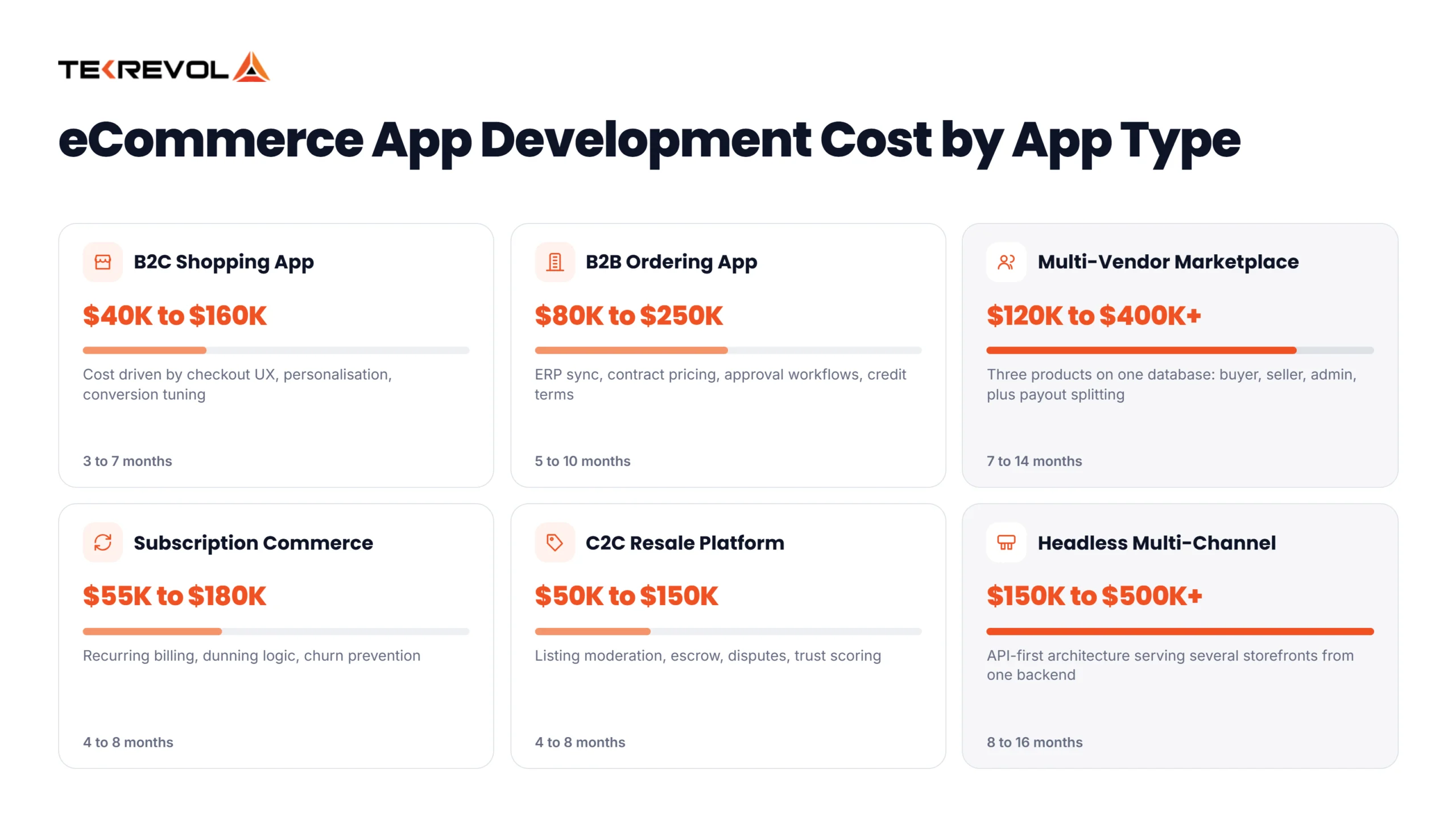
The app type sets your floor before you pick a single feature. Here’s what each one actually costs and why.
| App Type | Cost Range | Timeline | What Drives the Price |
| B2C Shopping App | $40,000 – $160,000 | 3 – 7 months | Checkout UX, personalization, conversion tuning |
| B2B Ordering App | $80,000 – $250,000 | 5 – 10 months | ERP sync, contract pricing, approval workflows, credit terms |
| Multi-Vendor Marketplace | $120,000 – $400,000+ | 7 – 14 months | Buyer, seller, and admin panels plus payout splitting |
| Subscription Commerce | $55,000 – $180,000 | 4 – 8 months | Recurring billing logic, dunning, churn prevention |
| C2C Resale Platform | $50,000 – $150,000 | 4 – 8 months | Listing moderation, escrow, dispute handling, trust scoring |
| Headless Multi-Channel | $150,000 – $500,000+ | 8 – 16 months | API-first architecture, several storefronts on one backend |
The jump from B2C to marketplace is the one that surprises people most. A marketplace isn’t one app with a seller login bolted on. It’s three products sharing a database, and every payout rule you add multiplies the QA effort. Our B2B trading marketplace for Arrow Recovery, which cut quote turnaround by 20 percent, sits in exactly that bracket.
If your model looks closer to on-demand fulfillment than classic retail, the pricing logic shifts again, and our on-demand app development service breakdown covers that path properly.
Which eCommerce App Features Impact the Cost the Most?
Features that impact eCommerce app cost the most are the ones touching money and inventory. Payment gateway integration runs $3,000 to $12,000. Real-time inventory sync runs $8,000 to $25,000. AI recommendation engines run $10,000 to $30,000. Catalog and cart screens cost far less.
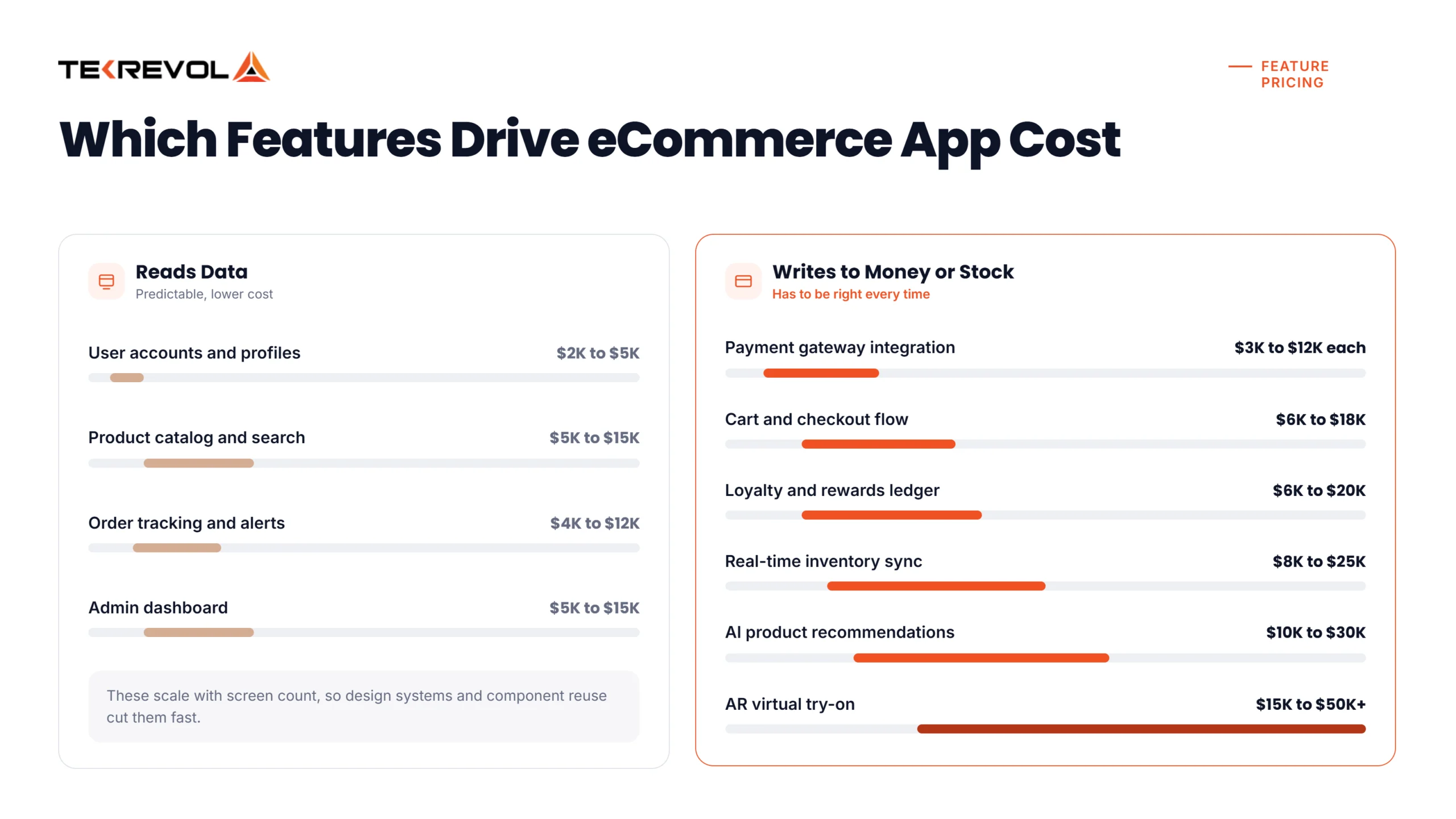
Most feature lists we receive are sorted by excitement. They should be sorted by revenue impact. Here’s what the common ones actually cost to build properly.
| Feature | Cost Range | Why It Costs That |
| User Registration & Profiles | $2,000 – $5,000 | Social login, OTP, session handling |
| Product Catalog & Search | $5,000 – $15,000 | Faceted filters and search indexing, not just a list |
| Cart & Checkout Flow | $6,000 – $18,000 | Tax, shipping rules, promo logic, guest checkout |
| Payment Gateway Integration | $3,000 – $12,000 per gateway | Tokenization, 3DS, refunds, reconciliation |
| Real-Time Inventory Sync | $8,000 – $25,000 | Race conditions, oversell protection, warehouse feeds |
| Order Tracking & Notifications | $4,000 – $12,000 | Carrier APIs, webhooks, push infrastructure |
| Admin Dashboard | $5,000 – $15,000 | Roles, permissions, reporting, bulk actions |
| Loyalty & Rewards | $6,000 – $20,000 | Points ledger, tier rules, expiry handling |
| AI Product Recommendations | $10,000 – $30,000 | Model training, event pipeline, cold-start handling |
| AR Virtual Try-On | $15,000 – $50,000+ | 3D assets, device calibration, per-SKU modelling |
Here’s the pattern worth internalising. Anything that reads from a database is cheap. Anything that writes to money or stock is expensive, because it has to be right every time.
And checkout deserves special attention. Baymard Institute, which compiled 50 separate studies on the subject, puts the average documented cart abandonment rate at 70.22 percent. Seven in ten filled carts never convert. Spending an extra $8,000 to make checkout faster usually pays for itself before the loyalty programme ever ships.
How Do AI and Advanced Technologies Change eCommerce App Cost?
AI adds $5,000 to $50,000 per feature to eCommerce app cost, plus ongoing inference bills. A rule-based chatbot starts near $3,000. A trained recommendation engine runs $10,000 to $30,000. Custom pricing or fraud models push past $35,000 before monthly compute costs.
AI is the fastest-moving line item in any 2026 build estimate, and it’s the one clients most often over-order. Gartner forecasts worldwide AI spending will reach $2.52 trillion in 2026, a 44 percent jump, with $452.5 billion of that going to AI software. That money is chasing outcomes, not novelty, and your app budget should do the same.
| AI Capability | Build Cost | Ongoing Monthly | Worth It When |
| Rule-Based Chatbot | $3,000 – $8,000 | $50 – $300 | Support volume is repetitive and high |
| LLM-Powered Support Agent | $10,000 – $30,000 | $300 – $3,000 | Queries are varied and human support is your bottleneck |
| Recommendation Engine | $10,000 – $30,000 | $200 – $2,000 | Catalog is large enough that browsing fails |
| Visual Search | $8,000 – $18,000 | $150 – $1,200 | Customers shop by look, not by keyword |
| Dynamic Pricing | $12,000 – $35,000 | $300 – $2,500 | Margins are thin and competitors move daily |
| Fraud Detection | $10,000 – $30,000 | $200 – $2,000 | Chargebacks are eating real money |
| AR Virtual Try-On | $15,000 – $50,000+ | $200 – $1,500 | Returns are driven by fit or fabric uncertainty |
The mistake we see repeatedly is ordering four AI features at once on a catalog too small to train any of them. Recommendation engines need behavioural data. With 300 SKUs and 400 monthly orders, a well-merchandised category page beats a cold-start model that costs $22,000.
Our advice is boring, and it works: ship one AI feature that protects revenue you’re already losing, measure it for a quarter, then fund the next one from what it returned. Teams that want the model layer built properly rather than bolted on can look at how we approach AI development services for commerce workloads.
What Factors Affect the eCommerce App Development Cost the Most?
Factors affecting eCommerce app development cost, ranked by impact: backend architecture, number of third-party integrations, team location and hourly rate, platform coverage, design complexity, and compliance scope. Backend and integrations together account for most budget variance between similar-looking projects.
Let’s take them one at a time, because the ranking matters more than the list.
Backend architecture
Monolithic is cheaper to start and painful to scale. Headless costs more upfront and saves you a rebuild at year three. If you’re planning several storefronts or channels, headless is the cheaper option measured over five years, not the expensive one.
Third-Party Integrations
Every integration adds engineering hours. A Stripe payment gateway integration is straightforward. Connecting to a legacy ERP system, syncing real-time inventory across 40 warehouse locations, or building a custom OMS is a materially different conversation. Budget for integrations based on the complexity of each system, not just the count.
Our custom software development service team regularly handles complex ERP and CRM bridge builds that standard app agencies simply don’t scope for.
Team location
This is the single largest swing on the invoice. The bands below reflect what we consistently see when clients bring us competing quotes to compare.
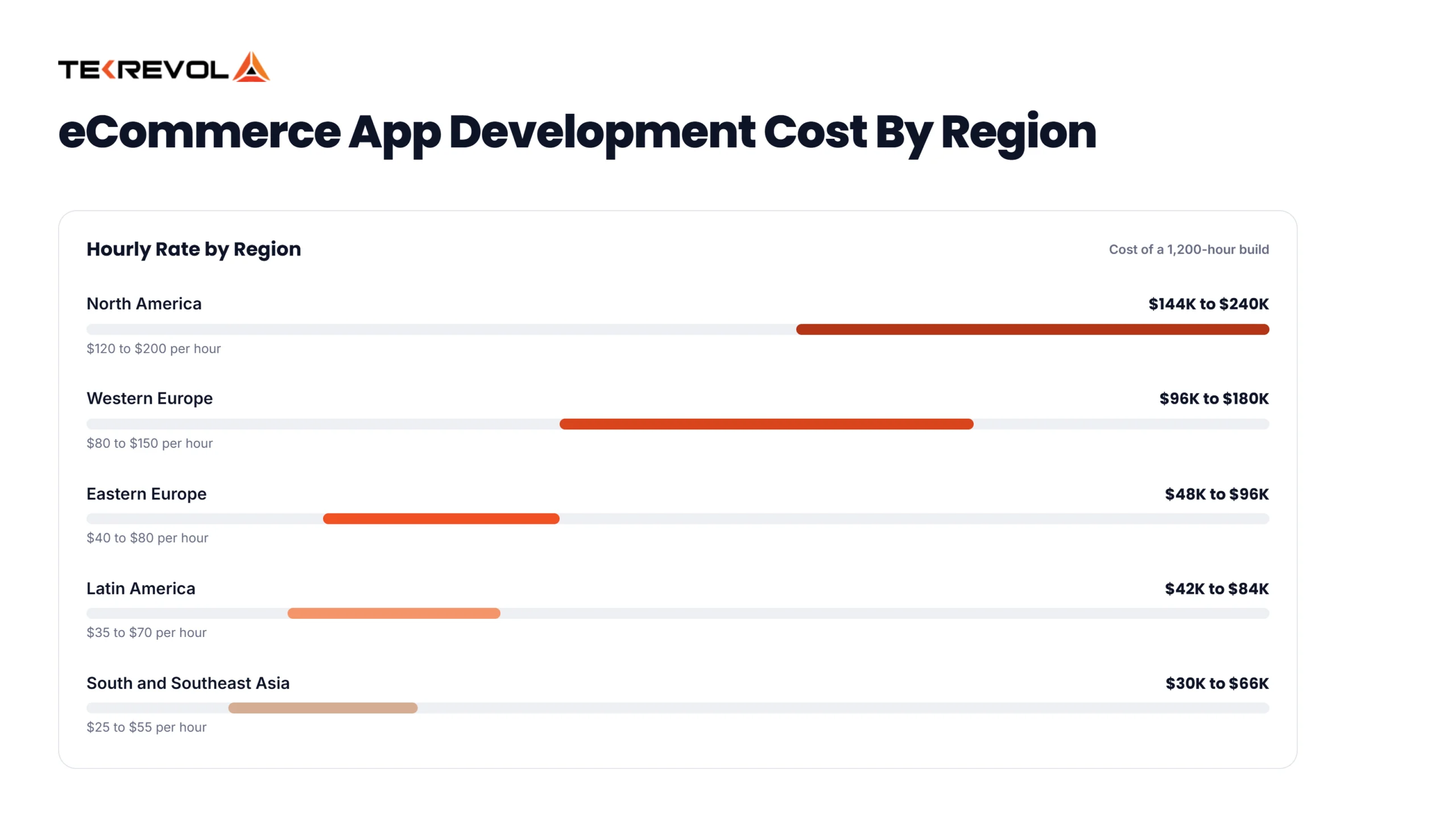
| Region | Typical Hourly Rate | 1,200-Hour Project |
| North America | $120 – $200 | $144,000 – $240,000 |
| Western Europe | $80 – $150 | $96,000 – $180,000 |
| Eastern Europe | $40 – $80 | $48,000 – $96,000 |
| Latin America | $35 – $70 | $42,000 – $84,000 |
| South & Southeast Asia | $25 – $55 | $30,000 – $66,000 |
Cheap rates only stay cheap if the code holds. We’ve been hired to rescue enough $30,000 builds to know that a rewrite costs more than doing it right did.
Platform coverage
Going native on both iOS and Android gives you peak performance, critical if your app relies on real-time inventory, camera-based AR, or payment-grade security. Cross-platform frameworks like Flutter or React Native can cut your budget by 30–40% and are a legitimate choice for most MVP-stage projects. The right choice depends on your roadmap, not just your current budget.
Cross-Platform (Flutter / React Native) |
Native (Swift + Kotlin) Best Performance |
| One codebase for iOS + Android | Full access to device hardware APIs |
| 30–40% faster time to market | Superior for AR, payments, and biometrics |
| Lower initial development cost | Better long-term scalability |
| Ideal for MVPs and content-heavy apps | Higher cost but higher conversion ceiling |
| Performance gaps in hardware-intensive tasks | Preferred for iOS app development at enterprise scale |
UI/UX Design Strategy — Conversion-Focused vs. Basic
There is a measurable difference between a UI that looks good in a Figma deck and a UX that converts at 4%+ in production. Conversion-focused design, optimized checkout flows, strategic product-card layouts, behavior-triggered nudges, cost more upfront but pay back in weeks.
Generic template-based design costs less and usually costs you more in the long run through abandoned carts and poor retention.
Compliance scope
PCI-DSS, GDPR, and regional data residency each add engineering and audit hours. This is not a line you negotiate down.
What Does Each Stage of the eCommerce App Development Process Cost?
The eCommerce app development process costs break down across six stages: discovery at 8 to 12 percent of budget, design at 15 to 20 percent, development at 40 to 55 percent, QA at 10 to 15 percent, deployment at 5 percent, and post-launch stabilisation at 5 to 10 percent.
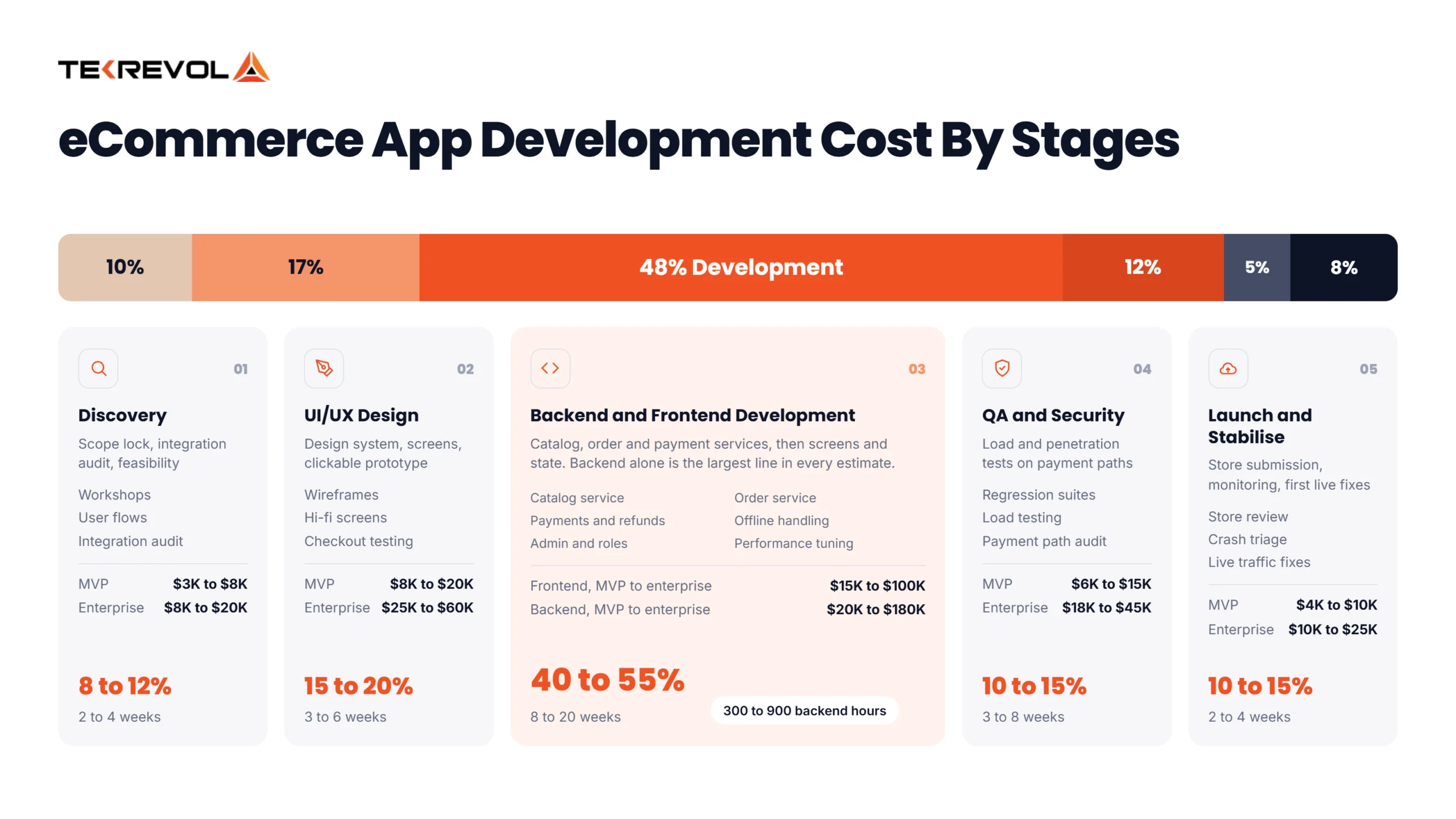
Your total eCommerce mobile app development cost is the sum of six phases. Each one has its own hour range, its own cost drivers, and its own failure point where budget gets burned for nothing. Knowing the percentages also helps you spot a bad quote instantly. If a proposal allocates two percent to discovery, you’re paying for that missing analysis later, in change requests.
Phase 1: Discovery and Business Analysis
40 to 80 hours. $3,000 to $8,000 on an MVP, $8,000 to $20,000 at enterprise scale.
This is the phase clients want to skip and good teams refuse to. Stakeholder interviews, competitor teardowns, user-journey mapping, and a technical feasibility assessment on every system the app has to touch. We’ve watched this phase catch integration problems that would have surfaced in month four and cost five figures to unpick.
Phase 2: UI/UX Design
120 to 300 hours. $8,000 to $20,000 on an MVP, $25,000 to $60,000 at enterprise scale.
Information architecture, user flows, wireframes, high-fidelity mockups, an interactive prototype, and a design system you can build on. The lower end buys you a clean, conventional shopping experience.
The upper end buys a conversion-engineered checkout that’s been tested before a line of code exists. What comes out of this phase shapes your development bill almost as much as your feature list does.
Phase 3: Frontend Development
200 to 600 hours. $15,000 to $35,000 on an MVP, $45,000 to $100,000 at enterprise scale.
Everything users see and touch, translated into a responsive, accessible, fast interface across every device you’re targeting. Screen count, platform count, and animation complexity drive the range.
SwiftUI has genuinely sped up native frontend work, though enterprise apps still need performance profiling at every stage, which is the kind of detail our iPhone app development service team plans for upfront.
Phase 4: Backend Development
300 to 900 hours. $20,000 to $55,000 on an MVP, $70,000 to $180,000 at enterprise scale.
The engine room, and the biggest single line in your budget. APIs, databases, server architecture, authentication, inventory management, order processing, payment gateway connections, third-party integrations, and the admin panel. A good backend is invisible to shoppers and indispensable to your operations team.
We build microservices-first with cloud application development service patterns for anything expected to pass 10,000 daily active users.
Phase 5: Testing and QA
80 to 200 hours. $6,000 to $15,000 on an MVP, $18,000 to $45,000 at enterprise scale.
Functional testing, regression, performance and load testing, security audits, PCI-DSS compliance checks, and device compatibility across your real user base. Non-negotiable for anything processing payments. Apps that thin out QA to save money tend to ship payment-flow bugs, and the refunds plus one-star reviews cost more than the testing would have.
Phase 6: Deployment and Launch
40 to 100 hours. $4,000 to $10,000 on an MVP, $10,000 to $25,000 at enterprise scale.
App Store and Google Play submission, server provisioning, payment webhook configuration, analytics, crash monitoring, and app store optimisation basics. This phase also covers the 30 to 90 day post-launch window, where real conversion data tells you what to fix first. Budget for it, because that first iteration round is where the app starts earning.
The full phase breakdown
| Phase | Engineering Hours | MVP Cost | Enterprise Cost |
| Discovery & Business Analysis | 40 – 80 | $3,000 – $8,000 | $8,000 – $20,000 |
| UI/UX Design | 120 – 300 | $8,000 – $20,000 | $25,000 – $60,000 |
| Frontend Development | 200 – 600 | $15,000 – $35,000 | $45,000 – $100,000 |
| Backend Development | 300 – 900 | $20,000 – $55,000 | $70,000 – $180,000 |
| Testing & QA | 80 – 200 | $6,000 – $15,000 | $18,000 – $45,000 |
| Deployment & Launch | 40 – 100 | $4,000 – $10,000 | $10,000 – $25,000 |
| Total | 780 – 2,180 | $56,000 – $143,000 | $176,000 – $430,000 |
Backend is where timelines slip too, because integration surprises surface there rather than in discovery. That’s the argument for spending properly on phase one.
Want the process explained end to end rather than by cost line? Our guide on how to build an eCommerce app from scratch walks through it step by step.
Where Most Companies Overspend?
The most common budget leak we see: clients scope a “simple” app and discover mid-build that their payment processor requires custom fraud detection logic, their warehouse software doesn’t have a public API, or their compliance team needs GDPR-grade data handling built in retroactively.
These aren’t surprises; they’re discovery failures. A thorough Phase 1 eliminates them.
Which Tech Stack Powers a Cost-Efficient eCommerce App?
A cost-efficient eCommerce tech stack in 2026 pairs Flutter or React Native on the frontend with Node.js or Python on the backend, PostgreSQL for transactional data, Redis for caching, and AWS or GCP for hosting. This combination cuts build costs without capping growth.
Your stack decision is a cost decision disguised as a technical one. Here’s how the common choices compare.
| Layer | Cost-Efficient Pick | Enterprise Pick | Cost Impact |
| Mobile Frontend | Flutter or React Native | Native Swift + Kotlin | Cross-platform saves 30 – 40% |
| Backend | Node.js or Python (Django) | Java or .NET microservices | Microservices add 20 – 35% upfront |
| Database | PostgreSQL | PostgreSQL + Elasticsearch + Redis | Search infrastructure adds $8K – $20K |
| Commerce Engine | BigCommerce or Shopify headless | Custom or commercial tools | Custom engine adds $50K – $150K |
| Hosting | AWS or GCP managed services | Multi-region with global CDN | Multi-region adds $2K – $15K monthly |
| Payments | Stripe or a regional gateway | Multiple gateways plus fraud layer | Each extra gateway adds $3K – $12K |
Flutter and React Native are close enough on cost that team availability should decide it, and our cross-platform app development service team will tell you which one fits your hiring plan rather than which one is fashionable.
One more thing: don’t buy a custom commerce engine to avoid a $2,000 annual platform fee. That math never works. Buy custom when the platform genuinely blocks your business model, and not a moment before.
How Do eCommerce Apps Make Money?
eCommerce apps make money through direct product sales, commission on marketplace transactions, subscription fees, delivery and service charges, in-app advertising, and premium tiers. Most profitable apps run two or three of these together rather than relying on product margin alone.
The revenue model shapes your build cost, so it belongs in the budget conversation and not after it.
| Model | How It Earns | Build Cost Impact |
| Direct Product Sales | Margin on your own inventory | Baseline, no extra systems |
| Marketplace Commission | 5 – 20% cut per seller transaction | Adds seller panel and payout engine, $25K – $70K |
| Subscription or Membership | Recurring fee for perks or free delivery | Adds billing and dunning logic, $10K – $30K |
| Delivery and Service Fees | Charge per order or per zone | Adds routing and zone rules, $8K – $20K |
| In-App Advertising | Sponsored placements and banners | Adds ad slots and reporting, $5K – $15K |
| Data and Insights | Anonymised trend reports for brands | Adds analytics pipeline, $15K – $40K |
What Hidden Costs Should You Budget For After Launch?
Hidden costs of eCommerce apps include annual maintenance at 15 to 20 percent of build cost, cloud hosting, payment processing fees of roughly 2.9 percent per transaction, third-party API subscriptions, app store fees, compliance renewals, and customer support tooling. These recur every year.
The build invoice is the part everyone plans for. The running costs are the part that quietly reshapes your margin.
| Ongoing Cost | Typical Annual Range | Notes |
| Maintenance and Updates | 15 – 20% of build cost | OS updates, library patches, bug fixes |
| Cloud Hosting and Infrastructure | $3,000 – $50,000+ | Scales with traffic and catalog size |
| Payment Processing | ~2.9% + fixed fee per transaction | Grows with revenue, never with budget |
| Third-Party APIs and SaaS | $3,000 – $25,000 | Search, email, reviews, analytics, shipping |
| App Store Fees | $99 Apple + $25 one-time Google | Plus store commission on digital goods |
| Security and Compliance | $5,000 – $30,000 | PCI-DSS renewals, pen tests, audits |
| Customer Support Tooling | $2,000 – $20,000 | Helpdesk, live chat, ticket routing |
If you want the operational side handled properly rather than improvised, our custom software development services build the internal tooling that keeps commerce operations running.
How Can You Reduce eCommerce App Development Cost Without Cutting Quality?
To reduce eCommerce app development cost, ship a focused MVP first, choose cross-platform over dual native, use managed services instead of custom infrastructure, integrate proven APIs rather than building them, and phase AI features. These cut 30 to 45 percent without weakening the product.
Cost reduction done badly is just deferred cost. Here’s what actually holds up.
- Ship an MVP that can take money. Catalog, search, cart, one gateway, order tracking. Everything else waits for evidence from real users.
- Go cross-platform unless hardware demands otherwise. One codebase, two stores, roughly 30 to 40 percent saved on frontend hours.
- Buy the commodity, build the differentiator. Search, reviews, email, and analytics are solved problems. Your merchandising logic isn’t.
- Use managed cloud services. Managed databases and queues cost more per month and far less per year once you count the DevOps time they replace.
- Phase the AI layer. One feature, one quarter, one measurement. Fund the next from the return.
- Fix checkout before adding features. With cart abandonment averaging above 70 percent per the Baymard Institute, checkout is where the cheapest revenue lives.
- Extend your team instead of rebuilding it. Bringing in specialists for a defined phase costs less than hiring permanently, and our IT staff augmentation model exists for exactly that.
- Reuse a proven design system. Custom every pixel, and you’ll pay twice: once in design and again in QA.
What we’d steer you away from is picking a partner on hourly rate alone. The cost of a rewrite dwarfs the savings, and we’ve been on the rescue side of that story more times than we’d like. If you want a longer look at what disciplined engineering returns, here’s how TekRevol helped a business achieve 10x business growth.
Why Choose TekRevol for eCommerce App Development?
TekRevol has delivered 150+ eCommerce apps across 11 industries with a 50+ strong eCommerce engineering team. We build on fixed, phase-based estimates, integrate PCI-DSS-compliant payment flows from day one, and hand over a codebase you own outright, not one you’re locked into.
Here’s what that means in practice for your budget.
- One team, end to end. Discovery, design, engineering, QA, and launch sit under one roof. You’re not paying a coordination tax between three vendors, and nobody gets to blame the other guy when something breaks.
- Estimates tied to scope, not optimism. We break every quote into the six phases in the table above, so you can see what you’re paying for and cut what you don’t need before work starts.
- Commerce-specific experience. Multi-vendor payouts, omnichannel inventory sync, regional payment gateways, and loyalty ledgers are problems we’ve already solved. Solved problems cost less than novel ones.
- Built to scale from the first commit. Modular codebases and cloud-ready frameworks mean your version two doesn’t start with a rewrite. Our broader mobile app development service practice applies the same standard across every build.
TekRevol holds a 4.8 out of 5 rating across 83 verified Clutch reviews, and has been recognised by the Horizon Interactive Awards and the dotCOMM Awards for interactive product design.
Ready to stop guessing what your eCommerce app will cost?
Share your idea, and we'll return a phase-by-phase estimate and delivery timeline you can take to your board.
Talk to Our eCommerce Experts →


