



- Hybrid app development costs $15,000 for a simple build and $250,000 or more for enterprise.
- One shared codebase serves iOS and Android, cutting build costs by 40% compared to two native apps.
- Your framework choice carries genuine exit risk, since Microsoft ended all Xamarin support in 2024.
- Developer location swings your hourly rate from $20 to $180 for the same work.
- Annual maintenance adds another 15% to 20% of build cost every year after you launch.
- An accurate hybrid app quote needs a feature list, not a paragraph describing your idea.
Building a multi-platform mobile application is one of the most effective ways to expand your digital reach, but setting a realistic financial strategy comes first. When you want to connect with users on both iPhones and Android, writing separate software applications can quickly strain your capital. That is why so many growing businesses turn to hybrid app development to streamline engineering hours while keeping initial costs predictable.
Hybrid app development costs $15,000 to $250,000+, and most businesses land between $45,000 and $120,000 for a build covering iOS and Android. Because one team maintains one codebase, hybrid usually runs about 40% below two separate native apps, which is the same economics behind cross-platform mobile app development generally.
This comprehensive pricing guide breaks down total expenses across complexity tiers, hiring models, industry demands, and ongoing post-launch care. We will also share practical optimization strategies to help you get maximum value from our mobile app development services without overspending.
What Is Hybrid App Development?
Hybrid app development is the process of building one codebase that ships to both the App Store and Google Play. The app installs like a native app and uses device hardware through plugins. However, it splits into two approaches that cost very differently.
That split is the thing to understand before you read a single price.
WebView-based Hybrid Apps
WebView hybrid apps wrap a web application inside a native shell. Ionic works this way. Because your team writes HTML, CSS, and JavaScript, web developers can build it, so this route costs the least.
The trade-off shows up in feel. Animations stutter, scrolling lags on cheaper Android phones, and users can often tell. Still, for internal tools and content apps, that ceiling rarely matters.
Compiled Cross-platform Apps
Compiled hybrid apps ship code that runs natively on the device rather than inside a browser. Flutter and React Native both work this way, and they now dominate serious hybrid work.
| WebView Hybrid | Compiled Cross-Platform | |
| Frameworks | Ionic, Capacitor | Flutter, React Native, .NET MAUI |
| Skills needed | Web developers | Mobile-focused developers |
| Relative build cost | 25% – 35% lower | Higher, closer to native |
| Performance ceiling | Moderate | Near-native |
| Best for | Internal tools, content, MVPs | Consumer apps, ecommerce, marketplaces |
Source: TekRevol pricing observations
Therefore, when an agency quotes “a hybrid app,” ask which of these two they mean. It’s the single fastest way to explain a gap between two proposals. For a sense of what the compiled route produces at scale, our roundup of hybrid app examples covers products you already use.
How Much Does Hybrid App Development Cost in 2026?
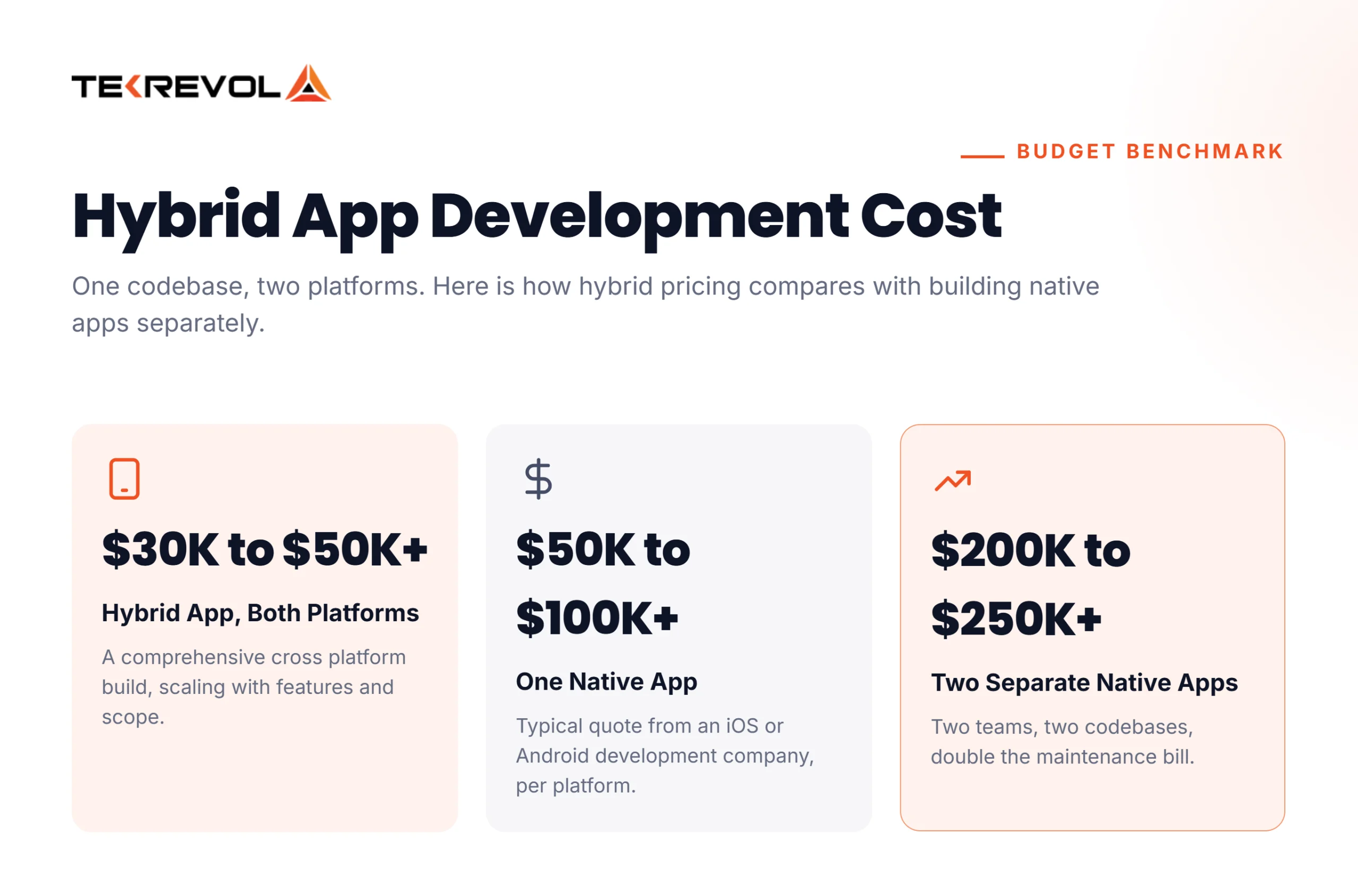
Hybrid app development costs $15,000 to $250,000+ in 2026. Simple apps run $15,000 to $45,000. Medium-complexity apps cost $45,000 to $120,000. Complex platforms reach $250,000. Each figure covers both iOS and Android together.
| Tier | Cost (both platforms) | Timeline | Best Fit |
| Simple | $15,000 – $45,000 | 6 – 10 weeks | MVPs, internal tools, single workflow |
| Medium | $45,000 – $120,000 | 3 – 6 months | Funded startups, growing businesses |
| Complex | $120,000 – $250,000 | 6 – 10 months | Marketplaces, regulated products |
| Enterprise | $250,000+ | 10 – 16 months | Multi-app systems, deep integrations |
Source: TekRevol pricing observations across hybrid engagements
That comparison matters when you’re reading a hybrid mobile app development quote. The cost covers two platforms at once, while a native quote usually covers one. So put the two numbers side by side without adjusting for coverage, and you’ll reach the wrong conclusion every time.
The range also stays wide because of the WebView versus compiled split above. That single decision moves your number by roughly 30% before anyone writes a line of code, so settle it first.
After that, four things narrow the range: how complex your app is, which industry rules apply, where your team sits, and which framework you build on. The rest of this guide takes them one at a time.
Unsure Which Kind of Hybrid App You're Actually Buying?
Give us 30 minutes and a feature list and we'll tell you whether you're being priced for a WebView wrapper or a compiled build.
Get a Free Hybrid App Quote Review →Hybrid App Development Cost Breakdown by Complexity
Hybrid app development cost by complexity scales from $15,000 for simple MVPs to over $250,000 for enterprise systems. Complexity is determined by the number of screens, custom UI elements, database workflows, third-party APIs, and offline sync capabilities.
Simple Hybrid Apps: $15,000 to $45,000
Simple hybrid apps handle one job well. Think a store locator, an event guide, a booking form, or an internal reporting tool. There’s one user type, data mostly flows in one direction, and the backend is a managed service rather than something custom.
You get standard components, email or social login, push notifications, basic analytics, and submission to both stores. However, you don’t get offline sync or a custom API at this price.
Medium-complexity Hybrid Apps: $45,000 to $120,000
Medium apps are where most real businesses land. Accounts, user roles, a payment flow, a custom backend, and an admin panel. Ecommerce apps, booking platforms, and subscription products all sit here.
The jump in cost comes from the backend rather than the app itself. Once you outgrow a managed service and need your own API with permissions and reporting, you’ve added a second engineering discipline to the project.
Complex Hybrid Apps: $120,000 to $250,000
Complex means real-time. Live tracking, in-app messaging, video, or matching algorithms, plus heavy third-party integration. Each of those features carries its own infrastructure and its own long tail of edge cases.
Regulated industries land here almost automatically, because compliance work is invisible to users and expensive to build properly.
Enterprise Hybrid Platforms: $250,000+
Enterprise builds aren’t just bigger apps. Rather, they’re systems. That means several linked apps, single sign-on against your existing directory, a link into whatever ERP or CRM you already run, and a security audit before anything ships.
Which Factors Influence the Cost of Hybrid App Development?
Factors affecting hybrid app development cost include feature complexity, custom visual design, backend infrastructure, third-party integrations, developer geographic location, compliance security demands, and team engagement models.
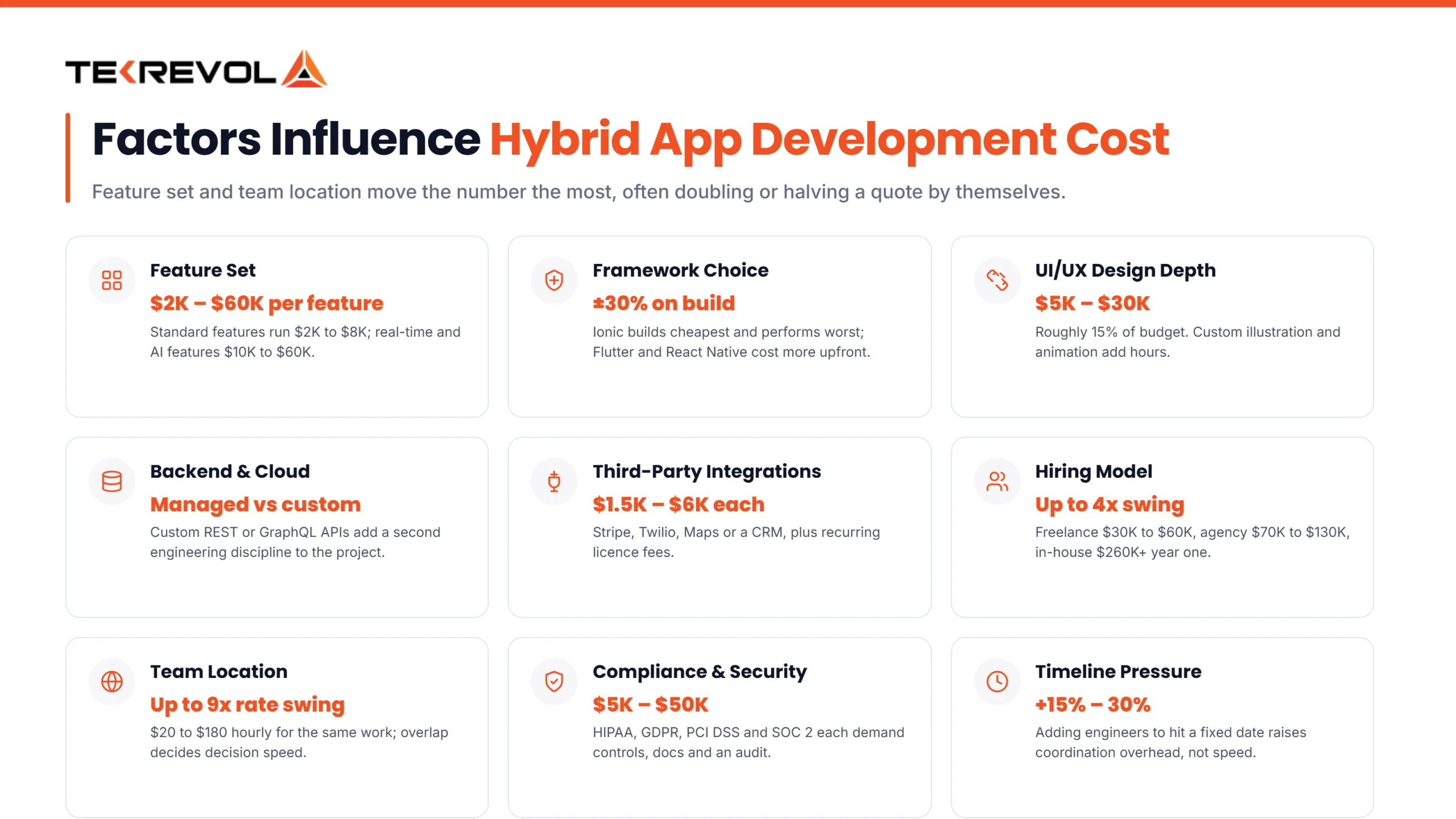
Feature set and location move the number the most, often doubling or halving a quote by themselves. Knowing which functional variables move the financial needle helps you make informed scope trade-offs before launch.
1. Feature Set
Your feature set is the most direct driver of cost. Standard features run $2,000 to $8,000 each, while real-time and AI features run $10,000 to $50,000.
| Feature | Hybrid cost |
| User authentication | $2,000 – $8,000 |
| Push notifications | $1,500 – $5,000 |
| In-app payments | $5,000 – $18,000 |
| Geolocation and mapping | $4,000 – $15,000 |
| Real-time chat | $8,000 – $25,000 |
| Video or audio streaming | $10,000 – $28,000 |
| Custom dashboards | $8,000 – $30,000 |
| AI or ML features | $15,000 – $60,000 |
Source: TekRevol pricing observation
2. Framework Choice
Framework choice affects both build cost and long-term risk. Ionic builds cheapest but perform the worst. Flutter and React Native cost more upfront, yet they perform close to native and have far healthier ecosystems. The framework section below covers the risk side properly.
3. UI/UX Design Depth
Design consumes 15% of the hybrid app development budget, or $5,000 to $30,000 depending on ambition. Pre-built UI components keep initial investment low, whereas custom illustrations, complex animations, and bespoke branding add design hours.
4. Backend Systems & Cloud Infrastructure
Backend work decides whether growth costs you linearly or exponentially. A managed backend keeps early costs low, although building custom RESTful/GraphQL APIs and serverless architectures requires dedicated backend software engineering.
5. Third-party Integrations
API connections like Stripe, Twilio, Google Maps, or external CRMs introduce configuration effort and ongoing software licensing fees. Each integration adds $1,500 to $6,000. Integrations are also where estimates go wrong most often.
6. Hiring Model
Your hiring model changes the same project’s price by more than 4x. Freelancers cost the least and carry the most delivery risk. Agencies cost more and absorb it. In-house teams cost the most and only make sense once your roadmap is long enough to keep them busy.
| Hiring model | Cost for an $80K-scope hybrid app | Monthly per developer | Best for |
| Freelance team | $30,000 – $60,000 | $3,000 – $8,000 | Small scope, technical founder on hand |
| Staff augmentation | $50,000 – $95,000 | $6,000 – $14,000 | You have a PM; you need engineers |
| Development agency | $70,000 – $130,000 | Priced per project | No internal tech leadership |
| In-house team | $260,000+ first year | $9,000 – $16,000 loaded | Long roadmap, funded, already hiring |
Source: TekRevol pricing observations
The freelance figure is real, and so is the failure rate behind it. Most hybrid rescue projects we take on began as a freelance build that stalled past halfway. Meanwhile, staff augmentation sits in the middle, giving you dedicated engineers without agency margin, provided somebody on your side runs the project.
7. Team location
Location swings your rate 9x on its own, as the region table showed earlier. Beyond the rate card, timezone overlap decides how fast decisions get made, which is why a cheap team in a distant timezone often costs more in elapsed weeks than it saves in dollars.
8. Compliance and Security
Compliance adds $5,000 to $50,000 depending on your sector. HIPAA, GDPR, PCI DSS, and SOC 2 each demand specific technical controls, documentation, and usually an external audit before launch.
9. Timeline Pressure
Compressing a hybrid app development timeline costs money. Adding engineers to hit a fixed date raises coordination overhead, so it typically adds 15% to 30% to total cost without shortening delivery proportionally.
What Does Hybrid App Development Cost by Industry?
Hybrid app development cost by industry spans from $25,000 for education apps to $220,000 for fintech, based on sector requirements. Regulated sectors cost the most because compliance and security work sit on top of the build. Consumer content apps cost the least.
| Industry | Hybrid cost | Primary cost driver |
| Fintech | $80,000 – $220,000 | KYC, encryption, PCI DSS, audits |
| Healthcare | $70,000 – $190,000 | HIPAA, encrypted records, EHR links |
| On-demand services | $60,000 – $170,000 | Live tracking, dispatch, multiple apps |
| Social networking | $50,000 – $160,000 | Real-time messaging, feeds, moderation |
| Ecommerce | $35,000 – $120,000 | Catalog, checkout, payment providers |
| Entertainment & media | $40,000 – $150,000 | Streaming, media delivery, licensing |
| Education | $25,000 – $90,000 | Content delivery, progress, offline mode |
| Business & internal tools | $20,000 – $75,000 | Reporting, roles, legacy system links |
Source: TekRevol pricing observations.
Notice the pattern here. The expensive industries aren’t the ones with more features. Instead, they’re the ones where being wrong has consequences, so the money goes into audit trails, encryption, and review cycles nobody ever sees.
Ecommerce Hybrid App Cost
Ecommerce hybrid apps cost $35,000 to $120,000. Catalog, cart, and checkout are well-trodden ground, so what raises ecommerce app development budget is inventory sync with an existing ERP plus multiple payment providers across regions.
Healthcare Hybrid App Cost
Healthcare hybrid apps cost $70,000 to $190,000. HIPAA drives the premium: encrypted storage, audit logging, role-based access, and agreements with every vendor touching patient data. This compliance necessitates advanced security measures and thorough testing, driving up healthcare app development costs.
Fintech Hybrid App Cost
Fintech hybrid apps cost $80,000 to $220,000, the top of this table. Identity verification, transaction ledgers, fraud rules, and an external security review before launch all carry weight. Our fintech app development cost guide separates one-time spend from recurring compliance.
Education and eLearning Apps
Education apps cost $25,000 to $90,000; the cheapest category here. The category usually skips real-time features and heavy compliance, which is precisely where money goes in the rows above. Our educational app development guide covers the offline access most teams underestimate.
Where Does the Hybrid App Budget Actually Go?
Hybrid app development budget allocation splits into four main phases: UI/UX Design (15–20%), Core Development & Backend (40–50%), Quality Assurance & Testing (15–20%), and Project Management & Deployment (10–15%). Development alone consumes nearly half.
| Phase | Share | What happens |
| Discovery and planning | 10% | Requirements, flows, framework decision |
| UI/UX design | 15% | Wireframes, visuals, shared component library |
| Development | 45% | Screens, state, backend, integrations |
| QA and testing | 15% | Both platforms, device matrix, regression |
| Project management | 10% | Sprints, coordination, stakeholder reporting |
| Deployment | 5% | Two store submissions, release pipeline |
Source: TekRevol pricing observations
Understanding how your hybrid app investment is distributed across development phases ensures your project remains well-structured and fully resourced.
- UI/UX Design: Creating user journeys, wireframes, visual design systems, and responsive layouts across target screens.
- Frontend & Backend Engineering: Writing cross-platform code, setting up custom cloud servers, and wiring business logic.
- Testing & Quality Assurance: Device testing, security audits, performance profiling, and bug fixes.
- Project Management & Launch: Agile sprint planning, client communications, app store guideline compliance, and store publishing.
Design deserves particular attention in hybrid projects. A shared component library gets reused across both platforms and every future screen. So money spent there keeps paying you back, which it doesn’t do on native builds.
Know Your Budget But Not What It Actually Buys?
Tell us your ceiling and we'll work backwards: what scope fits, which phases it covers properly, and which corners you'd be cutting to get there. Straight answer, no upsell.
Book a Free Budget-Fit Session →How Much Does Hybrid App Development Cost Vary by Region?
Hybrid app development cost by region varies by up to 9x for identical work. US developers charge $100 to $180 hourly, Canadian developers $85 to $150, and South Asian developers $20 to $50. Rate alone is a poor way to choose.
| Region | Hourly Rate | 1,000-hour Build | Overlap with US Hours |
| United States | $100 – $180 | $100,000 – $180,000 | Full |
| Canada | $85 – $150 | $85,000 – $150,000 | Full |
| Australia | $90 – $140 | $90,000 – $140,000 | 2 – 4 hours |
| Western Europe and UK | $80 – $150 | $80,000 – $150,000 | 3 – 5 hours |
| Middle East (UAE, KSA) | $40 – $80 | $40,000 – $80,000 | 1 – 3 hours |
| Eastern Europe | $40 – $75 | $40,000 – $75,000 | 2 – 4 hours |
| Latin America | $40 – $70 | $40,000 – $70,000 | 5 – 8 hours |
| South Asia (India, Pakistan) | $20 – $50 | $20,000 – $50,000 | 1 – 3 hours |
| Southeast Asia | $20 – $45 | $20,000 – $45,000 | 0 – 2 hours |
Source: TekRevol pricing observation
Offshore and Nearshore Tradeoffs
Offshore teams cost 60% to 80% less per hour, and plenty of excellent hybrid work happens at those rates. Still, check overlap before you check the rate card, since coordination lag quietly eats the savings on decision-heavy projects.
Nearshore in Latin America splits the difference: $40 to $70 hourly with five to eight hours of daily overlap. That combination explains why nearshore has taken so much work from traditional offshore over the past few years.
How Does Hybrid App Development Cost Compare to Other Platforms?
Hybrid app development costs roughly 40% less than building separate native iOS and Android apps. Against a single native app, hybrid costs slightly more, since you’re covering two platforms. Flutter and React Native price within about 10% of each other.
| Approach | Medium-complexity build | Platforms covered | Trade-off |
| Hybrid (Flutter) | $45,000 – $110,000 | iOS + Android | Larger app size, smaller hiring pool |
| Hybrid (React Native) | $45,000 – $120,000 | iOS + Android | Native modules for hardware features |
| Hybrid (Ionic / WebView) | $30,000 – $80,000 | iOS + Android + web | Weaker performance, dated feel |
| Native iOS only | $55,000 – $165,000 | iOS | Best performance, no Android users |
| Native Android only | $50,000 – $150,000 | Android | Wider QA matrix, no iOS users |
| Both, natively | $105,000 – $315,000 | iOS + Android | Two codebases, two release cycles |
Source: TekRevol pricing observations, August 2026.
Hybrid vs Native iOS Cost
Hybrid beats native iOS app development on cost only when you genuinely need both platforms. So if your whole audience is on iPhone, native Swift is the better buy and the comparison stops being useful.
Hybrid vs Native Android Cost
The same logic holds against native Android app development cost, although with one catch. Hybrid inherits Android’s device fragmentation problem, so you still test across many OS versions and manufacturer skins. As a result, your QA savings are smaller than your development savings.
Flutter vs React Native Cost
Flutter app development prices are within roughly 10% of React Native, so cost shouldn’t decide this one. Instead, pick Flutter when pixel-identical interfaces across platforms matter, since Flutter renders its own widgets rather than mapping to native ones.
Meanwhile, React Native cost wins on hiring. Its JavaScript base means your existing web developers can contribute, and replacing someone mid-project is considerably easier.
Which Hybrid Framework Should You Budget For?
Budget for Flutter or React Native in 2026. Both are actively maintained with large ecosystems. Avoid starting new projects on frameworks with uncertain futures, because Microsoft ended Xamarin support on May 1, 2024, leaving those apps needing migration.
This is the hybrid cost almost nobody quotes for, and it’s the one that arrives years later.
Xamarin is the cautionary example: Per Microsoft’s official Xamarin support policy, support for all Xamarin SDKs, including Xamarin. Forms ended on May 1, 2024. Microsoft’s guidance is direct: existing Xamarin.Forms projects “should be migrated to .NET MAUI.”
The healthy frameworks ship changes too
Flutter released version 3.47 on August 12, 2026, moving Material and Cupertino into standalone packages, with the in-SDK versions scheduled for deprecation in the November 2026 stable release. Meanwhile, React Native froze its legacy architecture in June 2025 and has begun removing that code entirely.
| Framework | Status | Budget implication |
| Flutter | Actively developed, Google-backed | Plan for package migration before November 2026 |
| React Native | Actively developed, Meta-backed | Older apps need New Architecture migration |
| Ionic | Maintained, WebView-based | Cheapest build, weakest performance ceiling |
| .NET MAUI | Actively developed, Microsoft-backed | Sensible only on a Microsoft stack |
| Xamarin | Support ended May 1, 2024 | Migration required; do not start new builds |
Sources: Microsoft official Xamarin support policy; Flutter and React Native official release documentation
Therefore, ask two questions of any framework before you commit. First, who funds it? Second, what happened to the last framework this vendor retired? Those answers predict your five-year cost far better than the build quote does.
Hidden Costs Involved in Hybrid App Development
Hidden costs of hybrid app development include app store fees, hosting, third-party subscriptions, framework upgrades, and maintenance at 15% to 20% of build cost annually. Together, these add $10,000 to $40,000 in the first year alone.
| Hidden cost | Typical range | When it hits |
| Annual maintenance | 15% – 20% of build | Every year, forever |
| Framework major upgrade | $6,000 – $25,000 | Every 12 to 18 months |
| Cloud hosting and backend | $600 – $24,000 / year | Ongoing, scales with users |
| Third-party SDK subscriptions | $1,200 – $18,000 / year | Ongoing from launch |
| Apple Developer Program | $99 / year | Annually, recurring |
| Google Play registration | $25 one-time | At launch only |
| Security audits | $3,000 – $15,000 | Before launch, then periodically |
| Performance optimisation | $5,000 – $15,000 | After launch, when things feel slow |
Sources: Apple Developer Program and Google Play Console pricing; TekRevol observations
Maintenance is the one that surprises people most. Both Apple and Google ship a major OS release every year, so your app either keeps up or starts breaking in ways users notice and review. Our app maintenance cost guide breaks down what sits inside that figure.
Performance optimisation deserves a mention too, particularly on WebView-based hybrid apps. Long lists, heavy animation, and large images behave differently on a low-end Android phone than on the test device sitting in your office.
What Are the Best Hybrid App Optimisation Strategies?
Hybrid app optimisation strategies that genuinely cut cost include shipping a smaller first release, reusing framework components, choosing managed backend services, and picking your region by timezone overlap. Together, these save 30% to 45% without hurting quality.
Here they are ranked by how much each actually saves.
- Ship a smaller version first: This saves more than everything else combined. Pick the single workflow that proves your business works, build only that, then let real usage decide what comes second. Most feature lists we receive carry roughly 40% that no user ever asked for.
- Reuse the framework’s component library: Flutter and React Native both ship deep sets of ready-made components. So custom-designing a date picker the framework already gives you is spending money to move backwards.
- Build a shared component library early: Two weeks spent here feels slow and pays back on every screen afterwards. Teams that skip it end up with forty bespoke screens and a cost-per-feature that climbs instead of falling.
- Use managed backend services until scale forces you off them: Firebase, Supabase, and similar platforms handle auth, database, and notifications for a fraction of custom backend cost. Migrate later, once you have revenue and know your real load.
- Write the requirements down properly: A clear product requirements document costs $3,000 to $8,000 and routinely saves five times that in avoided rework. Vague requirements remain the single most expensive thing in software.
- Pick your region by overlap, then by rate: A $25 hourly rate with one hour of overlap often costs more in elapsed weeks than a $50 rate with six. So compare total delivered cost rather than the rate card.
- Don’t cut QA: We’ve never once seen this work. Testing you skip before launch gets paid for afterwards, at a higher rate, with users watching.
Working to a Fixed Budget and Unsure What to Cut First?
Send us your feature list and your ceiling. We'll mark what belongs in version one, what can wait, and what quietly drags three other features along with it.
Book a Free Scope Prioritisation Session →How Do You Get an Accurate Hybrid App Development Quote?
To get an accurate hybrid mobile app development quote, bring a written feature list, your target platforms, your compliance requirements, and your launch date. Vague briefs produce vague quotes, so any agency quoting from a paragraph is guessing.
Most quote disputes trace back to the brief rather than the agency. So here’s what to prepare before you ask anyone for a number.
- Write the feature list down: Not a description of your idea, but a list: every screen, every user type, every action someone takes. This single document explains most of the variance between quotes.
- Name your platforms: iOS and Android are the default; however, adding web or desktop changes the number meaningfully, and retrofitting a platform later costs far more than including it upfront.
- Flag your compliance scope early: HIPAA, PCI DSS, or GDPR each add work that has to be designed in rather than bolted on afterward.
- Ask for phased pricing: A single lump figure tells you nothing. Instead, ask for cost against discovery, design, development, QA, and deployment, then compare those splits against the budget table earlier in this guide.
- Ask what isn’t included: Maintenance, hosting, third-party licences, and store fees are the four things most commonly left out, and together they run $10,000 to $40,000 in year one.
Finally, treat any quote given without questions as a red flag. A partner who doesn’t interrogate your brief hasn’t understood it, so the number they gave you will change once they do.
Partner With TekRevol to Develop a Hybrid App on a Budget
Managing your total hybrid mobile app development cost requires a practical technical partner who values clear budgets as much as good design. We focus on straightforward communication, structured sprint milestones, and smart technical choices that maximize your investment.
Our cross-platform app development services bring years of experience building scalable applications across major commercial sectors. When you partner with us, you work with an engineering team dedicated to your long-term success. We help you prioritize essential features for your initial release, ensuring you launch on time and within budget.
Whether you need a simple MVP or an enterprise hybrid mobile app development quote, we deliver reliable solutions tailored to your financial blueprint.
Ready to Build Your Hybrid App?
Schedule a free strategic consultation with our technical team to receive a transparent cost estimate for your mobile project.
Get a Free Hybrid App Quote →



![Cost to Build a Crypto Exchange App Like BitOasis UAE 2026 [Guide]](https://assets.tekrevol.com/images-tek/uploads/2026/08/finage-400x203.webp)


