



- A basic crypto exchange app development project can cost between AED 91,800 and AED 164,900.
- A BitOasis-level build with Arabic and English UX, multi-asset trading, fiat integrations, security controls, and a regulatory-ready architecture can cost AED 440,400 to AED 917,500.
- For Dubai, VARA’s current fee schedule lists an AED 100,000 licence application fee and an AED 200,000 annual supervision fee.
- The lack of AI tools, Arabic-first UX, Islamic finance features, and micro-investment options in BitOasis presents open opportunities
Building a crypto exchange app like BitOasis in the UAE costs between AED 91,800 ($25,000) for an MVP and AED 917,500 ($250,000) for a fully VARA-compliant platform.
UAE-specific requirements, i.e Arabic RTL design and AED fiat integration, add 30–40% on top of what a similar build costs elsewhere. But the number alone does not tell the full story.
Here is a quick breakdown of crypto exchange app development cost in the UAE by exchange tier:
- MVP Crypto Exchange: AED 91,800 – AED 164,900 ($25,000 – $45,000) – Basic trading for early users
- Standard Exchange: AED 220,200 – AED 440,400 ($60,000 – $120,000) – Full spot trading with mobile apps
- BitOasis-Level Platform: AED 440,400 – AED 917,500 ($120,000 – $250,000) – Fully regulated, multi-asset, and localized
- Enterprise Exchange: AED 1,101,000 – AED 1,284,500+ ($300,000 – $350,000+) – Includes derivatives, AI, and global compliance
The UAE’s Virtual Assets Law made it far easier for founders to launch a regulated exchange and for users to trust local platforms. Whether you are a founder scoping your first exchange or an investor assessing one, the question is the same: “How much does it cost to develop a crypto exchange app in the UAE?
As an experienced mobile app development company in Dubai, we put together every figure, from cost by exchange type and factors that affect the budget to UAE licensing fees, to help you build something that competes with BitOasis
Not Sure How Much Your Exchange Will Cost?
Share your feature list with TekRevol to receive a detailed cost breakdown, helping you plan accurately and avoid unexpected development expenses.
Claim Your Estimates TodayWhat Is BitOasis and How Does It Set the Regional Benchmark for Crypto Exchange Apps?
Founded in 2015 in Dubai, BitOasis is a long-standing crypto platform serving users across the Middle East. BitOasis Technologies FZE currently holds an active Virtual Asset Service Provider licence from Dubai’s Virtual Assets Regulatory Authority, VARA, for Broker-Dealer Services. The licence was issued on 29 November 2024 and permits the entity to serve institutional, qualified, and retail investors.
BitOasis currently promotes more than 80 crypto assets and 200+ trading pairs, alongside AED and SAR local-currency trading. Its product lineup includes BitOasis Lite for simpler buying and selling and BitOasis Pro for advanced order types, charts, and order-book trading. In August 2026, BitOasis also launched Recurring Buy for automated daily, weekly, or monthly purchases.
If you are building a crypto exchange or brokerage platform for the UAE, BitOasis remains a useful regional benchmark. The key is to benchmark its current product and licensed activity accurately rather than treating most popular mobile wallets in the UAE as the same regulatory model.
Why the UAE Is a High-Growth Market for Crypto Exchanges
The UAE remains one of the region’s most active virtual-asset markets because of regulatory development, institutional participation, fintech infrastructure, and growing retail usage. The regulatory landscape is also more mature than it was a few years ago, with dedicated frameworks in Dubai, ADGM, DIFC, and at the federal level.
- AED 440 billion market size: IMARC Group values the Middle East cryptocurrency market at USD 119.9 billion (AED 440 billion) in 2025.
- 8.30% projected CAGR: IMARC forecasts the Middle East cryptocurrency market to reach USD 245.8 billion (AED 903 billion) by 2034.
- $56 billion in on-chain value received: The UAE received over $56 billion in on-chain value in the 12 months to June 2025, making it MENA’s second-largest crypto market behind Türkiye, per Chainalysis’s 2025 Geography of Crypto report.
Full Breakdown of Cost to Build a Crypto Exchange App Like BitOasis in Dubai
The cost to develop a mobile app in Dubai for a crypto platform depends on what tier of product you are building. Here is how crypto exchange app development costs differ across 4 levels, including BitOasis:
| App Tier | What You Get | Estimated Cost (AED) | Estimated Cost (USD) | Timeline |
| MVP / Prototype | Core spot trading, basic KYC, one fiat pair, iOS or Android only | AED 91,800 – AED 164,900 | $25,000 – $45,000 | 4 – 6 months |
| Standard Exchange | Multi-asset spot trading, full KYC/AML, basic admin panel, 2 to 3 fiat pairs | AED 220,200 – AED 440,400 | $60,000 – $120,000 | 5 – 8 months |
| BitOasis-Level | Full spot trading, VARA-compliant build, Arabic and English UI, multi-fiat, mobile, and web | AED 440,400 – AED 917,500 | $120,000 – $250,000 | 10 – 14 months |
| Enterprise / Beyond | Derivatives, margin trading, staking, AI fraud detection, multi-jurisdiction compliance | AED 1,101,000 – AED 1,284,500+ | $300,000 – $350,000+ | 12 – 18 months |
These ranges cover custom development in the UAE. White-label solutions can reduce upfront cost but come with licensing limits and less flexibility.
A simple way to calculate the total development cost is:
The biggest budget jump happens between the standard tier and the BitOasis-level tier. That gap in the cost to build a cryptocurrency exchange app in the UAE mostly comes from three things:
- VARA-compliant architecture ($20K–$40K added)
- Arabic RTL design system ($8K–$15K added), and
- Proper security audit ($10K–$30K added)
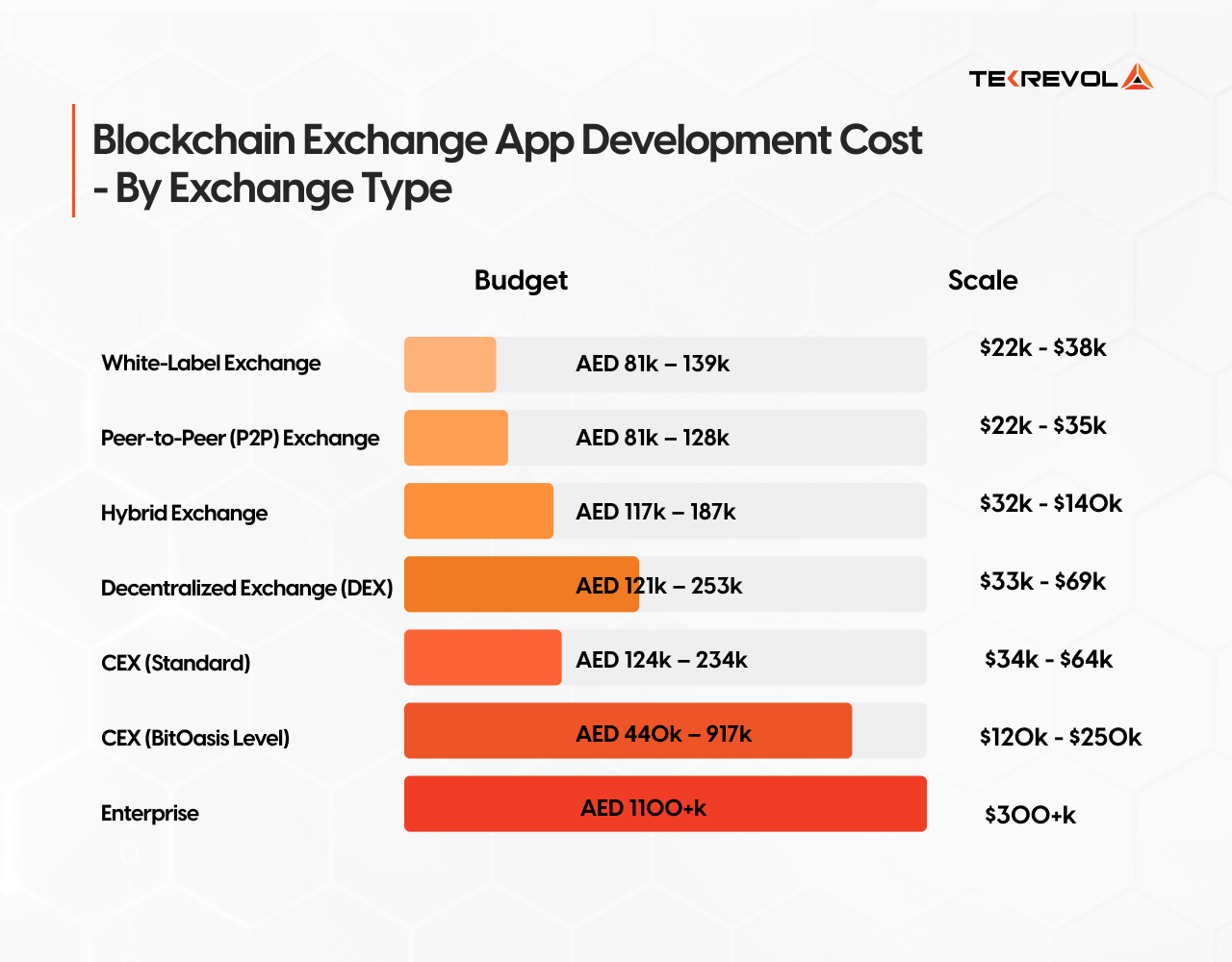
Blockchain Exchange App Development Cost [Breakdown by Exchange Type]
The type of exchange you build changes the architecture and the budget. Each model has a different approach to handling user funds, trades, and compliance.
Let’s break down each model and what it actually costs to build in the UAE:
1. Centralized Exchange (CEX) — Most Similar to BitOasis
A centralized exchange is the model most similar to BitOasis, but licensing is determined by the exact services and regulated activities the operator performs. BitOasis itself is currently licensed by VARA for Broker-Dealer Services, not Exchange Services, so founders should not assume that a CEX architecture automatically maps to a single licence category.
| Component | Estimated Cost (AED) | Estimated Cost (USD) |
| Order Matching Engine | AED 29,360 – AED 73,400 | $8,000 – $20,000 |
| Wallet System (Hot and Cold) | AED 22,020 – AED 44,040 | $6,000 – $12,000 |
| Backend and Admin Panel | AED 29,360 – AED 44,040 | $8,000 – $12,000 |
| Security and KYC/AML | AED 22,020 – AED 36,700 | $6,000 – $10,000 |
| UI/UX (Mobile and Web) | AED 22,020 – AED 36,700 | $6,000 – $10,000 |
| Total (base build) | AED 124,780 – AED 234,880 | $34,000 – $64,000 |
| Total (BitOasis-level with VARA) | AED 440,400 – AED 917,500 | $120,000 – $250,000 |
2. Decentralized Exchange (DEX)
A DEX runs on smart contracts. Users trade directly from their wallets, and there is no central server holding their funds.
DEX development is actually comparable in price to a CEX because smart contract development is specialized work. Firms like CertiK and Halborn are the standard auditors for UAE-facing products
| Component | Estimated Cost (AED) | Estimated Cost (USD) |
| Smart Contract Development | AED 29,360 – AED 55,050 | $8,000 – $15,000 |
| Blockchain Integration | AED 22,020 – AED 36,700 | $6,000 – $10,000 |
| Smart Contract Security Audit | AED 36,700 – AED 110,100 | $10,000 – $30,000 |
| Frontend Development | AED 18,350 – AED 29,360 | $5,000 – $8,000 |
| Testing and Deployment | AED 14,680 – AED 22,020 | $4,000 – $6,000 |
| Total Cost | AED 121,110 – AED 253,230 | $33,000 – $69,000+ |
3. Hybrid Exchange
A hybrid exchange combines the speed of a CEX with the self-custody option of a DEX. This model works well when your audience includes both first-time users and experienced crypto traders.
| Component | Estimated Cost (AED) | Estimated Cost (USD) |
| Centralized Infrastructure | AED 29,360 – AED 44,040 | $8,000 – $12,000 |
| Blockchain and Smart Contract Layer | AED 25,690 – AED 44,040 | $7,000 – $12,000 |
| Wallet (Custodial and Non-Custodial) | AED 22,020 – AED 33,030 | $6,000 – $9,000 |
| Security and Compliance | AED 22,020 – AED 36,700 | $6,000 – $10,000 |
| UI/UX | AED 18,350 – AED 29,360 | $5,000 – $8,000 |
| Total Cost | AED 117,440 – AED 187,170 (base) / AED 514,000+ (full) | $32,000 – $51,000 (base) / $140,000+ (full) |
4. Peer-to-Peer (P2P) Exchange
A P2P exchange connects buyers and sellers directly. The platform holds crypto in escrow until both sides confirm the trade, then releases it. There is no central order book, which makes the build simpler and cheaper.
You still need solid KYC checks, a dispute resolution process, and VARA compliance if you serve UAE users publicly. Fiat deposits and withdrawals in P2P builds require integrations with UAE-compatible payment gateways to support AED transactions properly.
| Component | Estimated Cost (AED) | Estimated Cost (USD) |
| Escrow System | AED 18,350 – AED 29,360 | $5,000 – $8,000 |
| User Verification (KYC) | AED 14,680 – AED 25,690 | $4,000 – $7,000 |
| Backend Development | AED 18,350 – AED 29,360 | $5,000 – $8,000 |
| Security Features | AED 14,680 – AED 22,020 | $4,000 – $6,000 |
| UI/UX | AED 14,680 – AED 22,020 | $4,000 – $6,000 |
| Total Cost | AED 80,740 – AED 128,450 | $22,000 – $35,000+ |
5. White-Label Exchange
A white-label exchange is a pre-built platform you customize with your branding. The core engine already exists. You configure features, add your logo and colors, and integrate third-party tools. This is the fastest way to go live.
The trade-offs are real. Customization has limits. You are dependent on the vendor’s roadmap and pricing. Not all white-label providers are VARA-compliant, which means additional legal work on your end.
| Component | Estimated Cost (AED) | Estimated Cost (USD) |
| White-Label License | AED 44,040 – AED 73,400 | $12,000 – $20,000 |
| Custom Branding | AED 11,010 – AED 22,020 | $3,000 – $6,000 |
| Third-Party Integrations | AED 11,010 – AED 18,350 | $3,000 – $5,000 |
| Security Setup | AED 7,340 – AED 14,680 | $2,000 – $4,000 |
| Deployment | AED 7,340 – AED 11,010 | $2,000 – $3,000 |
| Total Cost | AED 80,740 – AED 139,450 | $22,000 – $38,000+ |
Building a crypto exchange that also needs a standalone wallet? Read how to create a crypto exchange app, since the wallet component is a significant part of the backend phase cost.
Key Factors That Determine Your Crypto Exchange App Development Cost in the UAE
UAE compliance alone adds AED 55,000–AED 220,000 to your base build cost. That single factor, aside from features, team size, or platform choice, is what separates UAE exchange budgets from global crypto exchange app development costs.
Here are the six variables that move your number the most:
1. UAE Regulatory Compliance
This is the single biggest variable in any UAE crypto exchange budget. Unlike markets where regulation is still being defined, the UAE has 4 established licensing frameworks, and each one carries different requirements.
| VARA Activity | Application Fee | Annual Supervision Fee | Paid-Up Capital Reference |
| Broker-Dealer Services | AED 100,000 | AED 200,000 | If approved to use a VARA-licensed custodian or otherwise approved: higher of AED 400,000 or 15% of fixed annual overheads. Otherwise: higher of AED 600,000 or 25% of fixed annual overheads. |
| Exchange Services | AED 100,000 | AED 200,000 | If approved to use a VARA-licensed custodian or otherwise approved: higher of AED 800,000 or 15% of fixed annual overheads. Otherwise: higher of AED 1,500,000 or 25% of fixed annual overheads. |
| Additional regulated activity | Licence extension fee applies | Annual supervision fee applies for each licensed activity | VARA states that the extension fee for an additional activity is 50% of the lower licence application fee or fees, subject to the applicable schedule. |
2. Core Feature Complexity
The more features you build, the higher the crypto exchange app development cost. Some components are far more expensive than others because of how technically demanding they are.
| Feature | Estimated Cost (AED) | Estimated Cost (USD) |
| Order Matching Engine | AED 29,360 – AED 73,400 | $8,000 – $20,000 |
| Hot and Cold Wallet System | AED 22,020 – AED 44,040 | $6,000 – $12,000 |
| KYC/AML Integration | AED 7,340 – AED 29,360 | $2,000 – $8,000 |
| Security Layer (audit, 2FA, encryption) | AED 18,350 – AED 110,100 | $5,000 – $30,000 |
| Arabic RTL Design System | AED 29,360 – AED 55,050 | $8,000 – $15,000 |
| Web Trading Dashboard | AED 55,050 – AED 110,100 | $15,000 – $30,000 |
| Fiat on/off Ramp (AED, SAR, USD) | AED 22,020 – AED 55,050 | $6,000 – $15,000 |
3. Technology Stack
The tools your team uses affect both the BitOasis app development cost and long-term performance. Here is a recommended stack for a VARA-compliant, production-grade exchange in the UAE.
| Layer | Recommended Tool | Cost Impact |
| Mobile (frontend) | React Native or Flutter | Saves AED 36,700 – AED 73,400 vs native |
| Backend | Node.js or Go | Standard pricing |
| Blockchain Layer | Ethereum, Polygon, Solidity | Standard pricing |
| Database | PostgreSQL and Redis | Standard pricing |
| Cloud | AWS or Azure (UAE region) | AED 7,340 – AED 18,350/month |
| KYC Tools | Sumsub or Onfido | AED 7,340 – AED 29,360 setup |
| Price Feed API | CoinGecko or CoinMarketCap API | AED 0 to AED 3,670/month |
4. Development Team Expertise
The skill level of your development team changes both the price and the quality of the result.
A junior freelancer may charge less per hour but take twice as long and need more revisions. An experienced fintech software development team may cost more upfront, but relevant regulatory and security experience can reduce avoidable rework and help the product architecture align with the operator’s compliance roadmap.
Regulatory approval itself remains the regulator’s decision and should never be guaranteed by a development vendor.
| Team Type | What You Get | Hourly Rate | Estimated Cost |
| Freelancers | Variable quality, minimal regulatory knowledge, and slower iteration | AED 110 – AED 550 ($30 – $150) | AED 110,100 – AED 293,600 ($30,000 – $80,000) |
| Mid-Level Agency | Solid technical skills, some fintech experience, may need guidance on VARA | AED 183 – AED 367 ($50 – $100) | AED 183,500 – AED 367,000 ($50,000 – $100,000) |
| Experienced Firm | Deep fintech expertise, knows VARA requirements, fewer revisions | AED 367 – AED 734 ($100 – $200) | AED 440,400 – AED 734,000 ($120,000 – $200,000) |
Rates are based on 2026 market averages. Actual cost depends on team size, project scope, and revision cycles.
5. Platform Choice (iOS, Android, Web)
Building separate apps for iOS and Android costs more than using cross-platform frameworks. Adding a web trading dashboard is a separate build component and adds AED 55,050 – AED 110,100 ($15,000 – $30,000) to the budget.
| Platform Option | Best For | Estimated Cost Impact (AED) | Estimated Cost Impact (USD) |
| iOS or Android only | MVP or early market test | AED 36,700 – AED 73,400 | $10,000 – $20,000 |
| Cross-platform | Standard and BitOasis-level builds | AED 73,400 – AED 146,800 | $20,000 – $40,000 |
| iOS/Android and Web Dashboard | Full BitOasis-level product | AED 110,100 – AED 220,200 | $30,000 – $60,000 |
How Much Does it Cost to Develop a Crypto Exchange Like BitOasis? [Phase-Wise Breakdown]
Knowing how the crypto exchange app development cost splits across phases helps you plan cash flow and set milestone payments with your development team. It also shows you where delays most commonly happen.
| Phase | Key Work Done | Duration | Est. Cost (AED) | Est. Cost (USD) |
| Research and Planning | Market research, feature list, compliance roadmap, wireframes | 3 – 6 weeks | AED 18,350 – AED 55,050 | $5,000 – $15,000 |
| UI/UX Design | Screen designs, user testing, Arabic and English UI | 4 – 6 weeks | AED 25,690 – AED 91,750 | $7,000 – $25,000 |
| Backend Development | Order matching engine, wallet infrastructure, APIs, database | 10 – 16 weeks | AED 146,800 – AED 550,500 | $40,000 – $150,000 |
| Frontend Development | Mobile app (iOS and Android), web trading dashboard | 8 – 12 weeks | AED 73,400 – AED 183,500 | $20,000 – $50,000 |
| Security & Compliance | Penetration testing, smart contract audit, KYC/AML integration | 4 – 8 weeks | AED 55,050 – AED 183,500 | $15,000 – $50,000 |
| QA and Testing | Load testing, security testing, and user acceptance testing | 3 – 5 weeks | AED 36,700 – AED 128,450 | $10,000 – $35,000 |
| VARA Licensing | Documentation, capital verification, and regulatory submission | 3 – 6 months | AED 100,000 + legal/advisory | $27,200 + advisor |
| Deployment and Launch | App store submission, server setup, and go-live checks | 2 – 4 weeks | AED 11,010 – AED 55,050 | $3,000 – $15,000 |
| Total (MVP) | Basic product with real users | 4 – 6 months | AED 91,800 – AED 164,900 | $25,000 – $45,000 |
| Total (BitOasis-Level) | Full product, publicly compliant and operational | 10 – 14 months | AED 440,400 – AED 917,500 | $120,000 – $250,000 |
The backend phase carries the most hours and the most cost. This is also where scope creep happens most often.
Hidden Crypto Exchange App Development Cost That Affects Your Total Budget
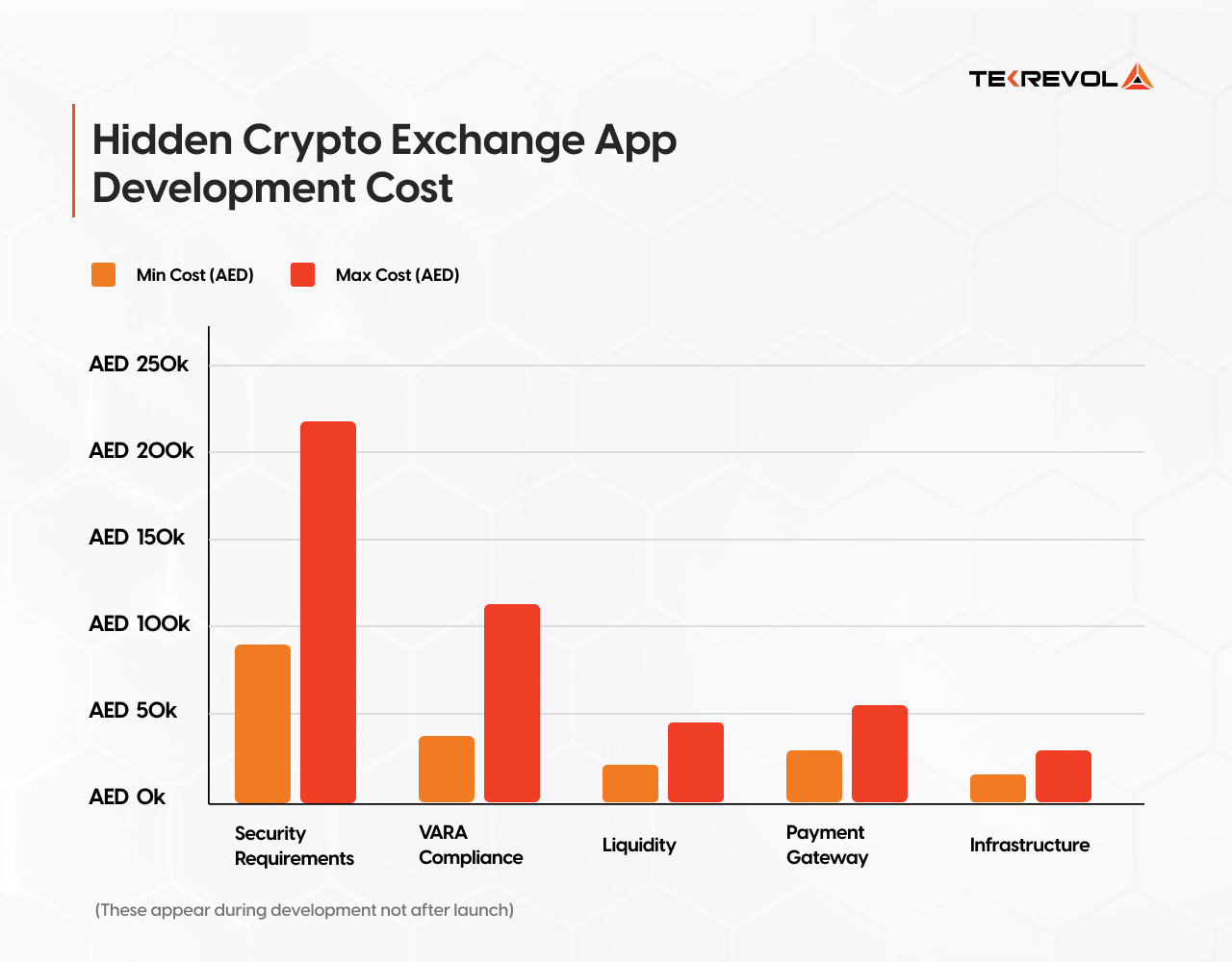
These are costs that appear during development, not after launch. They are not optional. Miss them in your initial budget, and they show up as surprise invoices or project delays.
1. Security Requirements
Security is not optional and not something to cut on. A crypto exchange that gets hacked loses user funds, its VARA license, and its reputation in the same week.
Below are the core security components that add AED 91,750 – AED 220,200 to the initial build cost:
| Security Component | Why It Matters | Est. Cost (AED) | Est. Cost (USD) |
| Multi-Signature Wallets | Requires multiple approvals for large transactions | AED 14,680 – AED 29,360 | $4,000 – $8,000 |
| Hardware Security Modules (HSMs) | Stores private keys in tamper-proof hardware offline | AED 18,350 – AED 44,040 | $5,000 – $12,000 |
| Smart Contract Audit (CertiK or Halborn) | Review all smart contract code before going live | AED 18,350 – AED 110,100 | $5,000 – $30,000 |
| Annual Penetration Testing | Yearly external attack simulation to find weaknesses | AED 36,700 – AED 91,750 | $10,000 – $25,000 |
2. VARA Compliance
VARA (Virtual Assets Regulatory Authority) is the Dubai government body that licenses and supervises all crypto exchanges operating in the emirate. Without a VARA license, a platform cannot legally accept retail user funds in Dubai.
The license fee is only one part of the compliance cost. Building the architecture that passes VARA’s technical review is a separate expense of about AED 36,700 – AED 110,100 entirely.
3 VARA Requirements That Catch Founders Off Guard
Resident Compliance Officer required
VARA requires a Compliance Officer with at least five years of compliance experience, approved as a Fit and Proper Person, who is a UAE resident or a UAE passport holder, employed full-time, and reporting directly to the Board. The same residency test applies to Responsible Individuals. Your MLRO needs two years of AML/CFT experience and Fit and Proper approval, but carries no residency requirement. Budget AED 15,000 – AED 25,000 per month for the CO on top of your build cost.
Client-asset Segregation and Risk-based Wallet Controls
VARA requires client virtual assets to be segregated from the VASP’s own assets and held on a one-to-one basis. For custody, VARA requires a risk-based approach to hot, warm, and cold storage. The current rulebooks do not establish a universal 95% cold-storage requirement.
KYC/AML Vendor Due Diligence
VARA sets AML/CFT and compliance obligations on the VASP. The article should not claim that only named ‘VARA-approved’ KYC providers can be used unless an official approved-vendor list is published for the relevant requirement. Provider selection should be based on regulatory fit, data controls, geographic coverage, fraud controls, security, and integration needs.
3. Liquidity Management and Trading Engine
A new exchange with no users faces a real problem: no buyers means no sellers. Most new exchanges integrate a liquidity provider such as B2Broker or Bitfinex to solve this. Setup costs AED 18,350 – AED 36,700 plus a monthly fee.
The trading engine also needs stress-testing under simulated high-volume conditions before launch, adding 2 to 4 weeks and AED 18,350 – AED 55,050 to the project.
4. Scalability and Infrastructure
Your exchange needs to stay online 24 hours a day, 7 days a week. Building for high availability means cloud infrastructure with auto-scaling on AWS or Azure in the UAE region. The setup cost is included in the backend build budget, but the monthly running cost adds AED 7,340 – AED 18,350 per month from launch.
5. Payment Gateway and Bank Integration
Letting users deposit and withdraw AED requires integration with UAE banks and local payment processors. Banks in the UAE have their own API requirements. Getting these integrations approved and tested adds AED 22,020 – AED 55,050 to the build cost and can extend the timeline by 4 to 8 weeks.
Ongoing Costs After Your Crypto Exchange App Goes Live
The ongoing crypto exchange app development costs are what you pay every month to keep it running. Here is the Year-1 cost of ownership for a BitOasis-level exchange.
| Cost Category | Updated Treatment | Note |
| App Development | AED 440,400 to AED 917,500 | Existing TekRevol project estimate |
| VARA Licence Application | AED 100,000 per Broker-Dealer or Exchange Services activity | Official regulator fee |
| VARA Annual Supervision | AED 200,000 per Broker-Dealer or Exchange Services activity | Official annual fee |
| Paid-Up Capital | Separate requirement | Broker-Dealer and Exchange Services capital depends on custody model and fixed annual overheads. Do not count this as an operating expense. |
| Legal and Compliance Setup | AED 55,050 to AED 110,100 | Keep as TekRevol planning estimate, not a regulator fee |
| Server Infrastructure | AED 7,340 to AED 18,350 per month | Existing planning estimate |
| Blockchain Node Hosting | AED 734 to AED 7,340 per month | Existing planning estimate |
| Annual Security Audit | AED 36,700 to AED 91,750 | Existing planning estimate |
| KYC Verification Spend | AED 1,835 to AED 11,010 per month | Usage-dependent planning estimate; do not label this as ‘per user’ |
| Liquidity Provider | AED 3,670 to AED 18,350 per month | Existing planning estimate |
| Marketing and User Acquisition | AED 73,400 to AED 183,500 | Existing planning estimate |
| App Maintenance and Updates | AED 11,010 to AED 29,360 per month | Existing planning estimate |
| External Legal/Compliance Retainer | AED 3,670 to AED 11,010 per month | Rename from ‘VARA Legal Retainer’ |
| Estimated Year-1 Spend, excluding paid-up capital | About AED 1.25 million to AED 2.75 million | Assumes one VARA-regulated activity and retains the article’s existing operational cost ranges |
The two costs that catch most founders and enterprises off guard are liquidity and KYC verification fees. A liquidity provider solves this, but adds a monthly cost from day one. KYC providers charge per user verification, so the cost grows as your user base grows.
How Does a Crypto Exchange Like BitOasis Make Money?
Most exchanges at the BitOasis level generate the bulk of their revenue from trading fees and spreads. Token listing fees become significant only after you have enough daily active users to make your exchange attractive to new projects.
Let’s take a look at the main revenue streams for a BitOasis-style exchange:
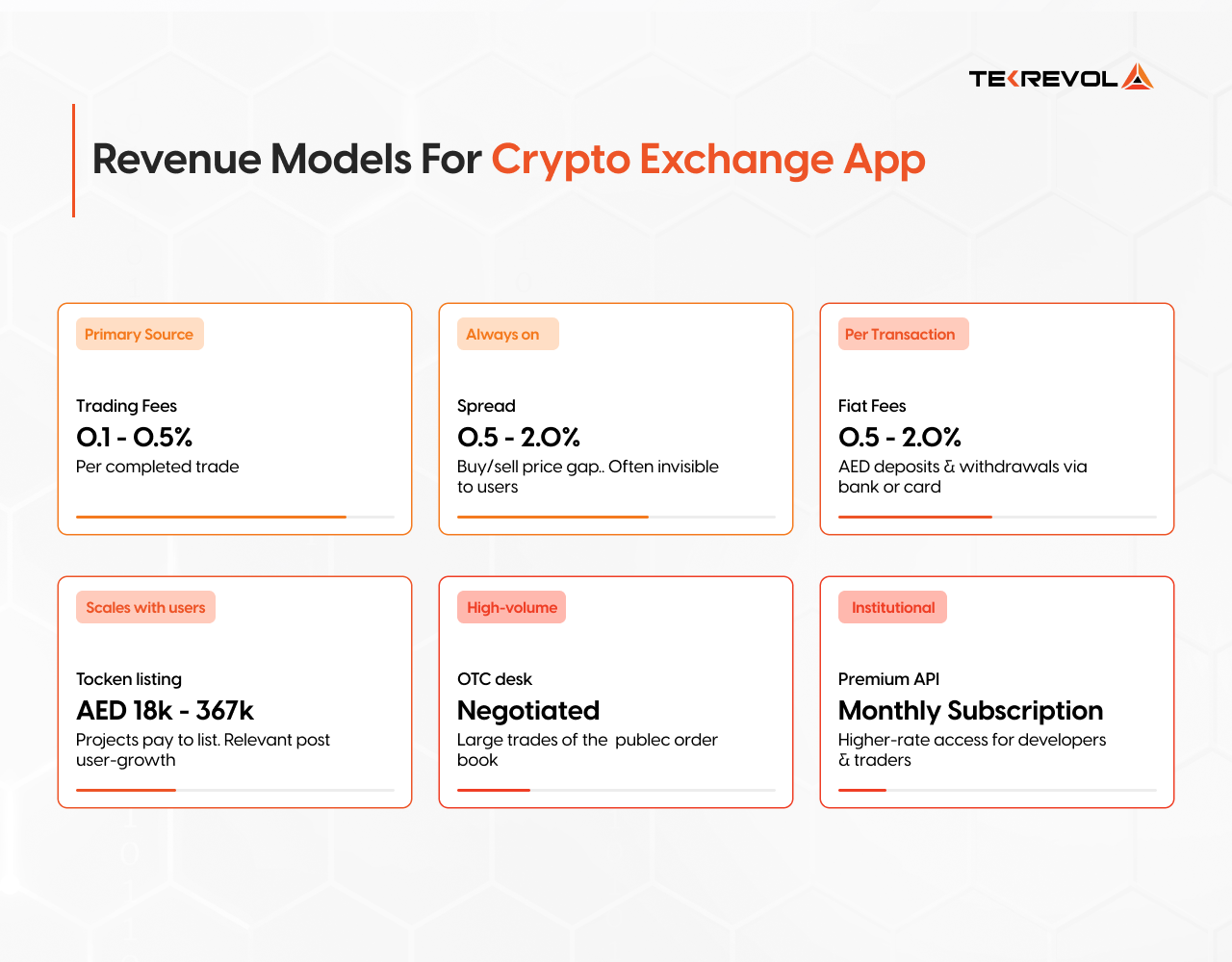
1) Trading Fees (Maker-Taker): Charge a percentage on each completed trade. Makers (who add liquidity) pay less than takers (who take it). This is the primary revenue source to recover crypto exchange app development costs.
- Typical Rate: 0.1% – 0.5% per trade
2) Spread: Buy crypto at a slightly lower price than you sell it to users. Common for retail-facing exchanges and often invisible to users.
- Typical Rate: 0.5% – 2.0%
3) Fiat Deposit/Withdrawal Fees: Charge users for moving AED or other fiat in and out via bank transfer or card. Applies to both deposits and withdrawals in many cases.
- Typical Rate: 0.5% – 2.0%
4) Token Listing Fees: Projects pay your exchange to list their token. Only relevant once you have enough users to make your exchange worth listing on.
- Typical Rate: AED 18,350 to AED 367,000+ per listing
5) Staking and Earn Products: Offer users interest on held crypto. The exchange keeps a margin on the yield
- Typical Margin: Varies by asset
6) OTC Desk Fees: Charge high-volume traders a service fee for large trades that go outside the public order book.
- Typical Rate: Negotiated per trade
7) Premium API Access: Charge institutional traders or developers for higher-rate API access.
- Typical Rate: Monthly subscription
For early-stage planning, model your revenue primarily around trading volume and trading fees.
Which UAE Regulatory License Is Right for Your Exchange App?
The license you choose determines your legal structure, capital requirements, and the architecture your development team must build for. It also determines how long before you can go live.
There are 4 main regulatory pathways in the UAE. Each one fits a different type of operator.
| Regulatory Body | Best For | Approx. License Cost | Timeline |
| VARA | Public exchange serving UAE retail users in Dubai | AED 100,000 application + AED 200,000 annual supervision ($27,200 + $54,500) | 6 – 12 months |
| ADGM (FSRA) | Institutional exchange based in Abu Dhabi | AED 91,750 – AED 293,600 ($25,000 – $80,000) | 6 – 14 months |
| DMCC | Crypto tech company or proprietary trading | AED 18,350 – AED 55,050 ($5,000 – $15,000) | 2 – 4 months |
| DIFC (DFSA) | Premium fintech with institutional banking needs | $40,000 – $100,000+ | 9 – 18 months |
BitOasis Feature Audit: What You Need to Replicate and Where to Go Further
Before you can build something competitive, you need to understand what BitOasis actually offers. Here is a clear breakdown of the main platform features, whether BitOasis has them, and how each one affects your development budget.
| Feature | BitOasis Has It? | Build Cost Impact | Opportunity |
| Spot trading (68+ assets) | Yes | AED 29,360 – AED 73,400 | Faster asset listing process |
| Fiat on/off ramp (AED, SAR, USD) | Yes | AED 22,020 – AED 55,050 | Add more local bank integrations |
| KYC/AML verification | Yes | AED 7,340 – AED 29,360 | Faster onboarding flow |
| Hot and Cold wallet infrastructure | Yes | AED 22,020 – AED 44,040 | No gap here |
| Arabic and English interface | Yes (Arabic and English) | AED 29,360 – AED 55,050 | Build Arabic-first |
| iOS and Android App | Yes | AED 73,400 – AED 146,800 | No gap here |
| Web trading dashboard | Yes | AED 55,050 – AED 110,100 | Better charting and portfolio tools |
| Real-time price charts | Yes | AED 18,350 – AED 36,700 | AI-powered price insights on top |
| Margin and derivatives trading | No | AED 183,500 – AED 367,000+ | Strong differentiator for pros |
| Staking and earn features | No | AED 73,400 – AED 183,500 | Revenue line and retention driver |
| AI-powered trading tools | No | AED 55,050 – AED 110,100 | No UAE exchange has this well |
| DeFi wallet integration | No | AED 73,400 – AED 183,500 | Appeals to self-custody users |
| Halal mode (Sharia-compliant) | No | AED 36,700 – AED 73,400 | 414M Muslim users in MENA |
How You Can Outcompete BitOasis: 5 Real Differentiators
Building a copy of BitOasis is not a viable strategy. To compete, build something that it does not offer or does not do well. There are real gaps in the BitOasis product that represent genuine market opportunities.
1. AI-Powered Trading Tools
BitOasis does not prominently market an AI trading assistant in its current public Lite and Pro product pages. A new entrant could explore AI-assisted market explainers, unusual-movement alerts, portfolio analytics, and personalized education. Keep the experience clearly informational, avoid guaranteed outcomes or unlicensed financial-advice behavior, and involve compliance in the feature design.
2. DeFi and CeFi Bridge
BitOasis is fully centralized. Users cannot access DeFi yields or decentralized protocols. A hybrid CeFi/DeFi model that lets users keep assets in their own wallet while still accessing the exchange’s liquidity and fiat on-ramp appeals to the growing segment that wants the benefits of both worlds.
3. Arabic-First UX
BitOasis already supports Arabic, so simply translating an English product is not enough to differentiate. A stronger opportunity is Arabic-first product design, including RTL-first QA, localized onboarding, Arabic educational content, culturally appropriate support flows, and region-specific examples throughout the trading experience.
4. Islamic Finance Features (Halal Crypto)
A Sharia-conscious product mode could be a meaningful regional differentiator, but it should not be marketed as ‘halal’ or Sharia-compliant based only on product design. Asset screening, product structures, fee models, staking or yield features, and customer communications should be reviewed through qualified Sharia governance and legal and regulatory counsel before launch.
5. Micro-Investment and First-Time Buyer Features
BitOasis currently publishes a minimum AED 100 deposit and introduced Recurring Buy in August 2026. A better differentiation strategy is to improve beginner onboarding, risk education, fee transparency, budgeting controls, goal-based journeys, support, and simplified portfolio understanding.
How To Optimize Crypto Exchange App Development Cost Without Compromising Security
If your budget is tight, there are smart ways to reduce the crypto exchange app development cost without putting your platform at risk. The key is knowing exactly where you can save and where cutting will cost you more in the end.
1. Use Cross-platform Development For Mobile
Building native iOS and Android apps means two codebases, two test cycles, and two release processes for the life of the product. React Native or Flutter share most of that work across one codebase. For a trading UI with standard charting and order entry, the performance difference is not material; for high-frequency chart rendering, benchmark before you commit.
2. Start With a White-Label MVP Then Rebuild
A white-label solution at AED 80,740 – AED 139,450 lets you test user behaviour and trading volume before committing to a full custom build.
3. Use Managed Blockchain Node Providers
Running full Ethereum or Polygon nodes is expensive and operationally complex. Managed providers like Infura or Alchemy give reliable node access for AED 734 – AED 7,340 ($200 – $2,000) per month.
4. Launch With a Lean Feature Set
Every feature you add before launch adds cost and extends your timeline. Start with spot trading, basic KYC, and AED fiat support. Add staking, margin trading, and AI tools after you have users and transaction data. Understanding how blockchain features affect app development scope helps decide which capabilities to prioritize and which ones can wait until post-launch.
5. Work With an Offshore Team That Knows UAE Compliance
An offshore development team with documented fintech and crypto compliance experience can reduce your build cost by 40–60% compared to a UAE-based agency.
Where you should not cut
Never reduce the budget for wallet security or a smart contract audit. A slow or insecure engine destroys user trust. Saving AED 18,350 ($15,000) on an audit is not a saving; it is a risk that cannot be priced.
Build Your Crypto Exchange App with TekRevol Dubai
Building a crypto exchange in the UAE is not just a development project. It is a regulated fintech system that requires coordination across product architecture, blockchain infrastructure, security, AML/KYC, financial integrations, legal structure, and regulatory requirements.
TekRevol can design UAE-facing crypto and fintech products with regulatory requirements considered from the architecture stage, integrate suitable KYC/AML and security providers, and build the technical controls required for a production-grade platform. Final licensing, legal classification, and regulatory approval remain the responsibility of the operator and the relevant authorities and advisers.
Whether you are starting with an MVP or building a more complete BitOasis-level platform, the estimate should be based on the exact regulated activities, custody model, fiat integrations, asset coverage, user roles, platforms, security controls, and launch jurisdiction.
Ready to Build Your Own Crypto Exchange?
TekRevol has delivered VARA-compliant crypto and fintech apps for the UAE market, ensuring security, compliance, and high-performance scalability.
Start Your Project Today


