



- Building an app like Qiwa in Saudi Arabia costs SAR 60,000 to SAR 1,000,000+, depending on scope.
- No public Qiwa or ministry API exists, so integration access is an approval process, not code.
- A focused HR module ships for SAR 60,000 to 120,000; full Qiwa-level builds exceed SAR 600,000.
- Timelines run three to four months for a module, twelve to eighteen for a Qiwa-scale platform.
- Nafath authentication gives you verified national identity without needing direct access to any ministry’s employment records.
- PDPL compliance shapes your data model from day one; penalties reach SAR 5 million per serious violation.
Building an app like Qiwa in Saudi Arabia costs between SAR 60,000 and SAR 1,000,000+ ($16,000 to $266,000+), depending on how much of the platform you actually need. A Riyadh or Jeddah startup can ship a basic HR module for SAR 60,000 to 120,000. A full Qiwa-level build with AI and government data integration runs past SAR 600,000.
More than an HR app, Qiwa serves as the digital heartbeat of Saudi Vision 2030 and the National Transformation Program. Connected to systems like GOSI, Muqeem, and the Ministry of Human Resources and Social Development, it handles work permits and contracts effortlessly for millions.
Businesses and startups seeking to develop a similar solution require the expertise of a trusted mobile app development company in Saudi Arabia. Because developing such a platform demands a deep understanding of the digital transformation Saudi Arabia is pushing.
Our guide explains the essential features of a Qiwa-like app and outlines costs by development phase. See how factors like complexity, backend integrations, and AI drive pricing.
How Much Does it Cost to Build an App Like Qiwa in Saudi Arabia?
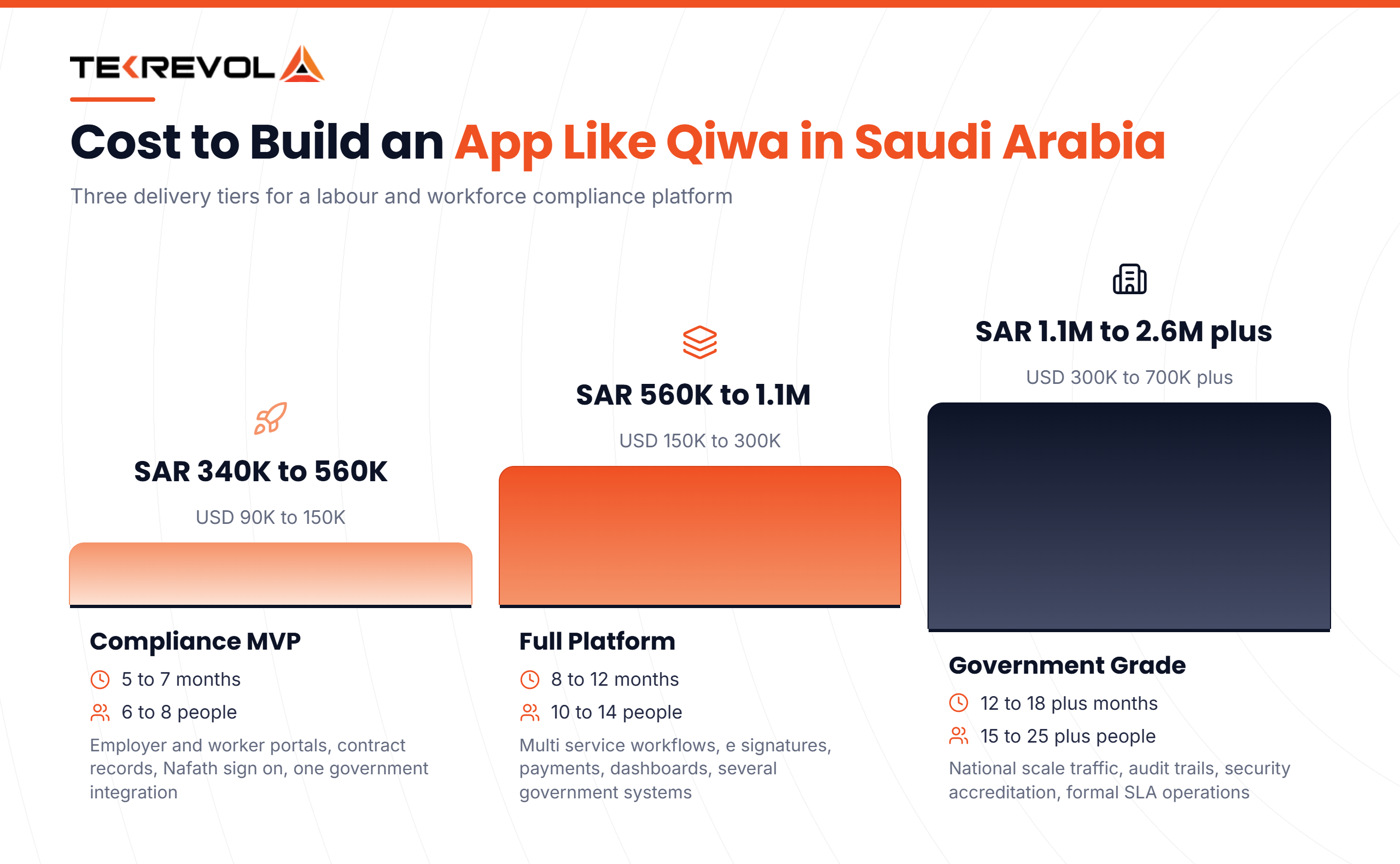
The cost to build an app like Qiwa varies by feature complexity and tech stack. A simple version to test the market hits SAR 60,000. But a full-scale platform linked to the government will reach the SAR 1,000,000 mark.
Below, we give a structured breakdown by app type:
| App Complexity | Estimated Cost (SAR) | Estimated Cost (USD) |
| Basic Features (MVP) | SAR 60,000 – 120,000 | $16,000 – $32,000 |
| Mid-Level Complexity | SAR 120,000 – 250,000 | $32,000 – $67,000 |
| Advanced (Qiwa-Like) | SAR 250,000 – 600,000 | $67,000 – $160,000 |
| AI-First / Enterprise | SAR 600,000 – 1,000,000+ | $160,000 – $266,000+ |
Basic Features
A simple version focuses on simple workflow apps with basic dashboards and notifications. The cost remains between SAR 60,000 and SAR 120,000 because you exclude complex ministry database links. Using MVP development services can reduce costs and speed up launch.
Mid-Level Features
Medium complexity adds analytics and multilingual support for Arabic and English. These apps often include basic AI for document sorting and more robust backend development to validate market fit, which requires an investment of SAR 120,000 to SAR 250,000.
Advanced (Qiwa-Level)
Building at the Qiwa level requires complex integrations with government databases and predictive HR analytics. These are enterprise-grade apps designed for high scalability and strictly follow Saudi labor market regulations. The budget here starts at SAR 250,000 and scales based on the number of modules.
Generative/AI-First
The most expensive tier utilizes Large Language Models and automated workflows to handle complex legal queries. The next-gen workforce uses Generative AI solutions to provide real-time learning and support for users. Costs for these advanced platforms often exceed SAR 600,000.
Need Estimate For Your App?
TekRevol guides app budgeting and feature planning for smooth deployment.
Request Quote TodayWhy Qiwa is the Benchmark for KSA GovTech?
Qiwa is the Ministry of Human Resources and Social Development’s unified labour platform, launched in April 2019 and operated by Takamol Holding.
Today, the Qiwa app KSA carries more than 2 million registered establishments, over 13 million users, and more than 12 million documented employment contracts. That operating model matters if you are pricing a comparable build: Qiwa is not a ministry IT project; it is a state-owned delivery company running a platform on the ministry’s behalf, with the budget and engineering headcount that implies
Key modules include:
- Employers: Employee management, work permits, and reporting
- Employees: Personal profiles, salary slips, and work updates
- Agents: HR service providers and outsourcing management
- Government integration: Links with GOSI, MHRSD, Muqeem, and Mudad
Qiwa also supports the National Transformation Program and Saudi labor market reforms. Its design accommodates multi-user access and large-scale HR analytics, making it a benchmark for enterprise-grade HR technology in KSA.
For startups and enterprises looking to develop a similar solution, replicating Qiwa requires more than a clean interface. The challenge lies in creating a robust system that can handle government integrations and data protection according to the Personal Data Protection Law (PDPL).
Key Factors Affecting the Cost to Build an App Like Qiwa
From feature complexity to regulatory compliance, each decision can significantly impact your total cost to build an app like Qiwa in Saudi Arabia. Let’s examine the multiple factors that influence development budgets.
App Type & Features
The more modules you add, such as employment contracts, employee service transfers, work permits, visa-related workflows, document management, Nitaqat tracking, or workforce analytics, the higher your cost to build an app like Qiwa. Integrations with government systems such as MHRSD services, GOSI, Muqeem, Absher, or Nafath may require specialized development, but access is not automatically available to every private platform. Eligibility, authorization, API availability, security requirements, and formal agreements must be confirmed before these integrations are treated as committed scope.
Technology Stack
The technology stack also affects costs. Native Android and iOS apps built with Swift or Kotlin provide higher performance but increase development time. Cross-platform frameworks like Flutter and React Native use one codebase to serve iOS and Android, which cuts build costs compared to shipping two native apps.
The savings are real, but it is not a fixed percentage, and it shrinks the moment you need deep device integration, background services, or biometric flows tied to Nafath. For a Qiwa-style HR app, a cross-platform app development company is usually the right call. For anything doing heavy on-device document processing, price native and compare
UI/UX Design
High-quality interfaces ensure employees and employers can navigate complex workflows with ease. For KSA, you need a bi-directional interface that supports right-to-left Arabic text perfectly. Design typically runs 10 to 20 percent of total budget.
For an HR platform that lands at the top of that range, because you are designing two distinct experiences- an employer dashboard dense with data and an employee app that has to work for a first-time smartphone user- plus full Arabic RTL layouts for both
Backend & API Integrations
The backend is the most expensive part because it handles all the data processing. You must use API integration services to connect with government gateways. This ensures your app remains the single source of truth for its users.
Development Team
Hiring app developers in KSA usually comes with premium rates, but don’t miss any SDAIA or NCA requirements.
Offshore and nearshore teams cost less per hour than an in-Kingdom team. The gap is real, but the size of it depends entirely on your rate mix and how much coordination overhead you absorb. Rather than quote a blanket percentage, price both scenarios properly: a fully in-Kingdom team, and a hybrid with a Saudi-based lead plus an offshore delivery team.
The hybrid usually wins on cost, and it is also the only one of the two that keeps a local contact for government-facing conversations
Testing & QA
Quality assurance in KSA is not just about bugs; it is about compliance. Mobile app testing & QA typically run 15 to 25 percent of total project cost, and a regulated build sits at the top of that band because compliance testing, penetration testing, and audit evidence are all separate workstreams from functional QA.
Maintenance and Updates
A living app requires SAR 5,000–40,000 per year to stay relevant. Most app maintenance and support services cover security patches and updates to stay compliant with new ministerial decisions. Budget for ongoing cloud hosting and feature iterations.
How to Build a Qiwa-Level App [Phase-Wise Cost Breakdown]
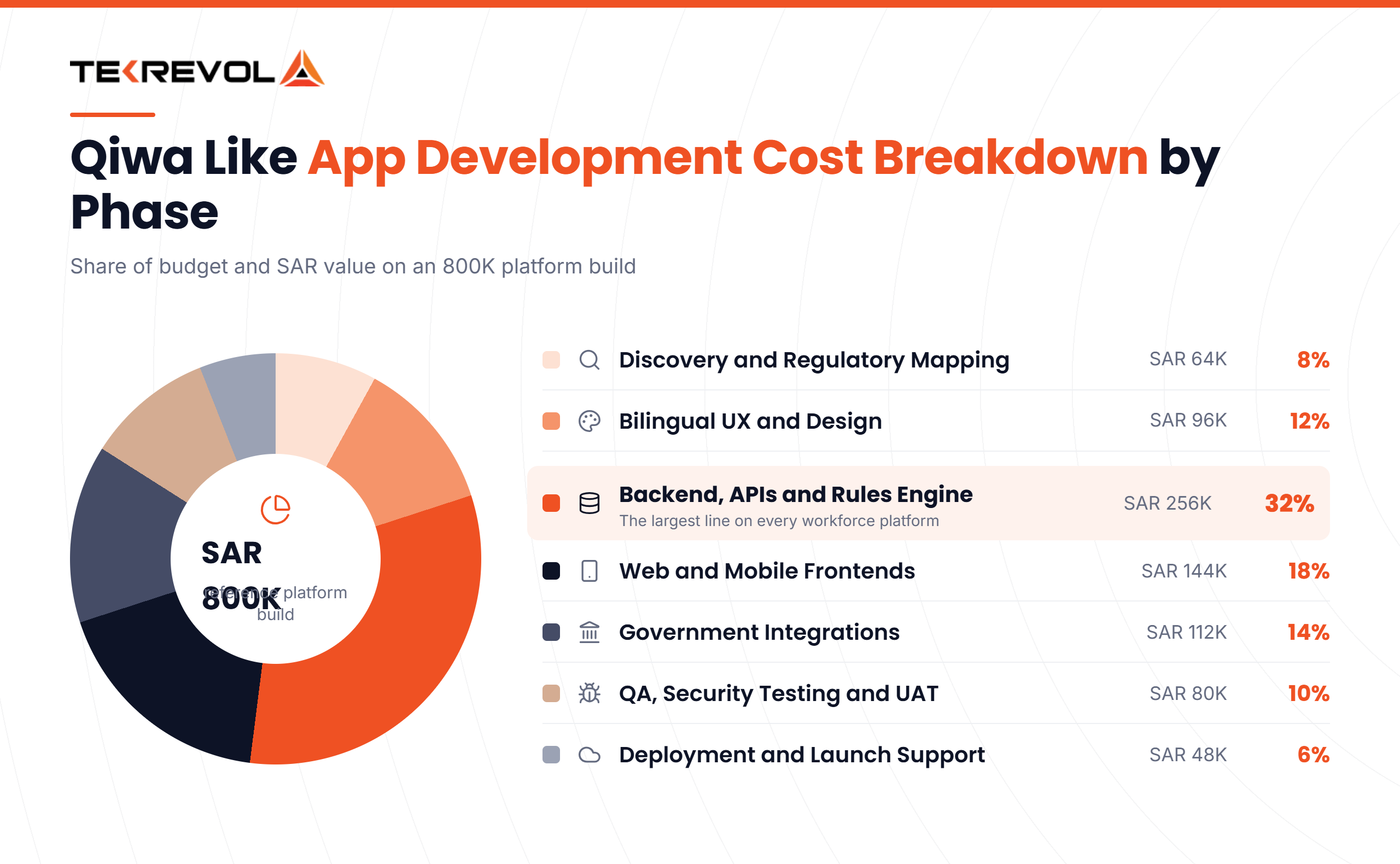
Structuring your project into phases helps manage the cost to build an app like Qiwa in Saudi Arabia effectively. Each phase has a specific price and a goal for your startup or enterprise.
| Phase | Range |
| 1. Planning & Discovery | SAR 25,000 – 55,000 |
| 2. MVP Development | SAR 85,000 – 160,000 |
| 3. Full Feature Development | SAR 250,000 – 550,000 |
| 4. AI & Compliance Automation | SAR 150,000 – 350,000 |
| 5. Testing & Compliance QA | SAR 40,000 – 70,000 |
| 6. Launch & Deployment | SAR 20,000 – 40,000 |
| Total | SAR 570,000 – 1,225,000 |
These six phases together describe a full AI-enabled enterprise build, which is the SAR 600,000 to 1,000,000+ tier in the table above. Total: SAR 570,000 to SAR 1,225,000. If you are building the Advanced tier without Phase 4, drop AI & Compliance Automation, and the ladder lands at SAR 420,000 to SAR 875,000
1st Phase: Planning & Discovery (SAR 25,000 – 55,000)
The first phase focuses on market analysis and regulatory feasibility. In Saudi Arabia, this stage also includes reviewing labor law requirements, PDPL data rules, and integration readiness for platforms such as GOSI and MOL. This phase ensures your KSA app development pricing remains transparent.
2nd Phase: MVP Development (SAR 85,000 – 160,000)
MVP development focuses on launching core functionality to get an initial Qiwa app install base and gather user feedback. At this stage, there are no advanced government integrations, but the architecture is designed to support them later.
3rd Phase: Full Feature Development (SAR 250,000 – 550,000)
Here, you add the high-value modules like Visa Management and GOSI integration. This stage requires high-level web portal development services to support desktop users. Your app becomes a comprehensive HR solution during this phase.
4th Phase: AI & Compliance Automation (SAR 150,000 – 350,000)
Integrating predictive analytics helps companies anticipate their staffing needs or Saudization gaps. Use AI to automate repetitive tasks like document verification. It adds the “smart” layer that separates your app from basic HR tools.
5th Phase: Testing & Compliance QA (SAR 40,000 – 70,000)
Your app must undergo penetration testing to meet SDAIA and NCA standards. This ensures that user data is protected according to the Personal Data Protection Law (PDPL). This is a non-negotiable step for any app in the Kingdom.
6th Phase: Launch & Deployment (SAR 20,000 – 40,000)
Deploying to the Qiwa app on iOS and Android stores requires meeting strict technical guidelines. You also need local cloud application services to keep the app online 24/7. A coordinated launch ensures high visibility from day one.
Cost to Build an App Like Qiwa by Feature Complexity
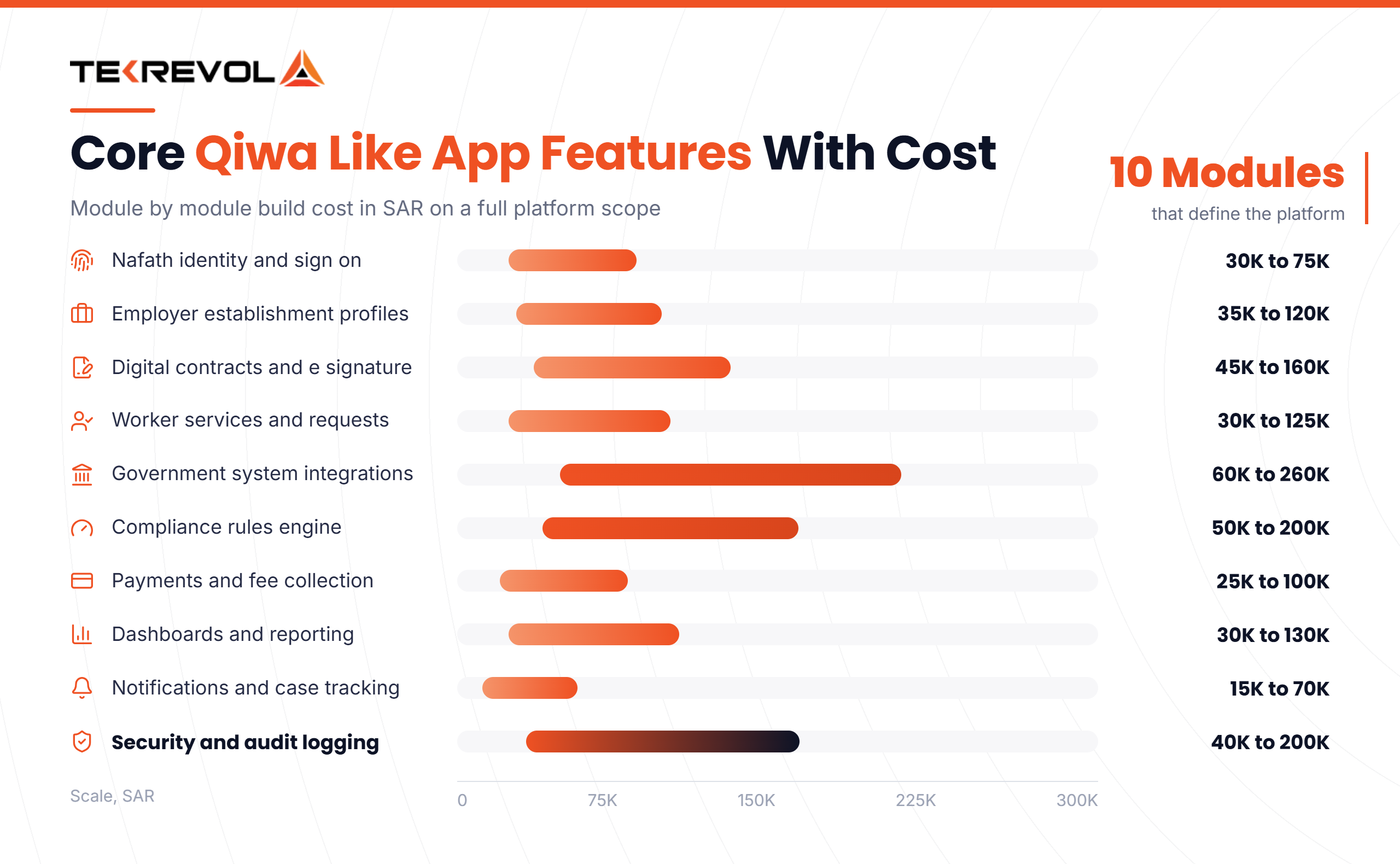
The following table provides a clear look at where your money goes when developing specific modules. Use this to prioritize features based on your current budget.
| Feature / Module | Basic (SAR) | Mid-Level (SAR) | Advanced (SAR) | Generative AI (SAR) |
| Employer Dashboard | 15,000 | 25,000 | 50,000 | 75,000+ |
| Employee Transfer Module | 10,000 | 20,000 | 40,000 | 60,000+ |
| Visa & Payroll | 20,000 | 35,000 | 70,000 | 120,000+ |
| AI Analytics | – | 30,000 | 80,000 | 200,000+ |
| Security/Compliance | 10,000 | 15,000 | 30,000 | 50,000+ |
| Maintenance (Yearly) | 5,000 | 10,000 | 20,000 | 40,000+ |
Employer Dashboard
The dashboard is the heart of the Qiwa App KSA experience for business owners. A basic version provides basic reporting, while an advanced one offers real-time Nitaqat tracking and risk alerts. High-level reporting tools drive the cost up in this module.
Employee Transfer Module
This module handles user profiles and contract signatures under Saudi law. It must sync with Muqeem and GOSI to update residency and insurance records instantly. The technical depth here requires expertise from seasoned mobile app development companies in Saudi Arabia.
Visa & Payroll Integration
Connecting to MHRSD, GOSI, and Absher is the most technical part of the build. These integrations require secure handshakes between your app and government servers. This feature is what makes a Qiwa clone truly functional.
AI Features
Adding an AI-powered features layer helps automate contract drafting and legal advice. Automation is becoming a standard for government apps. It provides instant value by reducing the need for human consultants.
Technical & Regulatory Considerations in an App like Qiwa
App development in Saudi Arabia requires following specific rules that differ from those in other global markets. Your technical excellence must prioritize data residency and local hosting to avoid legal issues.
Cloud Hosting and Infrastructure
Saudi data rules are strict, but they are not a blanket residency mandate. The Cloud First Policy makes local hosting compulsory for government entities. For private companies, it is strongly recommended, not required.
What binds you is the PDPL: personal data can leave the Kingdom only under the conditions SDAIA sets, and the transfer risk assessment sits with you. In practice, most HR platforms host in-Kingdom anyway, because it removes the transfer question entirely and because enterprise clients ask for it in procurement.
Treat in-Kingdom hosting as a commercial decision backed by a regulatory preference, not as a legal ultimatum.
Government System Integrations
Qiwa-like apps connect with government platforms such as GOSI, MHRSD, Muqeem and Mudad. These systems require secure data exchange and accurate records. Poor integration causes payroll delays and visa issues. Experienced mobile app developers in Saudi Arabia can complete these integrations faster and with fewer risks.
Nafath
Identity is the one government integration a private platform can realistically reach. Nafath, operated by the National Information Center, is the Kingdom’s national single sign-on, and it is the login layer behind most government and banking services here.
Building Nafath authentication into your app gives you verified national identity at onboarding without needing access to any ministry’s employment records. For most Qiwa-style products, this is the difference between a platform users trust and one they do not, and it is a fraction of the cost of pursuing direct ministry integration
Cybersecurity (NCA Standards)
The National Cybersecurity Authority publishes the Essential Cybersecurity Controls (ECC). Compliance is mandatory for government entities and for organisations running critical national infrastructure. A private HR platform is not automatically in scope. It lands in scope the moment it serves a government client or handles data on their behalf, which for a Qiwa-style product is close to inevitable.
Build to ECC from the start rather than retrofitting it after your first public sector RFP, because retrofitting costs more than designing for it.
SDAIA Compliance
The Saudi Data & AI Authority oversees how personal data is handled. Your app must follow the PDPL, which gives users rights over their own information. Compliance involves clear privacy policies and secure data processing methods.
The PDPL has been enforceable since 14 September 2024 and is regulated by SDAIA. It requires a lawful basis for processing, a documented cross-border transfer assessment, breach notification, and honoured data subject rights, including access and erasure. Penalties reach SAR 5 million for the most serious violations, and double for repeat offences. For an HR platform holding contracts, salaries and Iqama data on millions of workers, PDPL work is not a compliance checkbox at the end. It shapes the data model
Monetization Strategies For a Qiwa-like App
Investing in a Qiwa-like platform can be highly profitable if you choose the right business model. Most successful apps use a mix of subscriptions and enterprise partnerships.
Subscription Models
You can charge businesses a monthly fee based on the number of employees they manage. This provides a steady stream of revenue while keeping the app accessible for SMEs. Tiered pricing allows you to serve both small shops and large corporations.
Enterprise Partnerships
Partnering with government entities or large recruiters can provide significant funding. These organizations often pay for custom features that help them manage their workforce more efficiently. It also adds a layer of credibility to your platform.
Value from Automation
The real ROI comes from the time saved through automation. Reducing the manual work needed for visa renewals or contract filing saves businesses thousands of Riyals. This efficiency makes your app an essential tool for any HR department in the Kingdom.
Tips to Optimize Your Cost to Build An App Like Qiwa
Developing a large platform does not mean you have to overspend. You can use several strategies to keep your costs to build an app like Qiwa under control while maintaining quality.
Phased Development
Build your app in stages by starting with an MVP. This reduces your initial app development timeline and helps you focus on the most important features first. It also lets you generate revenue earlier to fund future updates.
Use Staff Augmentation
Instead of hiring a full team, use IT staff augmentation to fill specific gaps. This gives you access to senior developers for the critical integration phases without long-term overhead. It is a flexible way to manage your costs to build an app like Qiwa.
Reuse Existing Modules
Do not reinvent the wheel for standard features like login or payment gateways. Using proven app development frameworks for KSA and pre-built modules speeds up the process. This allows you to focus on the unique parts of your app, like the regulatory logic.
Simplify the Design
While high-end design is important, you should focus on usability over fancy animations. A clean and simple interface is often more effective for government apps. This approach reduces design hours and makes the app easier to maintain.
Conclusion
The cost to build an app like Qiwa in Saudi Arabia is a significant but strategic investment for any business looking to lead in the Saudi HR tech space. Budget between SAR 600,000 and SAR 1,000,000+ for a platform genuinely comparable to a government-grade system, or start at SAR 60,000 to 120,000 with a focused module and expand from there
Success depends on balancing high-end features with strict compliance and local data hosting. Consider professional website development services to complement your mobile presence in Saudi Arabia. A specialized team like TekRevol ensures your project meets the highest standards of the National Cybersecurity Authority.
Ready to build the next Qiwa for KSA?
TekRevol turns your vision into a reality that serves the whole Kingdom.
Book Your Free Consultation


