



- Flutter app development cost ranges from $15,000 for a simple MVP to $250,000+ for an enterprise build.
- Team location swings project cost more than almost any other factor, with US rates roughly triple India’s.
- Flutter itself is free and open source; your budget pays for people, servers, and integrations.
- Post-launch maintenance typically adds 15–20% of your build cost every year.
- Mid-complexity apps, in the $40,000–$90,000 range, are where most real businesses land.
- Locking your feature list before development starts is the single best way to protect your budget.
Somewhere right now, a founder is staring at three quotes for the same app idea. One says $18,000. Another says $65,000. The third says $180,000. Same brief, three wildly different numbers, and no clear reason why.
That gap is confusing, and it is expensive if you guess wrong. Flutter itself costs nothing to use. Google gives the framework away, so the cost of Flutter app development is entirely the people building it. Flutter app development costs $15,000 to $250,000+, and most US businesses land between $40,000 and $90,000. It moves with app complexity, the country your development team sits in, the design work involved, and what happens to your app after it launches.
This guide breaks the cost down properly. You’ll get real price ranges by complexity and by country, the features that quietly inflate a budget, what a Flutter app development company actually charges for in 2026, and a few ways to trim costs without cutting the features your users care about.
How Much Does Flutter App Development Cost in 2026?
Keeping it simple, Flutter app development typically costs between $15,000 and $250,000 or more, depending on the complexity and feature stack.
Simple MVPs run $15,000 to $40,000. Intermediate apps cost $40,000 to $90,000. Advanced builds reach $200,000. Every figure covers both iOS and Android from one codebase.
Here’s the Flutter app development cost breakdown by app complexity, detailing, and development timeline.
| Flutter App Complexity | Defining Aspects | Development Timeline | Development Timeline |
|---|---|---|---|
| Simple Flutter App | Basic UI, MVP features | 6–10 weeks | $15,000 – $40,000 |
| Intermediate Flutter App | Custom UI, moderate functionality | 3–5 months | $40,000 – $90,000 |
| Advanced Flutter App | Complex UI, advanced features | 6–9 months | $100,000-$200,000 |
| Enterprise Flutter App | Bespoke UI, high-complexity features | 12-16 months | $200,000-$250,000+ |
These price ranges are general estimates that can vary from project to project. Flutter itself doesn’t cost anything to use.
The price tag comes from the people building your app: developers, designers, QA testers, and project managers, plus the time it takes to plan, build, test, and launch. A Flutter build follows a fairly predictable set of stages, and each stage adds its own hours to the final invoice.
If your app needs to work on both iOS and Android without hiring two separate teams, Flutter tends to come out cheaper than building native apps twice. That’s a big part of why so many businesses ask about it by name instead of asking for “an app.”
Get a Real Number for Your App Description
Ranges are useful, but your project isn't average. Tell us what you're building and get a cost estimate based on your actual features, not a generic bracket.
Get My Free Cost Estimate →Key Factors that Determine Flutter App Development Cost
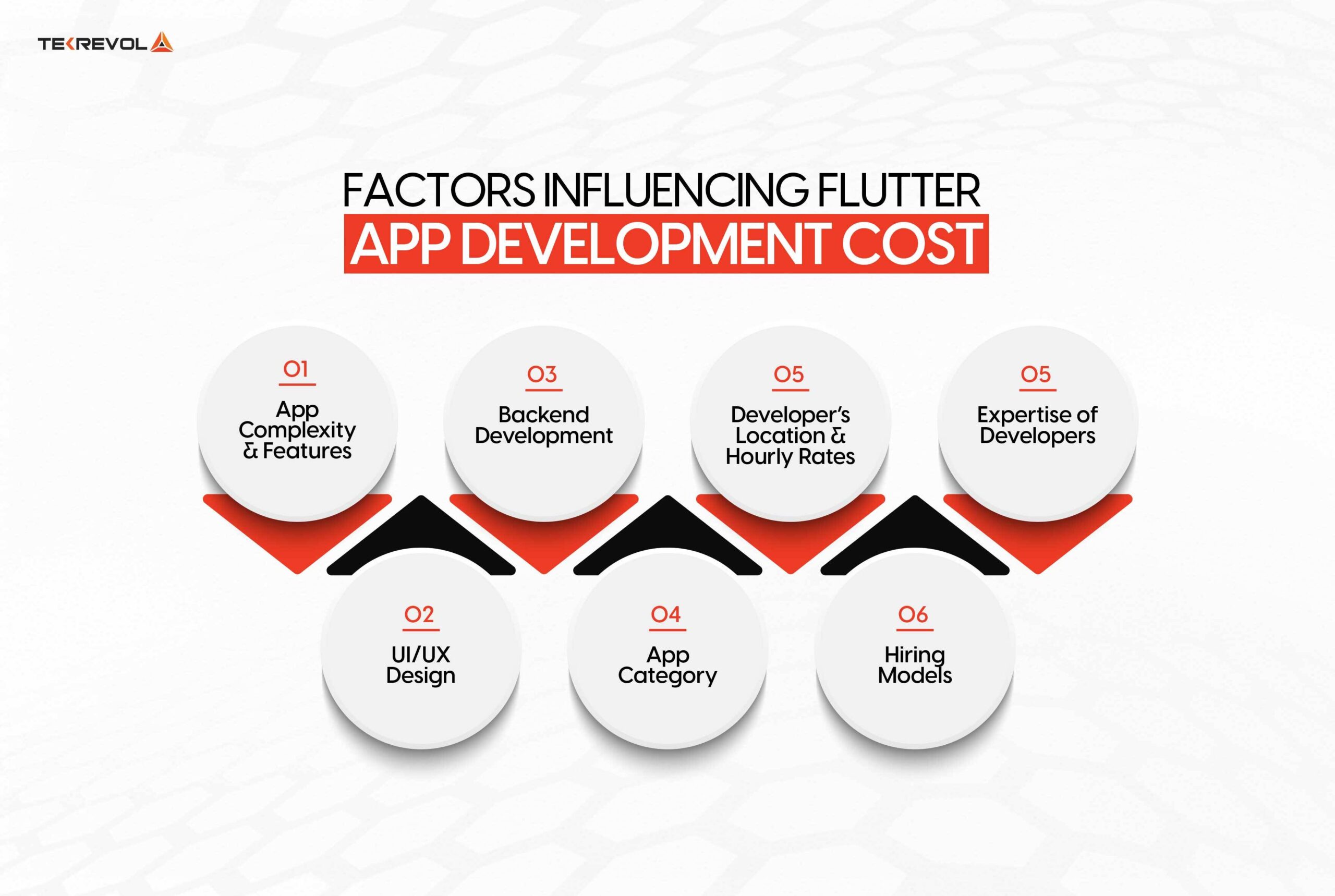
1. App Complexity & Features
App complexity and features are the primary cost drivers. Features impact Flutter app costs by driving the total engineering hours required for UI design, backend infrastructure, API integration, and QA testing.
- Simple Flutter Apps require basic UI and MVP features, costing between $30,000-$50,000 and taking 2-3 months. These apps usually include fundamental functionalities with straightforward interfaces.
- Intermediate Flutter Apps involve custom UI and moderate functionality, priced at $50,000-$100,000 over 3-6 months. They often need additional features like third-party integrations, user authentication, and more complex data management.
- Advanced Flutter Apps have complex UI and advanced features, ranging from $100,000-$200,000 with a 6-12 month timeline. These apps might include advanced user interactions, real-time updates, and extensive backend services.
- Enterprise Flutter Apps feature bespoke UI and high-complexity elements, costing $200,000-$250,000 and taking 12-18 months. They typically require high scalability, robust security, and extensive integration with other systems.
Expert insight:
2. UI/UX Design
Design work in Flutter breaks down into distinct activities, each with its own price. Effective design requires thorough research and meticulous execution.
| Workflow Stages | Average Cost |
|---|---|
| Pre-design Activities & Research | $500-$700 |
| UI Preparation | $200-$1,000 |
| UX Creation | $5,000-$10,000 |
| Brand Identity Design | $5,000-$10,000 |
| Images/Animations | $1,000-$10,000 |
- Pre-design Activities & Research set the foundation for successful UI/UX design, costing $500-$700. This phase includes understanding user needs, market analysis, and setting design goals.
- UI Preparation involves creating the visual layout, priced at $200-$1,000. It focuses on the app’s look and feel, ensuring an appealing and intuitive interface.
- UX Creation costs $5,000-$10,000, aiming to make the app easy to use and navigate. This stage includes wireframing, prototyping, and user testing to optimize the user experience.
- Brand Identity Design reinforces the app’s visual appeal, costing $5,000-$10,000. It includes designing logos, color schemes, and other brand elements to ensure a cohesive look.
- Images & Animations enhance user interaction, costing $1,000-$10,000. These elements add dynamism to the app, making it more engaging.
Our guide to designing an app interface for a seamless experience covers how these decisions carry through the build.
3. Backend Development
Backend costs cover server operations, databases, application logic, cloud integration, microservices architecture, and security protocols. A managed backend keeps early costs low. A custom API costs more upfront and scales more predictably past 50,000 users.
4. App Category
Category sets your compliance and infrastructure floor before a single screen gets designed. Healthcare carries HIPAA. Finance carries encryption and audit requirements. On-demand carries real-time tracking infrastructure. The industry table earlier in this guide prices each one.
5. Third-party integrations
Each integration adds $1,000 to $5,000. Payment gateways, mapping, analytics, CRM sync, and identity providers all need wiring and testing. Integrations are also where estimates go wrong most often, because a “simple payment integration” gets complicated the moment you need refunds and reconciliation.
6. Developer Expertise and Team Composition
Team seniority changes both the cost to develop a Flutter app and delivery risk. Here’s what each role runs across project sizes.
| Flutter App Development Team | Simple Flutter App | Medium Flutter App | Complex Flutter App |
|---|---|---|---|
| Developers (Junior, Middle, Senior) | $10,000-$20,000 | $20,000-$40,000 | $50,000+ |
| QA Specialist | $8,000+ | $10,000+ | $50,000-$100,000 |
| UI/UX Designers | $4,000-$5,000 | $5,000-$7,000 | $10,000-$15,000 |
| Project Manager | $5,000-$7,000 | $10,000-$15,000 | $15,000+ |
| Business Analyst | $2,000-$3,000 | $5,000-$8,000 | $10,000+ |
| DevOps | $2,000-$4,000 | $5,000-$7,000 | $10,000+ |
A well-rounded team includes junior, middle, and senior developers, QA specialists, UI/UX designers, project managers, business analysts, and DevOps engineers. Each role brings specific expertise, ensuring comprehensive and efficient project execution.
See What Your App Tier Actually Costs
Not sure if your idea is a simple build or a mid-tier project? Send us your feature list and we'll tell you exactly where it lands, no obligation.
Get a Free Feature Breakdown →What Does Flutter App Development Cost by App Type?
Flutter app development cost by app type ranges from $15,000 for a simple MVP to $300,000 for a super app. B2C and ecommerce apps cost $25,000 to $100,000. SaaS and enterprise platforms cost $80,000 to $250,000. App type predicts cost better than screen count.
| App type | Cost range | Timeline | What’s inside |
|---|---|---|---|
| Simple MVP or Internal tool | $15,000 – $40,000 | 6–12 weeks | One workflow, basic auth, minimal backend |
| B2C app or ecommerce | $30,000 – $100,000 | 3–6 months | Accounts, payments, catalog, admin panel |
| Marketplace or on-demand | $60,000 – $180,000 | 5–9 months | Live tracking, two-sided users, dispatch |
| SaaS or enterprise platform | $80,000 – $250,000 | 6–12 months | Multi-tenancy, SSO, compliance, reporting |
| Super app or multi-platform | $150,000 – $300,000+ | 9–14 months | Several services, web and desktop targets |
Source: TekRevol pricing observations
Flutter now targets iOS, Android, web, macOS, Windows, and Linux from the same codebase, so a super app spreading across six surfaces is genuinely cheaper per platform than it looks in that number.
So how much does a Flutter app cost for your specific case? Find your row above, then read the industry and region sections, because those two adjust the number more than anything else on this page.
Unsure which app type row your product actually sits in?
Send us your feature list and platform targets. We'll place your build in the right band, show you what moving a single feature does to the total, and give you a phased breakdown.
Book a Free Flutter Scoping Session →Cost to Create a Flutter App by Features
The cost of Flutter app features ranges from $1,000 for simple authentication to $25,000+ for advanced AI or custom backend logic. Key drivers include payment integration ($2,000–$5,000), real-time chat/GPS ($3,000–$8,000), and custom UI/UX animations ($4,000–$10,000).
Every functionality you add directly impacts the engineering hours required to code, test, and maintain your application.
- User Authentication & Profiles ($1,000 – $3,000): Standard email/password registration, social media logins (Apple, Google, Facebook), and multi-factor authentication (MFA).
- Payment Gateways & In-App Purchases ($2,000 – $5,000): Secure integration with Stripe, PayPal, Apple Pay, or Google Pay for automated subscriptions, store checkout, and invoice generation.
- Push Notifications & Messaging ($2,000 – $6,000): Automated transactional alerts, dynamic user re-engagement messaging via Firebase Cloud Messaging, and live continuous polling.
- Real-Time GPS & Location Mapping ($3,000 – $8,000): Google Maps SDK integration, real-time vehicle or order tracking, geofencing, and route calculation logic.
- Custom UI Animations & Micro-Interactions ($4,000 – $10,000): Advanced dynamic graphic rendering, custom interactive widgets, and seamless view transitions that elevate brand polish.
- AI, Machine Learning & Live Sync ($10,000 – $25,000+): Custom recommendation engines, automated chat assistants, offline database sync, and complex third-party enterprise integrations.
What Does Flutter App Development Cost by Industry?
Flutter app development cost by industry runs from $25,000 for education apps to $220,000 for fintech. Regulated sectors cost the most because compliance, encryption, and audit work sit on top of the build. Consumer content apps cost the least.
| Industry | Flutter cost | Primary cost driver |
|---|---|---|
| Fintech | $70,000 – $220,000 | Encryption, KYC, compliance, real-time updates |
| Healthcare | $60,000 – $180,000 | HIPAA compliance, advanced security, EHR links |
| On-demand services | $55,000 – $160,000 | Real-time tracking, payments, multiple user apps |
| Social networking | $45,000 – $150,000 | Real-time messaging, multimedia handling, feeds |
| Ecommerce | $30,000 – $110,000 | Payment gateways, authentication, inventory sync |
| Gaming and entertainment | $40,000 – $140,000 | Animation, media delivery, monetisation |
| Education | $25,000 – $85,000 | Interactive features, LMS integration, accessibility |
| Business and internal tools | $20,000 – $70,000 | Reporting, role management, existing system links |
Source: TekRevol pricing observations
Healthcare Flutter App Cost
Healthcare Flutter apps cost $60,000 to $180,000. The app must be HIPAA-compliant, with encrypted storage, audit logging, role-based access, and a signed agreement with every vendor touching patient data. This compliance necessitates advanced security measures and thorough testing, driving up healthcare app development costs.
Fintech Flutter App Cost
Fintech Flutter apps cost $70,000 to $220,000, the top of this table. Encryption, identity verification, transaction ledgers, and an external security review before launch all carry real engineering weight, driving up the fintech app development cost.
Ecommerce Flutter App Cost
Ecommerce Flutter apps cost $30,000 to $110,000. Payment gateways, catalog handling, and checkout are well-trodden ground in Flutter. What raises ecommerce app development budget is inventory synchronisation with an existing ERP and support for several payment providers across regions.
Social Networking Apps
The cost to build social network apps using Flutter ranges from $45,000 to $150,000. Demand real-time communication, multimedia handling, and extensive user data management – these features increase social media app cost as they require robust backend services and scalable architecture to handle high user loads and data traffic.
On-demand Service Apps
On-demand Flutter applications cost $55,000 – $160,000 to develop and require real-time tracking, user authentication, and payment integration. These apps, used for services like ride-hailing or food delivery, need reliable backend support and robust APIs for smooth operation and user satisfaction. Our on-demand app development cost guide covers that architecture.
Education Apps
Education apps cost $25,000 to $85,000 and often need interactive features, multimedia content, and user progress tracking. They may require integration with learning management systems (LMS) and adherence to accessibility standards, adding to development complexity.
How Developer’s Location & Hourly Rates Influence Flutter App Cost
Flutter app development cost by region varies by up to 8x for identical work. North American developers charge $75 to $250 hourly. Western Europe charges $50 to $200. Asia charges $25 to $40. Nearshore options sit in between with better timezone overlap. Here’s what each role runs across project sizes
| Location | Hourly Rates of Flutter Developers |
|---|---|
| Central & Eastern Europe (CEE) | $50-$60/h |
| Western Europe | $50-$200/h |
| North America | $75-$250/h |
| Latin America | $30-$50/h |
| Australia | $100-$150/h |
| Africa | $20-$45/h |
| Asia | $25-$40/h |
Location also determines tax treatment and currency conversion, which quietly affects what you actually pay versus what the rate card says.
Flutter App Development in USA
Flutter app development in USA costs $75 to $250 hourly, the highest band. You’re paying for full timezone overlap, contract enforceability, and a team you can meet in person. For regulated builds where compliance sign-off runs through US counsel, that premium usually pays for itself.
Most of our US clients ask what a Flutter app price looks like against an offshore quote for the same brief. The honest answer is two to four times higher on the rate card, and considerably closer once you account for rework and elapsed time.
Nearshore Flutter App Development
Nearshore Flutter development means hiring in Latin America for US clients. It will cost you $30 to $50 per hour with five to eight hours of daily overlap. That combination is why nearshore has taken so much work from traditional offshore.
Flutter projects are decision-heavy in the first six weeks. Widget architecture, state management, and platform targets all get settled early, and each question bounces between you and the team. With one hour of overlap, a decision that should take an afternoon takes three days. With six, it takes an afternoon.
Flutter App Development cost in Asia
Flutter development in India and across Asia costs $25 to $40 hourly, the lowest rates available. The talent pool is genuinely deep, and plenty of excellent Flutter work happens at these rates. Budget for the coordination overhead that one to three hours of overlap creates, and the savings still hold on most projects.
How Does Hiring Models Influence Flutter App Development Cost?
Flutter app development cost by hiring model splits three ways. Outsourcing to an agency costs $40,000 to $120,000 per project. Staff augmentation costs $6,000 to $14,000 per developer monthly. An in-house team costs $250,000 or more in year one.
In-House Team
This option will give you more control and flexibility with your Flutter project, but the definite con here is the HR costs. You need to recruit technical professionals and pay them full-time wages with benefits.
So, unless you are an established organization with cash flows dedicated to hiring full teams and meeting recruitment costs, reconsider this choice.
Outsourcing
This is the second option and the most common one that most startups, as well as mid-sized businesses, typically follow. You get to hire a mobile app development company after ensuring they have these 5 resources in their teams:
- UI and UX designer with knowledge of Material Design
- Flutter developer
- Project manager
- Testing & QA professional
- Business analyst
These companies usually start with understanding your project requirements. Then they align a business analyst and project manager for coordination and updates about the progress of your Flutter project.
Also, companies that work on outsourced projects will tell you a fixed price for the entire project or charge according to the number of hours you wish them to dedicate to your app.
Staff Augmentation
This hiring model more or less works like a subscription model for your app development team. You choose to work with specific Flutter teams and pay them hourly charges. The model gives you the highest level of flexibility and control while allowing you to manage your costs according to your development stages and milestones.
If you pick outsourcing or staff augmentation work arrangements, you can further reduce your app development costs by researching the development rates in different locations. That’s because tech talent and IT resources charge differently because of their local tax requirements and currency conversions.
Flutter App Development Budget Breakdown by Stage
Flutter app development cost by stage splits predictably. Discovery takes 10% of the budget, UI/UX design 15%, Flutter development 40%, backend and API work 15%, QA 15%, and deployment 5%. Development and backend together consume more than half.
| Stage | % of budget | What happens |
|---|---|---|
| Discovery and planning | 10% | Requirements, user flows, architecture |
| UI/UX design | 15% | Wireframes, visual design, widget library |
| Flutter development | 40% | Screens, state management, platform handling |
| Backend and API | 15% | Database, server logic, admin panel |
| QA and testing | 15% | Both platforms, device matrix, regression |
| Deployment | 5% | Two store submissions, release pipeline |
Source: TekRevol pricing observations
Use this split to sanity-check any proposal you receive. If an agency quotes $70,000 and allocates $3,000 to QA, that’s not a bargain. That’s a bug backlog with a delivery date attached.
It also answers a question the range at the top can’t: how much does it cost to create a Flutter app at each step, rather than as one number you either accept or reject.
Design deserves a specific note in Flutter. A shared widget library built properly in the design stage gets reused across every screen and every platform target afterward, so the money spent here compounds in a way it doesn’t on native projects.
What Hidden Costs Show Up After Your Flutter App Launches?
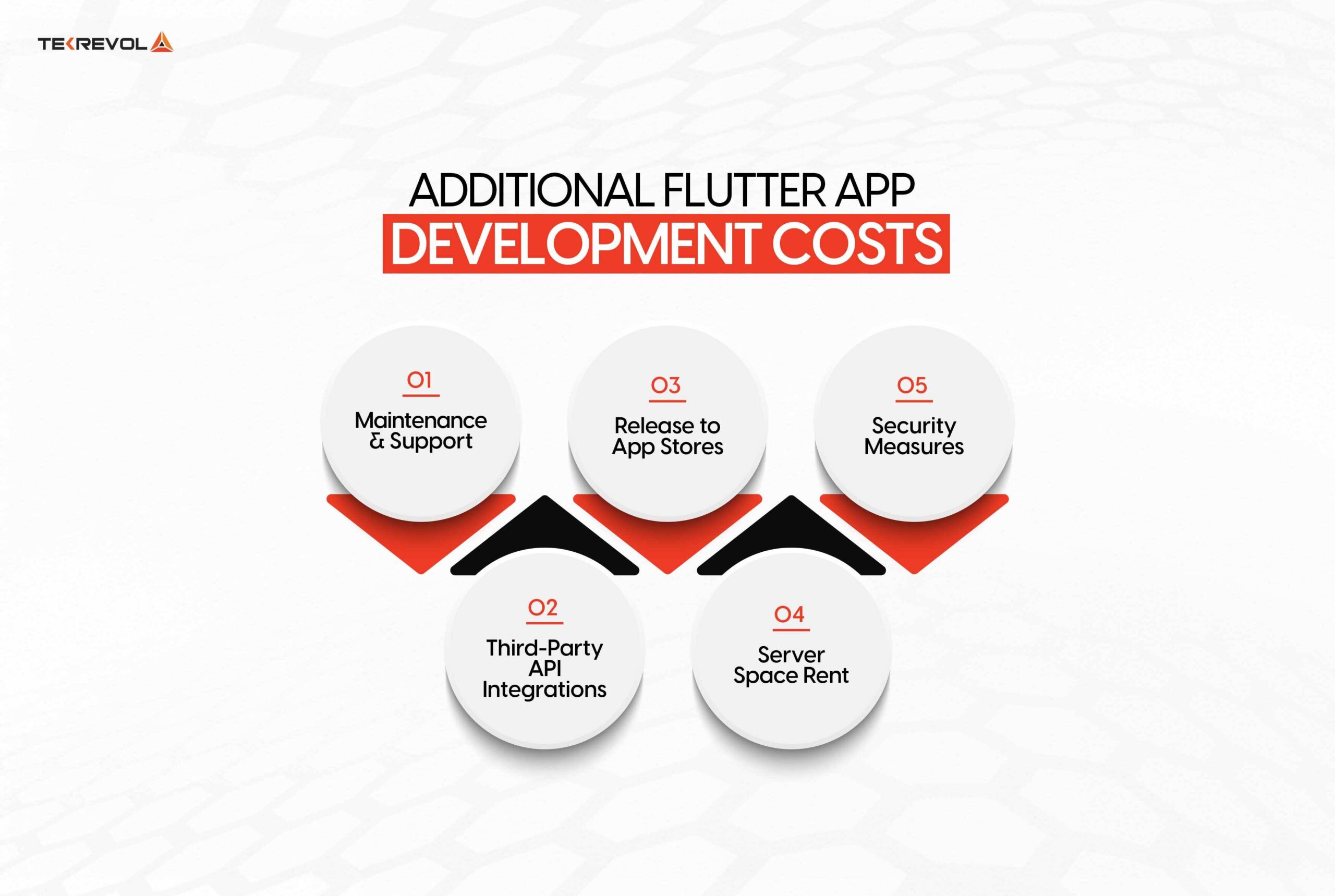
When planning the budget for your Flutter app, it’s crucial to consider the additional costs beyond the initial development. These expenses ensure your app remains competitive, secure, and functional over time. Ignoring these factors can lead to higher long-term costs and potential revenue loss.
| Cost Factor | Estimated Cost |
|---|---|
| Maintenance & Support | 15-20% of initial development cost annually |
| Third-Party API Integrations | Varies with complexity; higher for advanced APIs |
| Third-Party API Integrations | Varies with complexity; higher for advanced APIs |
| App Store Release | Google Play: $25 (one-time), Apple App Store: $99/year |
| Server Space Rent | $1650/year for a server with 8-core CPU and 32 GiBs RAM |
| Security Measures | Initial setup: $1,000-$5,000, ongoing monitoring and updates: varies |
How Much It Costs to Maintain a Flutter App
Flutter app maintenance costs 15% to 20% of your original build cost annually. On a $70,000 app, that’s $10,500 to $14,000 per year, or roughly $875 to $1,170 monthly. Year one usually runs higher, closer to 25% to 30%.
| Maintenance item | Annual cost | Notes |
|---|---|---|
| Flutter SDK and package upgrades | $3,000 – $12,000 | Flutter ships releases frequently |
| OS compatibility updates | $2,000 – $8,000 | iOS and Android each ship yearly |
| Bug fixing and support | $3,000 – $15,000 | Spikes after launch and OS releases |
| Backend and hosting | $1,800 – $24,000 | Scales with your user count |
| Security patching | $2,000 – $10,000 | Dependency vulnerabilities |
| Third-party service fees | $1,200 – $18,000 | Every SDK bills separately |
Source: TekRevol pricing observations
Flutter maintenance carries one cost native apps don’t: you track three moving parts instead of one. iOS ships an update, Android ships an update, and Flutter ships releases far more often than either. Our app maintenance cost guide breaks down what sits inside that number.
Skipping maintenance feels free and isn’t. Deferred upgrades compound, and an app three versions behind costs considerably more to bring current than one that stayed close to the release cycle.
Flutter App Development Cost Vs Other Platforms
Flutter app development costs 30% to 40% less than building separate native iOS and Android apps, and prices within roughly 10% of React Native. Against a single native app, it costs slightly more because you’re covering two platforms rather than one.
| Approach | Mid-complexity build | Platforms covered | Trade-off |
|---|---|---|---|
| Flutter | $40,000 – $90,000 | iOS + Android | Larger app size, smaller hiring pool |
| React Native | $40,000 – $100,000 | iOS + Android | Native modules for hardware features |
| Native iOS only | $55,000 – $165,000 | iOS | Best performance, no Android users |
| Native Android only | $50,000 – $150,000 | Android | Wider QA matrix, no iOS users |
| Both, natively | $105,000 – $315,000 | iOS + Android | Two codebases, two release cycles |
Source: TekRevol pricing observations.
Flutter vs React Native
Flutter and React Native development cost within about 10% of each other, so cost is not the deciding factor. Pick Flutter if pixel-identical UI across platforms matters, since Flutter renders its own widgets rather than mapping to native ones. Pick React Native if you already employ JavaScript developers and want an easier hiring market.
Flutter vs Native iOS and Android
Flutter beats native iOS development on cost only when you need both platforms. If your entire audience is on iPhone, native Swift is the better buy and the comparison stops mattering.
The same holds against native Android development cost, with one caveat. Flutter inherits Android’s device fragmentation problem, so you still test across many OS versions and manufacturer skins.
When Native Still Makes Sense
Past a certain point, cross-platform stops saving money. Deep hardware access, heavy AR, or platform-specific system integrations all need native code written twice, which erases Flutter’s advantage. Our rough threshold is five or more platform-specific features.
Why Do Businesses Choose Flutter App Development?
Businesses choose Flutter because it enables faster, more cost-effective cross-platform development without compromising performance or user experience. Companies like eBay, Tencent, Toyota, and Stadia have adopted Flutter to build high-quality apps from a single codebase.
Key advantages of Flutter include:
- Free & Open Source: Backed by Google, Flutter is free to use and eliminates the need for separate Android and iOS development teams.
- Developer-Friendly: A single codebase simplifies development, testing, and deployment, reducing time and maintenance effort.
- Faster Development: Cross-platform capabilities help businesses launch apps in as little as 2–3 months.
- Real-Time Testing: Hot Reload lets developers instantly test code changes, speeding up debugging and QA.
- Rich UI & Graphics: Built-in widgets and Material Design support create visually consistent, high-performance interfaces.
- Fast Performance: Flutter apps deliver quick load times and smooth user experiences across devices.
- Ideal for MVPs: Startups can build and launch a functional MVP quickly, making it easier to validate ideas and attract investors.
What are the Strategies to Optimize Flutter App Development Cost?
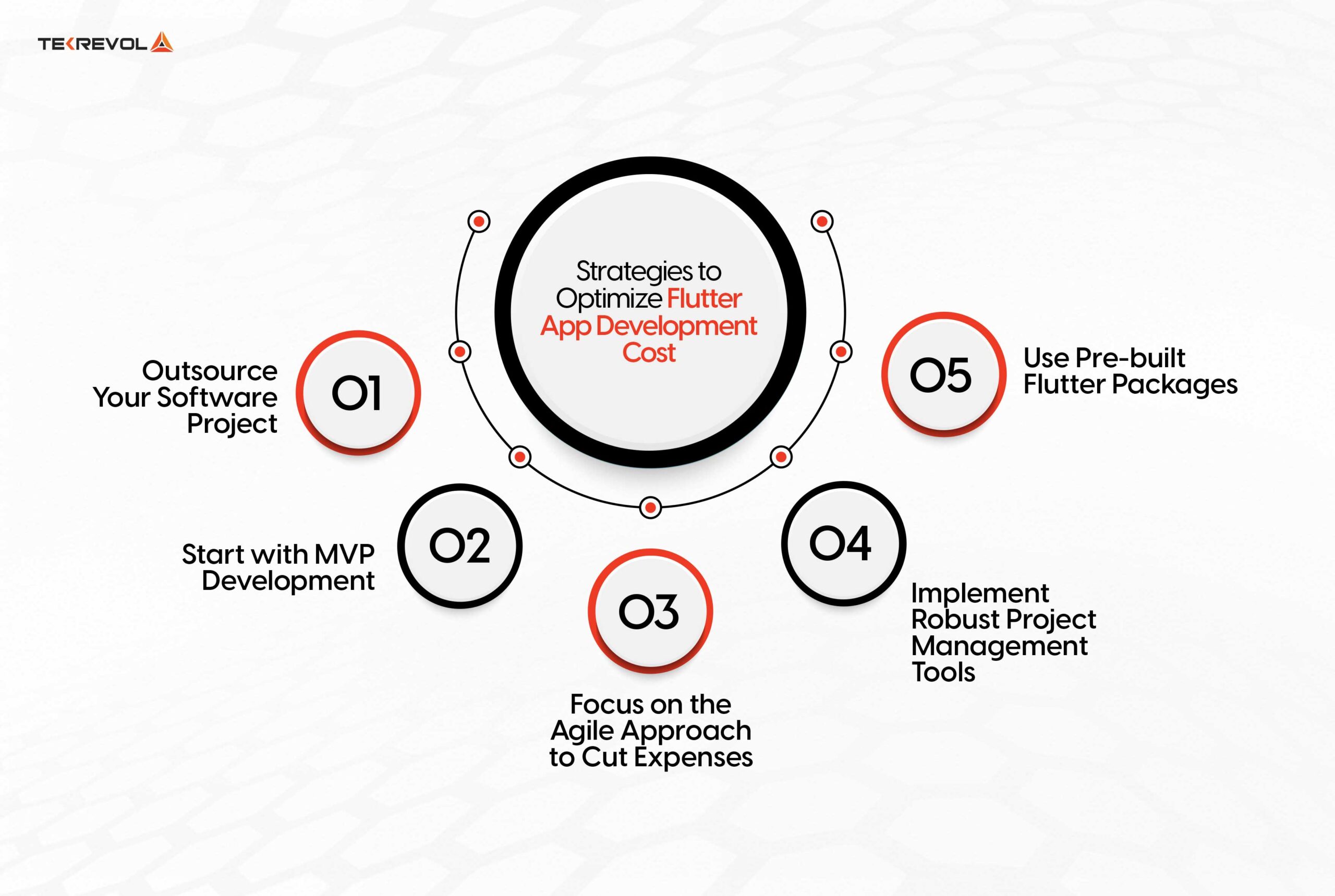
You can reduce Flutter app development cost by trimming your feature list to a true MVP, reusing pre-built UI components, choosing an experienced team over the cheapest quote, and testing continuously instead of fixing bugs after launch.
A few things that actually move the needle:
- Start with an MVP, not the full vision. Launch with the features your core users need, then add the rest based on real usage data instead of guesses.
- Reuse Flutter’s widget library instead of custom-building everything. Flutter ships with a huge set of pre-built, tested components, so custom UI work should be reserved for things that truly need it.
- Pick a team with Flutter-specific experience. A team that’s built ten Flutter apps moves faster and hits fewer surprises than one learning the framework on your project’s dime.
- Test as you build, not at the end. Catching a bug during development costs a fraction of what it costs to fix after users have already found it.
- Plan integrations early. Deciding on your payment gateway or analytics tool late in the build often means rework, which is one of the more avoidable cost spikes in any project.
Flutter App Development in 2026 [Key Notes]
Flutter’s 2026 changes create a migration cost for existing apps. Flutter 3.47, released on August 12, 2026, moved Material and Cupertino into standalone packages, and Google will deprecate the core SDK versions in the November stable release. Older apps need updating.
Per the official Flutter blog, Material and Cupertino design systems now ship as standalone packages, material_ui and cupertino_ui version 1.0, so they can update on their own schedule. The versions currently inside the core SDK are scheduled for formal deprecation in the November 2026 stable release.
- Impeller is now the default renderer on desktop
Flutter 3.47 made Impeller default on macOS, Windows, and Linux, having already replaced Skia on mobile. Google states Skia remains available as a fallback but will be removed in a future release, and its 2026 roadmap confirms the legacy Skia backend is being removed on Android 10 and above.
- WebAssembly is heading to default for web.
Google’s 2026 roadmap names WebAssembly as the intended default for Flutter Web, with developers able to opt in today using the –wasm flag.
What this means for your budget: If you’re commissioning a new Flutter app, none of this costs you anything, since a good team will build on current packages from day one. If you already run a Flutter app, budget $4,000 to $15,000 for the design-system migration before the November deprecation, depending on how much custom theming you have.
Why Choose TekRevol for Flutter App Development?
TekRevol stands out as a leading Flutter app development company in the USA. We build Flutter apps that hold up after launch, not just reach it.
Our in-house team of skilled Flutter engineers is adept at using only the most useful technologies to create robust, scalable, and high-performance apps that perfectly fit within the client’s budget. Our expertise across healthcare, fintech, and ecommerce allows us to deliver tailored solutions that meet specific business requirements.
We follow an agile development approach, ensuring flexibility and responsiveness to changing project needs. By starting with an MVP, we enable quick time-to-market and gather valuable user feedback early in the development process.
Our focus on continuous improvement and scaling based on performance insights ensures that your app evolves to meet modern user needs.
Talk to a Flutter Team That's Shipped at Every Budget Tier
From lean MVPs to enterprise super apps, we've built and shipped Flutter projects across every complexity level covered in this guide.
Book a Free Consultation →


