



- Mobile app maintenance costs $5,000 to $120,000 or more per year, depending on app complexity.
- Year one runs 30% to 50% of build cost, then settles to 15% to 25% annually.
- Google Play requires apps to target Android 16 by August 31, 2026, or lose new users.
- Infrastructure spend scales with your active user count, not with what you originally paid to build.
- Removing an app from the store does not stop your cloud, SDK, or developer account fees.
- Deferred maintenance compounds quietly, so year four routinely costs far more than year two did.
You built and launched your mobile app, but what comes next?
Many founders assume the heavy financial lifting ends once an application lands in the app stores. In reality, launching is just day one of your product’s life cycle. Operating systems update, third-party APIs change, security threats evolve, and users demand fresh features. So, how much does it cost to maintain an app?
To keep your product stable and secure, your average annual mobile app maintenance cost will sit between 15% and 20% of your initial development budget. For a $100,000 application, that’s roughly $15,000 to $20,000 every year to handle server hosting, bug fixes, security patches, and OS upgrades. In the first post-launch year, costs can even reach 30–50% as your codebase stabilizes under real-world traffic.
In this guide, we break down app maintenance costs by category, complexity, platform, and key cost drivers. We will also share actionable strategies our mobile app maintenance and support team uses to help you optimize your support budget without sacrificing app performance.
What Is Mobile App Maintenance, and What Types Are There?
Mobile app maintenance is the ongoing work that keeps a live app functional, secure, and store-compliant. It splits into five types: corrective fixes what’s broken, adaptive keeps up with OS changes, perfective improves what works, preventive stops future problems, and emergency handles outages.
Keeping an app alive is not the same as improving it, and conflating them is how retainers turn into arguments.
| Type | Trigger | Typical annual cost | Can you plan it? |
| Corrective | Reported bugs and defects | $2,000 – $15,000 | Partly |
| Adaptive | OS releases, API deprecations | $5,000 – $30,000 | Yes, dates are published |
| Perfective | User feedback, analytics | $8,000 – $40,000 | Yes |
| Preventive | Code health, dependency aging | $3,000 – $20,000 | Yes |
| Emergency | Outages, breaches, critical bugs | $0 – $25,000+ | No |
How Much Does Mobile App Maintenance Cost in 2026?
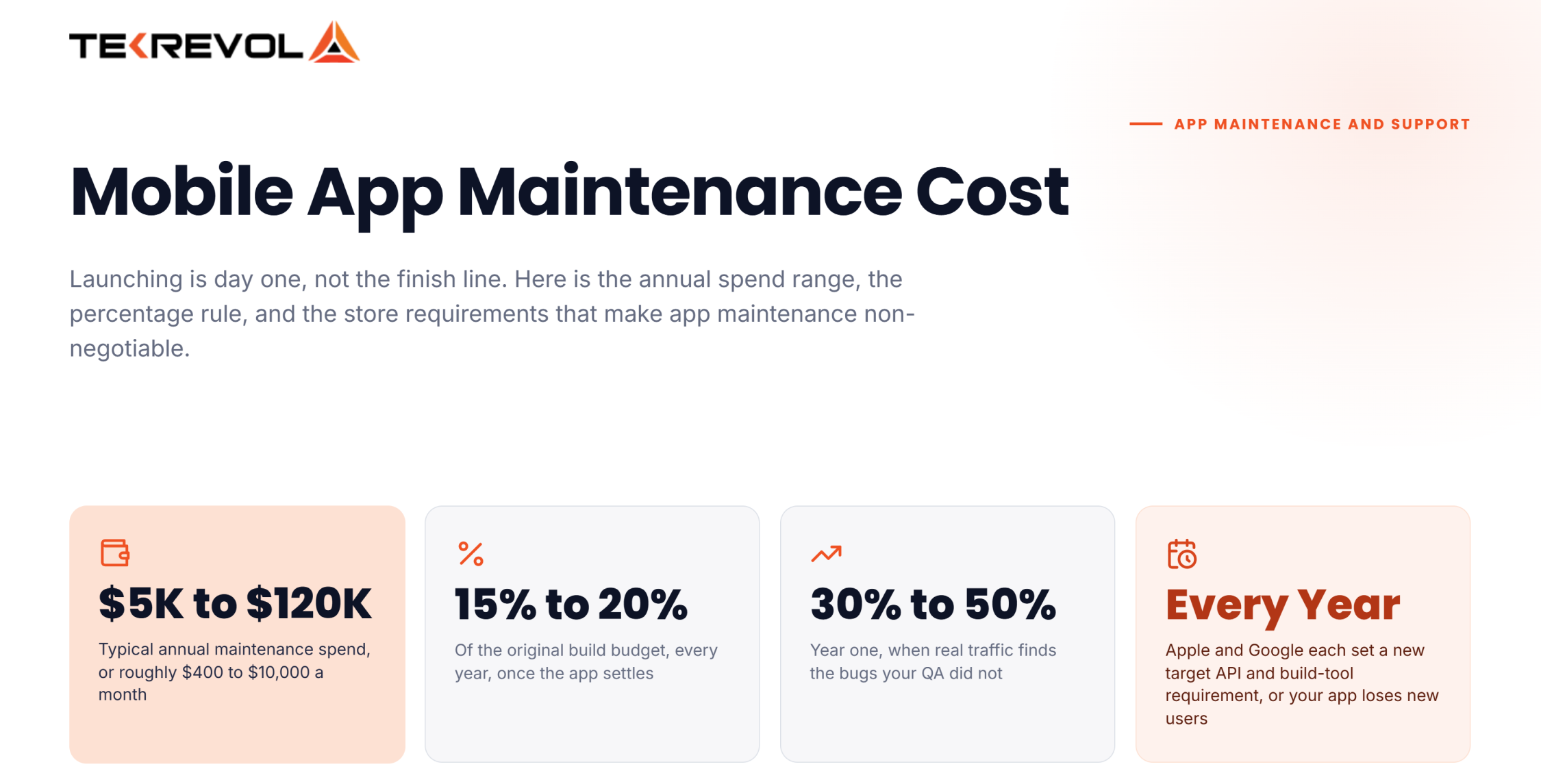
Mobile app maintenance costs $5,000 to $120,000+ per year, or roughly $400 to $10,000 monthly. The widely quoted rule for application maintenance cost is 15% to 20% of your original development budget, annually.
That rule gets repeated everywhere, so let’s put real numbers before we explain where it breaks. If you want to know how much does app maintenance cost for a build of your size, find your row below.
| Original build cost | Year 1 maintenance | Year 2+ maintenance | Monthly (year 2+) |
| $40,000 | $12,000 – $20,000 | $6,000 – $10,000 | $500 – $835 |
| $100,000 | $30,000 – $50,000 | $15,000 – $25,000 | $1,250 – $2,085 |
| $250,000 | $75,000 – $125,000 | $37,500 – $62,500 | $3,125 – $5,210 |
| $500,000 | $150,000 – $250,000 | $75,000 – $125,000 | $6,250 – $10,415 |
Notice year one. It runs 30% to 50% of build cost rather than 15%. The first twelve months after launch are when users find the bugs your QA didn’t, when your infrastructure assumptions meet actual traffic, and when you discover which features nobody uses.
The app maintenance cost per year then settles into that 15% to 25% band across years two and three. After that, it tends to climb again as technical debt accumulates and dependencies age out, which almost nobody tells you upfront.
Got an app nobody has touched in a year?
We'll run a full technical and compliance audit, hand you the findings document, and quote fixed-price remediation.
Schedule a Free App Health AuditWhat’s Included in Mobile App Maintenance Cost?
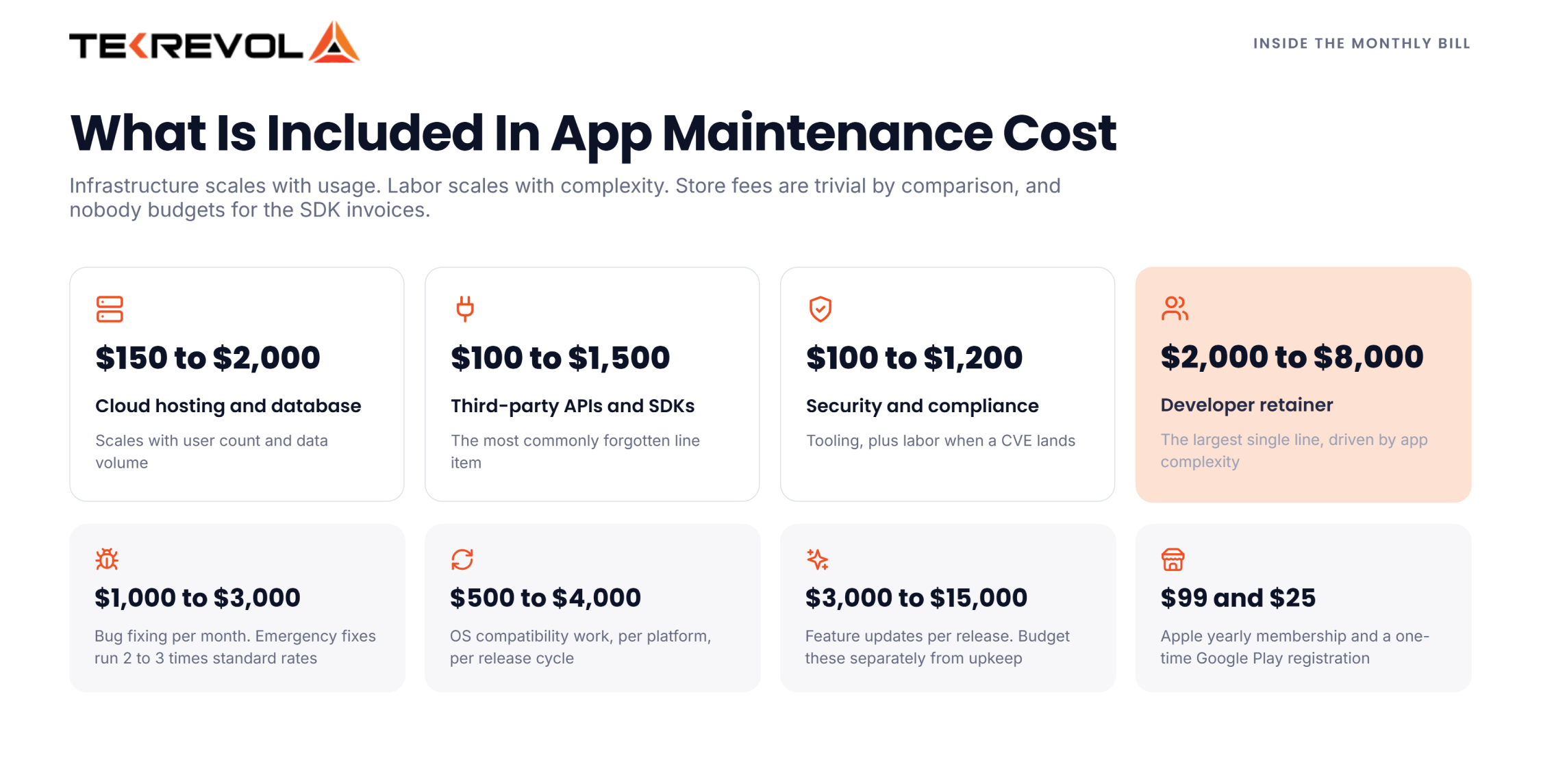
The cost to maintain an app splits into two halves. Infrastructure and third-party services run $300 to $4,000 monthly and scale with usage. Developer labor runs $2,000 to $8,000 monthly and scales with complexity. App store fees are trivial by comparison.
| Category | Monthly cost | Scales with |
| Cloud hosting and database | $150 – $2,000 | User count and data volume |
| CDN, media storage, bandwidth | $50 – $600 | Content served |
| Third-party APIs and SDKs | $100 – $1,500 | Transactions and calls |
| Monitoring and crash reporting | $0 – $500 | Event volume |
| Push notifications and messaging | $0 – $400 | Send volume |
| Security and compliance tooling | $100 – $1,200 | Regulatory scope |
| Developer retainer (labor) | $2,000 – $8,000 | App complexity |
| App store fees | About $8 | Nothing; it’s flat |
Source: TekRevol maintenance engagement observations
Hosting and Infrastructure
Hosting and infrastructure costs $150 to $2,000 monthly for most apps. A backend serving 1,000 users and one serving 100,000 users run identical code on very different bills.
Managed platforms like Firebase look cheap at launch and get expensive fast at scale, because their pricing is usage-metered rather than capacity-based. Our cloud support and maintenance services cover when moving off managed infrastructure starts paying for itself.
Third-party Service
Third-party services cost $100 to $1,500 monthly and are the most commonly forgotten line item in app maintenance budgets. Payment gateways, mapping, SMS and email delivery, analytics, authentication providers, and chat SDKs all bill separately.
We’d suggest doing this once a year: list every SDK in your app and find its invoice. Most teams discover at least one subscription nobody remembers approving.
App Store Fees
App store fees cost far less than people assume. The Apple Developer Program costs 99 USD per membership year according to Apple’s own documentation, and a Google Play developer account costs a one-time 25 USD registration fee with no annual renewal.
The store fee that actually matters is the revenue share, not the membership. Google restructured its service fee on June 30, 2026, taking 10% on the first $1 million in annual earnings, plus a separate 5% billing fee if you use Google Play’s own billing system in the US, UK, or EEA.
Bug Fixing and Issue Resolution
Bug fixing costs $1,000 to $3,000 monthly on a typical app, though it spikes hard after launch and after every major OS release. A minor cosmetic fix runs $100 to $300 in labor. A core functional bug that touches your payment or auth flow can run $2,000 to $6,000.
Emergency fixes cost the most, often 2 to 3 times standard rates, because they jump the queue and get worked outside a planned sprint.
OS Compatibility Updates
OS compatibility updates cost $500 to $4,000 per platform per release cycle. Apple and Google each ship a major OS version annually, and each one deprecates APIs your app may depend on. This work produces zero new features and is completely non-negotiable, which is the frustrating part.
Security Patching and Monitoring
Security patching costs $100 to $1,200 monthly in tooling, plus labor when something needs fixing. Dependency vulnerabilities are the usual trigger: a library you installed three years ago gets a CVE, and now it needs upgrading along with everything that depends on it.
Feature Updates and Improvements
Feature updates cost $3,000 to $15,000 per release and are technical enhancements rather than maintenance, though almost every retainer blurs the two. This is the only category on this list that grows your business rather than protecting it.
Worth separating these in your budget. Mixing them makes it impossible to tell whether you’re investing or just treading water.
How Much Does It Cost to Maintain a Mobile App by Complexity Level?
Mobile app maintenance cost by app complexity ranges from $5,000 annually for simple apps to $300,000+ for enterprise platforms. Complexity here means integrations, real-time features, and data volume, not screen count. More moving parts means more things that break.
| Complexity | Annual maintenance | Monthly | What sits inside |
| Simple | $5,000 – $15,000 | $400 – $1,250 | Static content, basic auth, minimal backend |
| Medium | $15,000 – $50,000 | $1,250 – $4,200 | Payments, custom API, several integrations |
| Complex | $50,000 – $120,000 | $4,200 – $10,000 | Real-time features, heavy data, high traffic |
| Enterprise | $120,000 – $300,000+ | $10,000 – $25,000+ | Multi-app systems, compliance, dedicated team |
Source: TekRevol maintenance engagement observations
Simple App
Simple apps cost $5,000 to $15,000 per year to maintain. Most of that budget goes to OS compatibility updates and hosting, with very little firefighting. A simple app can genuinely run on a part-time retainer, checking in monthly and doing real work twice a year around OS releases.
Medium-complexity App
Medium apps cost $15,000 to $50,000 per year. This band covers most ecommerce, booking, and subscription content apps, and it’s where the majority of businesses reading this will land. Payment integrations drive a lot of the cost. Gateways change their APIs, add compliance requirements, and deprecate old versions on their own schedule rather than yours.
Complex App
Complex apps cost $50,000 to $120,000 per year. Real-time features are the reason: live tracking, messaging, video, and matching logic all need infrastructure that must stay up, monitored, and scaled. These apps usually need a named engineer with real availability rather than a shared support queue, and that staffing model is most of the cost difference.
Enterprise App
Enterprise platforms cost $120,000 to $300,000 or more per year. You’re maintaining several connected applications, integrations into an ERP or CRM, single sign-on against a corporate directory, and an audit trail somebody reviews. Compliance renewal alone can consume a meaningful share of that budget before a single line of code changes.
Not sure which complexity band your app sits in?
Avoiding common pitfalls is only half the game; success depends on having the right game development team by your side.
Book a Free Maintenance Cost ReviewHow Much Does It Cost to Maintain an App by Platform?
Mobile app maintenance cost by platform varies more than most people expect. Native Android costs $7,000 to $22,000 annually, native iOS costs $8,000 to $25,000, and cross-platform frameworks land between them. Maintaining two native codebases roughly doubles the bill.
| Platform | Annual maintenance | Main cost driver |
| Native Android | $7,000 – $22,000 | Device and OS fragmentation testing |
| Native iOS | $8,000 – $25,000 | Annual SDK requirements, faster deprecation |
| Both, natively | $15,000 – $47,000 | Two codebases, two release cycles |
| React Native | $10,000 – $28,000 | Framework upgrades, native module drift |
| Flutter | $9,000 – $26,000 | Framework upgrades, plugin maintenance |
| Progressive web app | $4,000 – $15,000 | Browser compatibility only |
iOS App Maintenance Cost
iOS app maintenance costs $8,000 to $25,000 per year. Apple deprecates APIs faster than Google does and enforces build-tool requirements with firm dates, which forces a predictable annual work cycle whether your app needs changes or not.
The upside is a narrow device matrix. Testing on six device-OS combinations covers most of your users. See our iOS app development cost guide for how that plays out at build time too.
Android App Maintenance Expenses
Android app maintenance costs $7,000 to $22,000 per year. The per-release work is often lighter than iOS, but the testing surface is much wider because your users sit across many OS versions and manufacturer skins simultaneously.
That widened QA matrix is the whole story on Android maintenance, and our Android app development cost breakdown quantifies the fragmentation math behind it.
Cross-platform App Maintenance Cost
Cross-platform apps built in React Native or Flutter cost $9,000 to $28,000 per year, which is less than maintaining two native codebases but more than maintaining one. You fix bugs once, which is the real saving.
The trade-off nobody mentions at build time: you now depend on a framework that ships breaking changes on its own schedule. A major React Native or Flutter upgrade is a real project, not a patch. Our native versus cross-platform cost comparison covers that lifetime trade properly.
Estimated Cost of App Maintenance by Industry
Mobile app maintenance cost by industry runs from $12,000 a year for education apps to $200,000+ for fintech. Regulated sectors cost the most because compliance recurs on a calendar you don’t control. Consumer utility apps cost the least. Your industry sets a floor beneath your usage.
| Industry | Annual Maintenance | Cost Drivers |
| Fintech | $60,000 – $200,000+ | Annual PCI DSS, banking API changes, fraud rules |
| Healthcare | $50,000 – $150,000 | HIPAA reviews, EHR API drift, audit logging |
| Social media | $30,000 – $150,000 | Moderation, media storage, feed infrastructure |
| Gaming | $25,000 – $120,000 | Live ops, content drops, game server uptime |
| On-demand | $35,000 – $100,000 | Real-time tracking, map billing, three apps |
| SaaS | $30,000 – $90,000 | Uptime commitments, billing logic, tenant support |
| Music & Streaming | $25,000 – $80,000 | Bandwidth, DRM, licensing reporting |
| Ecommerce | $20,000 – $60,000 | Gateway updates, catalog sync, peak traffic |
| Retail | $18,000 – $55,000 | POS integration drift, loyalty, seasonal load |
| Education | $12,000 – $45,000 | Content delivery, term-cycle spikes, COPPA |
Source: TekRevol maintenance engagement observations
Key Insight
In most industries, maintenance cost is driven by usage. In regulated ones, it’s driven by the calendar. So if you’re in a regulated sector, model your maintenance as a fixed annual commitment first and a usage-based cost second. If you’re not, do the reverse.
Fintech App Maintenance Cost
Fintech apps cost $60,000 to $200,000 or more per year to maintain. PCI DSS re-certification, KYC and AML rule changes, banking API versioning, and fraud-detection tuning all recur annually, and none of them are optional. Our fintech app development cost guide separates the one-time licensing spend from the recurring compliance spend.
Healthcare App Maintenance Cost
Healthcare apps cost $50,000 to $150,000 per year. HIPAA obligations don’t end at launch: risk assessments recur, business associate agreements need renewing with every vendor, and audit logging has to keep working. EHR integrations are another recurring cost separate from healthcare app development cost since hospital systems update on their own timelines.
Ecommerce and Retail App Maintenance Cost
Ecommerce apps cost $20,000 to $60,000 per year and retail apps $18,000 to $55,000. Payment gateways drive most of it, because processors deprecate API versions on schedules you don’t set. Add seasonal infrastructure scaling for peak trading periods. Our ecommerce app development cost guide covers how that carries from build into run.
On-demand App Maintenance Cost
On-demand apps cost $35,000 to $100,000 per year because you’re maintaining several apps, not one. A customer app, a provider app, and an admin dashboard each need their own release cycle, and live tracking means mapping API bills that scale directly with trip volume. We outline the architecture in detail in our guide to on-demand app development costs.
Mobile Game Maintenance Cost
Mobile games cost $25,000 to $120,000 annually to maintain. Live-ops, seasonal events, balance patches, and content drops are ongoing production work rather than upkeep, and game servers have to stay up through peak hours. A game’s maintenance line is a small content studio, which is why our mobile game development cost guide treats live-ops as its own category.
Music and Video Streaming App Maintenance Cost
Music and video streaming apps cost $25,000 to $80,000 per year. Bandwidth is the defining line item, and it’s the one infrastructure cost that can outgrow your labor spend as your library and audience expand together. DRM upkeep and licensing reporting add the rest. In our guide to music streaming app development cost, we break down that content delivery spend.
SaaS App Maintenance Cost
SaaS apps cost $30,000 to $90,000 per year. Uptime commitments drive most of it, because an SLA turns monitoring and on-call coverage into a contractual obligation rather than good practice you can defer when things get busy. Subscription billing is the other constant. It has to be correct every month, and billing bugs cost you customers instead of just tickets. Our SaaS application cost guide covers the multi-tenancy side.
Education App Maintenance Cost
Education apps sit lowest at $12,000 to $45,000 per year. Traffic falls to almost nothing over summer, then spikes hard in September when term starts. You end up paying for infrastructure that idles for months and then has to absorb a sharp seasonal swing without falling over. Our educational app development cost guide covers how to size for that pattern.
What Factors Drive Mobile App Maintenance Cost?
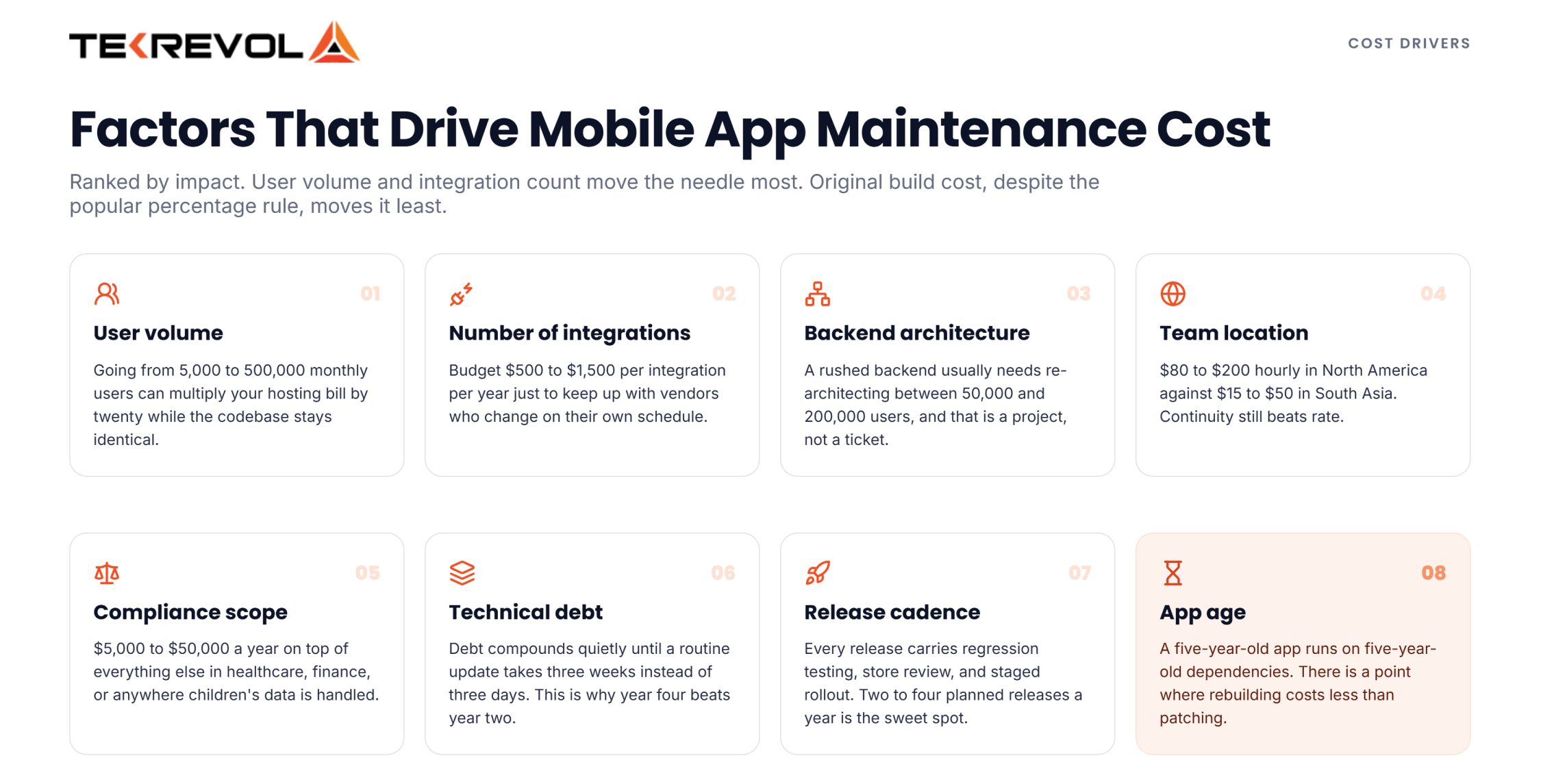
Key drivers of mobile app maintenance cost are user volume, integration count, backend architecture, team location, compliance scope, technical debt, and release cadence.
User volume and integration count move the needle the most. Build cost, despite the popular rule, drives it the least. Here they are in order of impact.
User Volume
User volume is the single biggest driver of infrastructure spend, and it’s completely decoupled from what you paid to build the app. Going from 5,000 to 500,000 monthly active users can multiply your hosting bill by twenty while your codebase stays identical.
Number of Integrations
Every third-party integration is a dependency that can change without asking you. Ten integrations means ten vendors who might deprecate an endpoint, change pricing, or introduce a breaking update in any given quarter. We budget roughly $500 to $1,500 per integration per year just for keeping up.
Backend Architecture
Backend architecture decides whether growth costs you linearly or exponentially. A well-structured backend absorbs new users cheaply. A backend that was rushed to launch tends to need re-architecting somewhere between 50,000 and 200,000 users, and that’s a project, not a maintenance ticket.
Development Team Location
Team location changes your labor rate by 4x or more, exactly as it does at build time. A maintenance retainer costs $80 to $200 hourly in North America and $15 to $50 hourly in South Asia.
Continuity matters more than rate here, though, because a mobile app development team that knows your codebase works far faster than a cheaper team learning it.
Compliance and Regulatory Scope
Compliance costs $5,000 to $50,000 annually on top of everything else if you operate in healthcare, finance, or handle children’s data. Regulations change, audits recur, and certifications expire. This spend is entirely invisible to users and entirely non-optional.
Technical Debt
Technical debt is the driver that makes year four cost more than year two. Every deferred refactor, skipped test, and quick fix makes the next change slower and riskier. Debt compounds quietly until a routine update takes three weeks instead of three days.
Release Cadence
Release cadence sets your baseline labor. Shipping monthly costs more than shipping quarterly, because each release carries regression testing, store review, staged rollout, and monitoring. Two to four planned releases a year is the sweet spot for most non-consumer apps.
App Age
App age raises cost in a way most budgets never account for. A five-year-old app is running on dependencies that are five years old, and upgrade paths get harder the longer you wait. There’s a point where rebuilding costs less than continuing to patch, and recognizing it early saves real money.
Why Do App Stores Force You to Pay for App Maintenance Fees?
App stores force maintenance fees through hard compliance deadlines. Google Play requires apps to target Android 16 (API level 36) by August 31, 2026, or lose visibility to new users on newer devices. Apple requires App Store Connect uploads built with Xcode 26 from April 28, 2026.
Google Play’s Target API Level Requirement
Per Google Play Console Help, new apps and app updates must target Android 16 or higher as of August 31, 2026, with an extension available to November 1, 2026. Google states the consequence for existing apps plainly:
Your app will stop being available in Google Play store to new users on devices running Android OS newer than what your app targets.
Read that carefully. Your app isn’t deleted. Existing users keep it. But it stops appearing for anyone on a newer device, which for a growing app is functionally the same as being removed. Google repeats this cycle every single year.
Apple’s SDK Requirement
Apple’s published upcoming requirements state that from April 28, 2026, apps uploaded to App Store Connect must be built with Xcode 26 or later, using the iOS 26 SDK or its equivalent on other Apple platforms. You cannot ship any update, including a critical bug fix, without meeting it first.
Want to know what API level your live app currently targets?
We'll check your app against current requirements and tell you what work stands between you and compliance.
Request a Free Store Compliance CheckWhat Happens If You Stop Maintaining Your App?
Stopping app maintenance costs more than continuing it. Your app loses store visibility at the next API deadline, breaks on the next OS release, accumulates security vulnerabilities, and eventually needs a rebuild. Rebuilding typically costs 60% to 80% of the original development budget.
Here’s the sequence we see, and it’s remarkably consistent.
- Months 1 to 6: nothing visible happens. This is the dangerous part, because it feels like the decision was free.
- Months 6 to 12: a new OS version ships. Some screens misbehave. Crash rate climbs. Reviews start mentioning it.
- Months 12 to 18: the store API deadline passes. New users on current devices stop finding the app. Downloads fall without an obvious cause.
- Months 18 to 36: dependencies are now years out of date. Upgrading one requires upgrading five. A “quick fix” quote comes back at $30,000.
- Month 36 onward: rebuilding is genuinely cheaper than repairing. You pay most of the build cost again, and lose the users who left along the way.
How Can You Optimize Your Mobile App Maintenance Cost?
By following best practices, you can optimize app maintenance costs by 30% to 40% without cutting corners. Consolidate third-party services, right-size your infrastructure, automate testing, keep the same team, and separate genuine maintenance from feature work in your budget.
- Audit your infrastructure annually
This is the fastest way to save. Over-provisioned instances, unused storage, and duplicate services routinely account for 20% to 40% of a cloud bill. One afternoon of review often pays for itself several times over.
- Cut redundant third-party services
Most apps carry two analytics tools, an unused A/B testing platform, and a messaging SDK from a feature that got removed. List every SDK, find every invoice, and cancel what isn’t earning its keep.
- Automate your regression testing
Automated test suites cost $8,000 to $25,000 to build and then cut per-release QA effort substantially, forever. If you ship more than twice a year, this pays back in eighteen months.
- Keep the same development team
Handover costs are brutal and invisible. A new team needs two to three months to work at full speed on an unfamiliar codebase, and you pay for every hour of that ramp-up.
- Stay ahead of OS deadlines
Planned compatibility work costs a fraction of emergency compatibility work. The dates are published a year in advance, so there’s no excuse for being surprised.
- Don’t confuse maintenance with enhancement
Track them separately. Half the “maintenance costs are out of control” conversations we have turn out to be feature development filed under the wrong budget line.
Why Choose TekRevol for Mobile App Maintenance and Support?
TekRevol maintains apps we didn’t necessarily build, which is the harder half of this work. Our mobile app maintenance and support services support products across 11+ industries, and every maintenance engagement starts with an audit rather than a retainer quote.
Here’s what that looks like in practice.
- Audit first, retainer second: Before quoting a monthly figure, our team reviews your codebase, dependency health, infrastructure spend, and store compliance status. You get that assessment as a document you keep, whether or not you hire us.
- Infrastructure savings: Right-sizing cloud resources and cutting dead third-party subscriptions is standard practice in our first ninety days. In several engagements, the work has covered a meaningful share of the maintenance fee.
- Independent reviews: TekRevol holds a 4.8 out of 5 rating across 83 verified reviews on Clutch, and has been recognized by the Horizon Interactive Awards, the dotCOMM Awards, and Forbes’ America’s Best Startup Employers list.
- Your code stays yours: Repositories, infrastructure access, and documentation belong to you throughout. A maintenance partner who holds your access hostage is a cost you’ll discover later, and we’d rather you never have that conversation.
Planning your annual app maintenance budget?
We'll audit your current stack, your store compliance status, and your infrastructure spend, then hand you a twelve-month maintenance forecast.
Get a Free App Maintenance Audit


