
Healthcare is frustrating. We all know it.
You wait weeks for an appointment and spend hours in waiting rooms, only to find that your doctor is unavailable when you need care most. And even in a small town, you can never come across a specialist within two hours. And the costs? Don’t even get
These aren’t new problems. They’ve been around forever. But here’s what’s different now: they’re actually getting solved.
Digital healthcare solutions are transforming the way we receive care, the way physicians practice, and the way patients manage their health. This isn’t a future concept, it’s happening right now. In 2026, the healthcare apps and platforms we use daily are addressing long-standing challenges, and partnering with a reliable healthcare mobile app development company ensures these solutions are secure, user-friendly, and impactful for both patients and providers.
Healthcare solutions have moved from novelty to necessity in the digital landscape. What was initially a simple appointment booking system and fitness devices has now developed into advanced applications that carry experts in your pocket.
In this blog, we’ll break down how app development for healthcare is finally fixing the everyday problems patients and providers face.
The Rise of Healthcare Apps: Insights Backed by Data
The app development for the healthcare industry is undergoing a digital revolution. To get an idea of how immense this change is, you can see the figures that indicate that this is not just a trend but the new standard of care.
- AMA research indicates that 93% of physicians recognize the role of digital health tools, including mobile apps and connected platforms, in elevating patient care standards.
- During COVID-19, telemedicine apps became widely adopted nationwide, and data show that approximately 80% of physicians plan to maintain their use.
- Global health and fitness app downloads reached approximately 3.6 billion in 2024, reflecting growing demand for mobile health solutions worldwide.
- Over 350,000 healthcare web apps and medical apps are now available globally, with patient downloads exceeding 3.2 billion in 2025 alone.
- Nearly 25–30% of all U.S. medical visits are expected to be conducted virtually by 2026. This rapid shift to virtual care is motivating healthcare providers to develop custom telemedicine apps.
This isn’t a temporary trend. It’s a fundamental shift in healthcare delivery that’s here to stay, and working with an experienced healthcare app development company is essential for organizations looking to build innovative solutions and be part of this transformation.
Take the next step in healthcare innovation with your app.
Tekrevol creates intelligent apps that empower patients and streamline provider workflows.
Talk to Our Experts10 Biggest Problems Healthcare Apps Are Solving Today
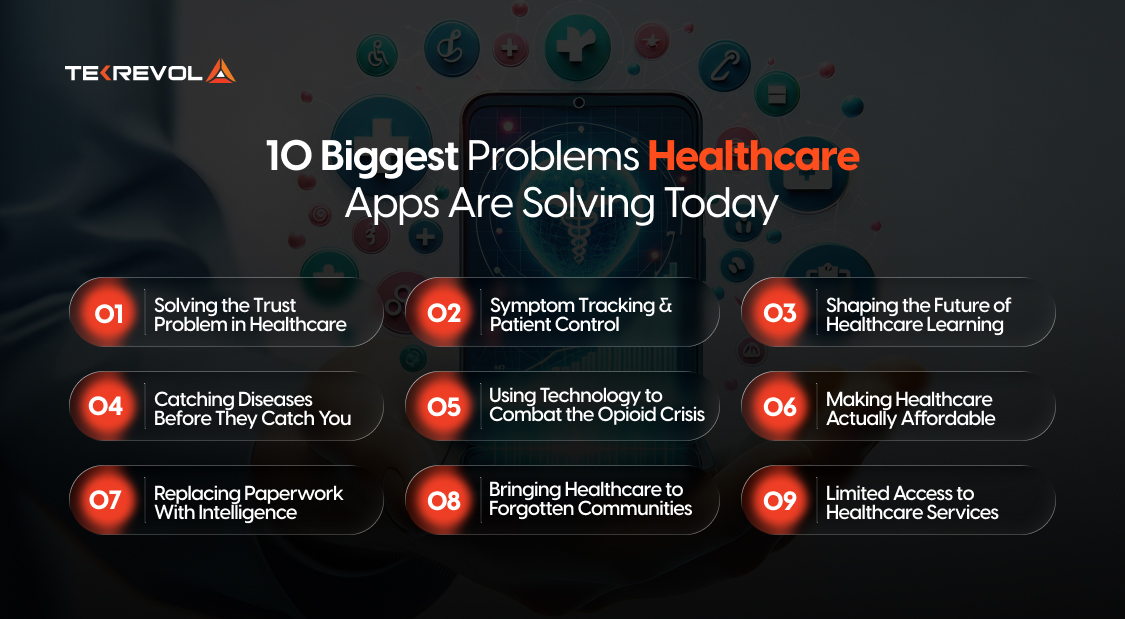
Top Healthcare apps are revolutionizing how we access medical care, manage chronic conditions, and take control of our health. We’ve identified the 10 largest issues app development for healthcare is solving today.
1. Solving the Trust Problem in Healthcare
In the United States, diagnostic errors result in about 795,000 severe harm every year, 371,000 of which lead to fatality, and 424,000 persons who experience lifetime disability.
When you go to a doctor, you leave your issue to him and anticipate that he knows what is wrong and how to rectify it. Physicians are not Gods, however, and errors are committed. The crucial aspect is to identify methods of making them more precise.
This is where artificial intelligence in healthcare comes in, and it is no longer science fiction. Medical diagnostic devices that use AI are already examining medical images, medical history, and symptoms with greater accuracy and speed than ever before. The best healthcare app development companies are designing systems that are capable of identifying trends in millions of medical records that no human physician could ever recall.
The current status of AI in the field of diagnostics looks like this:
- Predicting the real-time patient biometrics and medical records to analyze large datasets and give actionable information.
- Minimizing human error in medical coding and documentation.
- Determining trends in millions of cases that contribute to quicker diagnosis.
- Identifying possible problems before they become critical.
2. Symptom Tracking and Patient Control
Remembering your symptoms is one of the greatest difficulties when you pay a visit to the doctor. Do you recall the onset of the headache, or was the pain sharp or dull?
The majority of us are not able to answer these questions exactly, and that is a fault. A missed detail may result in misdiagnosis.
Enter symptom trackers. These applications will enable tracking of the symptoms on a real-time basis as they happen. Feeling dizzy? Note it down as you do at the time, with a description of what you were doing, what you ate, and how you slept. This allows the doctor to access the full and precise history and not whatwas collectedd two weeks ago.
Apple’s HealthKit and Google Fit have made biomarker tracking part of everyday life. Instead of basic logs, today’s symptom tracking apps offer AI alerts, charts, and secure data sharing. Today, every mobile app development company is focused on building smarter health solutions. Their apps analyze your data, provide custom advice, and work smoothly with other health systems, making it easier to take control of your wellness.
By combining these systems with AI, physicians will be able to make superior clinical judgments and predict possible diagnoses more quickly.
3. Shaping the Future of Healthcare Learning
Medical students all over the world struggle to secure a few residency spots per year. The waits may take years to be accepted, and some never get accepted, which means that particular skills are not available to take care of patients.
The bottleneck? Funding and geography. The best experts are located in large medical hubs, leaving the rural population underserved. However, geography is no longer an obstacle with virtual reality (VR). VR allows professionals to educate students in any location, and AI and augmented reality provide a simulation of complicated processes.
Virtual reality and AI are making this possible:
- VR enables the consultants to train students all over the world.
- AI, together with augmented reality, provides realistic simulated environments in which doctors can train to perform complicated procedures.
- Live AI feedback can assist trainees in training more efficiently and safely.
- Routine tasks can be automated in computer vision,n and doctors can learn important skills.
4. Catching Diseases Before They Catch You
Cancer. Aneurysms. Strokes. These conditions are usually unpredictable. It can take a long time before the symptoms manifest, and then it may be too late. Patients do not die because they are treated too late in their lives, but because the disease is detected too late.
The risk factors are known to us, and they include sedentary lifestyles, poor nutrition, andthe absence of exercise. Sitting is the new smoking. However, it is not enough to be aware of the risks. The most important thing is early diagnosis and the ability to find out a disease at the moment it can be treated, which may save millions of lives.
This is how app development in healthcare could detect disease earlier:
- Thermal camera add-ons for smartphones, combined with medical imaging apps, could create accessible breast cancer scanners
- Wearable healthcare devices like the Apple Watch and the Fitbit can create patient profiles that AI analyzes for specific risk factors.
- Sleep patterns, activity levels, blood pressure, and nutrition markers can all feed into early detection systems.ms
- When risks are detected, notifications go to both the patient and the physician for further testing.
This is exactly why Apple included an ECG in the Apple Watch. It’s not a gimmick. It’ss early detection technology on your wrist. The future of healthcare isn’t just about treating disease better; it’s about catching it before it becomes life-threatening.
5. Using Technology to Combat the Opioid Crisis
More Americans have died during the opioid crisis than in most wars. The CDC estimates that 130 people die daily due to opioid overdoses. This is an expense to the American economy equivalent to 78.5 billion dollars in medical services, lost productivity, and policing.
The fundamental problem? Healthcare institutions are failing to track who’s getting medications, how much they’re taking, and where they’re getting them from. Paper prescriptions make it easy to claim a lost script and get refills from multiple doctors.
Here’s how app development for healthcare can fix this:
- Digital prescription systems enable end-to-end monitoring of who received which medications and when
- AI-based e-prescribing systems monitor the trends in prescriptions in real-time and identify possible risks.
- The sharing of data across healthcare networks can be centralized, detecting cases of patients visiting more than one doctor seeking the same drugs.
- Patients receive automated notifications reminding them to take medication and record the fact, which eliminates the risk of accidental overdoses.
- AI can analyze medical records to warn physicians about patients showing signs of potential drug abuse.
6. Making Healthcare Actually Affordable
Here’s a hard truth: the Emergency Room is now acting like a regular clinic. Many people who can’t afford basic healthcare go there for routine checkups, and it’s not sustainable.
The US has some of the highest healthcare costs in the world. Without insurance, access to care is extremely limited. The system favors insurers, pharma companies, and hospital networks, while patients often get the short end of the stick.
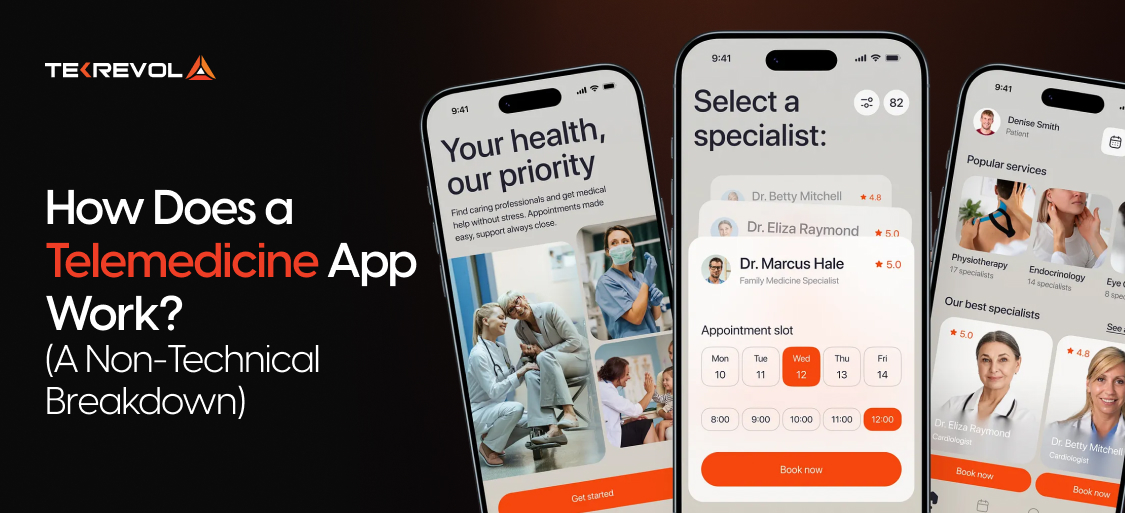
Telehealth is changing this equation. Companies are delivering healthcare services through secure video chat and end-to-end encrypted messaging. Patients can get consultations from home or their office. It’s like Uber for healthcare; you take out a credit card and pay for a much-needed consultation without the distance barrier.
But telehealth is getting even smarter. Generative AI is helping the healthcare industry enhance virtual visits by pre-analyzing patient symptoms, generating preliminary assessments, and suggesting questions for doctors to ask during consultations. This makes remote care not just convenient, but also more thorough and accurate.
The advantages of telehealth are transforming patient care:
- Commoditizes healthcare services, making them accessible to anyone with internet
- Eliminates travel costs and time for non-critical checkups
- Allows patients to access doctors beyond state borders
- Particularly effective for managing lifestyle diseases like obesity, hypertension, and diabetes
- Extends to specialized fields like telepsychiatry, teledermatology, and telenursing
For patients struggling with healthcare bills, these apps make a real difference. While the healthcare app development cost can be high, it’s worth it, empowering patients and pushing providers to offer better value.
7. Replacing Paperwork With Intelligence
Healthcare is drowning in administrative tasks. Data entry, patient record management, and appointment scheduling are manual tasks that eat up time that doctors could spend with patients. They also increase the likelihood of human error.
AI agents in healthcare are changing this by automatically generating medical reports, summarizing patient records, and assisting in charting patient notes during consultations.
Here’s what AI automation delivers:
- Automatic generation of medical reports and documentation
- Appointment scheduling without human intervention
- Reduced risk of human error in documentation and billing
- More time for doctors to focus on patient care instead of paperwork
- Improved operational efficiency across the entire healthcare organization
The focus is on supporting healthcare workers, not replacing them, and reducing administrative burdens so they can spend more time with patients.
8. Bringing Healthcare to Forgotten Communities
The rural and underserved communities have tremendous healthcare problems. Such communities do not have the quality resources and infrastructure to care about their health. The lack of access to specialists and the need to travel to urban centers is a barrier that results in poor health outcomes and increased mortality.
These forgotten communities need to be part of the future of healthcare, and technology is facilitating it. The use of AI in the creation of Telehealth apps can help address these gaps.
In rural healthcare, technology is empowering in a strong manner:
- Telehealth uses AI to provide care to underserved groups of people remotely.
- Even without specialists on the spot, rural clinics will be able to use high-quality diagnostic instruments and expert knowledge.
- Early interventions are possible with continuous remote monitoring and tracking of symptoms in at-risk patients.
- AI helps with diagnoses and treatment plans, and advanced care can be achieved without the presence of a physical specialist.
9. Limited Access to Healthcare Services
The crisis of doctor shortage is a problem that has an impact on millions of people worldwide- the WHO has projected a shortage of 11 million health workers by the year 2030. Healthcare applications are closing this divide by providing telemedicine platforms that allow patients to interact with doctors without regard to state and international boundaries.
- Telemedicine platforms bring specialists to underserved areas where they’re desperately needed.
- Research demonstrates that telehealth greatly decreases hospital readmission and emergency room visits among chronic patients.
- These apps are making healthcare available when and where it’s needed most, literally saving lives.
10. Mental Health Access Gaps
Mental health care in America is at a crisis. Millions of individuals require assistance but are unable to take it. The stigma of mental health and a gross lack of mental health professionals present a barrier, and people continue to suffer anonymously.
The waiting time to meet a psychiatrist can take months. The mental health services are insufficiently covered in numerous insurance plans. In rural settings, there is hardly any time to locate a therapist within a driving range. And to a lot of people, the very thought of waiting in a queue where somebody may identify them makes them not want to seek help at all.
Technology is breaking down these barriers:
- AI-powered healthcare chatbots provide instant crisis assistance to individuals.
- Mental health applications provide mood tracking and cognitive behavior therapy.
- Online support groups have anonymous groups where individuals can share their plights.
- Digital screening tools can be used to detect mental health problems before they are too late.
Partner with Tekrevol to Create Next-Generation Healthcare Applications
The digital transformation of the healthcare sector requires a partner that is both aware of the latest technology and familiar with the specifics of medical implementation. If you have any healthcare app ideas and want to turn them into reality, then we’re here to help. Tekrevol is an on-demand app development company that is focused on building healthcare solutions that fluidly link patients and providers whenever they require medical services.
Tekrevol brings your vision to life with applications that meet rigorous HIPAA compliance and security standards while delivering exceptional user experiences. Every solution, from intuitive patient portals to AI-powered diagnostics, focuses on simplifying healthcare delivery while improving results.
With a proven record of building AI-powered healthcare apps, including platforms like “The Nurse” and “Kinekt”, we deliver solutions that enhance patient engagement, streamline provider workflows, and drive better health outcomes.
Revolutionize Patient Care with Modern Healthcare App Development
Build HIPAA-compliant, AI-powered apps with Tekrevol for smarter patient care.
Schedule a free call now!

![How Much Would It Truly Cost to Develop a Food Ordering Website? [2026 Analysis]](https://d3r5yd0374231.cloudfront.net/images-tek/uploads/2026/03/Tek-Feature-7-1.jpg)