



- An ASO strategy is a continuous loop, not a one-time metadata edit. You research, optimize, ship, measure, and repeat.
- The top three search positions capture roughly half of all downloads, while apps past rank ten get almost none
- iOS and Android reward different things. Apple leans on structured metadata; Google Play rewards semantic relevance and repetition.
- 2026’s biggest shift is AI. Users now ask ChatGPT, Gemini, and Siri which app to install before they open the store.
- Keywords drive discovery, and creatives drive conversion are the best app store optimization strategies. Pull both levers at once.
- Give every change three to four weeks and test one variable at a time before you judge the result.
Every day, thousands of new apps launch on the App Store and Google Play, and most disappear without a single organic install. You built something worth using. But when shoppers can’t find it in a search bar buried under a thousand competitors, that effort never converts into growth.
An app store optimization strategy solves that problem directly. Whether you handle it in-house or work with an experienced app store optimization agency, it provides the structured, ongoing framework needed to optimize your keywords, metadata, visuals, and reviews so users discover your app and tap install.
This guide breaks down the best app store optimization strategies that drive that outcome. We show how the App Store and Google Play judge your listing, list the tool stack and a tracking framework, and flag the mistakes that quietly kill downloads. Let’s dig in.
What Is an App Store Optimization Strategy?
An app store optimization strategy is a structured system for growing your app’s organic installs. It combines goals, keyword research, metadata, creatives, reviews, and measurement into one repeatable process.
In other words, it is the difference between doing ASO and running ASO like a discipline. Plenty of teams confuse the two. They tweak a title once, swap a screenshot, and call it a day. The real app store optimization strategies look different, because they tie every change to a KPI and a feedback loop.
What an ASO Strategy Covers
- Growth goals tied to installs, revenue, or retention
- Ongoing keyword research and clustering
- Metadata built around each store’s specific ranking rules
- Visual assets tested on a recurring schedule
- A review and reputation loop
- Monthly or quarterly performance reviews
Think of app store optimization as the engine that turns store traffic into loyal users. Get the engine right, and everything downstream say, retention, revenue, word of mouth runs smoother. Master the fundamentals of app seo first, and the advanced tactics later in this guide will land far harder.
Now that the definition is clear, let’s talk about why this matters more in 2026 than it ever has.
Why Every App Needs an ASO Strategy in 2026
Every app needs an ASO strategy because discoverability is the ceiling on your growth. If users can’t find you, nothing else about your product matters. And in 2026, that ceiling got both higher and harder to reach.
Consider how top-heavy the stores are. According to AppsFlyer, the top three search results capture about half of all downloads, and anything past the tenth position gets practically none. So ranking is not a vanity metric; it is the whole game.
The economics reinforce the point. Organic users typically cost less and stick around longer than paid ones, which means strong app store optimization strategies quietly lower your blended acquisition cost across every channel.
But here is what changed. App discovery has moved upstream of the store:
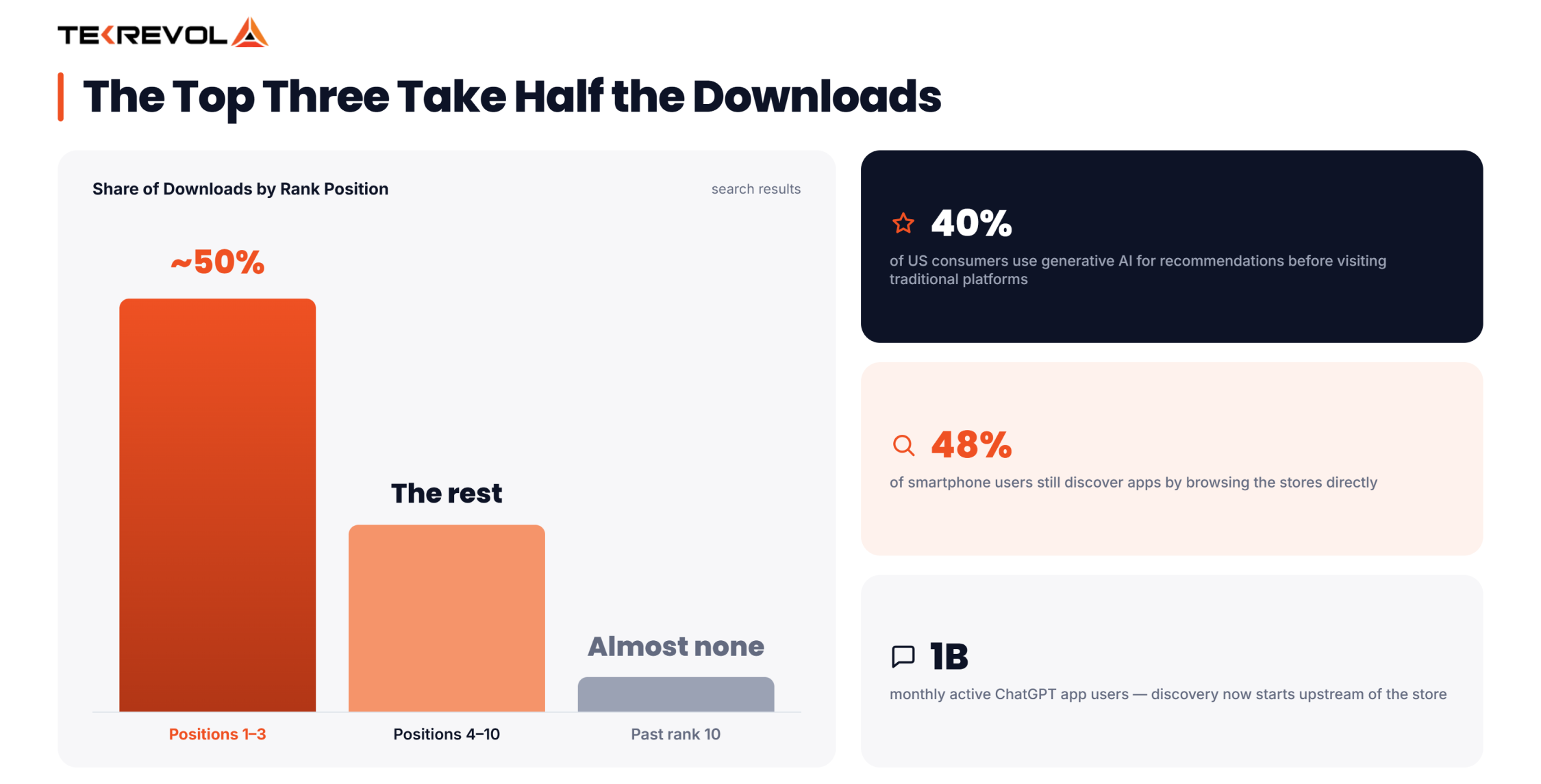
- AI is reshaping app discovery: 40% of US consumers use generative AI for product recommendations before visiting traditional platforms. Source: Adobe Digital Insights, 2025
- App stores remain a major discovery channel: 48% of smartphone users discover apps by browsing app stores. Source: Google and Ipsos App Discovery Research
- ChatGPT reached massive mobile adoption: It reportedly surpassed 1 billion monthly active app users in May 2026. Source: Sensor Tower
That shift is why your reviews, description, and even your social presence now feed the AI models deciding whether to name your app. Channels like social media marketing services suddenly influence discovery in ways they never used to.
Why It Matters:
Understanding the importance of app store optimization today means understanding an AI-shaped funnel, not just the search box. If an AI assistant can’t “read” your app, it won’t recommend it, and you’ll be invisible at the exact moment someone is choosing what to install.
Want Your App to Top the Charts?
Avoiding common pitfalls is only half the game; success depends on having the right game development team by your side.
Get in TouchWith the stakes clear, let’s clear up a misconception that trips up almost every founder.
ASO vs SEO: Clearing Up the Confusion
ASO and SEO share the same DNA; you optimize for a ranking algorithm. But they play out very differently, so treating them as identical is the fastest way to waste effort.
Both disciplines chase visibility. Yet the mechanics, the metrics, and the fields you optimize barely overlap. Here is the honest contrast between ASO vs SEO:
- Goal: SEO drives website traffic and conversions; ASO drives downloads and lowers acquisition cost.
- Ranking signals: SEO leans on backlinks and domain authority; ASO leans on installs, ratings, engagement, and metadata.
- Real estate: SEO works across an entire site; ASO works inside a single, character-limited listing.
While web-based search engine optimization services rely heavily on long-form content, app store rankings depend on immediate visual impact and post-click download conversions.
Applying advanced SEO strategies helps drive web traffic to your app landing page, but specialized app store tactics are required once users arrive at the marketplace
Now that expectations are set, let’s get tactical. These are the best app store optimization strategies that do the heavy lifting.
ASO Strategy #1: Keyword Research for App Stores
App keyword research means finding the search terms with real volume, winnable competition, and matching intent, then grouping them so the algorithm understands what your app is about. Get this right, and every other strategy compounds on top of it.
Start by mapping keywords to how people actually search. AppsFlyer groups app keywords into helpful buckets, and they are a great brainstorming frame:
- Problem: what pain does your app solve?
- Feature: what does it do especially well?
- User: who is it for?
- Location & action: where and for what occasion is it used?
Once you have a long list, validate each term against three filters:
- Relevance — if it is a stretch, drop it.
- Difficulty — how many strong apps already compete for it?
- Search volume — do enough people actually search it?
Then cluster the survivors. Semantic clustering matters more in 2026 than it used to. Store algorithms and AI assistants both read intent now, rather than matching exact strings. Our guide on how to use semantic SEO for better rankings explains the clustering logic in depth.
With your keywords chosen, the next move is putting the most valuable ones where they count most: your title.
ASO Strategy #2: Optimizing App Titles and Subtitles
Your app title is the single most powerful metadata field you control. So it should lead with your highest-value keyword paired with your brand all inside a 30-character limit. The subtitle then does the second-heaviest lifting.
Because space is brutal, structure beats cleverness. A few proven title formulas:
- Brand + keyword: “Notion – Notes, Docs, Tasks”
- Brand: keyword phrase: “Canva: Design, Photo & Video”
- Coined name alone (only if the brand is already known): “Airbnb”
Your subtitle (iOS, 30 characters, and indexed) is prime real estate for a second keyword theme plus a value hook. Treat it as a headline, not an afterthought.
A quick contrast of strong versus weak app store optimization strategies examples: “FitLog” tells the algorithm and the user almost nothing. While “FitLog: Workout & Gym Tracker” earns keyword coverage and clarity in the same character budget.
Titles pull people in; descriptions and keyword fields tell the full story. Let’s go there next.
ASO Strategy #3: App Descriptions and Keyword Fields
Descriptions and keyword fields work very differently on each store, so your strategy has to split here: iOS ranks a hidden keyword field, while Google Play ranks your visible long description. Miss that distinction, and you leave rankings on the table.
Here is how the pieces map out:
- iOS keyword field (100 characters, hidden): separate terms with commas, skip spaces after commas, and never duplicate a word. Apple counts each keyword only once.
- Short description (iOS 45 / Android 80 characters): your click-to-expand hook, written to make “more” irresistible.
- Long description (up to 4,000 characters): on Google Play it is indexed, so weave your primary keyword in naturally a handful of times; on iOS it is for humans, not ranking.
Whatever the store, write the long description to sell: lead with your standout features, explain what makes you different, and stack social proof like awards or a high rating. And write it cleanly because AI models now read that same copy to decide whether to recommend you.
Words set the context, but visuals are what actually convert a browser into a user. That is our next and arguably highest-leverage strategy.
ASO Strategy #4: Visual Assets (Icons, Screenshots, Video Previews)
Visual assets drive conversion more than any line of copy, and your first three screenshots carry the entire pitch. Users decide in seconds, so your icon, screenshots, and preview video have to land fast.
Treat each asset as a job to be done:
- App icon: distinctive, scalable, and legible at thumbnail size. Use text only when it truly helps, and always test alternatives.
- Screenshots: lead with your single biggest value proposition, keep on-screen text minimal, let the panels tell a story, and stay consistent with your brand colors.
- Preview/promo video: hook viewers in the first five seconds, show only real in-app footage, and design for silent viewing with captions and a clear call to action.
We have seen this firsthand. Take TruthGPT, an app our team engineered: layering in 3D features and Flutter animations tripled user engagement and lifted interactions by 40%, clear proof that motion and polish move people.
Strong visuals are among the best app store optimization strategies precisely because they lift conversion without costing you a cent in ad spend.
Great visuals win the click. But ratings and reviews decide whether the shopper trusts you enough to tap “Get.” On to strategy five.
ASO Strategy #5: Ratings, Reviews, and User Engagement
Ratings and review recency influence both your ranking and your ASO conversion rate, and a sub-4.0 average quietly caps how many people install. So reputation is not a soft metric; it is a growth lever.
Managing it well comes down to a few disciplined habits:
- Ask at the right moment. Trigger in-app review prompts right after a completed workout, a saved design, or a first win.
- Respond to the negatives. A thoughtful reply turns a one-star complaint into public proof that you listen.
- Mine competitor reviews. Their recurring complaints are your positioning gaps; fill them.
- Watch velocity, not just average. A steady stream of fresh reviews signals momentum to the algorithm.
Engagement is where TekRevol tends to shine, and it feeds reviews directly. Pure Plank, an app we built, reached 98% user satisfaction and a 50% jump in engagement, while Super App Yeppy saw a 30% engagement lift in its very first month. Happy, engaged users are the ones who leave the ratings that power your ASO strategy.
The Best Time to Fix Your App Ranking Is Now
See exactly where your current listing is losing installs today.
Start with a Free ASO Consult →Once your reputation engine is humming at home, the next frontier is everyone else’s home market. Let’s talk localization.
ASO Strategy #6: Localization and Regional Optimization
Localization is the highest-leverage way to expand your reach, because it multiplies your keyword coverage across entire new markets as long as you adapt, not just translate. A word-for-word translation misses local search behavior; true localization captures it.
Do it in a deliberate order:
- Start with proven demand. Localize first for markets where you already see traction or clear opportunity.
- Adapt everything, not just text. Rework keywords, screenshots, and value propositions for each region’s language and culture.
- Reassess keyword demand locally. The winning term in the US may be a dead phrase in Germany or Brazil.
Layer seasonality on top for an extra lift. Updating creatives ahead of New Year fitness spikes, Black Friday, or regional holidays lets you catch high-intent traffic right as it surges. Among the best app store optimization strategies for mature apps, localization is often the one that unlocks the next growth curve.
Those are the six core strategies. But how you apply them depends heavily on where you apply them, and the two big stores are not the same.
App Store vs Google Play: A Platform-Specific ASO Strategy
Yes, an effective ASO strategy must be platform-specific, because Apple and Google use different ranking algorithms, metadata structures, and testing tools. Optimize both stores the same way, and you leave visibility on the table in at least one of them.
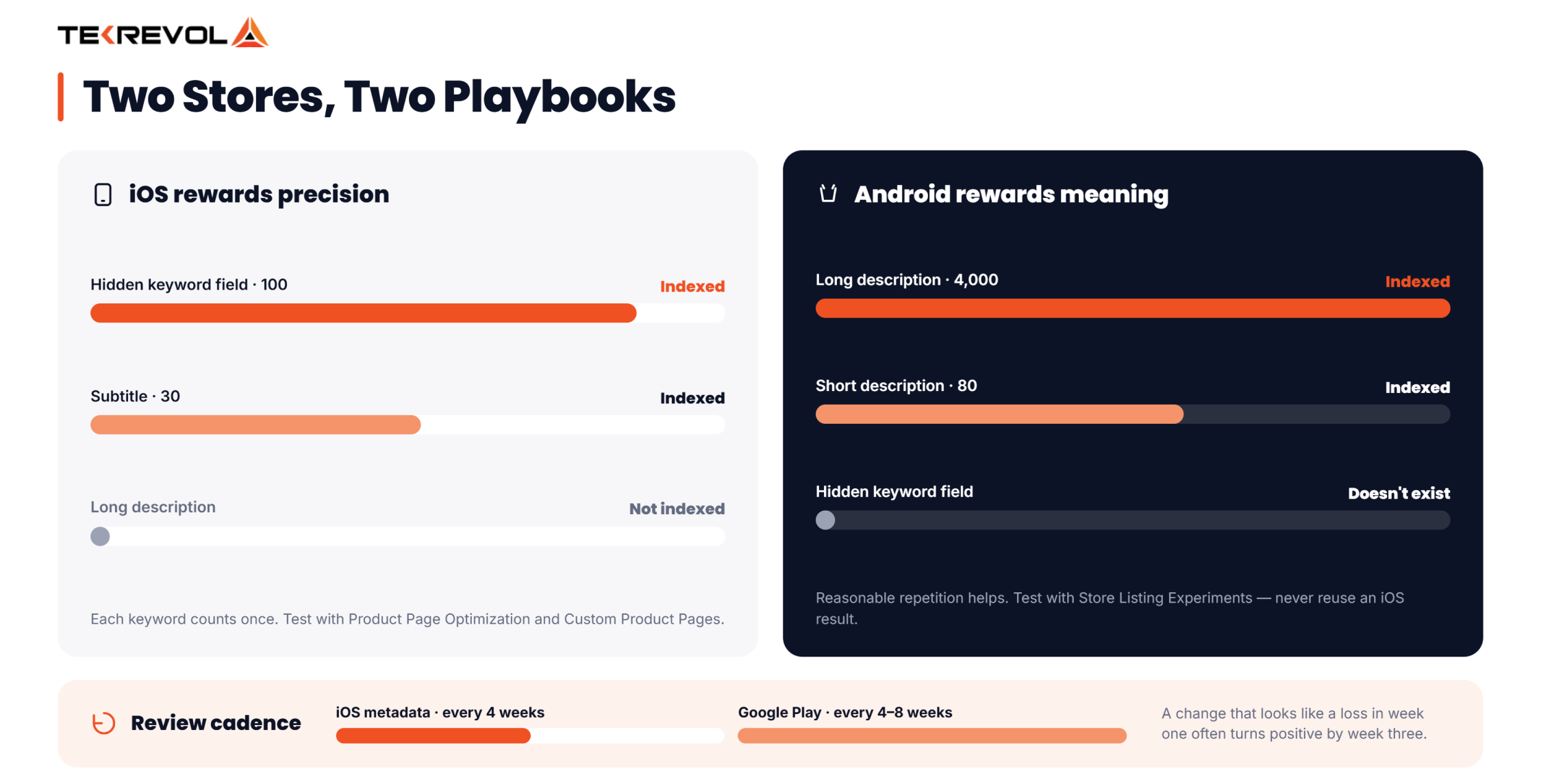
Here is the side-by-side that should shape your plan:
| Element | App Store (iOS) | Google Play (Android) |
| Title | 30 chars, high weight | 30 chars, high weight |
| Subtitle / short description | 30-char subtitle, indexed | 80-char short description, indexed |
| Keyword field | 100-char hidden field | None — keywords live in title + long description |
| Long description | Not indexed for keywords | Indexed; repetition (~5×) rewarded |
| Duplication | Each keyword counts once | Repetition can help |
| Creative testing | Product Page Optimization + Custom Product Pages (up to 35 variants) | Store Listing Experiments (broader A/B testing) |
The takeaways are practical. On iOS, precision wins: every character in that hidden field counts. On Android, natural, keyword-rich writing wins, because Google reads your long description for meaning.
Understanding each App Store ranking algorithm is what lets you stop guessing and start optimizing on purpose.
You now have the strategies and the platform nuance. Here is how TekRevol packages all of it into a system you can actually run.
The TekRevol ASO Strategy Framework: The “ASO Growth Loop”
The above app store optimization strategies are not a checklist you finish once. TekRevol runs them as a repeating loop, so your app keeps compounding gains instead of stalling after launch. We call it the ASO Growth Loop, and it is the backbone of every engagement.
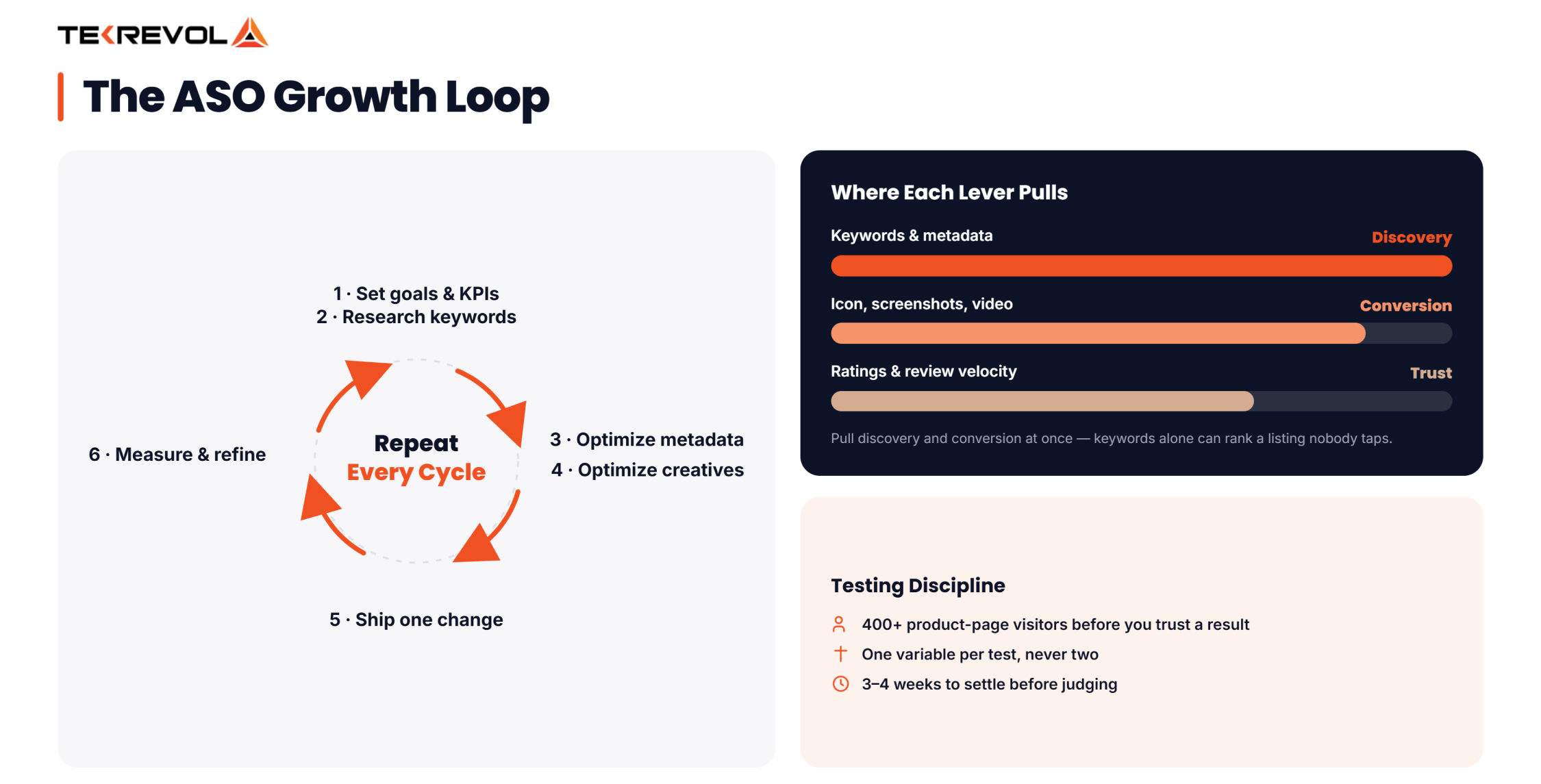
The loop has six phases that never really stop:
- Set goals & KPIs: define the visibility and conversion targets you are chasing.
- Research: keywords, competitors, and market gaps.
- Optimize metadata: titles, subtitles, descriptions, keyword fields.
- Optimize creatives: icon, screenshots, preview video.
- Ship: release changes deliberately, one variable at a time.
- Measure & refine: read the data, then feed it back into the loop.
This is also where a partner earns its fee. With 800+ successful projects across 11+ industries and a 4.8/5 rating on Clutch, our team runs this loop so founders can stay focused on the product. As a full-service digital marketing agency, we connect your ASO strategy to the paid, social, and SEO channels around it.
Ready to make your app go viral on the app stores?
Get a free 15-minute session worth $300 with our ASO team to discover untapped opportunities.
Claim a Free Success Consultation →A loop only runs as well as the tools feeding it. Let’s build your stack.
App Store Optimization Tools to Build Your ASO Stack
The right app store optimization tools fall into four categories: intelligence, market research, review management, and paid-search alignment, and a mature ASO strategy uses at least one from each. You do not need every tool; you need the right coverage.
Here is a simple way to think about your stack by team size:
| Tool category | What it does | Example tools | Best for |
| ASO intelligence | Keyword research, metadata, rank tracking | AppTweak, App Radar | Every team |
| Market intelligence | Competitor + download/revenue estimates | Sensor Tower | Scaleups, enterprise |
| Review management | Monitor and respond to ratings at scale | AppFollow | Growing review volume |
| A/B & paid alignment | Creative testing + Apple Ads insight | SplitMetrics | Paid-heavy teams |
A few principles keep this practical.
- Start lean: a single strong intelligence tool covers most early needs.
- Add market and review tools as your volume grows.
- And consolidate where you can, since unified platforms save hours of context-switching.
The best app store keyword search tools don’t just spit out volume. They show difficulty and competitor gaps, so your keyword research stays grounded in reality.
With your stack in place, the final discipline is knowing whether any of it is working. That means tracking.
Tracking ASO Performance and Iteration
Tracking closes the loop as you measure impressions, conversion rate, download velocity, and keyword rankings, then feed what you learn straight back into your next round of changes. Without measurement, you are guessing; with it, every cycle gets sharper.
Focus on the metrics that actually signal health:
- Impressions & visibility: are more people seeing your listing?
- Product-page conversion rate: are viewers becoming installers?
- Download velocity: is momentum building or fading?
- Keyword rankings: are your target terms climbing?
Then test with rigor. Aim for at least 400 product-page visitors before you trust an A/B result, change one variable at a time, and give each experiment one to two weeks to reach significance.
On cadence, review iOS metadata roughly every four weeks and Google Play every four to eight weeks, allowing three to four weeks per change to settle before you judge it.
One 2026 wrinkle deserves your attention: AI-driven installs often show up as branded searches or deep-link taps, so watch for attribution blind spots. This is exactly where connecting ASO to your broader performance data, the same discipline behind smart search engine marketing services, keeps your reporting honest.
Measurement tells you what is working. Just as usefully, it exposes the mistakes dragging you down, so let’s name them.
Common ASO Mistakes That Quietly Kill Downloads
Most underperforming apps aren’t failing at strategy. They are losing to a handful of avoidable mistakes that bleed downloads slowly enough to go unnoticed. Catch these, and you protect everything you have built.
The usual culprits:
- Keyword stuffing or duplication: it wastes characters and can hurt conversion without lifting rank.
- Skipping real research: guesswork sends you after terms nobody searches.
- Never A/B testing: you optimize on opinion instead of evidence.
- Ignoring reviews: a slipping rating caps installs no matter how good your keywords are.
- Treating ASO as one-time: static listings decay as competitors and algorithms move.
- Skipping localization: you cede entire markets to rivals who bothered to translate.
- Ignoring AI discovery: if assistants can’t parse your listing, you are invisible in the fastest-growing discovery channel.
The practitioner community tends to agree on the fixes. Scan any active thread of app store optimization strategies on Reddit, and you will see the same consensus we hold: there is no secret “hack,” fake installs backfire, and the winners simply test best ASO practices relentlessly and manage reviews well. Studying app store optimization strategy examples beats hunting for shortcuts every time.
Avoid these traps, run the loop, and your ASO strategy starts working for you. Let’s bring it home.
Conclusion
App store optimization strategies are not a launch-week chore. They are a growth engine you run continuously, tuning keywords, creatives, and reviews while an AI-shaped discovery layer reshapes how users find you. The six strategies in this guide, run as a loop, are how you stay visible in both the search box and the AI answer.
So start where you stand. Fix your title today, tighten your keyword research this week, and build the testing habit that turns small edits into compounding gains. Teams that treat the ASO process as a discipline, not a checklist, are the ones that climb and keep climbing.
If you would rather run that loop with an experienced app store optimization agency that has done it across 800+ projects, TekRevol is ready when you are.
Ready to improve your app’s visibility and installs?
Turn your ASO strategy into a measurable growth plan with TekRevol’s mobile app experts.
Get Your Free App Growth Consultation


