



- An ASO expert company delivers better ROI for most apps below enterprise scale, thanks to lower fixed costs and broader skill coverage.
- An in-house ASO team only wins once app-store revenue is central to your business, and you can fund a real team, not one hire.
- One in-house generalist rarely covers keyword research, creative, and data analysis at agency-level depth.
- Measure ASO ROI through cost per install, conversion lift, and keyword movement, not just monthly spend.
- A hybrid model, internal owner plus external specialist execution, often outperforms either option alone.
- TekRevol delivers full-stack ASO expertise and measurable ROI without the salary and ramp-up time of an in-house hire.
An ASO expert company usually delivers better ROI for most apps, because you get a full skill stack: keyword research, creative testing, and data analysis, without carrying year-round salary costs. An in-house ASO team wins only when app store revenue is core to your business, and you can afford to hire more than one specialist. That’s the short answer.
Most teams get this decision backward. They hire one in-house ASO generalist too early, expecting agency-level output from one person, or they wait too long to bring in outside expertise while a competitor’s app climbs past them in search results. Either mistake costs months of downloads you can’t get back, and the budget spent chasing the wrong option rarely gets recovered later.
This guide breaks down real cost numbers, a clear ROI framework, and exactly when each option makes sense. If you want an app store optimization agency to run the numbers on your specific app first, that’s usually the fastest way to get a straight answer instead of guessing.
In-House ASO Team or ASO Expert Company: Which Delivers Better ROI?
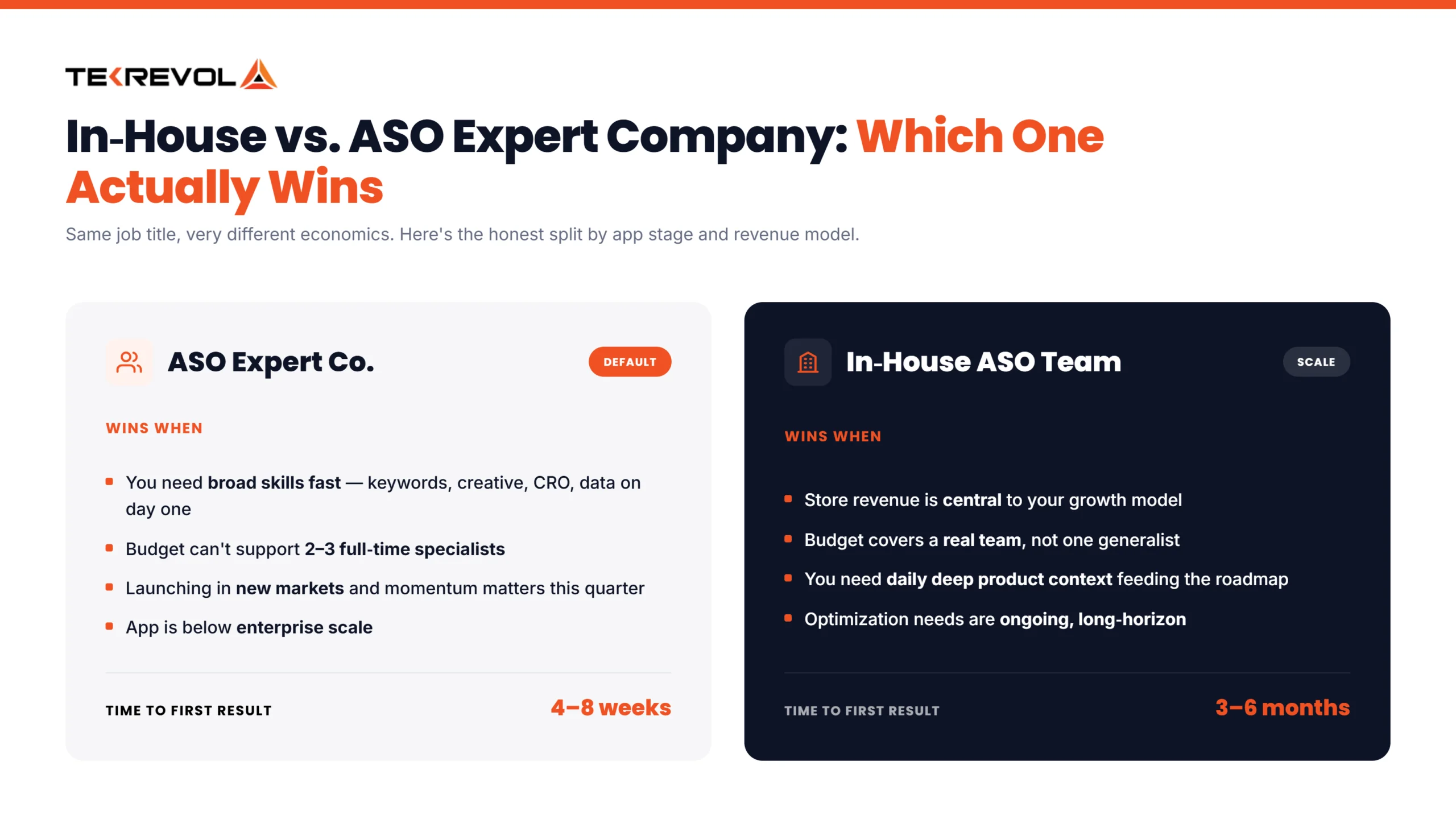
An ASO expert company delivers better ROI for most apps below enterprise scale, because the fixed cost is lower and the skill coverage is broader from day one. An in-house team delivers better ROI only once your app has enough store-driven revenue to justify a full specialist team, not just one hire.
Here’s the short version of when each wins:
- ASO expert company wins when you need broad skills fast, your budget can’t support 2-3 full-time specialists, or you’re launching in new markets and need momentum quickly.
- An in-house team wins when ASO is central to your growth model, you have the budget for a real team (not one generalist), and you need daily, deep product context.
The rest of this guide breaks down the cost math, the pros and cons of each, and how to measure ROI properly so you’re not comparing monthly spend to monthly spend without looking at outcomes.
Not Sure Which Model Fits Your App Right Now?
Get a free ROI comparison built around your app's category, stage, and budget.
Get Your Free ASO ROI Breakdown →What Is the Difference Between an ASO Consultant and an ASO Agency?
An ASO consultant is a single specialist who works hands-on with a narrower scope, while an ASO agency is a full team covering keyword strategy, creative, development, and data together. An in-house team sits in a third category: full internal control, but full overhead too.
| Model | Scope | Control | Speed to Start | Best Fit |
| ASO consultant | Narrow, usually strategy-only | Medium | Fast | Small apps, single-market focus |
| ASO agency/expert company | Full stack: keywords, creative, CRO, data | Medium-high | Fast | Apps scaling across markets or categories |
| In-house team | Full stack, if properly staffed | Full | Slow (hiring cycle) | Apps where ASO drives core revenue |
A consultant is a good fit when the need is narrow, like a one-time keyword audit. A mobile app development company fits when you need ongoing execution across multiple disciplines. In-house only makes sense once the workload justifies more than one hire.
How Much Does an In-House ASO Team Cost vs. an ASO Consultant?
An in-house ASO hire typically costs $70,000 to $95,000 a year in salary alone, before benefits, tools, and management overhead, while an ASO agency retainer usually runs a fraction of that fully-loaded cost while covering more skill areas. The comparison isn’t salary versus retainer. It’s total cost of ownership versus retainer.
In-House Cost Breakdown
- Base salary: a mid-level digital marketing specialist averages roughly $70,000-$75,000 annually in the US
- Benefits and payroll tax: typically adds another 20-30% on top of salary
- Tools and software licenses: keyword research, competitor tracking, and A/B testing platforms often run $500-$2,000+ per month
- Management overhead: someone still needs to manage this hire’s output and hold them accountable
- Ramp-up time: three to six months before a new hire is fully productive on your specific app
ASO Consultant / Agency Cost Breakdown
- Retainer pricing: usually scoped to app size and market count, with tools often bundled in
- Project-based pricing: for one-time overhauls or audits rather than ongoing work
- No hiring risk: you’re not carrying the cost of a bad fit for six months before realizing it isn’t working
Hidden costs matter too. In-house teams often underspend on tools once salary eats the budget. Agencies sometimes underspend on your specific product context if onboarding is rushed. Neither option is free of trade-offs.
The honest way to compare the two isn’t line-item spend. It’s cost per outcome. A $6,000-a-month retainer that produces measurable ranking movement in six weeks often beats a $90,000-a-year hire that’s still ramping up in month four, even though the annual numbers look similar on paper.
What Are the Pros and Cons of an In-House ASO Team?
The biggest advantage of an in-house ASO team is deep product context, and the biggest drawback is that one hire rarely covers the full skill set ASO actually requires. Keyword research, creative testing, and data analysis are three different skill sets, and most in-house budgets only support one person.
Pros
- Full product context without repeated onboarding
- Faster internal communication with product and dev teams
- Institutional knowledge builds over time and doesn’t walk out the door with a contract
- Full control over priorities and roadmap
Cons
- Slow to hire, especially for a specialized skill like ASO
- One generalist can’t realistically cover keyword strategy, creative, and CRO at agency depth
- Fixed cost regardless of how much optimization work exists that month
- Risk of strategy stagnation without external benchmarking against other apps and categories
What Are the Pros and Cons of Hiring an ASO Expert Company?
The biggest advantage of an ASO expert company is cross-client pattern recognition; they’ve already tested what works across dozens of apps in your category, and the main drawback is that your product context takes real onboarding time to build. That gap closes fast with a good kickoff process, but it’s not instant.
Pros
- Full skill stack available immediately: keyword research, creative, CRO, and data together
- Faster testing cycles, because the team has already run similar tests elsewhere
- Lower fixed cost, since you’re not carrying a full-time salary
- Outside perspective catches blind spots an internal team stops noticing over time
Cons
- Less built-in product context at the start
- Shared attention across other clients, though a good agency structures this so it doesn’t slow your work
- Requires a strong onboarding process to close the context gap quickly
According to Forbes Agency Council, the clearest trade-off is time allocation: an in-house hire gives 100% of their time to one company, while an agency team splits attention across clients, but that same agency team usually brings a wider range of expertise than one full-time hire ever could.
How Do You Measure ROI for ASO: In-House or Outsourced?
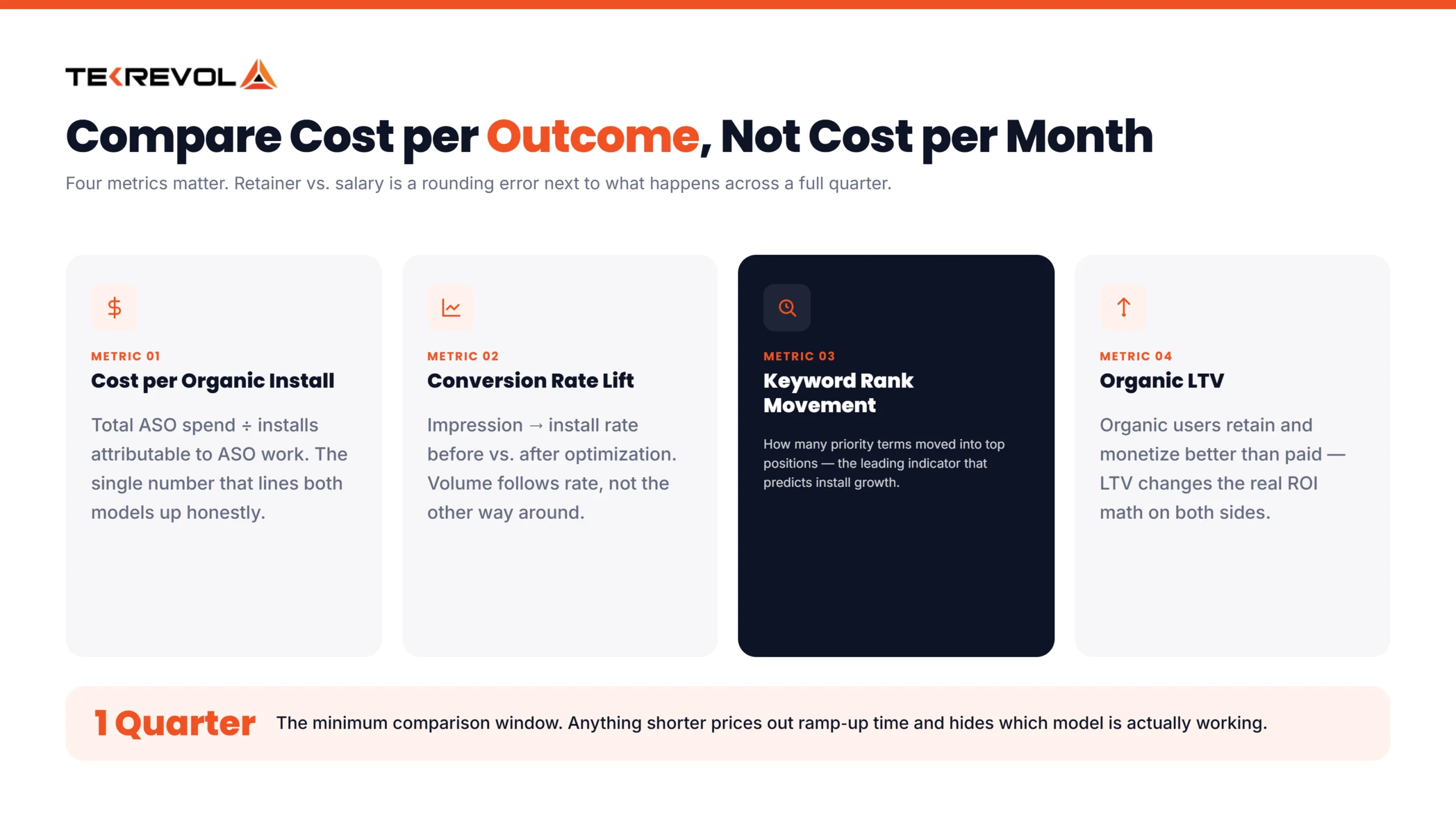
You measure ASO ROI by tracking cost per install, organic conversion rate lift, keyword ranking movement, and the lifetime value of organically acquired users, not just monthly spend against a budget line. Comparing retainer cost to salary cost alone misses the entire point of the exercise.
Core Metrics to Track
- Cost per organic install: total spend divided by organic installs attributable to ASO work
- Conversion rate lift: impressions-to-install rate before and after optimization
- Keyword ranking movement: how many priority terms moved into top positions
- LTV of organically acquired users: organic users often retain and monetize better than paid ones, which changes the real ROI math
Why Time to First Result Matters
An option that costs less per month but takes twice as long to show results isn’t automatically the better ROI. Factor in how many months of flat performance you’re willing to accept before a strategy pays off, and weigh that against the monthly cost either way.
Don’t compare a single month of retainer cost to a single month of salary and call it done. Run the comparison across a full quarter, factoring in ramp-up time on the in-house side and early testing time on the agency side. The gap usually looks very different once time is priced into the equation.
When Does an In-House ASO Team Make More Sense?
An in-house ASO team makes more sense once app-store-driven revenue is central to your business model and your budget supports a real team, not one generalist hire. Below that threshold, the fixed cost usually outweighs the benefit of full internal control.
- High app-store-driven revenue: when organic installs are a primary growth channel, not a side channel
- Budget for a real team: enough to hire 2-3 specialists covering different parts of ASO, not one person wearing every hat
- Ongoing, long-term optimization needs: across many markets or multiple products, where deep context compounds in value over time
- Existing internal marketing infrastructure: an ASO hire slots into a broader team rather than working in isolation
Understanding how the app store ranking system actually works helps clarify whether your app is at the scale where in-house makes sense. This breakdown of the app store ranking algorithm explains which signals drive rank, and how much ongoing work that actually requires to maintain.
When Does Hiring an ASO Expert Company Make More Sense?
Hiring an ASO expert company makes more sense for early-stage apps, teams with limited budget, or a specific launch push that needs broad expertise fast without a multi-month hiring cycle. This covers most apps, which is why agencies and consultants are the default starting point for the majority of teams.
- Early-stage apps needing full-stack ASO expertise without building a team from scratch
- Limited budget that can’t realistically support a full in-house hire, let alone a team
- A defined project: a launch push, a one-time listing overhaul, or entry into a new international market
- A second opinion alongside an existing internal marketing function that needs an outside perspective
What Mistakes Do Companies Make When Building an In-House ASO Team?
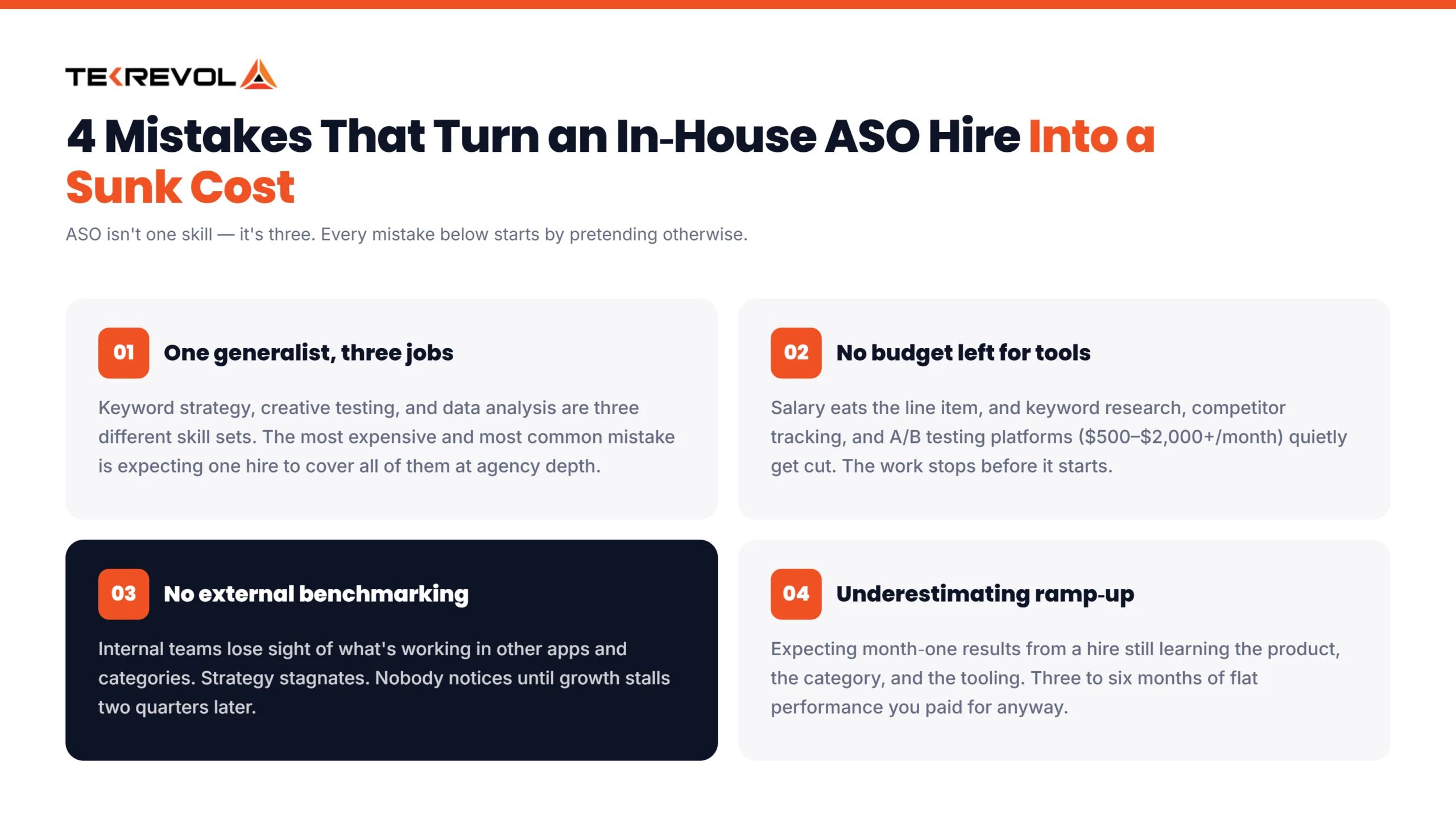
The most common mistake is hiring one generalist and expecting agency-level output across keyword research, creative testing, and data analysis at once. ASO isn’t one skill. It’s several, and most companies budget for exactly one hire to cover all of them.
- Hiring one generalist, expecting full coverage: the most expensive and most common mistake
- No budget left for tools after hiring: salary eats the budget, leaving no room for the software that makes the work possible
- No external benchmarking: internal teams lose sight of what’s working in other apps and categories over time
- Underestimating ramp-up time: expecting results in month one from a hire who’s still learning the product
This mistake often traces back to how the app was built in the first place. Teams that treat ASO as an afterthought tacked on after launch tend to make the same hiring mistake later, expecting one late hire to fix a gap that should have been planned for earlier.
These mobile app development tips cover how to build ASO considerations into the product roadmap from day one, so the hiring decision isn’t made under pressure after the fact.
How Do You Choose the Right ASO Consultant or Agency?
Choose an ASO consultant or agency by checking category-specific case studies, confirming reporting cadence upfront, and verifying they cover keyword, creative, and CRO work together rather than just one slice of ASO. Skipping any of these three is how companies end up paying for work that never moves the needle.
What to Ask For
- Case studies in your specific app category, not generic “we grew downloads” claims
- A clear reporting cadence: what gets reported, how often, and in what format
- Confirmation that keyword, creative, and CRO work are covered together, not sold as separate add-ons
Red Flags to Avoid
- No data ownership; you should always own your own keyword and performance data
- Vague deliverables with no defined milestones
- One-size-fits-all pricing that doesn’t scale with app size or market count
Getting keyword research right matters regardless of which model you choose, and this list of best app store keyword research tools is a useful gut-check for whether a consultant or agency is actually using proper tools instead of guesswork.
One more practical test: ask what happens in month two if the first round of changes doesn’t move the needle. A credible consultant or agency will have a clear answer, usually involving a specific next test or a data-driven pivot. A vague “we’ll keep monitoring” answer is worth treating as a warning sign.
Can You Combine an In-House Team and an ASO Consultant?
Yes, a hybrid model works well: keep one internal owner who holds product context, and bring in external ASO specialists for execution depth. This often outperforms either option alone, because it solves the two biggest weaknesses of each approach at once.
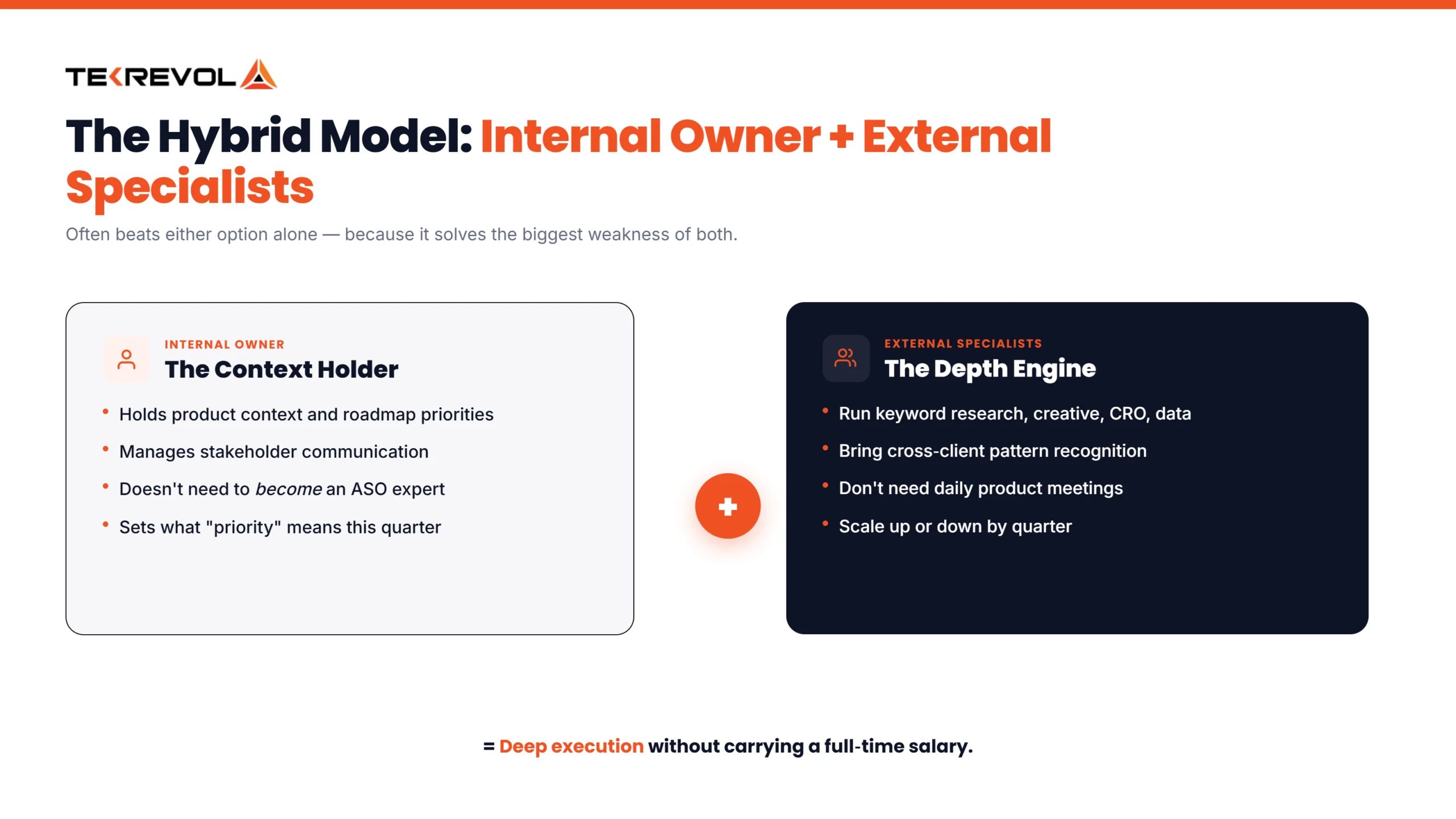
- Internal owner manages priorities, product context, and stakeholder communication
- External specialist support handles the deep execution work: keyword research, creative testing, and data analysis
- Clear ownership split prevents duplicated work; the internal person doesn’t need to become an ASO expert, and the external team doesn’t need daily product meetings
This model works especially well for teams that already have a marketing function in place and just need ASO-specific depth added to it, rather than building that expertise from zero.
Because ASO and organic search share some underlying principles but work very differently in practice, this comparison of ASO vs SEO is worth a read before deciding how much of this work an existing SEO-focused internal hire can realistically absorb.
ASO also doesn’t operate in a vacuum from the rest of your growth plan. Paid user acquisition, social content, and influencer partnerships all perform better when the store listing they point to is already optimized. This roundup of top app marketing strategies covers how ASO fits into the broader marketing mix, whichever staffing model you choose.
How TekRevol Helps You Get Better ASO ROI Without the In-House Overhead
Building an in-house ASO team takes more than hiring one specialist. You need expertise across keyword research, listing optimization, creative testing, competitor analysis, and performance tracking. TekRevol brings these capabilities together without the salary, benefits, and months of ramp-up required to build the same skill set internally.
What this looks like in practice:
- Category-specific strategy: Recommendations are based on your app, audience, competitors, and growth goals rather than generic ASO playbooks.
- Full skill coverage: Keyword research, metadata, screenshots, videos, and conversion optimization work together instead of in silos.
- Measurable performance: Progress is tracked through keyword visibility, organic installs, conversion rates, and user acquisition efficiency.
- Ongoing optimization: ASO is continuously tested and refined as search behavior, competitors, and rankings change.
TekRevol’s full project portfolio shows the range of apps and digital products the company has delivered across industries. That experience helps connect ASO with the product itself, rather than treating the app listing as a standalone marketing asset.
The result is access to specialized ASO expertise when you need it, whether for a launch, listing overhaul, market expansion, or ongoing growth, without the overhead and lengthy ramp-up of building a full in-house team.
Want ASO Expertise Without the Hiring Cycle?
Book a free 30-minute strategy call and get a straight answer on what your app needs right now.
Book Your Free ASO Strategy Call →


