



- App store optimization is important because 65% of app downloads begin with a search, making ASO essential for discoverability.
- ASO drives free organic installs and attracts users who typically retain better than those acquired through paid campaigns.
- Apple’s 2025–2026 updates, including screenshot caption indexing, organic CPPs, and expanded paid ads, have made ASO more important than ever.
- Better keyword targeting attracts higher-intent users, improving retention and strengthening app store rankings.
- Ignoring ASO for months means missing valuable organic installs and relying more on costly paid acquisition.
- TekRevol has delivered proven ASO results, including 3M+ downloads for Tamreeni and a 30% engagement boost for Save & Win.
Every day, millions of people search the Apple App Store and Google Play for apps that solve a specific problem. If your app doesn’t appear for those searches, or fails to convince users to install it, you’re losing potential downloads to competitors with stronger visibility.
That’s where App Store Optimization services come in. ASO helps improve your app’s discoverability, increase listing conversions, and attract more organic installs without relying entirely on paid acquisition.
In this guide, you’ll learn why app store optimization is important in 2026, how it drives sustainable app growth, the latest platform changes affecting rankings, and the practical strategies that help apps earn more visibility and installs over time.
Why Is App Store Optimization Important?
App store optimization is important because it determines whether your app shows up in search results at all.
Around 65% of app downloads begin with a search, making visibility one of the biggest growth drivers. Apple reports that the App Store attracts over 850 million weekly visitors, while Google Play reaches more than 2.5 billion active Android devices worldwide. For most apps, appearing in these searches is the difference between steady organic growth and limited discoverability.
That statistic changes how you should think about growth. Most founders think about marketing first. Ads, social media, press coverage. But the majority of downloads don’t come from any of those channels. They come from someone typing a search term into an app store and downloading one of the top results.
If your app isn’t in those results, you don’t exist for that user.
App store optimization, also called ASO, app store SEO, or app store listing optimization, is the practice of improving an app’s visibility and conversion rate inside the App Store and Google Play. It covers two jobs:
- Getting found: Ranking for the searches your target users actually type before they download
- Getting installed: Converting impressions into downloads once users land on your listing
Both jobs have to work together. Ranking for a keyword means nothing if your listing doesn’t convince users to tap “Install.” And a beautiful listing with no keyword coverage is a page nobody ever reaches.
Not Sure Where Your App Ranks for the Keywords That Matter?
TekRevol's ASO experts analyze your current app listing, uncover keyword opportunities, identify optimization gaps, and show you what's limiting your downloads—all at no cost.
Get My Free ASO AuditHow ASO Actually Drives App Growth — The Three Mechanisms
App store optimization drives growth through three connected mechanisms: visibility, conversion, and the retention-ranking loop. Each one builds on the others, and together they compound over time.
Most guides explain ASO as a list of tasks: optimize your title, write a good description, and get more reviews. That’s accurate but incomplete. The reason why app store optimization is important isn’t the tasks themselves. It’s the mechanism they power.
Mechanism 1: Visibility — Getting in Front of the Right Searches
The first job of ASO is helping your app appear when users search for relevant terms in the App Store or Google Play. Visibility depends on choosing the right keywords and optimizing your store metadata for each platform.
Keyword Optimization
Keyword research identifies the phrases your target audience actually searches for before downloading an app. Including high-intent keywords naturally in your title, subtitle, and description improves your chances of ranking for relevant searches.
Metadata Optimization
Metadata is one of the strongest ranking signals for both app stores. Your app title, subtitle, short description, long description, and keyword fields should clearly describe your app while matching the language your users use.
Store Differences
Apple App Store and Google Play use different indexing systems. iOS App Store optimization primarily relies on the title, subtitle, and keyword field, while Google Play Store optimization also evaluates the long description. Using the same metadata across both stores usually limits your visibility, making platform-specific optimization essential.
Mechanism 2: Conversion — Turning Impressions into Installs
Visibility without conversion is wasted traffic. A user who searches for your keyword and sees your listing in the results still has to choose to install.
Your first three screenshots are the most important conversion lever on the page. Most users make the install decision before reading a word of your description. Show the core value proposition in those first three frames, not feature lists, not company branding.
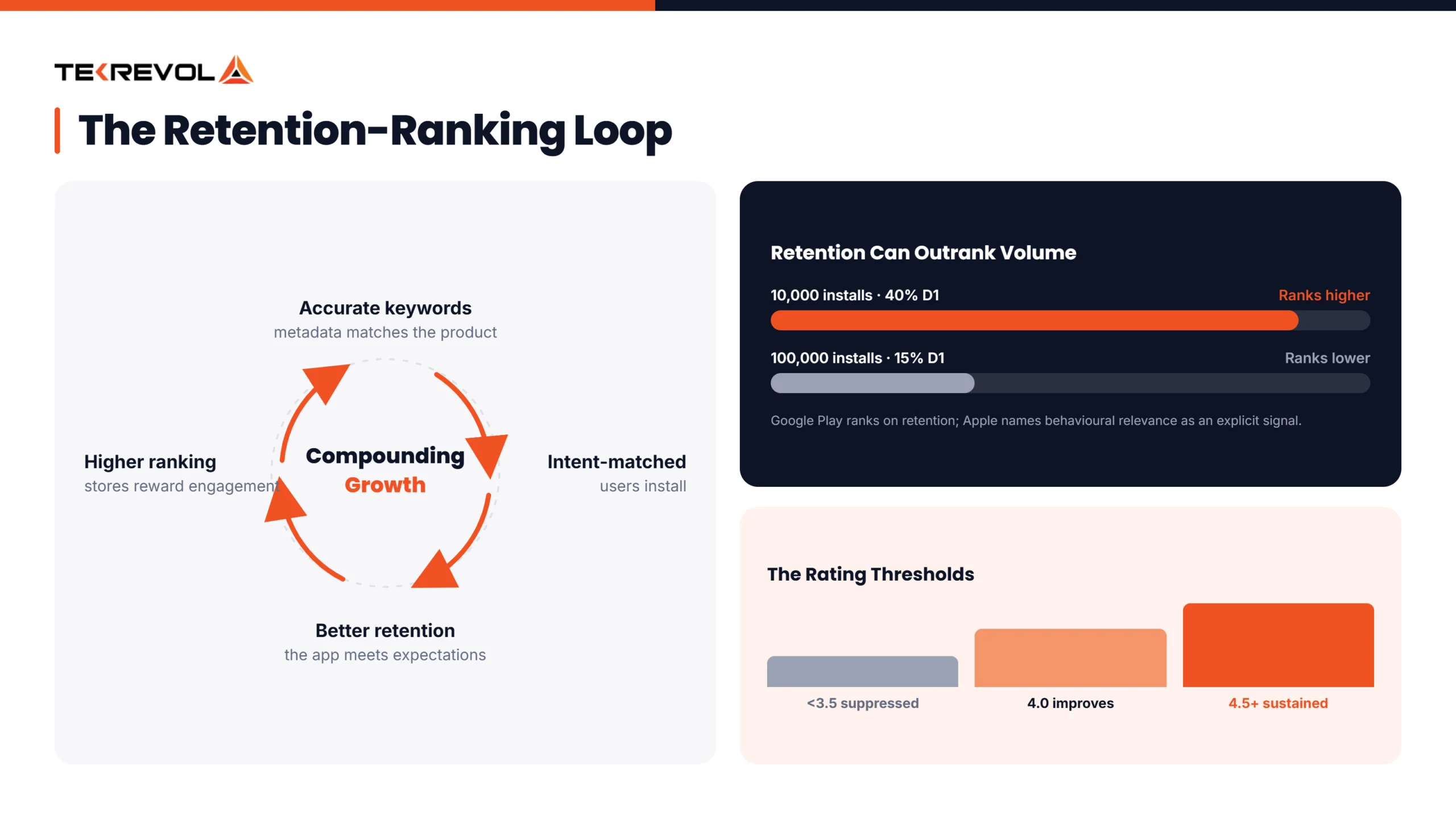
Rating quality matters significantly here. Apps below a 3.5-star rating see suppressed visibility. Above 4.0, rankings improve measurably. Above 4.5, the algorithm treats the rating as a sustained quality signal.
That’s why review strategy- prompting users at the right moment, responding to negative reviews within 48 hours, and fixing reported issues- isn’t just a PR task. It’s an ASO task.
Mechanism 3: The Retention-Ranking Loop
This is the mechanism that separates ASO as a growth system from ASO as a marketing tactic.
When your listing uses keywords that accurately reflect what your app does, you attract users whose intent matches your product. Those users retain better because the app meets what they expected.
Google Play now explicitly ranks apps based on retention; an app with 10,000 installs and 40% Day-1 retention can outrank an app with 100,000 installs and 15% retention. Apple has named “behavioral relevance”, which includes post-install engagement, as one of two explicit ranking signals.
Better retention tells the algorithm the app delivers on its promise. Higher ranking follows. More downloads arrive from users with matching intent. Retention improves further. The cycle compounds.
Benefits of App Store Optimization
The importance of app store optimization extends beyond improving keyword rankings. A well-executed ASO strategy helps reduce acquisition costs, improve user quality, and create sustainable growth that compounds over time.
Higher Organic Installs
Better keyword targeting and optimized listings increase your visibility in App Store and Google Play search results, helping more users discover your app without relying on paid advertising.
Lower User Acquisition Costs
Every organic install is one less install you need to purchase through paid campaigns. As your rankings improve, the cost savings continue to grow over time.
Better Keyword Rankings
Optimized metadata, relevant keywords, and consistent listing updates help your app rank for more high-intent searches, increasing long-term discoverability.
Higher Conversion Rates
Compelling screenshots, app icons, videos, and persuasive copy encourage more users to tap Install after visiting your listing.
Stronger Brand Credibility
Apps with polished listings, positive reviews, and high ratings build greater trust, making users more confident about downloading them.
Better User Retention
When your listing accurately reflects your app’s value, users arrive with the right expectations. Better-fit users are more likely to stay engaged, leave positive reviews, and strengthen your app’s ranking signals over time.
ASO vs Paid User Acquisition
| App Store Optimization (ASO) | Paid User Acquisition |
| Generates organic installs | Generates paid installs |
| Long-term compounding growth | Stops when budget stops |
| Lower acquisition cost over time | Ongoing cost per install |
| Improves app store visibility | Doesn’t improve keyword rankings directly |
| Strengthens credibility through ratings and reviews | Focuses on traffic acquisition |
| Best for sustainable growth | Best for immediate visibility |
What the Importance of App Store Optimization Looks Like in Real Numbers
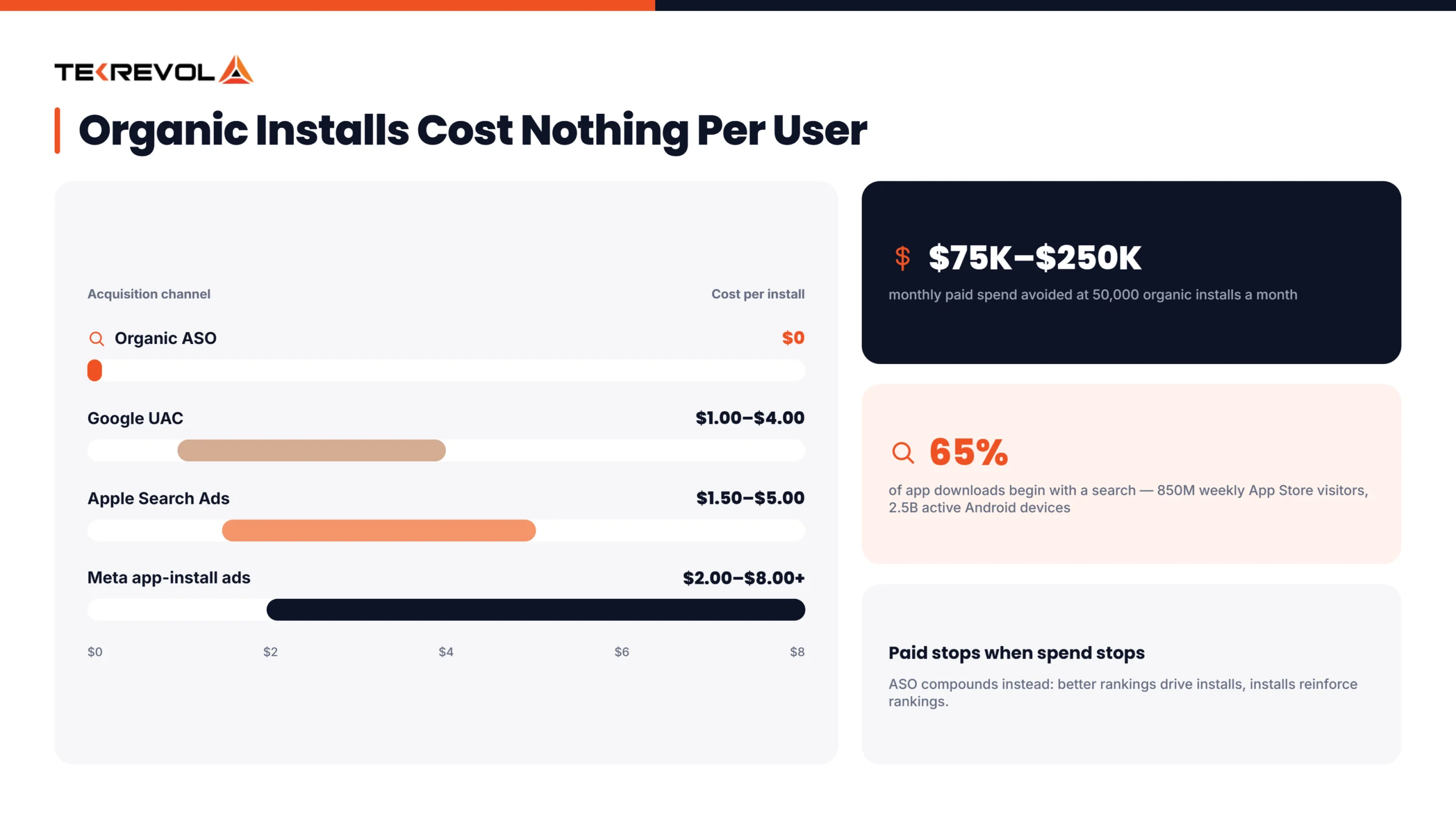
The importance of app store optimization is measurable in cost-per-install terms: organic installs generated through ASO carry a cost of zero, while paid UA costs $1.50 to $8.00 per install, depending on platform and category.
This ASO cost difference is where the business case becomes undeniable.
| Channel | Cost Per Install | Scales Without Increasing Budget | User Retention Quality |
| Organic ASO | $0 after setup | Yes — compounds over time | Higher — intent-matched users |
| Apple Search Ads | $1.50–$5.00 | No — linear to spend | Good |
| Meta Ads for App Install | $2.00–$8.00+ | No — linear to spend | Lower |
| Google UAC | $1.00–$4.00 | No — linear to spend | Moderate |
An app generating 50,000 organic installs per month through ASO is avoiding $75,000 to $250,000 in monthly paid UA spend. That figure grows as the app’s organic ranking improves — and shrinks every month, as ASO isn’t in place.
The top app marketing strategies that deliver sustainable growth treat ASO as the organic foundation, not an optional add-on to paid campaigns.
How ASO and Paid User Acquisition Work Together
Strong ASO directly improves the ROI of paid user acquisition because paid campaigns send users to the same store listing that organic search does; a high-converting listing lifts performance for every channel simultaneously.
This is one of the most underappreciated aspects of why app store optimization is important. Founders often treat ASO and paid UA as separate workstreams. They aren’t.
When a paid campaign (Apple Search Ads, Meta, Google UAC) sends a user to your listing, they see exactly what organic search users see. If that listing converts at 3%, paid campaigns get 3% efficiency. If it converts at 8%, they get 8% efficiency. The same creative work that boosts organic conversion also boosts paid conversion simultaneously.
There’s also a ranking dynamic that works in reverse. Paid campaigns generate install velocity. That install velocity feeds into the same behavioral signals the organic ranking algorithm weighs. Enough paid-driven installs above the category baseline can lift organic ranking position, which then generates more organic installs, which reduces paid dependency over time.
This is why proven mobile app promotion strategies treat ASO and paid UA as a single integrated system, not two separate budgets.
The 2026 Algorithm Changes That Make ASO More Critical Than Ever
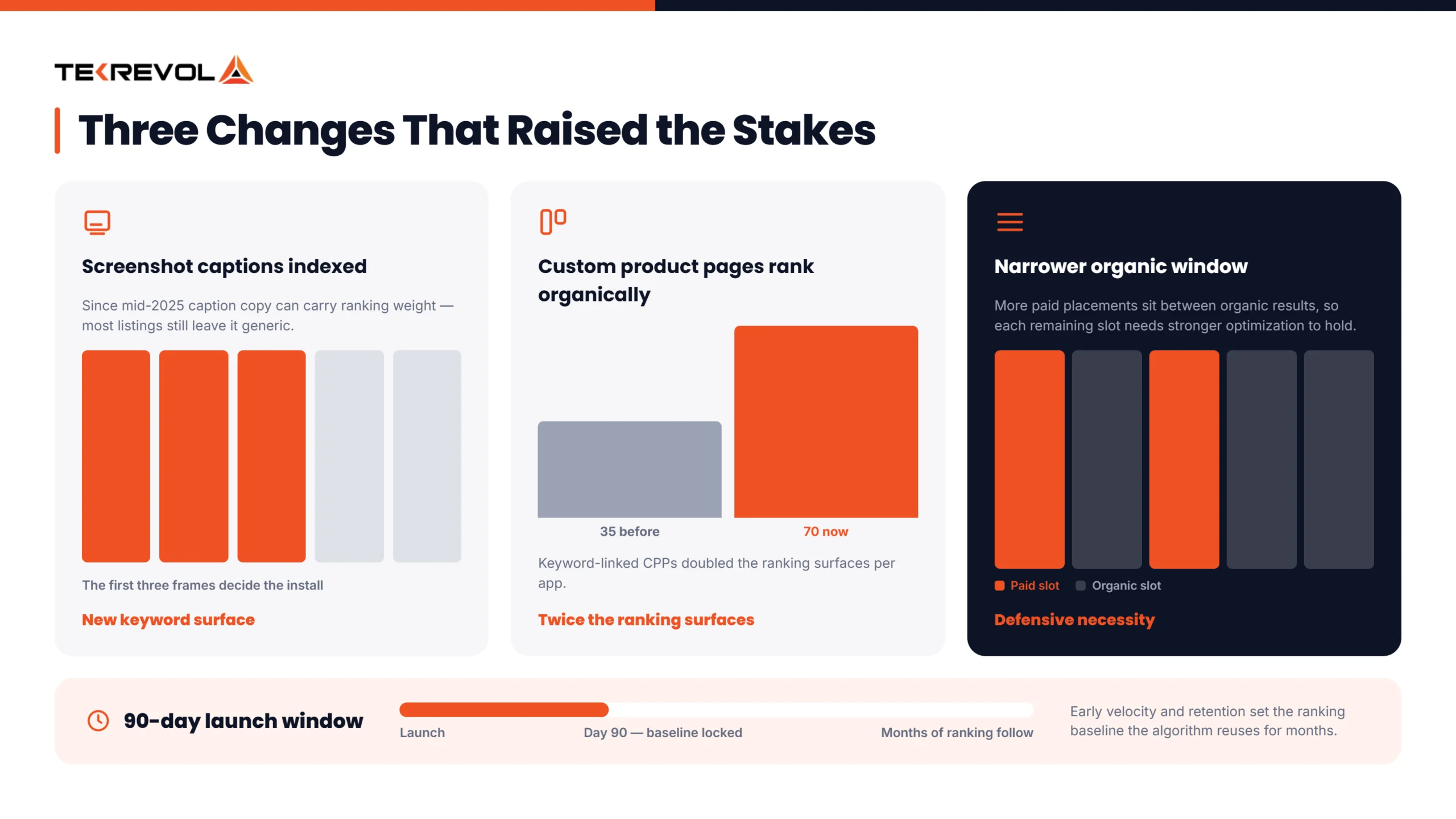
Three specific algorithm changes in 2025–2026 have made ASO more important than at any previous point. Screenshot captions are now indexed for keyword ranking, custom product pages appear in organic search, and Apple’s expanded paid ad placements have compressed the organic visibility window.
Screenshot Caption Text Is Now Indexed
Industry analyses indicate that Apple began indexing text in App Store screenshot captions around June 2025, making screenshot copy a potential ranking signal. Captions that were previously just design elements are now indexable metadata. Every caption on every screenshot is an optimization surface that most apps are still leaving blank or generic.
The practical implication: screenshot captions need the same keyword-aware thinking as your title and subtitle. Not keyword-stuffed text that converts poorly, but the natural language your users actually search with.
Custom Product Pages Now Rank in Organic Search
Before July 2025, Apple’s custom product pages (CPPs) were purely a paid acquisition tool. Since July 2025, Apple has allowed keyword linking to CPPs, meaning they can appear in organic search results for their assigned keywords. The maximum number of CPPs also doubled from 35 to 70.
This effectively doubled the number of ranking surfaces available to each app. Teams that haven’t built out CPP coverage since July 2025 are leaving organic ranking real estate empty.
The Organic Visibility Window Is Narrower
Apple’s March 2026 paid ad expansion added more paid placements between organic results. Fewer organic slots per search page means each remaining organic position requires stronger optimization to hold.
Good ASO is no longer a growth accelerator in isolation. In the current competitive environment, it’s a defensive necessity that protects organic ranking from being displaced entirely by paid inventory.
Following mobile app development tips that account for these algorithm realities from the build phase, not just post-launch, is what keeps apps competitive in 2026.
What Happens When You Ignore App Store Optimization
Ignoring app store optimization means relying more on paid acquisition while missing out on sustainable organic growth. Without ASO, your app is less likely to appear in relevant searches, resulting in fewer installs and higher acquisition costs.
Over time, poor visibility, weak conversion rates, and outdated listings make it harder to compete. In contrast, consistent keyword optimization, creative testing, review management, and metadata updates help improve rankings, increase organic installs, and reduce dependence on paid campaigns.
The Most Common ASO Mistakes That Kill App Growth
The most common mistakes that undermine ASO results are using identical metadata on iOS and Google Play, neglecting conversion rate alongside keyword ranking, and treating ASO as a launch task rather than a monthly practice.
Here’s each one, and the fix:
- Same metadata on both stores. iOS and Google Play index differently. Apple reads your title, subtitle, and 100-character keyword field. Google Play reads your full long description. One shared strategy underperforms on both.
- Optimizing for ranking but not conversion. A team that focuses entirely on keywords while leaving screenshots unoptimized is driving traffic to a listing that doesn’t convert it. Ranking and conversion are separate problems that both need to be solved.
- Review prompts at the wrong moment. Asking for a review immediately after install produces poor ratings from users who haven’t experienced the app yet. Ask after a moment of success — after a workout is logged, a purchase is completed, a goal is reached.
- Ignoring Android Vitals on Google Play. Apps that exceed Google’s crash rate or ANR thresholds can be excluded from prominent discovery surfaces entirely. Technical health is an ASO factor, not just a development issue.
- Setting and forgetting. Keyword landscapes shift. Competitors update listings. Algorithm weights change. A listing optimized six months ago is an uncompetitive listing today. Monthly iteration is the baseline practice for apps that sustain organic growth.
How TekRevol ensures your app’s success post-launch covers the operational side of this: the review cadences, iteration schedules, and performance tracking that keep organic rankings healthy over time.
2026 App Store Optimization Checklist
Before launching or updating your app, make sure these ASO fundamentals are in place.
| ✓ Checklist | Why It Matters |
| Keyword research | Targets the searches your users actually make. |
| Platform-specific metadata | Optimize separately for the App Store and Google Play. |
| Optimized screenshots & app icon | Improve conversion from listing views to installs. |
| Strong ratings & reviews | Build trust and support higher rankings. |
| Well-timed review prompts | Encourage positive reviews after successful user actions. |
| Localization | Reach more users with region-specific listings. |
| Custom Product Pages / Custom Store Listings | Tailor creatives for different audiences and campaigns. |
| Android Vitals monitoring | Maintain technical quality and Google Play visibility. |
| Monthly ASO reviews | Adapt to keyword trends, competitors, and algorithm updates. |
ASO and AI Search Discovery — A New Growth Layer
AI-powered search is becoming another way users discover apps. Assistants such as ChatGPT, Perplexity, and Gemini may recommend apps by synthesizing information from trusted sources, including official websites, editorial content, reviews, and public web pages.
While this doesn’t directly influence the App Store ranking algorithm, it creates an additional discovery channel that complements traditional ASO.
This is a 2026-specific development. When a user asks an AI assistant for “the best fitness app for beginners” or “a budgeting app for freelancers,” the recommendation comes from a mix of review content, blog articles, and structured web data, not from the app store’s search bar.
Apps with strong third-party review coverage, comparison-article mentions, and editorial presence have an advantage in these AI-generated recommendations that operate entirely outside traditional ASO channels.
How TekRevol Approaches ASO for App Growth
TekRevol runs app store optimization as a continuous, data-backed practice, platform-specific keyword strategy, conversion-focused creative testing, rating management, and monthly performance reviews tied to real organic install numbers.
The approach starts with a discovery audit before any optimization begins. Current keyword coverage, conversion rate, rating trajectory, and competitive positioning are mapped first. That baseline is what every subsequent change is measured against.
From there, the process runs on a defined cadence:
- Platform-specific keyword research and metadata optimization for iOS and Google Play separately
- Screenshot and icon A/B testing at a minimum of quarterly, with conversion rate as the primary measurement
- Rating prompt strategy built into the in-app experience at user success moments, with negative review responses within 24 to 48 hours
- Monthly reporting on keyword ranking movement, conversion rate change, organic install volume, and cost-per-install comparison against paid channels
Portfolio results that reflect this approach: Tamreeni (3 million downloads, 60% retention), Save & Win (30% engagement lift), Alif Play (GCC market localization and engagement growth).
For founders who want their app built and optimized from day one, TekRevol’s mobile app development services and ASO practice work together as a single integrated engagement. For brands that have an existing app and want to close the organic growth gap, a standalone ASO engagement starts with the free audit below.
Ranking Well on One Store Doesn't Mean You're Maximizing Installs
TekRevol's ASO specialists analyze your App Store and Google Play listings, uncover optimization gaps, and deliver a prioritized action plan to help increase visibility and downloads.
Book My Free ASO Strategy Session


