- React Native app development costs $15,000 to $250,000+, with most funded startups landing near $60,000.
- One codebase covers both platforms, cutting build cost 30% to 40% versus two separate native apps.
- Developer location swings your effective rate from $20 to $180 per hour for identical work.
- React Native’s legacy architecture was frozen in 2025, so older apps now carry a migration bill.
- React Native costs less to build than native, but slightly more to maintain every year afterward.
- Custom native modules are where most budgets break, adding $10,000 to $30,000 per hardware-dependent feature.
In June 2025, Meta froze React Native’s legacy architecture. No new fixes, no release testing, no pull requests except for security patches. If your app was built before late 2024 and hasn’t been upgraded since, you’re running on a foundation the framework is actively deleting.
This update set average React Native app development costs from $15,000 to $250,000, with most funded startups paying $40,000 to $100,000 for both platforms. A single codebase ships to iOS and Android, which typically runs 30% to 40% below two separate native builds.
This guide compares React Native development costs by complexity, platform, industry, region, engagement model, and development phase. We also cover the factors that move a quote, the hidden costs behind overruns, and what that architecture migration costs if your app is already in market.
So, without any further ado, let’s begin!
What’s React Native?
Before we jump right into dollars and cents, let’s briefly go over what React Native is and why it’s really trending right now.
React Native is an open-source framework that Facebook developed (now Meta). It allows developers to write apps for both iOS and Android with a single codebase.
Why Use React Native for App Development?
- Reduce your cost: Cut down development costs by allowing you to develop code with a single codebase instead of two.
- Quick development: Cross-platform development shortens timelines and helps you with a speedy launch.
- Good Performance: Apps developed with the React Native platform give similar vibes to natively built ones, providing users with optimal performance.
Here’s the Kicker: React Native is used by some big brands, like Facebook, Instagram, and Airbnb. So, if it’s good enough for them, it’s probably good enough for you too!
How Much Does React Native App Development Cost in 2026?
React Native app development costs $15,000 to $250,000+ in 2026. A simple MVP runs $15,000 to $40,000. Mid-complexity apps cost $40,000 to $100,000. Complex platforms reach $180,000 and beyond.
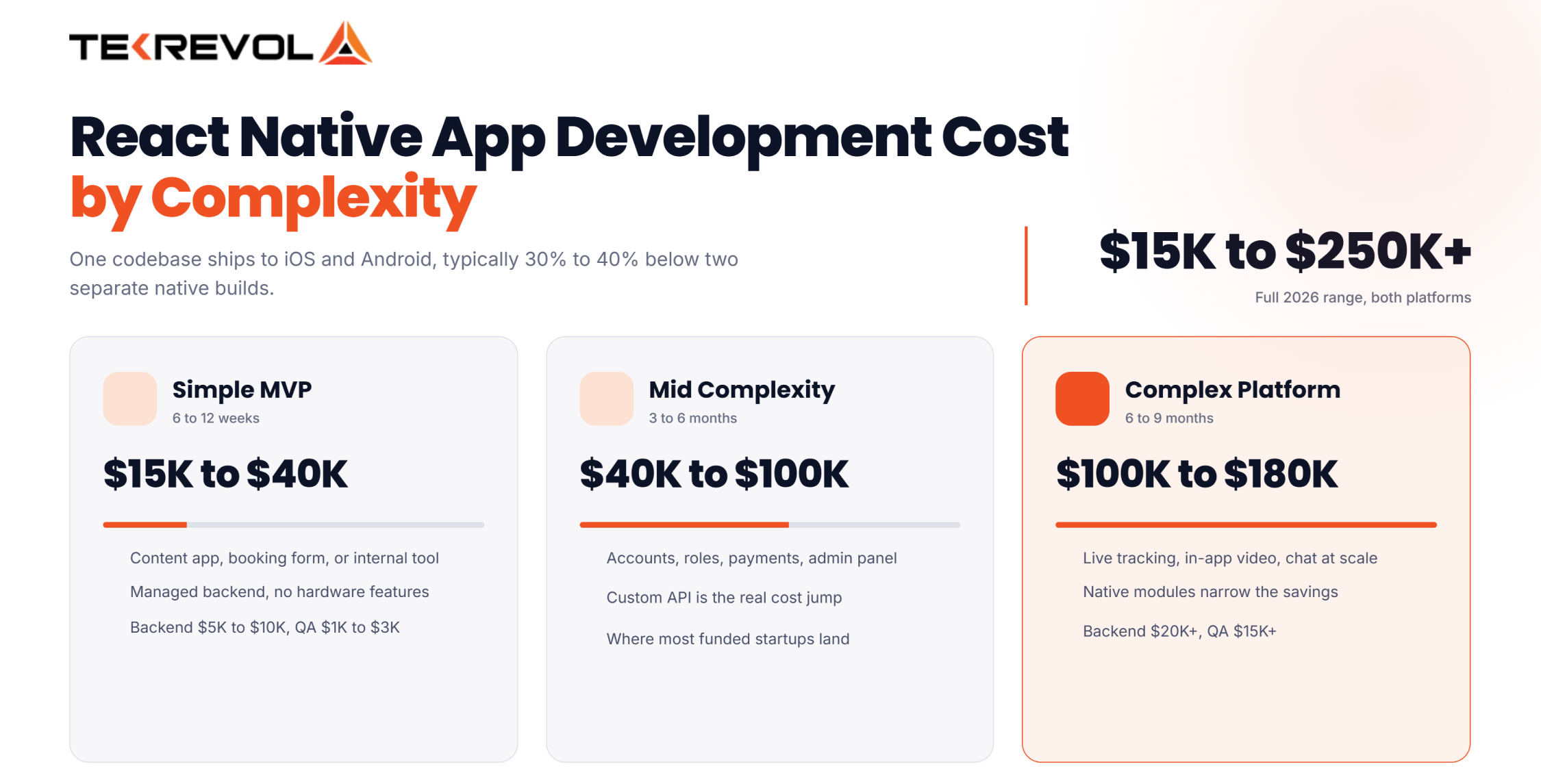
The cost of React Native app work covers both iOS and Android. A native quote usually covers one, so comparing the two figures side by side without adjusting for coverage will mislead you every time.
Saying that, the table below will help you understand the variables that contribute to React Native development cost.
| Development Factor | Simple Apps ($) | Medium Complexity Apps ($) | Complex Apps ($) |
| Estimated Cost Range | 15,000 – 40,000 | 40,000 – 100,000 | 100,000 – 180,000 |
| Development Timeline | 2-3 months | 4-6 months | 6+ months |
| Key Features | Basic UI, minimal features | APIs, payment gateways, advanced UI | Real-time features, custom algorithms |
| Backend Costs | $5,000 – $10,000 | $10,000 – $20,000 | $20,000+ |
| Testing and QA | $1,000 – $3,000 | $5,000 – $10,000 | $15,000+ |
Simple React Native App
Simple React Native apps cost $15,000 to $40,000 and ship in 6 to 12 weeks. Think a content app, a booking form, a directory, or an internal tool. Everything runs in JavaScript, the backend is a managed service, and no feature needs the phone’s hardware. This tier is where React Native looks unbeatable on price. You genuinely get two apps for a bit more than the cost of one.
Mid-complexity React Native App
Mid-complexity apps cost $40,000 to $100,000 over 3 to 6 months. Accounts, roles, payments, a custom API, push notifications, and an admin panel. Most ecommerce and marketplace products sit here. The cost jump comes from the backend, not the app. Once you outgrow Firebase and need your own API with permissions and reporting, you’ve added a second engineering discipline to the project.
Complex React Native App
Complex apps cost $100,000 to $180,000 across 6 to 9 months. Real-time features are the trigger: live tracking, in-app video, chat at scale, or heavy offline sync. Each one needs infrastructure and, often, a native module. This is also the tier where React Native’s savings start narrowing. The more native code you write, the closer you get to native pricing.
Need a defensible React Native number before your next board meeting?
Give us 30 minutes and your feature list. You'll walk out with a phased cost range, a timeline, and the native-module risks named, in a format you can put into a deck.
Book a 30-Minute Costing CallFactors Influencing React Native App Development Costs
The cost of developing a React Native app depends on factors like the complexity of the app, your unique design requirements, features, and a lot more.
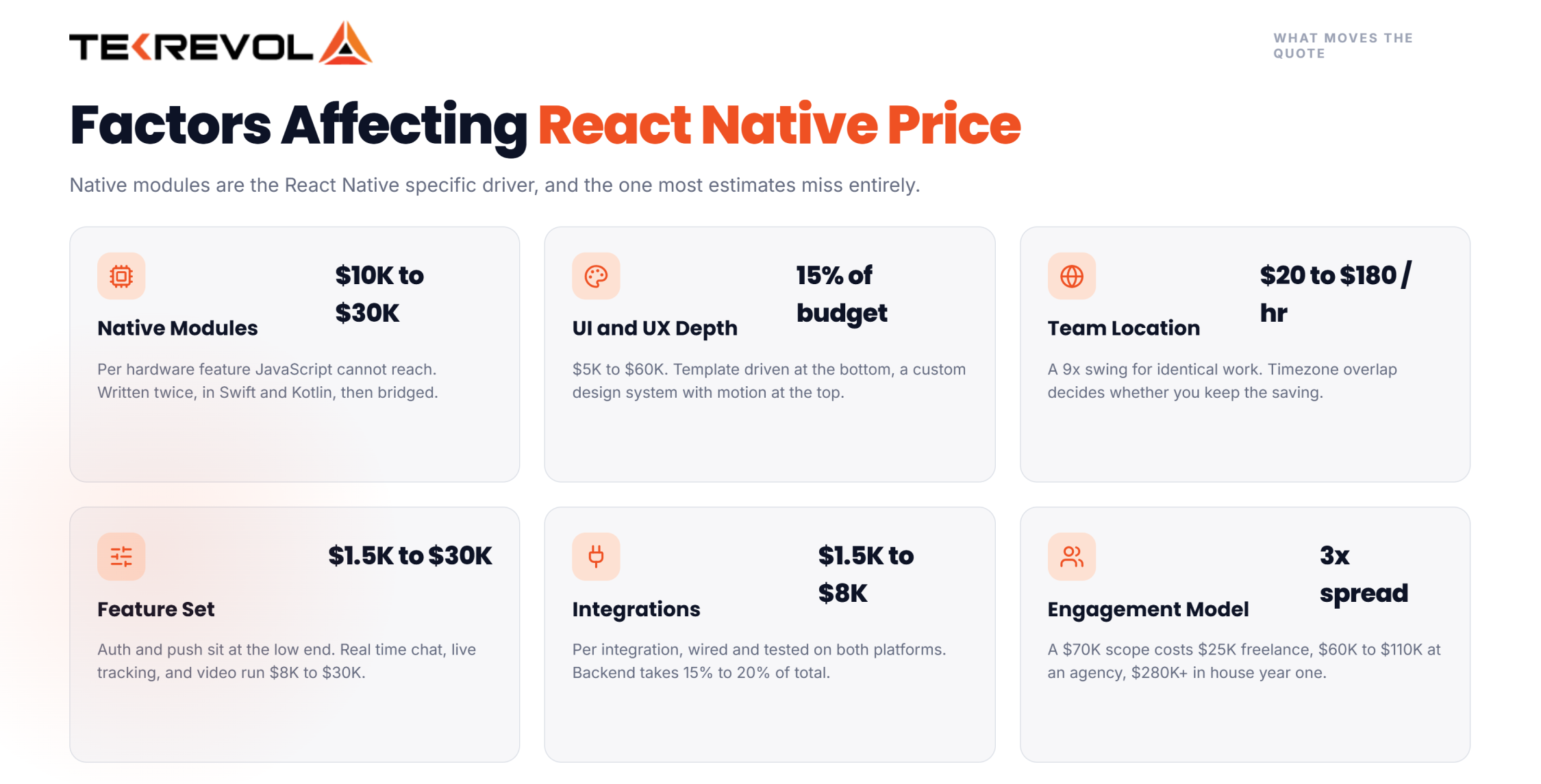
Let’s break down the prices we estimated above and give you a full teardown of where you’ll be spending your hard-earned money. From design demands to your developer’s zip code, here’s everything that impacts your React Native development pricing.
1. Native Module Requirements
Native modules are the React Native specific cost driver and the one most estimates miss. Anything JavaScript can’t reach needs Swift and Kotlin code plus a bridge, so you pay native rates for that feature on both platforms.
Check for a maintained community package first. If one exists and is actively updated, the feature costs a few days. If not, budget $10,000 to $30,000.
2. UI/UX Design Depth
Design consumes 15% of a React Native budget, or $5,000 to $60,000 depending on ambition. Template-driven design sits at the bottom. A custom design system with shared components and motion sits at the top.
Here are some of the design requirements that directly affect your React Native development pricing:
- Custom animations
- Unique UI/UX
- Extra layers and padding
Whether you’re going for a sleek minimalist app or one that comes dripping with animations, your app development cost breakdown will reflect the complexity of the design.
3. Development Team Location
Location swings your rate from $20 to $180 hourly for identical work, which the region section below breaks down properly. Rate alone is a poor filter, since timezone overlap changes how fast decisions get made. Thus, you need to choose a reputable React Native app development company with proven experience that can bring your idea to reality!
4. Feature Set and App Complexity
Your feature set drives the base number. Standard features like authentication, profiles, and push notifications cost $1,500 to $5,000 each in React Native. Real-time features like chat, live tracking, and video run $8,000 to $30,000.
| Feature | React Native Cost |
| Authentication and profiles | $2,000 – $6,000 |
| Push notifications | $1,500 – $4,000 |
| In-app payments | $5,000 – $14,000 |
| Search and filtering | $3,000 – $8,000 |
| Real-time chat | $8,000 – $18,000 |
| Live location tracking | $10,000 – $25,000 |
| Offline sync | $6,000 – $16,000 |
| Video streaming | $12,000 – $30,000 |
Source: TekRevol pricing observations
5. Third-party Integrations and Backend
Integrating your React Native app with GPS, real-time tracking, or API integrations will also cost you an arm and a leg. Each integration adds $1,500 to $8,000, and the backend consumes 15% to 20% of total budget.
Payment gateways, mapping, analytics, CRM sync, and identity providers all need wiring and testing on both platforms. Managed backends keep early costs low. Custom APIs cost more upfront and scale more predictably.
6. Engagement Model
Your engagement model changes the same project’s price by 3x. Freelancers cost the least and carry the most delivery risk. Agencies cost more and absorb it. In-house teams cost the most and only make sense after product-market fit.
| Model | Cost for a $70K-scope app | Best for |
| Freelance team | $25,000 – $50,000 | Small scope, technical founder on hand |
| Staff augmentation | $45,000 – $85,000 | You have a PM; you need engineers |
| Development agency | $60,000 – $110,000 | No internal tech leadership |
| In-house team | $280,000+ first year | Long roadmap, funded, hiring already |
Source: TekRevol pricing observations
The freelance figure is real, and so is the failure rate. Most React Native rescue projects we take on started as a freelance build that stalled around 70% complete, usually on a native module nobody scoped.
7. Timeline and Sprint Velocity
Compressing a timeline costs money. Adding engineers to hit a fixed date raises coordination overhead and typically adds 15% to 30% to total cost without proportionally shortening delivery.
Slower, smaller teams almost always deliver React Native projects cheaper. They rarely deliver them faster.
8. Target Devices and Platforms
Supporting older Android devices and tablets widens your QA matrix and your optimisation work. Adding React Native for Web or desktop later is a genuine project, not a configuration flag, so decide early whether you need it.
React Native App Development Cost Breakdown by Industry
React Native app development cost by industry ranges from $25,000 for education apps to $250,000+ for fintech. Regulated sectors cost the most because compliance work happens in native code and within the audit scope. Consumer content apps cost the least.
| Industry | React Native cost | What drives it |
| Fintech | $80,000 – $250,000+ | KYC, encryption, native security modules |
| Healthcare | $70,000 – $200,000 | HIPAA, encrypted storage, EHR integration |
| On-demand | $60,000 – $160,000 | Live tracking, dispatch, multiple apps |
| Social media | $50,000 – $180,000 | Feeds, real-time chat, media handling |
| Ecommerce | $35,000 – $110,000 | Catalog, checkout, payment providers |
| SaaS | $45,000 – $140,000 | Multi-tenancy, subscriptions, admin tools |
| Retail | $30,000 – $90,000 | Loyalty, POS integration, scanning |
| Education | $25,000 – $85,000 | Content delivery, progress, offline access |
Source: TekRevol pricing observation
Fintech
Fintech React Native apps cost $80,000 to $250,000 or more, the highest band here. Certificate pinning, secure key storage, biometric authentication, and jailbreak detection all live in native modules rather than JavaScript, so you pay native rates for the security layer. Our fintech app development cost guide covers the compliance side.
Healthcare
Healthcare React Native apps cost $70,000 to $200,000. HIPAA requires encrypted local storage and audit logging, both of which need native implementation on each platform. EHR integration adds $20,000 to $60,000 depending on the system. Our healthcare app development cost guide breaks that integration work down.
On-demand
On-demand apps cost $60,000 to $160,000 because you’re building several apps, not one. A customer app, a provider app, and an admin dashboard share components, which is where React Native genuinely earns its keep. Background location tracking still needs native work on both platforms. Our on-demand app development cost guide covers that architecture.
Social Media App
Social media React Native apps cost $50,000 to $180,000. Feeds and profiles are straightforward in JavaScript. Real-time messaging, media compression, and video playback are not, and list performance at scale is the classic React Native tuning problem. Our social media app cost guide covers the scaling curve.
Ecommerce and Retail App
Ecommerce React Native apps cost $35,000 to $110,000 and retail apps $30,000 to $90,000. This is React Native’s strongest category, which is why Shopify built all of its mobile apps on it. Payment SDK integration is the main recurring cost. Our ecommerce app development cost guide covers the full feature set.
SaaS and Education App
SaaS React Native apps cost $45,000 to $140,000, mostly on multi-tenant data handling and subscription billing. Education apps sit lowest at $25,000 to $85,000, where offline content access is the feature teams consistently underestimate. Our SaaS application cost guide covers the tenancy side.
React Native App Development Cost Compared to Other Platforms
React Native app development costs 30% to 40% less than separate native app development costs. Against a single native app, it costs slightly more because you’re covering two platforms instead of one.
| Approach | Mid-complexity build | Platforms covered | The trade-off |
| React Native | $40,000 – $100,000 | iOS + Android | Native modules for hardware features |
| Flutter | $42,000 – $105,000 | iOS + Android | Larger app size, smaller hiring pool |
| Native iOS only | $55,000 – $165,000 | iOS | Best performance, no Android users |
| Native Android only | $50,000 – $150,000 | Android | Wider QA matrix, no iOS users |
| Both, natively | $105,000 – $315,000 | iOS + Android | Two codebases, two release cycles |
| Progressive web app | $30,000 – $90,000 | Any browser | No store presence, limited device APIs |
Source: TekRevol pricing observations
React Native vs Native iOS
React Native beats iOS app development on cost only when you need both platforms. If your entire audience is on iPhone, native Swift is the better buy at $55,000 to $165,000, and the comparison stops mattering.
React Native vs Native Android
The same logic applies to native Android app development cost, with one wrinkle. React Native inherits Android’s device fragmentation problem, so you still test across many OS versions and manufacturer skins. The QA savings are smaller than the development savings.
Flutter vs React Native Cost Comparison
Flutter and React Native price within roughly 10% of each other. A mid-complexity Flutter app development runs $42,000 to $105,000 against React Native’s $40,000 to $100,000, so cost is not the deciding factor between them.
| React Native | Flutter | |
| Mid-complexity build | $40,000 – $100,000 | $42,000 – $105,000 |
| Language | JavaScript / TypeScript | Dart |
| Hiring pool | Larger, overlaps with web teams | Smaller, Dart-specific |
| UI consistency | Uses native components | Renders its own, pixel-identical |
| App size | Smaller | Larger by 3 to 5 MB |
| Annual maintenance | $10,000 – $28,000 | $9,000 – $26,000 |
Source: TekRevol pricing observations
The real cost difference shows up in staffing, not the quote. A React Native developer is easier to replace mid-project, and replacement cost is a line item nobody budgets until they need it.
Torn between React Native, Flutter, and Fully Native?
We'll run your actual feature list against all three and show you where the cost lines cross for your product, not for a generic example app.
Book a Free Framework ComparisonEstimated Cost to Build a React Native App by Region
React Native app price by region varies up to 9x for identical work. US developers charge $80 to $180 hourly. Eastern Europe charges $30 to $80. South Asia charges $20 to $50. Rate alone is a poor way to choose.
| Region | Hourly rate | 1,000-hour build | Overlap with US hours |
| United States | $80 – $180 | $80,000 – $180,000 | Full |
| Canada | $70 – $150 | $70,000 – $150,000 | Full |
| Western Europe | $60 – $150 | $60,000 – $150,000 | 3 – 5 hours |
| Australia / NZ | $60 – $120 | $60,000 – $120,000 | 2 – 4 hours |
| Middle East (UAE, KSA) | $35 – $90 | $35,000 – $90,000 | 1 – 3 hours |
| Latin America | $35 – $75 | $35,000 – $75,000 | 5 – 8 hours |
| Eastern Europe | $30 – $80 | $30,000 – $80,000 | 2 – 4 hours |
| South Asia (India, Pakistan) | $20 – $50 | $20,000 – $50,000 | 1 – 3 hours |
| Southeast Asia | $20 – $55 | $20,000 – $55,000 | 0 – 2 hours |
Source: TekRevol pricing observations
Offshore vs Onshore Cost tradeoffs
Offshore React Native teams cost 40% to 75% less per hour than onshore ones. The savings are real, but overlap decides whether you keep it. That’s why the table above includes an overlap column.
Plenty of excellent React Native work happens at $30 an hour. Just check overlap before you check the rate, and treat a low React Native developer’s cost as a starting figure rather than a final one.
Where Does the React Native Budget Actually Go?
The cost of react native app goes mostly to development. Discovery takes 10% of the budget, UI/UX design 15%, development 40%, backend and API work 15%, QA and testing 15%, and deployment 5%. Development and backend together consume more than half of the React Native budget.
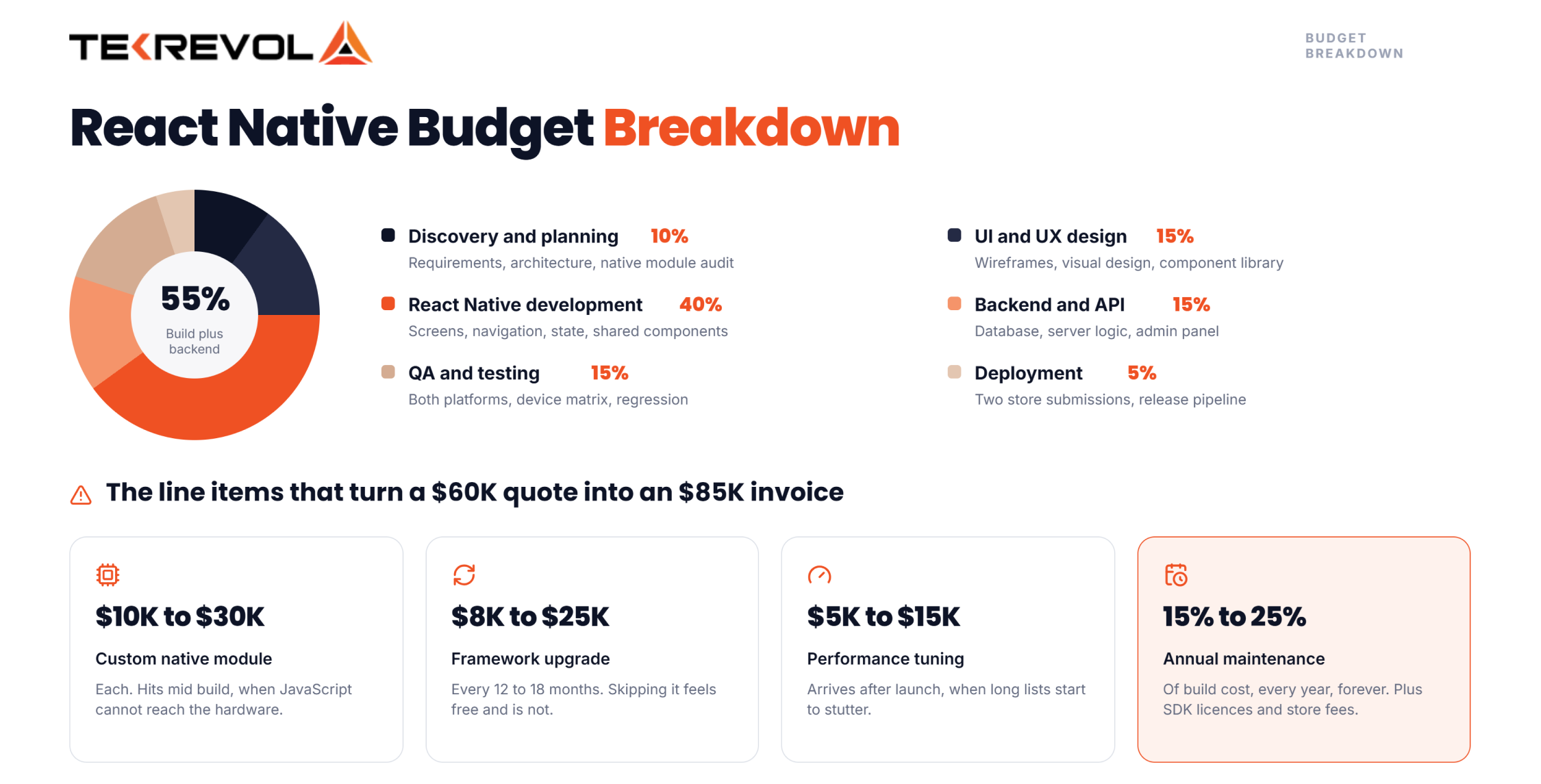
| Phase | Share | What happens |
| Discovery and planning | 10% | Requirements, architecture, native module audit |
| UI/UX design | 15% | Wireframes, visual design, component library |
| React Native development | 40% | Screens, navigation, state, shared components |
| Backend and API | 15% | Database, server logic, admin panel |
| QA and testing | 15% | Both platforms, device matrix, regression |
| Deployment | 5% | Two store submissions, release pipeline |
Source: TekRevol pricing observations
Two rows in that table are React Native specific.
- Discovery includes a native module audit. Before coding, someone lists every feature touching hardware or a platform API and checks whether a maintained community package covers it. Skipping this is how a $50,000 project finds a $20,000 native module in month three.
- QA is 15%, not 10%, despite the single codebase. Shared code fails differently on iOS and Android, particularly around keyboards, navigation gestures, and permissions. One codebase does not mean one test pass.
Hidden Costs of React Native App Development
Hidden React Native development costs include native modules at $10,000 to $30,000 each, framework upgrades at $8,000 to $25,000, performance tuning at $5,000 to $15,000, plus store fees, SDK licences, and annual maintenance at 15% to 25% of build cost.
These are the line items that turn a $60,000 quote into an $85,000 invoice, and most of them are predictable if somebody looks for them early.
| Hidden cost | Typical range | When it hits |
| Custom native module | $10,000 – $30,000 each | Mid-build, when JavaScript can’t reach the hardware |
| Framework major upgrade | $8,000 – $25,000 | Every 12 to 18 months |
| Performance optimisation | $5,000 – $15,000 | After launch, when lists get slow |
| Third-party SDK licences | $1,200 – $18,000 / year | Ongoing from launch |
| App store compliance work | $3,000 – $8,000 | At submission, often twice |
| Backend infrastructure | $1,800 – $24,000 / year | Ongoing, scales with users |
| Annual maintenance | 15% – 25% of build | Every year, forever |
Source: TekRevol pricing observations
Native Modules
Native modules are the single biggest budget risk in React Native app price. Anything JavaScript can’t reach needs Swift or Kotlin code written twice, once per platform, then bridged. Bluetooth, advanced camera control, background location, biometrics, and AR all fall here.
- The honest planning rule: assume any feature you can’t find a well-maintained community package for will cost $10,000 to $30,000 to build yourself.
Framework Upgrades
React Native ships frequent releases, and staying current is real work rather than a version bump. Budget $8,000 to $25,000 for a major upgrade every 12 to 18 months, more if you depend on packages that lag behind the core.
Skipping upgrades feels free and isn’t. The longer you wait, the more versions you jump at once, and the more community packages you find abandoned.
Performance Optimisation
Performance work costs $5,000 to $15,000 and usually arrives after launch. Long scrolling lists, heavy animations, and large images are the usual culprits, and they behave differently on low-end Android devices than they do on the test iPhone in your office.
What Does Migrating to React Native’s New Architecture Cost?
Migrating to React Native’s New Architecture costs $8,000 to $40,000 depending on how many native modules and legacy packages your app uses. The legacy architecture was frozen in June 2025, and its removal has already begun, so this migration is no longer optional.
This is the React Native cost nobody is quoting for, and it’s the most important thing on this page if you already have an app in market.
Per the official React Native blog, version 0.76 made the New Architecture the default in October 2024; version 0.82 became the first release running entirely on it. Version 0.84 began removing legacy architecture code from both iOS and Android. React Native 0.87 shipped on August 11, 2026, and continues that removal.
| Version | What changed | Date |
| 0.76 | New Architecture became the default | October 2024 |
| 0.80 | Legacy architecture officially frozen | June 2025 |
| 0.82 | First release running entirely on New Architecture | October 2025 |
| 0.84 | Legacy architecture code removal began | 2026 |
| 0.87 | Current release, removal continues | August 11, 2026 |
Source: React Native official blog and the React Native New Architecture working group
What it means for your budget. If your app was built before late 2024 and hasn’t been upgraded, you are running on a frozen foundation that receives no fixes and isn’t tested against new releases. Every month you wait adds versions to jump and increases the chance a package you depend on has been abandoned.
We price these migrations in three bands, based almost entirely on native module count.
| Migration Scope | Native Modules Involved | Typical Cost |
| Light | 0 – 2, all well-maintained packages | $8,000 – $15,000 |
| Moderate | 3 – 6, some custom or lagging packages | $15,000 – $28,000 |
| Heavy | 7+, several custom or abandoned packages | $28,000 – $40,000+ |
Source: TekRevol React Native migration engagements
Not sure which React Native version your app is running?
We'll check your project, tell you how far behind you are, and quote the migration in a couple of days.
Get a Free React Native Migration AssessmentHow to Optimize React Native App Development Costs
You can optimize React Native app price by 30% to 50% by following these practices: Audit for native modules before you scope, ship a smaller first release, use maintained community packages instead of custom code, and pick a region by timezone overlap rather than by rate alone.
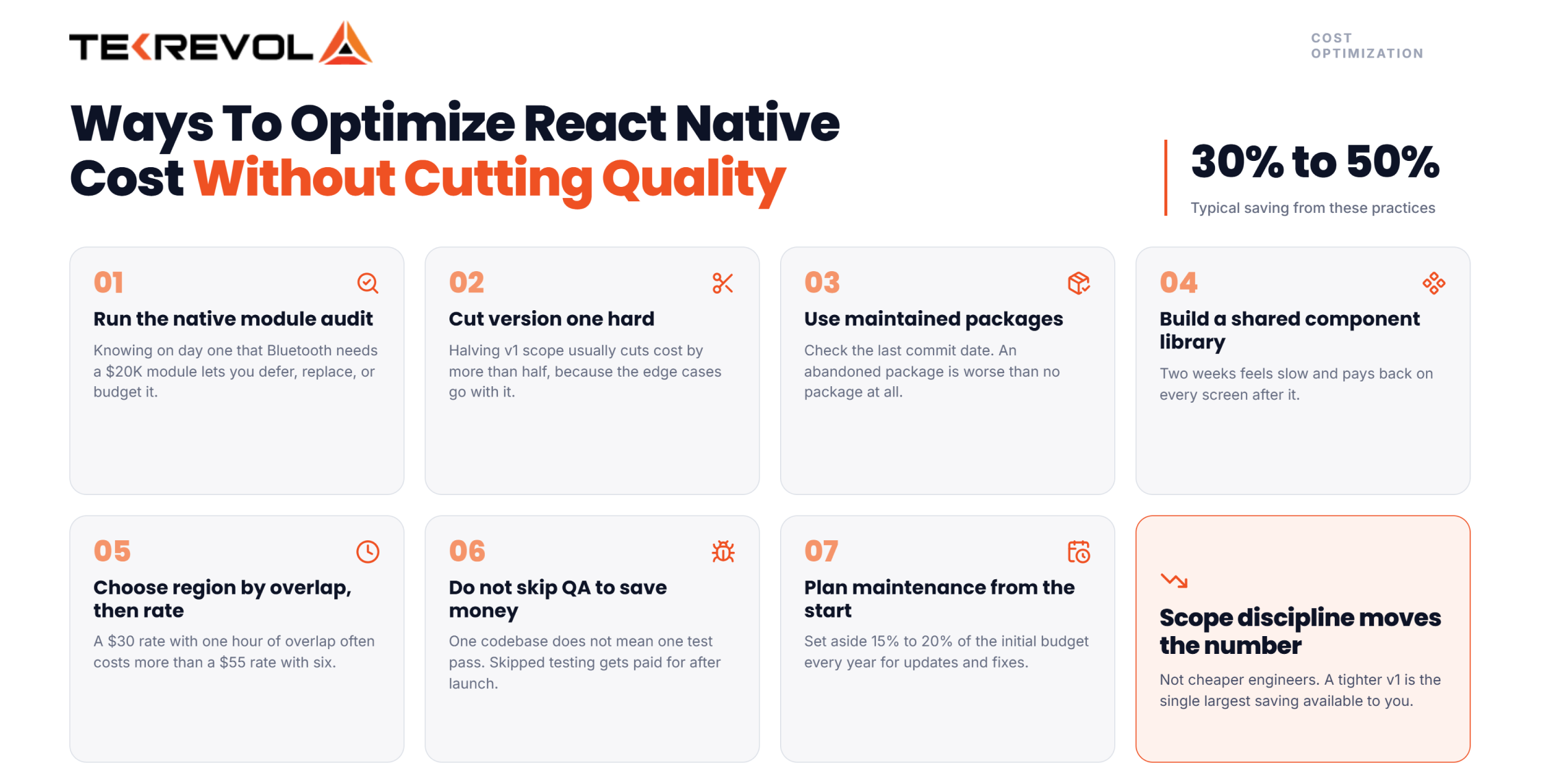
- Run the native module audit first. Knowing on day one that your Bluetooth feature needs a $20,000 native module lets you defer it, replace it, or budget it. Discovering it in month three costs you the same money plus the schedule.
- Cut version one hard: Halving your v1 scope typically cuts cost by more than half, because you also drop the integrations and edge cases those features dragged along. Our MVP development guide covers how to scope a first release that still proves something.
- Use maintained packages, not custom code: React Native’s ecosystem is its real cost advantage. A well-maintained navigation, camera, or payments package saves weeks. Check the repository’s last commit date before you commit to it, though, because an abandoned package is worse than no package.
- Build a shared component library early: Spending two weeks on reusable components feels slow and pays back across every screen afterward. Teams that skip this end up with forty bespoke screens and a cost-per-feature that rises instead of falling.
- Choose region by overlap, then by rate: A $30 hourly rate with one hour of overlap often costs more in elapsed time and rework than a $55 rate with six hours. Compare total delivered cost, not the rate card.
- Don’t skip QA to save money: One codebase does not mean one test pass. Testing you skip before launch gets paid for after launch, at a higher rate, with users watching.
- Plan for maintenance from the start: Budgeting for updates, bug fixes, and new platform requirements ensures you’re prepared for ongoing costs. It’s advised to allocate about 15-20% of your initial budget for annual maintenance.
Future Trends Shaping React Native Development Cost Trends
Speak to an IT expert, and he’ll tell you how fast the tech landscape is changing today. And just like that, you can’t predict how future trends will shape React Native development pricing.
It doesn’t matter if you’re a startup or an enterprise; staying ahead of the curve can surely help you come up with a better and smarter mobile app development budget and adopt more cost-effective strategies.
Saying that, let’s have a look at the future trends that are shaping React Native app development pricing.
1. Rising Trends of AI and Machine Learning
As Machine learning and Artificial Intelligence are becoming mainstream in modern apps, integrating them into React Native apps has become a common trend.
Features such as chatbots, personalized recommendations, or real-time analytics can have a cost impact because they are complex features.
- Impact on Costs: The complexity level of the React Native app increases with the inclusion of AI, and its development and maintenance costs tend to rise.
- How to Prepare: Focus on getting only the necessary integration of AI features in your app to prevent paying extra costs.
2. Increasing Need for More User-Friendly Experiences
Users demand sleek, intuitive apps with smooth designs. High-end UI/UX demands, such as 3D graphics or custom animations, increase the cost of cross-platform app development.
- Cost Implications: Custom design work can increase your budget by 20-40%.
- How to Plan: Spend your design dollars wisely by focusing on user-centric features.
3. Increased Automation in Development Tools
Automation is streamlining app development, making processes faster and cheaper. Futuristic tools like CodePush can allow users to get real-time updates out of their app while reducing time spent on bug fixes and deployments.
- Cost Impact: Labor costs get reduced, and timelines accelerate.
- How to Prepare: Use automation tools for time-intensive tasks to cut down the budget.
4. Evolving Developer Rates
As the demand for skilled React Native developers rises, hourly rates, particularly in competitive regions, are expected to increase.
- Impact on Costs: Labor costs may rise, influencing factors affecting app development expenses.
- How to Prepare: Consider outsourcing to cost-efficient regions without compromising quality.
5. Focus on Sustainable and Scalable Solutions
With businesses looking to be in the market for a prolonged time, scalable and sustainable app solutions are becoming a priority. Developing apps that can handle increased user loads or adapt to future updates can save costs in the long run.
- Impact on Costs: Initial costs may be higher, but scalability reduces long-term expenses.
- How to Prepare: Plan for scalability while estimating app development costs to future-proof your app.
By staying informed about these trends, you’ll not only navigate rising React Native development pricing but also create apps that are ready for the future. Investing in these areas strategically will keep your mobile app development budget efficient while delivering apps that stand out.
Build React Native App With TekRevol At An Unbelievable Price
TekRevol builds React Native apps that survive their second year, which is the harder test. Our 500+ person team has delivered 800+ projects across 11+ industries, and every React Native estimate we write starts with a native module audit rather than a screen count.
Whether you have a simple MVP or a feature-rich, scalable solution, our team of experts understands the nuances of React Native development pricing and helps you navigate factors that affect app development expenses smoothly – so that you can get your desired app without costing an arm and a leg!
With decades of experience, our React Native app development services utilize low-cost strategies that keep your budget optimized without hindering its quality.
Our extensive portfolio and never-ending list of testimonials are more than enough to show why you should partner with TekRevol to get a high-performance, cross-platform application in today’s competitive marketplace!
Ready to Replace React Native Cost Range With Real Number?
We'll scope your React Native build into phases, attach a cost and timeline, and hand you the estimate as a document you keep.
Talk to Our React Native Team