



- On-demand app development in Austin runs $60,000 to $250,000+ in 2026, based on how many sides you build.
- Texas HB 4215 now requires Austin delivery platforms to hold a state permit, a cost most founders miss.
- Austin apps skip the local pay floors and shift rules that add real cost in New York and Seattle.Two
- Texas contractor tests apply to Austin delivery apps at once, and they don’t ask the same things.
- Austin’s robotaxi boom means supply for local ride apps is no longer just human drivers.
Austin’s gig economy is booming, and it’s not just about ride-shares and food delivery anymore. From pet care to home repairs to peer-to-peer rentals, on-demand apps are reshaping how this city gets things done and how local entrepreneurs are building businesses around it.
If you’ve got an idea for the next big on-demand platform, here’s the range. A custom on-demand app in Austin runs $60,000 to $250,000 in 2026. Where you land depends less on your feature list than on how many separate apps you have to ship.
That’s the part nobody warns you about. An on-demand marketplace isn’t one app. It’s a customer app, a provider app, and an admin panel with at minimum three products that have to stay in sync in real time.
Our Austin app development team scoped enough builds to know where the surprises hide. So let’s walk through what on-demand app development really costs, how long it takes and Texas requirements worth settling before you scope anything.
Still Sketching Out Your Austin On-Demand Idea?
Talk to our team about a build that fits Texas regulations and business requirements from day one.
Get a Free On-Demand App ConsultationWhat Does On-Demand App Development Cost in Austin in 2026?
An on-demand app in Austin costs $60,000 to $250,000+ in 2026. One-service MVP with a single provider type lands near the bottom. A multi-service platform with real-time dispatch, split payouts, and three separate apps lands at the top.
The thing that trips founders up is scope, not features.
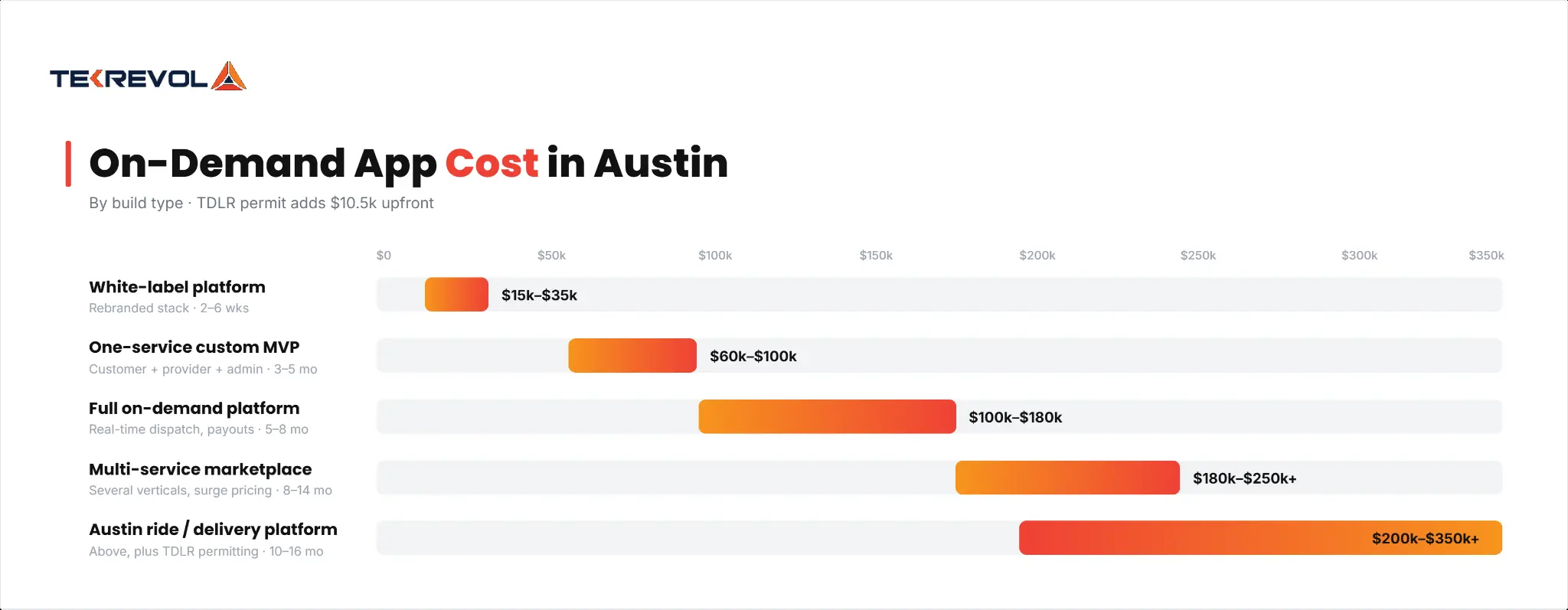
You’re not building one app. You’re building three, minimum. A customer app, a provider app, and an admin panel. Add a fourth if restaurants or stores sit in the middle of your marketplace.
That’s why on-demand costs more than a comparable one-sided consumer app.
| Build type | What you get | Cost range | Timeline |
| White-label platform | Rebranded existing stack, limited customization | $15,000–$35,000 | 2–6 weeks |
| One-service custom MVP | One vertical, customer + provider + admin, basic matching | $60,000–$100,000 | 3–5 months |
| Full on-demand platform | Real-time dispatch, split payouts, ratings, merchant side | $100,000–$180,000 | 5–8 months |
| Multi-service marketplace | Several verticals, surge pricing, smarter dispatch | $180,000–$250,000+ | 8–14 months |
| Austin ride or delivery platform | Above, plus TDLR permits, insurance hooks, compliance flows | $200,000–$350,000+ | 10–16 months |
Two decisions move your on-demand app development cost more than anything on your feature list.
How many apps you ship. Each one is a complete product with its own onboarding, notifications, and edge cases. Going from two apps to three doesn’t add 50% to your cost. It adds closer to 80%.
Whether dispatch runs in real time. A booking app, where a customer picks a provider and a time, is simple. An app that finds the nearest available provider in eight seconds, handles rejections, and re-routes on its own is a different engineering problem. That one decision can swing your budget by $40,000.
If you’re trying to get to a launchable version fast rather than building all three apps at once, our MVP development guide for Austin breaks down how to trim scope without cutting the parts investors and early users actually judge.
What Does Each Feature Cost in an Austin On-Demand Build?
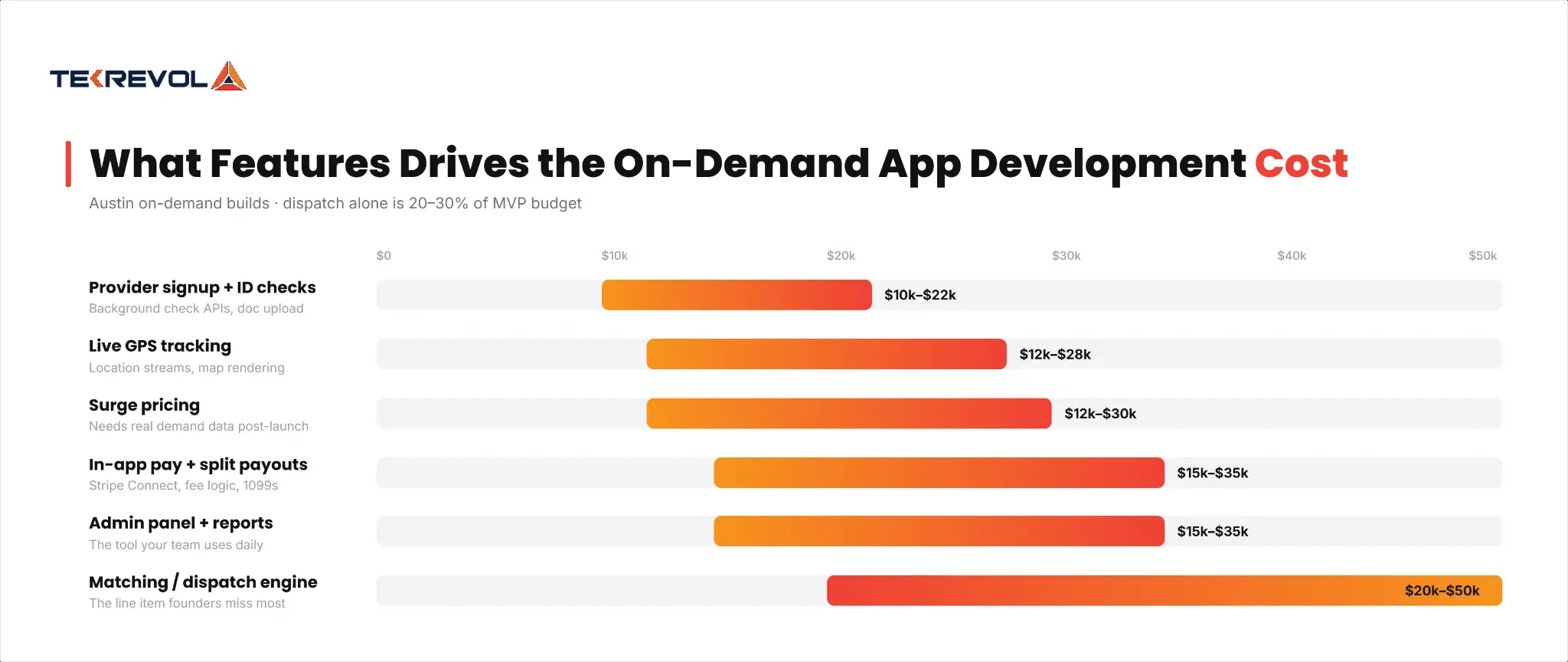
Feature costs in an on-demand build cluster around three things: live tracking, money movement, and trust. Everything else is comparatively cheap. Dispatch and real-time location alone often eat 20% to 30% of an MVP budget.
| Feature | Estimated cost | Why it costs what it does |
| Provider signup + ID checks | $10,000–$22,000 | Background check APIs, doc upload, review queue |
| Live GPS tracking | $12,000–$28,000 | Location streams, map draw, battery drain |
| Matching / dispatch engine | $20,000–$50,000 | The line item Austin founders miss most |
| In-app pay + split payouts | $15,000–$35,000 | Stripe Connect or similar, fee logic, 1099 filing |
| Ratings and two-way reviews | $6,000–$14,000 | Looks easy until you add review checks |
| Push alerts + in-app chat | $8,000–$18,000 | Chat needs its own review and storage policy |
| Shift and hours tools | $10,000–$20,000 | Where Texas contractor rules bite hardest |
| Admin panel + reports | $15,000–$35,000 | You will use this every single day |
| Surge pricing | $12,000–$30,000 | Needs real demand data, so budget for work after launch |
For three-app builds like these, React Native developers in Austin are the most common staffing choice. Flutter developers in Austin are the other common pick, especially for teams that want one codebase across customer, provider, and admin apps rather than splitting frameworks.
Teams that go fully native instead hire iOS app developers for the customer-facing app at minimum. Services of Austin-based Android developers are particularly preferred for the provider-side app, where Android’s larger share of gig-worker devices makes it the practical default.
Most Popular On-Demand App Categories in Austin
Austin’s on-demand activity clusters in four areas: home and trade services, healthcare and mobile care, last-mile logistics, and food and grocery delivery.
The city’s autonomous vehicle buildout is also reshaping supply for anything that dispatches a vehicle. That overlaps with automotive mobility app development, as robotaxi fleets start filling gaps in ride-hailing supply that used to be human-driver-only.
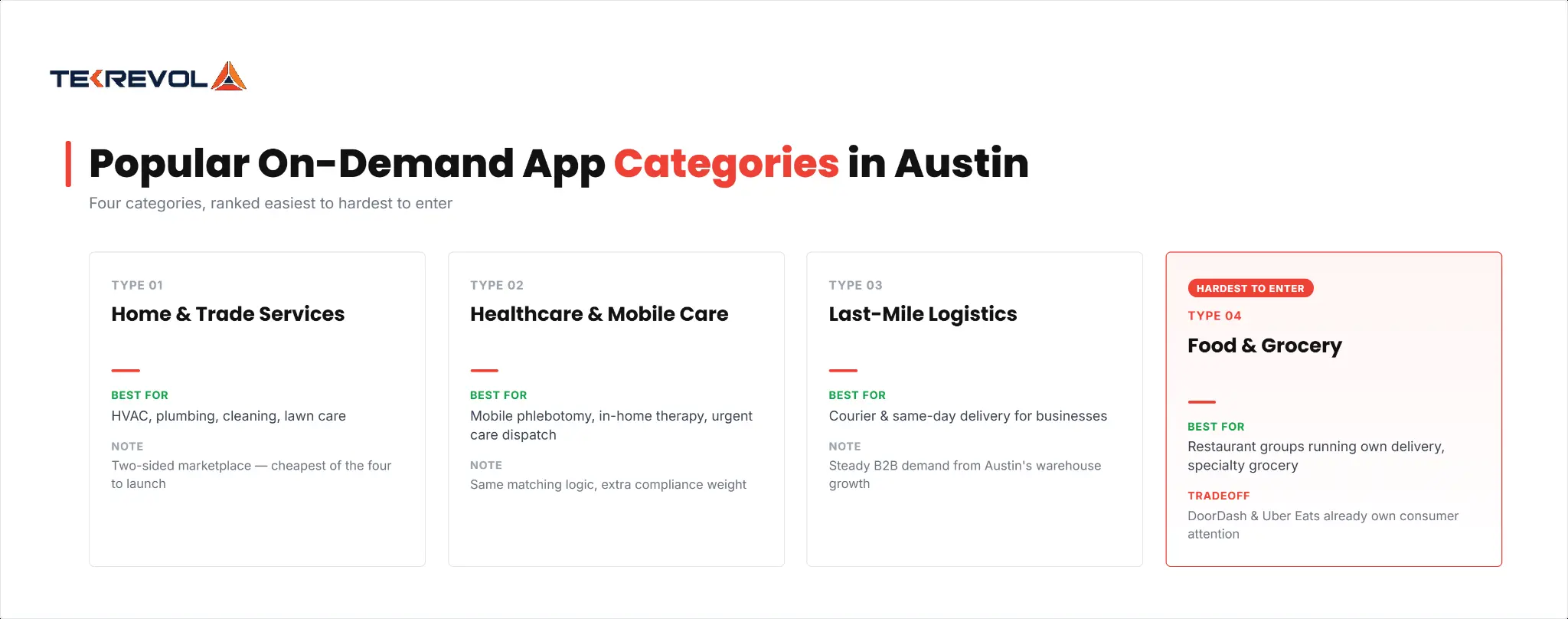
Home and trade services
Austin’s growth has kept demand high for HVAC, plumbing, cleaning, and lawn care. These are the most common on-demand builds we see locally, and they’re the cheapest to launch because the marketplace is two-sided rather than three. Several of these platforms end up overlapping with real estate app development in Austin, especially when maintenance requests get folded into a property management tool rather than shipped as a standalone app.
Healthcare and mobile care
Mobile phlebotomy, in-home therapy, and urgent care dispatch all follow on-demand mechanics. They carry extra compliance weight, but the matching logic is the same. Our guide to healthcare app development in Austin covers what that HIPAA layer adds on top of the on-demand cost baseline here.
Last-mile logistics
Austin’s warehouse and distribution growth has created steady demand for courier and same-day delivery platforms serving businesses rather than consumers. Our guide to logistics app development in Austin goes deeper into the routing and fleet-visibility features that come up most in this category.
Food and grocery
The hardest category to enter, because DoorDash and Uber Eats already own consumer attention. The openings are in narrow niches: restaurant groups running their own delivery, or specialty grocery. That overlaps closely with dedicated restaurant and food-ordering app development, where the same delivery mechanics apply to a single brand instead of a marketplace.
Not Sure Which On-Demand Category Fits Your Idea?
Spend 30 minutes with our team and we'll pressure-test your vertical against what's actually working in Austin.
Book a Free Strategy SessionWhat Texas Permits Does Your Austin On-Demand App Need?
If your Austin app arranges rides or delivers food, beverages, or consumer goods from restaurants or retailers, you need a state permit from the Texas Department of Licensing and Regulation. This is a pre-launch must, not a scale-up problem.
This requirement catches almost everybody in Austin, because it’s genuinely new.
Texas House Bill 4215 folded “delivery network companies” into the same chapter of the Occupations Code that already covered rideshare. So DoorDash-style platforms built in Austin now require the same permit as Uber and Lyft.
TDLR’s apply page now lists a $10,500 fee for a transportation or delivery network company permit. It’s not refundable, and you renew each year.
The fiscal note for HB 4215 pegged renewals at $7,500 under the current TNC fee list.
What this means for your Austin build:
- Budget the permit as a line item: It’s a five-figure cost that lands before your first Austin user signs up.
- Your signup flow has legal minimums: HB 4215 says delivery people must be at least 18, hold a valid government ID, and pass a local, state, and national background check. If they drive, they need a valid license and a checked driving record.
- You need policy tooling: The law calls for a substance policy barring any level of intoxication for anyone logged into your network. That means a report flow, a way to suspend, and an audit trail.
Our on-demand app development team builds these permit flows into the plan rather than bolting them on later.
How Long Does It Take to Launch an On-Demand App in Austin?
Plan on three to five months for a single-service MVP and five to eight months for a full platform. Ride and delivery apps run longer, usually ten to sixteen months, because permitting and compliance work happen alongside development rather than after it.
A rough sequence for a typical Austin build:
- Discovery and scoping: 2–4 weeks. Vertical, provider model, and Texas requirements get settled here.
- Design and architecture: 3–6 weeks. Dispatch logic gets designed before it gets built.
- Core development: 10–20 weeks. Customer, provider, and admin apps run in parallel.
- Testing and pilot: 3–5 weeks. Real providers in a limited Austin service area.
- Launch and tuning: ongoing. Your matching algorithm will be wrong at launch.
Launching in one neighborhood or service area first is almost always right. Liquidity in a small zone beats thin coverage across the metro.
What Ongoing Costs Should Austin On-Demand Founders Plan For?
Plan on 30% to 50% of your initial build cost annually. On-demand carries higher ongoing costs than most app categories, because maps, messaging, background checks, and payment processing all meter by volume. Austin adds an annual TDLR renewal on top.
The recurring categories Austin founders underestimate most consistently:
- API fees that scale with jobs: Maps calls, SMS alerts, background checks, and payment processing grow directly with your transaction count. Model them per-job, not monthly.
- Dispatch tuning: Your matching algorithm will be wrong at launch. It’s wrong for everyone at launch. Budget engineering time for the first two quarters to tune it against real Austin demand patterns.
- Provider support: Two-sided platforms generate support volume from both sides, and the provider side is usually noisier.
- TDLR renewal and compliance upkeep: The renewal is annual. Background check re-runs, policy updates, and record retention are ongoing duties under HB 4215, not one-time setup.
The rule of thumb we give Austin clients: whatever you budget to build, hold at least half that again for year one of running it.
Is Austin Cheaper for Gig Platforms Than New York or Seattle?
Yes, and the gap is structural, not cosmetic. Austin platforms don’t face the local pay floors, scheduling rules, and app-design mandates that New York and Seattle impose. That strips out both an engineering cost and a permanent operating cost.
| Requirement | Austin, TX | New York City |
| State or city permit | TDLR permit, $10,500 to start | Both state and city rules apply |
| Local pay floor for delivery workers | None | $22.13/hour before tips |
| Same pay floor for grocery apps | None | Yes, as of January 26, 2026 |
| City rules on app design | None | Tip-prompt rules enforced by DCWP |
| Risk of new city rules | Held back by HB 2127 | Live and growing |
Sources: TDLR; NYC Department of Consumer and Worker Protection, January and April 2026 announcements; Texas HB 2127 as upheld July 2025.
Why Choose TekRevol for On-Demand App Development in Austin?
Because we scope Texas permitting and contractor rules during discovery, not after your contract is signed. In on-demand app, the expensive mistakes are architectural and regulatory, and they get locked in early.
TekRevol has run an Austin office since our founding in 2018, alongside teams in Houston, Dallas, and seven other US cities. It’s part of why Austin startups choose TekRevol as a build partner across categories, not just on-demand specifically.
On-demand is one of our named solution practices, not a category we picked up along the way. It sits alongside our broader mobile app development work.
- We map your product against TWC Rule 815.134 and HB 4215, so scheduling and payout decisions get made once.
- We model maps, SMS, and payment fees against your projected Austin job volume, rather than leaving them out to make a quote look smaller.
- We build TDLR permitting workflows into the plan, including background check flows and substance-policy tooling.
- We design supply layers that stay provider-type-agnostic, which matters more in Austin than anywhere else in the country.
Our work is rated 4.8 on Clutch, 5.0 on GoodFirms, and 4.8 on RightFirms.
The founders who launch fastest in Austin aren’t the ones who move quickest through design. They’re the ones who figured out in week one which of their product decisions were legal decisions.
Have an Austin On-Demand Idea You Want Scoped?
We'll map your build against Texas requirements before you commit a budget.
Schedule a Free App Consultation


