

Worried about connecting an app to your GPS, ELD, or TMS?
Talk to TekRevol's Austin team and get your integration questions answered in a free call.
Consult With Our Austin Team

Ask any Austin logistics operator what separates the fleets winning contracts from the ones stuck bidding low, and it usually comes down to one thing: visibility. The operations that can track, route, and prove every delivery in real time are the ones pulling ahead, and that capability now lives in software.
Logistics app development in Austin is the work of building exactly that visibility into your fleet, freight, or delivery operation. Most builds run between $30,000 for a focused MVP and $200,000+ for a full platform, and where you land depends on integrations and complexity, not a flat fee.
Being a top-rated mobile app development company in Austin, TekRevol has over 10 years of experience in building logistics and transportation apps. So here are our insights: what logistics app development costs here, the features that actually cut costs, the integrations they must connect to, and how to pick the right partner.
Logistics app development is the process of building the software that moves goods (fleet and driver apps), route and dispatch tools, freight and 3PL platforms, and warehouse or inventory systems. It spans real-time tracking, delivery management, and the back-office tools that tie them together.
The type you build shapes cost, integrations, and timeline, so it’s worth naming your model first.
At the simple end sits a delivery or driver app: assignments, navigation, proof of delivery. In the middle are fleet and transportation management apps covering dispatch, tracking, and reporting. At the complex end are freight marketplaces and warehouse systems with many parties and live inventory.
We group most Austin logistics app development services into four buckets.
| Logistics app type | What it does | Typical complexity |
| Delivery / last-mile app | Driver assignments, navigation, proof of delivery | Low–medium |
| Fleet/transportation management | Dispatch, GPS tracking, maintenance, reporting | Medium–high |
| Freight / 3PL marketplace | Matches shippers and carriers, bidding, payments | High |
| Warehouse/inventory system | Real-time stock, picking, and fulfillment | High |
If your operation runs its own trucks, you’re likely in fleet-management territory, and our logistics software development page walks through what that scope looks like.
Talk to TekRevol's team for an itemized estimate within 48 hours.
Get a Free Logistics App ConsultationBecause freight volume keeps climbing and manual tools can’t keep up. US business logistics costs hit $2.6 trillion, and the logistics software market is growing fast. Austin operators are investing in apps to protect margins that squeeze tighter every year.
The macro numbers explain the urgency. US business logistics costs reached $2.6 trillion, according to the CSCMP State of Logistics Report, a record that shows just how much money moves through the system.
The tooling market is racing to match. The global logistics software market is projected to reach $34.68 billion by 2035, according to Precedence Research, which tells you where operators are putting their budgets.
Austin makes the pressure local. It sits on the I-35 freight corridor, one of the busiest routes in the country, and the region’s growth means more deliveries, more trucks, and more chances for a manual process to break.
There’s a hiring angle too. Good driver and dispatch apps make the job easier, which matters in a tight labor market where keeping drivers is its own cost line.
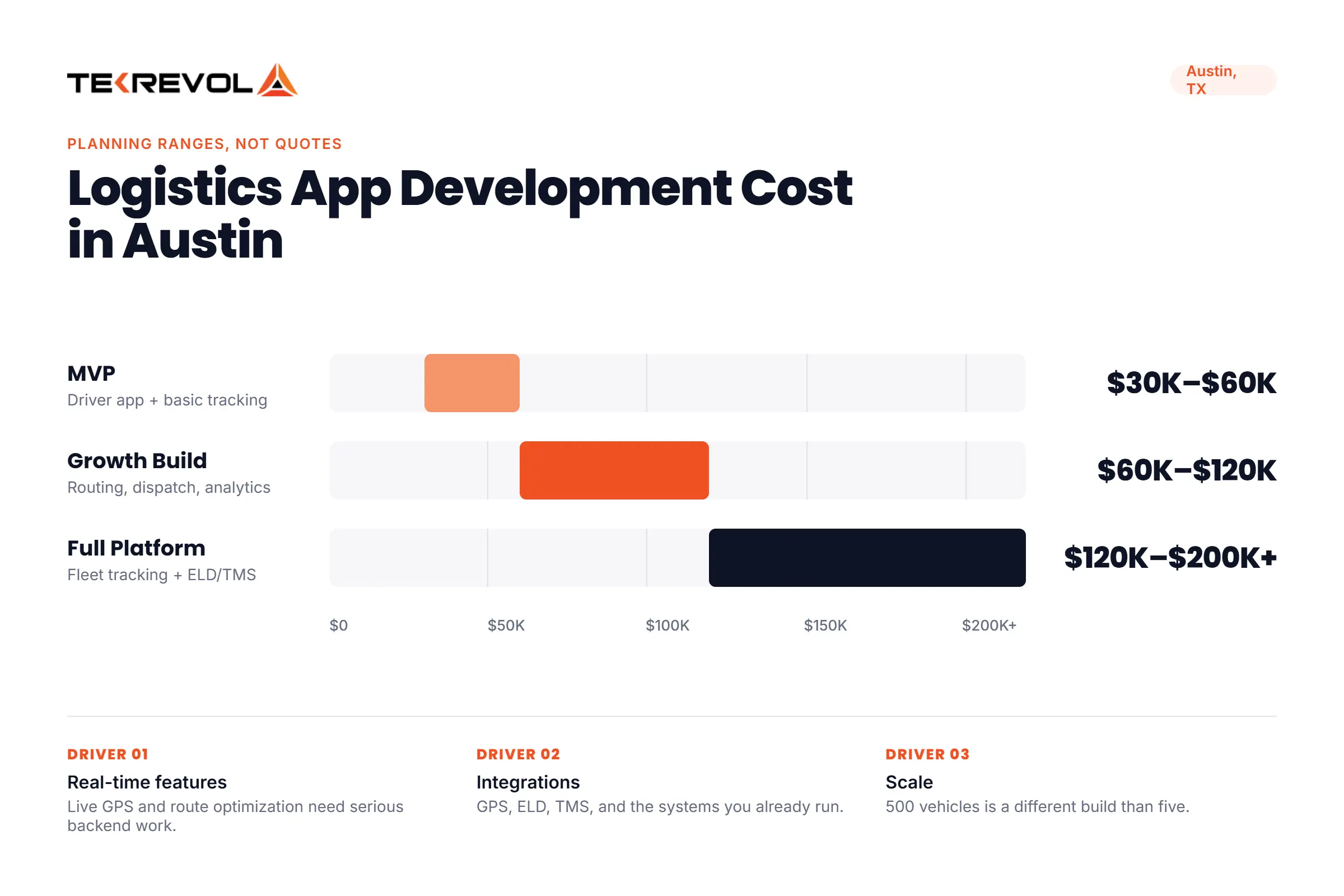
Most logistics apps in Austin cost between $30,000 and $200,000+, based on TekRevol’s Austin pricing. A lean driver or delivery MVP sits at the low end. A full fleet or freight platform with live tracking, route optimization, and deep integrations runs to the higher end.
| Project stage | What you get | Planning range |
| MVP | Driver app, assignments, basic tracking, one platform | $30,000–$60,000 |
| Growth build | Route optimization, dispatch, analytics, iOS + Android | $60,000–$120,000 |
| Full platform | Live fleet tracking, ELD/TMS integration, marketplace | $120,000–$200,000+ |
Let’s be honest about what moves the number. It’s rarely the screen count; it’s what happens behind them.
Three drivers push a logistics budget upward most.
Get a scoped logistics app estimate against your real fleet and systems, not a template.
Get a Free Project EstimateThe features that move logistics economics cut miles, time, and failed deliveries. Real-time GPS tracking, route optimization, proof of delivery, and a clean dispatch view do more for margin than anything else. Reporting and alerts come next.
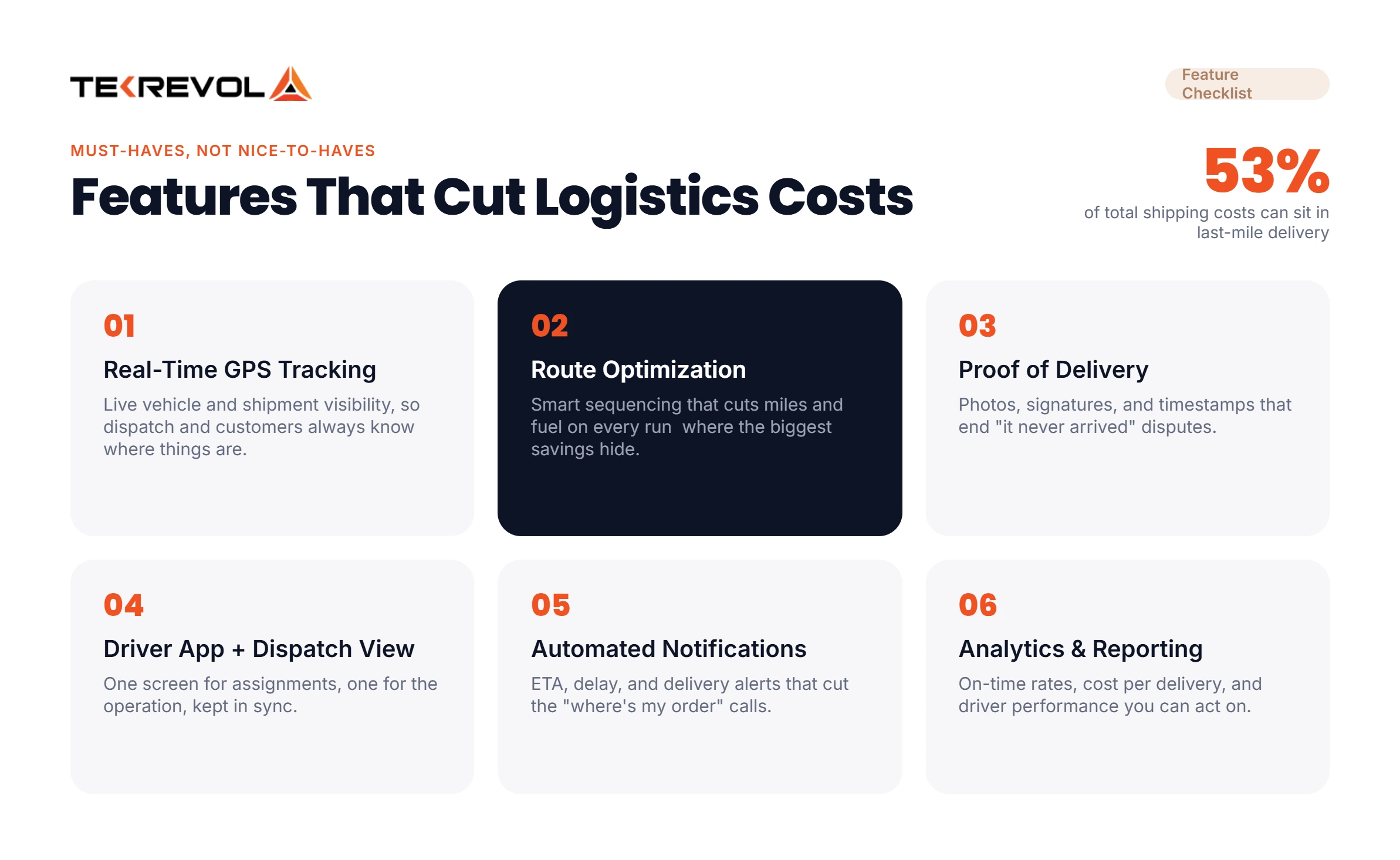
We tell operators to separate must-haves from nice-to-haves. Here’s the core set a serious logistics app needs, with the payoff each one earns:
Notice each feature names the payoff, not just the label. That’s how you brief a developer and know nothing critical got skipped. AI-based demand forecasting is worth adding later, once the core loop runs clean.
Real logistics apps live or die on integrations. API integration services connect to GPS and telematics hardware, ELD devices for compliance, a transportation or warehouse management system, and often your ERP or accounting tools. This is the part that separates a working logistics platform from a demo.
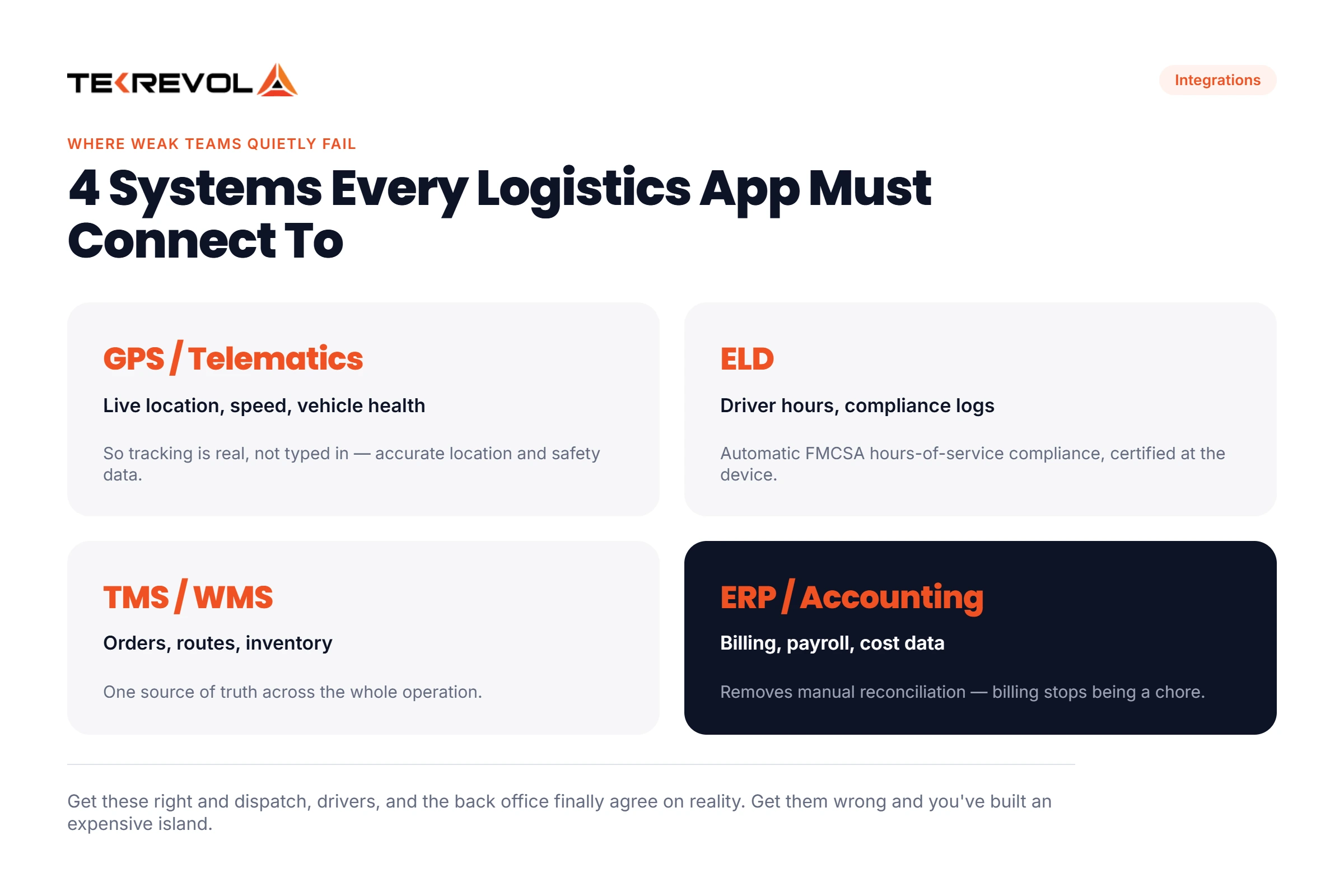
The integrations that matter most are
Add ERP or accounting, and billing stops being a manual chore.
| System | What it handles | Why it matters |
| GPS / telematics | Live location, speed, vehicle health | Accurate tracking and safety data |
| ELD | Driver hours, compliance logs | Automatic FMCSA hours-of-service compliance |
| TMS / WMS | Orders, routes, inventory | One source of truth across the operation |
| ERP / accounting | Billing, payroll, cost data | Removes manual reconciliation |
Once you’re pulling engine and diagnostic data rather than GPS pings alone, you’ve crossed into connected vehicle app development in Austin, which changes the integration scope and usually the hardware conversation too.”
Talk to TekRevol's Austin team and get your integration questions answered in a free call.
Consult With Our Austin TeamUse an off-the-shelf TMS when your operation is standard, and you need it running fast. Build custom when your routing logic, service model, or integrations are your competitive edge and generic tools force you to compromise. Many Austin operators run a custom layer on proven infrastructure.
We push back on both extremes. Rebuilding what a standard TMS already does well is wasted budget. But forcing a genuinely unique operation into rigid software caps your efficiency at whatever the vendor imagined.
The honest framework is about where your advantage actually lives.
| Approach | Best when | Trade-off |
| Off-the-shelf TMS | Standard operation, need speed | Less control, recurring fees, limited fit |
| Fully custom build | Routing or workflow is your edge | Higher upfront cost, longer build |
| Custom layer on proven base | You want a unique edge on stable rails | Requires careful architecture |
For operations that need something built to their exact workflow, our guide explains when custom logistics software genuinely beats off-the-shelf.
They cut the three biggest cost leaks: wasted miles, failed deliveries, and idle time.
In last-mile operations, where costs run highest, those savings compound fast.
The economics are simple once you see them. Every extra mile costs fuel and labor, and every failed delivery costs a redelivery plus an unhappy customer.
Route optimization attacks the biggest bucket by sequencing stops so drivers cover less ground. Real-time tracking and proof of delivery cut the failed-drop-off tax. Automated dispatch reduces the idle time between jobs that quietly drains a fleet’s productivity.
There’s a data dividend too. Once every trip is logged, you can see your true cost per delivery and per route, then fix the ones bleeding money. That visibility is often worth as much as the direct savings.
Most logistics apps take four to eight months from kickoff to launch. A lean driver-and-tracking MVP ships faster; a full fleet or freight platform with ELD and TMS integration takes longer.
The biggest timeline variable isn’t code but how many hardware and software systems need connecting. The app build is measurable. What adds weeks is wiring in telematics hardware, ELD devices, and a legacy TMS that wasn’t designed to share data. Clear scope and early access to those systems is the single biggest factor in hitting the date.
| Build type | Typical timeline | What drives the range |
| MVP | 4–5 months | Driver app, assignments, basic tracking |
| Growth build | 5–7 months | Route optimization, dispatch, analytics |
| Full platform | 7–10 months | Live fleet tracking, ELD/TMS integration |
We run a clear path: sketch, design, develop, test, then rollout and upscale so you approve the flow before code, and an MVP lets you prove the routing logic before scaling to the whole fleet.
Done right, logistics apps move engagement, delivery speed, and control. Across TekRevol’s logistics and transportation portfolio, Hard Shoulder drove 3x partner engagement, C-More cut material delivery time by 30%, and Stock n Ship gave one Austin operation 40% more control over inventory and orders. The pattern is friction removal, not feature stuffing.
These are named-project results, not company-wide averages, and each traces back to a specific fix:
| Project | Category | Result | What drove it |
| Hard Shoulder | Roadside assistance | 3x partner engagement | Scalable, mobile-first dispatch |
| C-More | Construction logistics | 30% faster material delivery | Streamlined procurement and routing |
| Stock n Ship | Logistics operations | 40% more inventory and order control | Real-time inventory accuracy |
Pick a partner who’s shipped real logistics software, not just generic apps. Ask for named operational results, confirm they’ve handled GPS, ELD, and TMS integrations, and check for a local presence. In logistics, integration experience and post-launch support matter as much as design.
Run every candidate through the same short test. It saves months.
Local matters in logistics because when a route breaks at 6 a.m, you want a partner in your time zone who picks up: one reason Austin startups choose TekRevol.
We build logistics apps with real integration experience, a downtown Austin presence, and a track record you can verify. That mix of engineers who’ve wired up tracking and dispatch plus a local team you can reach is what keeps a logistics build from turning into an expensive rebuild.
A few things that matter for a logistics app specifically:
Logistics rewards apps that cut miles, failed drops, and idle time, and the right partner gets the integrations correct the first time. We’d rather help you scope it that way than watch you rebuild after a rough launch.
Talk to TekRevol's logistics app specialists for a scoped, itemized estimate within 48 hours.
Schedule Your Free Consultation


Usually separate. Drivers need a focused app for assignments, navigation, and proof of delivery, while customers or dispatchers get a different view. They share one backend, so data stays in sync, but the interfaces are built for very different jobs.
It should. Good logistics apps cache assignments and capture proof of delivery offline, then sync when the driver regains signal. If a vendor doesn’t design for dead zones, rural and warehouse-basement routes will break, so raise it early.
By integrating with certified ELD hardware that logs driver hours automatically and stores them for FMCSA rules. The app surfaces that data, but the compliance certification lives with the ELD device, so integration, not reinvention, is the right approach.
That’s an adoption problem, not just a build problem. The apps that stick are fast, work with gloves and sunlight, and cut steps for drivers rather than adding them. Involving a few drivers in testing early is the cheapest way to protect adoption.
If it’s architected for it, yes. Cloud infrastructure and a modular backend let an app go from five vehicles to five hundred without a rebuild. Ask any partner how their architecture handles growth before you commit; retrofitting scale later is expensive.
Muhammad Ejaz Amir is an AVP and Mobile Development Team Lead at Tekrevol, with over 5 years of experience building polished and scalable mobile applications across diverse industries. Specializing in Flutter and native Android development, he brings deep expertise in mobile architecture and a sharp eye for performance. His ability to balance technical depth with strong leadership and cross-functional collaboration makes him a key driving force behind Tekrevol's mobile success.
There must be an app on your phone that just works the way you expect. The ease of use, smooth navigation, recommendations, and every feature match your expectations. That experience comes from backend app development, a process that often goes...
Read More
You can easily make predictions on a company’s future by analyzing how well it is handling its data. Those businesses that know their way to turn simple information into an insight, and that insight into a mandatory action, are truly...
Read More
Got a killer idea but no clue where to start? You’re not the only one. Many entrepreneurs hit that same wall—big vision, but bigger questions. The truth? Around 90% of startups don’t make it, and it’s usually not because the...
Read MoreGet valuable consultation form our professionals to discuss your projects. We are here to help you with all of your queries.
Collaborate with us and become a trendsetter through our innovative approach.


