

Looking for a partner who's shipped in this category?
Talk to TekRevol's Austin team for an itemized scope on your automotive build.
Start Your Project

Austin has quietly become one of the country’s busiest testing grounds for the connected car. Waymo and Tesla both run robotaxis on city streets, and autonomous and EV companies test here every day. For any business that touches vehicles, that’s a signal: automotive software is where the market is heading.
If interested in the category, know that automotive and mobility app development in Austin ranges from $35,000 for a booking app to $450,000 and up for autonomous-vehicle tooling. Your feature list isn’t what decides the number. What decides it is how many vehicle systems, payment rails, and outside networks your app has to talk to. And whether Texas has to authorize your operator first.
This guide covers everything about automotive app development in Austin. You will learn what these builds cost, which in-car platform reads the data you need, how Senate Bill 2807 changes your roadmap, and what to ask before you hire.
Automotive and mobility app development means building software that connects drivers, vehicles, fleets, and transport infrastructure.
It breaks into four groups: autonomous vehicle operations, EV and charging, fleet and telematics, and dealer or aftermarket services. They share a category name and almost nothing else.
That distinction isn’t academic. As an experienced app development company in Austin, we’ve watched teams scope a telematics platform using booking-app assumptions, only to find out in month five that their database can’t hold the data.
| Segment | What gets built | Who buys it in Austin |
| AV operations | Rider apps, remote assist consoles, dispatch, incident review, state reporting | AV operators, fleet partners, Uber and Lyft integrations |
| EV & charging | Charge discovery, session start, payment, roaming, battery state | Charging networks, property owners, utilities, EV startups |
| Fleet & telematics | Tracking, driver scoring, routing, maintenance, energy management | Logistics firms, service fleets, transit operators |
| Dealer & aftermarket | Service booking, detailing, parking, rental, leasing, inspection, parts | Dealer groups, repair shops, on-demand startups |
Most Austin businesses land in that fourth row. It’s also the fastest segment to validate. Our automotive app development work covers vehicle tracking, fleet tools, repair apps, navigation, and rental or leasing platforms.
Talk to TekRevol's Austin team for a scoped estimate on your automotive build.
Get a Free App ConsultationAustin gives automotive products a rare edge: a live, real-world testing ground. Waymo and Tesla run robotaxis in the city, EV adoption is climbing, and the connected-car market keeps expanding fast, per Fortune Business Insights. That concentration means real demand and engineers who’ve shipped on actual vehicles.
The ecosystem is the advantage. Autonomous fleets, charging networks, and dealer groups all operate in one metro. That means the talent and the test conditions live close together.
There’s a regulatory angle too, and it’s uniquely Texan. The state now authorizes driverless commercial vehicles through the TxDMV. So anything touching autonomous operations has compliance built into the roadmap from day one. More on that below.
For most Austin businesses, though, the opportunity is simpler. Dealerships, rental outfits, service shops, and fleets still run on aging software. A well-built app is often the fastest way to win back time and customers.
Almost any vehicle-related service can become an app: car rental and leasing, dealership and inventory tools, fleet management, EV charging, parking, car wash and detailing, roadside assistance, and connected-car dashboards. Each solves a different problem, and each carries its own integration and data demands.
The trick is matching the app to a real business bottleneck, not to a trend.
Pick the one tied to money you’re leaving on the table today. That’s the build that pays for itself fastest.
Automotive app development in Austin usually runs between $35,000 and $300,000+, based on TekRevol’s Austin pricing. A service or booking app sits at the low end. A fleet, telematics, or connected-vehicle platform with live data and deep integrations runs to the higher end.
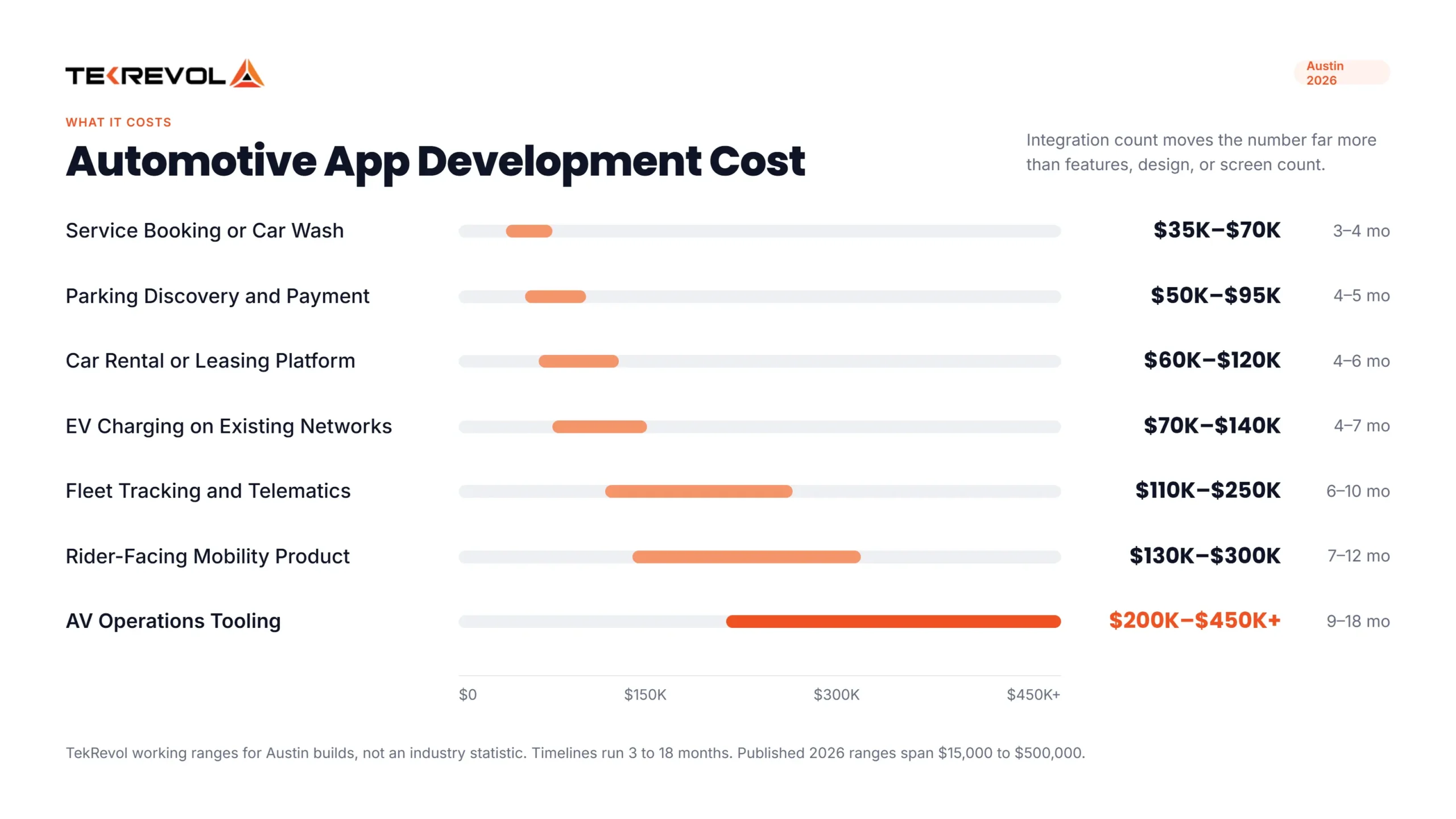
Here’s how we scope it. These are our working ranges for the Austin app development cost, not an industry statistic.
| Build type | Working range | Timeline | Main cost driver |
| Service booking or car wash app | $35,000–$70,000 | 3–4 months | Payments, scheduling, notifications |
| Parking discovery and payment | $50,000–$95,000 | 4–5 months | Mapping, real-time availability, payments |
| Car rental or leasing platform | $60,000–$120,000 | 4–6 months | Inventory, CRM, pricing engine, contracts |
| EV charging app on existing networks | $70,000–$140,000 | 4–7 months | OCPP integration, roaming, reconciliation |
| Fleet tracking and telematics | $110,000–$250,000 | 6–10 months | Time-series data layer, hardware, alerting |
| Rider-facing mobility product | $130,000–$300,000 | 7–12 months | Real-time dispatch, driver app, matching |
| AV operations tooling | $200,000–$450,000+ | 9–18 months | Hard real-time, TxDMV compliance, remote assist |
Four things move you inside those ranges.
The same telematics layer behind a consumer connected-car feature is what commercial fleets run on, though logistics app build costs in Austin account for uptime and integration requirements. Weighing a maintenance product specifically? We broke that build down in a car maintenance app guide.
Send us your scope, and we'll come back with a free, itemized estimate.
Get a Free Project EstimateFour options are available in Austin. CarPlay and Android Auto run on the phone and can’t read vehicle data. Android Automotive OS runs on the car and can. CarPlay Ultra spans every screen but barely ships yet.
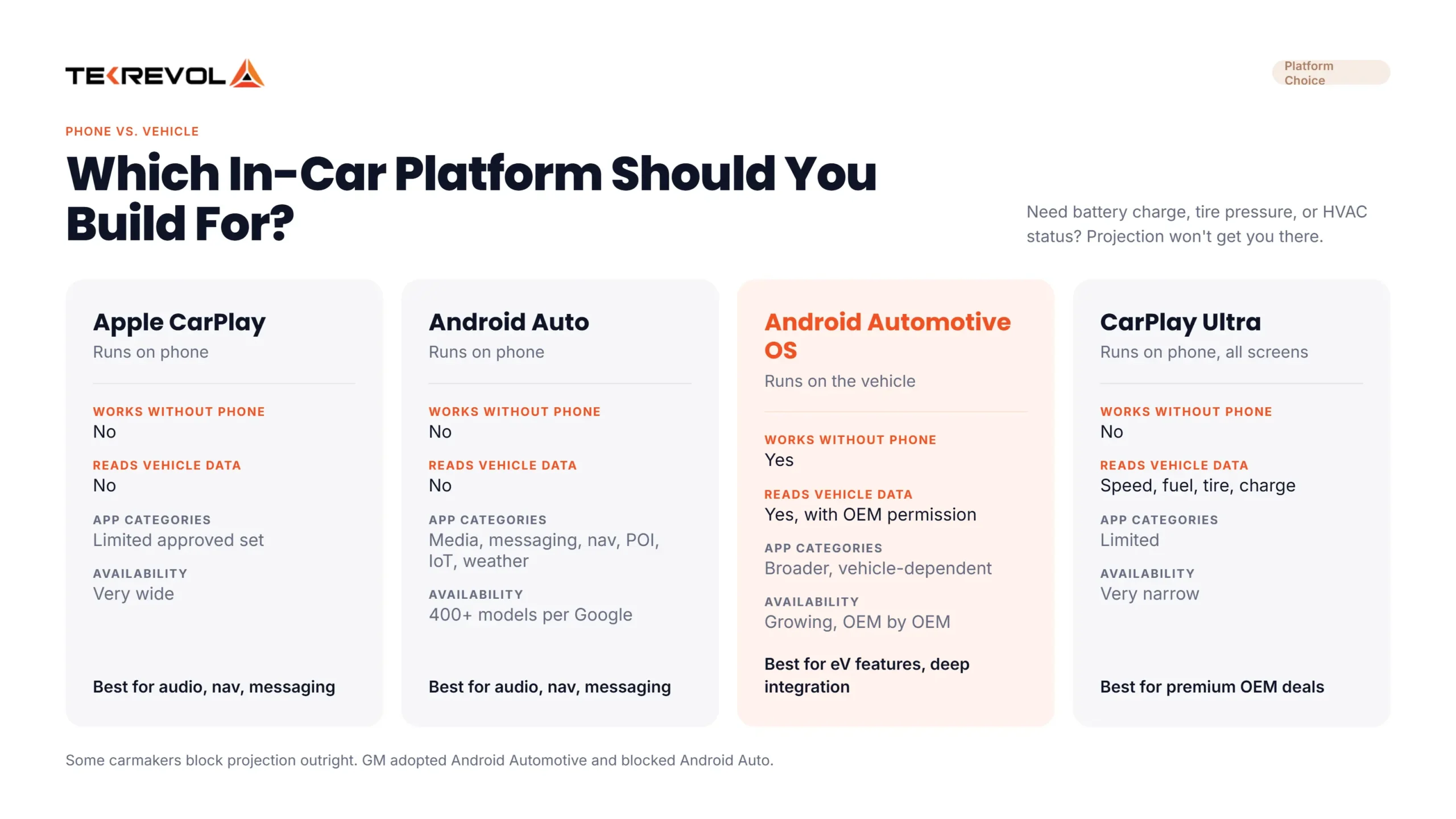
The right option depends on whether your app only needs a car-friendly screen or deeper access to the vehicle.
| Apple CarPlay | Android Auto | Android Automotive OS | CarPlay Ultra | |
| Runs on | Phone | Phone | The vehicle | Phone, all screens |
| Works without a phone | No | No | Yes | No |
| Reads vehicle data | No | No | Yes, with OEM permission | Displays speed, fuel, tire, charge |
| App categories | Limited approved set | Media, messaging, navigation, POI, IoT, weather | Broader, vehicle-dependent | Limited |
| Availability | Very wide | 400+ models per Google | Growing, OEM by OEM | Very narrow |
| Best for | Audio, nav, messaging | Same | EV features, deep integration | Premium OEM deals |
Three things worth knowing first.
Android Auto’s approved categories are a hard wall. Media, messaging, navigation, points of interest, IoT, weather. If your app isn’t one of those, projection isn’t your path.
CarPlay Ultra is real but thin. Reporting in early 2026 showed Aston Martin as the only shipping brand. Hyundai, Kia and Genesis committed. BMW, Mercedes-Benz and Audi declined. Don’t build a roadmap on it yet.
Some carmakers block projection outright. GM adopted Android Automotive and blocked Android Auto. If you assume projection is universal, check what your users drive.
Through one of three paths: an OBD-II dongle, a manufacturer’s telematics API, or a direct CAN bus connection. Each trades setup ease against data depth. The right one depends on how much the app truly needs to see, and how much hardware you’re willing to own.
Most consumer apps never touch the vehicle at all as they run on cloud data and payments. The deeper the vehicle access, the more engineering and support the build demands.
| Path | Cost | Data depth | Main risk |
| OBD-II dongle | Low | Basic diagnostics, location | Hardware becomes your support burden |
| OEM telematics API | Medium | Good, structured | Partnership terms, rate limits |
| Direct CAN bus | High | Deepest | Needs embedded expertise and safety separation |
Most automotive apps don’t. Parking, rental, dealership, service, and standard fleet apps launch without special approval. Approval is required only when an app supports commercial driverless vehicles on public roads. That falls under Texas Senate Bill 2807.
So for the vast majority of Austin builds, this is a non-issue, but you should know where the line sits.
If you are building for driverless vehicles, the Texas Department of Motor Vehicles requires state approval. The law took effect in September 2025, with enforcement following in 2026. For developers, that can mean tracking a vehicle’s approval status in code, blocking it when approval is pulled, and reporting changes to the state.
This isn’t only legal box-checking. It shapes dispatch logic, features, and your release process. Review the TxDMV program and consult a Texas attorney before launch.
Get a compliance and integration scope from TekRevol before you lock your architecture.
Book a Free ConsultationDone right, automotive apps move engagement, efficiency, and speed of transaction. Across TekRevol’s automotive portfolio, Oz Leasing lifted customer engagement by 30%, Select Dealer improved dealer efficiency by 40%, and Arrow Recovery delivered real-time quotes 20% faster. The pattern is integration, not decoration.
These are named-project results, not company-wide averages. Each one traces back to a simple move: wiring the app into the systems the business already runs on.
| Project | Category | Result | What drove it |
| Oz Leasing | Auto leasing | 30% higher customer engagement | Rebuilt UX plus CRM, pricing, and API integration |
| Select Dealer | Dealership platform | 40% better dealer efficiency | Streamlined listings and dealer tools |
| Arrow Recovery | Auto parts/recovery | 20% faster real-time quotes | Faster quoting and data flow |
The takeaway is consistent: in automotive, the win comes from the integrations under the surface, not the screen on top.
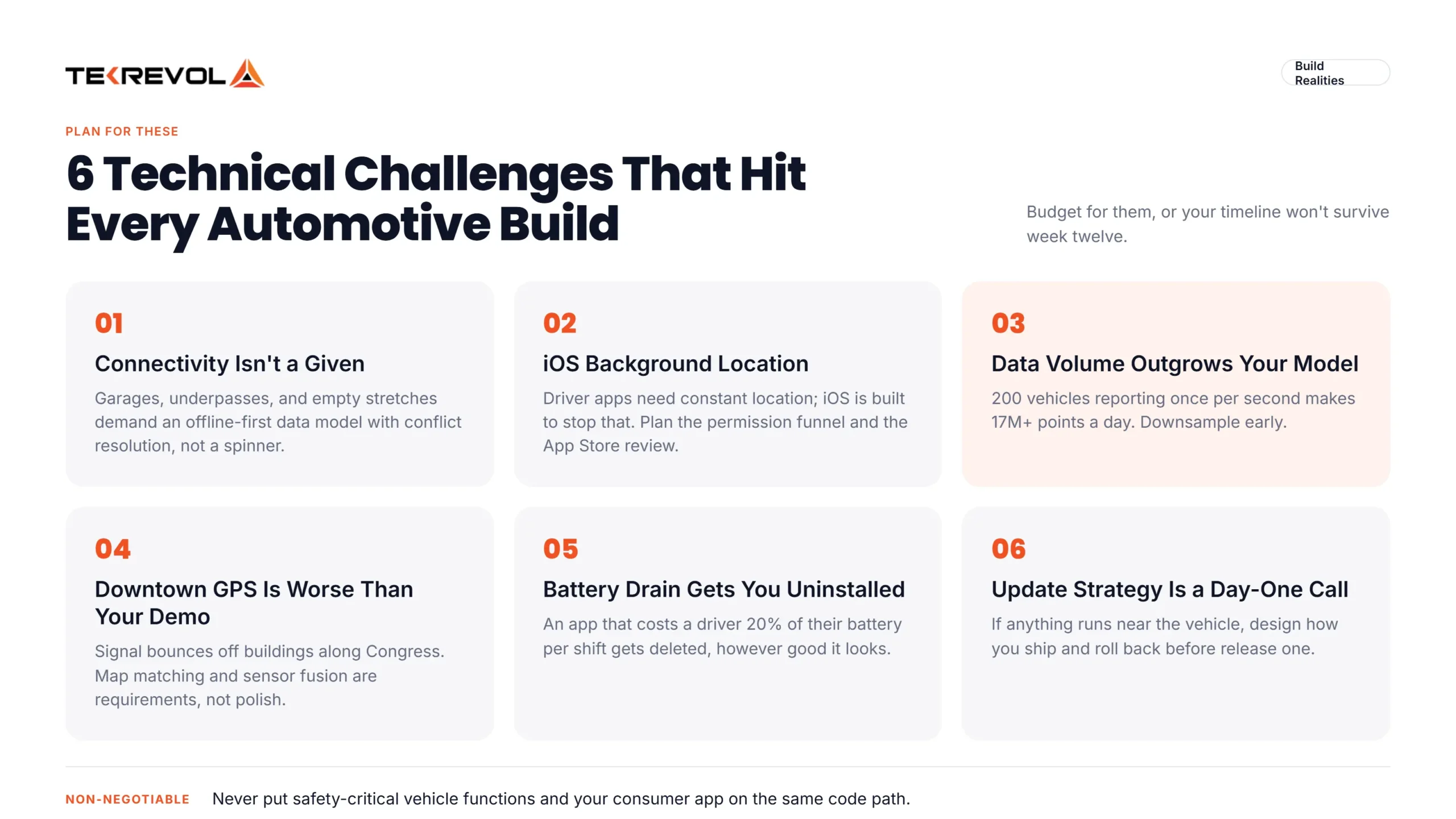
Six, and they hit every project. Connectivity gaps, iOS background location limits, data volume growth, downtown GPS accuracy, battery drain, and update strategy. Budget for them or your timeline won’t survive week twelve.
Hardware-adjacent work narrows the field fast, so picking an Austin app development partner should start with who has shipped against a vehicle platform rather than who has the largest portfolio. Ask for named results, not mockups. In this category, integration experience and a local presence matter as much as clean design.
Run every candidate through the same short test:
Get honest answers to those four, and the right partner usually stands out fast. For a broader view of where the category is heading, our AI in automotive breakdown is a useful primer.
We’ve shipped the integration-heavy end of this category. Our automotive work spans vehicle tracking, fleet management, maintenance, navigation, and leasing platforms where the hard part is wiring an app into systems that were never designed to talk to each other.
That’s the difference that matters in automotive. A polished screen is easy; a screen that stays in sync with a CRM, a pricing engine, and a third-party API under real load is not.
Take our Oz Leasing build. The client came to us with an underperforming site, in a category where the entire transaction happens online. We rebuilt it around a cleaner, interactive design, then wired in the four systems the business actually ran on: a lease calculator, ZOHO CRM, the EDMUNDS API, and a lease-order system. The rebuild lifted customer engagement by 30%, and the full integration story lives in the case study.
Our work in this space has earned a gold Horizon Interactive Award, a platinum dotCOMM Award, and No. 165 on Forbes’ America’s Best Startup Employers in 2023.
Talk to TekRevol's Austin team for an itemized scope on your automotive build.
Start Your Project


Android Auto runs on the driver’s phone and projects onto the head unit. Android Automotive OS runs on the vehicle itself and is the infotainment system. Android Auto cannot read battery charge, tire pressure, or HVAC status. Android Automotive OS can, with the carmaker’s permission. That single difference usually decides your platform choice before anything else does.
Six to ten months for a mid-complexity platform, based on how we scope them. Integration count is the biggest variable, since every outside system adds contract, testing, and maintenance time. Anything involving hardware like dongles or gateways runs longer, because procurement and firmware enter the schedule alongside software. Prove the riskiest integration first.
Usually telematics, because of data volume and storage design. EV charging carries a heavier payment and compliance load, but its data model is session-based and fairly light. Telematics is a constant high-frequency pipeline feeding dashboards and alerts. That costs more to build, and considerably more to run once your fleet grows past a few hundred vehicles.
The riskiest integration. Not login, not onboarding, but the connection most likely to fail, hit rate limits, or turn out unavailable. If that one doesn’t work, everything designed around it is wasted effort. Prove it by week five, then design the rest of the product around what you actually learned from it.
Only up to a point. Cloud, payment, and booking features work on any phone regardless of the vehicle. But deep data like battery or diagnostics depends on each carmaker’s API or hardware, so multi-brand vehicle access usually means integrating several systems, not one.
Cross-platform works well for booking, payments, dashboards, and notifications. Go native when you need steady background location, Bluetooth links to vehicle hardware, or in-car OS features. Most shipped automotive apps end up hybrid cross-platform screens with native modules for the vehicle-facing work.
Through roaming agreements and payment integrations that let one app start a session on networks it doesn’t own. Matching sessions, pricing, and settlement across providers is usually the hardest part of an EV charging build. It goes well beyond the map and the start button.
Adeel Sabzali is a Senior Full Stack Developer and Team Lead at Tekrevol with over 9 years of experience building high-performance web and mobile solutions. He specializes in Node.js, Laravel, React.js, and React Native, with strong expertise in cloud infrastructure and scalable architecture. A trusted technical leader, Adeel mentors development teams and delivers projects with precision and purpose.

Whenever companies put their money into novel software concepts, AI-driven initiatives, or robotization programs, there is always one question that throws them off at the very first stage. Is it better for us to test the idea with a proof...
Read More
Few rivalries in tech spark as much passion as Android vs iOS. In 2026, Android vs iOS Statistics reveal a fierce battle shaping the smartphone world. With 4.8 billion smartphones in use globally (3.4 billion Android, 1.4 billion iOS), this...
Read More
Geofencing is a buzzy mobile app capability that’s been around for at least a decade
Read MoreGet valuable consultation form our professionals to discuss your projects. We are here to help you with all of your queries.
Collaborate with us and become a trendsetter through our innovative approach.


