

Looking for a partner who's shipped real estate, not just quoted on it?
Talk to TekRevol's Austin team for an itemized scope on your real estate build.
Start Your Project

Nearly every home search in Austin now starts on a screen, and most buyers house-hunt from a phone long before they call an agent. In a market as fast and competitive as Austin’s, the brokerage or proptech startup with the better app quietly wins more of the deals.
For Austin’s brokerages, agents, and proptech founders, a real estate app is now the front door where buyers search, agents chase leads, and investors size up deals. Whether it’s a listing marketplace, an agent CRM, or a property-management tool, real estate app development in Austin comes down to data and features far more than screen count.
As an experienced app development company in Austin, TekRevol knows where real estate app development projects get expensive and where they stall. Ahead: we disclose the cost to develop real estate apps in Austin, the types you can build, how they make money, and how to pick a proven partner.
Real estate app development means building the software that lists, sells, manages, or invests in property. It covers listing marketplaces, agent and brokerage tools, property-management platforms, and investment or proptech apps. Each solves a different problem and carries its own data and integration demands.
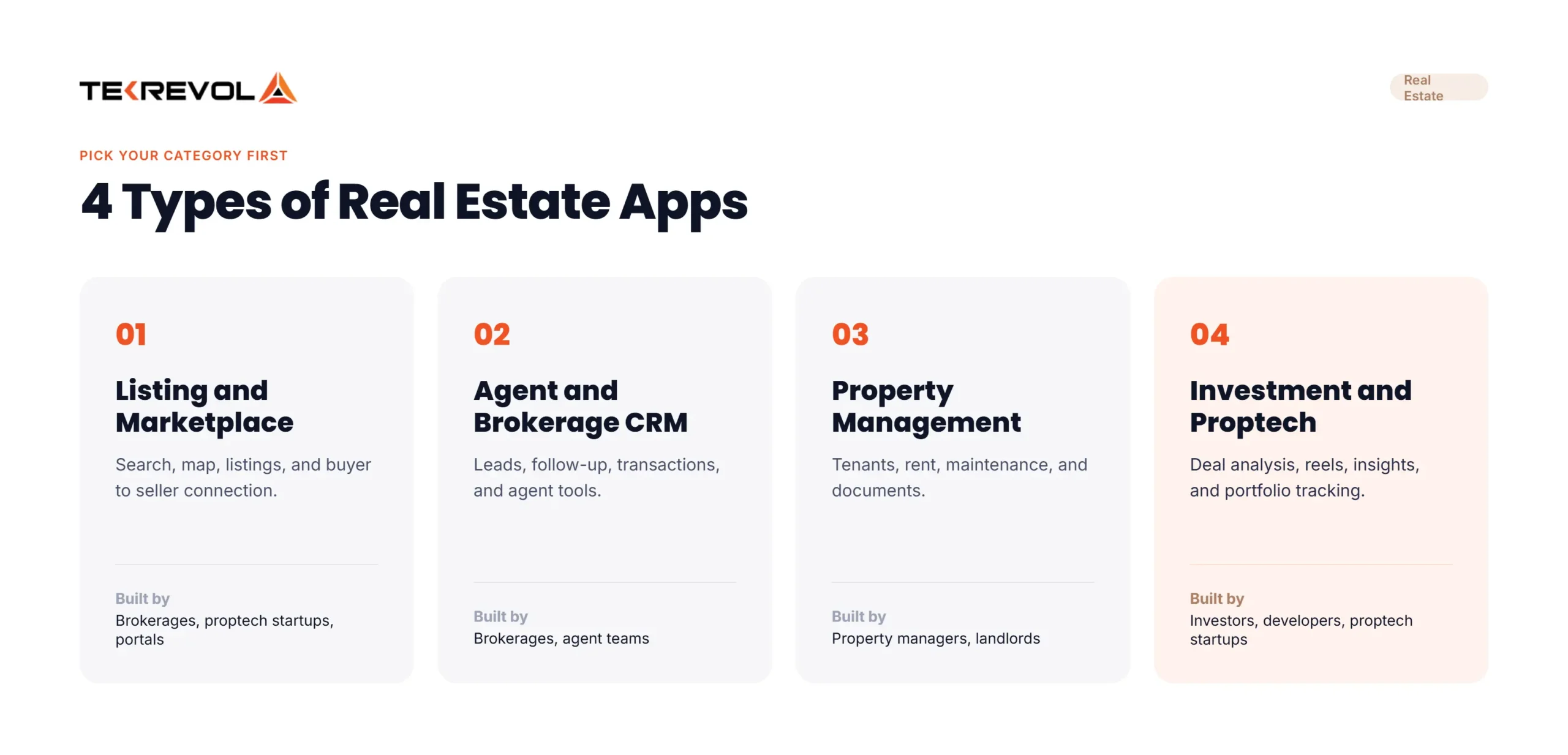
The type you build shapes everything: cost, timeline, and which data sources you’ll wrestle with.
A listing app like a local Zillow needs deep MLS data and search, while a brokerage CRM is really about leads and agent workflow, and property management centers on tenants, payments, and maintenance. Investment tools, meanwhile, are about numbers and analysis. Same industry, genuinely different builds.
| App type | What it does | Who builds it in Austin |
| Listing/marketplace | Search, map, listings, buyer-seller connection | Brokerages, proptech startups, portals |
| Agent/brokerage CRM | Leads, follow-up, transactions, agent tools | Brokerages, agent teams |
| Property management | Tenants, rent, maintenance, documents | Property managers, landlords |
| Investment / proptech | Deal analysis, reels, insights, portfolio | Investors, developers, fintech-adjacent startups |
Our real estate app development services span listing platforms, property-management tools, and investment apps.
Tell us your idea, and we'll map it to the right build in a free consultation.
Get a Free ConsultationAustin is one of the country’s hottest housing markets, with heavy migration, active investors, and buyers who expect a polished mobile search. That demand, plus a deep local tech talent pool, makes it a strong place to build and test a real estate product against real users.
The buyer behavior backs it up. Roughly three-quarters of buyers found the home they purchased on a mobile device, and 88% still bought through an agent, according to the National Association of Realtors’ 2025 report.
The competitive pressure is the point, because when buyers can browse a rival brokerage’s slick app at midnight, a clunky website quietly loses them before an agent ever hears from them.
Austin also concentrates the whole ecosystem. Brokerages, proptech startups, property managers, and developers all operate here, which means real feedback from real users is a short drive away rather than a drawn-out research project.
For most local real estate businesses, the opportunity is simple: aging portals and spreadsheet workflows leave money on the table, and a focused app is often the fastest way to capture leads and save valuable agent hours.
Real estate app development in Austin usually runs between $35,000 and $250,000+, based on TekRevols’ pricing. A simple listing or agent app sits at the low end, while a full marketplace or investment platform with MLS data, maps, and analytics runs to the higher end.
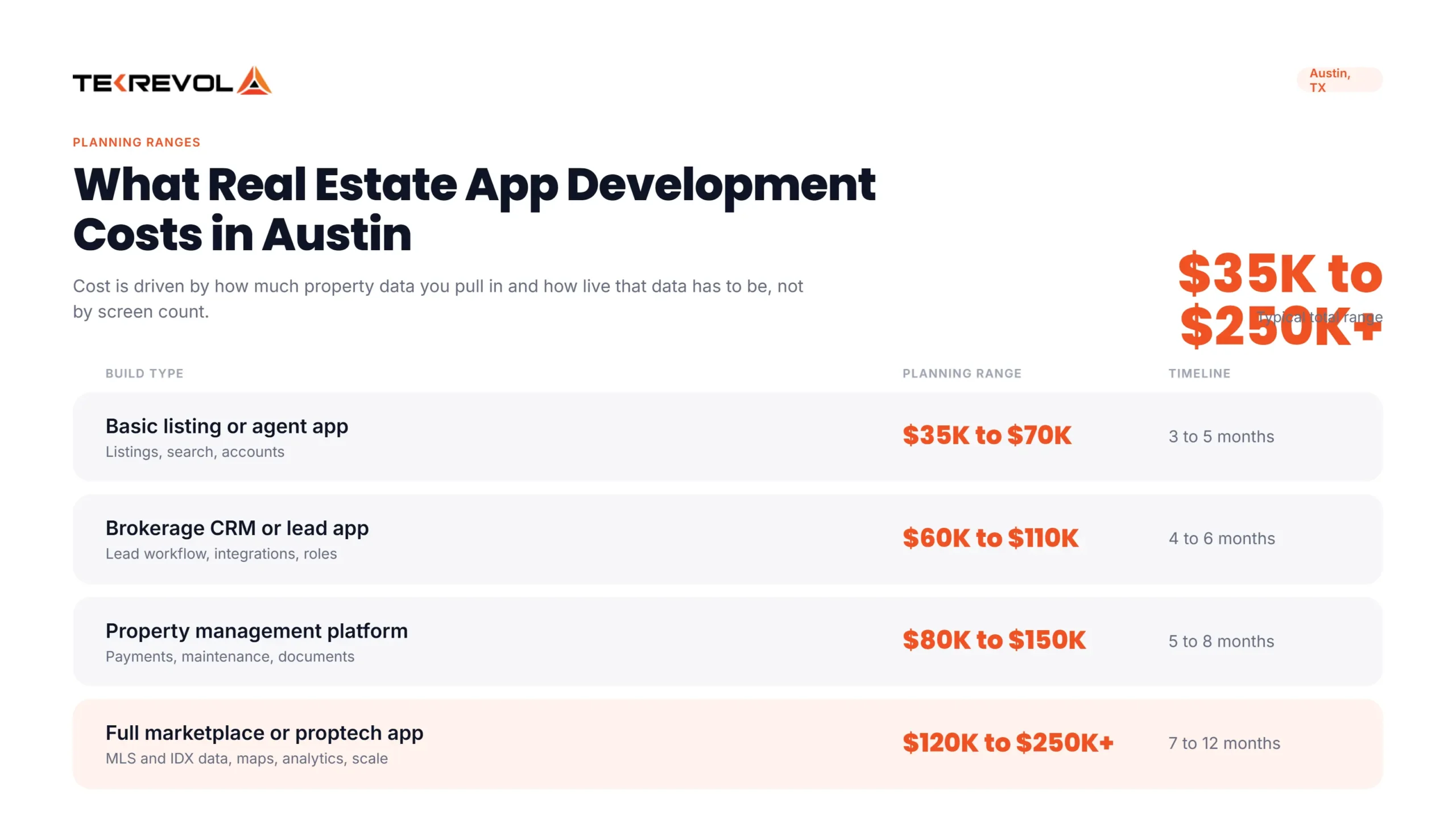
The number isn’t really about screens; it’s about data: how much property data you pull in, and how live that data has to be.
| Build type | Planning range | Timeline | Main cost driver |
| Basic listing or agent app | $35,000–$70,000 | 3–5 months | Listings, search, accounts |
| Brokerage CRM or lead app | $60,000–$110,000 | 4–6 months | Lead workflow, integrations, roles |
| Property management platform | $80,000–$150,000 | 5–8 months | Payments, maintenance, documents |
| Full marketplace or proptech app | $120,000–$250,000+ | 7–12 months | MLS/IDX data, maps, analytics, scale |
Two forces move you within those ranges.
Send us your scope, and we'll come back with a free, itemized estimate.
Get a Free Project EstimateThe features that matter most help people find and trust a property fast, so powerful search and filters, accurate listings, maps, saved favorites, and easy agent contact do more than any flashy extra. Virtual tours, mortgage tools, and alerts come next, once the basics are solid.
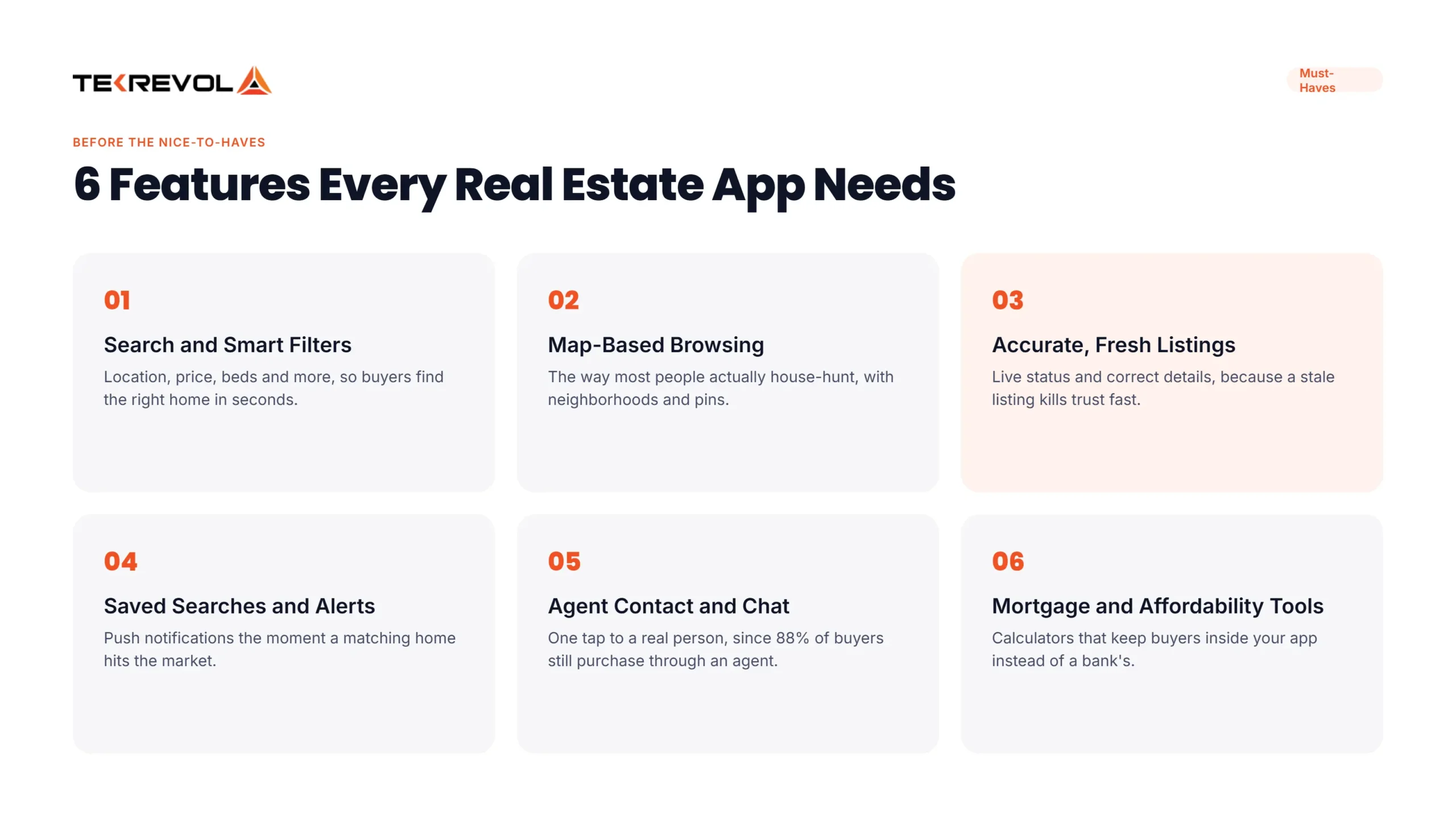
We tell clients to separate must-haves from nice-to-haves. Here’s the core set a serious real estate app needs, with the payoff each one earns:
Notice each feature names the payoff, not just the label. Virtual tours and AI recommendations are worth adding once the search-and-listing core converts. For a deeper list, our real estate app features guide breaks them down.
Through the MLS, IDX feeds, or property-data APIs. The MLS holds the listings, IDX lets you display them publicly, and third-party APIs add details like valuations and history. Getting this data flow right is the hardest, most under-budgeted part of a real estate build.
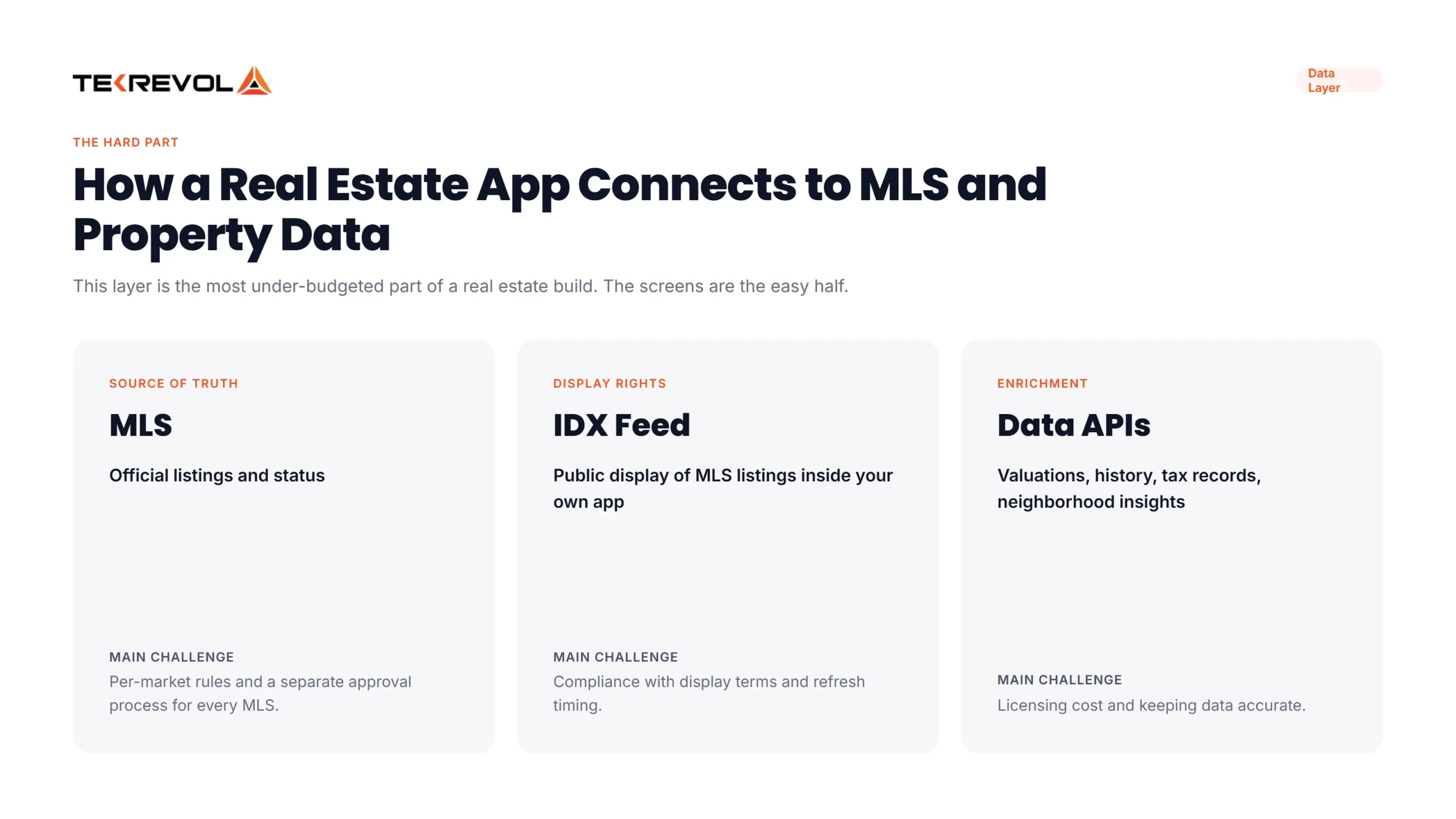
This is the part that separates a real estate app from a pretty catalog, and it’s worth understanding before you budget.
Each MLS has its own rules, formats, and approval process, which means pulling clean listing data is rarely plug-and-play. IDX integration lets a brokerage show MLS listings inside its own app legally, while data APIs layer on valuations, tax records, and neighborhood insights.
| Data source | What it provides | Main challenge |
| MLS | Official listings and status | Per-market rules and approval |
| IDX feed | Public display of MLS listings | Compliance and refresh timing |
| Property data API | Valuations, history, tax, insights | Licensing cost and data accuracy |
Get this layer right, and your app feels alive and trustworthy, but get it wrong and listings go stale, which is the fastest way to lose a user’s trust for good. Our guide to real estate data APIs covers the options in detail.
Real estate apps earn through a few proven models: agent or brokerage subscriptions, lead-generation fees, listing or featured-placement fees, and commissions or transaction cuts. Property-management apps often charge per unit. The right model depends on whether agents, buyers, or owners are your paying customer.
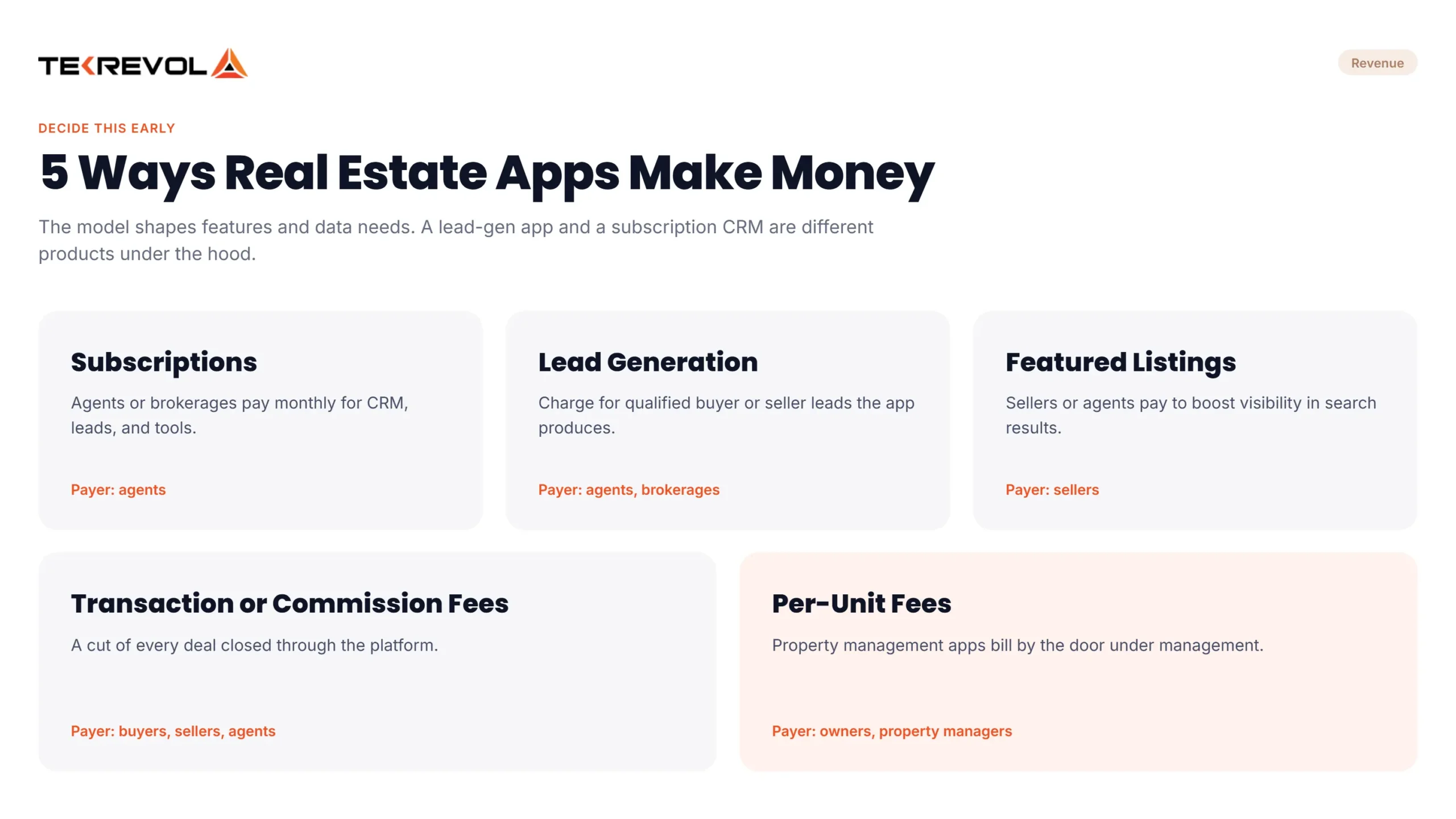
Monetization should be decided early, because it shapes features and data needs.
Pick the model that matches who actually pays, then build the billing and data flows to fit, because a lead-gen app and a subscription CRM are genuinely different products under the hood. The moment money moves through your app rather than past it, you inherit the compliance load that shapes fintech app development in Austin.
Clone-style templates are cheap and fast but generic, and they rarely handle your local MLS or unique workflow well. Custom costs more but fits your market, brand, and data exactly. Most serious Austin real estate businesses outgrow templates fast.
We push back on both extremes, because a template can validate a simple idea but then caps you at whatever the template’s makers imagined for it.
A real listing marketplace lives or dies on data and search quality, and that’s exactly where cheap clones fall short. If your edge is a specific neighborhood, a niche, or a smarter workflow, a template will flatten it. Building a Zillow-style app the right way is its own project, which our guide to building a real estate app like Zillow walks through.
Talk to TekRevol's Austin team, and we'll help you scope the right path.
Book a Free ConsultationHere’s proof over promises. Across TekRevol’s real estate portfolio, Houze Hookup engaged 30,000+ users with interactive property reels, Muirfield boosted investment efficiency by 40%, and our AI Strategy Advisor accelerated real estate growth by 30%. The wins came from data and experience, not decoration.
| Project | Category | Result | What drove it |
| Houze Hookup | Listing/discovery | 30,000+ engaged users | Interactive property reels |
| Muirfield | Real estate investment | 40% better efficiency | Streamlined investment workflow |
| AI Strategy Advisor | Real estate insights | 30% faster growth | AI-driven market analysis |
The pattern is consistent: in real estate, the win comes from getting data and user experience right. Our custom mobile app development services work around that kind of integration-heavy build.
Pick a partner who’s shipped real estate software, understands MLS and IDX data, and can show named results. Ask about their data-integration experience specifically, since that’s where most real estate builds go sideways. Local presence and proof matter as much as design.
Run every candidate through the same short test:
Get honest answers to those four, and the right partner usually stands out fast.
We’ve built the data-heavy end of real estate: the listing, investment, and property platforms where success depends on clean data and search that works under real listings.
Here’s why Austin businesses choose TekRevol:
In real estate, a nice screen is easy. A screen backed by accurate, fresh, well-integrated data is not. That harder part is exactly what we’ve shipped.
Talk to TekRevol's Austin team for an itemized scope on your real estate build.
Start Your Project


Usually yes, or a licensed data partner. To show live MLS listings, you need IDX access through a broker or an approved data feed for each market. If you don’t have MLS rights, third-party property APIs can supply listings and details, though coverage and freshness vary by source.
With data normalization and deduplication logic. Feeds from different sources often disagree on the same property, so a good build matches records, resolves conflicts, and flags stale listings automatically. Skipping this is why some apps show sold homes as available — the fastest way to lose user trust.
It can, but they need different experiences on a shared backend. Buyers want search and saved homes; agents want leads, follow-up, and transaction tools. The smart approach is one platform with role-based views, not two disconnected apps or one cluttered screen trying to serve both.
Increasingly important, but not before the basics. Buyers expect photos and ideally video or 3D tours, and AR staging is a genuine differentiator in a competitive market like Austin. Still, they only matter once search, accurate data, and fast listings already work well.
By encrypting user and financial data, controlling access by role, and respecting MLS and IDX display rules. Real estate apps handle sensitive buyer and payment information, so security is an architecture decision, not a final checklist. Compliance with each MLS’s terms is part of that same discipline.
Muhammad Ejaz Amir is an AVP and Mobile Development Team Lead at Tekrevol, with over 5 years of experience building polished and scalable mobile applications across diverse industries. Specializing in Flutter and native Android development, he brings deep expertise in mobile architecture and a sharp eye for performance. His ability to balance technical depth with strong leadership and cross-functional collaboration makes him a key driving force behind Tekrevol's mobile success.

At TekRevol, we leverage AI to build high-performing mobile applications that drive engagement and business growth. Our AI-powered app development strategy ensures an intuitive, data-driven, and intelligent user experience. Here are the key AI-driven features that set TekRevol apart. AI-Powered...
Read More
Ever double-tapped a photo, watched a Reel, or vanished into your Explore page for far longer than you meant to? We have all been there. Instagram has that effect, and somewhere along the way, a lot of founders start thinking,...
Read More
Cross-platform builds trim 30% to 40% off native pricing without hurting the customer ordering experience. A food delivery app isn’t expensive to build because it has a lot of screens. The actual cost goes to everything happening behind the order...
Read MoreGet valuable consultation form our professionals to discuss your projects. We are here to help you with all of your queries.
Collaborate with us and become a trendsetter through our innovative approach.


