



- Hiring Flutter developers in Austin costs $8,000 to $18,000/month through a dedicated team model, or $100 to $160/hr for project-based work.
- Austin has 28,210 software developers, at twice the national concentration, per BLS
- Austin’s Flutter specialist pool is thin, so most teams recruit from the wider mobile community.
- Four hiring routes exist, and the right one depends on who maintains your codebase later.
- Test Dart fluency, state management judgment, and native channel experience instead of résumé years.
- Ask for source code, IP transfer, and named developers in writing before you sign anything.
Here’s a number that surprises the Austin founders. The Austin metro employs 28,210 software developers at 2.09 times the national rate, per Bureau of Labor Statistics data. Yet hiring one good Flutter developer here still drags on for months, because a deep pool of engineers is not the same thing as a deep pool of Flutter engineers.
So here’s the answer. Hiring Flutter developers in Austin typically runs about $111,000 to $199,000 a year once benefits are included; the local specialist pool is genuinely thin, and the best places to find people are rarely the big job boards.
This guide covers what Flutter developers actually cost in Austin, when Flutter is the right technical choice, and what belongs in your contract before you sign.
How Much Does it Cost to Hire Flutter Developers in Austin?
Flutter roles in Austin post an average salary of $97,648 per year, or $46.95 per hour, per ZipRecruiter. Factor in benefits, which BLS puts at 31.5% of total compensation for professional roles, and a mid-level in-house Flutter app development agency hire actually costs you close to $143,000.
That headline number hides something odd. Austin pays software engineers generously as a rule, but jobs with “Flutter” in the title get priced considerably below the wider market.
| Data source | What it measures | Austin figure |
| BLS Occupational Employment and Wage Statistics | Mean annual wage, all Austin software developers | $139,390 |
| Built In Austin | Average base salary, software engineers in Austin | $144,034 (median $142,000) |
| ZipRecruiter (July 2026) | Average posted pay, Flutter roles in Austin | $97,648 ($46.95/hour) |
Why Flutter Roles are Priced Below Austin’s Engineering Average
We call that $46,000 spread the Austin Flutter pay gap. Two things create it:
- Flutter postings skew small. They cluster around contract, agency, and startup work rather than enterprise headcount.
- Big employers pull the average up. Apple, Oracle, and Tesla lift Austin’s engineering number, and very few of those roles say Flutter.
Knowing that spread protects your budget both ways, because each end carries a risk:
- Budget $97,000 for a genuinely senior developer and your role sits open for months. Strong candidates price against that $144,034 market, not the Flutter-titled one.
- Budget $180,000 for a mid-level developer and you’re overpaying badly for the seat.
What Will a Flutter Hire Really Cost?
Salary is never your real cost. Benefits add roughly a third on top. BLS Employer Costs for Employee Compensation puts them at 31.5% of total compensation for professional roles, which lifts a $118,400 senior salary to about $173,000 a year.
Here’s what each band actually costs once benefits are counted.
| Who you’re hiring | Advertised salary | What it really costs | Per hour |
| Junior | $78,300 | $114,307 | ~$55 |
| Mid-level | $97,648 | $142,552 | ~$69 |
| Senior | $118,400 | $172,847 | ~$83 |
| Lead | $139,760 | $204,029 | ~$98 |
Then add what nobody budgets for: recruiter fees, laptops, software licenses, and the three to six months before a new hire ships production code.
Our Flutter app development cost guide shows how those line items stack up across a whole build.
Want a Real Number for Your Flutter Project?
Send us your project scope, and we'll provide a free, itemized estimate tailored to your requirements.
Get a Free Estimate →How Big is the Flutter Talent Pool in Austin?
Austin’s tech base is deep, with 79,720 computer and math jobs here, or 6.3% of local jobs against 3.4% nationally. Flutter specialists are a small slice, since Stack Overflow’s 2024 survey put Flutter use at 9.4% of developers.
Is the Austin Tech Market Getting Easier or Harder to Hire in?
Things have shifted in your favor. SignalFire’s analysis found Austin big tech employment fell 1.6% during 2024, while startup tech employment dropped 4.9%. Fewer companies are chasing each candidate now.
Per the SignalFire analysis reported by Texas Standard, three things drove those declines:
- Layoffs at companies that had only recently relocated to Texas
- Return-to-office mandates that pushed remote workers out of the metro
- Rising housing costs eroding Austin’s original cost advantage
More engineers on the market means more realistic salary expectations than Austin employers faced back in 2021 and 2022. And the underlying base is still enormous: the Austin Chamber of Commerce reported the metro’s tech industries at 195,879 jobs, or 16.3% of all local jobs against 9.0% nationally, at an average wage of $151,873.
Where Can You Find Flutter Developers in Austin?
Skip the generic job boards first. The channels that consistently produce Austin Flutter candidates are the local mobile and Google Developer Group meetups, the UT Austin pipeline, Dart-specific LinkedIn searches, and established mobile app development companies in Austin with benched teams.
We’ve tracked which channels actually convert, and the pattern holds up consistently. Flutter developers cluster in community spaces rather than job boards, largely because Flutter itself grew through its community.
| Where to look | Who you’ll meet | How long it takes | Best for |
| Austin mobile & GDG meetups | Working Flutter developers, often open to a chat | 4–8 weeks | Direct full-time hires |
| LinkedIn, filtered for Dart | People whose Flutter work hides under “mobile developer” | 3–6 weeks | Mid to senior hires |
| UT Austin, Texas State, ACC | Juniors who pick up frameworks quickly | 6–12 weeks | Roles you’ll train |
| Austin app agencies | Vetted teams ready now, with design and QA | 1–3 weeks | Full product builds |
| Open freelance marketplaces | Huge swings in quality and follow-through | 1–2 weeks | Small, scoped features |
| Staff augmentation partners | Developers who join your existing sprints | 1–2 weeks | Scaling a team you run |
Should You Hire In-house, Freelance, Agency, or Staff Augmentation?
Hire in-house when Flutter sits at the core of your product for years. Hire a dedicated app development team in Austin when you need a complete app shipped. Choose staff augmentation when you lack Flutter capacity. Use freelancers only for small features.
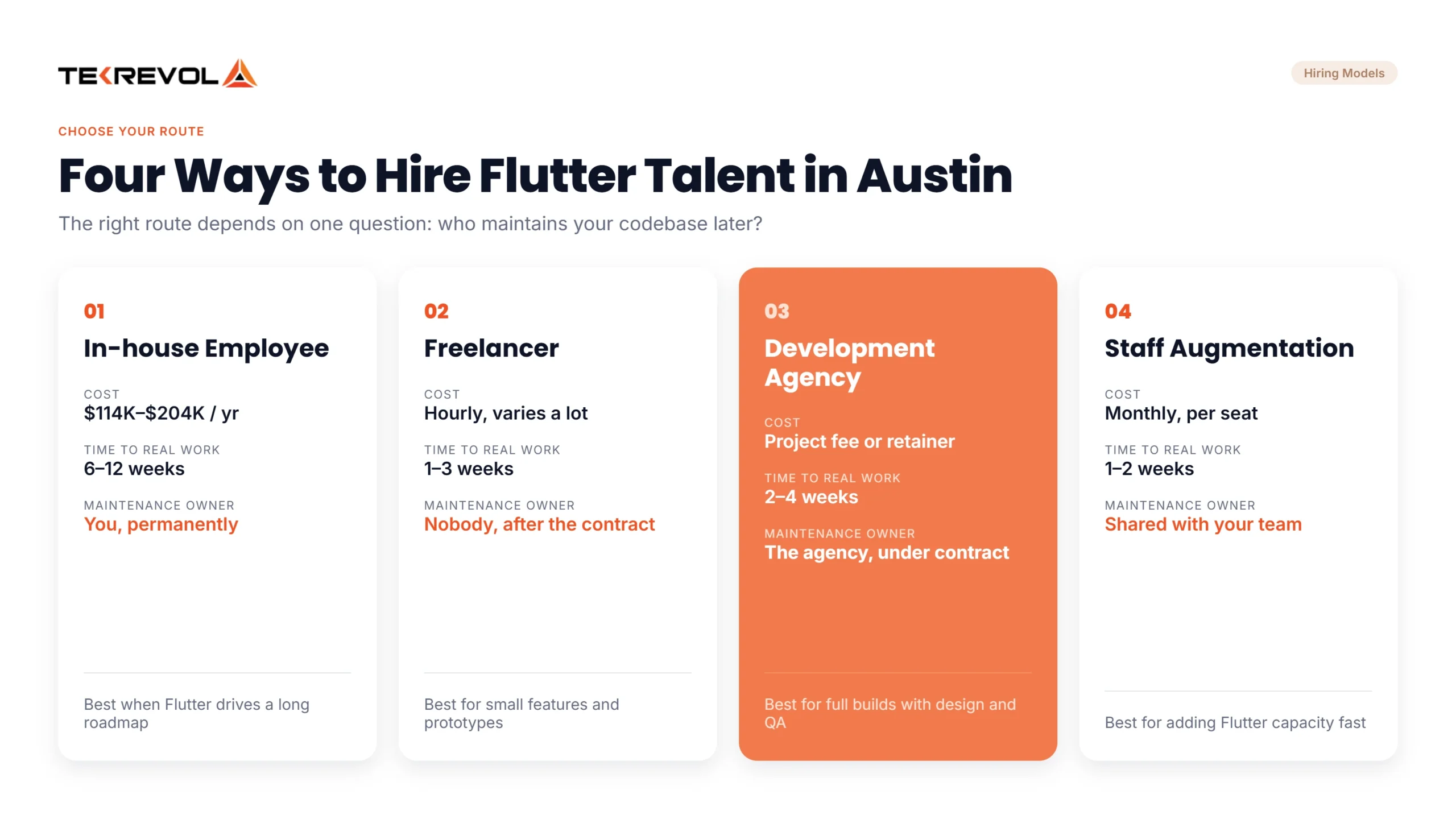
Decide who that person is before you compare a single price.
| Route | What it costs | Time to real work | Who owns maintenance | Best fit |
| In-house employee | $114K–$204K a year, loaded | 6–12 weeks | You, permanently | Flutter drives a long roadmap |
| Freelancer | Hourly, varies a lot | 1–3 weeks | Nobody, once the contract ends | Small features, prototypes |
| Development agency | Project fee or retainer | 2–4 weeks | The agency, under contract | Full builds with design and QA |
| Staff augmentation | Monthly, per seat | 1–2 weeks | Shared with your team | Adding Flutter capacity |
Cost range comes from the loaded model above. We’re deliberately not quoting freelance or agency rates, because published averages for those routes are all over the map.
When Does Hiring a Full-Time Flutter Developer Stop Making Sense?
Run a nine-month test. If your Flutter roadmap holds less than about nine months of steady work, a full-time app development company in Austin is hard to justify. You’d carry a six-figure cost for a seat that goes quiet.
Below that threshold, IT staff augmentation or an agency almost always wins on cost, because you pay for capacity only while you’re genuinely using it.
The reverse holds just as firmly. If Flutter is how you ship across several products, retainers will eventually outrun a payroll line, and the knowledge your team accumulates walks out the door at every contract renewal.
Why Do Austin Companies Choose Flutter over React Native?
Flutter uses one Dart codebase for iOS and Android, so you fund one team instead of two. It renders its own UI, which keeps the design identical across devices. Most CTOs keep standardizing on it when budget is tight and the interface matters.
Flutter is Google’s open-source SDK, and it’s currently the most widely used cross-platform framework. But popularity alone isn’t a reason to choose Flutter, so here’s the honest comparison.
Flutter vs React Native vs Native
The real comparison isn’t Flutter against native; it’s Flutter against React Native. React Native developers in Austin draw from a far deeper adjacent pool, roughly 11,100 React developers against 2,650 Flutter specialists, which changes the hiring timeline more than the framework changes the build.
| Factor | Flutter | React Native | Native (Swift/Kotlin) |
| Codebases | One | One | Two |
| Language | Dart | JavaScript/TypeScript | Swift + Kotlin |
| UI consistency | Identical across devices (own render engine) | Uses platform components, small differences appear | Perfect per platform |
| Team size needed | One team | One team | Two teams |
| Hiring pool in Austin | Smaller | Larger (JS is everywhere) | Large but expensive |
| Best for | Design-heavy apps, tight budgets | Teams already fluent in React | Heavy hardware or OS-level features |
When Flutter Is the Right Choice
Flutter is the strong choice when:
- Your app is design-heavy and needs to look identical on every platform
- You want near-native performance from a single codebase
- You may eventually ship to desktop or web from that same codebase
- Your product looks like a fintech dashboard, a retail app where a consistent interface matters most
React Native or Native Development When:
Pick React Native development when:
- You need the biggest possible local hiring pool, since Austin’s React Native bench is considerably larger.
- Your app leans on brand-new phone hardware features, which native SDKs support first.
- Your team already knows JavaScript thoroughly and has never touched Dart.
Not Sure Which Framework Fits Your Specific Product?
Book a free 30-minute technical consultation with TekRevol's Austin team before committing to the right development path.
Book a Free Technical Consultation →What Skills Should You Test When Hiring a Flutter Developer in Austin?
Test Dart fluency, state management judgment, native platform channel work, and release pipeline know-how. Years on a résumé predict very little here, because Flutter hit wide production use fairly recently and self-rated skill is all over the map.
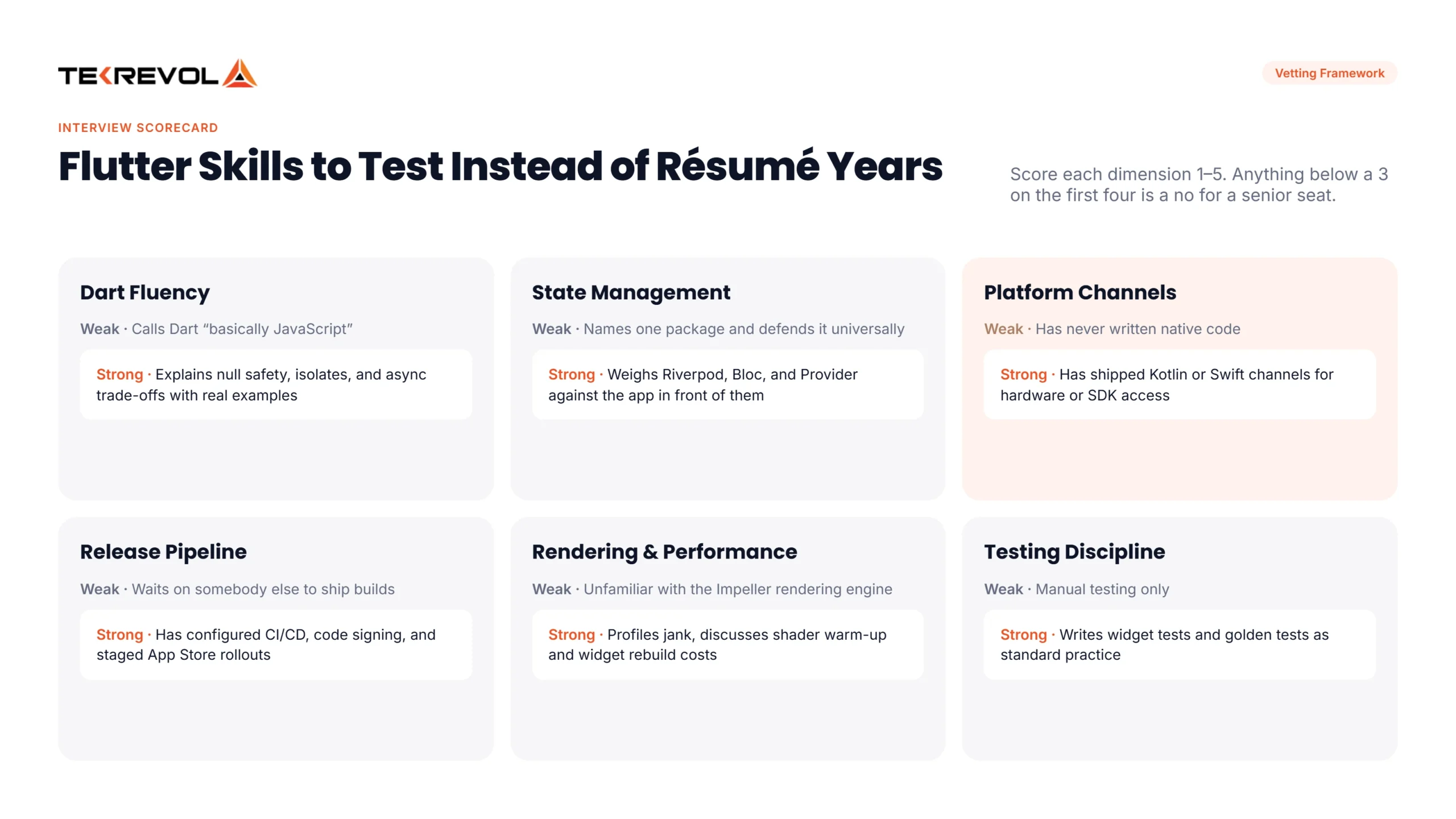
Here’s the vetting scorecard we use internally, trimmed so any Austin hiring manager can run it without a Flutter expert in the room. Score each row one to five, and treat anything below a three on the first four rows as a no for a senior seat.
| Dimension | Weak answer | Strong answer |
| Dart fluency | Describes Dart as “basically JavaScript” | Explains null safety, isolates, and async trade-offs using real examples |
| State management | Names one package and defends it universally | Weighs Riverpod, Bloc, and Provider against the specific application in front of them |
| Platform channels | Has never written native code | Has shipped Kotlin or Swift channels for hardware or SDK access |
| Release pipeline | Waits on somebody else to ship builds | Has configured CI/CD, code signing, and staged App Store rollouts |
| Rendering & performance | Unfamiliar with the Impeller rendering engine | Profiles jank, and discusses shader warm-up and widget rebuild costs |
| Testing discipline | Manual testing only | Writes widget tests and golden tests as standard practice |
Original TekRevol vetting framework. Copy it directly into your interview scorecard.
Which Austin Industries Get the Most Out of Flutter?
Fintech, healthtech, real estate, and logistics see the strongest fit. All four need the same app on iOS and Android, care deeply about interface consistency, and move fast enough that maintaining two native codebases becomes a drag on the roadmap.
Austin’s industry mix genuinely suits Flutter, and that isn’t marketing language — it follows directly from what these particular sectors require.
Fintech and Banking
Consistency isn’t cosmetic in finance. When a transaction confirmation renders differently on Android than iOS, users pause. Flutter’s own rendering engine removes that class of problem entirely, which is why it shows up so often in discussions around fintech app development costs and compliance in Austin.
Healthcare and MedTech
Clinical staff use whatever phone they own, from iPhones to personal Android devices. Teams building HIPAA-aligned healthcare apps in Austin favour Flutter because one codebase means one compliance surface to audit rather than two.
Real estate and PropTech
“Austin’s housing market moves quickly, and property apps live or die on image-heavy browsing. When building real estate apps for Austin, investing in specialized agency gives you a performance edge: Flutter handles smooth scrolling through large media sets exceptionally well.
Logistics and Field Operations
Driver and warehouse apps need reliable offline handling and fast iteration to keep up with demanding supply chains. Logistics app development focuses on high-efficiency cross-platform builds that cut order processing time by 40% and reduce manual data errors by 20%.
What Should Be in the Contract Before You Sign?
Get source code ownership, full IP transfer at project close, a mutual NDA, named developers with defined availability, and a written post-launch support scope. Missing any one of these creates a problem later that’s expensive to fix.
- Source Code and IP: You should own the repository and every asset at close. Nothing about your product should stay with the developer after handoff.
- Mutual NDA Before Discovery: Signed before you share the concept, never afterwards.
- Named Developers and Availability: “A senior Flutter developer” is not a commitment. A name and an allocation percentage is.
- Post-launch Scope: What happens when iOS 27 ships and something breaks? Who fixes it, how fast, and at what rate? Sort this out before launch, not during an outage.
- Payment Tied to Milestones: Milestones you can see and verify, not calendar dates.
Why Do Austin Companies Work with TekRevol for Flutter Development?
Operating from downtown Austin at 701 Brazos Street, we’ve shipped 150+ apps across iOS, Android, and cross-platform.
Our Flutter portfolio includes:
- Heet, a location-based dating app that hit 50,000+ active users and cut fraud by 55%,
- Hard Shoulder, a roadside assistance platform that improved response speed by 40%.
What that looks like in practice
- Dedicated Flutter developers with 3+ years on the framework, not generalists learning Dart on your budget
- Senior team leads including Ejaz Amir, who has spent over a decade in mobile development
- A 4.8 out of 5 rating on Clutch across 83 verified reviews
- An Austin office you can walk into, so reviews happen face to face rather than only over video
We’re also ISO 27001 certified, which matters considerably if you operate in a regulated industry and your security team asks.
Hiring Flutter talent is really a bet on reliability, and the right partner removes the gamble. We’d rather earn that trust with proof than ask you to take it on faith.
Ready to Put a Vetted Flutter Developer on Your Project?
Tell us your idea, and we'll come back with a free consultation tailored to your project requirements.
Hire a Flutter Developer in Austin


![Automotive & Mobility App Development in Austin: Cost, Compliance & Platform Guide [2026]](https://d3r5yd0374231.cloudfront.net/images-tek/uploads/2026/07/automotive-mobility-app-development-in-Austin-400x211.webp)


