



- Mobile app development cost in Qatar runs from QAR 20,000 to QAR 300,000+, or roughly $5,500 to $82,000.
- Arabic and RTL support adds 15% to 25% of budget, and retrofitting it costs three times more.
- Local payment rails like QPay, Fatora, and PayTabs add QAR 8,000 to QAR 30,000 to a build.
- Qatar agency rates run QAR 150 to 500 an hour, against QAR 70 to 200 for offshore teams.
- Budget 15% to 25% of build cost every year for maintenance, hosting, and third-party fees.
Building an app in Doha takes more than a good idea. You need a clear budget, a realistic timeline, and a scope that supports Qatar National Vision 2030 and TASMU Smart Qatar. Careful planning helps you control mobile app development cost in Qatar, prevent delays, and invest in features your business actually needs.
But before proceeding with development, one critical question needs clarification: How much does it cost to build an app in Qatar?
The answer isn’t one-size-fits-all. App development costs in Qatar can range from QAR 20,000 for a basic MVP to QAR 300,000 or more for a custom, feature-rich application. Factors like the type of app, local integrations like QPay, custom Arabic user experiences, backend infrastructure, and the development team’s expertise all shape the final budget.
Thus, to get the best estimate for cost to develop an app, it is always advisable to work with a reputable mobile app development company in Qatar that really knows the local market and local user behavior as well as industry-specific needs.
In this blog, we break down app development costs in Qatar by tier, by development stage and by industry, alongside Arabic and RTL support so that you know where your money is going and how you can budget best for your app idea.
How Much Does Mobile App Development Cost in Qatar in 2026?
Mobile app development cost in Qatar starts at QAR 20,000 for a basic MVP and reaches QAR 300,000+ for a custom platform. Mid-level apps with logins, admin panels, and API integrations run QAR 75,000 to QAR 150,000. Enterprise builds exceed QAR 300,000.
| App Type | Estimated Cost (QAR) | Development Timeframe | Key Features |
| Basic App | 20,000 – 70,000 | 1-3 months | Static content, simple UI, no backend, basic contact |
| Mid Level App | 75,000 – 150,000 | 3-5 months | API integration, user login, admin panel, push notifications |
| Custom App | 150,000 – 300,0 00 | 5-8 months | Real-time features, advanced UI/UX, payments, analytics, scalability |
| Enterprise-Level App | 350,000+ | 8 months and up | Custom workflows, multiple user roles, high security, and integrations with enterprise systems |
Note: Every dollar figure converts at QAR 3.64 to the dollar. Qatar Central Bank buys dollars at QAR 3.6385 and sells at QAR 3.6415, so the rate is fixed, and your budget doesn’t move with the market.
Not sure which tier fits your project?
Tell us your scope and feature list, and we'll map it to a real number, not a range.
Get a Free Cost Estimate →Why Is Qatar Investing So Heavily in Mobile Apps?
Qatar is investing heavily in mobile apps because Qatar National Vision 2030 and the TASMU Smart Qatar programme have pushed digital services from optional to expected. Government, healthcare, retail, and logistics all now run on apps residents use daily.
Look at what people actually have installed. Metrash2 handles government services. Talabat and Snoonu handle food delivery. Careem handles rides. Meddy handles doctor bookings. Each one raised the baseline for what a Qatari user expects from any app they download next. Our overview of innovative app development in Qatar walks through what each sector is actually commissioning.
Three market conditions make this work commercially:
- Near-universal connectivity: Ooredoo’s 5G rollout means performance-heavy features are viable across the country, not just in central Doha.
- High spend per user: Qatar’s small population is offset by purchasing power, so subscription and transaction models work where they’d struggle elsewhere.
- Sector-level digitisation: TASMU targets healthcare, transport, logistics, environment and sports specifically, which creates procurement demand rather than just consumer demand.
The practical consequence for your budget: users here compare your app against Metrash2 and Talabat, not against a startup MVP. So, polish is not optional. Our mobile app development company in Qatar scopes against that expectation from the first session
What Factors Impact Mobile App Development Cost in Qatar?
The cost of mobile app development in Qatar may fluctuate considerably depending on many factors, including complexity, targeted platforms (iOS, Android, or both), UI/UX design, and backend infrastructure. Localization and integration depth cause the most underestimation, while platform choice and team location offer the biggest savings.
1. App Complexity and Feature Set: QAR 20,000 to QAR 300,000+
The more features your app has, the more it costs to make. Basic functionalities like user login, push notifications, or a contact form may cost relatively little. But features that require more development and testing time, such as AI integration, in-app chat, real-time syncing, GPS tracking, and sophisticated admin panels, add more costs.
Each feature affects the time, complexity, and cost of the app — therefore, prioritization is critical.
Tip: The app’s first state must be an MVP, which contains only the most crucial functionality. You can incorporate feedback and improve on it in future releases.
2. Arabic and RTL Localization: 15% to 25% of Budget
Every screen mirrors, icons flip, and Arabic typography needs its own line heights and font pairing. You also maintain two content sets permanently. Decide before design starts, because retrofitting costs three to four times what building it in costs.
3. Platform Choice: QAR 0 to QAR 90,000
Developing an application for either iOS or Android is more cost-effective compared to an app for both. Native applications perform better as they are specially designed for a particular platform, but they are costly.
Today, cross-platform frameworks such as Flutter and React Native cover both stores from a single codebase and typically save 30% to 40% compared to two native builds. Native still wins for AR, heavy graphics, and deep hardware access.
Tip: Prior to doing anything else, determine which platform your target audience prefers. Start there and work your way up after the app gains interest.
4. UI/UX Design: 15% to 25% of Budget
Qatari users judge credibility on presentation before they read a word. Delivering native Arabic support requires right-to-left (RTL) layout mirroring, custom Arabic typography, and regional UX adjustments, adding 15% to 25% to standard design allocations
5. Backend Architecture & Cloud Hosting: QAR 20,000 to QAR 150,000
Most of the modern applications need a backend to maintain their data, profile on the cloud, or for real-time updates. Establishing a secure and scalable backend with complex microservices, custom admin portals, database synchronization, and local cloud hosting (AWS Bahrain or Google Cloud Doha) scales infrastructure costs based on concurrent user volume.
6. Third-Party Integrations: QAR 5,000 to QAR 25,000 Each
These days, most apps don’t run on their own. Connecting Qatari payment gateways (QPay, Fatora, Sadad), local SMS gateways (Ooredoo, Vodafone), or logistics APIs introduces additional licensing and development hours. Each one means build time, sandbox testing, failure handling, and a subscription you’ll pay every month indefinitely.
7. Security and Compliance: QAR 10,000 to QAR 100,000+
Data protection is non-negotiable if your app collects user information, such as personal, financial, or behavioral. End-to-end encryption, secure authentication methods (such as biometrics or two-factor authentication), and compliance regulations increase development time and cost. Fintech and healthcare apps carry the heaviest load, since financial and patient data both attract regulatory attention that consumer apps never face.
8. Development Team Location: QAR 70 to QAR 500 Per Hour
The cost of the project would influence highly on the size, experience, and location of your development team. Qatar-based agencies run QAR 150 to 500. Offshore teams run QAR 70 to 200. But rate alone predicts very little, because a slower, cheaper team frequently costs more in total. Full breakdown further down.
9. Testing and Quality Assurance: QAR 10,000 to QAR 30,000
Functional, device, performance, and security testing, ideally running parallel to development rather than after it. Bilingual apps need testing twice, since Arabic layouts break in ways English layouts never reveal.
10. Post-Launch Maintenance: 15% to 25% Annually
Lack of maintenance simply means that app bugs will not be fixed, new updates will not be added, performance will be halved, and new OS updates will not be supported. It also invites negative reviews from users, dropping user engagement and retention, leading to long-term abandonment. The more complex the app, the more frequent and expensive the maintenance.
Common Mobile App Features Cost in Qatar
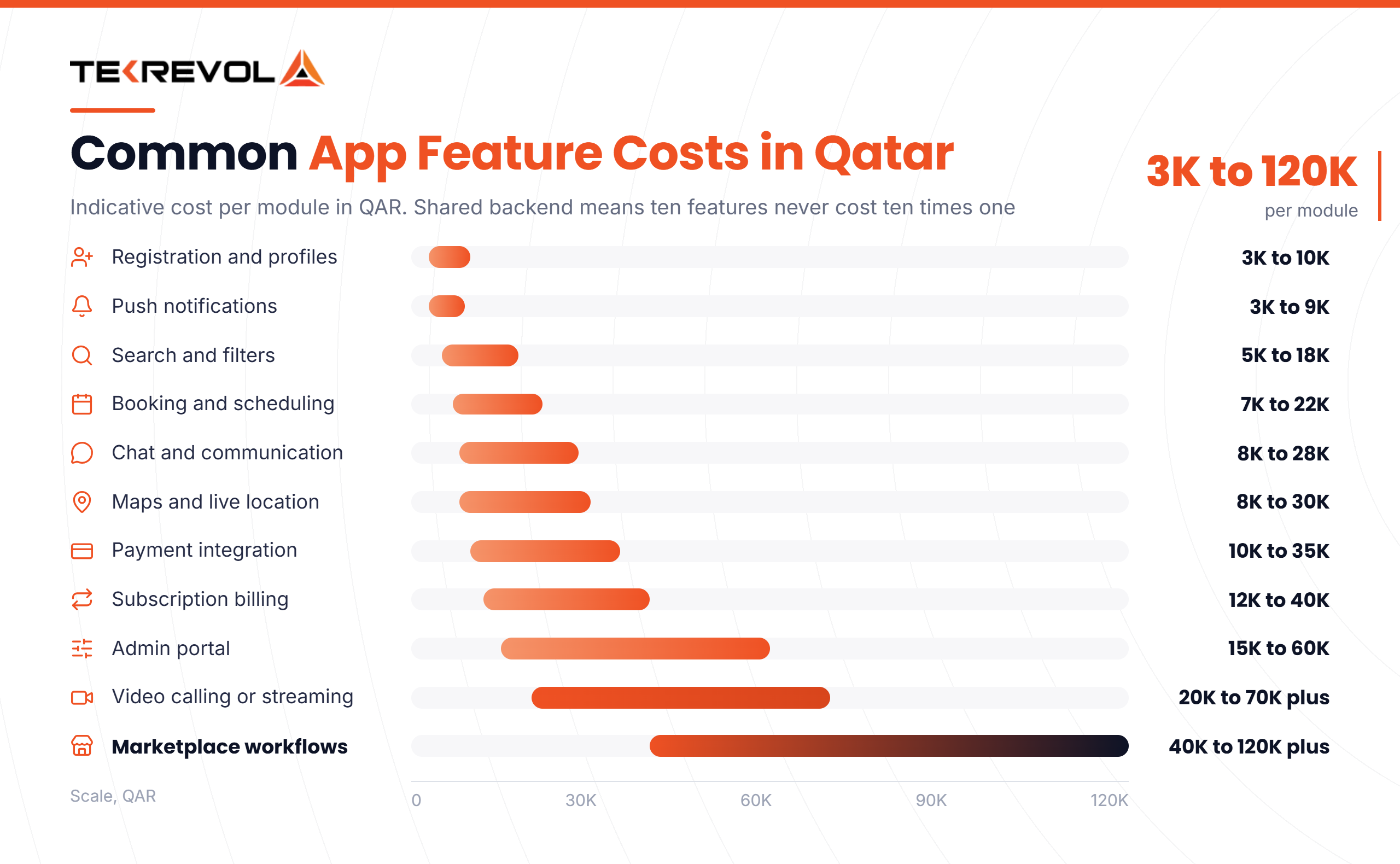
Mobile app features in Qatar add roughly QAR 3,000 to more than QAR 80,000 per module. Authentication and basic notifications cost less. Marketplaces, video, payments, complex administration, and real-time operational workflows need significantly more design, engineering, and testing.
| Feature or module | Indicative cost (QAR) | Main scope considerations |
| Registration and profiles | 3,000 to 10,000 | Authentication, verification, recovery, roles |
| Search and filters | 5,000 to 18,000 | Indexing, categories, ranking, saved criteria |
| Push notifications | 3,000 to 9,000 | Triggers, preferences, campaigns, deep links |
| Booking and scheduling | 7,000 to 22,000 | Availability, reminders, changes, calendars |
| Maps and live location | 8,000 to 30,000 | Geocoding, tracking, routes, background location |
| Chat and communication | 8,000 to 28,000 | Real-time messaging, media, moderation, alerts |
| Payment integration | 10,000 to 35,000 | Checkout, webhooks, refunds, reconciliation |
| Subscription billing | 12,000 to 40,000 | Plans, renewals, failed payments, entitlements |
| Admin portal | 15,000 to 60,000 | Users, content, transactions, reports, support |
| Marketplace workflows | 40,000 to 120,000+ | Multiple roles, commissions, payouts, disputes |
| Video calling or streaming | 20,000 to 70,000+ | Provider, quality, recording, bandwidth, security |
These amounts should not be added blindly. Shared design, backend, and infrastructure reduce duplication across modules, so ten features never cost ten times one feature. Conversely, shipping the same feature across customer, provider, administrator, and web interfaces multiplies the work rather than repeating it once.
Estimated Cost to Add AI Features to a Mobile App For Qatar
Integrating AI features into a mobile app ranges between QAR 20,000 and QAR 150,000+, depending on whether you are integrating off-the-shelf API models or building custom machine learning architecture. Chatbots sit at the bottom, recommendation engines in the middle, and predictive analytics or custom models at the top. Each also carries a monthly running cost.
| AI capability | Build Cost (QAR) | Ongoing Monthly (QAR) |
| AI chatbot for support and enquiries | 20,000 to 50,000 | 700 to 3,500 |
| Recommendation engine | 30,000 to 80,000 | 1,000 to 4,500 |
| Predictive analytics and forecasting | 50,000 to 150,000 | 1,800 to 9,000 |
| Custom-trained model | 100,000+ | 3,500 to 15,000+ |
In Qatar, local businesses leverage AI capabilities across e-commerce, logistics, real estate, and fintech to automate workflows and elevate user engagement. Working alongside specialized AI app development services ensures that model training aligns with local Qatari dialects, regional consumer behaviors, and regulatory privacy mandates.
Wondering whether AI belongs in your first release?
We'll map your user journey, show where AI genuinely saves time, and tell you if the answer is nowhere yet.
Book a Free AI Feasibility Review →How Much Does Arabic and RTL Support Add to a Qatar App Development Cost?
Arabic language support and right-to-left (RTL) layout design add 15% to 25% of your budget, or roughly QAR 10,000 to QAR 45,000 on a mid-level app development cost in Qatar, depending on content complexity and dynamic UI elements.
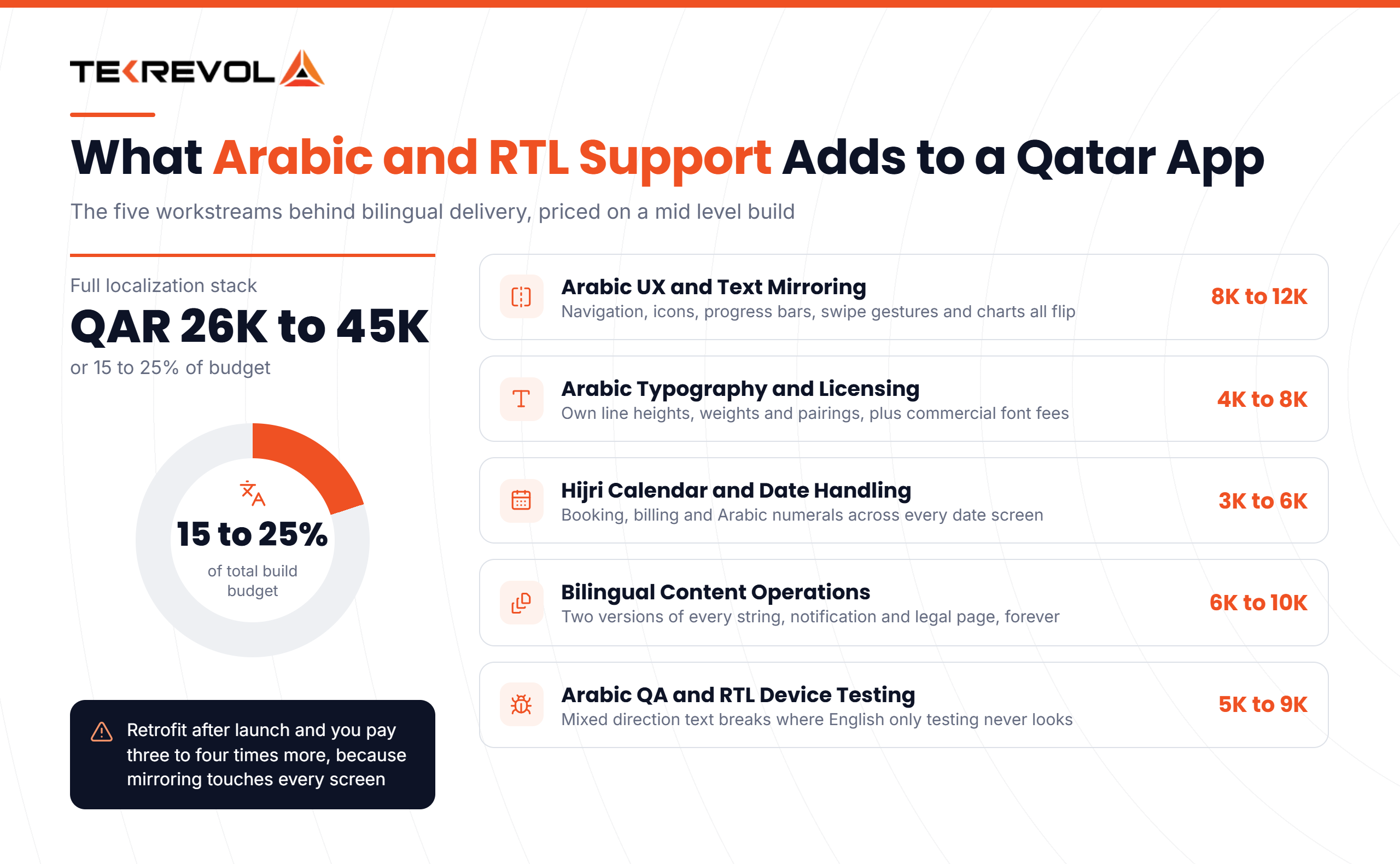
Localization in Qatar goes far beyond simple text translation. Delivering a genuinely seamless user experience means adapting layout flows, reversing visual elements, choosing appropriate Arabic typography, and integrating the Hijri calendar alongside Gregorian dates.
Basic Arabic UX and Text Mirroring: QAR 8,000 to QAR 12,000
Navigation, icons, progress bars, swipe gestures, and charts all flip. Retrofit this after launch, and you’ll pay three to four times what building it in would have cost, because mirroring touches every screen rather than a settings file.
Arabic Typography and Font Licensing: QAR 4,000 to QAR 8,000
Arabic script needs different line heights, weights, and font pairings, and commercial Arabic typefaces carry their own licence fees. Your English design system won’t transfer cleanly, however carefully it was built.
Hijri Calendar and Date Localization: QAR 3,000 to QAR 6,000
Booking, scheduling, and billing screens frequently need Hijri dates shown alongside Gregorian ones, particularly for government-adjacent and finance products. Number formatting and Arabic-Indic numerals sit in the same workstream.
Bilingual Content Operations: QAR 6,000 to QAR 10,000
Two versions of every string, notification, error message, and legal page, managed through a CMS that handles both. This is the one that never ends, since it becomes a staffing question rather than a one-off build cost.
Arabic QA and RTL Device Testing: QAR 5,000 to QAR 9,000
Mixed-direction text breaks in ways English-only testing never surfaces, especially where Arabic sentences contain English brand names or Latin numerals. Bilingual apps need testing twice, on real devices, with real content.
A full localization stack across all five items runs QAR 26,000 to QAR 45,000 on a mid-level build. The QAR 10,000 floor covers basic mirroring and typography on a smaller app, not the complete treatment.
How Much Does Local Payment Gateway Integration Cost in Qatar?
Integrating Qatari payment gateways costs QAR 8,000 to QAR 30,000 ($2,200 to $8,200), depending on how many rails you support. That covers integration, sandbox testing, reconciliation logic, and failure handling, but excludes the per-transaction fees you’ll pay afterward.
Unlocking high conversion rates in Qatar requires supporting local payment rails alongside global standard options like Visa, Mastercard, and Apple Pay Qatar.
- QPay (NAPS) Integration (QAR 7,000 to QAR 12,000): Essential for direct debit and local debit cardholder usage, since QPay runs on the NAPS network that most Qatari bank cards sit on.
- Fatora and PayTabs Qatar (QAR 8,000 to QAR 14,000): Ideal for fast e-commerce checkout flows and merchant management, with hosted pages, tokenization, and a dashboard your finance team can use. PayTabs extends the same integration across the wider GCC if you’re planning regional expansion.
- SADAD and Fawran Integrations (QAR 10,000 to QAR 18,000): Standard for instant peer-to-peer and direct bank account payments. Fawran is Qatar Central Bank’s instant payment service, which matters for any product moving money between individuals rather than just taking card payments.
Decide localization before design starts. That single sequencing choice is the whole difference between 15% and 40%. Our guide to eCommerce app development in Qatar covers Arabic UX and QPay integration in more practical detail.
Industry-Wise Breakdown of Mobile App Development Cost in Qatar
Custom mobile app development cost in Qatar ranges from QAR 40,000 for basic education apps to QAR 350,000+ for fintech. Costs vary by industry vertical due to unique regulatory requirements, third-party integrations, and target security standards.
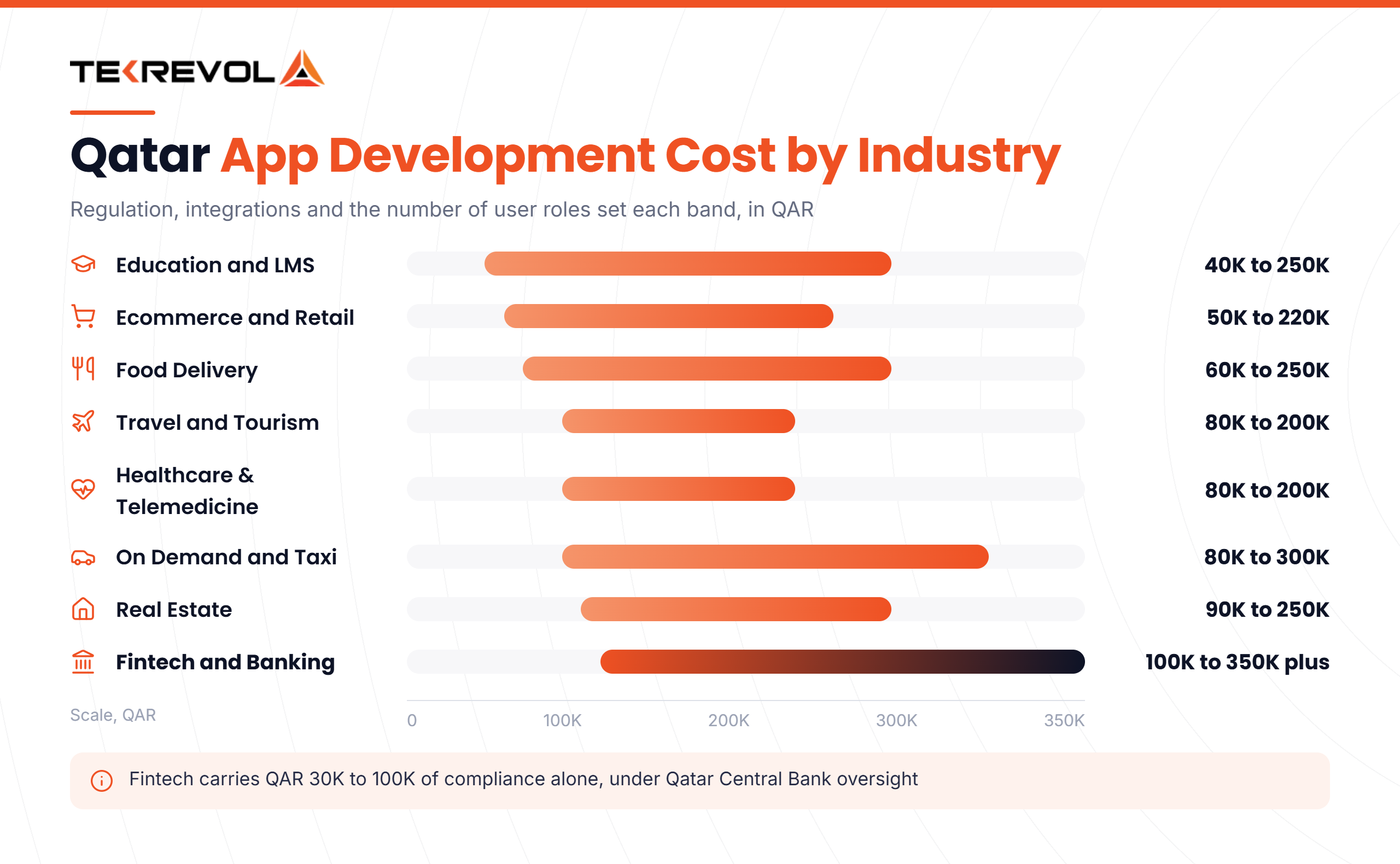
Education and LMS: QAR 40,000 to QAR 250,000
Education platforms look simple until you count the interfaces. Students, teachers, parents, and administrators each need their own view of the same records, with different permissions attached. That’s four products sharing a database, which is where the budget actually goes.
eCommerce and Retail: QAR 50,000 to QAR 220,000
Retail is the most predictable build on this list, because the problems are solved and the components exist. Cost concentrates in catalogue architecture, inventory sync with whatever system you already run, and checkout. Add QPay and Fatora alongside cards, because card-only checkout quietly loses Qatari buyers who reach for a domestic debit card first.
Travel and Tourism: QAR 80,000 to QAR 200,000
Cheap to build, expensive to maintain. The booking engine and availability sync are straightforward engineering, but this is the category where Arabic and English both have to be genuinely good. Half your users are residents, half are visitors, and neither group forgives a badly translated confirmation screen.
Healthcare and Telemedicine: QAR 80,000 to QAR 200,000
Healthcare apps carry the compliance weight without fintech’s revenue model to absorb it. Patient records need consent handling, storage decisions, and access logging designed into the architecture. Video consultation pushes it further, since bandwidth, recording, and session security all become your problem. Our healthcare app development services price HIPAA-aligned data handling and access logging as separate lines, because they are architecture decisions rather than features you can add later.
Real Estate: QAR 90,000 to QAR 250,000
Property apps live or die on search and photography. Listings need real filtering, maps need to be fast, and thirty high-resolution images per property have to load without stalling. Agent tools add a second interface on top. Our real estate app developers scope the media layer before design, because retrofitting it is painful.
Food Delivery: QAR 60,000 to QAR 250,000
You’re building three products, not one: a customer app, a rider app, and a restaurant console. Live tracking is the expensive part, needing sockets, geolocation, dispatch logic, and graceful failure when a rider loses signal in a basement car park. Talabat and Snoonu set the benchmark, and users compare you to them from the first screen.
On-Demand and Taxi: QAR 80,000 to QAR 300,000
Same three-sided structure as delivery, with tighter latency requirements. Matching algorithms, surge logic, driver payouts, and trip disputes each add engineering that never appears in a wireframe. Careem’s presence means Qatari users already know what good looks like, which raises the floor rather than the ceiling. Our on-demand app development company scopes dispatch and payout logic before design, since both drive more hours than the rider-facing screens.
Fintech and Banking: QAR 100,000 to QAR 350,000+
The most expensive category here, and the only one where regulation costs more than features. Regulated financial activity falls under Qatar Central Bank oversight, which means KYC flows, audit trails, penetration testing, and a security posture built in from the architecture stage. Budget QAR 30,000 to QAR 100,000 of the total for compliance alone. Our fintech app development services allocate prices that work as their own line so you can see it.
Mobile App Development Cost in Qatar by Development Stage
The cost of mobile application development in Qatar is distributed among six phases: discovery, design, development, testing, deployment, and delivery management. Development receives the largest share, although backend services, enterprise integrations, Arabic design, and security can materially change the allocation.
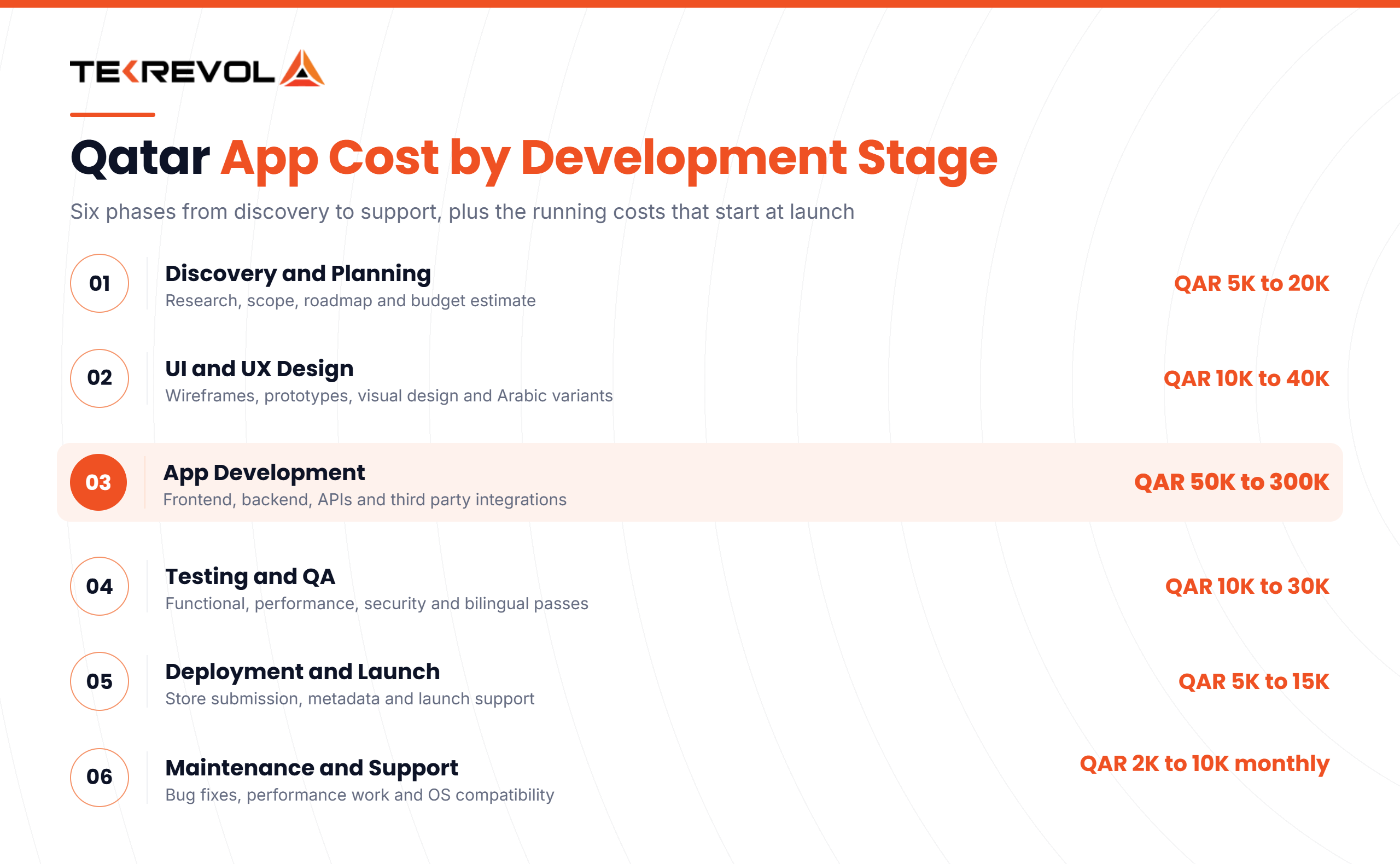
Here is a stage-wise average cost breakdown for the app development process in Qatar:
1. Discovery and Planning
Estimated Cost: QAR 5,000 – QAR 20,000
It is the first and most important stage where your idea starts to take shape. You can now work with business analysts and strategists by defining your application goals, target audience, features, and overall functionality. This stage involves market research, competitor analysis, and creating a project roadmap.
Key Deliverables:
- Requirement gathering
- Market Research
- Project Scope and Timelines
- Budget Estimation
Tip: Don’t skip this step. A well-planned discovery phase saves costs later during development by avoiding scope changes.
2. UI/UX Design
Estimated Cost: QAR 10,000 to 40,000
An interface that anticipates user needs and is simultaneously beautiful appears to be the winning card for user acquisition and retention. The design stage includes UI and UX designs to ensure that your app is not only functional but also pleasurable.
What Is Included:
- Wireframing: Basic layout sketches that show the arrangement of each screen.
- Interactive Prototypes: Simulate the user flows to test the functionality before the onset of development.
- Visual Design: High-res UI elements, icons, animations, and branding assets.
Why it Matters: A well-designed interface not only draws users in but also keeps them engaged, offering developers a smoother process through consistent and intuitive visuals.
3. App Development
Estimated Cost: QAR 50,000 to 300,000
The most resource-intensive stage. Developers begin coding your application, which focuses on both front-end (what consumers see) and back-end (server, database, APIs). What’s Included:
- Front-End Development: Using frameworks like Flutter, React Native, or Swift for building the app interface.
- Back-End Development: Setting up the server, database, and APIs for real-time communication and data handling.
- Third-Party Integrations: Incorporation of payment gateways, GPS, push notifications, chat, or analytics tools.
4. App Testing and Quality Assurance
Estimated Cost: 10,000 to 30,000
If an app is extremely beautiful yet has a lot of bugs or crashes repeatedly, it is doomed to fail. Quality assurance (QA) and testing are essential because they check the smooth running of your app with security and intended functionality, across devices and platforms.
This Includes:
- Functional Testing: Verifying that every feature works as expected
- Performance Testing: Measuring the app’s speed, responsiveness, and stability while under load.
- Security Testing: Safeguarding mobile applications against threats and vulnerabilities to protect sensitive user data.
- Compatibility Testing: Testing various operating systems (iOS and Android), screen sizes, and devices to ensure seamless performance across the board.
5. Deployment and Launch
Estimated Cost: QAR 5,000 to 15,000
Once the application is developed, it has to be deployed and submitted to the respective app stores. This phase includes everything that goes into fulfilling the submission requirement of Apple or Google and can optionally include marketing activities to generate traction during launch.
- App Store Submission: Opening developer accounts and submitting review applications.
- Metadata & Optimization: Writing engaging app descriptions, preparing screenshots, and optimizing for keywords.
- Initial Support: Addressing user feedback and bugs post-launch.
Tip: Prep all marketing materials and app screenshots ahead of time to speed up the launch process.
6. Maintenance and Support
Estimated Ongoing Cost: QAR 2,000 to 10,000 monthly
Once the app is launched, the actual development is considered to be done. Regular maintenance is of utmost importance to keep the app updated with the latest OS versions, working properly, and catering to user expectations.
Components of Maintenance:
- Bug Fixes: Fixing the bugs reported by users.
- Performance Updates: Updates that improve loading time, reduce crashes, and optimize storage.
- Feature Enhancements: Adding new features as requested by users or according to market trends.
- Compatibility Updates: Making the app compatible with the latest models and OS versions.
What Tech Stack Offers the Best ROI for App Development in Qatar?
Choosing modern cross-platform tech stacks like Flutter or React Native can reduce mobile app development costs in Qatar by 30% to 40% compared to native platforms. Instead of engineering separate codebases in Swift (iOS) and Kotlin (Android), cross-platform solutions use a single codebase that deploys smoothly to both platforms.
- Cross-Platform Frameworks: Flutter, React Native (Reduces overall build cost and speeds up market entry).
- Backend Frameworks: Node.js, Python (Django/FastAPI), Laravel (.NET for enterprise legacy systems).
- Cloud Infrastructure: AWS Middle East (Bahrain region), Google Cloud, Microsoft Azure (for low-latency operations in Qatar).
- Third-Party APIs: Twilio (SMS authentication), Google Maps Platform (geofencing), Firebase (push notifications).
How Much Does It Cost to Hire an App Developer in Qatar?
Mobile app developers in Qatar charge QAR 150 to QAR 500 per hour for local agency work. Offshore teams run QAR 70 to QAR 200 ($19 to $55). Freelancers sit lower again, with correspondingly higher continuity risk.
| Engagement model | QAR/hour | USD/hour | What you’re trading |
| Qatar-based agency | 150 to 500 | $41 to $137 | Local presence, timezone match, accountability |
| Regional GCC team | 120 to 350 | $33 to $96 | Cultural fit, partial timezone overlap |
| Offshore team | 70 to 200 | $19 to $55 | Lower rate, more management load on you |
| Freelance developer | 50 to 150 | $14 to $41 | Cheapest hour, highest continuity risk |
A team at QAR 100 an hour taking 1,400 hours costs QAR 140,000. A team at QAR 220 an hour taking 550 hours costs QAR 121,000 and ships three months sooner. The expensive team was cheaper. So ask for the estimated hour count alongside the price. A quote with no hours behind it is an opinion with a decimal point.
How Does App Development Cost in Qatar Compare Regionally and Globally?
Qatar offers highly competitive pricing when compared to Western markets, while matching regional enterprise benchmarks across the GCC.
Local agencies charge QAR 150 to 500 per hour, below the UAE at QAR 180 to 600, roughly level with Saudi Arabia at QAR 150 to 450, and well above India at QAR 50 to 200.
| Market | Hourly rate (QAR) | Hourly rate (USD) | Best suited to |
| UAE | 180 to 600 | $49 to $165 | Enterprise builds needing regional brand presence |
| Qatar | 150 to 500 | $41 to $137 | Local market products, government-adjacent work |
| Saudi Arabia | 150 to 450 | $41 to $124 | Large-scale consumer platforms |
| India | 50 to 200 | $14 to $55 | Cost-sensitive builds with strong internal management |
Hidden and Ongoing Costs of Running a Mobile App in Qatar
App maintenance and hidden ongoing operational fees typically cost between 15% and 25% of your total initial development spend annually.
- App Store Developer Accounts: Apple Developer Program costs QAR 360 ($99)/year; Google Play charges a one-time fee of QAR 90 ($25).
- Cloud Infrastructure & Hosting: AWS or Google Cloud hosting ranges from QAR 700 to QAR 4,500 monthly, scaling with active user traffic.
- Third-Party API Subscriptions: SMS verification gateways, map services, and external payment processors charge usage-based monthly fees.
- Annual OS Updates & Maintenance: Upgrading your codebase to maintain compatibility with new iOS and Android releases averages QAR 15,000 to QAR 35,000 annually
Practical Ways to Optimize Your Qatar App Budget
App development cost optimization starts with focusing on essential core features and leveraging reusable component libraries early in the development lifecycle.
Launch an MVP First: Saves QAR 60,000 to QAR 75,000
Cutting release one to the single workflow your business runs on removes 40% to 50% of the initial spend. More usefully, it tells you which phase-two features deserve funding and which ones only sounded essential in a planning meeting.
Build Cross-Platform: Saves QAR 30,000 to QAR 60,000
Flutter and React Native cover both app stores from one codebase, cutting 30% to 40% against two separate native builds. Native Swift and Kotlin still earn their premium for augmented reality, heavy graphics, and anything needing day-one access to new operating system features.
Plan Arabic From the Start: Saves QAR 50,000 to QAR 135,000
Building bilingual from day one costs 15% to 25% of the budget, or QAR 26,000 to QAR 45,000 on this build. Retrofitting the same work after launch costs three to four times that, because mirroring touches every screen rather than a settings file. This is the single largest avoidable expense in the Qatar market, and it’s avoided entirely by making one decision before design starts.
Lock Requirements Before Development: Avoids 15% to 30% Overrun
Mid-build scope changes remain the largest cause of overrun in every market we work in. A frozen scope with a formal change process protects both sides: you get predictable cost, and the team stops absorbing unbudgeted work.
Integrate Proven Services: Saves QAR 25,000 to QAR 50,000
Authentication, push notifications, analytics, and chat are solved problems. Building them in-house typically costs two to three times what integrating them does, and you inherit permanent maintenance for code that adds nothing distinctive to your product. Spend the saved budget on the workflow that makes your app worth downloading.
How to Choose the Right Mobile App Development Company in Qatar
Choosing an app development partner in Qatar requires looking beyond developer rates to evaluate verified Gulf experience, local integrations, and reliable post-launch support. Ask for a written scope before comparing prices.
- Verify Local GCC Expertise: Ensure the team has a track record of building apps for the Qatari market, including support for local payment gateways and regional compliance.
- Review Technical Portfolios: Examine past case studies to assess UI/UX design quality, system architecture, and overall product performance.
- Demand Transparent Pricing: Choose partners that provide clear, line-item budget breakdowns rather than vague lump-sum quotes.
- Evaluate Post-Launch Services: Confirm the agency offers ongoing maintenance, cloud infrastructure management, and regular app store updates.
If you want the longer version of this, our checklist for choosing the right mobile app development company in Qatar runs through ten criteria, including NCSA, QCB, and PDPPL compliance questions worth raising early.
Partner With TekRevol for Mobile App Development in Qatar
We have taken you step-by-step through the major factors that affect the mobile app development cost in Qatar; after all, understanding the investment is just as important as the idea itself. But another equally important step is finding a partner that not only realizes your vision but also can turn that vision into a dependable, scalable, and user-friendly digital product.
TekRevol Qatar office is located in Tornado Tower, Level 22, Doha. We build mobile apps for Qatar businesses across eCommerce, fintech, healthcare, education, logistics, and on-demand services. Whether you want an MVP or an enterprise-level solution with all bells and whistles, TekRevol will take you through the journey at every step.
Here’s what working with us looks like. We start with a scoping session rather than a proposal. You get a written scope covering every screen, integration, and architecture decision, plus an answer on what we’d leave out of release one and what year two will cost.
Across the company, we’ve delivered for 800+ clients across 11+ industries, with 120+ awards for product and design work. You can browse our project portfolio to see the range.
Ready to build a market-leading platform in Qatar?
We'll map your users, languages, workflows, payments, integrations, timeline, and first-year costs before recommending the right build approach.
Book a Free App Consultation →


