



- Flutter wins for Qatar apps that need pixel-perfect Arabic RTL design and consistent branding across iOS, Android, and web from a single codebase.
- React Native wins for Qatar apps where the team already knows JavaScript, the native platform feel matters most, or speed to market is the priority.
- Cross-platform app development in Qatar costs QAR 110,000 to 450,000 for most business apps; the bilingual UX layer drives costs higher.
- Arabic RTL is significantly easier to get right in Flutter, since it renders its own UI; React Native works well but needs more manual RTL testing.
- Neither framework has a compliance edge under PDPPL; data residency and audit logging are architecture decisions, not frontend ones.
- TekRevol has shipped production apps in both frameworks across Qatar and the GCC, including Arabic-first builds, from our Doha office in Tornado Tower.
You have an app idea. You have a Qatar audience that expects Arabic and English to feel equally native. And you have two frameworks sitting in front of every development quote you’ll get this year. Flutter or React Native. Both promise speed. Both promise cost savings over the native. Neither comparison you’ve read so far has actually answered the question for a Doha-based business.
That’s the real problem. Every Flutter vs React Native article online is written for a global, English-first audience. They compare frame rates and bundle sizes. They never mention what happens to your layout when Arabic text mirrors right to left across six screens. They never price anything in QAR. They never ask whether your app needs to talk to QPay, Fawran, or a TASMU government API.
We work from West Bay, inside Tornado Tower in Doha. As a mobile app development company building for this exact market, we’ve shipped apps in both frameworks for Qatari and GCC clients, including Arabic-first products built from the ground up. This guide gives you the regionally specific answer.
Which Is Better for Qatar Apps: Flutter or React Native?
Flutter generally wins for Qatar apps that need pixel-perfect Arabic RTL design, brand-heavy UI, and reach across iOS, Android, and web. React Native app development is the right choice when your team already knows JavaScript or you’re racing to launch.
Both frameworks cost roughly the same to build in Qatar. The real cost driver is bilingual UX complexity, not which framework you pick.
| Your Situation | Best Fit | Why |
| Heavy Arabic RTL UI with custom branding | Flutter | Own rendering engine gives full layout control |
| The team already knows JavaScript or React | React Native | Faster ramp-up, reuse existing skills |
| Building for iOS, Android, and web together | Flutter | One codebase across all three |
| Need a native iOS or Android feel immediately | React Native | Uses real native UI components |
| Integrating QPay, Fawran, or government APIs | Either | Both handle REST and SDK integration equally well |
| Tight budget, fast MVP for market validation | Either | Both cut costs 30–50% versus separate native builds |
Need Help Choosing Between Flutter and React Native?
We'll evaluate your app idea, Arabic UX requirements, and budget to recommend the best framework for your project, along with a QAR-based cost estimate and development timeline.
Book Your Free Discovery CallHow Do Flutter and React Native Handle Arabic RTL Differently?
Flutter handles Arabic RTL more consistently because it paints its own UI through its rendering engine, giving developers full control over text direction, icon mirroring, and layout flow.
React Native relies on native platform RTL support, which works well but needs more manual handling across custom components.
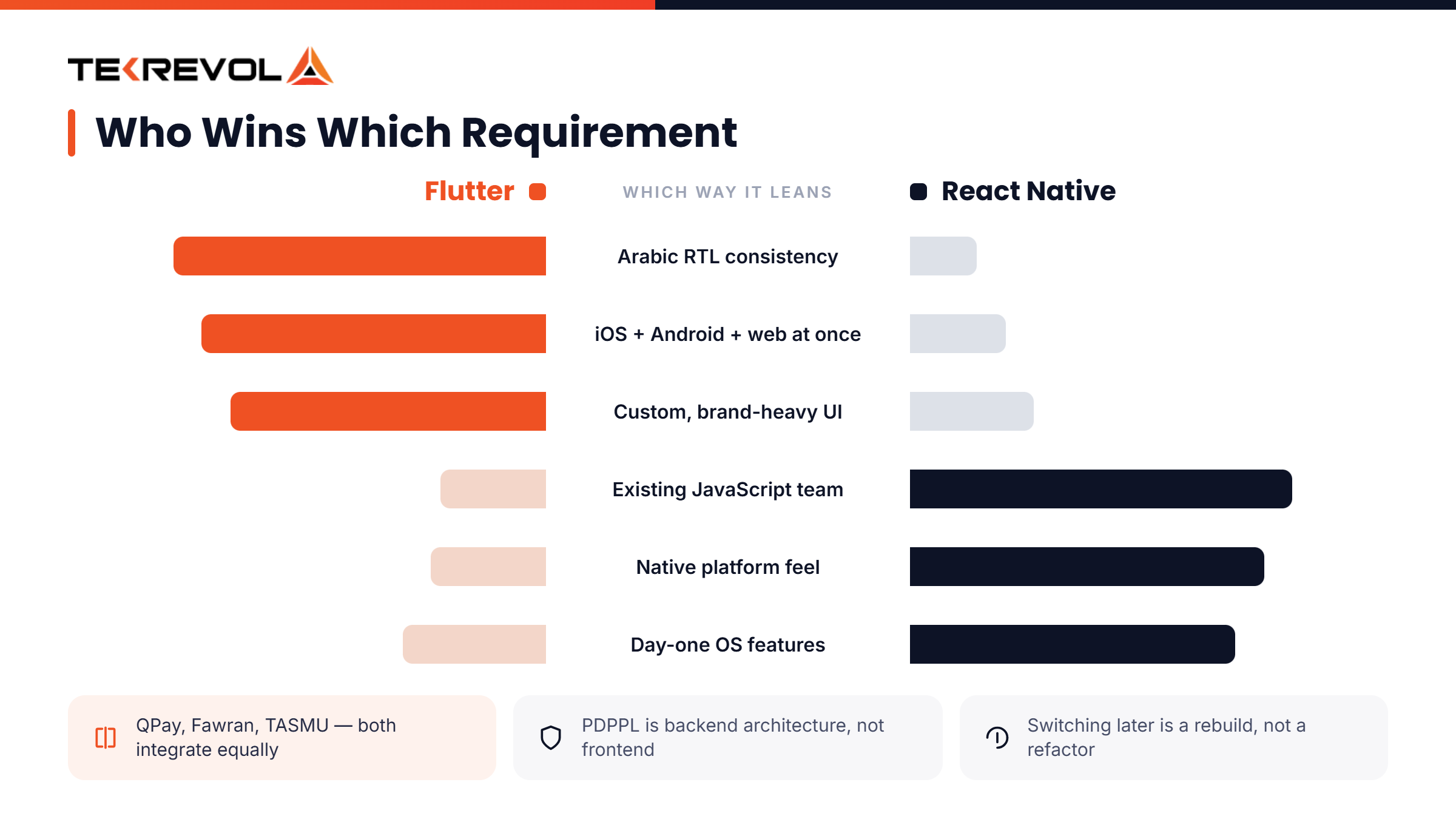
This is the single most important technical difference for a Qatar build. Get it wrong, and you’ll be patching mirrored icons and broken padding for weeks after launch.
Flutter’s RTL Advantage
- The built-in Directionality widget automatically mirrors layouts for Arabic, no platform-specific workarounds
- Rendering stays consistent across iOS, Android, and web, because Flutter draws every pixel itself
- Icon and animation mirroring is handled at the framework level, not screen by screen
- Best fit: government platforms, hospitality apps, and any product where visual consistency across devices matters to the brand
React Native’s RTL Approach
- Uses native I18nManager to flip layouts, leaning on each platform’s own RTL engine
- Performs well for standard layouts, but custom components need manual RTL testing
- Some third-party libraries lag on RTL support, which creates extra development work
- Best fit: apps built mostly from native components, where the native RTL behavior Qatari users already know from other Arabic apps is preferred
Your users switch between Arabic and English, sometimes mid-session. A government employee filling a form might toggle language to double-check a field. Every screen has to survive that switch without breaking layout or mirroring icons the wrong way.
How Much Does Cross-Platform App Development Cost in Qatar?
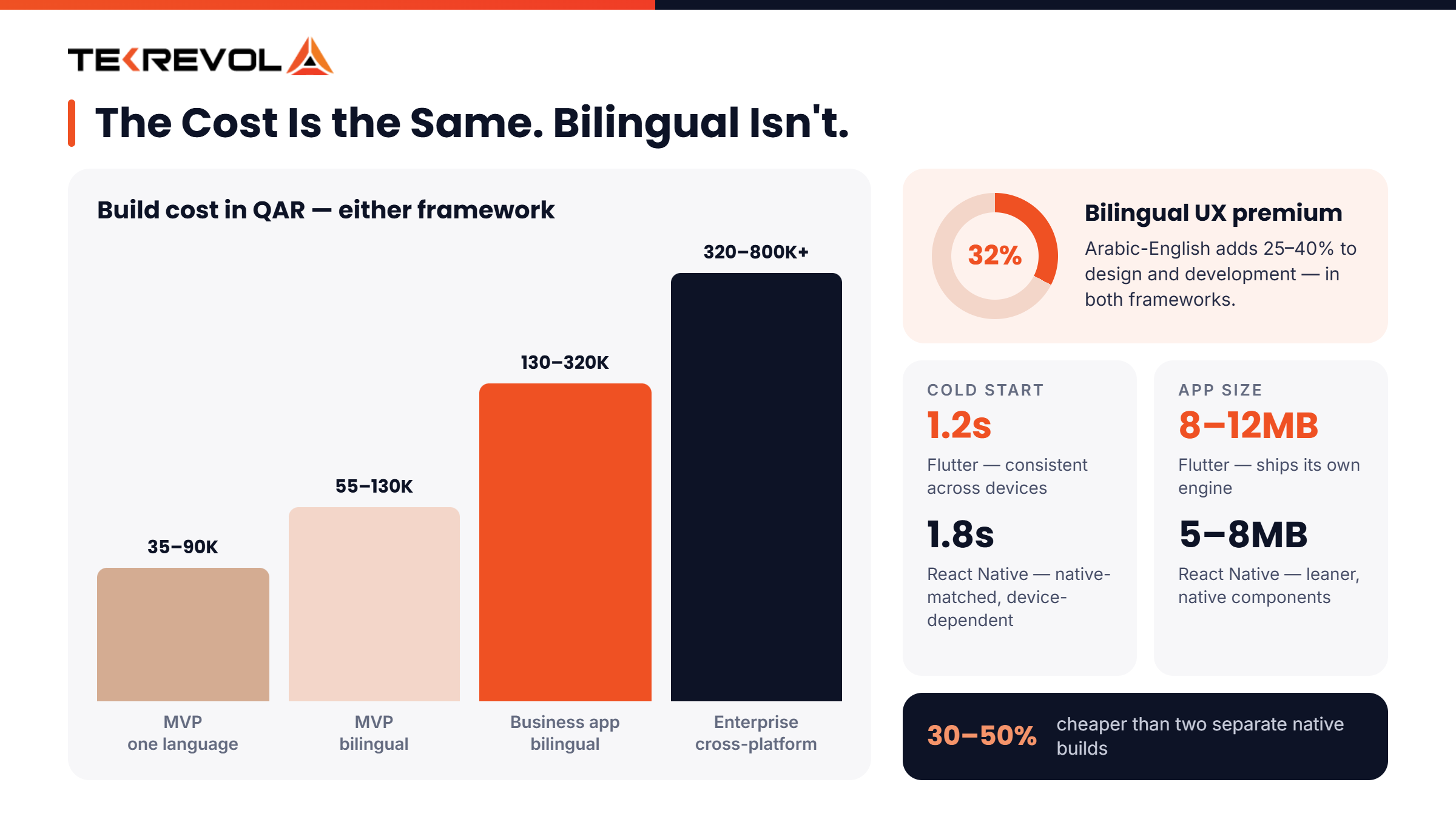
Cross-platform app development in Qatar costs QAR 35,000 for a basic MVP up to QAR 800,000+ for an enterprise-grade application, and that range is roughly the same whether you build in Flutter or React Native.
Framework choice doesn’t move the number much. Bilingual UX complexity and feature scope do.
| Project Type | Cost Range (QAR) | Timeline |
| Cross-platform MVP, single language | 35,000 – 90,000 | 6 – 10 weeks |
| Cross-platform MVP, bilingual Arabic-English | 55,000 – 130,000 | 8 – 14 weeks |
| Standard business app, bilingual | 130,000 – 320,000 | 3 – 6 months |
| Enterprise cross-platform app | 320,000 – 800,000+ | 6 – 12+ months |
| Ongoing maintenance | 15–20% of the build cost annually | Ongoing |
Bilingual UX alone typically adds 25–40% to a Qatar app’s design and development cost. That number holds steady across both frameworks.
What Does a Qatar App Actually Cost to Maintain Over Two Years?
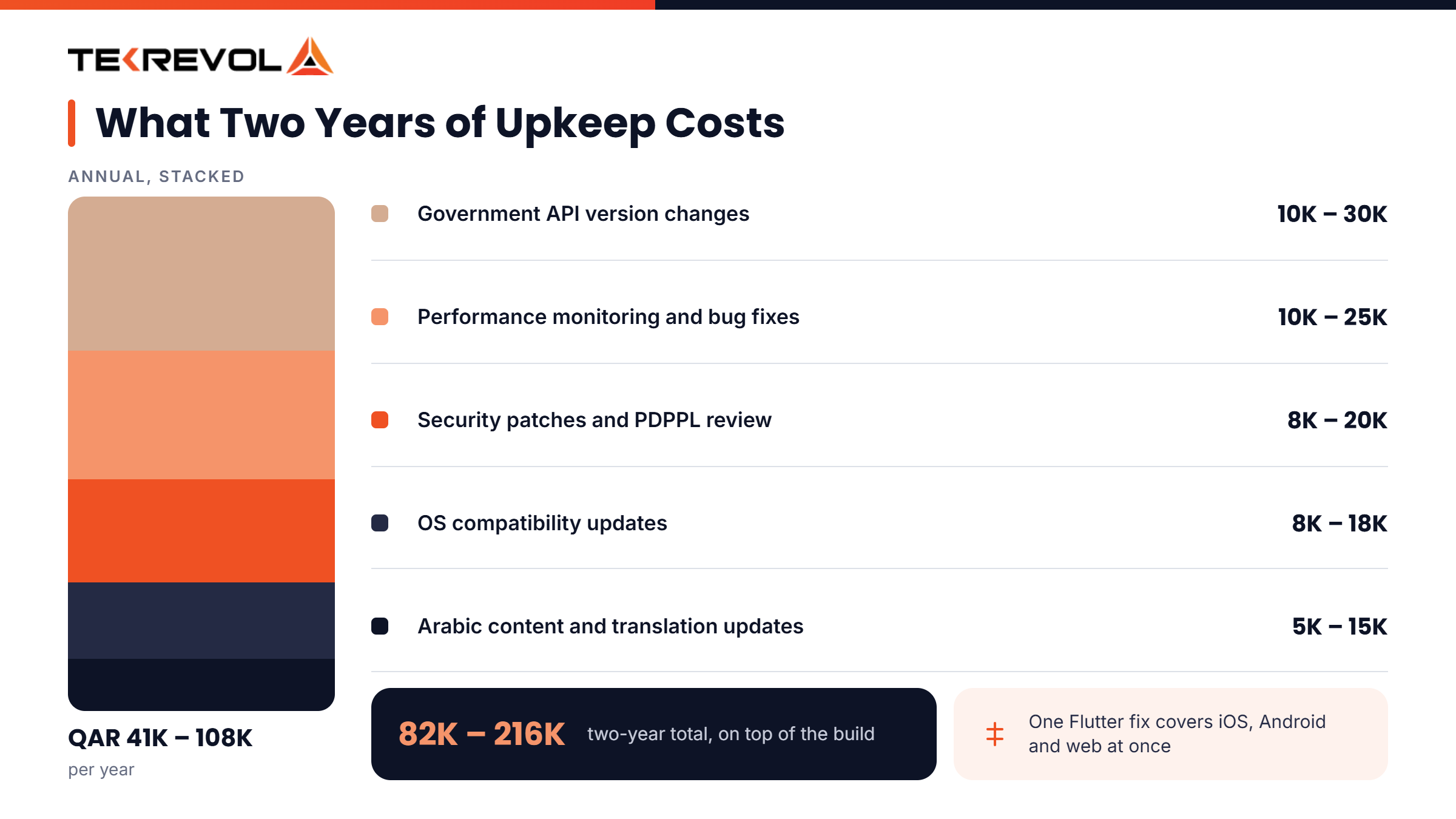
Most Flutter vs React Native cost comparisons stop at the build. Qatar app owners should plan for a two-year total cost of ownership because bilingual apps, government API dependencies, and annual OS updates create real ongoing maintenance obligations.
| Maintenance Category | Annual Cost (QAR) | Notes |
| OS compatibility updates (iOS/Android) | 8,000 – 18,000 | Major platform releases require testing and fixes |
| Arabic content and translation updates | 5,000 – 15,000 | Higher if the content is dynamic or government-regulated |
| Government API version changes | 10,000 – 30,000 | TASMU and payment gateway changes can require reintegration |
| Security patches and PDPPL compliance review | 8,000 – 20,000 | Required annually for any app handling personal data |
| Performance monitoring and bug fixes | 10,000 – 25,000 | Ongoing for any production app with active users |
| Total two-year maintenance estimate | QAR 82,000 – 216,000 | On top of the build cost |
Flutter cost has a slight long-term advantage here: its single codebase means a single fix covers iOS, Android, and web simultaneously. That efficiency can also reduce long-term Flutter app development cost by minimizing duplicate maintenance efforts.
With React Native, platform-specific maintenance sometimes creates two parallel fix cycles for native modules.
Which Framework Performs Better for Qatar’s App Market?
Flutter app development generally delivers more consistent performance across Qatar’s wide mix of devices. React Native matches native performance closely because it uses real native UI components.
| Metric | Flutter | React Native |
| Rendering approach | Own engine | Native platform components |
| Frame rate consistency | High across all devices | Native-matched, device-dependent |
| Cold start time | Faster, around 1.2 seconds | Slightly slower, around 1.8 seconds |
| App size | Slightly larger, 8–12MB | Slightly smaller, 5–8MB |
| Performance under traffic spikes | Strong, consistent rendering | Strong, native-level handling |
Qatar sees real traffic spikes, Ramadan evening usage, National Day, and major event periods. Both frameworks handle this fine at the app layer. What determines whether your app holds up under that load is backend architecture, not your frontend framework.
Device diversity in Qatar’s market is also wider than most founders assume, with high-end iPhones alongside mid-range Android devices used across the workforce. Flutter’s consistent rendering tends to age better across that spread.
Still Unsure Which Framework Fits Your Project?
Our experts will evaluate your business goals, feature requirements, and development timeline to recommend the best framework based on your project's needs—not agency preference.
Get Expert Framework AdviceDo Flutter and React Native Support Qatar’s Local Payment and Government Integrations Equally?
Yes. Both Flutter and React Native support QPay, Fawran, and TASMU government API integrations equally well, because these connections happen through standard REST APIs or SDKs that either framework can consume without limitation.
- QPay and Fawran: Both frameworks integrate cleanly through REST API or available SDKs
- TASMU government APIs: Integration complexity depends on the API’s documentation and authentication model — not your frontend choice
- Qatar Central Bank-regulated apps: Framework selection has no bearing on QCB AI Guideline compliance
- The real differentiator is whether your development team has actually built against Qatari payment rails before — not Flutter versus React Native
How Does Qatar’s PDPPL Affect Your Framework Choice?
Qatar’s Personal Data Privacy Protection Law applies equally regardless of framework; neither Flutter nor React Native has a built-in compliance advantage. Compliance comes from backend architecture, data residency, and audit logging, not your frontend framework.
- Data residency requirements are met through cloud infrastructure choice — AWS regional data centers, Qatar-based hosting, or a hybrid setup
- Audit logging and human oversight, where the QCB AI Guideline applies, are backend and data architecture concerns
- Both frameworks support equally secure local storage, encryption, and biometric authentication
- Flutter’s single codebase can make it easier to keep security implementation consistent across platforms; a React Native app development may need platform-specific native module review for security-critical features
What Type of Qatar Projects Suit Flutter vs React Native? (Real Patterns)
In the Flutter vs React Native comparison, both frameworks are used widely across the GCC. From government-adjacent platforms to consumer apps, the choice usually reflects each company’s design and integration priorities, not one framework being regionally dominant.
| Project Category | Better Fit | Why |
| Government citizen service apps | Flutter | Strict brand consistency, Arabic-first requirement, multi-platform from one audit |
| Hospitality and tourism platforms | Flutter | Design-heavy, brand-critical, Arabic/English parity essential |
| Retail and eCommerce apps | React Native | Fast iteration, JavaScript team continuity, native checkout feel |
| Internal enterprise tools (HR, ERP extensions) | React Native | Usually, JS-stack organizations, natives feel over-branded |
| EdTech and learning platforms | Flutter | Consistent rendering for animation-heavy Arabic content |
| FinTech and payment apps | Either | Integration quality matters more than the framework |
| Startup MVPs for validation | React Native | JS talent is more available in Qatar’s freelance market |
How Do You Choose Between Flutter and React Native for Your Qatar App?
Choose Flutter if Arabic RTL consistency, multi-platform reach, and brand-heavy UI matter most. Choose React Native if your team already knows React, you need a native platform feel right away, or speed to market with JavaScript developers is the priority.
| Question | Recommended Framework |
| Does your app need pixel-perfect, consistent Arabic RTL design across iOS, Android, and web? | Flutter |
| Does your team already have JavaScript or React experience you can put to work immediately? | React Native |
| Are you building for iOS, Android, and web at once, or starting with a single platform? | Flutter for multi-platform; React Native if starting with a single mobile platform and leveraging existing React skills. |
| Does your product lean on custom animations and brand-specific UI, or mostly standard native patterns? | Flutter for custom UI and animations; React Native for standard native interfaces. |
| Do you need new OS features on day one, or can you wait for community support to catch up? | React Native if immediate native OS access is critical; Flutter if consistency is the priority. |
| Is your development partner genuinely experienced in both frameworks, or do they default to one regardless of fit? | Choose the framework that best fits your requirements, not the agency’s default preference. |
What Should You Ask Any Qatar App Development Agency Before Choosing a Framework?
Before committing to Flutter or React Native, these five questions separate vendors who’ve genuinely shipped for Qatar.
- “Can you show me a live Arabic RTL app you built in this framework?” Not a mockup, not a demo, an App Store or Google Play listing you can open and test in Arabic yourself.gre
- “How do you handle RTL QA across custom components?” If the answer doesn’t include a specific process for testing icon mirroring, padding direction, and text alignment across every screen, they’re guessing.
- “Have you integrated QPay or Fawran before?” And if so, in which framework? Real integration experience versus theoretical compatibility is a significant difference.
- “How do you scope bilingual UX into your estimate?” The right answer is a line item. If they say, “We’ll add Arabic at the end,” leave.
- “What’s your plan if the government API version changes post-launch?” This Qatar-specific question sorts experienced local vendors from international teams who’ve never dealt with it.
Migrating a Flutter app to React Native, or the reverse, is a near-total rebuild, not a refactor. Treat the framework decision with the weight it deserves at the start.
Partner with TekRevol for Custom Development in Qatar
Choosing between Flutter and React Native is a strategic decision that affects your app’s timeline, maintenance, and long-term scalability. As a digital transformation company, we help you select the framework that fits your business goals.
Operating from Tornado Tower in Doha’s West Bay district, we build both Flutter and React Native applications for businesses across Qatar and the GCC. With 800+ delivered projects and ISO 27001 certification, we’ve developed Arabic-first products.
Beyond mobile development, our web development team builds the web layer for cross-platform products. Our AI specialists integrate intelligent features such as recommendation engines, bilingual chatbots, document processing, and workflow automation into either framework.
Here’s what the first step looks like:
- 30-minute discovery call
- Framework recommendation based on your design, integrations, and business goals
- Transparent project estimate in QAR within five business days
Ready to Build Your Cross-Platform App in Qatar?
We'll assess your project goals, feature requirements, and budget to recommend the right cross-platform framework, complete with a transparent QAR-based cost estimate and realistic delivery timeline.
Book Your Free Discovery Call


![How Much Does Mobile App Development Cost in Qatar [2026 Pricing Guide]](https://d3r5yd0374231.cloudfront.net/images-tek/uploads/2026/08/feature-image-2-2-400x204.webp)


