



- The skills required for software development split into technical foundations, tooling, and soft skills.
- JavaScript, HTML/CSS, SQL, and Python remain the four most used languages, per Stack Overflow’s 2025 survey.
- What separates a senior from a junior is judgment about tradeoffs, not knowledge of more syntax.
- AI tools are used by 84% of developers, yet only 3.1% highly trust the output.
- Median US software developer pay reached $133,080 in May 2024, per Bureau of Labor Statistics data.
- Hiring managers should test skills with real problems, because credentials predict very little on their own.
Did you know 84% of developers now use AI tools? According to Stack Overflow’s 2025 survey, only 3.1% highly trust the outcomes of AI tools. Sit with that gap for a moment, because it tells you exactly which software development skill just got scarce.
The skills required for software development fall into three groups. Technical skills mean languages, data structures, and databases; working skills like version control and testing; and the human skills that determine whether any of it becomes shipped software.
This guide covers all of them, from what we look for when staffing projects as a software development company. You’ll get the technical list with current usage data, the soft skills that matter, which languages to learn first, how the bar moves from junior to senior, and how to verify any of it when you’re the one hiring.
What Skills Are Required for Software Development?
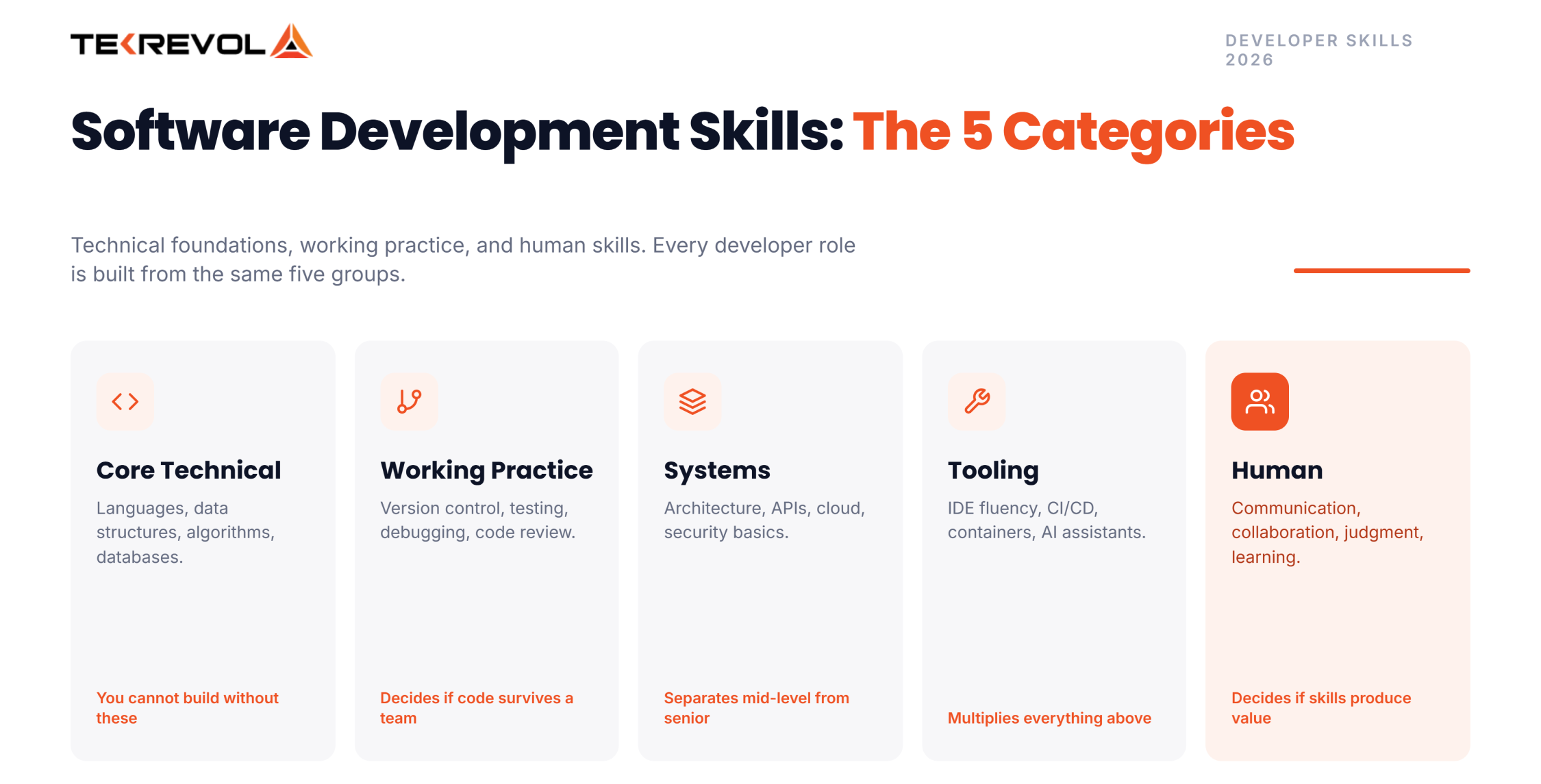
The skills required for software development split into technical and soft skills. Technical skills include programming languages, data structures and algorithms, version control, databases, testing, debugging, and system design. Soft skills include communication and problem-solving.
Here’s the honest summary before the details.
| Category | Skills | Why it matters |
| Core Technical | Languages, data structures, algorithms, databases | You can’t build without these |
| Working practice | Version control, testing, debugging, code review | Determines whether your code survives contact with a team |
| Systems | Architecture, APIs, cloud, security basics | Separates mid-level from senior |
| Tooling | IDE fluency, CI/CD, containers, AI assistants | Multiplies everything above |
| Human | Communication, collaboration, judgment, learning | Decides whether the technical skills ever produce value |
Before diving into complex technical requirements, taking time to grasp what software development is helps establish a reliable project baseline.
Hiring Developers and Unsure What to Test For?
Book a free call, and we'll walk through the skills in your roadmap, which ones to screen for first, and how we vet the developers.
Consult Your Staffing NeedsWhat Technical Skills Are Required for a Software Developer?
Technical skills required for a software developer include mastery of programming languages like Python and JavaScript, understanding data structures and algorithms, managing databases via SQL, utilizing Git version control, and deploying applications through modern cloud infrastructure.
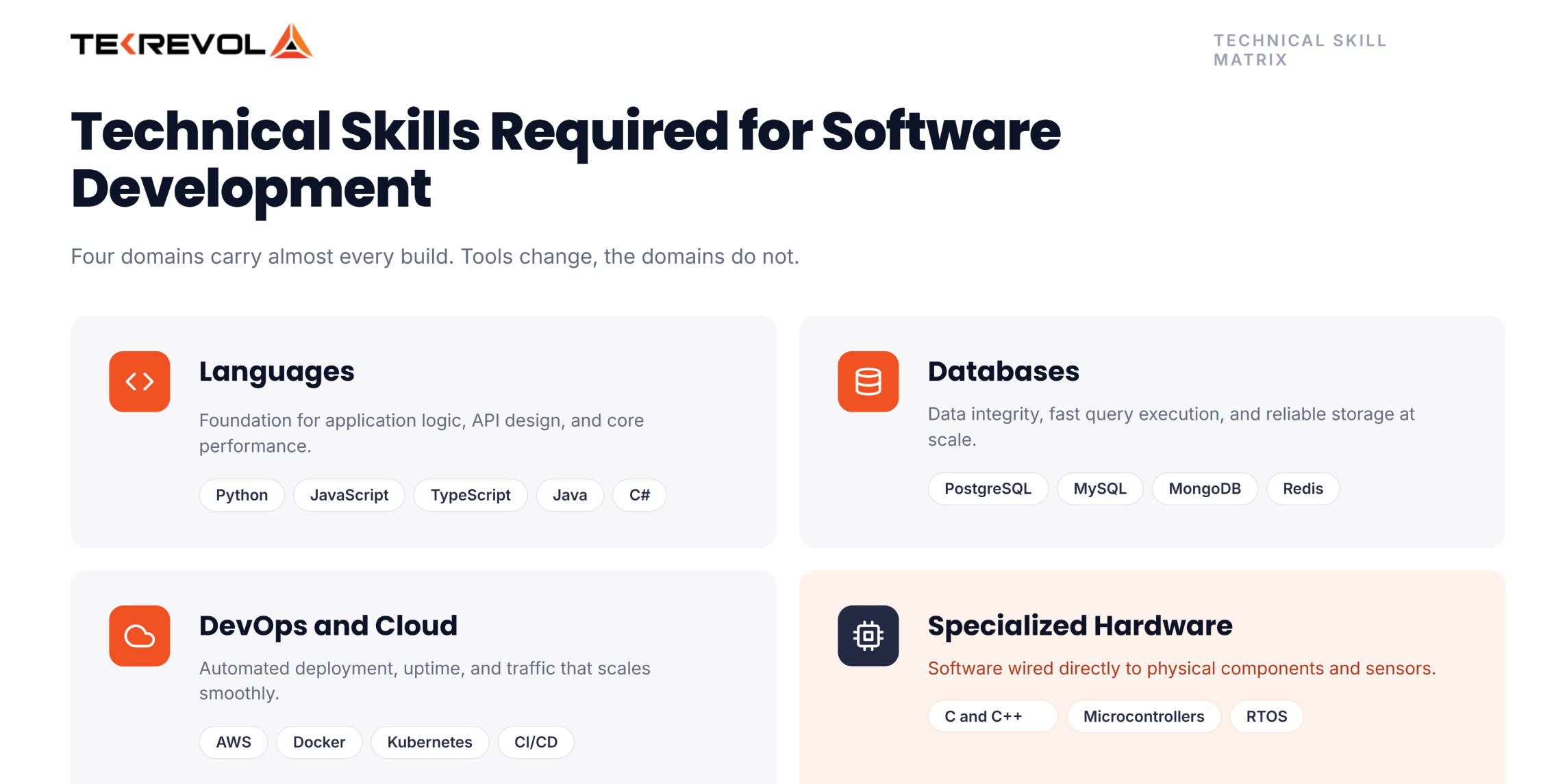
To write high-performing applications, developers must master foundational engineering tools. Selecting appropriate software development tools directly impacts sprint velocity, automated testing efficiency, and overall code quality across engineering pipelines.
Core Technical Competencies
- Programming Languages: Deep proficiency in foundational languages such as JavaScript, TypeScript, Python, Java, or C#.
- Data Structures & Algorithms: Mastery of arrays, trees, hash tables, and sorting algorithms to write memory-efficient code.
- Database Management: Designing relational (MySQL, PostgreSQL) and non-relational (MongoDB) schema structures.
- Version Control: Tracking code updates and managing branch merges across global dev teams using Git and GitHub.
- Specialized Hardware Logic: For IoT and firmware systems, understanding embedded software development helps engineers interface directly with microcontrollers and low-level system hardware.
Technical Skill Matrix
| Skill Domain | Tools & Tech | Business & Technical Impact | Target Application |
| Languages | Python, JavaScript, TypeScript, Java, C# | Foundation for application logic, API design, and core performance. | Web, Mobile, Cloud Apps |
| Databases | PostgreSQL, MySQL, MongoDB, Redis | Ensures data integrity, fast query execution, and reliable storage. | Enterprise Systems, Analytics |
| DevOps & Cloud | AWS, Docker, Kubernetes, CI/CD Pipelines | Automates deployment pipelines, ensures uptime, and scales traffic smoothly. | SaaS Platforms, Cloud Apps |
| Specialized Hardware | C, C++, Microcontrollers, RTOS | Connects software directly to physical hardware components and sensors. | IoT, Hardware, Robotics |
What Soft Skills Are Essential for Software Developers?
Soft skills essential for software developers include problem-solving, active communication, adaptability, empathy, time management, and team collaboration. These interpersonal skills help engineers translate complex business requirements into elegant technical solutions while keeping projects on schedule.
Technical knowledge gets code written, but soft skills ensure the right product gets built. In fast-paced product engineering, developers must communicate complex technical trade-offs clearly to non-technical stakeholders, product managers, and clients.
Critical Interpersonal Skills
- Analytical Problem-Solving: Breaking complex, ambiguous operational problems into simple, testable logical components.
- Active Collaboration: Working productively across cross-functional product, design, and marketing teams to meet project goals.
- Adaptability & Growth Mindset: Swiftly learning new frameworks, libraries, and tools as industry technologies evolve.
- Empathy for the User: Designing software features around human needs rather than technical convenience alone.
Types of Software Developer Roles Across the Industry
Software developer roles include front-end engineers focused on user interfaces, back-end developers handling servers and databases, full-stack developers covering both layers, mobile app developers, DevOps engineers managing deployment pipelines, and specialized AI developers.
Software engineering spans several distinct career paths depending on where a developer focuses their technical expertise. Understanding these roles helps businesses hire the right talent and helps developers choose their ideal specialization.
- Front-End Developers: Design the client-side visuals, buttons, and layouts users interact with directly using HTML, CSS, JavaScript, and React.
- Back-End Developers: Build the server-side logic, APIs, and database structures that power applications behind the scenes.
- Full-Stack Developers: Bridge the gap by mastering both front-end user experience and back-end architecture.
- Mobile App Developers: Specialize in building iOS and Android applications using native languages (Swift, Kotlin) or cross-platform frameworks (Flutter, React Native).
- DevOps Engineers: Automate code deployment, manage cloud server infrastructure (AWS, Azure), and maintain high application availability.
One quick note: Job ads use “developer” and “engineer” to mean the same thing, though the scope can differ at bigger firms, as our piece on software development vs software engineering explains.
What Skills Do Different Types of Software Developers Need?
Software developers need different specialisations on top of the shared core based on their seniority level. Frontend developers need UI frameworks and accessibility, backend developers need databases and APIs, mobile developers need plat
form SDKs, and DevOps engineers need infrastructure and automation.
| Type | Core specialisation | Common stack |
| Frontend | UI frameworks, accessibility, browser performance | React, Vue, TypeScript, CSS |
| Backend | APIs, databases, scalability, auth | Node, Python, Java, C#, SQL |
| Full-stack | Enough of both to own a feature end-to-end | JavaScript or TypeScript across the stack |
| Mobile | Platform SDKs, offline handling, store requirements | Swift, Kotlin, React Native, Flutter |
| DevOps | CI/CD, infrastructure as code, monitoring | Docker, Kubernetes, Terraform, cloud |
| Data / ML | Statistics, data pipelines, model training | Python, SQL, PyTorch, cloud data tools |
| QA automation | Test frameworks, test strategy | Playwright, Selenium, Jest |
The shared core stays the same across all of them: version control, testing, debugging, and communication. Specialisation sits on top of that foundation rather than replacing it.
How Do Skill Requirements Change by Seniority Level?
Software development skill requirements change less in breadth than in judgment. Juniors need enough syntax to complete defined tasks. Seniors need to know which of five workable approaches to choose and why. The technical list barely grows, and the decision-making does.
| Level | Technical expectation | The real difference |
| Junior | One language, basic Git, can follow patterns | Completes well-defined tasks with review |
| Mid-level | Comfortable across the stack, writes tests, debugs alone | Owns a whole feature without hand-holding |
| Senior | System design, performance, mentoring, security awareness | Chooses between tradeoffs and explains the choice |
| Staff/principal | Cross-team architecture, technical strategy | Decides what problems are worth solving at all |
The mistake candidates make is assuming the ladder is about learning more technologies. It isn’t. A senior developer often uses fewer tools than a mid-level one, because they’ve learned which ones cause problems later.
Not Sure If Your Candidate Is Really Senior?
Send us the role, and we'll share the technical screening questions we use and where CVs typically overstate real experience.
Consult Our ExpertsSoftware Developer Work Environment and Daily Workflows
A software developer work environment involves collaborative sprint planning, daily standup meetings, independent coding focus blocks, peer code reviews, and continuous testing across office, remote, or hybrid digital setups tailored to agile software engineering practices.
A typical workday includes a 15-minute morning standup meeting where engineers share progress, flag roadblocks, and align with product managers. Developers then dive into dedicated coding blocks, write automated tests, and submit code for peer review. Remote and hybrid setups have become standard, making digital collaboration tools like Slack, Jira, and GitHub central to daily developer communication.
Modern engineering teams rely heavily on flexible software development methodologies like Scrum or Kanban to organize daily sprints and manage product backlogs. They also use lean software development practices to reduce engineering waste, ship features rapidly, and continuously improve code efficiency based on real user feedback.
Software Developer Salary Trends and Earnings Expectations
Software developer salaries vary by experience, location, and technical specialization. Data from the US Bureau of Labor Statistics (BLS) reports a national median annual salary of $133,080 for software engineers, with top earners in major tech hubs exceeding $170,000 in base pay alone.
Software engineering remains one of the most lucrative and high-demand career paths globally. Salary packages reflect an engineer’s technical scope, mastery of high-demand frameworks, and ability to lead complex projects.
| Experience Tier | YRS of Experience | Median Salary Range (US) | Primary Industry Responsibilities |
| Junior / Entry | 0 – 2 Years | $65,000 – $85,000 | Writes basic features, fixes bugs, performs guided code maintenance |
| Mid-Level | 3 – 5 Years | $90,000 – $115,000 | Manages feature modules independently, writes APIs, designs databases |
| Senior Engineer | 5 – 8+ Years | $120,000 – $155,000+ | Leads system architecture, performs code reviews, manages cloud deployments. |
| DevOps / AI Spec. | 3 – 7+ Years | $130,000 – $170,000+ | Automates infrastructure, manages AI models, implements security protocols. |
How Is AI Changing the Software Development Skill Set?
AI has changed which skills are scarce rather than removing any. Writing code is faster, so reviewing, verifying, and deciding have become the bottleneck. Stack Overflow’s 2025 survey found 84% of developers use or plan to use AI tools.
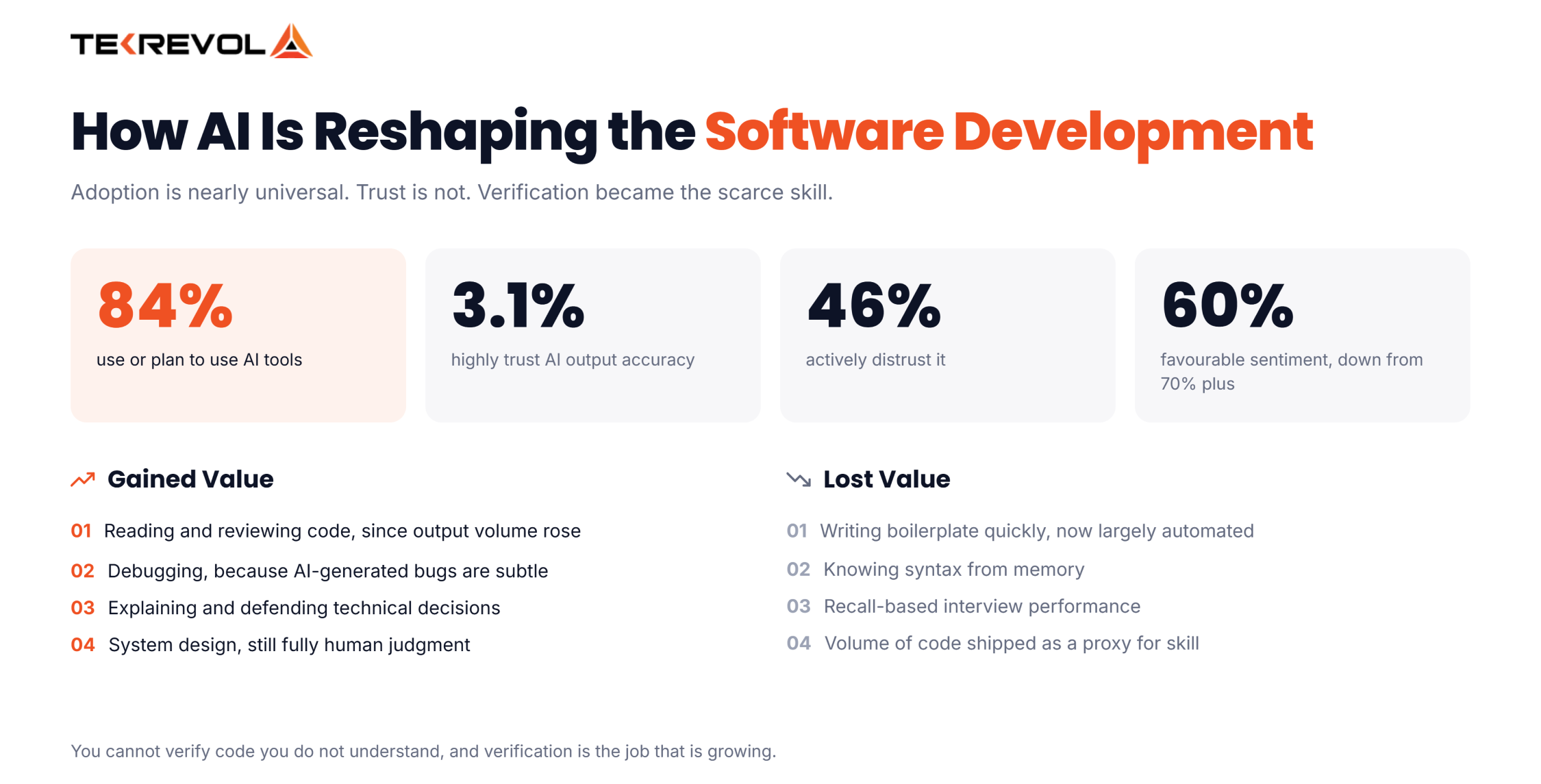
The trust data is the interesting part. Adoption is nearly universal, but favourable sentiment toward AI tools fell to 60%, down from over 70% in 2023 and 2024. Only 3.1% of developers say they highly trust the accuracy of AI output, while 46% actively distrust it.
So the skill that gained value isn’t prompting. It’s the ability to look at generated code and know whether it’s right.
| Skill | Effect of AI |
| Writing boilerplate | Largely automated, less valuable to be fast at |
| Reading and reviewing code | Sharply more valuable, since output volume rose |
| Debugging | More valuable, because AI-generated bugs are subtle |
| System design | Unchanged, still needs human judgment |
| Knowing syntax by memory | Much less valuable |
| Explaining and defending decisions | More valuable, since more decisions get made per week |
For anyone learning right now, this argues against skipping fundamentals. You cannot verify code you don’t understand, and verification is the job that’s growing.
How Do You Verify Software Development Skills When Hiring?
Verify software development skills with real problems from your actual codebase, not puzzles. Ask candidates to explain tradeoffs, review a flawed piece of code, or debug something broken. Credentials and CV keyword lists predict very little on their own.
Almost every article on this topic is written for people acquiring skills. This section is for the person on the other side of the table.
- Replace algorithm puzzles with realistic tasks
Whiteboard puzzles measure interview practice. Give candidates a small, messy, realistic problem instead, ideally one your team has actually solved.
- Ask them to review code, not just write it
Hand over a working but flawed snippet. What they notice, and what they choose to mention, tells you more than anything they’d write from scratch.
- Probe for tradeoffs rather than answers
“Why did you choose that?” and “What would break this?” separate people who understand from people who pattern-match.
- Test communication deliberately
Ask them to explain a technical decision as if to a non-technical stakeholder. This is the skill that most affects delivery and gets screened for least.
- Check learning, not just knowledge
Ask about something they learned recently and how. Frameworks turn over, and the durable skill is the picking up.
- Weight recent, relevant experience
Ten years of experience can mean one year repeated ten times. Ask what changed in how they work between year two and year eight.
If you’d rather not build a screening process from scratch, IT staff augmentation hands you pre-vetted developers while you keep the final interview and the final say.
Why Choose TekRevol for Software Development?
As a custom software development company, TekRevol screens for the skills above on every project, which matters because the developer skills that show up on a CV and the ones that show up in a sprint are rarely the same list.
How we assess and deploy developer skills.
| What we do | Why it matters to you |
| Screen on real problems | Candidates work through realistic tasks, not algorithm puzzles |
| Test communication explicitly | We check that they can explain a tradeoff, because you’ll need them to |
| Match seniority to the work | Seniors where judgment is needed, mid-levels for delivery, no overpaying |
| You interview everyone | We shortlist, you decide. Nobody joins your project sight unseen |
| Replace fast if it’s wrong | If the fit is off, you get a replacement rather than a performance process |
Two things worth knowing.
We’ll tell you which skills your project doesn’t need: Plenty of briefs ask for a full-stack developer with cloud, mobile, and machine learning experience for what is a straightforward web build. That conversation happens before you pay for it.
Our developers cover the specialisations above: Frontend, backend, mobile, DevOps, QA automation, and AI, across mobile app development, web, and cloud work.
We’ve staffed teams across 800+ projects in 11 industries, which is mostly useful here for pattern recognition about which skills a given kind of project genuinely requires.
Need Developers With Verified Skills, Not Just Good CVs?
Partner with TekRevol to build, launch, and scale high-impact web, mobile, and enterprise platforms today.
Let's Connect!


