



- Software development turns a business problem into working software through design, coding, testing, and ongoing maintenance.
- The software development cost depends more on integrations, changing requirements, and compliance than on the hourly rate.
- Eight development types cover most products, and real software almost always combines three or four of them.
- Nearly every developer now uses AI tools, but few of them trust the output without a review.
- Most projects fail on unclear requirements and missing ownership, not on the programming language you picked.
- Maintenance after launch costs more than the original build, so budget for it from day one.
Every company runs on software. Fewer know what goes into making it and that gap shows up the moment you’re asked to approve a budget, choose a vendor, or explain why a six-week estimate turned into six months. Knowing how the work runs fixes most of that.
Software development is the process of turning a business or user problem into working software. It runs through requirements, design, coding, testing, deployment, and maintenance. That’s true whether you’re building a mobile app, an internal tool, or a system nobody outside your company will ever see. Only the scale and the stakes change.
This guide covers the types, the seven-phase process, real cost and timeline figures, the models and methodologies, the tools teams use, best practices, what goes wrong, and where the field is heading.
What Is Software Development?
Software development is the process of turning a business or user problem into working software. It runs through requirements, design, coding, testing, deployment, and maintenance. The definition matters less than the sequence — skip a step, and you pay for it later.
Every piece of software started as somebody’s problem. A warehouse team counting stock by hand. A clinic losing referrals in an inbox. A customer who can’t book a slot without calling. An experienced custom software development company closes that gap, and then keeps it closed.
The scope is wider than writing code. Requirements gathering, architecture, interface design, testing, deployment, and years of maintenance all sit inside it. Coding is one phase of seven, and rarely the one that decides whether the project succeeds.
Software Development vs Software Engineering vs Programming
These three get used interchangeably, and the difference is real enough to matter when you’re hiring.
| Term | What it covers | Scope | Typical output |
| Programming | Writing code that makes a machine do a specific thing | Narrowest: a function, a script, a module | Working code |
| Software Development | The whole cycle from requirement to running system, including code | Full project lifecycle | A product in use |
| Software Engineering | Applying engineering discipline — architecture, scalability, reliability, formal process to that cycle | Same lifecycle, held to a higher standard of rigour | A system that holds up under load and change |
A Quick Glance At Software Business Right Now
Software has stopped being a department. Gartner’s July 2026 forecast puts worldwide IT spending at $6.37 trillion for the year. The software segment – mostly packaged and subscription products companies buy sits at $1.468 trillion, up 15.5%. IT services, which is where custom build and integration work lands, adds another $1.57 trillion.
The practical read for a business owner is simple. Your competitors are spending on both sides of that split. Bought software covers the problems every company shares. Built software covers the specific to how your business actually runs, and the gap between a company with good internal software and one without shows up in margin.
Not Sure What You Actually Need Built?
Send us the problem, and we'll tell you whether custom software development is even the right answer for your business.
Schedule Your Free ConsultationWhat Are the Different Types of Software Development?
Software development types split by what layer you’re building and where it runs. The eight main types are front-end, back-end, full-stack, mobile, cloud-native, embedded, AI/ML, and low-code. Most real products combine three or four of them.
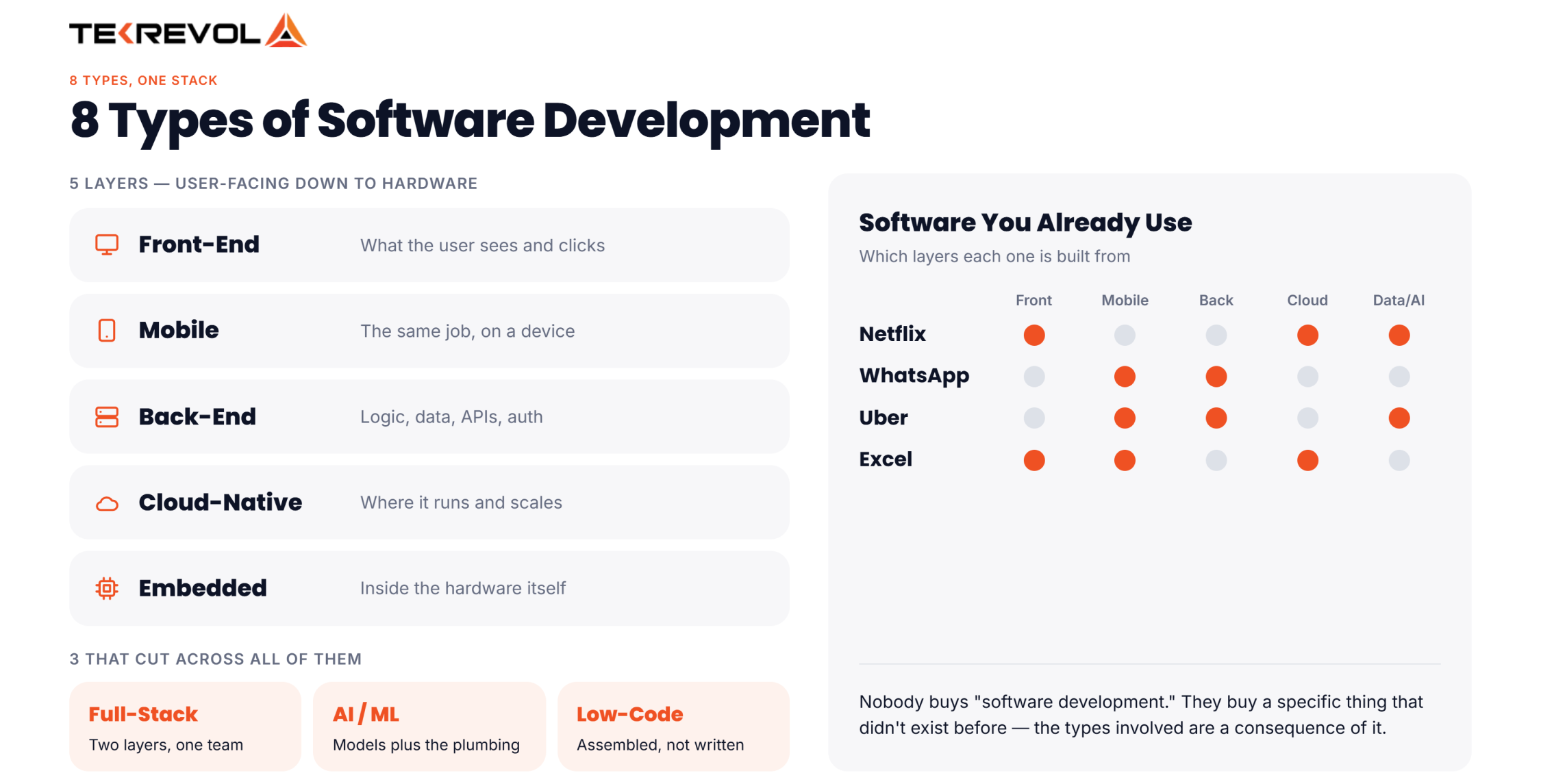
The list below is the working set. It isn’t the only way to cut the field. You can also split by industry or by platform, but this is the split that changes who you hire.
| Type | What it builds | Typical stack | Best for |
| Front-end | Everything the user sees and clicks | HTML, CSS, JavaScript, TypeScript, React, Vue | Web apps, dashboards, marketing sites |
| Back-end | Server logic, databases, APIs, auth | Node.js, Python, Java, C#, Go, PostgreSQL | Anything with accounts, data, or transactions |
| Full-stack | Both layers, one person or one team | Any front-end plus any back-end stack | Startups and small teams needing range |
| Mobile | iOS and Android applications | Swift, Kotlin, React Native, Flutter | Consumer products, field teams, on-demand services |
| Cloud-native | Systems designed to run and scale on cloud infrastructure | Docker, Kubernetes, AWS, Azure, GCP, microservices | High-traffic products, variable load, global users |
| Embedded | Software running inside hardware | C, C++, Rust, RTOS | Devices, vehicles, medical equipment, IoT |
| AI/ML | Models, inference, and the plumbing around them | Python, PyTorch, TensorFlow, vector databases, LLM APIs | Prediction, personalisation, document processing, agents |
| Low-code/no-code | Applications assembled visually rather than written | OutSystems, Mendix, Power Apps, internal tool builders | Internal workflows, forms, admin panels, quick pilots |
Eight is the useful working set, not a closed list. The examples further down use finer labels: desktop, data, geospatial, blockchain because real projects don’t stop at eight. We cover the longer breakdown in types of software development.
What Are Some Real Examples of Software Development?
Real examples make the categories concrete. Netflix is cloud-native plus front-end at scale. WhatsApp is mobile plus back-end built for extreme concurrency. Uber is mobile plus real-time back-end plus geospatial data. None is a single type.
Most software development examples stop at abstract categories. Here’s what the categories look like attached to software you’ve used.
| Product | Development types | What’s underneath | Why it’s a useful example |
| Netflix | Cloud-native, front-end, data/ML | Netflix has publicly documented running its streaming service on AWS and open-sourced much of its microservices tooling | Shows what “cloud-native” means when load is global and spiky |
| Mobile, back-end | Built on Erlang, a language chosen specifically for handling enormous numbers of simultaneous connections | Shows that stack choice can be a product decision, not a preference | |
| Uber | Mobile, back-end, geospatial, data | Uber’s engineering team has published extensively on its move from a monolith to microservices | Shows how architecture changes as a product outgrows its first design |
| Microsoft Excel | Desktop, cloud, front-end | A desktop application first shipped in 1985, now running alongside a separate browser version and a mobile app | Shows what maintenance actually looks like over a long life |
TekRevol’s Software Development Projects
Those are the famous ones. Here’s the same idea at the scale most businesses actually operate at, using projects from our own portfolio.
| Project | Development involved | What it does | Outcome |
| Al Hussaini | Web, back-end, integrations | Connects 40+ physical retail outlets to a rebuilt online storefront | Omnichannel platform with store locator, buy-online-pick-up, in-app wallet |
| Stop Vaping Challenge | Mobile, back-end, web admin | Cross-platform app with tracking, streaks, and a leaderboard | 65% success rate reported in its first six months |
| Kinder Morgan | Data, back-end, front-end | Turns complex operational data into readable dashboards | Reported 40% efficiency gain in getting to insight |
The pattern across all seven: nobody buys “software development.” They buy a specific thing that didn’t exist before, and the type of development involved is a consequence of that thing, not a choice made upfront.
What Is the Process of Software Development?
The software development process runs seven phases: planning, requirements analysis, design, development, testing, deployment, and maintenance. Each phase produces something the next one needs. Skipping a phase doesn’t save time — it moves the cost later.
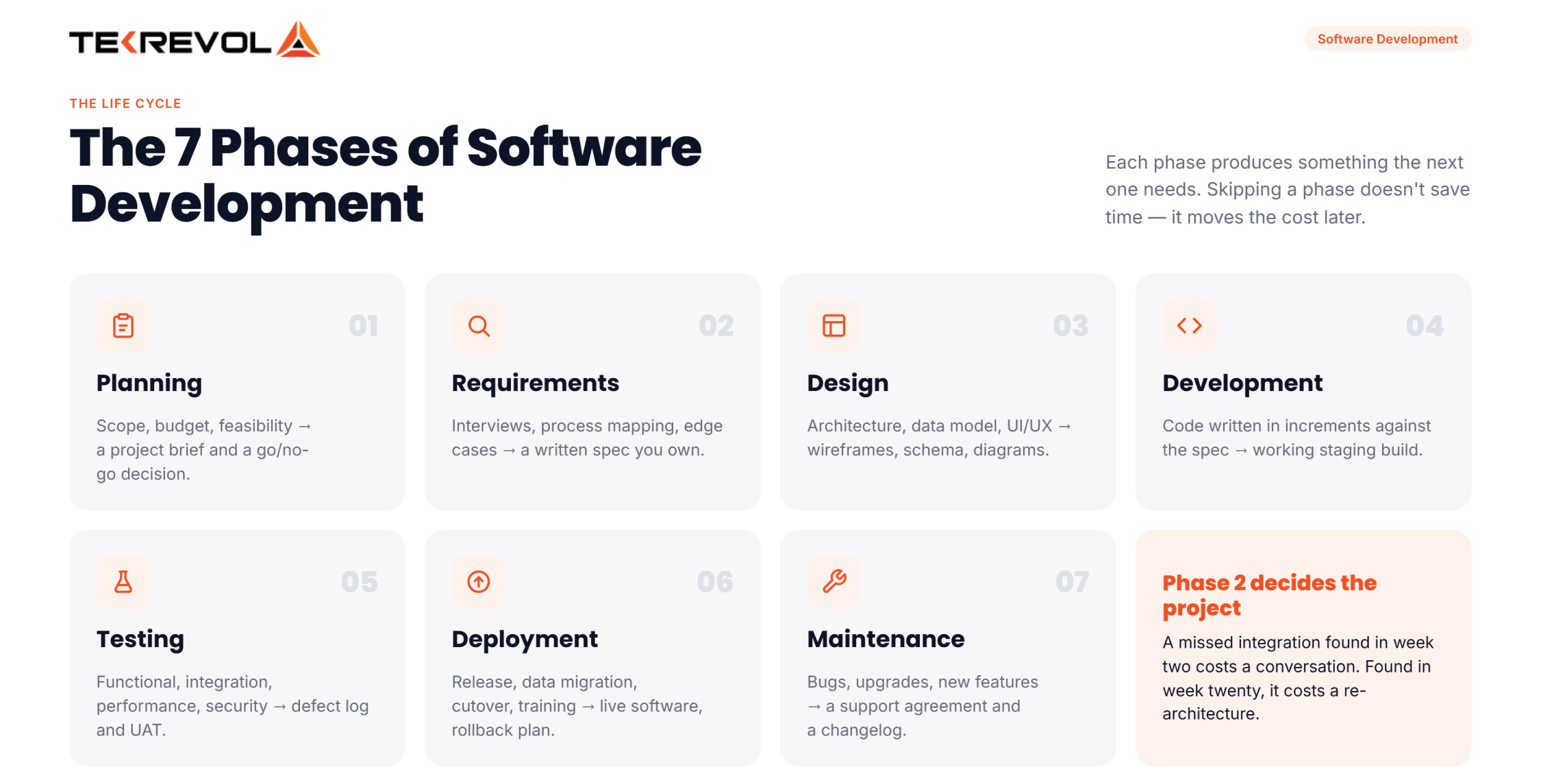
The sequence below is the standard software development life cycle. Different teams merge or rename phases, and the models in the next section change how many times you loop through them, but the phases themselves are stable.
| Phase | What actually happens | What you should get out of it |
| Planning | Scope, budget, timeline, feasibility, who’s involved | A project brief and a go/no-go decision |
| Requirements analysis | Interviews, process mapping, edge cases, acceptance criteria | A written specification you own |
| Design | Architecture, data model, integrations, UI/UX, security model | Wireframes, schema, architecture diagram |
| Development | Writing the code, in increments, against the spec | Working software in a staging environment |
| Testing | Functional, integration, performance, security, user acceptance | A defect log and a signed UAT |
| Deployment | Release to production, data migration, cutover, training | Live software and a rollback plan |
| Maintenance | Bugs, updates, dependency upgrades, new features | A support agreement and a changelog |
Three notes from doing this repeatedly.
- Phase 2 is where projects are won or lost. Requirements analysis is the cheapest phase to do well and the most expensive to skip. A missed integration discovered in week two costs a conversation. The same one discovered in week twenty costs a re-architecture.
- Testing isn’t a phase at the end anymore. On most modern projects, it runs alongside development, with automated tests written as features get built.
- Maintenance is not the small bit at the end. In a 2001 IEEE Software column, Robert Glass listed it among the fundamentals the industry keeps forgetting — 40 to 80% of total software cost, 60% on average.
We break each phase down properly: deliverables, exit criteria, who signs off — in our guide to the software development life cycle.
How Much Does Software Development Cost?
Clutch puts the average software development project at $132,480 with a timeline near thirteen months, though the most common band is $10,000 to $49,999. Hourly rates run $25–$49 offshore to $100–$149 in Canada and Australia.
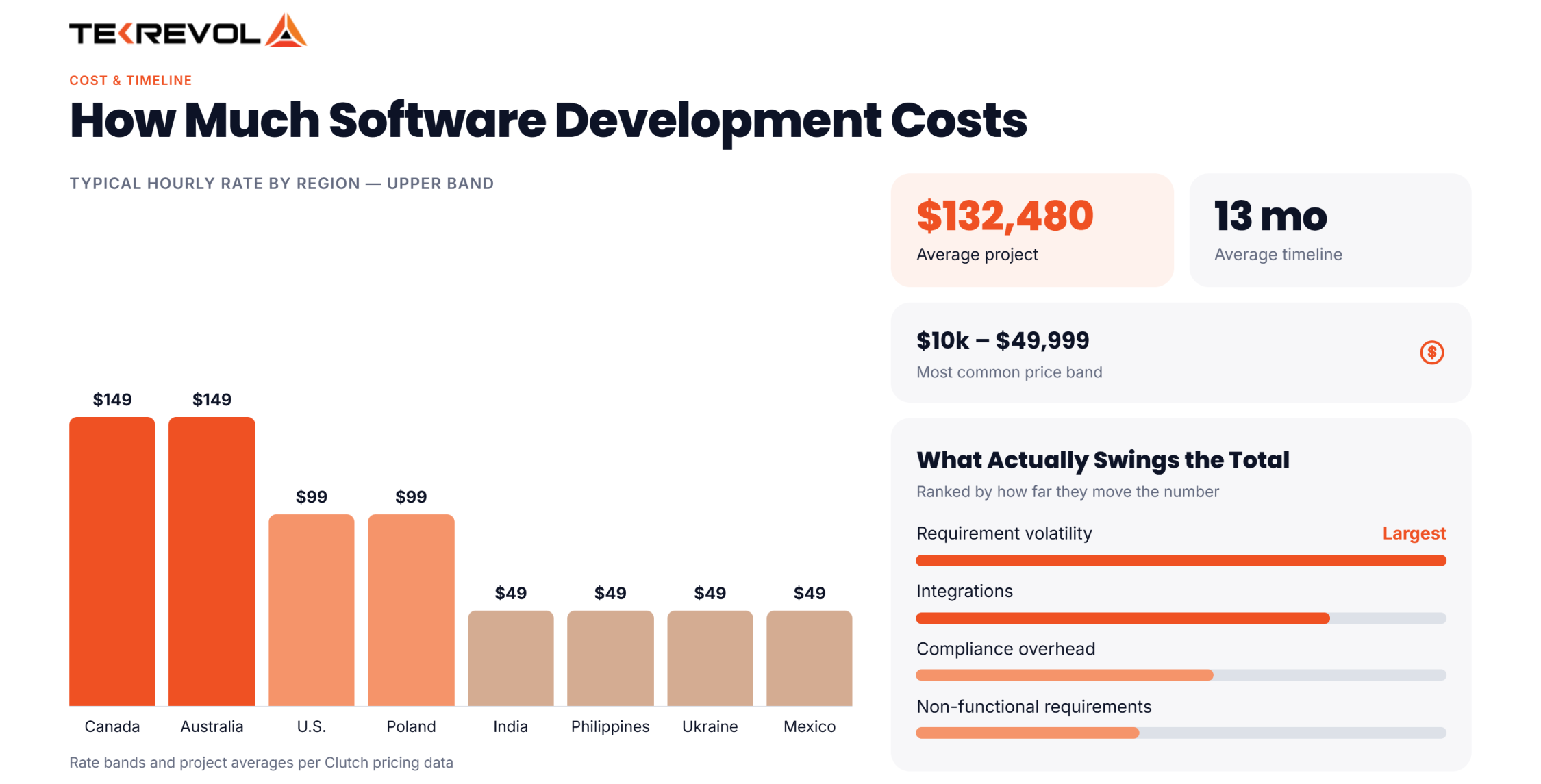
Cost is usually the second question a buyer asks, right after “can it be done.” Here’s what the available data actually supports.
| Region | Typical hourly rate |
| United States | $50–$99 |
| Canada | $100–$149 |
| Australia | $100–$149 |
| Poland | $50–$99 |
| India | $25–$49 |
| Philippines | $25–$49 |
| Ukraine | $25–$49 |
| Mexico | $25–$49 |
Rate bands per Clutch’s pricing data, updated July 2026.
Factors Drives Your Budget
Rate is the least interesting variable. These four move the total far more:
- Integrations. Every system your software has to talk to- payment, ERP, CRM, shipping, a legacy database is a line item. Two integrations and ten integrations are different projects at the same feature count.
- Requirement volatility. If the spec moves, the cost moves. This is the single largest swing factor, and it’s the one buyers control most directly.
- Compliance. Healthcare, finance, and government work carry documentation and audit overhead that has nothing to do with features. Budget for it explicitly.
- Non-functional requirements. “It should be fast” and “it should handle 50,000 concurrent users” are the same sentence to a client and completely different projects to an engineering team.
Our software development cost breakdown goes deeper into estimating a specific project.
Should You Build In-House, Outsource, or Use Staff Augmentation?
Build in-house when software is your core product, and you’ll keep changing it. Outsource to an agency when you need a defined thing built well and once. Use software development staff augmentation when you have a team and a gap, not a team and a project.
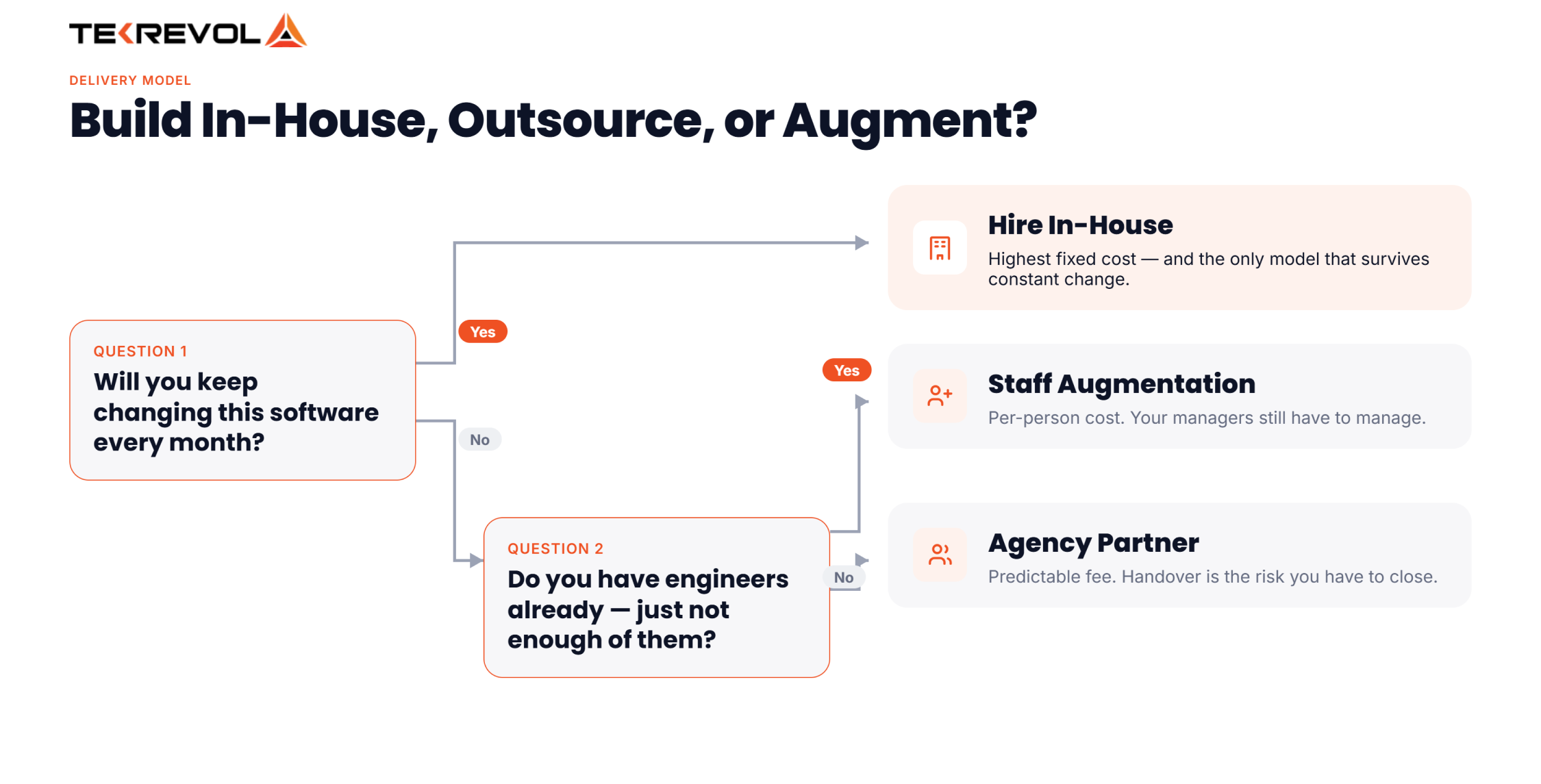
This is the first real decision most businesses face, and it’s usually made on instinct. Here’s the honest version, including where each option fails.
| Option | Best when | Roughly what it costs | Where it breaks |
| In-house team | Software is the product; you’ll iterate for years | Salaries, benefits, tooling, management overhead — highest fixed cost | Hiring takes months; a two-person team can’t cover eight disciplines |
| Agency / outsourced | Defined scope, fixed window, specialist skills you don’t have | Project fee or monthly retainer; predictable | Handover is the risk — if you don’t get the spec and source code, you’re locked in |
| Staff augmentation | You have a team and a capability gap | Hourly or monthly per person; between the other two | Your managers still have to manage; it doesn’t buy you delivery leadership |
| Hybrid | Core team in-house, surge or specialist work outsourced | Varies | Requires someone on your side who can own the seam |
Two things we’d tell you even though one of them costs us work.
If you’re going to change the software every month for the next five years, hire. Agency economics work against constant small changes. We’re honest about that in scoping, and IT staff augmentation is often the better middle path.
If you outsource, the contract matters more than the vendor. Get source code ownership, IP transfer, and the written specification in the agreement, not in an email. That single clause is the difference between a partnership and a hostage situation.
Software Development Models and Methodologies
Software development models sequence the phases: once through, in loops, or overlapping. Whereas software development methodologies govern how the team works day-to-day. Waterfall and Spiral are models. Scrum, Kanban, and XP are methodologies. The two get mixed up constantly.
Flattening the two into one list is why choosing feels harder than it should. They answer different questions.
| Models | Methodologies | |
| Question answered | How do the phases flow? | How does the team work? |
| Operates at | Project level | Team level |
| Examples | Waterfall, V-Model, Incremental, Iterative, Spiral, Prototype, RAD, Big Bang | Scrum, Kanban, Extreme Programming, Lean, DevOps |
| Changes | The order and repetition of phases | Ceremonies, roles, cadence, work-in-progress limits |
| Chosen by | Project constraints and contract type | Team size, culture, and workflow |
A quick orientation on the ones you’ll actually hear:
- Waterfall runs each phase once, in order, with sign-off between them. It works when requirements genuinely won’t move — regulated systems, hardware-coupled software, fixed-price public tenders — and fails badly when they do.
- Agile with Scrum works in fixed sprints, usually one to four weeks, with a prioritised backlog and a demo at the end of each. It’s the default for product work where you expect to learn as you go.
- Kanban drops the fixed sprint and limits how much work is in progress at once. Good for support, maintenance, and streams of unpredictable work.
- DevOps merges development and operations so that releasing is routine rather than an event. Less a way of planning work than a way of shipping it.
- Spiral loops through risk analysis before each build cycle. Heavyweight, and worth the overhead only when the risks are genuinely expensive.
Which Model or Method Fits Your Project?
Tell us your scope, timeline, and contract terms, and we'll map the delivery model that best fits your requirements.
Consult Our Strategy TeamWhat Tools and Technologies Do Software Development Teams Use?
Development teams use IDEs to write code, version control to track it, CI/CD to ship it, containers to run it, and monitoring to watch it. Add AI coding assistants, which roughly 85% of developers now use regularly.
Here’s the working software developemnt tech stack most teams use in 2026.
| Stage | Tool category | Common choices |
| Plan | Project and issue tracking | Jira, Linear, Asana, Trello |
| Design | Interface and architecture | Figma, Miro, Lucidchart |
| Write | IDEs and editors | Visual Studio Code, JetBrains IDEs, Visual Studio, Cursor |
| Write | AI coding assistants | GitHub Copilot, Cursor, Claude Code |
| Track | Version control | Git, with GitHub, GitLab, or Bitbucket |
| Build & ship | CI/CD | GitHub Actions, GitLab CI, Jenkins, CircleCI |
| Run | Containers and orchestration | Docker, Kubernetes |
| Host | Cloud platforms | AWS, Microsoft Azure, Google Cloud |
| Test | Automated testing | Jest, Playwright, Cypress, JUnit, pytest |
| Watch | Observability | Datadog, Grafana, Sentry, New Relic |
| Secure | Scanning and secrets | Dependabot, Snyk, SAST/DAST tooling, secrets managers |
GitHub’s Octoverse 2025 report recorded something that surprised a lot of people:
TypeScript overtook both Python and JavaScript to become the most-used language on GitHub, with 2.6 million contributors and 66% year-on-year growth. Python sat at 2.6 million contributors (+48%) and JavaScript at 2.15 million (+24.8%).
What Are Software Development Best Practices?
The best practices and coding standards that matter most aren’t technical. Write requirements down. Version everything. Test automatically. Review code. Ship small and often. Document as you go. Build security in from the start. Most failed projects broke one of these seven, not a coding rule.
Write the specification down, and make the client own it
Not a proposal but a document with screens, data fields, roles, and acceptance criteria. It’s what makes competing quotes comparable and disputes resolvable. If a vendor won’t produce one, that tells you something.
Put everything in version control, including infrastructure
Code, configuration, database migrations, deployment scripts. If a machine can build the thing from the repository alone, you own the software. If it takes a specific person’s laptop, you don’t.
Automate the tests you’d otherwise skip
In our experience, manual testing stops scaling somewhere around a three-person team. Past that, it quietly stops happening. Automated tests written alongside features are the only kind that survive a deadline.
Review code before it merges
Two reasons, and the second matters more: it catches defects, and it means more than one person understands every part of the system. The bus factor is a real risk on small teams.
Ship in small increments
Big-bang releases concentrate all the risk into one night. Small releases spread it out and make each failure survivable. This is the practical core of DevOps, whatever the process is called.
Document as you build, not after
Documentation written at the end is written by someone who’s already forgotten the reasoning. A short architecture decision record written the day the decision was made is worth ten pages of retrospective prose.
Build security in from requirements
Threat modelling during design, dependency scanning in the pipeline, secrets in a manager rather than a config file. Security added at the end is a patch, not a property.
What Are the Challenges in Software Development?
The recurring challenges are unclear requirements, scope creep, technical debt, communication gaps, unrealistic timelines, talent gaps, integration surprises, and security. Almost none of them are coding problems. Most of the software development challenges are decision problems that only surface later as coding problems.
| Challenge | Why it happens | What actually fixes it |
| Unclear requirements | Nobody wrote down the exceptions people work around daily | Process mapping with the people who do the work, not just their manager |
| Scope creep | No written baseline, so every request looks reasonable | A signed spec plus a change process with a price attached |
| Technical debt | Shortcuts taken under deadline and never repaid | A standing share of each sprint for debt, agreed upfront |
| Communication gaps | Client-side approver is unavailable or keeps changing | One named decision-maker with a stated response time |
| Unrealistic timelines | The date was promised before anyone estimated | Estimate ranges, not points; re-estimate after design |
| Talent gaps | Specialist skills needed for weeks, not years | Staff augmentation for the spike rather than a permanent hire |
| Security and compliance | Treated as a pre-launch checklist | Security requirements written into the spec at phase two |
| Integration surprises | The legacy system’s API doesn’t do what the docs claim | A technical spike against the real system during design |
What Are the Latest Trends in Software Development?
Among 2026 software development trends, the dominant one is AI development process. Current developer adoption runs from 78.5% in Stack Overflow’s survey to 90% in DORA’s. Behind it: platform engineering, DevSecOps, TypeScript’s rise, and cloud-native as the default.
AI-assisted Software Development
Three credible surveys ran in 2025 and reported different adoption figures. The spread is worth understanding, because it gets quoted carelessly.
| Survey | AI tool adoption | What it measured |
| Stack Overflow Developer Survey 2025 | 78.5% currently use; 84% including those planning to | Broad developer population, including hobbyists |
| JetBrains State of Developer Ecosystem 2025 | 85% regularly use AI tools for coding | Professional and student developers |
| DORA State of AI-assisted Software Development 2025 | 90% use AI | Technology professionals surveyed globally |
The Other Worth Tracking Trends
- Platform engineering. Instead of every team wiring its own deployment pipeline, one internal platform team builds paved paths the rest use.
- DevSecOps. Security scanning, dependency checks, and secrets management moved into the pipeline rather than sitting in a pre-launch review. Increasingly a procurement requirement rather than a nice-to-have.
- Cloud-native as the baseline. Containers and managed services are no longer an advanced choice; they’re the starting assumption for anything expected to scale.
Why Choose TekRevol for Software Development?
As your dedicated software developemnt team, we scope from your problem rather than a template: requirements, integrations, compliance, and constraints come first. What you’re getting, who signs off, and when it lands are settled in writing before a single line of code exists.
Four things we do on every custom software development project, and worth asking any vendor about.
- You leave discovery with a spec: Screens, data, roles, integrations, and acceptance criteria written and handed over, yours either way. It’s also what makes two quotes actually comparable.
- IP transfer is in the contract: Source code, environments, and credentials; written into the agreement at signing, not discussed later.
- Maintenance is in the estimate: We quote year-one running cost with the build. A number that stops at launch isn’t the real number.
- We’ll tell you when you don’t need us: If it’s a config change to something you already own, we’ll say so even though it costs us the project.
Got a Software Idea Worth Building?
Bring us the process that's breaking, and we'll scope the software development work around your specific needs.
Consult Our Experts


