



- Software development cost in UK typically runs £15,000 for simple tools to £400,000+ for enterprise builds.
- UK agency rates sit between £65 and £160 per hour, with London charging roughly 20-40% more.
- A £62,740 median developer salary becomes a £100+ hourly agency rate once NI, overhead and utilisation load in.
- Development is only 60% of the bill; design, QA, project management and infrastructure take the rest.
- Annual maintenance runs 15-20% of your original build cost, every year, for the software’s whole life.
- R&D tax relief and VAT both move your real number, and most UK price guides ignore both.
You’ve decided it’s finally time to replace that spreadsheet your team has been relying on for years. You approach three UK software companies with the same requirements and get three very different quotes: £30,000, £80,000, and £200,000. Which one is right? The answer lies in what each proposal actually includes.
So, how much does software development cost in the UK in 2026? Typically, software development costs in UK range from £15,000 to £400,000+, depending on complexity, features, integrations, security, and scope. An MVP may cost tens of thousands, while a complex enterprise platform can easily reach six figures.
In this guide, we break down software development costs in the UK by project type, development stage, developer rates, pricing models, and ongoing expenses. We’ll also cover hidden costs and practical ways to control your budget. If you’re looking for a development partner, explore our custom software development services to learn how we build and scale custom software.
How Much Does Software Development Cost in the UK?
Software development cost in UK ranges from £15,000 for a simple internal tool to £400,000 or more for a multi-system enterprise platform. Most mid-sized business projects land between £50,000 and £150,000, with timelines of four to nine months from kick-off to launch.
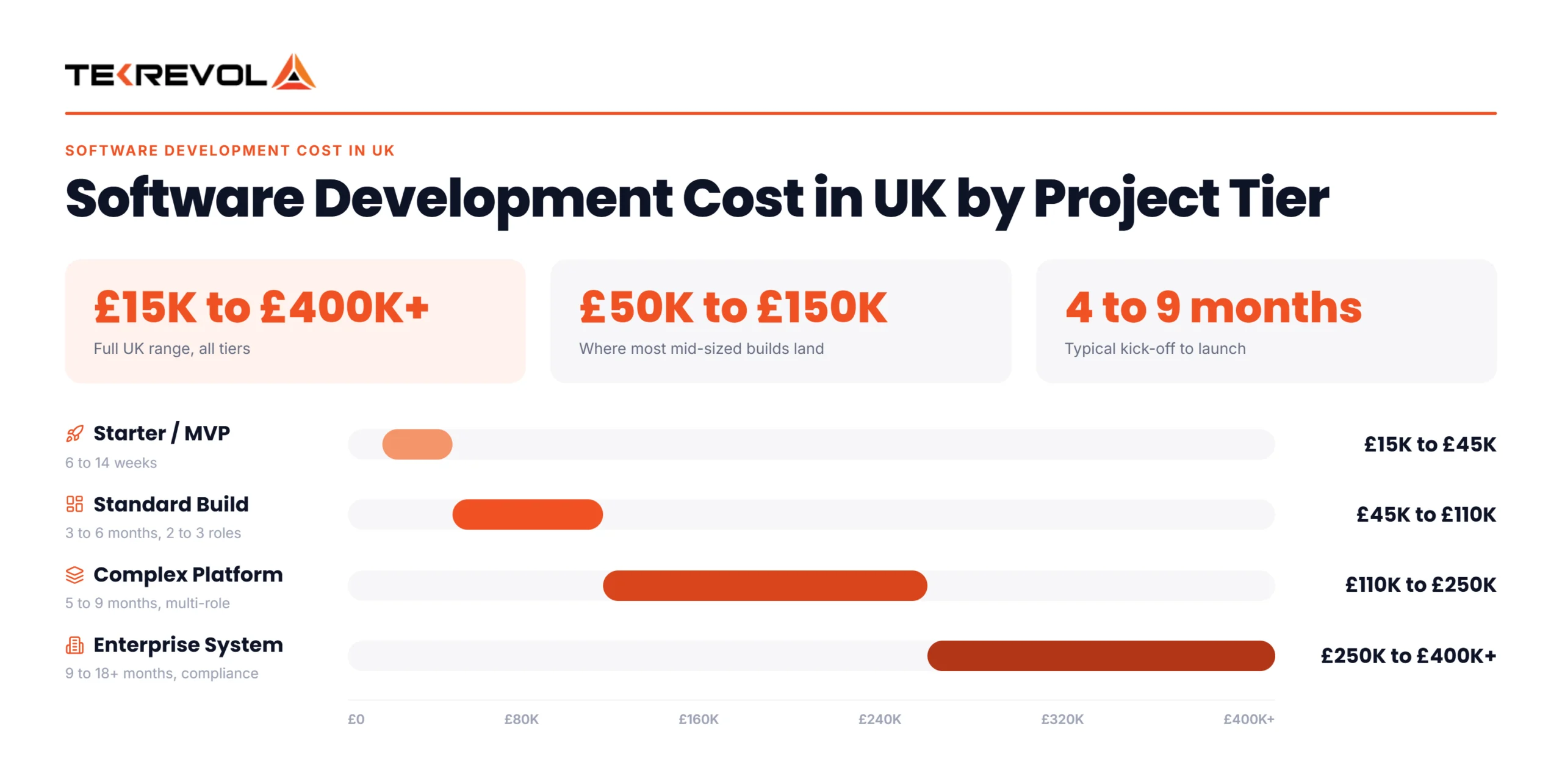
That range is wide because “software” covers everything from a booking form to a system that runs a warehouse. Here’s how UK budgets typically fall by project size:
| Project Tier | What It Usually Is | Typical UK Budget | Typical Timeline |
| Starter / MVP | Single-purpose tool, one user role, minimal integrations | £15,000 – £45,000 | 6 – 14 weeks |
| Standard Business Build | Customer-facing app or internal system, 2-3 roles | £45,000 – £110,000 | 3 – 6 months |
| Complex Platform | Multi-role, multiple integrations, custom logic | £110,000 – £250,000 | 5 – 9 months |
| Enterprise System | Core operations, legacy migration, heavy compliance | £250,000 – £400,000+ | 9 – 18+ months |
Not sure whether your idea is a £40,000 project or a £200,000 one?
Send us the rough concept, and we'll come back with a scoped range, a phase plan and the assumptions behind both.
Get Your Free Project Estimate →What Does Software Development Cost by Project Type in the UK?
The type of software has a huge impact on the software development pricing. A basic CMS starts near £10,000. An enterprise ERP or a regulated fintech platform can pass £400,000.
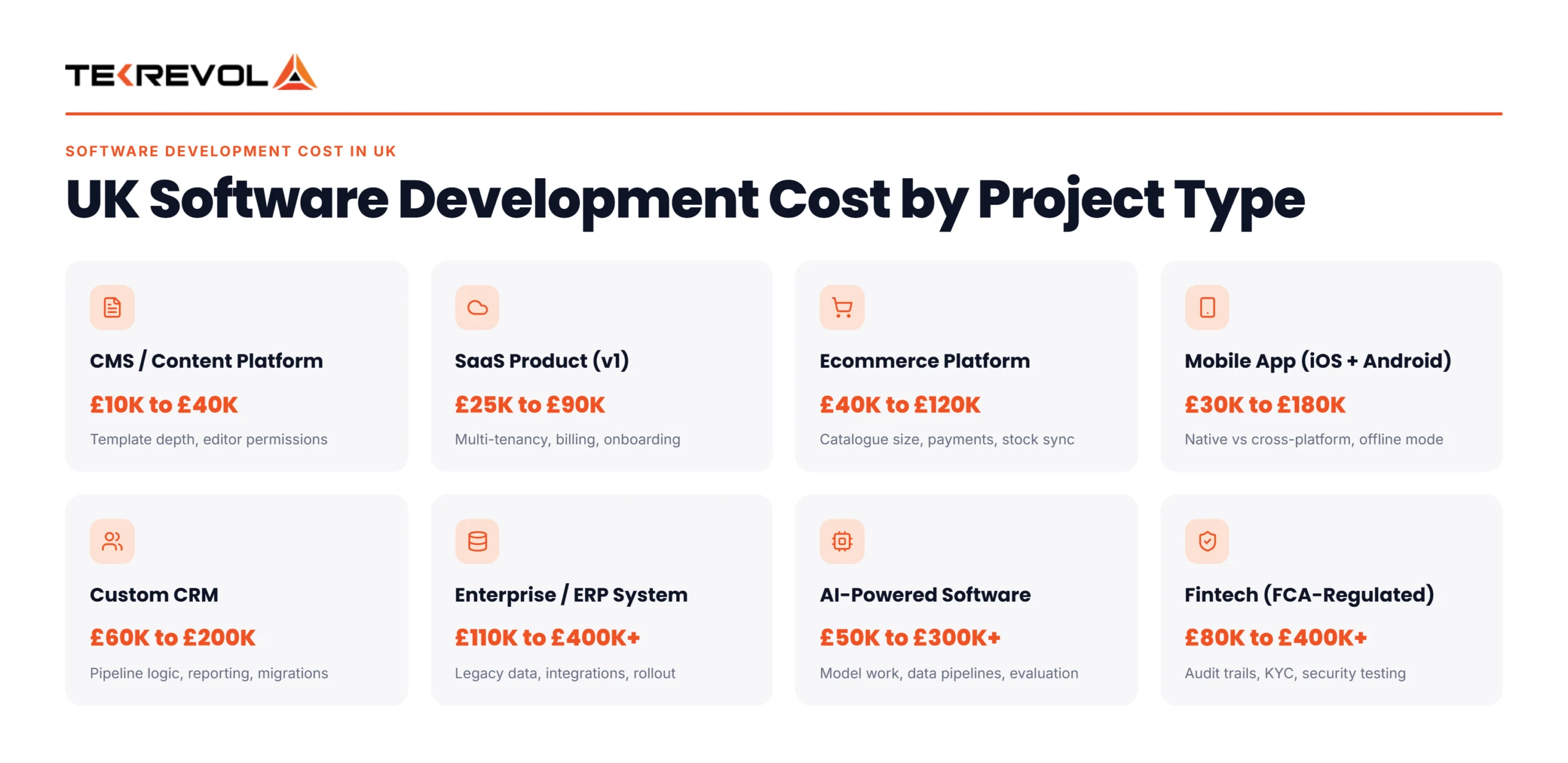
Every software has its own complexity level, considering the functionality and the user interface that are based on the overall scope of the project.
Here are some popular software types that you can relate to estimate the cost of your software development project in UK:
| Software Type | Typical UK Cost | What Drives the Number |
| CMS/content platform | £10,000 – £40,000 | Template depth, editor permissions |
| SaaS product (v1) | £25,000 – £90,000 | Multi-tenancy, billing, onboarding |
| Ecommerce platform | £40,000 – £120,000 | Catalogue size, payments, stock sync |
| Mobile app (iOS + Android) | £30,000 – £180,000 | Native vs cross-platform, offline mode |
| Custom CRM | £60,000 – £200,000 | Pipeline logic, reporting, migrations |
| Enterprise / ERP system | £110,000 – £400,000+ | Legacy data, integrations, rollout |
| AI-powered software | £50,000 – £300,000+ | Model work, data pipelines, evaluation |
| Fintech (FCA-regulated) | £80,000 – £400,000+ | Audit trails, KYC, security testing |
1- CRM Development
Customer Relationship Management (CRM) software helps businesses manage interactions with current and potential customers. It typically includes features for lead tracking, sales pipeline management, customer profiles, reporting, and analytics.
The cost of CRM development depends heavily on the complexity of the required features, the level of customization, integrations with existing systems, and scalability requirements. Businesses may also need features such as workflow automation, role-based access, reporting dashboards, and third-party integrations, which can increase the overall budget.
The development platform, deployment model (cloud-based or on-premises), data migration, security requirements, and ongoing maintenance can also influence the final cost.
CRM software development costs: £60,000 to £200,000 for a custom CRM, depending on its features, integrations, and business requirements. More advanced CRM solutions with complex workflows, extensive integrations, and enterprise-grade requirements can move toward the upper end of this range.
2- SaaS Product Development
SaaS product development involves building web-based software that customers can access over the internet, usually through a subscription-based model. A typical SaaS product may include user accounts, dashboards, subscription management, billing, admin controls, data storage, and third-party integrations.
The cost of SaaS development depends on the complexity of the product, the number of user roles, scalability requirements, security, and the integrations involved. Multi-tenancy, automated billing, onboarding workflows, analytics, and API development can further increase development effort.
Businesses also need to consider infrastructure, compliance, data protection, testing, and ongoing maintenance when estimating the total cost of a SaaS product.
SaaS software development costs: £25,000 to £90,000 for a first-version product, with the final cost depending on its complexity, integrations, scalability requirements, and feature set.
3- Enterprise Software Development
Enterprise software is built to address the specific operational needs of large organizations. These solutions often include custom workflows, advanced user permissions, reporting, automation, integrations, and tools for managing large volumes of business data.
The cost of enterprise software development is influenced by the scale and complexity of the platform. Integration with existing systems, legacy data migration, security requirements, compliance, and custom business logic can significantly increase development time and cost.
Additional expenses may also come from user training, infrastructure, testing, deployment, ongoing support, and long-term maintenance.
Enterprise software development costs: £110,000 to £400,000+ depending on the organization’s requirements, system complexity, integrations, security needs, and implementation scope.
4- CMS Development
Content Management System (CMS) development involves building software that allows businesses to create, manage, organize, and publish digital content. A custom CMS may include content editors, publishing workflows, media management, user permissions, search functionality, and SEO controls.
The cost of CMS development depends on the complexity of the content structure, number of user roles, customization requirements, integrations, and content migration needs. Advanced publishing workflows, multilingual content, custom dashboards, and third-party integrations can also increase the overall development budget.
Businesses should also consider ongoing hosting, security updates, maintenance, and support when calculating the long-term cost of a custom CMS.
CMS software development costs: £10,000 to £40,000 for a custom platform, depending on the required features, design complexity, integrations, and content management workflows.
5- E-commerce Development
E-commerce software enables businesses to sell products or services online through a digital storefront. Depending on the business model, an e-commerce platform may include product catalogs, customer accounts, shopping carts, checkout, payment processing, order management, inventory tracking, and shipping integrations.
The development cost depends on the number of products and categories, platform complexity, payment providers, shipping requirements, integrations, and the level of customization required. Features such as real-time inventory synchronization, multiple payment gateways, personalized experiences, advanced search, and analytics can increase the overall budget.
Security, scalability, third-party integrations, and ongoing maintenance should also be considered when planning an e-commerce project.
E-commerce software development costs: £40,000 to £120,000 depending on the platform’s complexity, catalog size, integrations, payment and shipping requirements, and custom functionality.
Additionally, a mobile app development company in UK can be your perfect partner when providing your customers with a simple shopping experience in the time of digital era.
Software Development Cost UK Breakdown by Development Stage
Software development cost breaks down across six stages, and writing code is only about 60% of it. Discovery takes 5-10%, design 10-15%, backend and frontend build 50-60%, QA 10-15%, and deployment plus infrastructure the final 5-10% of your total budget.
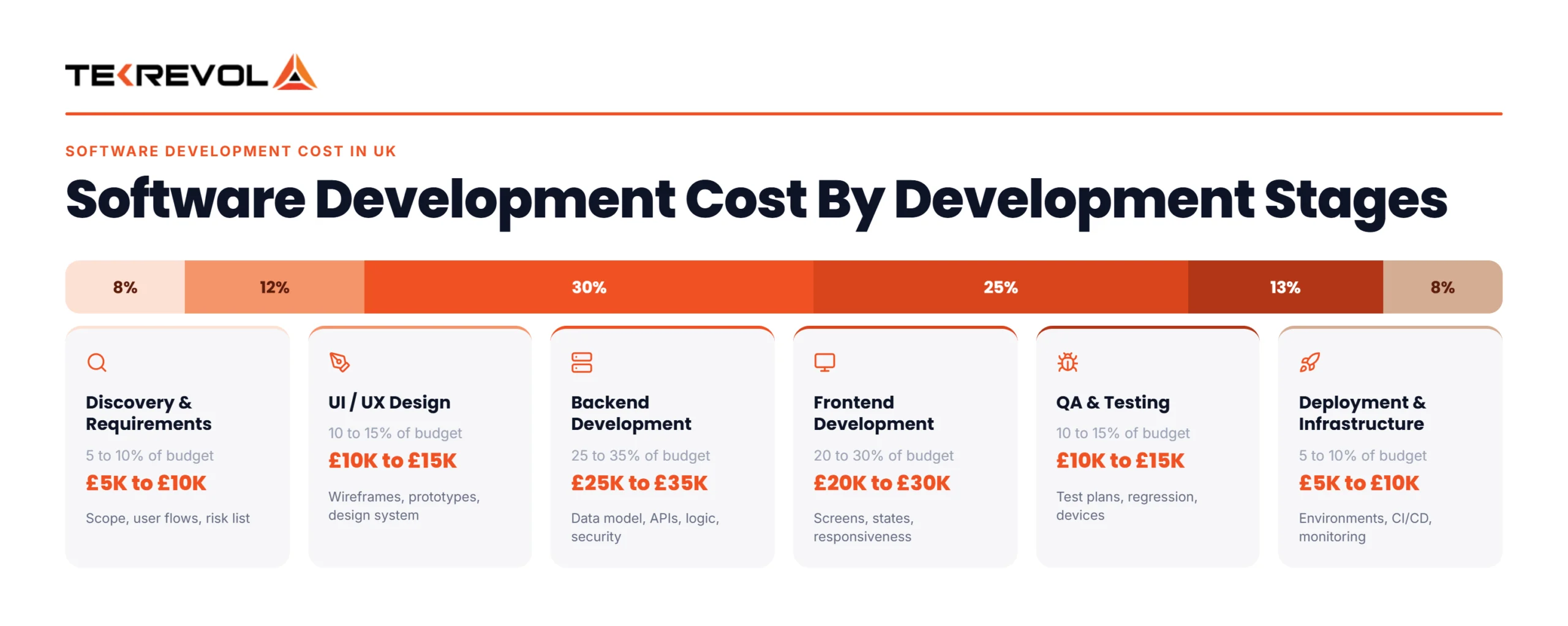
| Stage | Share of Budget | On a £100,000 Build | What You Get |
| Discovery & Requirements | 5 – 10% | £5,000 – £10,000 | Scope, user flows, technical plan, risk list |
| UI/UX Design | 10 – 15% | £10,000 – £15,000 | Wireframes, prototypes, design system |
| Backend Development | 25 – 35% | £25,000 – £35,000 | Data model, APIs, business logic, security |
| Frontend Development | 20 – 30% | £20,000 – £30,000 | Screens, states, responsiveness |
| QA & Testing | 10 – 15% | £10,000 – £15,000 | Test plans, regression, device coverage |
| Deployment & Infrastructure | 5 – 10% | £5,000 – £10,000 | Environments, CI/CD, monitoring, handover |
Discovery is the stage people try hardest to skip, and it’s the worst one to lose. Spending £6,000 to properly define a build is not overhead. It stops you paying £40,000 to rebuild a module in month five because nobody asked how the finance team actually approves an order.
QA is the second casualty. Skipping it doesn’t remove the cost; it moves it into your support budget and your users’ patience. A bug found after launch costs several times more to fix, because now it involves live data, real customers, and a release process.
What Are Software Developer Hourly Rates in the UK?
Software developer hourly rates in the UK run from £55 to £220 depending on seniority and location. Regional agencies charge £65-£110 per hour, London agencies £90-£160, and freelancers £50-£180. Day rates for contract developers sit around a £525 median.
That last number is worth pinning down. IT Jobs Watch puts the median UK contract day rate for a software developer at £525, up 5% year on year. Permanent roles tell a similar story: a £62,740 median salary nationally, £82,500 in London.
| Role/Model | UK Outside London | London | Offshore (South Asia) |
| Junior Developer | £55 – £80/hr | £75 – £100/hr | £15 – £30/hr |
| Mid-Level Developer | £80 – £110/hr | £100 – £140/hr | £25 – £40/hr |
| Senior Developer | £100 – £140/hr | £130 – £175/hr | £35 – £55/hr |
| Tech Lead/Architect | £120 – £170/hr | £160 – £220/hr | £40 – £65/hr |
Why a £62,740 developer costs you £100 an hour
A developer earning £62,740 annually can cost around £100 an hour through an agency once salaries, overheads, tools, management, and other business costs are included. Let’s break down the maths.
| Line Item | Amount | Where It Comes From |
| Median Developer Salary | £62,740 | IT Jobs Watch, UK, Aug 2026 |
| Employer National Insurance at 15% | + £8,661 | GOV.UK rate, above the £5,000 threshold |
| Employer Pension Contribution | + £1,300 – £1,900 | Auto-enrolment minimum on qualifying earnings |
| Total Employment Cost | ≈ £73,000 | |
| Working Hours After Holiday | ≈ 1,740 hrs | 232 working days at 7.5 hours |
| Billable Hours at 70% Utilisation | ≈ 1,220 hrs | Our own planning assumption |
| Break-Even Cost Per Billable Hour | ≈ £60 | £73,000 ÷ 1,220 |
The utilisation and overhead figures are our own modelling assumptions, and they shift a few points between firms. The shape holds, though. When a quote comes in at £45 an hour for UK-based senior developers, something is missing, and it’s usually QA, utilisation honesty, or the people who aren’t developers.
What Factors Affect Software Development Cost in the UK?
The cost of software development is formalized by multiple factors and each of them plays a critical role in determining the overall budget. These factors fall into seven groups: scope, business logic complexity, integrations, team seniority and location, compliance requirements, design depth, and post-launch support.
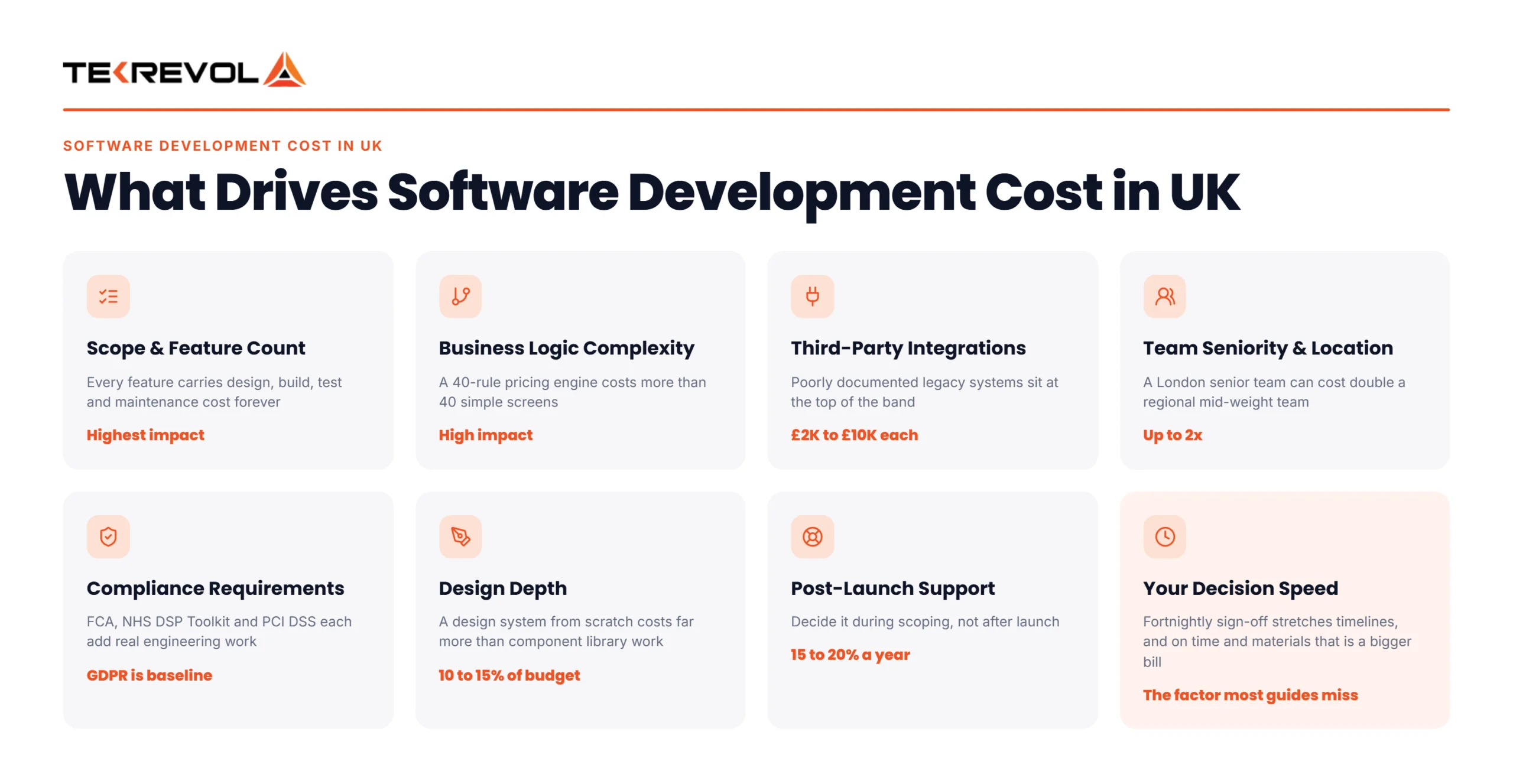
So, a clear understanding of these factors is essential for businesses to effectively plan and budget for their software projects. That’s how they can ensure successful outcomes and optimal return on investment.
1- Software Complexity
The complexity of a software project is a fundamental element of its development cost. Complexity is based on various factors, including the number of features and the diversity of business logic. Meanwhile, data processing requirements and integration with external systems have their own influence.
Highly complex projects often need extensive planning, coding, and testing that lead to increased development time and resource allocation. As complexity grows, so does the software development pricing. This is because developers require more time and expertise to structure complex designs and resolve the challenges.
2- Development Platform
The choice of platform highly impacts the overall cost of software development. Whether it’s web-based, mobile, or a combination of both, each platform has its unique development requirements. They have their own toolsets and ecosystems on which the development approach depends.
For instance, Native mobile app development usually requires separate codebases for different platforms such as iOS and Android. It results in higher software development prices compared to cross-platform solutions that leverage a single codebase to facilitate different platforms.
Moreover, platform-specific considerations such as performance optimization, device compatibility, and app store guidelines further contribute to the overall expense of the software development.
3- UI/UX Design
User interface (UI) and user experience (UX) design are crucial elements of software development. They directly impact the usability, interaction, and user satisfaction. A well-designed UI/UX enhances the overall user experience and facilitates fluent interaction.
Meanwhile, the designing of UI/UX is based on proper planning, prototyping, user testing, and iteration cycles. It also includes customized design elements, animation effects, and responsive layouts.
Furthermore, multiple accessibility features contribute to design complexity and require a separate focus. That’s how all these aspects collectively influence overall development costs.
4- Backend Development
Backend development deals with the server-side logic, database management, and system integration components of a software solution. The complexity of backend architecture, database, and system integration impacts development costs.
Meanwhile, custom backend solutions are created to cater to unique business requirements. They need extensive development efforts, including database design, API development, security implementation, and performance optimization.
On the other hand, the backend can also take advantage of pre-built frameworks, cloud-based services, or third-party APIs to reduce the development cost. However, it may limit the customization options and scalability in the future.
5- Team Hiring Model
The choice of team hiring model directly influences software development prices and the overall outcome of the project.
In-house teams offer greater control, communication, and alignment with business objectives. However, they cost way higher due to their top salaries, benefits, infrastructure, and training expenses.
On the other hand, outsourcing development to a custom software development company as external vendors or offshore teams can provide cost savings while accessing in-depth skills, and scalability advantages. However, it requires careful recruitment, project management, and proper collaboration to eliminate the risks and ensure quality standards.
When it comes to hybrid models, you can combine in-house and outsourced resources as per the flexibility to control the increasing budget. As a result, it allows businesses to leverage the benefits of both approaches based on project requirements, timelines, and budget parameters.
6- Compliance Requirements
Compliance requirements can significantly affect the overall cost of software development in the UK, particularly for applications that handle personal, financial, healthcare, or payment data. While GDPR is a baseline requirement for many projects, regulated industries may require additional security controls, documentation, testing, and audit capabilities.
For example, FCA authorisation, the NHS DSP Toolkit, and PCI DSS compliance can introduce additional engineering work. This may include stronger access controls, encryption, audit trails, secure payment processing, data retention policies, vulnerability testing, and ongoing monitoring.
The level of compliance required depends on the industry, type of data being processed, and the markets in which the software operates. Businesses should therefore identify compliance requirements during the planning stage rather than treating them as a post-development task, as late compliance changes can increase both development costs and timelines.
If you’re comparing suppliers rather than features, our guide on how to hire an app development company in the UK covers the questions that separate a good proposal from a well-designed one.
Which Software Development Pricing Models Are Used in the UK?
UK software development pricing models come in three main forms: fixed price, time and materials, and dedicated team. Fixed price suits tightly defined builds, time and materials suits evolving products, and a dedicated team suits ongoing roadmaps lasting six months or more.
Picking the wrong model is expensive in a quiet way. It doesn’t blow the budget in one go, it leaks.
| Model | You Pay For | Best When | Watch Out For |
| Fixed Price | An agreed scope, one number | Scope is documented and stable | Change requests priced at a premium |
| Time and Materials | Hours actually worked | Scope will evolve as you learn | Needs active budget management |
| Dedicated Team | A team, monthly | Long roadmap, continuous delivery | Cost continues whether or not you ship |
Fixed price feels safest and often isn’t. To quote a fixed number safely, an agency has to price in the risk of everything you haven’t thought of yet, which means you either pay a risk premium up front or you pay change-request rates later. It works beautifully when the spec is genuinely finished. It works badly when “finished” means a slide deck.
Time and materials get a bad reputation from projects with no governance. Run properly, with a sprint budget and a two-week review, it’s the model that lets you cut a feature in month three because you learned something in month two. That’s a saving, not a risk.
Our own preference for most UK builds is a hybrid: fixed price for a paid discovery phase, then time and materials for delivery with an agreed cap. You get a firm number on the part that’s knowable and flexibility on the part that isn’t.
How Do UK and Offshore Software Development Costs Compare?
UK software development costs roughly two to four times offshore rates, but total cost of ownership narrows that gap considerably. Offshore teams charge £20-£55 per hour versus £65-£160 in the UK, though specification quality, timezone overlap, and rework rates determine whether the savings survive.
We’ll be straight, because we deliver from multiple locations ourselves. Offshore works, and offshore fails, and the difference is rarely the developers.
| Factor | UK Team | Offshore Team | Hybrid Model |
| Hourly Rate | £65 – £160 | £20 – £55 | £45 – £95 blended |
| Timezone Overlap | Full | 2 – 5 hours typical | Managed overlap window |
| Spec Quality Needed | Moderate | High | Moderate |
| Client Management Time | Low | High | Medium |
| Rework Risk | Lower | Higher without strong spec | Lower |
| Best For | Regulated, complex, fast-changing | Well-defined, stable scope | Most mid-sized builds |
The hybrid model is where most of our UK clients land. Product strategy, architecture and client-facing work stay onshore. Build capacity scales offshore. You keep accountability where you need it and pay UK rates only where UK presence changes the outcome.
How Much Does It Cost To Develop Software In The UK?
Software development costs for small businesses usually fall between £20,000 and £90,000, while large enterprises might invest around £60,000 to over £400,000. However, startups aiming for an MVP typically budget between £4,000 and £20,000 due to limited resources.
Like any other region, UK has its own range to determine the cost of developing software. Meanwhile, the table provided here gives an overview of the standard cost variations of different software projects, estimated from our insights into software development costs in UK.
Although these figures provide a general idea, actual costs may vary depending on the overall services of software development companies UK.
What Hidden and Ongoing Software Development Costs Should You Budget For?
Hidden costs can impact the overall budget of software development projects. They often lead to budget exceed and project delays. Therefore, it is essential to account for these expenses before they can stress resources and affect the project’s success.
Hidden software development costs in the UK include annual maintenance at 15-20% of build cost, cloud hosting from £50 to £3,000 monthly, third-party licences, security audits at £2,000-£8,000, and VAT at 20% on top of every agency invoice.
1- Maintenance Cost
Here are the hidden costs of software development that come under the maintenance of a solution:
– Web hosting: Continual expenses for web hosting services can grow, especially for busy or resource-heavy websites, so budgeting wisely is crucial.
– Domain and SSL: Securing your domain and SSL certificates comes with recurring costs, adding to development expenses.
– Email services: Subscriptions for email marketing or CRM platforms may add extra charges, impacting project budgets, especially for businesses relying on email.
– User experience updates: Ongoing improvements to user experience based on feedback may require extra design work, adding to costs beyond the initial project.
– Tech support: Budgeting for ongoing technical support post-launch is vital to ensure software functionality, as maintenance services are necessary for performance.
2- Marketing Cost
The following are the hidden costs of software development that add up during the marketing of the product:
– SEO: Boosting visibility and traffic with SEO strategies may require outsourcing or investing in SEO tools, adding to project costs.
– Social media: Using social platforms for marketing may mean spending on ads or hiring social media services, which adds to the budget.
– Information structure: Organizing content for better user navigation may need specialized help, increasing project costs.
– Email campaigns: Running email marketing involves tools and content creation, adding to hidden expenses.
– Sales funnels: Creating conversion pathways needs content, tools, and analytics, contributing to project costs.
– PR: Building buzz with PR may require agency fees and event sponsorships, impacting the budget.
– Marketing: Allocating funds for paid ads and campaigns should be considered as extra costs for gaining market traction.
3. VAT
UK agencies typically charge 20% VAT on top of their fees. VAT-registered businesses may reclaim it, but for charities, partially exempt businesses, or those unable to reclaim VAT, it becomes a real project cost. A £120,000 build could mean a £144,000 upfront payment, so factor this in before setting your budget.
How Can You Reduce Software Development Costs Without Wrecking the Product?
Even after estimating the software development budget, there are effective ways to reduce expenses and optimize resource utilization throughout the development lifecycle.
By implementing strategic measures and leveraging cost-saving techniques, businesses in UK can control the overall budget while ensuring efficient project outcomes.
R&D Tax Relief
Eligible custom software projects may qualify for UK R&D tax relief, potentially reducing your net development cost. Under the merged scheme, GOV.UK sets the R&D Expenditure Credit at 20% of qualifying expenditure, with enhanced support available for qualifying R&D-intensive loss-making SMEs. Routine development generally doesn’t qualify, so discuss eligibility with your accountant early.
MVP Development
When you incorporate a minimum viable product (MVP) approach, it helps you to prioritize essential features and functionalities. It delivers value to users while minimizing development costs and marketing efforts.
So, businesses can validate product assumptions by focusing on core functionality and iterating based on user feedback. As a result, it will reduce development expenses, and you can alter it accordingly without investing in unnecessary features.
Pay for discovery
It is better to invest in the discovery phase rather than bear extra costs during the development of the project. It can help identify project requirements, risks, and potential challenges before execution.
That’s how you can make informed decisions and eliminate risk and inefficiency. Moreover, businesses can minimize costly rework and streamline the development process by having clarity about their project scope, objectives, and technical specifications.
Hire Professional Developers
You can ensure efficient project execution by investing in skilled and experienced custom software developers. With better code quality and adherence to best practices, the software development cost will automatically reduce.
By hiring professionals with expertise in relevant technologies and domains, businesses can minimize development errors. It will help to optimize code efficiency and eliminate the need for extensive rework on technical issues.
Use Frameworks and Proven Components
Custom-building authentication, payments or notifications is rarely a good use of budget. Buy those, build your differentiator.
If your project leans web-first, the technology choices you make now will shape maintenance costs for years, and our overview of web development trends in the UK is a reasonable place to sense-check the stack you’re being offered.
How We Estimate Software Development Cost at TekRevol UK?
Having proven experience and a deep understanding of software development, we are well aware of the fact that every business is unique. Therefore, we provide our undivided attention to each query that turns our way regarding the software development cost.
We facilitate each client in a fulfilling manner to ensure a wholesome experience by helping them estimate the right cost of their software project. Our whole process for software development cost estimation is simplified and it involves the following steps:
1. Consultation Call: Our process kicks off with an in-depth consultation call where our team engages with clients to understand their requirements, and objectives for the software project. It allows us to gather essential information and insights to guide us in the upcoming stages of the project.
2. Project Analysis: Following the consultation call, our team conducts a comprehensive analysis of the project requirements based on factors such as scope, complexity, and desired features. This analysis helps us determine the resources, technologies, and timeline needed to deliver a successful software solution.
3. Quote & Architecture Drafting: Based on the project analysis, we provide clients with a detailed quote that outlines the cost breakdown for the software development project. Additionally, our team provides the initial draft of the architecture to provide clients with a clear understanding of the project scope.
4. Final Proposal: Once the quote and architecture draft are reviewed and approved by the client, we finalize the proposal. It includes all project details, timelines, costs, and deliverables. That’s how we ensure transparency and alignment between our team and the client before initiating the software development process.
Got a quote you're not sure about?
We'll review the scope, the assumptions, and the gaps against what we'd price the same build at, and tell you honestly if it's a fair number.
Request a Free Quote Review →


![Healthcare App Development in Houston: HIPAA, Features & Cost [2026]](https://tekrevol-stage.s3.us-east-1.amazonaws.com/images-tek/uploads/2026/06/Tek-Feature-4-400x204.webp)

![Mobile App Development Cost in Saudi Arabia [2026 Pricing Guide]](https://tekrevol-stage.s3.us-east-1.amazonaws.com/images-tek/uploads/2026/08/fimage-400x204.webp)


