



- A basic HIPAA (Health Insurance Portability and Accountability Act)-compliant app development project in Miami starts at $40,000–$80,000; full-scale telemedicine platforms run $200,000–$500,000+.
- Healthcare data breaches now cost an average of $10.22 million per incident, the highest of any industry for 14 consecutive years.
- The US telemedicine market hits $59.72 billion in 2026and is headed to $230 billion by 2034.
- HIPAA fines range from $145 to $2.19 million per violation.
- TekRevol has delivered healthcare apps like Kinekt, Your Nurse, and Libido Health, each HIPAA-compliant, clinically sound, and actively used by real patients.
Healthcare app development gets expensive when businesses underestimate compliance requirements. Many clinics and healthcare startups focus heavily on UI and launch speed, only to realize later that HIPAA compliance, encrypted data storage, audit logging, secure APIs, and protected patient communication require specialized architecture from the beginning.
In telehealth platforms, even small backend oversights can lead to costly rebuilds, delayed launches, and legal risk. That’s why working with an experienced mobile app developer in Miami or a healthcare-focused development partner matters far beyond just design and development speed.
This guide breaks down the real cost factors behind healthcare app development so you can plan your budget correctly the first time.
The Healthcare App Opportunity in Miami
Miami’s healthcare market is genuinely exceptional. A multilingual, high-density population, one of the highest concentrations of specialist physicians on the East Coast, a rapidly aging demographic driving chronic care demand, and a tech ecosystem that has been accelerating since 2020, it’s one of the most fertile environments in the US for healthcare app development in Miami.
But it’s also one of the most legally demanding. Florida’s telehealth statutes, combined with federal HIPAA requirements and the OCR’s increasingly aggressive enforcement posture in 2026, mean that ‘move fast and fix compliance later’ is not a viable strategy here.
Whether you’re a clinic network, a digital health startup, a health insurance company, or a solo physician who wants to serve patients remotely, the path to a successful telemedicine app development in Miami runs directly through architecture decisions made in the first weeks of your project, not after launch.
TekRevol, as a trusted mobile app development company in Miami, has built 60+ healthcare applications with a perfect HIPAA compliance record, and this is everything we wish every client knew before starting.
Get a Free HIPAA Architecture Review — $600 Value
We’ll review your healthcare app concept, assess potential compliance risks, and provide a written cost estimate along with a HIPAA-focused development and compliance roadmap—completely free.
Claim Your Free ReviewQuick Answer — Cost to Develop a Healthcare App in 2026
Before the breakdown: the honest answer is that the cost to develop a healthcare app is determined more by your compliance architecture and integration requirements than by your feature list. HIPAA isn’t a feature you add at the end; it’s a structural decision that runs through your entire technology stack.
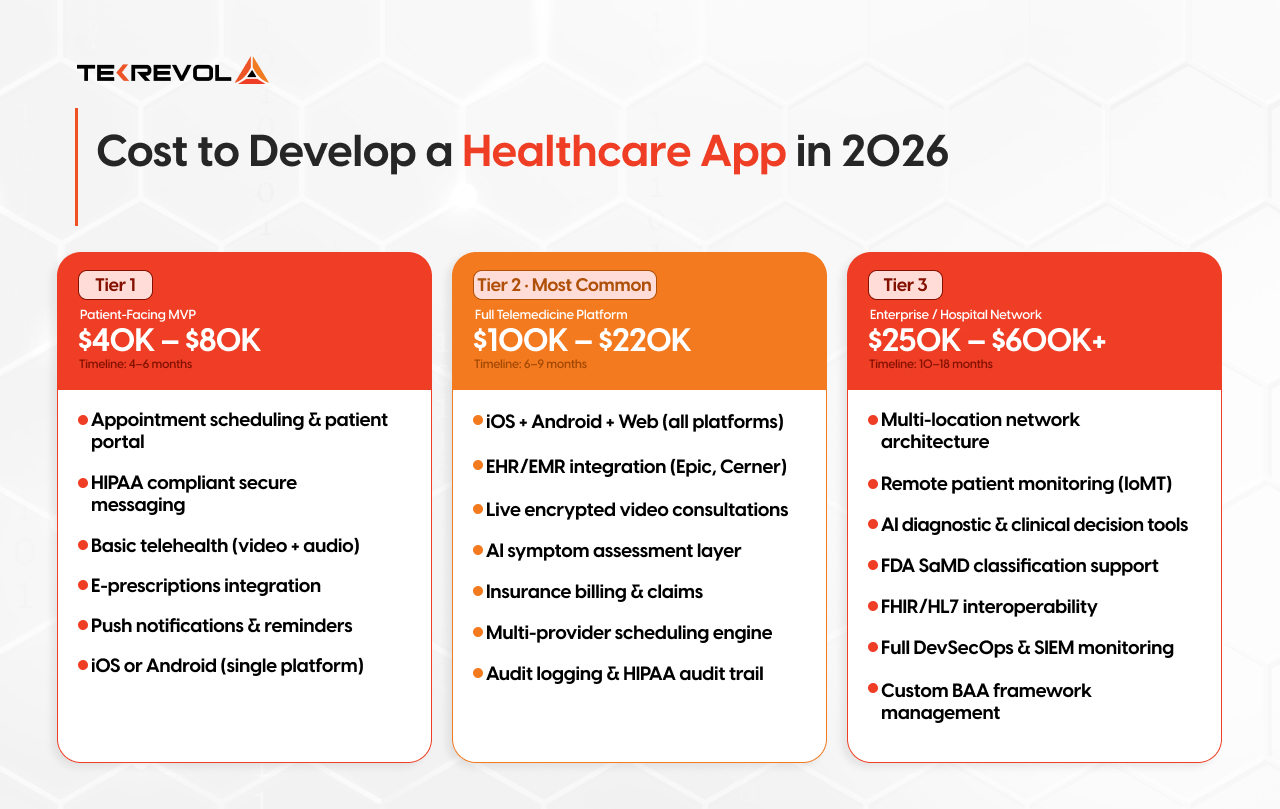
Most quotes don’t include HIPAA compliance infrastructure. Adding HIPAA infrastructure retroactively costs 2–4× more. If you’re still deciding between a full build and a phased approach, MVP app development in Miami follows the same principle — compliance scope needs to be locked before the first sprint, not after.
Always ask: Does this quote include end-to-end PHI encryption, audit logging, BAA management, and access control architecture?
What is HIPAA Compliant App Development?
HIPAA compliance in a mobile app is a set of overlapping architectural, legal, and operational requirements that touch every layer of your application. Here’s what your healthcare app development partner in Miami needs to build from the ground up.
The Real Cost of Getting It Wrong
The Office for Civil Rights processed 21 enforcement actions in 2025, the second-highest annual total in HIPAA enforcement history. In 2026, OCR expanded its enforcement initiative to include risk management, not just risk analysis. That means documenting risks is no longer enough; you have to prove you acted on them. The financial exposure is significant and tiered by culpability.
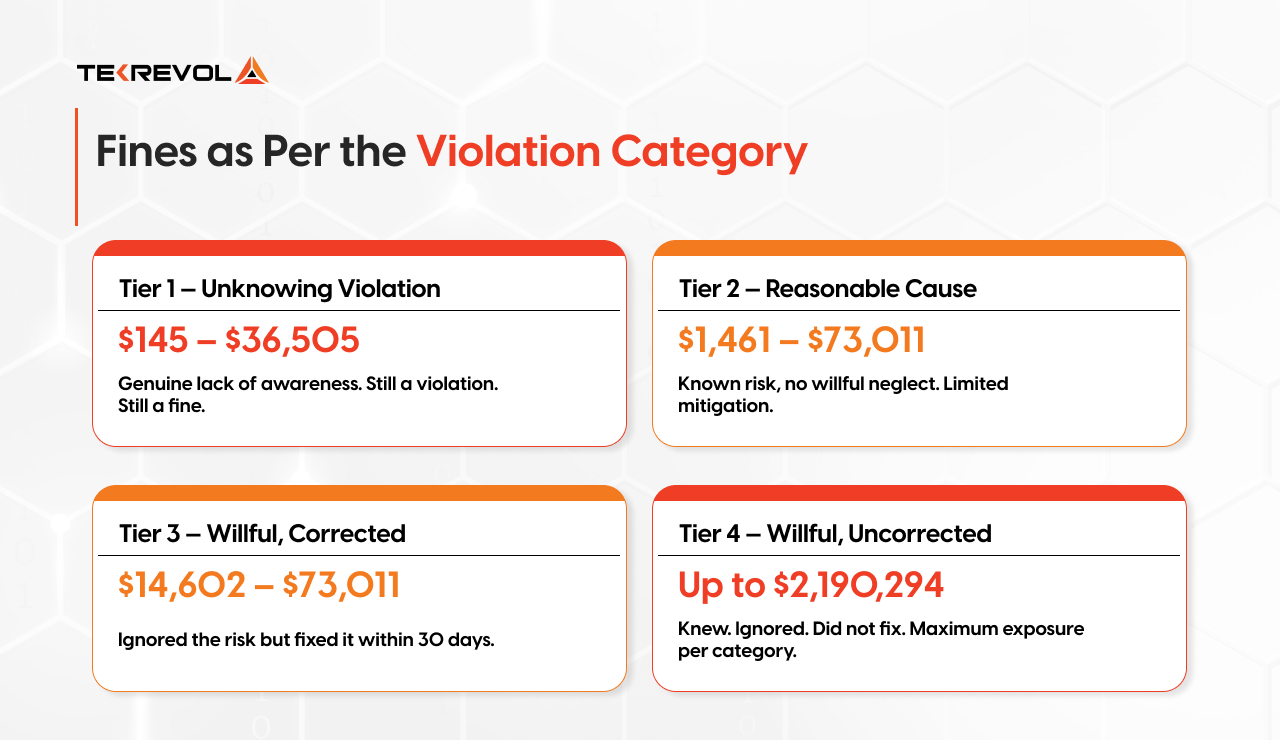
And those fines are per violation category. A non-compliant healthcare app that violates multiple provisions simultaneously, say, improper PHI storage, missing access controls, and delayed breach notification, can face stacked penalties across each category, with an annual cap of $1.5 million per category. Meanwhile, the average healthcare data breach costs $10.22 million in 2026, which includes fines, legal fees, notification costs, remediation, and reputational damage that takes years to quantify.
The Basic Technical Pillars of HIPAA Compliant App Development
When TekRevol builds a HIPAA-compliant healthcare app, these are the non-negotiable architectural requirements that go into every build, regardless of budget tier.
- End-to-end encryption (AES-256 at rest, TLS 1.3 in transit) for all Protected Health Information
- Role-based access control (RBAC) with least-privilege principles across all user types
- Complete audit logging, every PHI access, modification, and transmission is timestamped
- Business Associate Agreements (BAAs) are signed with every third-party vendor touching PHI
- Breach notification architecture, 60-day notification window, automated detection triggers
- Data minimization: Collect only the PHI your clinical workflow genuinely requires
- Secure session management with auto-logout and multi-factor authentication
- Annual security risk analysis AND risk management documentation (OCR 2026 requirement)
- HIPAA-compliant cloud infrastructure (AWS HIPAA-eligible services or equivalent)
- Patient consent management with documented audit trails for every consent
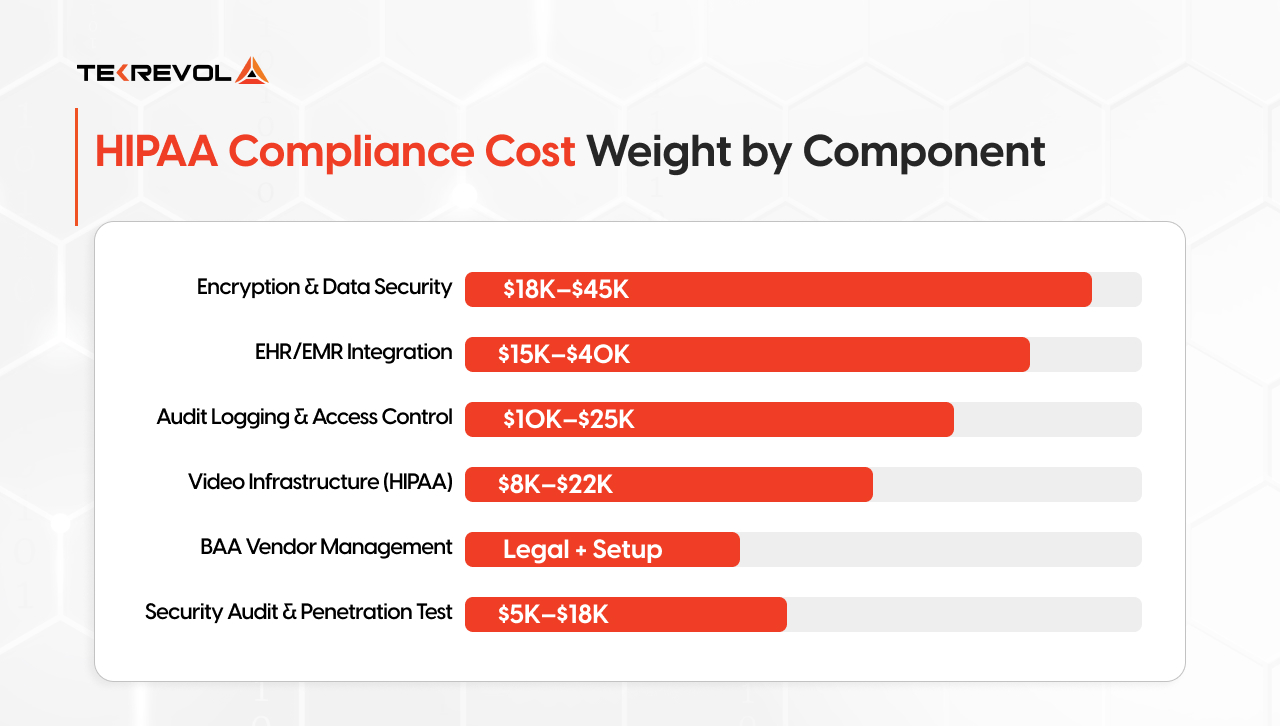
Florida has its own telehealth practice standards under F.S. § 456.47, which govern things like establishing a valid patient-provider relationship remotely, prescription authority via telehealth, and licensure requirements for providers treating Florida-based patients from out of state.
A HIPAA-compliant app architecture handles federal requirements; Florida state law is a separate compliance layer your legal team and technical architect need to address jointly before development begins.
Not Sure If Your Planned Architecture Is Truly HIPAA Compliant?
Our experts will review your technical specifications at no cost, identify compliance gaps, and provide guidance on how to build a secure, HIPAA-ready healthcare solution from the start.
Get Free Compliance ReviewWhy Miami Is a Breakout Market for Digital Health in 2026
Miami isn’t just a geography for healthcare app development, but also a specific patient profile, a specific regulatory environment, and a specific competitive window that most national players are only beginning to understand.
The Miami Healthcare Context
Florida is consistently ranked among the top US states for telehealth adoption, alongside Texas, driven by its large, geographically dispersed population and a significant proportion of older adults managing chronic conditions.
Miami-Dade County is home to one of the highest concentrations of Spanish-speaking households in the US, making bilingual UX design not a nice-to-have but a clinical requirement for any app that aims for meaningful patient engagement. The county’s high proportion of uninsured and underinsured residents also creates genuine demand for telehealth as a primary care access point.
The city’s tech ecosystem has matured rapidly since 2020. Miami is now home to over 3,000 tech companies, a growing network of health-tech investors, and proximity to the University of Miami Health System and Jackson Health System, two institutions actively seeking digital health partnerships.
For a mobile app development partner with healthcare expertise, Miami’s density of potential clinical partners is genuinely unusual among US markets outside of Boston and San Francisco.
The Market Numbers That Matter
| Market Indicator | Figure | Implication for App Builders |
| US Telehealth Market (2026) | $59.72B | Early movers in Miami’s bilingual market have a first-mover advantage |
| US Digital Health Market (2026) | $149B | Investor appetite for compliant digital health platforms is at an all-time high |
| Telehealth CAGR (2026–2034) | 18.4% | Annual growth compounds your platform’s value year over year |
| Florida Telehealth Adoption | Top 3 US States | Patient behavior has already shifted, demand exists, not a market-creation challenge |
| Avg. Healthcare Breach Cost | $10.22M | HIPAA compliance is the single best risk-adjusted investment in your build |
| Physicians Using Telehealth | 71.4% | Clinical adoption has crossed the threshold, and providers want digital tools |
Phase-Wise Cost to Develop a Healthcare App
The cost to develop a healthcare app is more predictable than most clients expect if you scope it correctly upfront. Here’s how the budget allocates across each development phase, with the compliance infrastructure that differentiates healthcare from standard app builds.
Phase 1 — Clinical Discovery & Compliance Architecture
Standard app development agencies run a 2-week discovery process. For healthcare, this phase needs to be longer and more rigorous. You’re mapping clinical workflows (not just user flows), defining your PHI data model, determining your FDA classification exposure, establishing your BAA vendor list, and producing a security risk analysis before a single screen is designed.
Budget: $6,000–$18,000. Skip this, and you will pay multiples of this cost in compliance remediation later. Our healthcare app development practice treats clinical discovery as a compliance deliverable, not a design exercise.
Phase 2 — Clinical UX/UI Design
Healthcare UX is different. People open your app during stressful moments, in a waiting room, during a medical crisis, while wearing exam gloves, in poor lighting. Clarity, speed, and error prevention matter more than visual polish. A clinical UX process includes usability testing with real patients and providers, not just design team reviews.
Budget: $12,000–$35,000. The design system you build here should also accommodate bilingual content, English and Spanish, from the outset if you’re building for Miami’s patient population.
Phase 3 — Backend & HIPAA Infrastructure
This is where healthcare app development diverges most sharply from standard mobile development. The backend doesn’t just process data; it must encrypt, log, control access to, and protect every piece of PHI in ways that survive a regulatory audit.
This includes HIPAA-eligible cloud configuration, end-to-end encryption implementation, role-based access control, audit trail database architecture, and the secure API design that EHR systems require.
For cloud application development in healthcare, we configure AWS HIPAA-eligible services (or equivalent GCP/Azure stacks) and sign Business Associate Agreements with every vendor at this phase.
Budget: $30,000–$150,000.
Phase 4 — Frontend & Telemedicine Feature Development
The patient-facing and provider-facing applications. For telemedicine specifically, this includes HIPAA-compliant video infrastructure (Twilio Healthcare, Daily.co with BAA, or custom WebRTC implementation), secure in-app messaging, appointment scheduling, prescription management UI, and notification systems.
For iPhone app development in healthcare, Swift’s native frameworks offer superior integration with Face ID biometric authentication, an important HIPAA-aligned access control mechanism.
Budget: $25,000–$90,000.
Phase 5 — Clinical QA, Security Testing & Penetration Testing
Standard QA tests functionality. Healthcare QA tests functionality, security, and compliance. Penetration testing, vulnerability scanning, HIPAA-specific security audit, PCI-DSS compliance for payment flows, and cross-device testing across iOS, Android, and web.
This phase often surfaces security issues that require backend remediation, budget for iteration, not just testing.
Budget: $8,000–$30,000.
Phase 6 — Launch, Compliance Documentation & Monitoring
App Store submission, production infrastructure hardening, monitoring setup (SIEM, intrusion detection), final compliance documentation package, and staff training materials. The 90-day post-launch monitoring window is particularly important in healthcare; real patient data exposes edge cases that staging environments never will.
Budget: $6,000–$20,000.
| Phase | Standard App | Healthcare / HIPAA App | Compliance Multiplier |
| Discovery & Architecture | $3K–$8K | $6K–$18K | 1.5–2× |
| UI/UX Design | $8K–$20K | $12K–$35K | 1.4–1.8× |
| Backend Development | $20K–$55K | $30K–$150K | 1.8–3× |
| Frontend Development | $15K–$35K | $25K–$90K | 1.5–2.5× |
| QA & Security Testing | $4K–$12K | $8K–$30K | 2–3× |
| Launch & Monitoring | $3K–$8K | $6K–$20K | 1.5–2× |
| Total | $53K–$138K | $87K–$343K | 1.7–2.5× avg |
The compliance premium in healthcare app development is roughly 1.7–2.5× of the standard app development costs in Miami. The figure sounds significant until you compare it to the $10.22M average cost of a healthcare data breach.
Built correctly from day one, HIPAA compliance is the cheapest insurance your healthcare startup will ever buy.
Healthcare App Types and How Each Affects the Cost?
Not every healthcare app is the same compliance or engineering challenge. Here’s how the most common digital health app categories in Miami differ in cost, complexity, and HIPAA exposure.
Telemedicine App Development
The highest-demand category in Miami’s healthcare market. A telemedicine platform must handle HIPAA-compliant live video, secure patient-provider messaging, e-prescription workflows, insurance verification, and appointment scheduling across multiple providers and specialties.
The video infrastructure alone, choosing, configuring, and signing a BAA with a HIPAA-eligible video API provider, requires dedicated engineering effort familiar to fintech app builders in Miami. Both verticals require regulated third-party integrations that have to be scoped before the build begins, not treated as plug-and-play additions.
- Cost range for telemedicine app development in Miami: $90,000–$250,000.
Patient Portal & EHR Integration Apps
Apps that give patients direct access to their health records, lab results, and care team communications, all connected to an existing EHR system like Epic or Cerner. The core complexity is the EHR integration layer: each EHR vendor has different API specifications, different data models, and different BAA requirements.
FHIR R4 interoperability standards make this more tractable than it was five years ago, but it’s still a 3–6 month engineering effort depending on integration depth.
- Cost range: $70,000–$200,000.
Our on-demand app development practice has deep experience with the real-time data synchronization requirements these integrations demand.
Remote Patient Monitoring (IoMT) Apps
Apps that connect to wearables and medical devices, blood pressure monitors, glucose meters, pulse oximeters, cardiac monitors, and stream real-time health data to a provider dashboard. The IoMT integration layer is unique: you’re writing device drivers, handling Bluetooth and Wi-Fi communication protocols, and managing a real-time data pipeline that can’t drop readings.
Add FDA Software as a Medical Device (SaMD) classification considerations for anything that influences clinical decisions, and this becomes your most complex build category.
Cost range: $120,000–$400,000+.
Mental Health & Behavioral Health Apps
Mental health and behavioral healthcare apps are among the fastest-growing healthcare categories, especially in diverse cities like Miami, where bilingual accessibility is increasingly important. These platforms handle highly sensitive patient information, including therapy records, psychiatric assessments, and behavioral health history, making HIPAA compliance and secure infrastructure critical from day one.
Beyond compliance, the complexity also lies in the user experience. Mental health apps often require private communication channels, personalized wellness journeys, progress tracking, appointment management, and engagement-focused design that encourages long-term user retention and trust.
| App Type | Cost Range | Timeline | Primary Compliance Risk |
| Telemedicine Platform | $90K–$250K | 6–9 months | Video infrastructure, BAA management |
| Patient Portal + EHR Integration | $70K–$200K | 5–8 months | FHIR interoperability, data provenance |
| Remote Patient Monitoring (IoMT) | $120K–$400K+ | 8–14 months | FDA SaMD classification, device security |
| Mental / Behavioral Health | $80K–$200K | 5–9 months | Sensitive PHI classification, crisis workflows |
| Hospital Network / Enterprise | $250K–$600K+ | 10–18 months | Multi-site architecture, SIEM, full DevSecOps |
The Tech Stack Behind HIPAA-Compliant Healthcare Apps in 2026
Healthcare apps don’t just need good technology; they need technology that can survive a regulatory audit. Every component choice has a compliance implication. Here’s what we use and why.
Native vs Cross-Platform for Healthcare
Healthcare apps have a specific argument for native development: Face ID and Touch ID biometric authentication, which satisfies HIPAA’s ‘something you are’ multi-factor authentication requirement, integrates far more reliably via native Swift on iOS than through cross-platform frameworks.
If you’re deciding which platform to launch on first, the iOS vs Android comparison for Miami breaks down how that decision plays out across different audience profiles and compliance requirements.
| Cross-Platform (Flutter / React Native) | Native Swift + Kotlin Clinical Grade |
| Faster MVP delivery for patient-facing apps | Direct Face ID / Touch ID — HIPAA MFA |
| Shared codebase reduces initial cost by 25–35% | Native HealthKit + Google Health Connect |
| Adequate for scheduling and messaging apps | Best Bluetooth medical device integration |
| Limited Bluetooth medical device support | Superior encrypted local storage (Secure Enclave) |
| HealthKit/Health Connect integration is indirect | Preferred for IoMT and clinical decision apps |
AI-Powered Healthcare Features in 2026
In 2026, AI is no longer a differentiator in healthcare apps; it’s becoming a baseline expectation. Patients now expect intelligent symptom triage, medication reminders with dosing awareness, and personalized care experiences, while providers increasingly rely on AI-assisted documentation, automated workflows, and clinical decision support tools.
But in healthcare, AI implementation is not just about functionality; it’s about compliance. AI development services in this space must operate within HIPAA-compliant, audit-ready infrastructures where patient data remains secure, traceable, and properly governed at every stage of processing.
Hidden Costs in Healthcare App Development Nobody Mentions Upfront
The invoice at launch is not your total cost. These are the ongoing expenses that healthcare app founders consistently underplan for, until they’re paying them under pressure.
| Hidden Cost Category | Annual Estimate | Why It’s Non-Negotiable |
| Security Risk Analysis (Annual) | $5K–$20K/yr | OCR now requires documented risk management alongside risk analysis |
| Penetration Testing | $8K–$25K/yr | Standard practice and increasingly required by healthcare enterprise clients |
| HIPAA-Compliant Cloud Hosting | $1K–$15K/mo | HIPAA-eligible AWS services cost more; the BAA is worth the premium |
| Compliance Legal Counsel | $5K–$30K/yr | BAA reviews, state telehealth law updates, OCR correspondence |
| App Maintenance & OS Updates | 15–20% of build/yr | iOS and Android updates break healthcare integrations regularly |
| Breach Response Preparation | $10K–$50K plan | OCR requires documented incident response plans; reactive planning costs more |
| Staff HIPAA Training | $2K–$8K/yr | Required for covered entities; gaps here are among the most common OCR findings |
Healthcare App Development Timeline in 2026
Healthcare apps take longer than standard apps, not because development is slower, but because compliance documentation, clinical testing, and EHR integration have timelines that parallel development and can’t be compressed below a safe threshold.
MVP Telemedicine App — 5 to 7 Months
- Clinical Discovery + Compliance Architecture (Weeks 1–3)
PHI data model, BAA vendor list, security risk analysis, Florida telehealth law review, technical spec.
- Clinical UX/UI Design + Provider Testing (Weeks 4–7)
Patient and provider flows, bilingual design system, prototype testing with real clinical users.
- Backend + HIPAA Infrastructure (Weeks 6–14)
HIPAA-eligible cloud setup, encryption, audit logging, access controls, video API integration + BAA.
- Frontend Development (iOS + Android) (Weeks 10–18)
Patient app, provider app, all screens, biometric authentication, push notifications.
- Clinical QA + Security Testing (Weeks 19–22)
HIPAA-specific security audit, penetration testing, and functional QA across all clinical workflows.
- Launch + Post-Launch Monitoring (Weeks 23–28+)
App Store submission, production hardening, 90-day monitoring, and compliance documentation delivery.
Full Enterprise Healthcare Platform — 10 to 18 Months
| Phase | Duration | Healthcare-Specific Deliverable |
| Clinical Discovery + Legal | 4–5 weeks | BAA framework, FDA SaMD risk assessment, FHIR spec |
| Clinical UX/UI System | 6–8 weeks | Provider dashboard, patient portal, emergency escalation UX |
| Backend + Compliance Infrastructure | 10–16 weeks | EHR integration, HIPAA cloud, SIEM, audit database |
| AI + IoMT Integration | 6–12 weeks | Device drivers, real-time monitoring pipeline, ML clinical layer |
| Frontend (iOS + Android + Web) | 8–12 weeks | All platforms, biometric auth, offline clinical data caching |
| Security Audit + Penetration Testing | 3–5 weeks | Third-party security audit, HIPAA compliance certification prep |
| Launch + Ongoing Support | Ongoing | DevSecOps, incident response, quarterly compliance reviews |
Why Choose TekRevol for Healthcare App Development in Miami
There are dozens of mobile app and software development companies in Miami, and most can build a functional app. Very few have a documented 100% HIPAA compliance record across 60+ healthcare applications, an in-house clinical compliance team, and the case studies to back it up.
100% HIPAA Compliance Record
Every healthcare app we’ve shipped has passed regulatory scrutiny. We’ve never had a client face an OCR enforcement action on a TekRevol-built application. That record exists because compliance is architecture, not an afterthought.
Real Clinical Portfolio
Kinekt, Nurse Practitioners, Libido Health, and several other real apps, used by real patients, with real PHI flowing through a HIPAA-compliant infrastructure we designed. These aren’t ‘healthcare-adjacent’ builds. They’re clinical-grade platforms.
Miami Market Understanding
We understand Miami’s bilingual patient demographics, Florida’s telehealth statute requirements, and the specific integration landscape of South Florida’s major health systems. Local context matters in healthcare UX design.
AI-Native Healthcare Development
GPT-4 clinical note summarization, AI symptom triage, behavioral health AI coaching, we build AI into healthcare architectures that are HIPAA-compliant and clinically validated before they touch a single patient record.
End-to-End, One Team
Strategy, UX design, HIPAA architecture, iOS and Android development, EHR integration, security testing, App Store launch, and post-launch monitoring. One accountable team across every deliverable, no vendor coordination risk.
ISO 27001 Certified
Our ISO 27001 certification means your healthcare app is built on a security management system that goes beyond HIPAA’s requirements. It’s the credential that enterprise healthcare clients and health system partners look for first.
Book a 30-Minute Call with Our Clinical Healthcare Architects
We’ll review your healthcare concept, assess HIPAA exposure, and provide a realistic cost range with a written breakdown delivered within 72 hours.
Book Your Free Consultation


