



The digital healthcare market is experiencing one of the most significant changes in modern medicine. The use of AI, wearables, and telehealth is transforming the world of healthcare, unlike any other person would have expected.
Over the decades, medical care has been confronted with the issue of disjointed systems, rising expenses, and the inability to access care.
All those are being broken down, and innovation is doing the job. Electronic health records are now intelligent. Remote monitoring is being used instead of unnecessary visits to the hospital. Predictive analytics are changing the face of medicine to preventive instead of curative medicine.
However, even with this momentum, execution is the biggest challenge. Building digital health solutions that actually work takes deep expertise and a clear vision.
This is why collaborating with a reputable healthcare app development company has now become a vital choice for health systems, start-ups, and businesses.
This blog provides in-depth research on the digital healthcare market, digital healthcare market trends, and investment prospects to provide decision-makers with the knowledge they require to take action with confidence.
The Digital Healthcare Market: Size & Growth
Before plunging into healthcare industry trends, here is the landscape. The digital health market has established itself as one of the foundation pillars of the contemporary economy globally. The numbers vary depending on who you ask and how they measure it, but everyone is pointing in the same direction: this market is growing fast.
The digital healthcare market will achieve a value of about $483 billion in 2026 and an estimated value of more than 1.17 trillion in 2035. Some estimates go even higher. The U.S. healthcare market is expected to grow from $5.15 trillion in 2026 to $8.09 trillion by 2034.
Regional Market Highlights:
- North America: The U.S. digital health market is projected to grow from $88.38 billion in 2025 to $266.5 billion by 2035, a CAGR of 11.67%.
- Europe: Europe is not far behind. Its digital health market is forecast to more than double in just five years, climbing from $113.94 billion in 2026 to $258.74 billion by 2031.
- Asia-Pacific: In Asia-Pacific, the consumer healthcare market is set to more than double over the next decade, rising from $54.59 billion in 2024 to $119.94 billion by 2033, hence the most active growth driver in the world.
- Global digital health ecosystem: The industry has a workforce of about 13.8 million providers across the world and has over 118,000 businesses with in excess of 7,500 startups underway.
The digital revolution in the healthcare market is not a hypothetical investment thesis anymore, but a structural economic fact driven by healthcare solutions that are changing the digital landscape.
Health spending in the world is projected to hit $6.2 trillion in 2028, and digital health solutions are rapidly becoming a major part of executing this value more effectively and fairly.
The demand for smarter, faster, more accessible healthcare has never been louder.
Partner with TekRevol and build the solution the market is waiting for.
Book a Consultation Now!The demand for smarter, faster, more accessible healthcare has never been louder.
Partner with TekRevol and build the solution the market is waiting for.
Book a Consultation Now!
Top Digital Health Market Trends Transforming Healthcare in 2026
To capture opportunities on the fly, investors, health systems, startups, and technology partners must take note of the forces that are shaping the digital health market. Digital healthcare market trends are reshaping healthcare fast. The world is changing with new trends, changing the manner care is given, the way providers practice, and the way the patient perceives the system.
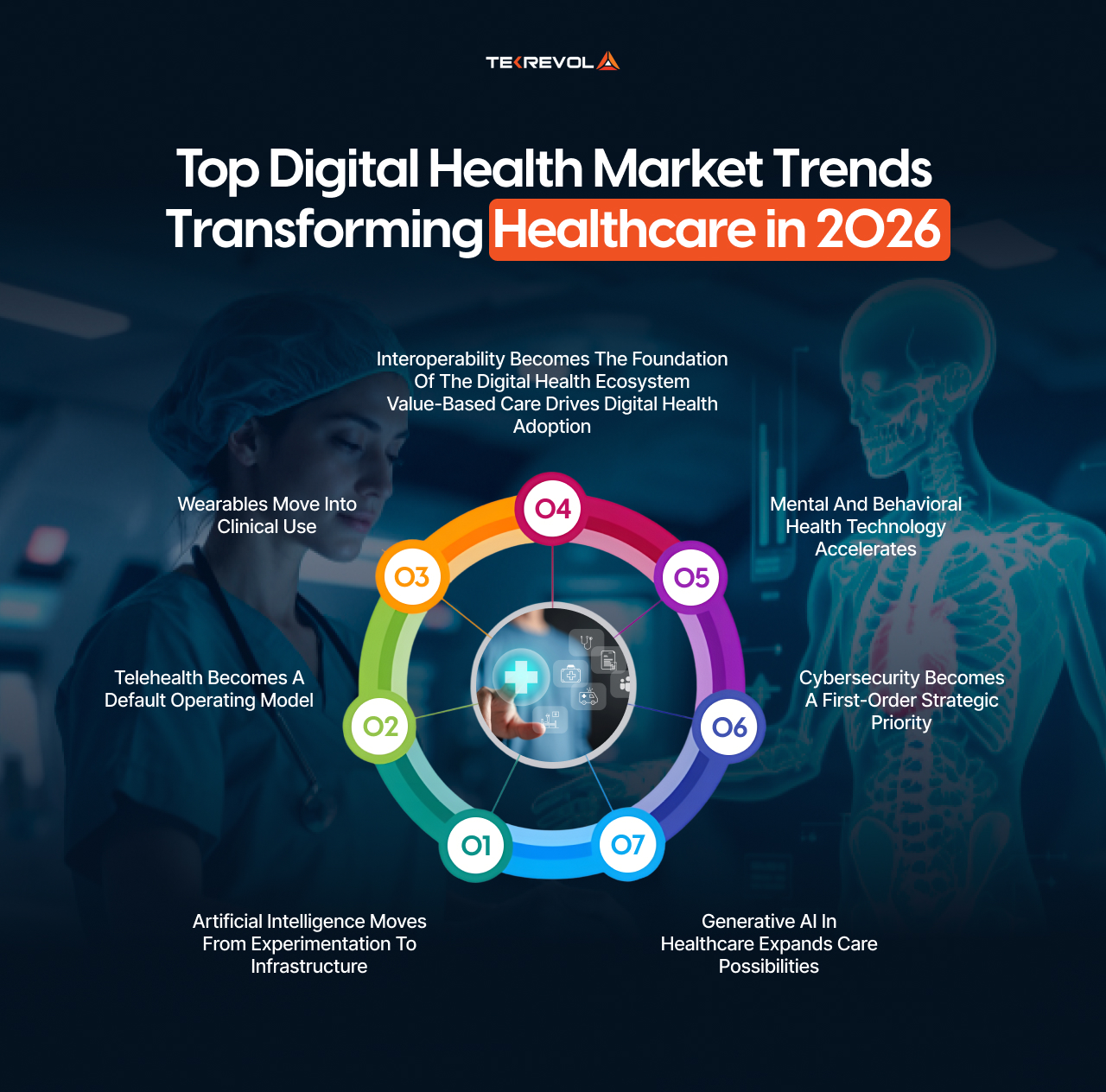
Trend 1: Artificial Intelligence Moves from Experimentation to Infrastructure
Artificial intelligence is no longer a pilot that becomes experimental. AI has now been integrated into clinical decision support, diagnostics, administrative automation, and engagement of patients on a large scale.
AI-enabled transformation in healthcare records and document conversations in real time, saving doctors time and easing their workload. Applications of machine learning in healthcare can analyze medical images with the same precision as specialists, and generative AI interfaces enable patients to analyze personal health information before appointments.
Trend 2: Telehealth Becomes a Default Operating Model
Telehealth is not a secret method anymore, but a cornerstone care framework. Remote monitoring, asynchronous consultation, home diagnostics, and hybrid care coordination are now categorized under virtual care.
The patients are growing towards a single path:
- AI symptom checker
- Virtual consultation
- Seamless in-clinic follow-up
This evolution is a direct result of app development solving the biggest healthcare challenges, from improving access to care to creating continuity to making delivery more efficient.
Trend 3: Wearables Move Into Clinical Use
Wearable technology in the healthcare sector has become a strong health monitoring ecosystem that is able to measure the variability of the heart rate, oxygen saturation, sleep, stress, and early signs of chronic conditions.
Clinical acceptance of wearable data is accelerating. Sensors and home diagnostics are no longer peripheral; they are being built into clinical workflows and regulated accordingly. When the team is oriented towards the development of medical apps, the wearable information must be safely integrated into next-generation patient monitoring.
Trend 4: Interoperability Becomes the Foundation of the Digital Health Ecosystem
Interoperability is transforming the sharing and use of patient data by health stakeholders. Standards such as FHIR and TEFCA are promoting the flow persistence, faultlessness, and exchange of audit-related data.
By making interoperability a priority, it becomes possible to provide better coordinated care, have a clearer view of patients over time, and be able to innovate with scales across the ecosystem.
Trend 5: Value-Based Care Drives Digital Health Adoption
The healthcare investment priorities are changing because of value-based care. The existing purchasers are now demanding measurable outcomes, which involve reduced expenses, improved patient results, and functional efficiency.
Digital health solutions that prove real-world impact are gaining traction, while those without a clear reimbursement strategy are struggling to scale.
Trend 6: Mental and Behavioral Health Technology Accelerates
Digital mental health is a growing phenomenon at a rapid pace. Adoption is being driven by workforce gaps, greater awareness, and actual clinical effectiveness. There is also the use of behavioral data, patient-reported outcomes, and AI to compute interventions and provide them at scale across platforms.
These technologies are broadening access to care among populations that the traditional systems have been unable to access.
Trend 7: Cybersecurity Becomes a First-Order Strategic Priority
With the increasingly integrated nature of healthcare systems, cybersecurity has now been placed as a priority at the board level. To protect sensitive health data, organizations are spending on zero-trust architecture, encryption, and modern threat recognition.
The consideration of security has become a key factor when choosing the technology, which supports the significance of trust in the digital health innovation.
Trend 8: Generative AI in Healthcare Expands Care Possibilities
The emergence of generative AI in healthcare is introducing completely new forms of providing care to patients. There is now the capability of AI models to give personalized treatment recommendations, synthesize medical literature to guide clinicians, and even simulate patient outcomes to plan complex interventions.
The incorporation of generative AI into apps is allowing providers to address some of the most unapproachable problems in healthcare, such as delays during diagnosis or individualized care planning, on a large scale.
The patients waiting for better healthcare can't afford delays.
Build your healthcare app with TekRevol and deliver the difference they deserve.
Talk to our healthcare experts!The Digital Health Market by Segment
There is a wide range of technology types in the digital health market, each having its own growth paths, competitive forces, and investment patterns.
Telehealthcare, The Dominant Force
Telehealthcare is expected to keep dominating the digital health market, estimated to be 59.5 percent in 2025. COVID-19 was the turning point. Patients tried virtual care out of necessity and found it worked, often better than in-person visits for managing chronic conditions and mental health.
The world telehealth market itself is bound to grow to $175 billion in 2026 as a result of developments in EHR integration, support of multilingual platforms, and employer-sponsored virtual care programs. At the same time, the mHealth market is expected to achieve the highest growth rate, due to the intersection of mobile technology, artificial intelligence, and the growing clinical validation models.
mHealth and Mobile Applications
The second-largest segment, and probably the most apparent to average consumers, is mobile health (mHealth), which includes apps, wearables, and distance monitoring devices. A wearable device to monitor health is now utilized by over one in every three American adults.
Doctors are adapting faster than many expected. Between 2016 and 2022, remote monitoring use among U.S. physicians grew from 12 to 30 percent, and the average number of digital health tools they use day to day has nearly doubled.
Women’s health and mental health apps are other subsegment growth drivers. In 2022, the NHS recorded that 47% of individuals in the UK accessed health apps, which was an increase of 38% the previous year. This shows that utilizing mHealth can scale to the level that traditional healthcare delivery methods are incapable of matching.
AI and Clinical Decision Support
The digital healthcare market is witnessing a swift growth in AI and clinical decision support due to the development of large language models, medical imaging analysis, predictive analytics, and ambient clinical intelligence. The use of AI-enabled tools is shifting to selective deployments to embedded infrastructure in health systems of all sizes.
Remote Patient Monitoring
Remote patient monitoring is expanding at a quicker rate than volumes in outpatient visits and is one of the most clinically meaningful market segments. RPM has developed into chronic care support to provide continuous, proactive home-based care, which allows clinicians to monitor patients in an ongoing instead of an episodic fashion.
Digital Therapeutics
Digital therapeutics is a validated technology that is used to treat health conditions, and it is becoming accepted by Health insurers.
Some of the conditions treated include diabetes, substance use disorder, insomnia, anxiety, and cardiovascular disease. The trend of value-based care that has historically led to improved opportunities broadly is taking root, and payers are becoming more aware of their long-term cost-efficacy.
Investment Landscape & Market Opportunities
The digital health investment arena is experiencing new momentum after a lengthy period of heavy adjustment following the 2021 funding peak. In the United States, digital health funding in 2025 crossed its highest point with 482 deals, totaling $14.2 billion, due to the integration of AI, growing deal volumes in M&A, and the resurgence of digital health IPOs because of credible and revenue-producing businesses.
Where the Opportunities Are in 2026:
- The AI-powered clinical tools are attracting serious investments, especially in ambient documentation, clinical decision support, and diagnostic imaging AI. The value proposition is these three fold: administrative burden will be reduced, accuracy will be enhanced, and cost will be decreased. These are issues that health systems will spend on getting resolved.
- Capital is still flowing into telemedicine app development, but not evenly. The market is maturing, and the leaders are becoming easier to spot. Capital is moving toward platforms that demonstrate strong unit economics, depth in specific specialties, and authentic EHR integration. Generic video visit tools are losing the room.
- Mental and behavioral health is one of the least funded in terms of funding versus demand. Technology-based platforms that offer licensed clinical services as opposed to mere wellness content are experiencing intense growth and retention.
- Another high conviction area is chronic disease management. Most healthcare expenditure is motivated by diabetes, hypertension, obesity, and cardiovascular disease. Digital solutions that prove to be beneficial in these categories have a direct way to payer and employer contracts.
- Interoperability and data infrastructure in healthcare are less apparent but are gaining significance. Behind every digital health solution are the companies building the foundational infrastructure, health information exchanges, FHIR-based APIs, and clinical data platforms. They rarely make headlines, but everything runs on what they build.
The rate of market consolidation in 2026 is accelerating. Many of the smaller digital health subscale firms are emerging as takeover targets by bigger firms that want to increase their client base, feature more product capabilities, and attain the needed scale to be profitable over the long term.
Digital Transformation in Healthcare: Challenges and How to Navigate Them
The healthcare market’s digital transformation does not come without its intricacies. There are numerous challenges that organizations operating in this environment must confront continuously, and they need to deal with them strategically to realize the full potential of digital health investment.
Regulatory Complexity
Across the globe, digital health regulations are changing rapidly, just not at the same rate or in the same direction. The growing FDA regulations on AI-assisted medical device software, the implementation schedule of the EU AI Act, the HIPAA compliance regulation, and the sovereignty of data regulation by international authorities present an intricate compliance environment.
In 2026, regulatory compliance is no longer a barrier to innovation; it is a competitive advantage. Companies that build compliance into their core product will move through procurement faster and hold stronger market positions.
Data Quality and Integration
The quality of the underlying health data, its completeness, and interoperability are the key to the promise of AI and predictive analytics in the healthcare sector.
In 2026, data readiness may be the most important investment a health organization can make. Clean, structured, semantically consistent clinical data is what makes AI models actually work.
Clinical Adoption and Change Management
Technology that clinicians do not adopt does not improve care. Solutions that are designed with frontline clinician input, that reduce administrative burden, and that show clear value within existing care delivery models achieve dramatically higher adoption rates and sustainable clinical impact.
Cybersecurity and Privacy
With the movement of patient data through an ever-expanding networked environment, the risk of cybersecurity increases as well. Healthcare organizations should make the investment in the overall security architectures, vendor risk management programs, personnel training, and incident response capabilities not as a compliance practice, but as a critical operational resilience investment.
Health Equity and Digital Inclusion
The immense potential of the digital healthcare market comes with an equally tremendous burden: the digital innovation needs to benefit all groups of people and not only those who have access to technology, are digitally literate, and able to afford the technology. Health equity should be one such design requirement that is imbued into digital health solutions during the design stage.
The Strategic Role of a Healthcare App Development Company
Surviving in the complexity of the digital health market, including its regulatory landscape, clinical workflow needs, interoperability criteria, and security controls demands experience that extends well beyond typical software development. The ones that would succeed in this space in 2026 are those that have selected the right healthcare app development partners that have not only learned how to build technology, but they have also known why it is important in clinical, operational, and commercial terms.
Clinical Domain Knowledge
Specialized healthcare app development companies combine both clinical domain knowledge and technical capacity, which cannot be emulated by generic development firms. Knowing the reality of care delivery, the stressors clinicians experience, the limitations health systems work within, and the demands patients make are the pillars on which meaningful digitized health solutions can be created. Without this knowledge, even technically advanced products fail where adoption is concerned.
Regulatory Expertise
The regulatory environment in the development of medical apps is complicated, area-specific, and constantly changing. Non-compliance is not a minor risk in digital health. The FDA’s software as a medical device framework, HIPAA rules, data privacy concerns, and clinical validation requirements all come with significant consequences.
The most successful healthcare app development firms incorporate regulatory expertise right into their development process, compliance not as a last stage of the development process, but as a design principle.
Interoperability and Technical Architecture
Technical choices made early in development matter more than ever, especially as FHIR compliance becomes mandatory and health systems favor vendors who work within open data ecosystems. Efficient healthcare app development firms design interoperability solutions at the beginning of the project, enabling products to be compatible with electronic health records, third-party platforms, and emerging data infrastructure without the need to do costly rework.
Outcome-Oriented Development
The best digital health organizations in 2026 are not just building technology; they are building it with clinicians, around real needs, and measuring it against outcomes that actually matter. An app development partner with a strategic focus on a healthcare venture introduces this orientation to each engagement, so that success is not determined by a product launch, but the resulting clinical and operational impact.
Where Digital Health Is Headed Next
The digital health market isn’t slowing down; it’s compounding. Every trend accelerating today is laying the groundwork for something bigger tomorrow, and the organizations paying attention now will be the ones best positioned to lead.
Data-driven care is becoming the default.
Evidence-based practice is turning into the norm. Two of the most rapidly expanding spheres of digital investment are mental health and women’s health, but both were previously underserved historically. In 2024 alone, the U.S. Department of Defense allocated $500 million to research on women’s health, which is an indication that it is no longer a niche concern but a national priority.
Virtual hospital wards are going mainstream.
The concept of providing care and treatment to the home safely (including the same supervision as an actual ward) has progressed to being committed to at an official policy level. In 2024, the NHS adopted an official structure to make virtual ward occupancy in England over 80% in the name of virtual care, not as a supplement to the hospital bed.
The biggest breakthroughs will come from unlikely partnerships
Cross-sector collaboration is becoming the dominant model for health tech innovation. The 2024 project of Sanofi, Formation Bio, and OpenAI partnership, involving pharma, biotech, and AI experience in creating drugs faster, is a blueprint of how the most effective solutions will be constructed in the future.
AI will move from assistant to decision-maker
The direction is clear. AI will not stay in a supporting role forever. Under the right conditions and with proper supervision, it will make clinical decisions, not just inform them. No longer will the systems that are being developed today be completely reliant on external diagnostic tools, but will have the capabilities of prediction that will indicate patients at risk of deterioration long before the symptoms manifest themselves. The health organizations that put in place governance structures of this now will be the most beneficiaries when it comes on a large scale.
Conclusion
In 2026, the digital health market doesn’t reward ambition alone; it rewards execution. TekRevol, a leading Mobile app development company, brings the clinical depth, technical expertise, and regulatory know-how to turn your digital health vision into a measurable reality.
We’ve built the solutions that health systems trust, the platforms that startups scale on, and the applications that patients actually use.
TekRevol has built across every corner of digital health. Libido Health brings HIPAA-compliant AI coaching to sexual wellness. Kinekt helps care providers act on patient feedback in real time. Synapptic makes digital health accessible to users with visual impairments. The portfolio is as diverse as the industry itself.
If you are ready to build something that genuinely moves the needle in healthcare, we are ready to build it with you.
Got a digital health idea worth building?
TekRevol is ready to help you take it from concept to clinical reality. Share your vision with us.
Schedule A FREE Consultation Now!


