



- TekRevol builds apps out of downtown Austin and has shipped 150+ apps across iOS, Android, and cross-platform.
- Roll App, a martial-arts training platform, reached 10,000+ monthly active users, 35% faster vendor booking, and a 4.8-star average rating.
- The Nurse Practitioners app, built HIPAA-compliant, now serves 25,000+ registered medical professionals and cut clinical workflow time by 55%.
- Stock n Ship, a cross-platform operations app, delivered 40% faster order processing, 20% fewer manual data errors, and 100% real-time inventory accuracy.
- Austin app budgets: most MVPs run $25,000–$60,000, and full-featured apps typically land $80,000–$200,000.
Case studies are where marketing claims go to get tested.
Any agency can say it “delivers world-class apps.” Far fewer can show you the app, name the industry, and hand you the number that changed after launch. That’s the difference between a portfolio and a promise.
Below are projects that TekRevol’s Austin app development team has delivered. Each covers what the client needed, what we built, and the result that came out the other side. And if you’re evaluating a mobile app development company in Austin right now, read these the way a skeptical stakeholder would. Look for the number.
Want to Discuss Your Own Project Instead of Reading About Someone Else's?
Book a free 30-minute scoping call and get a feature list, project timeline, and realistic budget range tailored to your build.
Schedule Your Free Consultation →Why Austin Founders Ask for Case Studies First
Austin is not a market where you can hide behind a nice homepage.
The city runs on startups, health-tech, logistics, and a downtown investor community that reads pitch decks for a living. When an Austin founder or product lead shortlists an app development company, they’re not asking “can you code?” They’re asking “have you shipped something like mine, and did it work?”
That’s the honest reason case studies matter more here than a services list does. A services list tells you what a company is willing to attempt. A case study tells you what it has already survived: the scope creep, the App Store review, the first 10,000 users, the HIPAA audit.
TekRevol has operated for the last 10 years and works from a downtown Austin office at 701 Brazos St. The projects below were chosen because each one has a documented, specific outcome, not a vibe.
Case Study 1: Roll App — A Martial Arts Platform With 10,000+ Monthly Users
Roll App is a martial arts training platform built for iOS and Android, made for athletes who want to learn technique on their own schedule and actually track their progress.
The core problem was retention. Training apps are easy to download and easier to abandon. The second the experience feels like a chore, the user is gone.
TekRevol focused on two things: self-directed learning that respected the athlete’s pace, and a booking flow smooth enough that scheduling a session never became a reason to quit. The 35% faster vendor booking figure is the one to sit with. It’s not a vanity metric. Faster booking means fewer drop-offs at the exact moment a user decides to commit money and time.
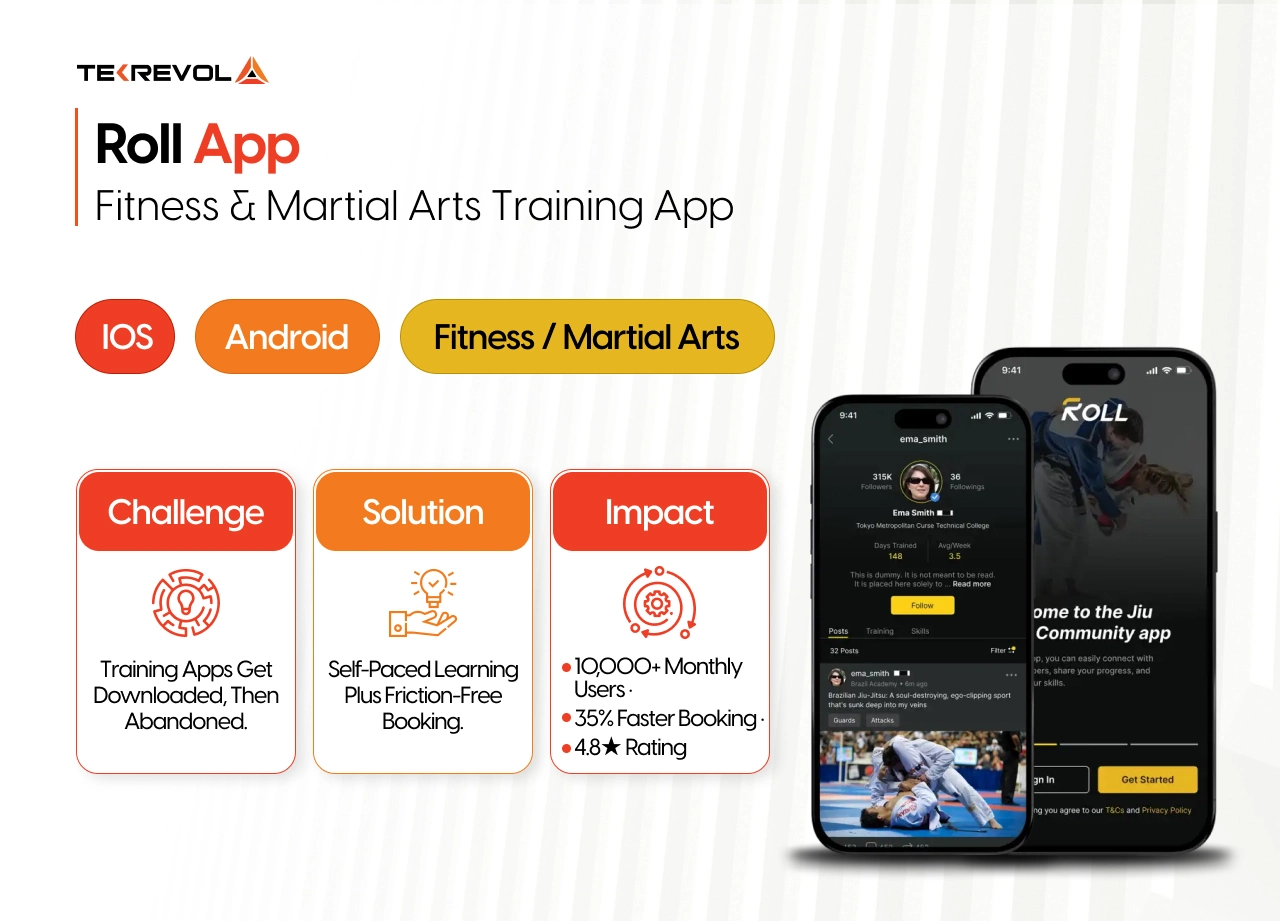
Roll App reached 10,000+ monthly active users, with 35% faster vendor booking. The payoff shows up in the 4.8-star average rating, which on the app stores is the difference between a product people tolerate and one they recommend. Read the full Roll App case study →
Why it matters: a fitness or training app lives or dies on whether the daily experience is frictionless. Roll App is a clean example of engagement engineering; every decision is measured against “does this make the user more likely to come back tomorrow?”
Building Something in Fitness, Sports, or Community?
Bring your concept to a free consultation, and we'll identify the retention risks most likely to slow your product's growth.
Start with a Free App Consultation →Case Study 2: Nurse Practitioners — A HIPAA-Compliant App Serving 25,000+ Medical Professionals
The result first: the Nurse Practitioners app now serves 25,000+ registered medical professionals, integrates 15+ clinical resource tools, and completes clinical workflows 55% faster.
Healthcare apps carry a weight consumer apps don’t: get the compliance wrong and there is no launch. This was a HIPAA-compliant app for clinical staff; our healthcare app development team scopes around patient-data rules before a single screen gets designed.
The hard part wasn’t a single feature. It was making a compliant healthcare app that clinical professionals actually wanted to open during a shift. TekRevol integrated 15+ clinical resource tools into one workflow so a nurse practitioner didn’t have to jump between systems mid-task. That consolidation is where the 55% faster clinical workflow completion comes from: fewer app-switches, fewer logins, fewer seconds lost per patient, multiplied across a workday.
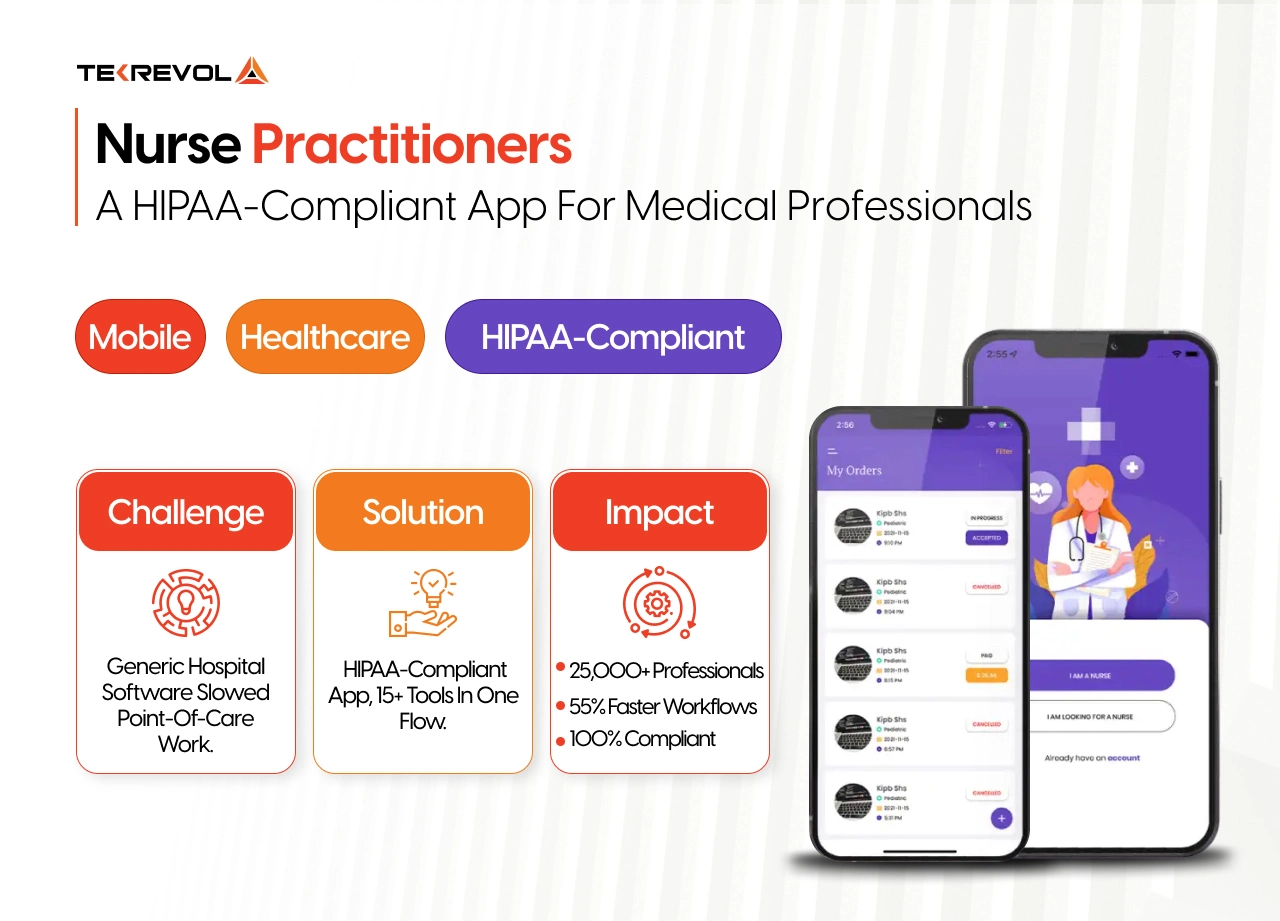
Compliance shaped this architecture from the first sprint rather than the last, which is the single biggest variable in healthcare app development costs in Austin. The 25,000+ registered medical professionals number is the trust signal. In healthcare, professionals don’t adopt tools that feel risky. Reaching that scale means the compliance and the usability both held up under real clinical pressure. Read the full Nurse Practitioners case study →
Why it matters: in health-tech, “we can build it” is table stakes. The question is whether the team understands HIPAA, clinical workflow, and the reality that a doctor will abandon anything that costs them time. This project answered all three.
Have a MedTech Idea Where Compliance Can't Be an Afterthought?
Get a free strategy session with a team that has shipped HIPAA-compliant solutions, and leave with a compliance-aware project scope.
Book a Free Strategy Session →Case Study 3: Stock n Ship — A Cross-Platform Operations App With 100% Inventory Accuracy
The result first: Stock n Ship delivered 40% faster order processing, a 20% reduction in manual data errors, and 100% real-time inventory data accuracy.
Operations software fails quietly. Nobody rage-quits an inventory tool the way they abandon a game; instead, small errors pile up until a warehouse ships the wrong thing to the wrong place and someone loses a customer.
Stock n Ship is an operations and inventory management app built to attack exactly that decay. It’s a logistics software development built and shipped so every location runs on the same live data. The headline outcome is 100% real-time inventory data accuracy, meaning the number on the screen matches the number on the shelf, always, not “after the nightly sync.”
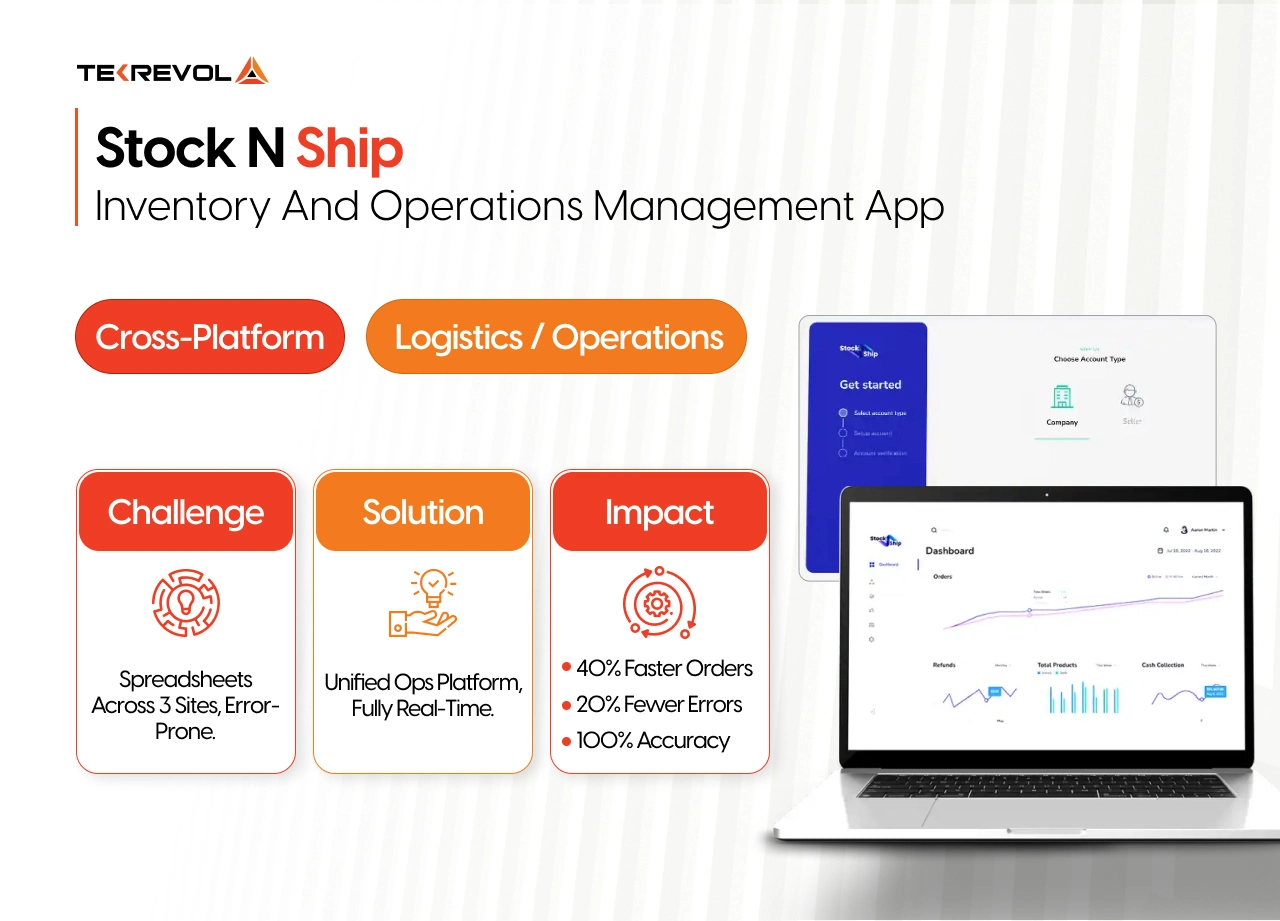
That accuracy cascades. Because the data is trustworthy, order processing runs 40% faster and manual data errors drop 20%. When staff stops double-checking a system they don’t trust, throughput goes up on its own. Read the full Stock n Ship case study →
Why it matters: logistics and operations apps built for Austin don’t buy features; they buy reliability. A single number that’s wrong at the wrong moment costs more than the whole app. Stock n Ship is proof that the boring, high-stakes category inventory, orders, fulfillment is where measurable ROI is easiest to demonstrate and hardest to fake.
Running Logistics, Retail, or Operations That Still Lean on Spreadsheets?
Walk us through your current workflow in a free consultation, and we'll show you where manual processes and errors are costing your business the most.
Discuss Your Project Scope →More Austin Projects in TekRevol’s Portfolio
The three case studies above go deep, but they aren’t the whole Austin story. TekRevol’s Austin roster spans several more products across fitness, AI, consumer, and health:
- Pure Plank — an interactive fitness app guiding a large base of plank-tutorial users through structured, gamified workouts.
- TruthGPT — a real-time fact-checking platform focused on accuracy and fast, verifiable responses.
- MoCuts — a booking app connecting users to barbers and beauticians on demand.
- OnSite — a social platform built around more meaningful, in-person connections.
- MiloCare+ — a health-records product built for faster access to dynamic patient information.
- Soundly — a music-discovery app designed to drive more streams and support for artists.
Each sits in a different category, and that range is itself a signal. An Austin app development company that has shipped across AI development, on-demand app development, healthcare app development, and music app development has already solved the cross-industry problem: auth, payments, scale, and compliance that trip up specialists working outside their lane.
What These Austin Case Studies Have in Common
Read the projects side by side and a pattern shows up. It’s worth naming, because it’s the actual “method” underneath the marketing.
Here’s every case study mapped to its industry, platform, and the single number that defines it:
| Project | Industry | Platform | Defining Result |
| Roll App | Fitness / Martial Arts | iOS & Android | 10,000+ monthly active users; 35% faster booking; 4.8★ |
| Nurse Practitioners | Healthcare (HIPAA) | Mobile | 25,000+ professionals; 55% faster workflows |
| Stock n Ship | Logistics / Operations | Cross-platform | 40% faster orders; 100% real-time inventory accuracy |
| Pure Plank | Fitness | Mobile | Large active tutorial-user base |
| TruthGPT | AI / Media | Mobile | Real-time, higher-accuracy fact-checking |
| MoCuts | On-Demand Services | Mobile | On-demand barber & beautician booking |
Three things repeat across all of them.
Every project targets one measurable outcome. Not “a better experience,” but a specific number: booking speed, workflow time, inventory accuracy, active users. That focus is deliberate. It forces every feature decision to justify itself against a metric a client can report upward.
The metric always maps to the business, not the app. Faster clinical workflows mean more patients seen. Accurate inventory means fewer wrong shipments. The engineering serves a business result the client already cared about before they ever wanted an app.
The category range is the moat. Fitness, HIPAA healthcare, logistics, AI, consumer social solving all of them means the hard, invisible infrastructure work is already done and battle-tested.
That’s the framework worth stealing whether or not you ever hire anyone: before you build, name the one number that has to move. Everything else is decoration.
What Does App Development Actually Cost in Austin?
Most MVPs run between $25,000 and $60,000, and a full-featured app typically lands between $80,000 and $200,000.
That’s a wide range on purpose, because “an app” covers everything from a single-screen MVP to a HIPAA-compliant clinical platform with 15+ integrated tools.
The variables that move the number are the ones you’d expect:
- how many platforms (iOS, Android, or both)
- how much custom backend and third-party integration
- whether you need compliance work like HIPAA, and
- how polished the design has to be at launch
For a line-by-line breakdown of what each of those variables adds, see our full Austin app development cost guide.
The useful way to think about budget isn’t “what’s the cheapest quote.” It’s “what does the result have to be worth.” Stock n Ship’s inventory accuracy or the Nurse Practitioners app’s 55% workflow gain pays for itself in operations most businesses can quantify. An MVP priced at the low end is a way to test that math before committing to the full build.
Not Sure Which End of That Range Your Idea Sits On?
Send us your feature list and we'll provide a free estimate with the MVP scoped and priced separately from the full product build.
Get a Free Project Estimate →How to Choose an Austin App Development Company
Case studies are the filter. When you’re comparing app development companies in Austin, run each one through the same test these projects would pass:
- Ask for the number, not the screenshot. A pretty UI proves design; a metric proves outcome. If a company can’t tell you what changed after launch, treat the project as a demo, not a result.
- Match the industry, then the tech. Someone who has shipped a HIPAA-compliant app understands a different world than someone who has only built consumer games. Ask specifically about your category.
- Check the local footprint and the credentials together. A real Austin office plus third-party validation. TekRevol holds a 4.8 rating across 83+ Clutch reviews, an Inc. 5000 (2024) listing, and GoodFirms Leader recognition is stronger than either signal alone.
- Look at range. A company that has shipped across fitness, healthcare, logistics, and AI has already solved the cross-cutting problems your project will hit.
For a broader landscape view before you decide, TekRevol also maintains a roundup of the top mobile app development companies in Austin, useful for building your own shortlist.
The Bottom Line
Every project on this page ends in a number: booking speed, workflow time, inventory accuracy, monthly users, a star rating. That’s not an accident. Its results of the efforts of a dedicated app development team in Austin that stayed through discovery, build, and the first post-launch quarter.
If you’re building in Austin and you want your own line on a page like this one, the next step is a conversation, not a contract.
Ready to Turn Your Idea into the Next Austin Case Study?
Book a free consultation with the team at 701 Brazos St and leave the call with a project scope, timeline, and clear cost estimate.
Schedule Your Free Consultation →


