



- Most mobile games cost $20,000 to $80,000 to build, but genre and scope move that number fast.
- Build cost is roughly half the story, since marketing and LiveOps usually match or exceed it.
- iOS costs about 10% to 20% more than Android, mostly in polish and store review work.
- A $60,000 game still needs paying players, so model break-even before you approve a budget.
- Vendor quotes differ by 3x because cheap ones quietly exclude backend, QA, art, and live support.
- Every mid-build scope change costs more than the feature itself, because rework spreads across systems.
Development is roughly a third of what a mobile game actually costs to build. Marketing, servers, content updates, and app store commission make up the rest, and unlike the build, they never stop billing. That’s the part missing from most mobile game development cost estimates you’ll find.
In fact, the build itself is the easy number to quote. Most mobile games cost between $20,000 and $80,000 to develop in 2026, with simple 2D titles near the bottom and multiplayer or custom 3D art pushing toward the top. Once you add user acquisition and live operations, though, a $60,000 build typically becomes a $250,000 venture across 24 months. Apple and Google then take 15% to 30% of every dollar that comes back to you.
So this guide covers both halves. First, we break down the mobile game development costs by genre, platform, region, and individual feature. Next, we look into the timeline, post-launch numbers and moenotization models that tell you whether the budget works at all.
So, let’s get started with the mobile game development cost breakdown.
How Much Does Mobile Game Development Cost in 2026?
Mobile game development generally costs $25,000 to $250,000 for commercial projects in 2026. Simple prototypes may cost less, while polished multiplayer, live-service, high-fidelity 3D, or content-heavy games can exceed $500,000 and reach several million dollars at AAA scale.
Instead of using one average, budget your game app development cost against the production level you actually need.
| Game tier | Typical build cost | Timeline | What you get |
| Hyper-casual prototype | 15,000–30,000 | 4–8 weeks | One mechanic, minimal UI, ad-only monetization |
| Casual / puzzle | 30,000–80,000 | 2–4 months | Level system, clean 2D art, ads plus in-app purchases |
| Premium casual (2D) | 80,000–250,000 | 4–8 months | Hand-drawn art, meta systems, live events |
| Mid-core / 3D single-player | 100,000–300,000 | 6–9 months | 3D assets, progression economy, deeper backend |
| Real-time multiplayer | 150,000–500,000 | 8–14 months | Netcode, matchmaking, servers, anti-cheat |
| Mid-core RPG / strategy | 300,000–1,500,000 | 12–24 months | Content pipeline, LiveOps, large art scope |
| AAA mobile | $3,000,000+ | 18–36 months | Console-grade production and a permanent team |
Two notes before you anchor on a number. First, these are build costs only, so marketing sits outside them. Second, the same feature list costs very different amounts depending on where your team sits, which we break down further down the page.
If you want a starting point rather than a range, our mobile game development services scope projects into one of these tiers in a single session.
Not sure which tier your idea actually falls into?
We'll help you estimate your mobile game development cost, prioritize the right features, and create a roadmap that fits your goals and budget.
Talk to Our Game ExpertsMobile Game Development: What Statistics Suggest?
Here are some of the fascinating statistics on mobile gaming, according to Statista:
- Market Growth: Global mobile gaming revenue is projected to surpass $280 billion by 2027, maintaining a steady compound annual growth rate (CAGR) of over 7%.
- User Base: The number of active mobile gamers is expected to hit 2.4 billion globally by 2027.
- Regional Leader: The United States continues to lead in revenue generation, with an estimated $55 billion in 2025 alone.
- Monetization Shift: In-app advertising (IAA) and hybrid monetization (combining ads with in-app purchases) now account for over 60% of total revenue for casual and mid-core games.
- AI Impact: Nearly 70% of studios now report using Generative AI to reduce asset creation time, which is shifting the “cost-per-asset” model in 2025.
Why Do Mobile Game Development Costs Vary So Much?
Mobile game costs vary because each new system creates work beyond its visible feature. Multiplayer needs networking and servers, larger worlds need content pipelines, advanced progression needs balancing tools, and LiveOps needs analytics, admin controls, events, testing, and continuous post-launch support.
The Game Budget Escalation Map
A better way to scope game app development cost is to see which production boundary your concept crosses.
| Budget pressure | Lower-cost Version | Higher-cost Version |
| Core gameplay | One clear mechanic | Multiple interacting systems |
| Content | Small reusable asset set | Large level, character, item pipeline |
| Connectivity | Offline/single-player | Real-time multiplayer |
| Backend | Saves and analytics | Matchmaking, economies, LiveOps, admin |
| Visuals | Controlled 2D / stylized 3D | Custom high-fidelity 3D and VFX |
| Platforms | One mobile OS | iOS + Android + additional devices |
| Monetization | Simple ads or IAP | Offers, battle passes, economies, experimentation |
| Lifecycle | Ship and maintain | Seasonal live-service product |
If your game lands on the right side of three or four rows, you are no longer estimating a small mobile app. You are funding a production system.
For example, adding 50 new levels is not only an art expense. Designers need to create them, developers may need supporting mechanics, QA needs to test them, analytics needs to measure them, and future updates need a repeatable content pipeline.
That interaction between features is where many early estimates break.
Which Features Increase Mobile Game App Development Cost the Most?
Individual features range from $300 for push notifications to $30,000 for real-time multiplayer. Multiplayer, in-game economies, and live events carry the highest cost, while authentication, ads, and leaderboards stay inexpensive and predictable.
Feature-level pricing is the most useful budgeting tool you have because it lets you cut scope without guessing.
| Feature | Cost | Build time | What it includes |
| User authentication | $500–$1,500 | 1 week | Google, Apple, and email sign-in, OTP |
| Push notifications | $300–$800 | 1 week | FCM setup, scheduling, deep links |
| Leaderboards | $1,000–$3,000 | 1–2 weeks | Game Center, Play Games, custom ranking |
| Ad integration | $500–$1,500 | 1 week | Banner, interstitial, and rewarded video |
| In-app purchases | $1,000–$3,000 | 1–2 weeks | SKUs, receipts, paywall placement |
| Cloud save/profiles | $1,500–$4,000 | 1–2 weeks | Sync, conflict handling, account recovery |
| Analytics and events | $1,500–$4,000 | 1–2 weeks | Funnels, cohorts, custom event tracking |
| Core gameplay logic | $5,000–$40,000+ | 3–12 weeks | Mechanics, physics, state management |
| Progression and economy | $6,000–$25,000 | 3–8 weeks | Currencies, balancing, reward curves |
| Turn-based multiplayer | $6,000–$15,000 | 3–6 weeks | Lobbies, turn state, reconnection |
| Real-time multiplayer | $10,000–$30,000 | 4–8 weeks | Netcode, matchmaking, latency handling |
| Battle pass/seasons | $8,000–$20,000 | 3–6 weeks | Tier logic, live scheduling, rewards |
| Anti-cheat | $5,000–$20,000 | 2–6 weeks | Validation, server authority, detection |
| Live event system | $10,000–$25,000 | 4–8 weeks | Remote config, event triggers, dashboards |
Notice the pattern. Anything that runs on a device is cheap. Anything that runs between devices is expensive, because it needs servers, state management, and a plan for what happens when the connection drops.
How Does Game Genre Affect Mobile Game Development Cost?
Genre influences game app development cost because it determines the mechanics, asset volume, backend requirements, narrative depth, content pipeline, and testing workload. Hyper-casual titles stay lean, while RPGs, strategy games, multiplayer games, and live-service products require more interconnected systems and ongoing content.
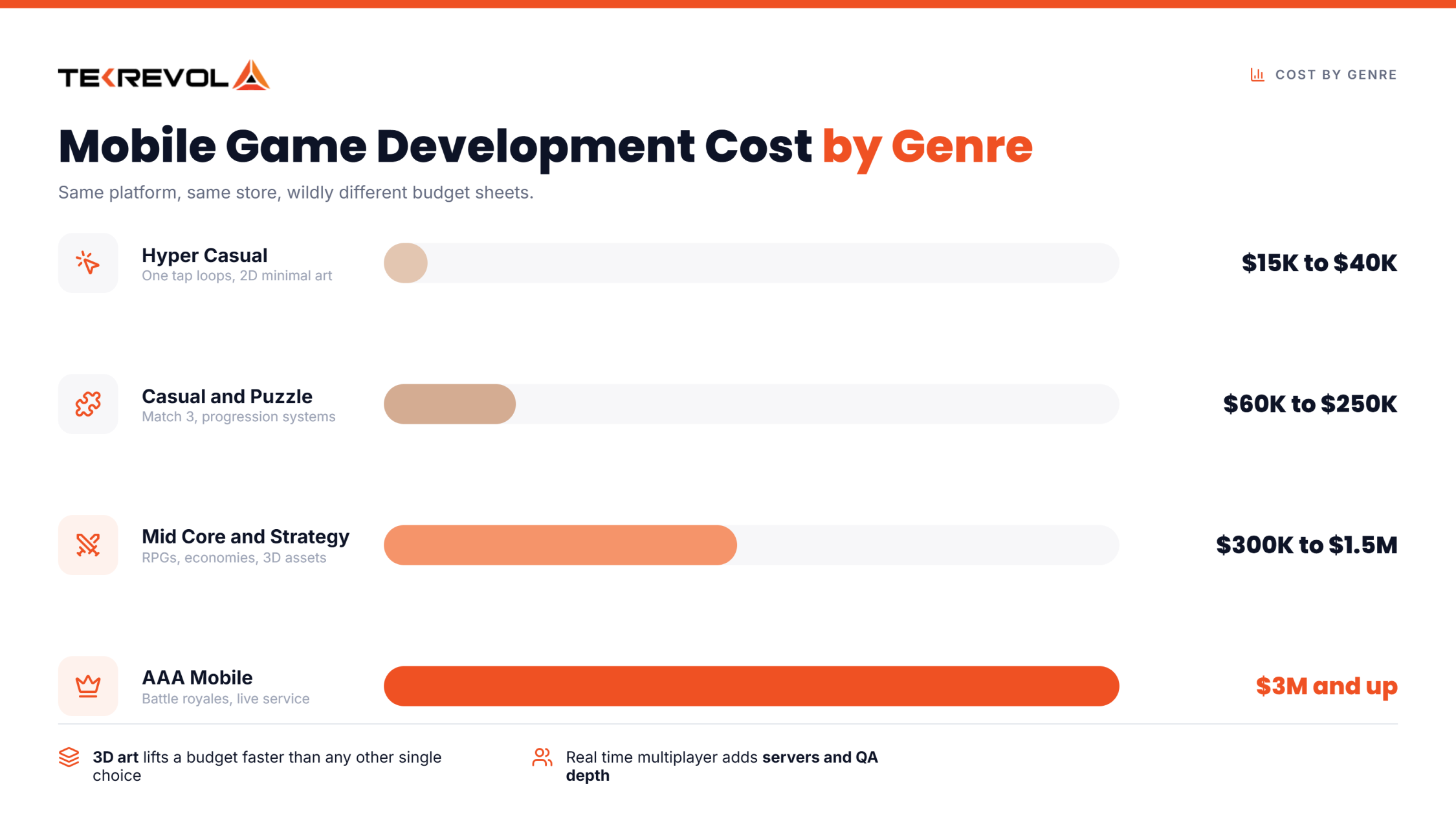
A practical 2026 breakdown looks like this:
| Genre | Cost Range (USD) | What drives the number |
| Hyper-casual / arcade | $15,000–$40,000 | Single mechanic, ad SDK, almost no backend |
| Puzzle / match-3 | $20,000–$60,000 | Level logic, hint systems, leaderboards |
| Ludo, Parcheesi, board | $10,000–$40,000 | Turn logic, lobbies, light multiplayer |
| Rummy, poker, teen patti | $20,000–$80,000 | Real-money handling, fairness logic, compliance |
| Casino/slots | $30,000–$100,000+ | RNG certification, licensing, jurisdiction rules |
| Simulation / idle | $50,000–$120,000 | Economy balancing, offline progression |
| Strategy | $60,000–$150,000 | AI behaviour, base systems, sync |
| Sports/fantasy sports | $60,000–$200,000 | Live data feeds, scoring engines, payments |
| RPG (2D) | $50,000–$250,000 | Dialogue, quests, inventory, content volume |
| RPG (3D) | $200,000–$1,000,000+ | Rigging, environments, cinematics |
| FPS/battle royale | $100,000–$300,000+ | Physics, rendering, netcode, anti-cheat |
| Real-time multiplayer | $120,000–$500,000+ | Server sync, matchmaking, voice or chat |
| AR games | $80,000–$250,000 | ARKit and ARCore work, mapping, geolocation |
| Blockchain / Web3 games | $150,000–$500,000+ | Wallets, smart contracts, audits |
| Educational games | $25,000–$70,000 | Curriculum logic, accessibility, COPPA work |
Casino genres deserve a warning. Licensing, RNG certification, and payment compliance often cost more than the game code itself, and requirements change by country. Web3 titles carry a similar tax, which is why teams building tokenized games usually scope them through Web3 game development services rather than treating them as a normal build.
How Much Does Android, iOS and Cross-Platform Game Development Cost?
Android and iOS development costs are usually closer. The bigger difference comes from device coverage, testing, store requirements, payments, and optimization.
Android game development costs $20,000 to $60,000; iOS runs about 10% to 20% higher at $25,000 to $70,000, and cross-platform builds land at $30,000 to $100,000. Cross-platform costs more upfront but far less across a multi-year lifespan.
The interesting part is not the gap. It is when the work happens.
Android is cheaper to start. You move faster, the store is more permissive, and early builds ship quickly. Then device fragmentation arrives. Testing across old chipsets, odd screen ratios, and low-RAM phones stretches QA well past what most estimates assume, and that work keeps recurring with every update.
iOS game development costs run the other way. More effort lands before release, because App Store review is stricter on payments, permissions, and performance. Once you pass review, though, the device range is narrow, and things stay stable.
|
Factor |
Android |
iOS |
| Typical build cost | $20,000–$60,000 | $25,000–$70,000 |
| Where effort concentrates | After launch, in device testing | Before launch, in polish and review |
| QA cost | Higher, due to fragmentation | Lower and more predictable |
| Store fee | $25 one-time (Google) | $99 per year (Apple) |
| Review friction | Lower | Higher |
| Long-term maintenance | Heavier | Lighter |
Cross-platform engines change this calculation entirely. One codebase in Unity or Godot adds roughly 15% to 30% upfront, but it removes the need to build and maintain two games. Over three years, most studios find that cheaper. Our cross-platform app development practice sees the crossover point land around month nine for games shipping regular content updates.
One caveat worth stating: platform choice rarely decides your budget. Scope does. A cross-platform puzzle game still costs less than a single-platform game with real-time multiplayer.
How Much Do Game Art, Animation, UI, and Audio Add to the Budget?
Art and audio costs depend more on asset volume and quality than the simple 2D-versus-3D label.
Art typically consumes 18% to 25% of a mobile game budget, and audio 3% to 8%. A basic 2D art package costs $8,000 to $20,000, stylized 3D runs $25,000 to $60,000, and photoreal 3D costs $100,000.
Use these numbers as planning ranges rather than standalone quotes:
| Art component | Low budget | Mid-range | High end |
| UI/UX design | $2,000–5,000 | $5,000–12,000 | $15,000+ |
| 2D art (characters, backgrounds) | $2,000–6,000 | $8,000–20,000 | $30,000+ |
| 3D modelling and texturing | $5,000–12,000 | $15,000–40,000 | $80,000+ |
| Character design | $2,500–6,000 | $8,000–20,000 | $40,000+ |
| Environment art | $4,000–10,000 | $12,000–30,000 | $60,000+ |
| Animation and rigging | $3,000–8,000 | $10,000–25,000 | $50,000+ |
| VFX | $1,500–4,000 | $6,000–15,000 | $30,000+ |
| Background music | $200–1,000 (stock) | $2,000–6,000 | $15,000+ |
| Sound effects | $300–1,000 | $1,500–5,000 | $12,000+ |
| Voice acting | $1,000–3,000 | $5,000–15,000 | $40,000+ |
Pick a style that hides cost, since pixel art and flat vector both age well and cost a fraction of realism. Reuse aggressively, because modular environments and recolored variants stretch an asset library. And budget for revisions, as art rarely lands in one pass, and unbudgeted revision rounds are a classic overrun.
Where Does the Money Actually Go at Each Stage?
Roughly 45% of a mobile game budget goes to production, 20% to art, 15% to design and prototyping, 10% to QA, and 10% to launch preparation. Pre-production feels cheap but decides how much everything after it costs.
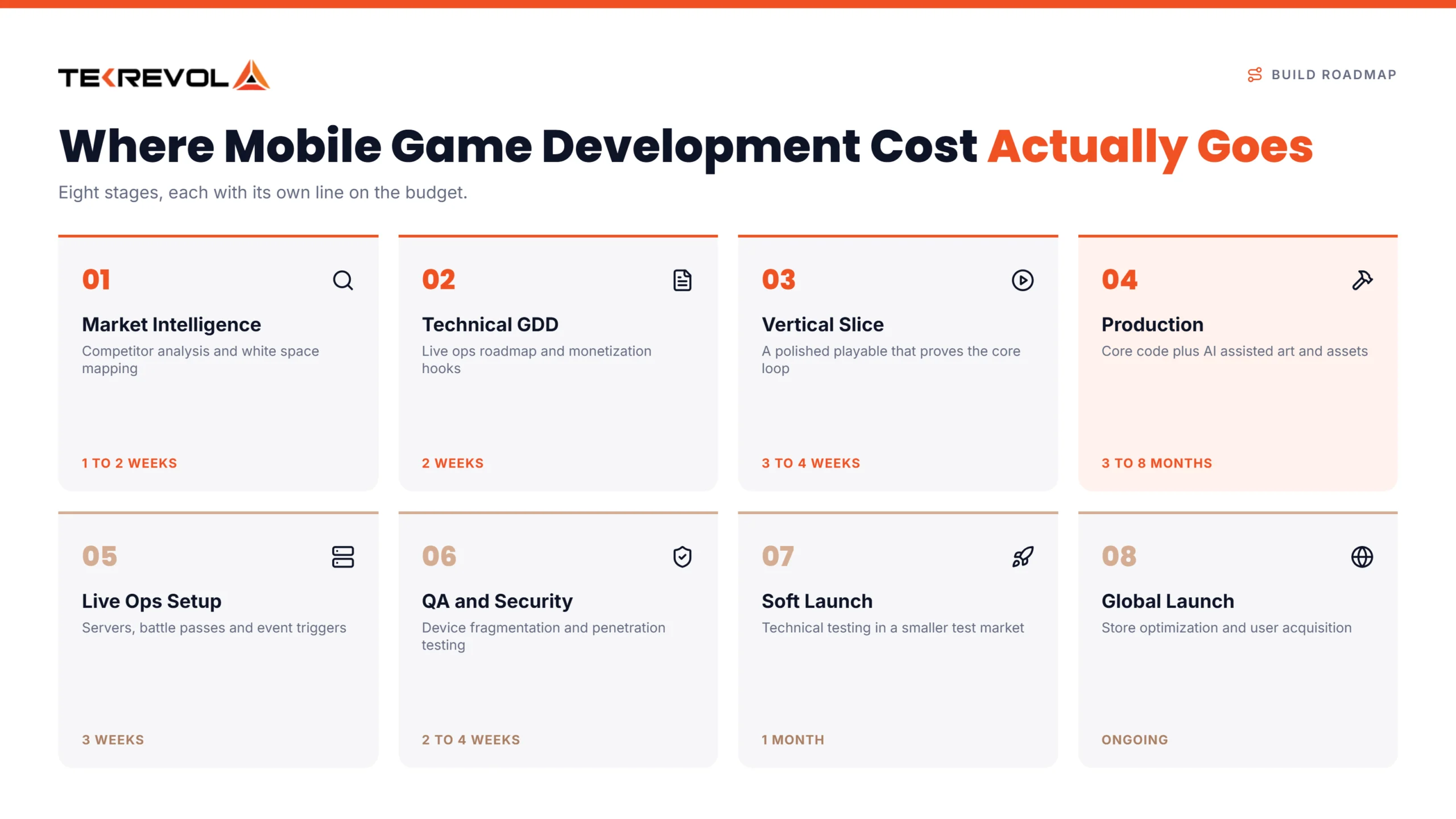
Here is what a mid-sized project looks like stage by stage. The percentages hold reasonably well from $40,000 up to $300,000.
| Stage | What happens | Duration | Share of build budget |
| Market and Concept Validation | Competitor teardown, audience sizing, white-space check | 1–2 weeks | 3%–5% |
| Game Design Document | Core loop, economy, monetization hooks, LiveOps roadmap | 1–3 weeks | 5%–8% |
| Technical Specification | Architecture, backend plan, engine decision, risk list | 1–2 weeks | 3%–5% |
| Prototype / vertical slice | Playable core loop with placeholder art | 3–5 weeks | 8%–12% |
| Art production | Characters, environments, UI, animation, VFX | Parallel, 2–6 months | 18%–25% |
| Core production | Gameplay code, systems, backend, integrations | 3–8 months | 40%–50% |
| QA and device testing | Functional, performance, compatibility, balance | 2–6 weeks | 8%–12% |
| Soft launch | Tier-2 market test, retention and monetization tuning | 3–6 weeks | 5%–8% |
| Global launch | Store assets, ASO, submission, day-one support | Ongoing | 3%–5% |
These percentages overlap in real production because artists, developers, designers, and QA frequently work in parallel.
Discovery and Game Design Document
The first stage defines genre, core loop, feature hierarchy, art direction, platforms, monetization, content, backend requirements, and production assumptions.
A well-structured Game Design Document cannot be overstated in the mobile game development process. It serves as the roadmap to a successful end product. A typical Game Design Document is organized into sections and subsections that present the details of all the essential aspects of your mobile game.
The key sections include:
- General Game Descriptions: This section provides a comprehensive look at the game, including its story, setting, and the overall concept that shapes the gaming experience
- Design Essentials: This section delves into the core game mechanics, describing gameplay features, objectives, and user interactions, which are fundamental to the player’s experience.
- Technical and Business-Related Information: This part covers the technical requirements, platform considerations (such as iOS or Android compatibility), monetization strategies, and other business-related aspects that influence development and cost.
Prototype and Vertical Slice
A prototype answers whether the mechanic works. A vertical slice answers a harder question: can the experience reach the intended quality?
That distinction matters. A rough playable test can be cheap while a polished slice may require representative art, UI, animation, backend integration, and production-quality architecture.
Full Production
Development, content creation, backend systems, monetization, tooling, animation, audio, and integration happen here. This is usually where the majority of capital is committed.
QA and Testing
Players have very little patience for buggy games, and rightly so. Testing isn’t optional; it’s baked into every serious project’s timeline and budget. The more complex your game, the more testing hours it needs, since testers are usually paid hourly and complex games simply take longer to check properly.
TekRevol is a top-class iPhone and Android game app development company that has a bug-free game testing process to ensure that your game not only meets industry standards but also exceeds them. Our team of skilled testers rigorously examines every aspect of your game, from its functionality and performance to its user interface and overall gameplay experience.
Soft Launch and Global Launch
A soft launch gives the team data before the full marketing push. Retention, tutorial completion, crashes, progression, monetization, difficulty, and acquisition economics can be measured before additional countries and budget are added. That evidence can prevent far more expensive mistakes after global launch.
What Do Mobile Game Marketing and User Acquisition Cost?
Plan for marketing to equal 30% to 100% of your development budget in the first six months, and budget for ASO cost as part of that spend. Cost per install is the dominant line item, followed by creative production and influencer campaigns. Games with no marketing budget rarely find players.
Mobile game marketing cost is the single biggest gap between what founders budget and what the business actually needs. Development builds the product. ASO for games buys the audience. Skipping the second makes the first worthless.
| Marketing activity | Cost | Notes |
| App Store Optimization setup | $500–$10,000 | Keyword research, listing copy, localization |
| Store creative assets | $1,000–$6,000 | Icon, screenshots, preview video |
| Playable ad production | $1,500–$6,000 each | Highest-performing format for casual games |
| Paid user acquisition | $5,000–$50,000+ per campaign | Scales with your target install volume |
| Micro-influencer campaigns | $100–$1,000 per post | Cheapest discovery channel for indies |
| Larger influencer campaigns | $10,000–$50,000 | Useful at launch spikes |
| Community management | $1,000–$4,000 per month | Discord, socials, player support |
| PR and launch outreach | $1,000–$25,000 | Optional, higher value for premium titles |
Cost per install is where budgets actually live or die. CPI varies enormously by genre, geography, and platform, and it moves month to month. So instead of quoting a fixed number, model it with your own inputs.
Need a game budget that includes the part after launch?
We will map your development cost, first-year LiveOps load, and a realistic user acquisition plan into one number, so you know what the whole venture costs.
Get a Free Full-Lifecycle Budget PlanHow Do Unity, Unreal Engine, and Other Game Engines Affect Development Cost?
The engine license is usually a smaller cost factor than development time and team expertise. Unity works well for many mobile-first projects, Unreal suits high-fidelity 3D, while open-source options can reduce licensing costs but may change hiring, tooling, and production requirements.
| Engine | Licence cost | Royalty | Best for | Hiring pool |
| Unity | Free tier, Pro at $2,040/seat/year | None | 2D and 3D mobile, most genres | Very large |
| Unreal Engine 5 | Free | 5% above $1M gross | High-fidelity 3D, cinematic visuals | Moderate on mobile |
| Godot 4 | Free and open source | None | 2D, indie, lightweight 3D | Growing, smaller |
| Cocos2d-x | Free and open source | None | Lightweight 2D, UI-heavy games | Small, strong in Asia |
| Custom engine | Very high build cost | None | Rare, AAA-scale only | Specialist only |
Verify current pricing with Unity and Epic before you budget, since both have changed terms in recent years.
For game developers, Unreal Engine does not require an upfront seat subscription. Epic’s standard model charges a 5% royalty on lifetime gross product revenue above the first $1 million, subject to its licensing terms and exemptions.
If you are choosing between the two, TekRevol’s Unity vs Unreal Engine comparison goes deeper into mobile support, graphics, development workflow, licensing, and project fit.
However, switching engines halfway through development can create far more cost than either license. Existing logic, shaders, assets, plugins, physics, tooling, and workflows may all need rework.
Choose the engine around the game you are actually building, not the engine with the most impressive demo reel.
How Long Does It Take to Build a Mobile Game?
A mobile game can take one month for a narrow prototype or more than a year for multiplayer and live-service production.
Hyper-casual games take 4 to 8 weeks. Casual and puzzle titles need 2 to 4 months. Mid-core 3D games run 6 to 9 months, and multiplayer or live-service games take 12 months or longer before a stable launch.
| Project type | Timeline | Typical team size |
| Hyper-casual prototype | 4–8 weeks | 2–3 people |
| Casual / puzzle game | 2–4 months | 3–5 people |
| Premium 2D game | 4–8 months | 4–7 people |
| 3D single-player | 6–9 months | 6–10 people |
| Real-time multiplayer | 8–14 months | 8–15 people |
| Mid-core live-service | 12–24 months | 15–30 people |
Timeline matters because in this industry, time is literally the unit of cost. Almost every budget is hours multiplied by rates, so a two-month delay is a two-month invoice.
Likewise, compressing a nine-month schedule into five months may increase cost rather than reduce it. More people have to work concurrently, and coordination overhead rises.
What Hidden Costs Show Up After Launch?
Expect hidden costs to add 30% to 40% over an 18-month lifecycle. The main ones are cloud servers, third-party SDK fees, localization, device testing, legal compliance, crash monitoring, store commission, and anti-cheat.
These rarely appear in a vendor quote because they are not development work. They are still your money.
- Store commission: Apple and Google both take 30% of in-app revenue, dropping to 15% for smaller developers under their published small-business programs. This is the largest recurring cost most founders forget to model.
- Developer accounts: Apple charges $99 per year, and Google charges $25 once, per their published developer program terms.
- Servers and cloud: A modest multiplayer game might run $100 to $500 per month. Viral success can push that to $5,000 or more, sometimes within a week.
- Third-party SDKs: Analytics, ad mediation, and multiplayer services start free and then scale into $200 to $1,000 per month once your user base grows.
- Localization: Five major languages typically cost $2,000 to $5,000 in translation, and $10,000 or more once you adapt UI layouts, legal notices, and cultural references.
- Device testing: Building a small device lab costs $2,000 to $5,000. Cloud testing services run $50 to $300 per month, plus QA labour.
- Legal and compliance: GDPR, CCPA, App Tracking Transparency, and COPPA all carry real work. Audits and legal reviews run $500 to $5,000, and games aimed at children need more.
- Crash and performance monitoring. Sentry, Crashlytics, or Bugsnag at scale cost $50 to $500 per month.
- OS version compatibility: Every major iOS and Android release means regression testing. Budget it annually, not once.
- Music and asset licensing: Commercial tracks run $100 to $1,000 each, and unlicensed assets are a legal risk, not a saving.
How Much Does It Cost to Hire Game Developers by Region?
Game developer rates range from $20 per hour in South Asia to $150 per hour in North America. Eastern Europe averages $40 to $80, and Latin America averages $25 to $55. The same MVP costs roughly four times more in the US than in India.
| Region | Hourly rate | Typical MVP budget | Strongest for |
| USA / Canada | 90–150+ | $80,000+ | IP-sensitive work, US market alignment |
| Western Europe | 60–120 | $65,000+ | UI/UX craft, GDPR-heavy products |
| Australia / NZ | 70–110 | $70,000+ | Design-led studios |
| Eastern Europe | 40–80 | $35,000+ | 3D, engineering-heavy titles |
| Latin America | 25–55 | $28,000+ | US time-zone overlap, LiveOps |
| Southeast Asia | 20–45 | $22,000+ | 2D, art production, hyper-casual |
| South Asia (India / Pakistan) | 20–50 | $20,000+ | Asset-heavy 2D, casual, scale |
Rate is not the same as cost, though. A $30 per hour team that needs 1,800 hours costs more than a $70 per hour team that needs 700. Ask any vendor for hours per module, not just a rate card.
Then decide how you want to staff the project.
| Model | Cost profile | Setup speed | Best for |
| In-house team | High and fixed | Slow | Long-running live-service games |
| Freelancers | Low and variable | Fast | Prototypes, single disciplines |
| Outsourced studio | Medium, tied to scope | Moderate | Full-cycle builds with a clear spec |
| Hybrid (core in-house, production outsourced) | Medium | Moderate | Studios protecting creative control |
| Staff augmentation | Medium, scales with need | Fast | Filling one gap, such as art or QA |
In-house makes sense when the work never stops. Outsourcing makes sense when it comes in waves. Most first-time studios overpay by hiring full-time for a project with a defined end date. If you are comparing routes, our guide on what it costs to hire game developers breaks the models down further.
Mobile Game Monetization Trends for 2026
Hybrid monetization is now the default, combining in-app advertising for casual players with in-app purchases for spenders. Battle passes, direct-to-consumer web stores and AI-driven ad mediation are the other three models shaping revenue in 2026.
In 2026, the most profitable games don’t rely on a single revenue stream. Instead, they use Hybrid mobile game monetization, which balances player experience with high LTV (Lifetime Value).
The entire purpose of including a monetization strategy in your mobile app is to make sure that every time a user downloads your app, you earn some bucks. Generally, there are different app monetization strategies that can help you generate revenue from mobile gaming. Here are the details:
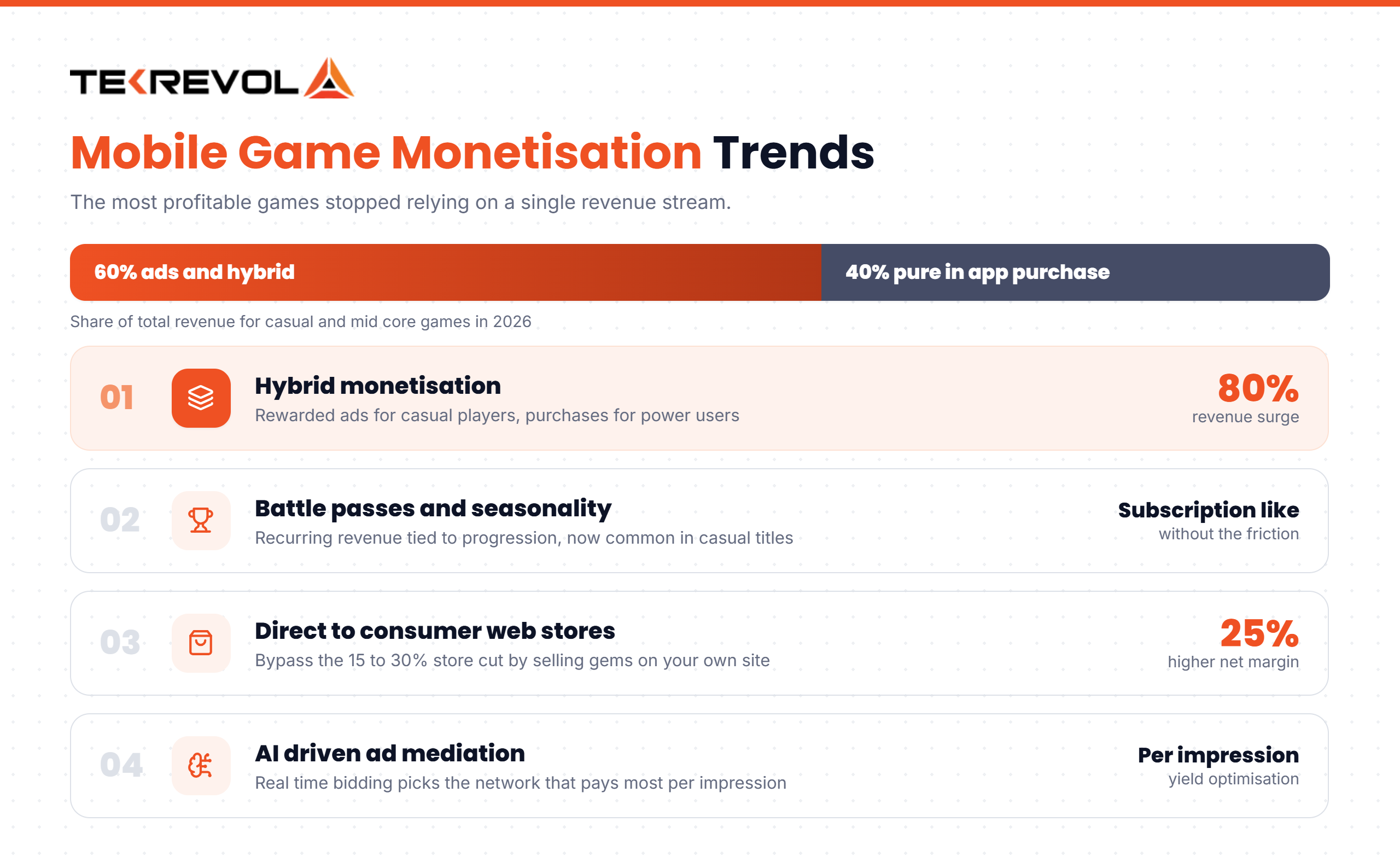
1. Hybrid Monetization (The Gold Standard)
The “miracle” strategy of 2026. This combines In-App Advertising (IAA) for casual players and In-App Purchases (IAP) for “power users.”
- Example: A player watches a Rewarded Video to get a “Revival Pack” after failing a level, but can also buy a $4.99 “Starter Bundle” to skip ads entirely and get premium skins.
- Impact: Hyper-casual studios adopting hybrid models consistently report meaningful revenue lifts over ad-only monetization, since it captures value from both casual and spending players.
2. Battle Passes & Seasonality
Borrowed from mid-core games, Battle Passes are now appearing in casual titles. They provide a recurring revenue stream similar to a subscription but feel more rewarding to the player because they are tied to progression.
Budget $8,000 to $20,000 to build the tier logic, live scheduling, and reward pipeline, plus ongoing content production for each season.
3. D2C (Direct-to-Consumer) Web Stores
To bypass the 15-30% “App Store Tax,” many studios now launch official web stores. Players are incentivized with 10% more “gems” if they buy directly on the developer’s website instead of inside the app.
Here’s what that actually costs to build, since the upside only matters if the setup pays for itself.
| Web shop component | Cost | Purpose |
| Storefront build | 5,000–15,000 | Catalogue, cart, account linking |
| Payment and tax integration | 2,000–6,000 | Processor, VAT and sales tax handling |
| Account linking and fraud checks | 1,500–4,000 | Matching web purchases to game accounts |
| Ongoing operations | 500–2,000 per month | Support, chargebacks, promotions |
The economics are simple. Payment processors take roughly 3% to 5% instead of 15% to 30%. Two conditions decide whether it makes sense: volume, since a web shop rarely pays for itself below roughly $10,000 per month in in-app revenue, and audience, because players need a visible reason to leave the game to buy something.
Also check current store rules before you build. Apple’s and Google’s policies on linking out to external purchases have changed repeatedly through litigation and regulation, so verify the current position in each market you operate in.
4. AI-Driven Ad Mediation
Using platforms like AppLovin (MAX) or Unity LevelPlay, AI now predicts exactly which ad network will pay the highest price for a specific player’s impression in real-time.
How Can You Cut Mobile Game Development Cost Without Wrecking the Game?
The highest-leverage savings come from scope discipline, not cheaper labour. Locking your design document, building a vertical slice first, reusing assets, and delaying non-core features typically cuts 30% to 40% from a first budget without visibly reducing quality.
Here are the levers that actually work, in rough order of impact.
- Lock the design document before production: This one decision prevents more overrun than every other item on this list combined.
- Build the vertical slice first: Prove the loop is fun with placeholder art. Kill or pivot cheaply if it is not.
- Ship a minimum lovable product, not a minimum viable one: Cut features, never polish. Players forgive a small game and never forgive a janky one.
- Pick an art style that hides cost: Stylized, flat, and pixel art all scale beautifully and cost a fraction of realism.
- Reuse and modularize assets: Recolors, shared rigs, and modular environments stretch an art budget a long way.
- Use asset stores for non-signature elements: Buy generic UI kits and background props. Spend custom art money on what players actually look at.
- Use backend-as-a-service: Firebase, PlayFab, or Supabase cost far less than a custom backend for most games.
- Outsource disciplines, not the vision: Art, audio, and QA outsource well. Core design usually does not.
- Test continuously instead of at the end: Bugs found in sprint cost a fraction of bugs found in review.
- Go cross-platform from day one: Retrofitting a second platform costs roughly twice what including it upfront does.
- Use AI tooling for volume work: Concept variations, boilerplate code, and automated test passes all benefit. Signature art and core design still need people.
- Treat contingency as spend: Set 20% to 30% aside and plan as if it is already gone.
How Do You Estimate Your Own Game’s Budget?
You can estimate in five passes: define the core loop, count your art assets, list the features that need a server, choose a region and team model, then add marketing and a 25% contingency. That sequence produces a usable number in about a day.
You do not need a vendor to reach a defensible ballpark. Work through this in order.
- Write the core loop in one paragraph. What does a player do in the first 30 seconds, and why do they do it again? If you cannot write it, no estimate will be accurate.
- Count the art. List characters, environments, UI screens, animations, and VFX. Multiply by the per-asset ranges in the art table above. Art is usually the biggest surprise.
- Mark every feature that needs a server. Multiplayer, leaderboards, cloud saves, live events, purchases. These are your expensive features, so price them individually from the feature table.
- Pick a region and a team model. Multiply estimated hours by the regional rate, then sanity-check the total against the tier table at the top of this guide.
- Add the rest of the business. Marketing at 30% to 100% of build, first-year LiveOps at 15% to 20%, plus infrastructure and compliance.
- Add 25% contingency. Not optional. Treat it as spent.
- Run the break-even model. If the numbers do not work at realistic CPI and ARPDAU, change the plan now rather than after the build.
Then pressure-test the result against two or three vendor quotes using the quote decoder above. If your own estimate and their quotes disagree by more than 40%, one of you has misunderstood the scope, and it is worth finding out which before contracts get signed.
Bring Your Game Idea into Reality with TekRevol
Whether you’re building a casual mobile game, a competitive multiplayer title, or a large-scale live-service experience, TekRevol helps transform your mobile game idea into a high-quality product built for long-term success.
Our Game Development Services include:
- Custom Game Development: Tailored solutions designed around your gameplay vision, business goals, and budget.
- Technical & Product Strategy: Expert guidance on game mechanics, technology selection, monetization, and launch planning.
- End-to-End Development: Complete support from concept validation and design to development, testing, launch, and ongoing post-release updates.
- Scalable Game Solutions: Architectures built to support growth, player retention, live operations, and future content expansions.
Ready to find out what your game actually costs?
Send us your concept and your budget. We will tell you what it buys, what it does not, and which version you should build first.
Start With a Free Cost Reality Check


![How to Build a Mobile Strategy Game in 2026 [Development Process, Cost & Monetization]](https://d3r5yd0374231.cloudfront.net/images-tek/uploads/2026/01/Tek-Feature2-400x160.jpg)


